

Introduction: The Industrial Dilemma of Liquid Barrier vs. Thermal Comfort
When evaluating waterproof vs breathable nitrile gloves for industrial EHS procurement, balancing liquid barrier security with thermal comfort is a critical challenge. Particularly at wet workstations involving coolant spills, cutting oil splashes, or frequent contact with water-based media, balancing “liquid barrier protection” with “breathable comfort” has become a key bottleneck determining both the actual PPE wear rate and safety compliance in the workshop.
The Trade-off Between Moisture Accumulation and Liquid Penetration
There is an inherent physical trade-off between fluid protection and thermal comfort in industrial gloves.
To achieve a 100% liquid barrier, traditional waterproof and oil-resistant gloves typically employ dense, non-porous smooth coatings or full-coverage impregnation processes. However, while this sealed rubber or plastic barrier prevents external liquids from entering, it also completely blocks the channels for hand perspiration evaporation and heat dissipation. Moisture accumulation in the hands creates a high-humidity environment inside the gloves, causing workers to experience intense stuffiness and a slippery sensation; conversely, if a high-porosity foam coating is chosen to enhance breathability, external liquids can easily seep into the gloves through the micro-pores or gaps in the knitted fabric on the back of the hand.
Occupational Dermatitis and Worker Fatigue in Wet Workstations
Neglecting moisture management and liquid spills not only reduces work efficiency but also directly leads to high hidden medical and workers’ compensation costs.
When hands are exposed for prolonged periods to accumulated sweat or are soaked in coolant or cutting oil, the skin’s stratum corneum undergoes severe maceration, greatly increasing the risk of occupational dermatitis and fungal infections. Furthermore, internal slipperiness reduces grip resistance, forcing workers to apply additional pinch force to secure workpieces. This accelerates hand muscle fatigue and significantly increases the incidence of cumulative strain injuries—such as tenosynovitis—as well as accidents involving workpieces slipping from the worker’s hands.
Scope & Pillar Page Integration
This guide will provide an in-depth analysis of how industrial gloves achieve a scientific balance between liquid barrier performance and breathability for heat dissipation, focusing on three key dimensions: the microscopic physics of polymer coatings, dipping depth processes, and ergonomics. We will systematically compare the physical properties of open-cell foam and dense, smooth nitrile, and reveal how double-dipping technology achieves composite protection featuring “waterproofing on the inner layer and strong grip on the outer layer.”
Before delving into the physical selection matrix for different wet-work environments, we recommend that you first review our core selection guide Nitrile-Coated Industrial Safety Gloves to gain a comprehensive understanding of the classification of industrial nitrile protective equipment, thereby better optimizing your workshop EHS procurement decisions.
Breathable Nitrile Science: Micro-Foam Porosity and Moisture Evaporation
The advent of breathable nitrile gloves has completely transformed the limitations of traditional rubber and plastic coatings, which were “stuffy and non-breathable.” To understand how these gloves achieve heat dissipation and breathability while blocking dry particulates and trace amounts of oil, we need to delve into the breakthroughs in the microscopic physical structure of micro-foam polymers.
Open-Cell Polymer Matrix: How Air Permeability Works
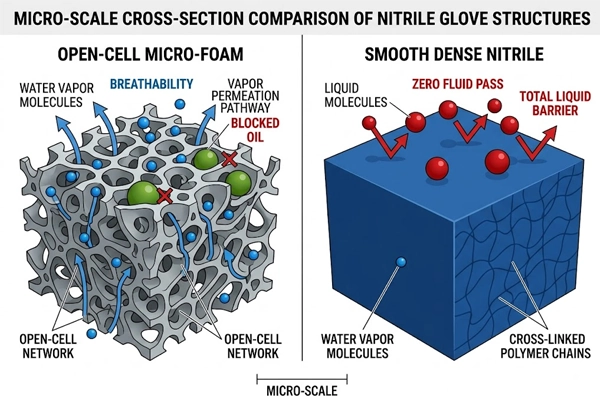
The breathability mechanism of the foamed nitrile coating relies on its unique open-cell polymer matrix.
During the dip-coating process, the introduction of specific foaming agents and mechanical agitation techniques creates an extremely uniform network of interconnected micron-scale pores within the nitrile latex.
Gas and Moisture Conduction: Unlike closed-cell, smooth coatings, this open-cell structure forms countless microscopic gas channels after curing. When hands sweat and generate heat, the warm air and water vapor produced by the palms can rapidly diffuse outward along these interconnected micropores (Vapor Transmission), achieving efficient 360-degree heat dissipation and breathability.
Liquid Barrier: Although gases and water vapor can freely pass through the open micropores, the surface tension of liquid nitrile molecules and the physical size of the micropores limit the flow. Low-viscosity gas molecules can pass through, while continuous liquids with high molecular weights are partially blocked. This allows the micro-foamed coating to maintain excellent breathability in both dry and slightly oily conditions while preventing trace oil films from directly contacting the skin.
Maintaining Fingertip Tactile Sensitivity in Precision Assembly
In workstations such as electronic component assembly, automotive micro-component installation, and precision machining, operators require extremely high levels of fingertip tactile sensitivity.
Traditional, bulky protective gloves severely diminish the physical feedback when the glove comes into contact with the workpiece, leading to distorted perception of grip strength. In contrast, open-cell micro-foamed nitrile coatings, rich in microscopic pores, possess a physical structure characterized by extremely high compressibility and elastic deformation capacity. When the fingertip presses against a component, the foamed coating conforms to subtle surface textures, providing a supple tactile sensation and flexibility similar to that of bare hands, thereby significantly reducing scrap rates and hand fatigue during high-frequency, precision assembly operations.
Polymer Cross-Linking and Breathability Trade-offs
In materials science, there is an inherent trade-off between breathability and durability.
Although the high-porosity open-cell foam structure endows the gloves with exceptional breathability and sensitivity, the presence of micropores also means that the continuity of the coating’s polymer network is partially disrupted. Under conditions of high-intensity, high-frequency abrasion (such as frequent handling of high-roughness metal parts), when the microporous structure is subjected to physical shear forces, its resistance to tearing and abrasion (as measured by Martindale cycles) is lower than that of a dense, smooth coating.
As analyzed in the Nitrile Coated vs. Polyurethane (PU) Gloves White Paper white paper, although PU coatings also offer a certain degree of lightness, the covalent cross-linked network structure formed during the vulcanization process of synthetic nitrile rubber allows it to maintain physical tear and scratch resistance far exceeding that of PU—even in an open-cell, foamed form—achieving an excellent balance between breathability, comfort, and mechanical durability.
Waterproof Nitrile Engineering: A Dense Barrier Against Liquid Siphoning
In workstations exposed to continuous fluid immersion, high-pressure coolant spray, or viscous heavy oil, open-cell foam coatings lose their effectiveness due to liquid penetration. To achieve a true physical seal against liquids, it is essential to rely on Smooth Nitrile Engineering—a dense, non-porous formulation that creates a leak-resistant barrier at both the physical and polymer chemistry levels.
Smooth Nitrile Chemistry: Creating a 100% Fluid Barrier
The fundamental reason why Smooth/Flat Nitrile coatings achieve 100% water and oil resistance lies in the pore-free, dense structure formed during the polymerization process.
During the dipping process, no foaming agents are added to the latex formulation. Through precise temperature control of the coagulant and a high-temperature vulcanization process, the polymer chains of synthetic nitrile rubber are tightly packed and seamlessly cross-linked, forming a non-porous film completely devoid of microporous channels. This dense rubber-plastic physical structure completely blocks the penetration of water molecules, cutting fluids, and various mineral oils, establishing an absolute liquid barrier for the hands.
Preventing Siphoning of Cutting Fluids, Coolants, and Oils
In actual workshop conditions, liquid penetration into the hands often does not originate directly from the palm but rather from the “siphoning effect” created between the glove interior and the knitted liner.
When a worker’s hands come into contact with parts saturated with water-based coolants, cutting oils, or high-viscosity gear oils, any liquid that touches the exposed knitted fibers of the glove will rapidly travel along the microscopic capillaries between the fibers, spreading inward toward the glove’s interior and up the back of the hand. A dense, smooth nitrile coating—applied through full coverage or deep impregnation—covers the areas of the hand most likely to come into contact with fluids. This blocks the path between the fluid and the inner knitted fibers at the source, eliminating the siphoning effect and keeping the hands dry.
Chemical Permeation Dynamics in Continuous Immersion
It is important to note that “liquid-proof” is not the same as “chemical-resistant.”
Under conditions of continuous immersion or contact with high-concentration solvents, liquid molecules, driven by concentration gradients, undergo a chemical permeation process involving “surface adsorption—interchain diffusion—internal desorption.” Even if smooth nitrile is physically intact, strong solvents or certain highly permeable chemicals will still penetrate the coating after a certain period of time.
As analyzed in our guide The Chemical Resistance of Nitrile Coatings: Protecting Hands Against Oils and Solvents, when evaluating the maximum protective capacity of water-resistant nitrile gloves, one must consider not only their physical non-porosity but also the breakthrough time for specific oils and chemical media in relation to coating thickness and the polymer cross-linking network, to make a scientifically sound safety selection.
Technical Selection Matrix: Dip Depth, Permeability, and Fluid Resistance
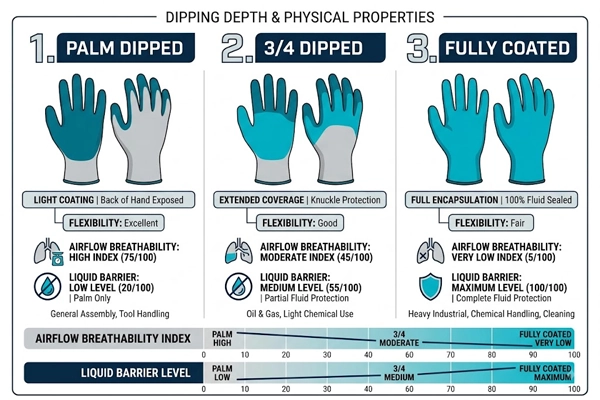
In industrial PPE procurement and EHS workstation audits, a glove’s “dip depth” and “coating technology” jointly determine its physical limits for breathability, heat dissipation, and liquid barrier performance. To help procurement teams translate microscopic material parameters into intuitive selection criteria, the table below establishes a mapping matrix that correlates different dip processes with breathability indices, liquid resistance ratings, and target operating conditions.
Comprehensive Performance Benchmark & Dip Level Table
| Dip Style & Technology | Coating Type | Air Permeability | Liquid Resistance | Target Hazard / Workstation |
| Palm Dipped (13G/18G) | Micro-Foam Nitrile | High (360° Vapor Pass) | Dry to Slightly Oily | Light assembly, electronics, dry handling |
| 3/4 Dipped | Micro-Foam / Sandy | Moderate (Airflow across the back of the hand) | Splash-Proof (Palm + Knuckles) | Machining, automotive parts handling |
| Fully Coated | Smooth + Sandy Double Dip | Zero (Fluid-Sealed) | 100% Waterproof & Oil-Proof | Chemical dipping, immersion in heavy fluids |
Key Takeaways for Workplace Hazard Audits
When conducting fluid risk assessments and glove selection audits on factory floors, the following three practical guidelines can be derived from the matrix above:
Precisely Match Dip Depth Based on Liquid Contact Depth: At dry or slightly oily assembly stations where only the palm comes into contact with components, prioritize the Palm Dipped style to maximize heat dissipation and breathability in the knitted back-of-the-hand area; If the workstation involves coolant splashes or frequent handling of wet, slippery parts, upgrade to 3/4 Dipped to prevent liquid leakage at the knuckles; for high-pressure spraying, immersion in oil baths, and liquid spill conditions, Fully Coated gloves must be mandated.
Utilize composite coating technology to balance liquid resistance and grip: For immersion workstations involving heavy oil that require high grip strength, a single-layer smooth coating may be waterproof but tends to be slippery. Prioritize the “Smooth + Sandy Double Dip” two-layer process—featuring a smooth, liquid-resistant base coat and a textured, oil-repellent top coat—to establish a 100% liquid seal while restoring high friction and preventing workpieces from slipping.
Select protective solutions based on the combined risks of the workstation: As discussed in our guide Best Nitrile Coated Work Gloves for Automotive and Precision Assembly Operations, for complex work environments—such as automotive engine manufacturing and transmission assembly—where both cutting fluid splashes and burr scratches are present, it is necessary to combine the cut resistance rating of the knitted liner (e.g., ANSI A4–A6) to provide integrated protection against both liquid penetration and physical cut injuries.
Ultra-Lightweight Breathability for High-Dexterity Precision Work
In precision workstations such as electronic component assembly, semiconductor packaging, and the machining of small lightweight mechanical parts, workers must perform prolonged, high-frequency, fine-motor tasks with their fingertips. In these precision work environments—which are dry or feature only a minimal oil film—“extreme sensitivity (High Dexterity)” and “long-lasting breathability and heat dissipation” are the core factors determining production yield and operational efficiency.
13-Gauge Seamless Liners with High-Porosity Palm Dip
The combination of high-gauge seamless knitted liners and a high-porosity foam coating forms the technical foundation for achieving a bare-hand feel during operations.
Traditional low-gauge (e.g., 10-gauge) gloves are coarse and bulky, whereas 13-gauge seamless knitting technology uses ultra-fine, highly elastic polyester or nylon fibers, allowing the liner to conform closely to the hand’s contours like a second skin while eliminating interference with fingertip sensitivity caused by internal seams:
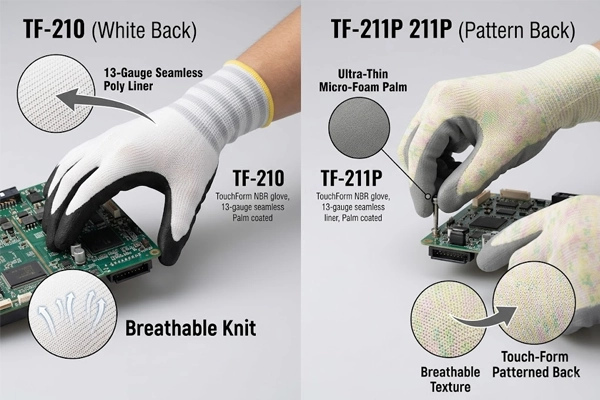
Palm-Dipped Construction Preserves Heat Dissipation on the Back of the Hand: The gloves feature a palm-dipped design, applying a layer of high-porosity micro-foam nitrile only to the palm and the front of the fingers, while leaving the entire knitted area on the back of the hand fully exposed to ensure air can freely pass through for heat convection.
Balancing Basic Protection and Precision: The foam coating on the palm blocks trace amounts of oil and dry dust while providing the fingertips with exceptional flexibility, allowing workers to easily pick up tiny screws or connect and disconnect electronic wiring harnesses.
Heat Dissipation Mechanics During Long Shifts
During high-intensity work in long shifts lasting 8 to 12 hours, a glove’s heat dissipation and breathability mechanisms directly translate into productivity.
When hands are in a state of high-frequency movement, they continuously generate heat and sweat. If moisture cannot be expelled in a timely manner, the temperature and humidity inside the gloves will rise rapidly, causing itchy skin, slippery hands, and even dermatitis. This forces workers to remove their gloves frequently, creating significant safety hazards and resulting in lost work time.
Practical Deployment of the Lightweight Breathable Series: For general-purpose, lightweight assembly workstations, we recommend deploying basic, highly breathable equipment—the TF-210 TouchForm NBR glove, 13-gauge seamless polyester liner, palm-coated. This model features a 13-gauge seamless polyester liner paired with a palm-dipped nitrile coating. Its extremely lightweight construction rapidly dissipates moisture and heat from the hands, making it a cost-effective choice for dry, light-duty assembly tasks.
Upgrade Solution for High-Frequency Fine-Motor-Skill Workstations: For precision assembly lines requiring further improvements in fit and tactile feedback, we recommend upgrading to the high-sensitivity model—TF-211P TouchForm NBR glove, 13-gauge seamless polyester liner, palm-coated. Its optimized impregnation formula and highly breathable, porous design help workers keep their hands dry and comfortable throughout long shifts, reducing assembly errors caused by hand fatigue and sweat-induced slippage at the source.
Hybrid Double-Dipped Technology: Waterproof Base with High-Grip Surface
When faced with severe liquid conditions—such as high-pressure spray of cutting fluid, spilled engine oil, or immersion in water-based media—single-layer coated gloves often present a dilemma: while smooth coatings provide absolute protection against water and oil, their surfaces are highly prone to slipping due to liquid lubrication; conversely, single-layer foam or textured coatings offer good grip, but liquids can seep through the pores into the interior. To resolve this conflict, Double-Dipped Technology combines nitrile with different physical properties to achieve composite protection featuring an “absolutely sealed inner layer + oil-repellent outer layer.”
Smooth Nitrile Sealant Combined with Sandy Outer Grip
This dual-layer, functionally specialized physical structure is the core technology that breaks the trade-off between “leak prevention” and “slip resistance.”
The composite double-dipping process is completed on the production line through two precise dipping and curing cycles:
First Layer: Dense, Smooth Nitrile Sealant Layer (Smooth Nitrile Base Sealant): The base layer uses non-porous, dense, smooth nitrile for full coating or large-area dipping, acting directly on the outer side of the knitted lining. The polymer chains are tightly cross-linked, forming a 360-degree, seamless rubber-plastic physical barrier that completely blocks the penetration of water, cutting fluids, engine oil, and various water-based chemical solvents.
Second Layer: Sandy/Foamed Nitrile Grip Layer (Sandy Outer Grip): During a specific window of time before the smooth base layer has fully cured, a second layer of micro-textured, modified sandy nitrile (Sandy Nitrile) is applied to the palm and high-frequency grip areas. This rough, textured surface acts like tire treads, instantly squeezing out interface fluids (Fluid Displacement) upon contact with oil- or water-coated components. The rigid protrusions interlock with the workpiece surface, restoring an extremely high coefficient of friction (CoF) on top of the liquid seal.
Eliminating Internal Glove Slippage in Heavy Fluid Workstations
At workstations involving heavy fluid exposure, double-layer protection not only safeguards the skin but also eliminates the safety hazards caused by internal glove slippage.
When liquid seeps into standard gloves, the saturated liner creates a “water-slip condition” with extremely low friction against the skin, causing the hand to slide uncontrollably inside the glove even when the worker grips a tool tightly with the outer layer. This internal slippage severely compromises precision, leading to tools slipping from the hand or workpieces causing injuries.
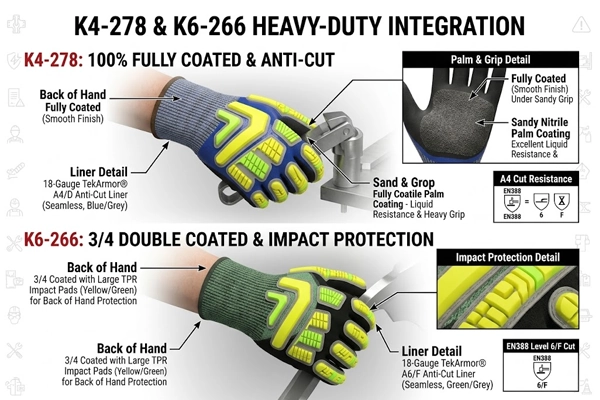
Recommended Full-Coverage Leak-Proof and Cut-Resistant Composite Solution: For extreme working conditions involving high-pressure liquid spills, heavy oil immersion, and sharp metal burrs, we recommend deploying top-tier composite protective gear—K4-278 Anti-Cut NBR glove, 18-gauge seamless TekArmor® A4/D liner, Smooth fully coated and sandy palm coated.
Hardcore Field-Ready Configuration: This model features an 18-gauge ultra-thin TekArmor® A4/D high-cut-resistant seamless liner, maintaining ultimate fingertip flexibility; The base layer is made of smooth nitrile with 100% full coverage (Smooth Fully Coated), creating a sealed compartment that prevents liquid penetration; the palm is overlaid with textured nitrile (Sandy Palm Coated), providing exceptional grip on heavy oil. It offers a one-stop solution to four major safety challenges—fluid penetration, internal slippage, external slip resistance, and advanced physical cut resistance—significantly extending the service life of gloves in high-risk workstations.
Multi-Hazard Integration: Waterproof Protection with Cut and Impact Defense
In extreme working conditions—such as oil and gas extraction, heavy equipment dismantling, offshore engineering, and high-pressure waterjet/coolant cleaning workshops—the risks faced by workers are never isolated. Slippery fluids (water and heavy oil), highly sharp edges (high cut hazards), and heavy object impacts (impact hazards) often occur simultaneously. Traditional single-function protective gloves are highly prone to leaving blind spots when facing such multi-hazard environments, making it essential to rely on comprehensive protective gear featuring integrated multi-dimensional physical structures.
3/4 Double-Dipped Construction to Prevent High-Pressure Fluid Siphoning
In heavy-oil workstations where high-pressure fluid splashes and spills occur, the 3/4-depth double-dipping process is key to preventing liquid siphoning and penetration.
When workers bend their hands to grip pipes overflowing with coolant or oil, the knuckles and large knitted areas on the back of the hand in standard palm-dipped gloves remain exposed. High-pressure fluids create a violent “siphoning effect” along the exposed knitted fibers, rapidly penetrating the glove and causing skin lesions and slippage on the inner surface.
Dual-Layer 3/4-Coverage Physical Barrier: The smooth nitrile coating on the base layer extends upward to cover 3/4 of the back of the hand (encompassing all knuckles and most of the back of the hand), establishing a 360-degree sealed barrier against high-pressure liquid splashes; the outer layer features a reinforced, high-friction matte nitrile finish, ensuring a firm grip on oily or wet metal parts.
Consistent Physical Performance Standards: As analyzed in our EN 388 Abrasion and Grip Test Breakdown for Nitrile-Coated Safety Gloves mechanical testing guide, the coating must not only block fluids, but the synergy between the base material and the top layer must also maintain the highest level of abrasion resistance (Level 4) and superior slip resistance in EN 388 mechanical testing, ensuring that the physical structure remains intact even under complex fluid exposure.
Back-of-the-Hand Impact Shielding in Wet and Oily Environments
Impact protection for the back of the hand and finger joints serves as the last line of defense against fractures and soft tissue tears during heavy-duty wet operations.
In slippery, heavy-oil environments, the likelihood of heavy tools slipping from the hand, high-pressure pipes recoiling, or heavy castings sliding off increases significantly. In the event of an impact, hands without back-of-the-hand protection are extremely vulnerable.
TPR (Thermoplastic Rubber) Shock-Absorbing Modules: By injection-molding and fusing highly elastic TPR modules onto the back of the hand and finger joints, their topological structure undergoes elastic deformation upon impact. This instantly absorbs localized physical impact energy and disperses it in all directions, significantly reducing the risk of impact injuries and crushing.
Recommended All-Purpose Heavy-Duty Protective Gear for Real-World Applications: For high-risk, multi-task workstations, we recommend deploying top-tier, all-purpose protective gear—K6-266 Anti-cut Sandy Nitrile glove, 18-gauge seamless TekArmor® A6/F liner, 3/4 double-coated, TPR on the back.
Ultimate Physical Protection Stack: This model features an 18-gauge ultra-fine TekArmor® A6/F premium cut-resistant liner, offering extreme cut resistance compliant with both ANSI A6 and ISO F standards; The back of the hand is equipped with dense TPR impact-absorbing modules; the palm and knuckles feature a 3/4-depth double-layer matte nitrile coating, providing a comprehensive solution to four critical safety challenges: water resistance and impermeability, slip resistance in heavy oil, advanced cut resistance, and impact protection on the back of the hand.
EHS Cost-Benefit Audit: Dermatitis Prevention and Total Cost of Ownership (TCO)
In daily EHS audits and procurement management at manufacturing facilities, using “unit price of gloves” as the sole procurement metric is an extremely dangerous financial misconception. Particularly at wet workstations involving coolants, cutting oils, and chemical solutions, the subsequent costs associated with occupational diseases and hidden work-related injuries caused by poor glove breathability or failure to prevent leakage far exceed the procurement cost of the PPE itself. By introducing the Total Cost of Ownership (TCO) model to calculate the comprehensive economic impact of hand health protection, glove replacement cycles, and waste disposal, companies can provide decision-makers with clear, quantifiable evidence.
Quantifying Hand Health Costs: Skin Maceration and Lost-Time Injuries
The costs of hidden workplace injuries resulting from hand skin lesions and moisture accumulation are often severely underestimated.
When workers wear non-breathable, sealed gloves for extended periods, leading to sweat buildup, or wear gloves that provide insufficient protection, allowing cutting fluids to seep through, the stratum corneum of the hands undergoes severe maceration:
Direct and Indirect Losses from Occupational Dermatitis: Damage to the skin barrier rapidly triggers occupational contact dermatitis. In mild cases, this causes workers to frequently pause work due to itchy, peeling hands, reducing production line efficiency; in severe cases, it leads to serious secondary fungal infections, resulting in high medical treatment costs, workers’ compensation claims, and lost time injuries (LTI).
The Cost-Saving and Efficiency-Boosting Logic: Equipping wet-work stations with advanced gloves featuring precise leak prevention or high breathability (such as double-layer impregnation or perforated foam) may slightly increase the unit purchase cost. However, simply preventing a single instance of lost time or compensation resulting from occupational dermatitis can directly save thousands to tens of thousands of yuan in hidden workers’ compensation expenses, yielding an extremely significant return on investment (ROI) in terms of total cost of ownership (TCO).
Extending Glove Lifespan via Liquid Barrier Chemistry
Liquid barrier chemistry can effectively slow the physical and chemical degradation of glove polymers and liner fabrics.
In environments involving continuous contact with coolant or oil, ordinary gloves quickly become unusable because, once liquid penetrates the knitted lining, chemical additives in the oil and moisture corrode the rubber or plastic coating from the inside, causing the coating to swell, peel, or harden and crack:
Extended Service Life: Gloves featuring a high-quality, dense, and smooth base coat (such as dual-layer impregnation technology) block fluid penetration into the inner lining, keeping the lining dry at all times. Since the coating and lining do not undergo chemical delamination, the glove’s overall physical tensile strength and abrasion resistance are fully preserved.
Comparison of Replacement Frequency: At workstations using heavy oil-based or water-based cutting fluids, standard single-layer palm-dipped gloves are discarded by workers after an average of 1 to 2 shifts due to internal slippage and odor caused by liquid penetration. In contrast, composite gloves featuring a barrier-sealed base coat and an abrasion-resistant top coat can reliably extend service life to 6 to 8 shifts, directly reducing glove consumption at a single workstation by more than 60%.
Sustainable PPE Sourcing: Reducing Waste Through Targeted Dipping Styles
Precisely selecting dipping depths (Dipping Styles) based on workstation risks is a powerful tool for factories to achieve ESG carbon reduction goals and pass green supply chain audits.
In modern factories implementing “Zero Waste to Landfill” initiatives and ISO 14001 Environmental Management System certification, solid waste generated by PPE (Waste Streams) is a key control indicator:
Avoiding “over-protection” and “under-protection”: At assembly workstations where only the palms are slightly oily, blindly purchasing heavy, full-coverage gloves not only increases raw material consumption and waste weight but also reduces workers’ willingness to wear them due to the stuffy heat; conversely, at workstations with liquid splashes, selecting the wrong palm-dipped gloves can lead to frequent replacements and waste.
Source Reduction: Through EHS risk assessments, lightweight, highly breathable palm-coated gloves (such as the TF-210) are precisely allocated for dry assembly tasks, while highly durable, double-layered, impermeable gloves (such as the K4-278 / K6-266) are allocated for workstations with heavy fluid exposure. This approach not only extends the service life of each pair of gloves but also reduces the total volume of discarded gloves entering incineration plants and landfills at the source, helping companies easily pass their customers’ green supply chain audits.
Knowledge Base: Frequently Asked Questions (FAQs) & Actionable Advice
To help EHS managers and procurement directors quickly resolve common questions regarding the selection of workplace protective gear, the following provides expert answers based on actual industrial testing for key issues such as the balance between waterproofing and breathability, decisions on impregnation methods, and the mechanisms of liquid leakage.
Can a nitrile glove be 100% waterproof and 100% breathable at the same time?
In single-layer polymer coating technology, 100% absolute waterproofing and 100% breathability and heat dissipation cannot coexist physically.
Conflicting Physical Principles: Waterproofing requires a non-porous, dense, continuous polymer structure (non-porous film) to block water molecules, whereas breathability relies on microscopic channels formed by open-cell micro-foam. If the coating allows water vapor to pass through, liquid molecules will also gradually penetrate under a certain pressure.
Industrial Solution: Currently, the best engineering compromise is to use double-dipped technology, in which a dense, smooth nitrile layer on the underside provides 100% liquid sealing, while leaving portions of the back of the hand uncoated to allow for physical heat dissipation; or to use a 3/4-dipped configuration, where the palm and knuckles are fully coated for liquid protection, while the exposed knitted layer on the back of the hand facilitates heat convection.
When should EHS managers choose a 3/4-dipped glove over a fully coated waterproof glove?
When conducting workstation audits, EHS managers should choose between 3/4-dipped and fully coated gloves based on the “location of liquid splashes” and the “duration of the task”:
Scenarios for selecting 3/4-dipped gloves: Workstations where cutting fluid splashes or parts are contaminated with lubricating oil, with liquids primarily concentrated on the palms, fingers, and knuckles, but where the back of the hand is not submerged below the liquid surface for extended periods. 3/4-dipped gloves prevent liquid leakage at the joints while preserving a 25% knit breathable area on the back of the hand, significantly enhancing comfort during prolonged wear.
Scenarios for Selecting Fully Coated Gloves: Workers need to fully immerse their hands in oil baths or wash tanks, or work in environments with high-pressure liquid spills. In these situations, any exposed knit fabric on the back of the hand can lead to liquid penetration, so 100% fully coated waterproof gloves must be used.
How does liquid siphoning occur in standard palm-dipped knit gloves?
Liquid siphoning is the root cause of moisture penetration inside palm-dipped gloves.
In standard palm-dipped gloves, the coating covers only the palm and the front of the fingers, while the back of the hand and the sides of the fingers remain exposed knit fabric:
Capillary action is triggered: When workers grip workpieces soaked in cutting fluid or oil, the liquid comes into contact with the knit fibers not covered by the nitrile coating.
Liquid Spreads Upward: The microscopic gaps between the high-density knitted yarn bundles form countless capillaries. Driven by capillary pressure, the liquid rapidly climbs along the fibers, seeping past the edges of the coating and into the interior of the glove.
Consequences: Once absorbed by the inner lining, the seeped-in liquid clings to the skin, causing the hands to quickly become soggy and slippery, resulting in a complete loss of protective effectiveness.
Call to Action (CTA)
Optimizing the selection of hand protection for the workshop not only eliminates safety hazards caused by occupational dermatitis and slips on wet surfaces, but also reduces the factory’s total cost of ownership (TCO) by extending the service life of gloves.
Whether you’re looking for ultra-breathable, lightweight workstation solutions for precision assembly lines or need all-around heavy-duty protection against leaks and impacts for high-pressure, heavy-oil, and high-impact environments, our team of technical experts can provide you with one-on-one workstation risk assessments and sample support:
Explore our full line of high-grade certified industrial nitrile-coated safety gloves: Explore Full Range of Certified Nitrile Coated Industrial Safety Gloves
Request free sample kits for your workshop and an on-site EHS assessment: Contact SQG® for Free Sample Kits


