

Introduction: Hand Protection Challenges in Automotive and Precision Assembly
In modern automotive manufacturing, selecting high-performance nitrile coated gloves for automotive assembly lines is essential to protect workers from micro-oil hazards while maintaining bare-hand dexterity. Automotive components are widely coated with trace amounts of cutting oil, rust-preventive oil, and high-viscosity grease during machining and rust prevention processes, requiring protective equipment to provide a reliable oil barrier. However, assembly workers on the shop floor also need to frequently pick up tiny screws, connect electrical plugs, or perform high-precision torque tightening, which places nearly exacting demands on the gloves’ tactile sensitivity and bare-hand dexterity.
The Dual Challenge: Micro-Oil Defense vs. Bare-Hand Dexterity
Frontline assembly workers are constantly caught in a trade-off between “protection” and “efficiency.”
If they choose thick, traditional protective gloves, while these can effectively block engine oil and cutting fluid, the loss of fingertip sensitivity makes it difficult to handle screws, prevents latches from snapping into place, and can even severely slow down the production line’s cycle time (Cycle Time). Conversely, if overly thin uncoated gloves or low-end PU gloves are chosen in pursuit of maximum flexibility, even trace amounts of oil can quickly penetrate the glove fibers, triggering skin allergies and contact dermatitis; at the same time, slippage caused by oil can easily lead to parts dropping and being damaged, or even result in scratches and cuts to the fingers from the edges of workpieces. How to establish a robust defense against micro-oil environments while maintaining bare-hand-level operational precision is a core challenge for EHS and procurement departments in the automotive industry.
Impact of Hand Strain and Fatigue on Assembly Line Productivity
In addition to the obvious risks of slippage and abrasions, hand strain and muscle fatigue are another hidden threat that severely impacts workshop productivity and safety.
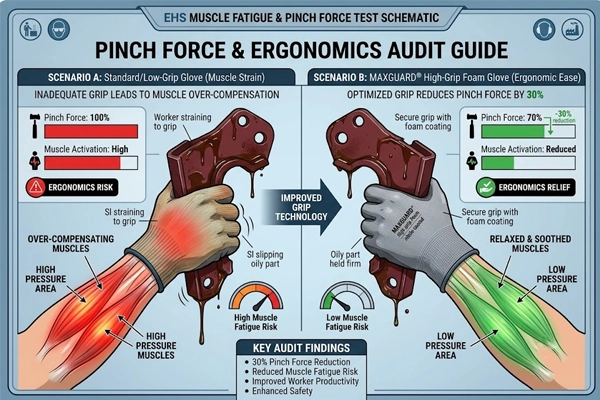
When glove grip performance is insufficient, workers unconsciously increase the pinch force of their palms and fingers to prevent oil-coated parts or pneumatic tools from slipping. During an 8-hour shift, this high-frequency and excessive muscular compensation can lead to cumulative occupational injuries such as tendonitis and carpal tunnel syndrome. More critically, hand muscle fatigue directly causes assembly movements to become distorted, resulting in an exponential increase in quality defects such as missed components and improper fastening.
Scope & Pillar Page Integration
This technical guide focuses on automotive manufacturing and precision assembly workstations, providing an in-depth analysis of the physical performance limits of different gauge liners (13G, 15G, 18G) and coating processes (foamed nitrile vs. smooth nitrile vs. dual-coating), and offers glove configuration matrices tailored to specific workstations such as engine final assembly, sheet metal stamping, and wire harness termination.
Whether you are looking for high-grip equipment that balances cut resistance and oil resistance, or need to configure an ultra-lightweight protective solution for precision assembly lines, you can refer to our Nitrile-Coated Industrial Safety Gloves product series to help your workshop achieve zero-accident safety management goals while improving production line cycle times.
Key Performance Standards for Automotive Assembly Gloves
When establishing PPE procurement standards for automotive manufacturing and precision assembly lines, assessments should not be based solely on subjective criteria such as “how good they feel” or “how high or low the price is.” Procurement and EHS departments need to establish a standards system based on polymer science and physical-mechanical properties, focusing on three core metrics: knit liner density (gauge), EN 388 mechanical protection certification, and polymer cross-linking density.
Liner Gauge Selection: 13-Gauge, 15-Gauge, vs. 18-Gauge
The “gauge” of a seamless knitted liner directly determines the glove’s fit, dexterity, and maximum level of physical protection. The higher the gauge, the finer the knit, resulting in a thinner, more form-fitting liner:
13-Gauge (13 stitches): The standard for general industrial use. The liner is relatively thick, offering excellent tensile strength and moisture-wicking performance, making it suitable for handling heavy components with heavy oil contamination and high abrasion, as well as rough chassis assembly workstations.
15-Gauge (15 stitches): A cost-effective choice that balances abrasion resistance and flexibility. With a higher lining density than 13-gauge, the gloves are lighter overall and are widely used in engine component assembly and general automotive parts assembly lines.
18-Gauge (18-stitch): A “bare-hand alternative” for high-precision assembly stations. Featuring ultra-fine fiber stitching, the gloves have an extremely thin wall, providing a “Second Skin”-like fit. Workers can effortlessly handle micro-screws under 2 mm and connect precision circuit connectors, making them essential for electronic wiring harness and instrument panel assembly.
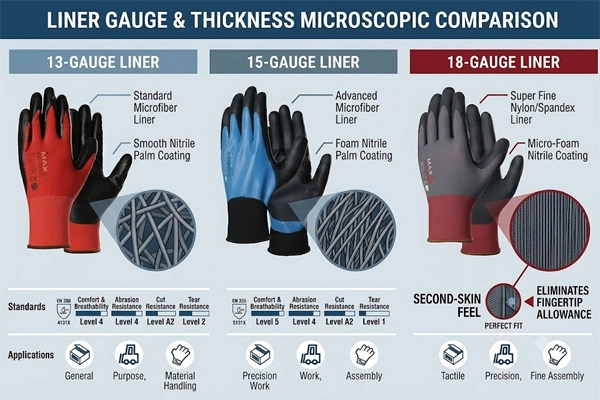
EN 388 Mechanical Risk Standards for Precision Assembly
According to the European EN 388:2016+A1:2018 mechanical safety standard, gloves for precision assembly must undergo four core physical tests: abrasion resistance (Levels 0–4), cut resistance (Cut Test, Levels 0–5), tear resistance (Levels 0–4), and puncture resistance (Levels 0–4).
On automotive assembly lines, the frequent handling of components places extremely high demands on the gloves’ abrasion resistance (Abrasion Level). High-quality precision assembly gloves must achieve EN 388 Abrasion Level 3 or Level 4 (the highest level) while maintaining an ultra-thin 18-gauge wall thickness. This ensures that even after tens of thousands of high-frequency friction cycles, the palm coating remains intact without peeling or flaking, preventing rubber and plastic microparticles from contaminating sensitive assembly components.
Cross-Linking Chemistry & Whitepaper Insights
The underlying polymer chemical structure plays a decisive role in enabling gloves to maintain high abrasion resistance and leak-proof properties while remaining lightweight and thin.
During the dip-molding process, nitrile rubber (NBR) coatings form a dense, three-dimensional network of molecular chains through vulcanization cross-linking. This chemical structure endows the nitrile rubber matrix with extremely high tensile strength and exceptional resistance to wear and tear.
As we analyzed in our in-depth Nitrile Coated vs. Polyurethane (PU) Gloves White Paper, standard PU coatings lack a high-density cross-linked network. Consequently, when exposed to cutting fluids and micro-oil on the surfaces of automotive components, their molecular chains are highly prone to softening, peeling, and degradation; In contrast, a highly cross-linked synthetic nitrile coating not only firmly seals the physical pores to block oil penetration but also significantly extends the service life of the gloves under complex workshop conditions.
Coating Technologies for Automotive Production Lines: Micro-Foam vs. Smooth Nitrile
At different stations along automotive production lines, the distribution patterns of oil contamination vary fundamentally—ranging from a thin layer of “micro-oil” on the surfaces of sheet metal parts and micro-screws to the overflowing “heavy oil/fluids” at engine assembly and transmission filling stations. Selecting the appropriate nitrile coating process for different fluid conditions is key to achieving stable grip and protection.
Micro-Foam Nitrile: Capillary Suction for Micro-Oily Fasteners
Micro-Foam Nitrile is the optimal process for assembly in lightly oiled environments and for handling precision fasteners.
Micro-foam technology introduces uniform open-cell micropores into the nitrile rubber matrix, endowing the coating with a unique physical gripping mechanism.
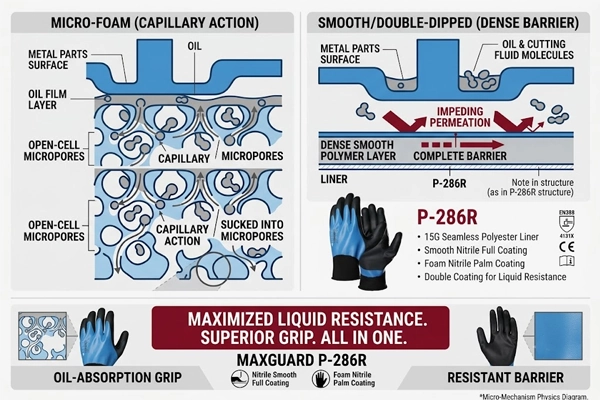
Capillary Suction Oil-Removal Mechanism: When workers grip screws or small washers coated with trace amounts of rust-preventive oil or cutting oil, the sponge-like micropores on the surface of the micro-foam coating instantly draw the trace oil film from the contact surface into the micropores via capillary action and squeeze it out.
Enhanced Physical Grip: By expelling the surface film, the rubber-plastic matrix of the glove comes into direct contact with the metal part’s substrate, generating extremely strong dry and low-oil friction, effectively preventing parts from slipping off the fingertips. At the same time, the open-cell microporous structure maintains good gas permeability, significantly reducing stuffiness and hand perspiration caused by prolonged wear.
Smooth Nitrile: Impermeable Liquid Barrier for Engine Powertrain Fluids
Smooth Nitrile serves as a dense barrier against liquid spills and heavy oil penetration.
Unlike the microporous structure of foamed coatings, Smooth Nitrile is produced using a dense, non-porous physical impregnation molding process, in which rubber molecules are tightly packed to form a continuous, uninterrupted polymer barrier.
Absolute Liquid Barrier: Workstations such as engine powertrain assembly, gearbox oil filling, and pipeline maintenance are exposed to large amounts of engine oil, hydraulic fluid, or transmission fluid. Smooth Nitrile completely blocks physical pathways for liquid penetration, ensuring that heavy oils cannot seep through the gloves into the fiber lining.
Expanded Chemical and Oil Resistance: As outlined in our industry guide, The Chemical Resistance of Nitrile Coatings: Protecting Hands Against Oils and Solvents, the dense, smooth nitrile coating exhibits exceptional resistance to swelling. It maintains structural stability even after prolonged exposure to high-viscosity engine oil and oil-based cleaning agents, without softening or peeling, thereby significantly extending the glove’s service life in heavy-duty oil applications.
Automotive Workstation Allocation Matrix
In large automotive manufacturing plants, there are significant differences among workstations in terms of fluid exposure levels, the sharpness of component edges, and the required level of manual dexterity. Establishing a clear allocation matrix for each core production workstation is an essential measure for EHS departments to avoid procurement waste, reduce total cost of ownership (TCO), and eliminate safety blind spots.
Comprehensive Workstation Benchmark & Glove Selection Table
The following table provides a side-by-side comparison of the four core workstation types in automotive manufacturing, their primary safety risks, and recommended configurations:
| Automotive Workstation | Primary Hazard / Risk | Recommended Liner Gauge | Recommended Coating Style | Sourcing / EHS Selection Advice |
| Precision Electronics & Wiring | Micro-fasteners; tactile feedback required | 18-Gauge Ultra-Thin | Micro-Foam Palm Coated | Prioritize a balance between bare-hand-level fingertip sensitivity and grip performance in slightly oily conditions. |
| Engine & Powertrain Assembly | Heavy motor oil; confined spaces; torque tools | 13-Gauge / 15-Gauge | Smooth / Double Dipped | It is essential to prevent high-viscosity lubricants from seeping into the palm, which could cause torque slippage. |
| Body Stamping & Sheet Metal | Sharp metal edges; stamping oil splatter | 18-Gauge Cut-Resistant | Micro-Foam / Fully Coated | The gloves must provide dual protection against cuts and oil in accordance with the high-level requirements of EN 388. |
| Parts Washing & Submersion | Cutting fluids; submersion in liquid | 15-Gauge / 18-Gauge | 360° Fully Coated | Palm-immersion styles are strictly prohibited to prevent cutting fluid from siphoning through the back of the hand. |
Key Insights from the Workstation Benchmark
From the allocation matrix above, we can summarize the following three practical guidelines to inform daily PPE selection decisions on the shop floor:
Tiered Protection Based on Need to Eliminate “Overprotection”: At workstations involving the handling of general-purpose parts in dry or slightly oily conditions, as well as in warehousing, logistics, and light component assembly, there is no need to blindly provide high-cost cut-resistant or heavy-duty chemical-resistant gloves. We recommend purchasing standard, lightweight, general-purpose models that combine environmental sustainability with cost-effectiveness—P-210R MAXGUARD, 13G seamless RPET liner, foam nitrile palm coating. Featuring a 13-gauge recycled polyester (RPET) seamless knitted liner paired with a palm-dipped foam nitrile coating, this model is not only breathable and lightweight but also perfectly suited for high-frequency assembly tasks in dry and slightly oily environments.
Strictly control the risk of liquid capillary penetration: For workstations involving parts immersion cleaning, liquid spills, or spills of deep-hole cutting fluid, the glove coating style must be upgraded from palm-coated to 360-degree fully coated. The exposed fabric on the back of the hand acts like a capillary tube, drawing liquid into the glove and thereby compromising protection.
Stitch Count Determines Productivity Limits: At workstations that rely on “fingertip tactile sensitivity”—such as electronic wiring harness assembly—an 18-stitch ultra-thin lining significantly reduces finger flexion resistance. This minimizes the frequency with which workers remove their gloves due to bulkiness, thereby reducing violations and lowering the accident rate at its source.
Precision Micro-Assembly: Bare-Hand Dexterity Without Oil Contamination
In modern automotive manufacturing and parts assembly lines, precision micro-assembly workstations place extremely high demands on the comprehensive physical properties of gloves. Whether snapping tiny clips into place inside the instrument panel, picking up micro-screws on an electronic control unit (ECU), or wiping down surfaces in the body paint preparation area, gloves must provide a basic barrier against oil while maintaining near-bare-hand tactile sensitivity and the utmost cleanliness.
Handling Micro-Fasteners, Screws, and Cable Harnesses
The assembly of micro-fasteners, screws, and complex cable harnesses relies critically on the gloves’ fingertip tactile sensitivity.
At traditional assembly stations, when workers wear thick rubber gloves, they often cannot feel the threads of screws or the positions of cable harness connectors with their fingertips, leading to frequent assembly defects such as screws slipping, latches not being secured properly, or connectors being only loosely connected.
Bare-Hand-Level Flexibility Control: By incorporating an 18-gauge ultra-fine nylon and spandex blend seamless knit lining, the gloves achieve exceptional elasticity, stretch, and form-fitting performance, eliminating excess material and wrinkles at the fingertips.
Comprehensive Protection Configuration: For precise and complex work environments that require both ultimate flexibility and protection against cutting fluids and rust-preventive oils seeping onto the back of the hand, we recommend the P-288 MAXGUARD, 18G seamless nylon/spandex liner, fully coated with foam nitrile. Featuring 18-gauge ultra-lightweight stitching technology combined with a 360-degree fully enveloping foamed nitrile coating, it not only perfectly preserves a “second-skin” tactile sensation at the fingertips but also establishes a seamless oil-resistant barrier, ensuring a secure grip on micro-screws and precision components even in low-oil environments.
Silicone-Free and Low-Lint Requirements for Automotive Paint Prep
In automotive paint preparation (Paint Prep) and precision electronic assembly stations for vehicle interiors, being silicone-free and low-lint are non-negotiable EHS and quality requirements.
In automotive manufacturing, paint pinholes (fish-eyes) are one of the primary defects leading to rework in the entire vehicle’s paint system. Trace amounts of silicone residues from glove coatings or release agents can easily transfer to the vehicle’s sheet metal surfaces through glove contact, causing pinholes and peeling during subsequent electrophoretic coating and topcoat application.
Silicone-Free Formulation Control: Gloves used in precision assembly and body preparation areas must strictly adhere to a synthetic nitrile formulation free of silicone oil and organic silicone additives to ensure zero silicone residue when the gloves come into contact with unpainted sheet metal or optical-grade in-vehicle displays.
Management of Low-Lint Yarn Fibers: Using continuous filament nylon (Nylon Continuous Filament) as the lining material instead of short-staple cotton yarn, which is prone to shedding lint, effectively prevents fiber contamination of electronic circuit boards or uncured paint films during assembly, thereby ensuring the yield rate of the entire vehicle assembly.
Powertrain & Engine Assembly: Managing Heavy Oils and Torque Tools
At automotive powertrain and engine assembly stations, the work environment shifts from minimal oil exposure to conditions characterized by heavy oil contamination and high physical stress. Assembly workers not only come into frequent contact with high-viscosity, heavy-duty engine oil, transmission fluid, and grease, but they also operate high-torque pneumatic wrenches and fastening tools. This requires gloves that not only provide extremely high resistance to fluid penetration but also offer a secure, non-slip grip on metal surfaces coated with heavy oils.
Preventing Lubricant Siphoning Through Knitted Liners
Preventing the “siphon effect”—where lubricants seep through knitted liners—is a top priority for safety management at powertrain assembly stations.
Standard palm-dipped gloves have inherent safety vulnerabilities in heavy-oil environments: when hands are immersed in oily areas or come into contact with oil-saturated gearboxes, the grease can be drawn up through the exposed knitted fibers on the back of the glove via the “siphon effect,” rapidly drawing oil into the glove’s interior.
Hazards of Liner Contamination: Once oil penetrates the skin of the palm, it not only causes occupational dermatitis but also leads to slippage inside the glove, causing workers to lose precise control over their hand movements.
Risks Associated with Operating Torque Tools: When operating high-torque fastening tools (such as pneumatic reaction wrenches), if the glove’s exterior loses grip due to heavy oil spillage or the interior becomes slippery, the tool is highly likely to slip out of the hand and recoil, resulting in wrist sprains or impact injuries.
Double-Dipped Barrier Protection for Liquid-Submerged Components
The double-dipped coating process is the optimal solution for resolving the conflict between preventing penetration by heavy oil fluids and ensuring high slip resistance and grip.
By applying two layers of nitrile coatings with different physical properties through a double-dipping process, the solution simultaneously achieves “absolute water and oil impermeability in the base layer” and “robust oil-repellent grip in the top layer.”
Synergistic Physical Mechanism of the Double Coating:
First Layer (Smooth, Fully-Dipped Base Layer): Utilizes a smooth, dense nitrile rubber that provides 360-degree full coverage, completely sealing knit gaps to establish a continuous polymer barrier that prevents the penetration of any liquids or heavy oils.
Second Layer (Foamed Palm-Coated Top Layer): A layer of micro-foamed nitrile is applied to the palm and fingertips. Utilizing its sponge-like open-cell microporosity, it rapidly adsorbs and displaces heavy oil films from component surfaces the moment a grip is made.
Recommended Product Configuration: For heavy-oil, high-stress workstations such as engine and gearbox assembly, we recommend P-286R MAXGUARD, 15G seamless polyester liner, smooth nitrile full coating, and foam nitrile palm coating. This glove features a 15-gauge seamless polyester liner combined with a dual-coating structure of a “smooth fully-dipped base layer + foamed palm-dipped top layer,” which not only completely blocks the inward penetration of heavy lubricating oil but also ensures a rock-solid grip when operating high-torque tools.
Body-in-White & Metal Stamping: Integrating Cut Protection with Oil Grip
In automotive manufacturing’s Body-in-White (BIW) assembly and metal stamping shops, hand protection faces the most severe combination of physical hazards on the entire production line. Workers must frequently handle thin-gauge metal parts, body panels, and structural frames that have been formed through high-tonnage stamping; the edges of these components are riddled with extremely sharp flash and burrs. At the same time, the sheet metal surfaces are heavily coated with high-viscosity drawing oil and stamping rust-preventive oil, creating a hazardous working environment where the “high risk of cuts” and “slip hazards from oil residue” overlap.
Managing Sharp Sheet Metal Edges and Stamping Oils
The core safety challenge at sheet metal stamping workstations lies in the combination of cut risks and oil-induced slippage.
When stamped parts are coated with stamping oil, metal components are highly prone to slipping out of workers’ hands. At the moment of slippage, sharp sheet metal edges exert extreme cutting and pulling forces on workers’ fingers and palms. If gloves offer only standard oil resistance but lack a high-grade cut-resistant lining, metal burrs can easily pierce the coating and cut through the skin, causing deep lacerations or even tendon ruptures. Conversely, if gloves provide only cut resistance but fail to block stamping oil, the oil seeping into the fabric can cause the gloves to become slippery inside, further increasing the risk of operational errors and muscle fatigue.
High-Gauge Cut-Resistant Liners with EZGRIP® Palm Coatings
For high-risk stamping stations, the optimal solution is a composite structure combining high-gauge, seamless cut-resistant liners with a patented oil-repellent grip coating.
To provide a high level of cut resistance without sacrificing the sensitivity required for high-frequency gripping during assembly, protective gear must be upgraded simultaneously in two areas: fiber materials and rubber-plastic coatings:
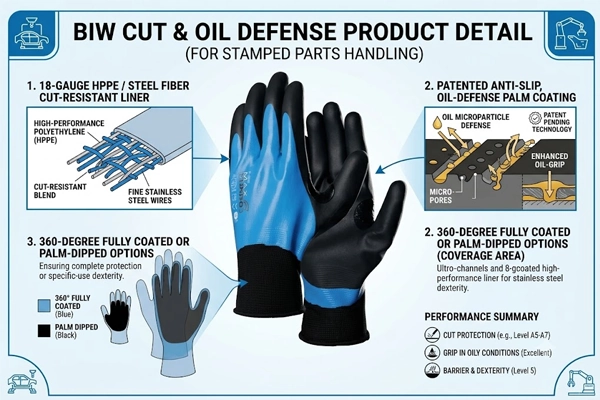
Selection of high-gauge cut-resistant liners: By using a multi-ply blend of ultra-high-molecular-weight polyethylene (HPPE), stainless steel wire, nylon, and spandex, a high-density cut-resistant fiber mesh can be constructed with extremely thin wall thickness. The 18-gauge ultra-fine stitching technology completely overcomes the drawbacks of traditional cut-resistant gloves—such as bulkiness and stiffness—resulting in a glove that conforms to the hand’s shape and offers minimal resistance.
Cut-Resistant + Oil-Resistant with High Grip—Recommended for Real-World Applications: For workstations involving white body welding, sheet metal handling, and stamped part quality inspection, we recommend deploying advanced composite protective gear—EZP5-318 18G HPPE/Steel/Nylon/Spandex, EZGRIP® palm coating. These gloves feature an 18-gauge ultra-thin cut-resistant lining that ingeniously combines steel wire with high-strength HPPE fibers to meet the highest standards of cut resistance. The palm is coated with the patented EZGRIP® nitrile coating, which rapidly repels oil from thick stamping oil films to establish a powerful grip, eliminating cut injuries caused by oil-induced slippage at the source.
Plant Procurement Audit: Evaluating Assembly Line Glove Efficiency
In the day-to-day operations of automotive manufacturing and precision electronics assembly plants, there is often a misconception regarding PPE procurement audits: using only the “unit cost of gloves” as the sole evaluation criterion. This price-centric approach overlooks the actual consumption rate of gloves during use, damage to workpieces, and the hidden impact on worker productivity. By establishing a scientific on-site audit mechanism, EHS departments and procurement managers can quantitatively assess the true efficiency of assembly line gloves from three key dimensions: muscle fatigue, total cost of ownership (TCO), and environmental compliance.
Measuring Worker Fatigue: Pinch Force & Slip Rate Metrics
Worker muscle fatigue and workpiece slip rates should be used as core audit metrics for glove usage efficiency.
The anti-slip grip performance of glove coatings directly determines the muscular load on workers when handling oil-coated parts. When glove grip strength is insufficient, workers unconsciously increase their pinch force to complete assembly tasks.
Pinch Force Testing and Fatigue Audits: On-site audits can be conducted using surface electromyography (sEMG) or pinch force gauges. Workers using high-grip foam nitrile gloves can reduce the pinch force required to grip oil-coated workpieces by more than 30%, significantly reducing cumulative fatigue in the hand tendons and wrist muscles.
Slip Rate Monitoring: Record the frequency of micro-screws, high-value sensors, or precision parts falling from assembly lines due to glove slippage. Reducing the slip rate not only directly minimizes material waste but also eliminates cycle time losses (Line Stop Time) caused by line stoppages to retrieve dropped parts.
Total Cost of Ownership (TCO): Lifespan vs. Unit Cost
Establish a procurement evaluation model based on TCO (Total Cost of Ownership).
The true cost of a pair of gloves is equal to their purchase price divided by their actual lifespan in the workshop. Low-end gloves with low unit prices often have deficiencies in coating abrasion resistance and resistance to oil swelling, resulting in a persistently high replacement rate.
Comparison of Service Life and Durability: High-quality, high-gauge (e.g., 15G/18G) nitrile gloves use a high-crosslinking-density formulation, and their service life in terms of abrasion resistance and resistance to delamination under oily conditions is typically 2 to 3 times longer than that of ordinary, low-end gloves.
Total Cost Analysis: Assuming Glove A costs 2 yuan per pair but must be discarded after a single shift due to the coating hardening and cracking, while Glove B costs 4 yuan per pair but offers excellent abrasion resistance and washability, allowing for continuous, reliable use over three shifts. From a TCO perspective, using Glove B reduces the average daily PPE consumption per workstation by 33% while significantly reducing waste disposal costs.
Environmental Compliance: Recycled RPET Liners in Modern Plant Procurement
Incorporating sustainability and low-carbon environmental metrics (ESG Compliance) into supply chain audit standards for modern chemical plants.
As leading global automakers and Tier 1 suppliers fully implement zero-carbon factory and sustainable supply chain strategies, the environmental attributes of PPE have become a key scoring criterion in procurement audits.
Application of RPET Recycled Fibers: Using recycled polyester (RPET)—made from recycled plastic bottles—as a seamless knitted liner for gloves can significantly reduce the carbon footprint of the raw material extraction process without compromising the gloves’ tensile strength or fit.
Green Supply Chain Empowerment: Prioritizing the procurement of RPET eco-friendly gloves with compliance certifications during factory audits not only meets EHS environmental and carbon reduction requirements but also helps automakers achieve their ESG carbon reduction targets at the supply chain level, ensuring dual compliance with safety protection and green production standards.
Knowledge Base: Frequently Asked Questions (FAQs)
Addressing the key challenges faced by automotive manufacturing, precision parts assembly, and shop floor EHS managers during the actual selection and procurement processes, this section compiles answers to the most common questions to provide a decision-making reference for standardized shop floor configurations.
Why Are 18-Gauge Nitrile Gloves Becoming the Standard for Automotive Precision Assembly?
18-gauge gloves have rapidly become the industry standard for automotive precision assembly because they completely resolve the challenge of having to choose between protection and tactile sensitivity.
In workstations involving automotive electronic harness connection, instrument panel assembly, and micro-screw handling, traditional 13-gauge or 15-gauge gloves—due to their thicker linings—diminish tactile feedback at the fingertips, leading to sluggish worker movements or frequent instances of false tightening. The 18-gauge ultra-fine knitting technology reduces the glove’s wall thickness to an extremely thin state, giving it a “second-skin” fit and extremely low flex resistance. Workers can precisely distinguish the texture and position of tiny components without removing their gloves, ensuring 100% compliance with glove-wearing requirements while significantly improving assembly line cycle times.
Are micro-foam nitrile gloves silicone-free and safe for use in paint shops?
Industrial-grade micro-foam nitrile gloves that meet quality standards can be silicone-free, but this must be verified through rigorous factory certification before purchase.
In the body painting and paint shop preparation areas of automotive manufacturing, silicone is a primary source of contamination that causes paint surface pitting (fish-eyes) and paint peeling. High-quality industrial oil-resistant gloves strictly prevent the introduction of silicone compounds in their rubber and plastic formulations and the use of release agents, ensuring zero silicone residue on workpiece surfaces when handling unpainted sheet metal. If your workstation involves pre-painting processes or the wiping of optical-grade components, we recommend requesting a specific Silicone-Free Certificate from your supplier to avoid costly paint rework losses.
How does a double-dipped nitrile glove (such as the P-286R) differ from a standard single-dip foam glove?
The key differences between the two lie in their “depth of physical liquid barrier” and “structural division of labor.”
A single-dip foam glove features a coating surface with countless interconnected open-cell micropores. Although this structure offers excellent breathability, oil-repellency, and grip, if the glove is immersed for an extended period in heavy oil, cutting fluid, or spilled lubricant, the liquid will eventually seep through the micropores and the fabric lining into the palm.
In contrast, double-dipped gloves like the P-286R employ a layered, synergistic design:
First Layer (Base Layer): A dense, smooth nitrile with 360-degree full coverage completely seals all gaps, establishing an absolute, dead-zone-free barrier that is both watertight and oil-tight.
Second layer (outer layer): A layer of micro-foamed nitrile is applied to the palm area, using micro-pores to displace heavy oil films and provide a strong, non-slip grip.
Therefore, single-foam styles are more suitable for precision assembly involving light oils or dry conditions, while double-dipped styles are the preferred choice for engine assembly, gearbox filling, and workstations with liquid spills.
Call to Action (CTA)
In modern automotive manufacturing facilities where automation and high production rates coexist, matching the right hand protection equipment to each workstation is a critical step toward reducing total cost of ownership (TCO), improving assembly yield rates, and achieving zero-accident EHS management.
If you are looking for automotive-grade protective gloves that combine bare-hand-level dexterity, superior oil-resistant grip, and high abrasion resistance, feel free to explore our full product line. Explorethe Full Range of Certified Nitrile-Coated Industrial Safety Gloves.
For manufacturing clients with bulk purchasing needs, factory audits, or customization evaluations, we offer professional workstation risk assessments and free sample testing services. Please feel free to contact our technical support team at SQG® for Free Sample Kits to receive a customized protective solution and a free sample kit.


