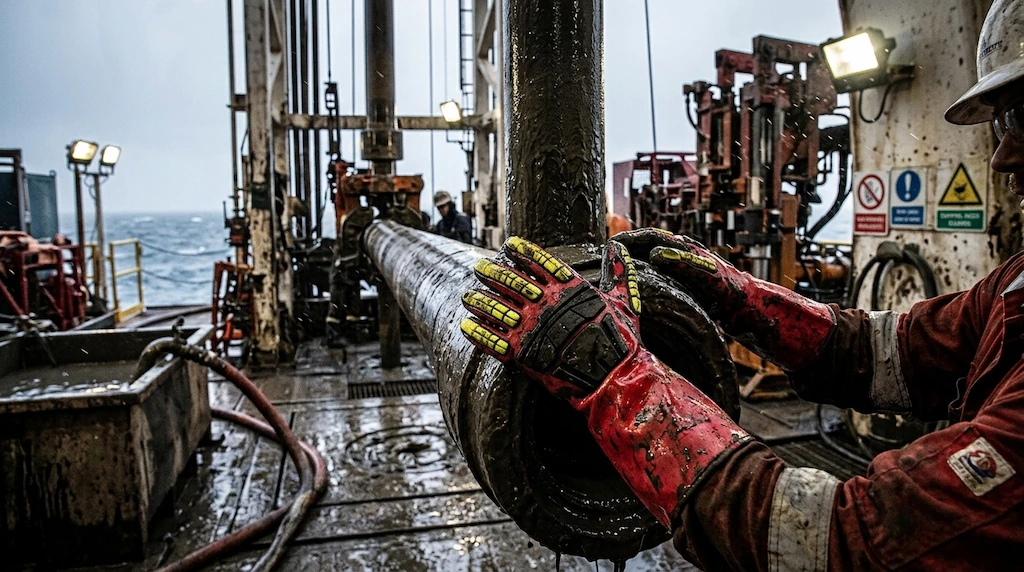
Introduction: The Hostile Triangle of Offshore Drill Floors
In modern deepwater offshore drilling operations, the proper use of industrial-grade oilfield mud chemical-resistant gloves is the core safety measure for protecting the physical well-being of frontline drill floor personnel and reducing lost-time injuries (LTIs) on drilling platforms. Whether on a semi-submersible rig battered by fierce winds and towering waves or under the harsh operating conditions of a jack-up rig, the drill floor, shale shaker, and solid control mud pit are universally recognized as some of the highest-risk areas in global heavy industry, where operational hazards are most concentrated.
At these critical workstations, frontline field personnel face a triple lethal threat every day—a combination of “high-kinetic-energy mechanical impact,” “exposure to highly corrosive chemical fluids,” and “severe liquid spillover and splashing”:
The lethal crushing force of heavy drill strings and large clamps: During tripping and single-strand operations, drill collars, drill pipe strings, and hydraulic power clamps (Iron Roughnecks) weighing tens of metric tons frequently move and rotate within the confined space of the drill floor. Even the slightest misalignment or swaying of the steel wire rope can instantly generate thousands of joules of devastating crushing kinetic energy, often resulting in comminuted fractures of the finger bones or even the severing of the hand;
Continuous Chemical Corrosion from Oil-Based Mud (OBM) and Synthetic-Based Drilling Fluid (SBM): To maintain wellbore stability and provide lubrication and cooling in deepwater wells, the drilling circulation system is filled with high concentrations of diesel distillates, synthetic mineral oils, emulsifiers, and caustic alkaline additives. These viscous, nonpolar, long-chain hydrocarbon liquids not only rapidly degrade the outer layer of ordinary gloves but also penetrate the skin, causing irreversible chemical burns and severe contact dermatitis;
Risk of mud backflow into the arm caused by high-pressure mud surges: High-pressure mud often erupts suddenly when quickly connecting high-pressure mud hoses, cleaning overlapping vibrating screen filters, or disassembling blowout preventer (BOP) control lines under backpressure. If protective gear lacks an effective physical deflection barrier, oily mud can easily flow back through the wrist opening into the forearm, causing deep contamination of the entire arm.
However, serious hazards related to “functionally fragmented protection” persist at many offshore oilfield service sites. On the one hand, traditional fabric-faced mechanical impact-resistant gloves—commonly procured on-site—feature rubber padding on the back of the hand, but their palms and side seams are often sewn with fabric or breathable microporous foam materials. Upon contact with warm oil-based drilling mud, these gloves become completely saturated with hydrocarbon liquids within minutes, effectively turning them into “wet dressings” soaked in chemicals. On the other hand, while conventional thin nitrile or latex chemical-resistant gloves offer basic leak-proofing capabilities, they lack any ability to absorb blunt impact or cushion blows when faced with rough, jagged drill pipe threaded joints and massive steel tongs weighing dozens of metric tons; even the slightest scrape or abrasion causes them to tear and fail.
To truly eliminate protection blind spots in deepwater oil and gas exploration, it is essential to rely on three-dimensional, heavy-duty chemical- and impact-resistant gloves that integrate a “heavy-duty, hydrocarbon-resistant rubberized shell,” a “segmented impact-resistant exoskeleton on the back of the hand,” and an “Extended Safety Cuff” designed to prevent mud backflow. By resisting heavy aromatic hydrocarbon penetration at the molecular level, dissipating high-kinetic-energy impacts at the skeletal level, and preventing mud backflow along the arm at the structural level, these gloves provide robust hand protection for the most extreme offshore oil and gas extraction operations.
For engineering safety directors and drilling supervision teams tasked with establishing comprehensive fluid defense standards for onshore heavy-duty drilling rigs, offshore wellhead platforms, and heavy-duty petrochemical refining operations, we recommend a thorough review of our core industrial protection guide: Chemical & Liquid Resistant Work Gloves.
Anatomy of Downhole Fluids: Drilling Muds & Completion Corrosives
On offshore drilling platforms and at onshore high-pressure oil and gas well sites, rig workers and drilling fluid engineers are exposed daily not to ordinary mud, but to engineering fluid systems with extremely complex compositions. These downhole fluids are precisely chemically formulated to withstand the extreme temperatures, pressures, and complex rock formations found deep within the earth. However, it is precisely these chemical components—which give drilling fluids their exceptional suspension, lubrication, and well-control capabilities—that pose a highly destructive chemical erosion risk to the personal protective equipment (PPE) worn by field personnel.
The selection of qualified oilfield mud chemical-impact gloves must be based on a deep understanding of the chemical corrosion mechanisms of downhole fluids. The reason ordinary industrial gloves are no match for drilling fluids lies in their failure to establish a molecular-level barrier against hydrocarbon mixtures, strongly alkaline solid control weighting agents, and highly corrosive fracturing chemicals.
Chemical Aggressiveness of Oil-Based Mud (OBM) & SBM
To address the problem of water-sensitive shale formation collapse in complex deep wells, modern offshore oil exploration widely employs oil-based mud (OBM) and synthetic-based mud (SBM), which have lower environmental toxicity:
Strong solubility of the high-concentration hydrocarbon continuous phase: Oil-based muds typically use diesel fractions, low-toxicity white oil, or synthetic isoparaffins as the base continuous phase. These nonpolar straight-chain alkanes, naphthenes, and residual aromatic hydrocarbon components exhibit strong affinity and swelling capacity toward nonpolar or low-polarity polymers, capable of rapidly breaking down the surface cross-linked networks of conventional rubber materials;
Penetration and disruption of the polymer interface by surfactants: To ensure that the aqueous phase is stably dispersed in the oil phase in the form of microemulsions, drilling fluids contain large amounts of high-concentration fatty acid soaps, imidazoline derivatives, and organic quaternary ammonium salt wetting agents. These surfactants not only reduce the oil-water interfacial tension but also significantly lower the surface tension of hydrocarbon liquids on the rubber layer of protective gloves, allowing organic hydrocarbon molecules to penetrate the glove polymer at extremely high capillary velocities;
Abrasion by barite particles and high-density wetting: To balance pore pressure in deep formations, the drilling fluid contains a large amount of high-density barium sulfate (barite powder) fine particles in suspension. Under the high-pressure pulsating action of the drilling circulation pump, these hard particles continuously erode the microscopic texture of the glove’s surface, accelerating the penetration and diffusion of chemical media deep into the rubber layer.
Flowback Slurries, Caustic Additives & Acid Fracking
In addition to the permeation hazards posed by long-chain hydrocarbons themselves, the highly corrosive chemical additives contained in drilling fluids and workover and completion fluids pose a direct and severe acute threat to the skin tissue of frontline workers:
Chemical burns from strongly alkaline setting accelerators: When preparing and maintaining the gelation properties of oil-based muds, large quantities of quicklime (calcium oxide) and industrial-grade sodium hydroxide (caustic soda) are typically added continuously in the mud mixing funnel area to maintain a high excess lime content in the mud system, suppress acid gas corrosion, and improve emulsion stability. If gloves become damaged or liquid seeps in through the cuffs, the highly concentrated, strongly alkaline solution rapidly saponifies the fatty tissues on the skin’s surface, resulting in severe, deep chemical alkali burns;
Composite Corrosion from Acidized Fracturing Flowback Fluids: During reservoir fracturing and acid washing operations to clear blockages, the returned residual acid mixture contains high concentrations—ranging from 15% to 28%—of hydrochloric acid, hydrofluoric acid complexes, and various demulsifiers. When strongly acidic fluids mix with heavy oil and hydrogen sulfide gas returned from the formation, they cause combined damage to protective equipment through “strong acid corrosion + strong solvent erosion.”
Accumulation of Formation-Associated Harmful Substances and Heavy Metals: Fracturing flowback fluids often carry dissolved heavy metal ions from the formation, highly mineralized brine, and trace amounts of naturally occurring radioactive materials (NORM). Prolonged exposure of the skin to immersion in such mixed slurries can easily lead to chronic, intractable eczema, severe skin peeling, and even irreversible tissue necrosis.
Polymer Swelling, Plasticizer Leaching, and Permeation
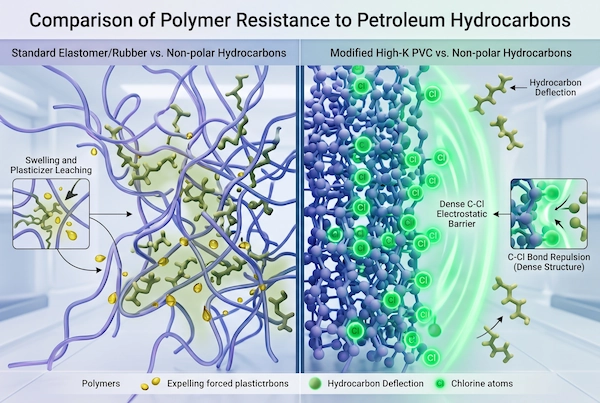
Many drilling sites have reported that newly issued standard oil-resistant gloves, after just one or two shifts of use in the mud tank area, rapidly become larger, with the rubber surface becoming soft and sticky, or subsequently hardening and becoming brittle. This physical deformation process reveals a collapse of the molecular-level structure within the polymer:
Polymer Swelling and Expansion of Free Volume (Swelling): When diesel-based drilling fluid comes into contact with a standard polymer rubber layer that lacks sufficient hydrocarbon resistance, low-molecular-weight nonpolar hydrocarbon molecules force their way between the polymer’s main chains. As foreign hydrocarbon molecules continue to accumulate, the spacing between polymer chains is forced to widen. Macroscopically, the material exhibits severe volume swelling, softening, and collapse, resulting in a precipitous drop of more than 70% in the glove’s original tensile strength and resistance to puncture and tear;
Irreversible Leaching of Functional Plasticizers: Conventional elastomer gloves typically contain an appropriate amount of phthalate or aliphatic plasticizers blended into the rubber layer to provide flexibility and bendability at low temperatures. However, the organic solvents in oil-based drilling mud act as excellent extractants, rapidly and thoroughly extracting the plasticizers from within the glove’s rubber layer and dissolving them into the surrounding mud. Once the rubber layer loses the structural support provided by the plasticizers and dries after being separated from the oil, it undergoes irreversible molecular hardening, quickly leading to surface cracking, flaking, and even direct breakage at flex points;
From Microscopic Penetration to Complete Loss of Liquid Tightness (Permeation): As the gaps between polymer main chains rapidly widen, toxic organic compounds and heavy metal ions in the drilling fluid no longer remain confined to the surface but form macroscopic chemical permeation pathways invisible to the naked eye (Permeation). Many workers find their palms greasy and experience a stinging sensation after removing their gloves. This is precisely because harmful chemical molecules have penetrated the inner wall of the seemingly intact rubber layer, causing hidden and dangerous transdermal absorption poisoning.
Polymer Metallurgy: Engineering Hydrocarbon-Resistant Heavy PVC
When confronted with highly permeable, strongly swelling oil-based mud (OBM) and fracturing chemicals on offshore drilling platforms, conventional lightweight rubber-coated gloves alone are simply incapable of providing a long-lasting physical barrier against these fluids. The primary defense in manufacturing professional-grade oilfield mud chemical impact gloves lies in the polymer engineering modification of the rubber-coated substrate.
The physical principle of “like dissolves like” in polymer chemistry determines the durability limits of different materials in hydrocarbon environments: Conventional natural rubber (NR) and standard polyurethane (PU) typically have nonpolar or low-polarity main chains, which are highly susceptible to rapid intermolecular solubility and softening collapse when exposed to long-chain alkanes, naphthenes, and diesel fractions. To block the microscopic penetration pathways of oil molecules, heavy-duty drilling protective equipment must utilize a polar polymer matrix with high electronegativity and a dense molecular arrangement, while addressing—at the formulation level—the industry-wide challenge of balancing the conflicting requirements of abrasion resistance and low-temperature flexural resistance in traditional materials.
Dense Molecular Packing of Plasticized Polyvinyl Chloride
The reason why specially modified polyvinyl chloride (PVC) has long maintained its position as the core matrix for heavy-duty oil and gas exploration chemical protection equipment stems from its unique microscopic molecular configuration:
Strongly polar carbon-chlorine bonds form an electrostatic repulsion barrier: Chlorine atoms (Cl) with extremely high electronegativity are densely and regularly suspended on the main chain of the PVC macromolecule. This asymmetric electron cloud distribution endows the polymer with a strong molecular dipole moment, creating a high-density electrostatic repulsion field. When exposed to heavy crude oil fractions, mineral oil-based drilling fluids, and diesel-based solvents—which are primarily composed of nonpolar covalent bonds—highly polar PVC exhibits extremely low chemical affinity, preventing the spontaneous diffusion of hydrocarbon molecules into the polymer matrix at the thermodynamic level;
High-polymerization-degree resin forms a dense microcrystalline physical network: SQG uses a special suspension-grade PVC resin powder with a polymerization degree exceeding 1,500 in the dipping slurry for heavy-duty chemical-resistant gloves. After precise high-temperature curing, the longer molecular segments form a highly ordered, dense, amorphous entanglement and microcrystalline cross-linked network. This high-density packing significantly reduces the free-volume pores within the polymer, making it difficult for long-chain hydrocarbons and high-density mud particles to penetrate and migrate through the intermolecular gaps;
The extraction-resistant polyester-based plasticizer system eliminates hardening and brittle fracture: To address the persistent issue with traditional PVC—where plasticizers are easily extracted by solvents during field use in oilfields, leading to glove hardening and cracking—the formulation eliminates low-molecular-weight conventional phthalate plasticizers and instead fully adopts oil-resistant, extraction-resistant high-molecular-weight polyester plasticizers combined with a specialized epoxy soybean oil stabilizer system. Even when gloves are fully immersed for extended periods in a warm mud circulation tank at 60°C, the internal flexibility additives are not leached out by the oil phase, ensuring the gloves’ mechanical toughness and barrier thickness throughout their long service life.
PVC/Nitrile Hybrid Formulation in P-901
Although pure heavy-duty PVC offers exceptionally strong resistance to chemical permeation, a single layer of PVC rubber often feels too heavy and stiff at the front edge of a drill rig—where frequent bending and gripping of rough, rugged drilling tools are required—and is prone to stiffening in cold temperatures during offshore operations. To strike a balance between extreme oil resistance and flexible handling, P-901 innovatively introduces a PVC/nitrile composite blend coating system:
In-situ molecular interpenetration between the elastic nitrile phase and the barrier PVC phase: P-901 involves the high-shear homogenization of microemulsified oil-resistant nitrile latex (NBR) with ultra-fine modified PVC slurry. After curing, the nonpolar polybutadiene elastic network interpenetrates with the highly polar crystalline regions of the PVC to form an interpenetrating polymer network (IPN). The nitrile phase provides exceptional tensile elasticity and high dynamic fatigue life, while the continuously distributed PVC phase firmly seals off penetration pathways for external hydrocarbon media;
significantly enhancing resistance to flexural fatigue during deep-sea operations at low temperatures: during operations in the North Sea, the Bering Sea, or at high latitudes in winter, cold seawater and chilly winds can easily cause the glove’s rubber layer to harden, resulting in stiff fingers and a loss of grip for workers. The PVC/nitrile composite blend in P-901 significantly lowers the material’s brittle glass transition temperature (Tg), allowing the gloves to maintain supple flexibility and resilience even under harsh drilling conditions near freezing temperatures, effectively reducing hand muscle fatigue during continuous shift work;
Excellent resistance to metal tearing and puncture elongation: Drilling platforms are littered with burrs from damaged drill collars and frayed steel wire rope strands. The PVC/nitrile composite rubber film exhibits exceptional yield tear strength. When subjected to localized puncture and compression by fine, sharp burrs or hard objects, the cross-linked network dissipates localized stress concentrations through transient microelastic deformation, effectively preventing uncontrolled tearing and fluid leakage caused by scratches or punctures from sharp foreign objects.
Cross-Cluster Integration: Chemical Permeation Benchmarks
In complex offshore and onshore oil and gas engineering systems, different process stages often involve exposure to vastly different chemical media—ranging from continuous immersion in high-viscosity diesel-based drilling mud on the rig deck to acute exposure to high-concentration hydrochloric acid and demulsifiers in acid washing and unblocking fluids at oil production and workover sites. It is simply impossible for a single material to withstand all operating conditions.
A deep understanding of the breakthrough times and degradation rate thresholds of different protective polymers (nitrile, neoprene, and modified PVC) when exposed to specific solvent groups—such as nonpolar aromatic hydrocarbons, polar alcohols and ketones, and strong inorganic acids and bases—is the technical cornerstone for plant EHS departments and drilling supervisors in developing scientifically sound protective equipment selection charts. For detailed information on the microscopic differences in permeation behavior among different materials’ molecular structures when immersed in complex fluids, as well as the engineering logic behind material selection, we recommend consulting our comprehensive technical white paper: Chemical Glove Selection Guide: Nitrile vs. Neoprene vs. PVC.
Back-of-Hand Kinetic Defense: Integrated TPR Exoskeletons
In frontline operations on drilling rigs, chemical fluid erosion is often a continuous and gradual process, but mechanical kinetic impacts always occur in the blink of an eye. Drilling rig workers spend years maneuvering in confined workspaces where heavy loads suspended at great heights, intense mechanical rotation, and narrow passageways intersect. With gloves that offer only chemical barrier protection, the delicate tissues on the back of the hand are virtually defenseless when faced with uncontrolled impacts from steel components weighing several metric tons.
To develop oilfield mud chemical impact gloves truly suited for the realities of heavy oil extraction, the fluid barrier and blunt-force protection systems must be integrated at the microstructural level. The P-901 and P-902 feature a specialized thermoplastic rubber (TPR) exoskeleton defense system deeply integrated into the exterior of their thick-walled, oil-resistant rubber shells, creating a second layer of heavy-duty, rigid-yet-flexible cushioning framework on the back of the hand to withstand the most devastating crushing and impact scenarios encountered at drilling sites.
Crushed Fingers and Pinch Points Around the Rotary Table
The rotary table and the surrounding tripping area on an offshore drilling rig are widely recognized as “high-kinetic-energy hazard zones” on the drilling platform:
Transient shearing in the blind spot where the hydraulic power tong engages the rotary table: When threading drill pipe joints, the torque applied by the hydraulic power tong (Iron Roughneck) typically reaches tens of thousands of newton-meters. If a worker’s hand is not withdrawn from the pinch point in time before the clamping cylinder closes, the fingers will be subjected to an extremely intense normal compressive load;
Uncontrolled Impacts from Hoisting Strings and Catwalk Slips: When weighted drill pipes and drill collars weighing several metric tons are hoisted by the derrick crane to the wellhead stringing platform, the steel pipe bodies are highly prone to unpredictable pendulum-like lateral swinging due to platform sway and wind and wave turbulence. When workers manually realign the string, the backs of their hands are highly susceptible to high-speed blunt impacts from the heavy pipes striking the derrick beams or catwalk rails;
Irreversible orthopedic trauma caused by high-kinetic-energy impacts: Historical statistics from the International Association of Drilling Contractors (IADC) indicate that hand and finger bone injuries account for more than one-third of serious workplace accidents on drilling rigs. If thousands of joules of transient kinetic energy act directly—without being attenuated—on the fragile metacarpal and phalangeal bones on the back of the hand, it can easily cause irreversible open comminuted fractures, tendon ruptures, or even avulsion injuries to the hand tissues.
Segmented Thermoplastic Rubber (TPR) Energy Dissipation Dynamics
To achieve superior mechanical cushioning in accordance with the ANSI/ISEA 138 impact protection standard, the P-901 and P-902 feature a custom-molded, segmented, articulated thermoplastic rubber (TPR) exoskeleton structure:
High-rebound molecular spring energy-absorption mechanism: The specialized TPR elastomer used features an extremely high damping coefficient and viscoelasticity. When subjected to external blunt impact loads, the dense polymer network absorbs the concentrated mechanical kinetic energy from downward compression through transient highly elastic deformation, rapidly converting it into minute amounts of thermal energy at the microscopic level;
Pyramid-shaped three-dimensional prismatic stress-dissipation architecture: The exoskeleton’s surface is not a simple, flat rubber strip, but is designed as segmented, raised prisms with force-guiding ramps. When an impact force acts perpendicularly on the finger or the dorsal side of the metacarpal bone, the robust TPR convex surface forces the vertical, downward single-point destructive force to break up, rapidly diverting it laterally along the inclined planes toward the bone-free, non-vulnerable areas on either side of the back of the hand;
Segmented articulation ensures near-bare-hand flexibility: Recognizing that heavy-duty industrial gloves often cause stiffness due to overly thick impact-resistant strips, the TPR exoskeleton precisely follows the anatomical movement patterns of the hand’s bones and tendons, featuring deep hinge grooves at all proximal interphalangeal and metacarpophalangeal joints. When workers bend their fingers to grip the handles of large pliers or grasp steel wire rope slings, the exoskeleton can freely open, close, and extend in sync with the joints’ natural range of motion, completely eliminating the fatigue caused by thick, heavy impact-resistant layers that hinder a firm grip.
Permanent Sonic and Thermal Bonding to Liquid Shells
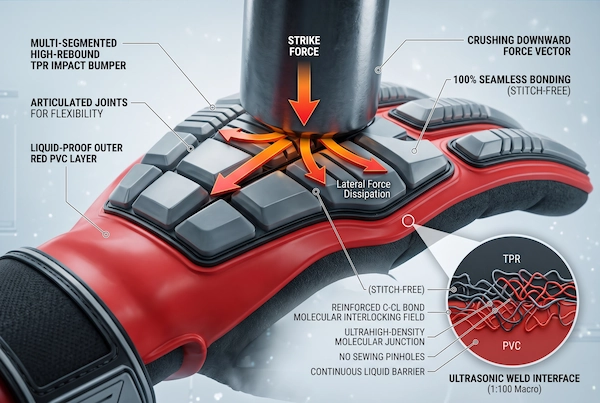
In traditional industrial impact-resistant gloves, TPR impact-resistant strips are typically sewn directly onto the fabric surface using nylon thread. However, for deep-well heavy-duty chemical-resistant gloves, this approach is tantamount to disaster—the steel needles of the sewing machine leave thousands of through-holes in the glove’s surface, allowing oil-based mud from the outside to instantly seep into the inner liner through these holes, completely compromising the liquid-tight barrier.
The P-901 and P-902 models have abandoned traditional needle-and-thread sewing in favor of a specialized high-frequency ultrasonic thermal fusion process (Sonic & Thermal Molecular Welding):
Molecular-level, pore-free thermal interpenetration curing: Under strict temperature control and pressure-servo-controlled clamping, high-frequency vibrations instantly generate intense molecular-level frictional heat at the contact surface between the underside of the TPR exoskeleton and the glove’s thick-walled PVC/nitrile coating. The two highly compatible thermoplastic polymers undergo deep melting and interpenetration at the interface, forming an unbreakable, native fusion layer upon cooling, eliminating the need for sewing;
Ensures a 100% continuous, seamless, liquid-tight barrier: Since the entire glove surface has not undergone any piercing mechanical processing, the underlying heavy-duty chemical-resistant rubber shell maintains 100% absolute impermeability, eliminating any possibility of microscopic fluid penetration or leakage through the joints of the exoskeleton on the back of the hand;
Resistant to tear, shear fatigue, and high-pressure water jet washing: Drilling rig sites frequently involve severe lateral scraping against rough steel components, as well as direct high-pressure mud water jet cleaning after operations. The TPR armor, anchored through high-frequency molecular hot-melt bonding, possesses exceptionally strong interlayer peel strength. Even under repeated heavy lateral shear stress, the impact-resistant exoskeleton remains tightly bonded to the rubber shell’s surface, without any peeling at the edges, delamination, or flaking.
Fluid Runoff Defense: The Physics of Extended Safety Cuffs
When evaluating chemical protection levels at offshore drilling and fracturing sites, safety managers often focus excessively on abrasion and puncture resistance ratings for the palms and fingertips, while frequently overlooking the weakest physical interface in the entire protective system—the glove cuffs. For workers frequently exposed to corrosive drilling fluids, liquid-tightness in the palm area alone cannot establish a complete, closed-loop defense system.
When selecting oilfield mud chemical impact gloves that meet heavy industry standards, it is essential to adopt a three-dimensional defense strategy to completely block the physical pathways through which liquids can flow back up the arm. The P-901 and P-902 are equipped with large-diameter, extended safety cuffs, which serve as heavy-duty structural barriers specifically designed for real-world working conditions such as high-pressure splashes above the drill floor, overhead work with arms raised, and mud splashes and backflow.
The Risk of Downward Infiltration from Overhead Mud Spray
On drilling rigs and at solids control work sites, front-line workers do not merely perform low-level tasks on the deck; many procedures involve frequently raising their arms overhead and looking upward:
High-Altitude Splash During Top Drive and Swivel Maintenance: When conducting pressure inspections or disassembly and assembly of the drill rig’s top drive system, mud rotary gooseneck, or riser manifold, workers must keep their hands raised above their heads for extended periods. If a flange joint loosens or residual pressure is released, warm, viscous oil-based drilling mud can spray directly downward onto the outer layer of the workers’ gloves;
Backflow from High-Pressure Mud Hoses: When switching lines in the mud tank area, cleaning the cyclonic desander, or replacing the vibrating screen feed hose, thick, high-specific-gravity mud mixtures are highly likely to spread along the outer surface of gloves the moment the pipe disconnects. Under the force of gravitational acceleration, the oily mixture will rapidly flow downward along the inclined wrist;
Severe occupational skin contact lesions caused by backflow: Drilling fluid is rich in straight-chain alkanes, aromatic diluents, strongly alkaline calcium oxide, and high-concentration surfactants. Once these viscous liquids slide down the wrist into the enclosed interior of the gloves, the skin on the wrist and forearm is directly exposed to a “sealed wet compress” environment that is damp, airtight, and saturated with chemically corrosive agents. During 12-hour shifts, workers are often unable to leave their posts immediately to wash their hands. Strong alkalis and organic solvents rapidly penetrate the stratum corneum, causing extensive redness and peeling of the skin on the wrists, as well as severe erythema and itching, which can lead to persistent acute chemical contact dermatitis or even deep tissue suppurative infections.
Rigid Extended Safety Cuff vs. Knit Wrist Limitations
In many onshore light-duty workshops, gloves commonly feature knit elastic ribbed cuffs (Knit Wrist). However, bringing these short-cuff knit gloves onto an offshore drilling platform is tantamount to planting a time bomb for safety:
The Capillary Siphoning Disaster Caused by Knitted Pores: Knitted cuffs are typically made from standard polyester or spandex filaments, with micron-sized gaps densely packed between the fibers. Upon contact with oil-based mud or emulsions—which have low surface tension—the knit fabric generates an extremely strong capillary siphoning effect. Within seconds, it actively absorbs the oily mud from the outside in, forming an “oily sponge” that clings tightly to the skin and completely undermines the physical barrier protecting the entire hand;
Rigid physical flow-control barrier of the extended safety hard cuff: The P-901 and P-902 models eliminate any porous, exposed knitted structures, instead extending the heavy-duty chemical-resistant rubber shell upward to form a large-diameter, extended safety hard cuff (Safety Cuff). The cuff base has been hardened and shaped using high-tensile composite fibers, maintaining an overall rigid, three-dimensional cylindrical bell-shaped form. When slurry or water-based cutting fluid pours down from above, the hard and smooth outer shell acts as a miniature “drip edge,” forcing the fluid to flow along the rigid outer wall and be flung directly onto the ground, preventing the liquid from accumulating and pooling at the wrist;
Rapid blind escape in the event of sudden entanglement: The extended, wide-mouth rigid cuff (Safety Cuff) also incorporates a critical mechanical escape mechanism. When working near a drill rig’s large clamps, high-speed rotating drill string, or pneumatic winch rope loops, if the glove’s exterior is accidentally caught and pulled into a rotating blind spot, the rigid, wide-mouth design allows workers to free themselves entirely without using their other hand—simply by instinctively jerking the trapped arm backward with force, the palm will smoothly disengage, preventing catastrophic accidents in which the entire hand or even the entire arm could be drawn into the machine’s blind spot.
Integrating Safety Cuffs with Offshore Slicker Suits
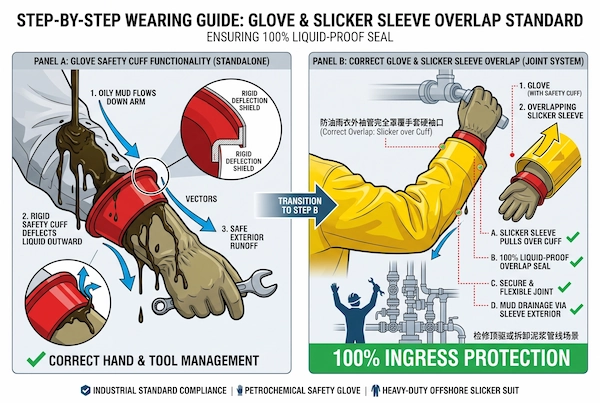
No matter how effective a single piece of PPE may be, without proper layering procedures, leakage hotspots will still form at the seams of the equipment. In offshore mud tank areas, during fracturing flowback and cleaning operations, and when working on deck in severe storm conditions, workers must wear heavy-duty oil- and water-resistant rain suits (Offshore Heavy-Duty Slicker Suits). The layering between the extended safety cuffs and the sleeves of the oil-resistant rain suit directly determines the success or failure of the backflow prevention system:
Strictly follow the “outer garment covers inner sleeve” backflow prevention principle: Offshore drilling safety regulations strictly prohibit tucking the sleeves of the rain suit inside the cuffs of safety gloves. The correct overlapping method is as follows: First, position the extended rigid cuffs of the P-901 or P-902 snugly against the forearm. Then, pull the wide outer sleeves of the oil-resistant raincoat fully downward to tightly wrap and cover the outer side of the glove’s rigid cuffs, forming a natural “top-to-bottom” drainage layer similar to that of architectural roof tiles;
This eliminates blind spots where the sleeve might slip back when raising the arm: If the workstation requires sustained work with the arms and head raised (such as replacing high-level mud valves), use the oil-resistant raincoat’s built-in Velcro straps or elastic drawstrings to secure the outer sleeve of the raincoat tightly around the outer circumference of the glove’s rigid cuff. This mechanical compression not only prevents the raincoat sleeves from sliding down due to gravity and exposing the forearm skin when the worker raises their arms, but also completely seals off any pathways for rebounding mud splashes to flow upward through gaps;
Tiered cleaning procedures before shift handover: At the end of a work shift or before temporarily removing gloves, operators must stand at the anti-splash washing station with their hands hanging naturally at their sides. They must first thoroughly rinse the mud and oil residue from the raincoat cuffs and the outer surfaces of the gloves from top to bottom using clean water or a low-pressure neutral detergent. Only after confirming that no residual chemical solution remains in the gaps may they proceed to remove the protective gear step by step according to protocol, thereby eliminating the risk of secondary skin contamination during removal.
Grip Tribology: Tackling Mud Cakes and Oily Tubular Surfaces
On deepwater drilling rigs and at high-pressure fracturing sites, many serious accidents resulting in severe hand injuries to workers and equipment damage often stem from the most basic physical failure—slip during gripping. The surfaces of various tools and heavy components operated on the drill floor are rarely in an ideal dry, oil-free state; instead, they are perpetually coated with a thick “mud cake” and an oil film composed of a mixture of crude oil fractions, barite powder, and shale debris.
Ordinary chemical-resistant or impact-resistant gloves, if they feature only smooth or lightly foamed rubber surfaces, lose their frictional damping almost instantly upon contact with these fluid interfaces. To ensure that oilfield mud chemical impact gloves maintain robust mechanical grip even when immersed in heavy oil mud, it is essential to address the issue from the fluid dynamics mechanisms of tribology, utilizing microscopic physical irregularities to disrupt the hydrodynamic lubrication state of the oil film. P-901 and P-902 were specifically developed for different types of drilling mud conditions, featuring two high-grip surface treatments: heavy-duty PVC physical particles and a finely ground sand texture.
Micro-Channel Hydrodynamic Lubrication of OBM
To thoroughly resolve slippage and loss of control in drilling mud environments, it is first necessary to analyze the complex hydrodynamic lubrication mechanisms formed by drilling mud on the workpiece surface:
Extreme-pressure lubrication film and hydrodynamic lubrication effects: Oil-based mud (OBM) inherently contains a very high proportion of fatty acid ester-based extreme-pressure anti-wear lubricants to protect the drill bit and reduce downhole torque resistance. When a worker wearing smooth gloves grips the drill pipe wall and applies a normal clamping force, a wedge-shaped micro-gap naturally forms between the rubber surface of the glove and the metal curved surface. The dense oil phase in the drilling fluid rapidly forms a continuous, high-shear-viscosity hydrodynamic lubrication film within this micro-gap, causing the static coefficient of friction at the contact interface to plummet from over 0.7 in the dry state to below 0.1;
The negative effects of “ball-bearing” lubrication caused by fine, heavy solid phases: The circulating drilling fluid contains large amounts of barite powder (barium sulfate) and bentonite particles with an average particle size of only a few micrometers. As the smooth glove surface is compressed and rubbed against the steel pipe surface, these tiny solid particles—enveloped by the dense oil layer—not only fail to provide rough friction but instead act as hundreds of millions of microscopic “ball bearings,” exponentially increasing the risk of the pipe string slipping out of control from the worker’s hands;
Grip Fatigue and Risks Associated with Compensatory Force Application: Due to severe slippage at the interface, workers are forced to significantly increase the grip load on their forearm flexor muscles when gripping slippery drill pipes or operating heavy-duty rotary knobs. This prolonged, compensatory, forceful grip is highly likely to induce finger tendon spasms and grip fatigue; should the drill string suddenly swing, workers would be completely unable to securely control the workpiece under such extreme conditions.
Heavy PVC Particles vs. Sandy Finish Textures
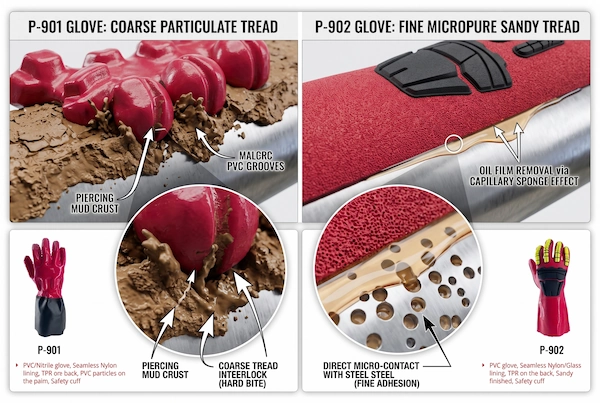
To penetrate this dense fluid-lubricated layer, the P-901 and P-902 employ two completely different microscopic physical damping solutions on the palm and fingertip areas, each tailored to fluid conditions with different physical viscosities:
P-901’s Heavy-Duty PVC Particles (PVC Particles, physical-mechanical coarse interlocking):
Coarse-particle microstructure: Before the palm’s rubber coating cures, P-901 uniformly embeds and firmly fuses three-dimensional particles made of high-hardness modified PVC with large particle diameters;
Mud-Piercing and Direct-Cutting Mechanism: In heavily contaminated conditions—such as at the sand discharge ports of vibrating screens or during casing-in operations—where the environment is filled with clumped mud cakes, drill cuttings, and high-viscosity mud sludge, the macroscopically protruding, hard PVC particles act like anti-slip studs on a shoe sole, directly piercing and penetrating the thick layer of mud paste accumulated on the surface;
Deep-Groove Mud and Debris Discharge Channels: The spaces between the particles form deep physical channels up to several hundred micrometers wide. When pressure is applied with the palm, mud and debris are instantly forced laterally into these channels and fall away under their own weight, while the tops of the particles achieve a rigid, hard-on-hard mechanical interlock with the metal workpiece base, providing exceptional resistance to twisting and slippage;
P-902’s fine sandblasted texture (Sandy Finish, microporous capillary vacuum adsorption):
High-density microporous, rough sponge-like framework: P-902 employs a special microporous salt-precipitation sandblasting curing process to create an extremely dense, sand-like rough cross-section—filled with microscopic sponge-like adsorption pores—on the surface of thick-walled, heavy-duty PVC;
Microchannel capillary transient oil film absorption and expulsion: When encountering low-viscosity but highly permeable fluids such as diesel-based floating oil, crude oil well-flushing fluids, or water-based cutting fluids, the P-902’s dense micro-sandy pores can, through the capillary negative pressure effect, transiently absorb and expel trace lubricating oil films between the glove and smooth metal surfaces;
Elastic gripping that maximizes actual contact area: After draining the localized oil film, the minute elastic peaks on the finely sandblasted surface interlock tightly with the microscopic rough peaks on the smooth cold-rolled metal surface, providing uniform, fine, and extremely stable dynamic anti-slip damping on micro-oil films and wet, slippery tube walls, thereby preventing wobbling and play when gripping precision tools.
Safe Handling of Drill Collars, Tongs, and Mud Agitators
This palm-surface damping system, finely tuned through tribological optimization, has demonstrated irreplaceable safety redundancy in a series of high-risk, heavy-load operational scenarios on offshore drilling platforms:
Aligning single-strand and deep-well drill string sections during tripping operations: During tripping operations, rig workers must frequently reach out to align weighted drill pipes and drill collar joints coated with black drilling mud. Whether dealing with thick-walled pipe strings coated with mud cake (P-901’s coarse-grained grip) or the outer walls of casing coated with thin anti-rust lubricant (P-902’s fine-grained sand-textured adhesion), both glove models help workers stabilize their palms the moment the slippery pipe string begins to sway, enabling them to calmly center and secure the pipe string;
Ultimate anti-slip protection for Manual & Power Tongs handles: When hydraulic tongs clamp down on the drill string threads, recoil and high-frequency vibrations are violently transmitted along the tongs’ mechanical handles. The gloves’ superior static friction damping ensures workers can maintain a secure grip on oil-covered handles without exerting excessive force, eliminating slips and impacts caused by vibration;
Cleaning Mud Tank Agitators and Desilter Piping: When entering enclosed mud storage tanks to inspect agitator impellers, clean cyclone desilter systems, and handle steel wire rope slings coated with thick oil, the gloves not only withstand high-intensity abrasion and mud corrosion, but their tough, textured palms also provide a firm grip on oil-soaked wire ropes and slippery valve handwheels, preventing the risk of falls from heights or falling components caused by accidental contact due to slippery hands.
Technical Matrix: Engineering Profiles of P-901 vs. P-902
When selecting oilfield mud chemical impact gloves for deepwater offshore drilling platforms and onshore high-pressure drilling operations, a “one-size-fits-all” approach must never be adopted. Different drilling processes exhibit significant engineering differences in terms of mechanical impact torque, chemical fluid viscosity, and the sharpness of workpieces.
To provide clear decision-making criteria for drilling rig supervisors (Toolpushers), drilling contractor procurement teams, and on-site EHS engineers, the SQG Industrial Protection Engineering Laboratory conducted comprehensive mechanical and chemical barrier tests on the P-901 and P-902—gloves specifically developed for heavy oil drilling—and performed a cross-comparison with traditional sewn fabric impact-resistant gloves commonly available on the market. While retaining the extended Safety Cuff and high-energy-absorbing TPR exoskeleton, these two heavy-duty gloves precisely address the diverse extreme operating conditions encountered on the front lines of drilling through differentiated polymer matrices, palm textures, and inner lining fiber combinations.
Multi-Parameter E-E-A-T Laboratory Data Matrix
The following quantitative benchmark test data covers key dimensions such as material engineering formulations, impact cushioning, palm friction mechanics, and anti-backflow structures, vividly demonstrating the physical protective advantages of professional-grade, fully liquid-tight impact-resistant equipment in deepwater drilling environments:
| Evaluation Metrics | SQG P-901 (PVC/Nitrile Composite) PNG | SQG P-902 (High-Strength, Heavy-Duty PVC Type) PNG | Traditional Stitched Patchwork Fabric Impact-Resistant Gloves |
| Coating Material and Formulation | Specialty PVC/nitrile composite blend modified rubber layer, offering both flexibility and resistance to hydrocarbon corrosion | Specialty pure-grade, high-polymerization, heavy-duty PVC latex, offering exceptional resistance to crude oil and strong alkali corrosion | A thin layer of nitrile or PU is spot-bonded to the palm area; the remaining areas are made of standard breathable fabric |
| Inner Lining Textile Structure | 13-gauge seamless nylon high-elasticity, comfortable knit lining that conforms to the hand’s shape | 13-gauge seamless nylon + continuous ultra-fine glass fiber high-cut-resistant composite liner | Stitched together using standard woven cotton fabric, low-count polyester fabric, or open-cell composite foam |
| Anti-Slip Friction Treatment on the Palm | Macroscopically raised PVC particles, specifically designed to handle thick, heavy mud cakes | Microporous, dense, sand-textured surface (Sandy Finished), specifically designed to combat thin hydrocarbon lubricant films | Smooth foamed nitrile, standard adhesive-coated, or synthetic leather palms; prone to slipping when exposed to oil |
| Impact Resistance System on the Back of the Hand | Fully molded TPR shock-absorbing exoskeleton covering the back of the hand and all finger joints | Large-area, segmented, articulated, high-thickness TPR shock-absorbing armor, designed for ergonomic comfort | Localized ultra-thin sewn-in foamed EVA blocks or thin adhesive strips applied externally; extremely low energy absorption and cushioning |
| Cuff Structure and Anti-Backflow Design | Black, extended, wide-mouth safety cuff with physical rigidity for drainage | Extended, wide-mouth safety cuffs in matching color, featuring wide-angle quick-release design | Short Velcro fasteners, elastic cuffs, or standard low-count knitted ribbed cuffs |
| Full Liquid Tightness and Leak-Proof Integrity | 100% continuous, seamless, and pinhole-free liquid-tight barrier with molecular-level high-frequency heat-sealed bonding | 100% continuous, seamless, pinhole-free, liquid-tight barrier with molecular-level high-frequency heat-sealed bonding | Serious defects: Dense needle holes from stitching allow slurry to seep through the seams within minutes |
| Shear Resistance and Mechanical Cut Resistance | Provides basic protection against mechanical abrasion and tear resistance | Advanced cut resistance effectively blocks pipe thread burrs and flying wire rope fragments | Extremely prone to tearing when snagged by metal burrs; fabric has poor shear resistance and low tear toughness |
| Typical Applications in Deep-Well Field Operations | Suitable for handling single-strand cables on drill rig catwalks, cleaning sand and gravel from vibrating screens, and maintenance in high-viscosity mud tank areas | Suitable for pipe rack column loading/unloading, heavy-duty oil-based mud pump room maintenance, and trapping operations during drilling and tripping | Suitable only for handling warehouse tools and routine equipment inspections on dry, oil-free surfaces |
Enhanced Cut Defense with Glass Fiber Reinforcement
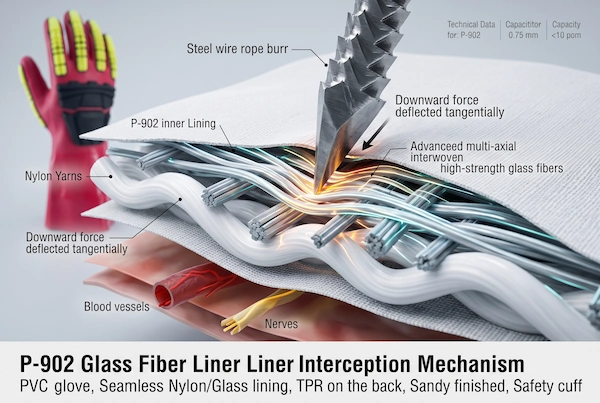
Near the drill floor, the drill string box, and the pipe-handling machine tracks, operators are not only exposed to mud splashes and heavy impact loads, but are also constantly surrounded by extremely sharp metal edges. The threaded shoulders of drill pipe joints damaged by frequent impacts during tripping operations, short sections of tubing with sharp metal burrs, and steel wires on winch drums that have frayed and developed jagged edges due to excessive stress (commonly known as “barbs”) all act like miniature blades and can easily cut through gloves.
In developing the P-902 lining, the focus was on enhancing microstructural shear resistance through a multi-axis twisted blend of seamless nylon and ultra-fine industrial-grade continuous glass fibers (Glass Fiber):
A micro-scale shear-resistant framework combining rigidity and flexibility: High-strength, high-toughness nylon filaments provide excellent tensile elongation and a comfortable, skin-friendly feel, while ultra-fine glass fiber microfibers embedded within the yarn structure form a high-hardness, rigid barrier. Glass fiber possesses an extremely high Young’s modulus and surface hardness; when metal spikes or threaded burrs cut into the outer PVC sheath, they first encounter the barrier of the glass fiber’s hard core;
Blunting the blade and dispersing concentrated shear energy: The micron-sized glass fibers, upon coming into contact with the blade under pressure, force minute wire rope burrs to undergo slight slippage along the tangential direction of the fibers, thereby dispersing localized normal stress and effectively preventing the risk of individual fibers being severed in a single cut;
Deep-layer protection for workers’ blood vessels and tendons: On work surfaces covered with oil-based mud, many metal lacerations are extremely difficult to detect—workers often suffer counter-cuts from sharp edges only when they grip violently with their palms as the pipe string slips out of control. The P-902’s glass-fiber-reinforced composite liner establishes a mechanical defense barrier with a high margin of safety for the palm and back of the hand. Even if the thick-walled external PVC coating is forcibly cut open by external forces under extreme heavy-duty loads, the tough internal glass-fiber microstructure remains capable of holding the line, preventing wounds from penetrating deep enough to reach the blood vessels and nerves in the palm and fingers.
Drill Rig Field Protocols: Deployment, Decontamination & TCO
At deepwater drilling platforms and high-pressure oil and gas extraction sites, procurement decisions for hand protection equipment often fall into the narrow trap of simply comparing “single or double initial purchase unit prices.” However, for mobile offshore drilling units (MODUs), where daily rental rates can easily reach hundreds of thousands of dollars, any unexpected accident caused by hand protection failure will result in downtime losses, medical evacuation costs, and compliance penalties that can erode operating profits by tens or even hundreds of times the initial cost.
To ensure that oilfield mud chemical impact gloves truly deliver on their investment value as industrial safety assets, offshore oilfield service companies and drilling supervisors must establish a set of standard operating procedures (SOPs) that cover both “on-site decontamination and maintenance” and “Total Cost of Ownership (TCO) accounting.” By implementing standardized on-site decontamination and maintenance procedures to slow polymer aging, and by systematically replacing low-quality gloves—which are prone to frequent wear and tear and pose significant safety hazards—with high-abrasion-resistant, impact- and chemical-resistant gloves designed for extended shift durations, companies can achieve significant improvements in safety and operational efficiency.
Offshore Rig Decontamination and Mud Washdown
The offshore drilling environment is characterized by a combination of high-concentration marine salt fog, intense UV exposure, and heavy oil-based mud coverage. The maintenance and care of gloves after a shift directly determine their physical service life:
It is strictly prohibited to soak and clean gloves indiscriminately with strong organic solvents: Many drillers are in the habit of using on-site diesel, toluene thinner, or strong trichloroethylene degreasers to clean thick oil residue from the surface of their gloves at the end of their shift. These strong solvents and chlorinated hydrocarbon cleaners rapidly degrade the heavy-duty PVC and PVC/nitrile rubber layers on the glove’s exterior, forcibly extracting the polymer polyester plasticizer system from within the rubber matrix. This causes the originally flexible gloves to harden, become brittle, and crack within just a few days, with the surface blistering and even the TPR exoskeleton interface delaminating and cracking;
Standardized low-pressure neutral surface cleaning procedure: On-site standard cleaning SOPs require operators to wear gloves and use lukewarm water below 40°C or room-temperature fresh water at the blowout prevention rinse station, combined with industrial-grade neutral surfactants (degreasing cleaners with a pH of 6.5 to 8.0) for mechanical scrubbing and rinsing. Neutral degreasing agents can quickly emulsify and remove barite powder, crude oil fractions, and mud cake adhering to the glove surface; residual foam should then be thoroughly rinsed away with clean water at low to medium pressure;
Avoid drying near high-heat sources or natural air-drying in deep-sea environments with high salt fog: After rinsing, gloves should be hung on a dedicated drying rack in a well-ventilated, cool area of the drilling rig changing room. It is strictly prohibited to place them directly on high-temperature mud heating pipes, steam radiators, or high-temperature exhaust pipes in the engine room for direct drying, to prevent high temperatures from causing irreversible thermal-oxidative degradation of the PVC resin’s molecular chains and deformation.
Shift Longevity vs. High Downtime Incidents
From a macro perspective of financial and risk compliance, the return on investment (ROI) of heavy-duty, fully liquid-tight, impact-resistant gloves is primarily reflected in two aspects: a significant reduction in the probability of catastrophic downtime incidents and a decrease in the frequency of glove issuance on-site:
The enormous downtime costs associated with a single severe hand injury: At deepwater well sites located dozens of nautical miles offshore, should a crushing injury from a stuck pipe result in a comminuted fracture of a finger bone or should mud backflow cause acute, severe chemical dermatitis, the platform must immediately initiate an emergency medical evacuation (Medevac) by helicopter. When combined with the subsequent on-site safety debriefings, shutdowns for rectification, third-party regulatory audits, and costly overseas commercial insurance claims, the total indirect losses from a single incident often range from $100,000 to $500,000;
Extended shift durability reduces per-shift consumption costs: Traditional patchwork fabric impact-resistant gloves, when exposed to oil-based mud and friction against rough pipe walls, typically last only 1 to 2 work shifts (12 to 24 hours) before becoming saturated with oil or tearing, forcing them to be discarded; workers must frequently request new batches; In contrast, the P-901 and P-902 models—featuring a 100% continuous, fully liquid-tight PVC shell and a thick TPR exoskeleton—have been tested to provide continuous service for 2 to 3 weeks or more in the harsh environments of mud vibrating screens and single-pipe connection workstations, directly reducing annualized total glove consumption by over 60%;
A fundamental reversal in the comprehensive TCO model: Even though the unit purchase cost of heavy-duty chemical-resistant and impact-resistant gloves is slightly higher than that of ordinary lightweight gloves, their exceptional physical wear resistance, guaranteed zero liquid leakage, and virtually eliminated risk of back-of-hand impact injuries save a single medium-sized drilling fleet tens of thousands of dollars annually in PPE expenses and accident risk reserves, delivering robust TCO benefits characterized by “moderate upfront procurement cost increases, a dramatic drop in back-end comprehensive operational and maintenance costs.”
Lightweight Liner Integration for Auxiliary Rig Operations
Although the P-901 and P-902 perform exceptionally well in high-risk areas subject to extreme mechanical impact—such as wellhead large-jaw operations, riser handling, and heavy-mud tank pits—there are still numerous auxiliary workstations within the vast engineering and operational systems of deepwater platforms and onshore oilfields that do not require high-level impact protection but demand extremely high standards for fingertip tactile sensitivity, breathability, and fine-level cut resistance.
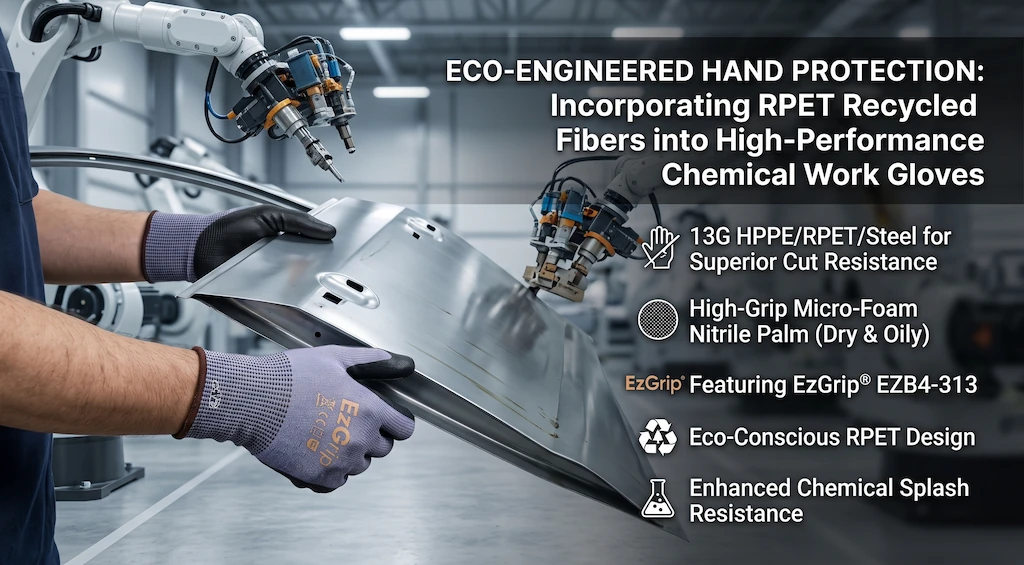
In workstations such as drilling fluid laboratory mud parameter titration and comparison, digital sensor circuit maintenance, high-density valve and pipe fitting assembly, and the sorting of hardware tools in offshore storage facilities, overly thick and heavy impact-resistant exoskeletons can actually limit the agility of hand movements. For these oil and gas support scenarios—which involve no heavy impacts but are subject to frequent cuts from sharp edges on thin metal sheets and require digital touchscreen operations—we recommend downsizing protective gear precisely by selecting the lightweight benchmark model: the EzGrip® EZB4-313 Cut-Resistant Glove, which utilizes GRS-certified eco-friendly fibers and features a micro-woven layer of austenitic stainless steel wire. By establishing a tiered configuration matrix—“heavy-duty chemical and impact protection for high-risk wellhead zones + lightweight, high-cut-resistance protection for auxiliary electromechanical zones”—we comprehensively address both personal safety and operational efficiency across the entire drilling crew’s work area.
Technical FAQ: Oilfield Mud and Impact Hand Protection
On deepwater drilling rigs, in onshore deep-well drilling operations, and at complex reservoir fracturing sites, frontline process engineers, mud supervisors, and on-site EHS specialists often raise a series of detailed questions directly related to real-world engineering scenarios when evaluating and procuring oilfield mud chemical impact gloves.
On-site concerns often center on specific failure mechanisms under extreme operating conditions: why traditional gloves fail to prevent mud penetration, how to choose between two different palm textures during actual operations, whether extended rigid safety cuffs restrict wrist flexibility, and whether heavy rubber shells become brittle and stiff in extremely cold conditions. This section provides an in-depth analysis of these frequently asked technical questions based on real-world materials testing and feedback from frontline oilfield wearers.
Can oil-based drilling mud penetrate standard impact gloves with stitched TPR backs?
Yes, and the penetration rate far exceeds the expectations of many safety managers. Many on-site procurement personnel mistakenly believe that as long as the back of the hand features a thick TPR impact-resistant strip, the gloves can provide both impact protection and resistance to oil and chemicals. This misconception blurs the physical distinction between mechanical impact protection and fluid barrier performance:
Liquid penetration caused by pinholes: Traditional mechanical impact-resistant gloves typically use high-strength nylon thread to sew the TPR exoskeleton onto the back fabric. During the sewing process, the steel needles leave tens of thousands of microscopic pinholes visible to the naked eye on the glove’s surface;
Capillary siphoning through the woven base fabric: The back of the hand and side seams of these gloves often use breathable blended stretch fabrics with extremely high porosity. When exposed to low-surface-tension oil-based mud (OBM) or diesel-based emulsions, the liquid does not roll off the surface but instead creates a strong capillary siphoning effect within the fiber pores and stitching pinholes, completely penetrating to the underlying fabric within just 3 to 5 minutes;
Absolute Fluid Barrier of the Seamless Dip-Coated Shell: The P-901 and P-902 utilize a specialized heavy-duty dip-coating process, resulting in a seamless, dense polymer membrane that forms the entire glove shell. Furthermore, the TPR exoskeleton on the back of the hand is entirely bonded using high-frequency, molecular-level thermal and sonic bonding, ensuring the glove surface is free of any stitching or needle holes. This one-piece, pore-free structure physically severs all capillary pathways for mud and harmful solvents, achieving true 100% continuous fluid barrier protection.
What is the operational difference between the PVC particles on the P-901 and the sandy finish on the P-902?
The physical PVC particles on the P-901 and the microporous sandblasted texture on the P-902 are designed for mud conditions with different physical states and viscosities; the two have distinct roles in terms of interfacial tribology:
P-901’s heavy-duty PVC particles (physical coarse interlocking and debris removal):
Primary applications: High-viscosity heavy mud, areas with accumulated cuttings and debris (such as vibrating screen cleaning, debris removal from sand discharge chutes, and single-pipe connections at catwalks);
Mechanism of Action: The macroscopically protruding and hard PVC particles possess excellent “mud-breaking” capabilities, able to directly penetrate dried mud clumps and viscous mud cakes adhering to the pipe wall. The tips of the particles grip the metal substrate directly, while the wide grooves between the particles channel the thick, compressed mud residue outward, preventing the palm from “skimming” or slipping on thick, heavy mud paste;
P-902’s Fine-Grain Textured Surface (Capillary Suction and Oil-Repellent Film):
Primary Applications: Low-viscosity, high-permeability hydrocarbon fluids, diluted crude oil, water/brine drilling fluids, or smooth casing surfaces with an extreme-pressure oil film;
Mechanism of Action: A microscopic, dense sand-like surface formed through a microporous salting-out process is covered with minute pits. When pressed against a wet, slippery metal surface, these pits rapidly draw in and absorb trace amounts of the liquid film at the contact interface via capillary action, disrupting the fluid lubrication state. The microscopic elastic peaks then directly interlock with the rough metal surface, providing fine, uniform, and high-damping anti-slip friction under conditions of minimal oil and moisture.
Does the extended Safety Cuff restrict wrist movement during high-tempo pipe tripping?
No. During fast-paced operations such as tripping in and out of the well on modern drilling rigs, workers’ wrists must frequently undergo wide-angle bending, rotation, and pushing and pulling motions. The large-diameter, extended Safety Cuffs featured on the P-901 and P-902 models are specifically designed with structural mechanical clearance to allow for full range of motion:
The wide-angle, funnel-shaped cut allows for joint freedom: rather than being a straight tube that fits snugly against the wrist and forearm, the cuff features a rigid, conical structure that naturally flares outward from the styloid process of the ulna. This design creates ample circular space for movement between the wrist and the inner wall of the glove, allowing workers to freely flex and extend their wrists by up to ±75 degrees and perform radial rotation—even when gripping large pliers or vigorously turning a handwheel—without causing jamming or localized compression;
Prevents glove sagging, deformation, and bunching: Traditional elongated soft rubber gloves are highly prone to forming permanent fabric creases at the wrist when bent, causing the glove to sag downward. This not only compresses the median nerve but also hinders finger movement; in contrast, the safety hard cuff is self-supporting and possesses excellent axial rigidity, maintaining a three-dimensional, open shape at all times to ensure unrestricted forearm movement;
Rapid blind removal for emergency escape in sudden entanglement hazards: The wide, rigid cuff design creates a vital emergency escape route. If the hand is accidentally caught and pulled by machinery—such as on a turntable clamp or in a blind spot of a catwalk steel cable—the rigid, wide cuff allows the worker to immediately utilize the instinctive motion of leaning backward to smoothly and quickly withdraw the hand from the glove with one hand, effectively preventing hand entanglement in rotating equipment and avoiding accidents resulting in disability.
How do sub-zero offshore winter temperatures affect the flexibility of heavy PVC armor?
In standard industrial gloves that have not undergone cold-resistant modification, polyvinyl chloride (PVC) material is highly prone to rapid hardening when ambient temperatures drop below 5°C to 0°C. As temperatures continue to fall below its glass transition temperature (Tg), the polymer backbone segments freeze completely, causing the material to become as brittle as glass; even a slight bending of the fingers by a worker can cause the rubber layer to crack along the crease.
To ensure that heavy-duty chemical-resistant and impact-resistant gloves can perform reliably in harsh cold-water conditions—such as at polar oil fields, in high-latitude deep-sea environments during winter, or at night—the materials engineering team implemented dual technical safeguards at the formulation level:
Cross-linking with ultra-low-temperature composite cold-resistant plasticizers: Replacing conventional phthalate-based additives with a specialized low-temperature plasticizing system composed of di-octyl esters of dicarboxylic acids and polyesters, which feature low freezing points and high cold resistance. These long-chain ester molecules possess extremely low intermolecular friction resistance, enabling them to penetrate deeply between PVC macromolecular chains, forcibly widening the intermolecular spacing, and significantly lowering the rubber layer’s critical point for cold-induced embrittlement (glass transition temperature) to below –20°C;
PVC/Nitrile (NBR) Elastomer Microphase Blending: Composite blending systems, represented by P-901, introduce microemulsified nitrile rubber components—which inherently possess excellent low-temperature fatigue resistance—into the matrix. The nitrile network acts as cold-resistant microsprings within the microstructure. Even during deck operations involving splashing from icy seawater or in blizzard conditions, the gloves maintain a supple, snug, and flexible feel—neither becoming stiff and restrictive nor causing the surface rubber layer to crack or peel off when subjected to heavy mechanical impacts at low temperatures.
Enhancing Rig Safety with Heavy-Duty Oilfield Armor (CTA)
In the extremely harsh environments of offshore deepwater drilling platforms, jack-up drilling vessels, and high-pressure oil and gas fracturing sites, any upgrade to personal protective equipment (PPE) designed to safeguard frontline workers and prevent lost-time injuries (LTIs) must not rely solely on technical agreements on paper or static observations in a laboratory setting.
Chemical resistance, oil resistance, and impact absorption on the back of the hand under real-world operating conditions must withstand the violent impacts of single-tubing-run clamps on the rotary table, continuous immersion in high-concentration oil-based mud (OBM), and the severe abrasive testing involved in cleaning high-viscosity cuttings from vibrating screens and desanders. As a leading manufacturer specializing in heavy-duty industrial protective equipment and specialized dipping processes, SQG leverages fully automated continuous dipping production lines and high-frequency molecular hot-melt technology to provide global offshore drilling contractors, international oilfield service giants, and multinational occupational safety and health system integrators with an industrial-grade, one-stop supply chain solution—ranging from real-world wellsite performance testing and customized reflective safety markings to direct container-load procurement at global hub ports.
Request Offshore Rig Crew Evaluation Trial Kits
If your drilling fleet or onshore drilling crews are currently facing issues such as rapid mud penetration through traditional surface-worn gloves, frequent alkaline chemical burns among workers, or the risk of crush injuries and fractures caused by delaminated or cracked impact-resistant rubber strips, we recommend immediately initiating targeted on-site wear evaluations at high-risk workstations such as the drill floor, wellhead box, and mud pump room:
Targeted, factory-direct test kits: SQG provides exclusive on-site engineering test kits for deepwater drilling supervisors (Toolpushers), platform safety officers, and oilfield service procurement departments. The sample kits are fully stocked with a complete size range of P-901 (PVC/nitrile composite blend) and P-902 (high-strength, pure-grade heavy-duty PVC with fiberglass liner) heavy-duty protective gloves;
They come with a full set of authoritative third-party testing and certification documents: The kit includes mechanical and chemical barrier test reports issued by authoritative laboratories, covering comprehensive ANSI/ISEA 138 back-of-hand impact protection certification, EN 388:2016 mechanical hazard protection reports, EN ISO 374-1 permeation test records for typical petroleum hydrocarbons and strong alkali chemicals, as well as detailed low-temperature flex fatigue decay curves;
Standard “Drilling Rig Workstation Hand Protection Comprehensive Evaluation Form”: Assists wellsite EHS teams and on-site shift foremen in accurately recording, over a continuous 168-hour period (one full operational shift cycle), the gloves’ slip resistance and grip damping in diesel-based mud, practical feedback on the TPR cushioning on the back of the hand, the anti-backflow performance of the extended safety hard cuffs, and worker comfort—using real-world frontline data to drive scientifically informed procurement decisions.
Container-Scale Sourcing & Custom Petrochemical Specifications
For global oilfield service and production groups and industrial product distributors seeking stable, bulk supply, streamlining intermediary markups, and strictly controlling the total cost of ownership (TCO) of their supply chains, partnering directly with source factories that integrate on-site dipping, weaving, and molding capabilities is the optimal solution for ensuring product consistency, timely supply, and profit margins:
Industrial-scale automated production capacity and strict batch uniformity: SQG operates large-scale, fully automated heavy-duty chemical-resistant dipping lines and servo-controlled temperature-regulated hot-melt workshops. From precision degassing of high-purity PVC slurry and shear blending of PVC/nitrile composite latex to high-frequency, molecular-level, pore-free hot-melt welding of TPR shock-absorbing exoskeletons, the entire process undergoes rigorous airtightness leak testing and batch-based tensile strength spot checks, eliminating defects common in traditionally hand-vulcanized gloves—such as liquid leakage, uneven thickness, and delamination;
Efficient direct container shipping to major global oil and gas hub ports: Deeply aligned with high-density pallet loading solutions for maritime containers (20GP / 40HQ), products are widely shipped to major offshore drilling supply hubs such as Houston, Aberdeen, Rotterdam, Dubai, Singapore, and West Africa, significantly reducing the transnational trunk shipping and customs clearance logistics costs for single- and double-layer work equipment;
Highly customized configurations tailored for the oil and mining industries: A comprehensive range of high-level OEM/ODM customization options is available. We support drilling service companies in customizing vibrant, high-visibility fluorescent color schemes (high-brightness fluorescent yellow/high-visibility orange), adding ink screen-printed or oil-resistant embossed corporate logos to the extended safety hard cuffs, and installing 3M high-grade reflective strips on the back of the hand—significantly enhancing workers’ visual recognition and collaborative safety during nighttime operations on stormy decks and in dimly lit mud tank areas.
Please feel free to contact our oil and gas industry safety engineering experts at any time to assess the chemical and physical composite risk levels for your specific operating conditions and to request a factory-customized test kit: Request an Oilfield Hand Armor Trial Pack.