

Introduction: Why EN 388 Abrasion and Grip Metrics Drive Glove Performance
When evaluating EN 388 nitrile gloves for industrial PPE procurement and EHS audits, relying solely on subjective wearer comfort is a common mistake. In reality, the true performance of a pair of gloves under complex and heavy-duty conditions depends entirely on objective data regarding their physical and mechanical properties. The EN 388 abrasion resistance and grip metrics are the two decisive cornerstones for establishing scientific safety standards and evaluating the true lifecycle of gloves.
Balancing Durability with Tactile Control in Heavy-Duty Workstations
In heavy-duty workstations—such as those used in sheet metal stamping, heavy machinery manufacturing, and high-intensity metal handling—safety management faces an inherent trade-off at the physical level.
While traditional, heavy-duty gloves can withstand frequent friction and cutting, they severely compromise workers’ fingertip sensation and the dexterity of bare hands (tactile control), making it difficult to grasp small components, slowing tool operation, and even leading to frequent assembly errors. On the other hand, gloves that are too thin are prone to rapid coating damage from scraping against rough metal edges. The core technological challenge for modern high-performance industrial gloves lies in achieving a perfect balance between rigorous physical durability and ultimate control precision through scientifically engineered polymer coating structures.
The Cost of Premature Wear and Slip-Induced Workplace Accidents
Neglecting core physical testing metrics will directly drive up hidden operating costs in manufacturing facilities.
Premature wear of glove coatings not only leads to a sharp rise in PPE replacement rates and waste disposal costs but also creates highly destructive safety vulnerabilities. When gloves fail to provide the required surface coefficient of friction in oily or slippery conditions, tools are likely to slip from the user’s hands or heavy components may fall. These slip-induced accidents can result in anything from the scrapping of high-value materials and production line downtime to severe worker injuries such as being run over or cut, leading to costly claims and compliance penalties.
Scope & Pillar Page Integration
This technical guide goes beyond basic product aesthetics to provide an in-depth breakdown of the laboratory testing logic behind the European EN 388 mechanical risk standard. We will quantitatively analyze the grading thresholds of the Martindale abrasion test and systematically explain the physical oil-repellency mechanisms of foamed and textured nitrile in extremely oily environments.
Whether you are seeking long-lasting protective solutions for high-frequency assembly lines or configuring high-grip equipment for heavy-oil metalworking stations, we recommend that you first consult our core selection matrix Nitrile-Coated Industrial Safety Gloves before delving into the in-depth test data in this article. This will help you establish a comprehensive framework for understanding coatings, enabling you to better utilize this testing guide to make precise EHS procurement decisions for your workshop.
EN 388 Abrasion Resistance Testing: Methodology and Rating Levels
Within the European standard EN 388:2016+A1:2018 framework, abrasion resistance is the primary core dimension for evaluating the mechanical strength of protective gloves. Understanding the actual testing principles and data grading used in laboratories can help EHS and procurement teams avoid being misled by manufacturers’ marketing claims and assess the actual durability limits of gloves based on objective physical data.
The Martindale Abrasion Tester: Sandpaper Cycles and Breakthrough Thresholds
The abrasion resistance rating of gloves is rigorously determined using a standard Martindale Abrasion Tester in a controlled laboratory environment.
During the test, technicians cut a circular specimen from the palm area of the glove and secure it to the test head. Under a preset constant pressure (9 kPa), the test head drives the specimen to perform multi-directional cyclic friction along a Lissajous pattern on the surface of standard sandpaper (Klingspoor PL31B, 180-grit).
Breakthrough Thresholds: The tester continuously records the number of friction cycles until the glove’s coating is completely worn through, exposing the internal knitted liner. The number of friction cycles at the moment of this physical failure is defined as the glove’s “breakthrough threshold.”
Multi-dimensional Testing Standards: To eliminate errors caused by uneven coating thickness, the test must be conducted in parallel on multiple independent samples of the same glove model, and the lowest test result is used as the basis for final certification.
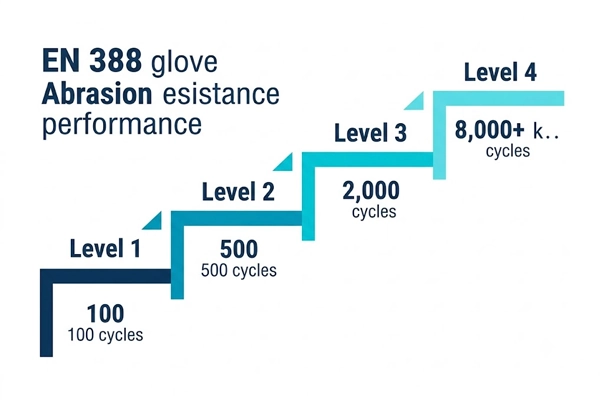
EN 388 Performance Level Breakdown: Level 1 (500 Cycles) to Level 4 (8,000 Cycles)
Based on the cycle thresholds measured during testing, the EN 388 standard clearly classifies glove abrasion resistance into four levels (Level 1–Level 4):
Level 1 (100 revolutions or more): Basic, lightweight protection. Suitable for light-duty electronic component handling tasks involving extremely low friction and infrequent contact.
Level 2 (500 revolutions or more): Protection against low-to-moderate wear. Commonly used in general warehouse logistics sorting and light material handling.
Level 3 (2,000 revolutions or more): Industrial-grade, high-performance abrasion resistance. Widely used in automotive parts assembly, machining of mechanical components, and general manufacturing workstations.
Level 4 (8,000 revolutions or more): The highest level of physical abrasion resistance. Specifically designed for extreme high-frequency friction environments such as heavy-duty metal stamping, handling of castings, and high-wear machining.
In practical workshop procurement, the numerical differences between grades follow a non-linear, multiplicative increase. The leap from Level 3’s 2,000 revolutions to Level 4’s 8,000 revolutions means that when gloves are subjected to continuous scraping against metal burrs and rough surfaces, the coating offers more than four times the physical service life.
Polymer Cross-Linking Density and Vulcanization Chemistry
The fundamental reason why the glove coating can withstand the grueling test of 8,000 revolutions lies in the breakthroughs in the microscopic chemical structure of its polymer material.
During the dip-molding and high-temperature vulcanization processes, synthetic nitrile rubber (NBR) coatings form a dense covalent cross-linked network between molecular chains. The higher the cross-linking density, the stronger the rubber’s three-dimensional network structure becomes in resisting mechanical shear forces and physical abrasion.
As analyzed in our in-depth Nitrile Coated vs. Polyurethane (PU) Gloves White Paper, standard polyurethane (PU) coatings primarily rely on weak hydrogen bonds between polymer segments; as a result, they are prone to polymer chain breakage and peeling when exposed to heat generated by friction or even trace amounts of oil contamination; In contrast, synthetic nitrile rubber with a high cross-linking density can maintain a stable three-dimensional network structure, endowing the gloves with exceptional abrasion resistance.
Understanding Grip Performance: Physical Mechanics and Testing Protocols
The grip performance of gloves is not a single static property, but rather the result of the combined effects of physical surface science and contact surface fluid dynamics. In industrial settings, the strength of surface grip directly determines workers’ stability and precision when handling tools. A thorough understanding of the physical oil-repellency and anti-slip mechanisms of gloves under different environmental conditions is a prerequisite for EHS departments to make scientifically informed product selections.
Coefficient of Friction (CoF) Dynamics in Dry, Micro-Oily, and Wet Conditions
In physics, the magnitude of grip force depends on the coefficient of friction (CoF) at the contact surface. In practical use, industrial gloves face three distinctly different interface conditions:
Dry Conditions: The rubber or plastic matrix of the glove comes into direct contact with clean metal or plastic; the elastic deformation of the polymer material itself and surface damping determine the baseline CoF value.
Micro-Oily Conditions: Component surfaces are coated with an extremely thin layer of rust-preventive oil or cutting fluid. The oil film acts as a “liquid lubricant,” separating the solid interfaces that would otherwise be in direct contact, causing a precipitous drop in CoF and resulting in slippage.
Wet & Heavy Oil Conditions: When encountering high-viscosity gearbox oil, engine oil, or spilled coolant, the fluid not only forms a lubricating film but also generates high viscous resistance, posing an extreme challenge to the glove’s physical grip.
Laboratories typically use dynamic and static friction testers to measure the maximum slip force of gloves when gripping oil-coated steel rods or plates, thereby accurately calculating CoF data for different coatings under various media conditions.
Open-Cell Micro-Foam vs. Rough Sandy Nitrile: Displacement Mechanics
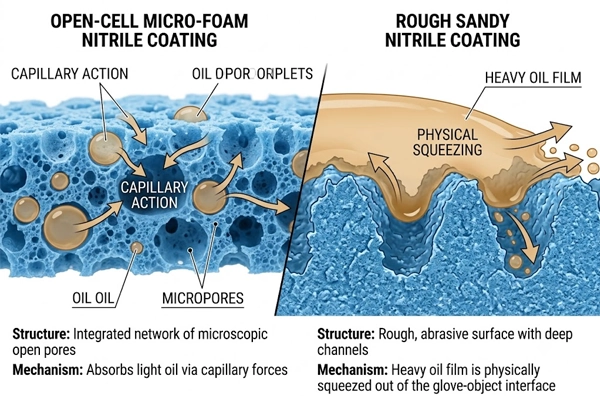
To restore high friction coefficients in oily and slippery environments, industrial gloves employ two completely different physical surface modification techniques: open-cell micro-foam and rough sandy nitrile.
Capillary adsorption mechanism of open-cell micro-foam: By introducing uniform open-cell micropores during the nitrile molding process, the coating surface takes on a sponge-like texture. Upon contact with oil-coated components, the micropores rapidly draw the trace oil film at the interface into the coating via capillary action, displacing the liquid and allowing the rubber-plastic matrix to come into direct contact with the component surface, thereby achieving a robust grip in both dry and lightly oiled conditions.
Fluid-Drainage Mechanism of the Sandy Nitrile Surface: The Sandy Nitrile coating utilizes a particle suspension process to create a rough, sandpaper-like textured surface. When gripping parts covered in heavy oil or spilled liquids, the high-density, uneven grooves—much like tire treads—rapidly squeeze and displace (Fluid Displacement) the thick oil film from the contact surface the moment pressure is applied, using the hard protrusions to directly interlock with the metal substrate.
Synergy Between Chemical Resistance and Grip: As explained in The Chemical Resistance of Nitrile Coatings: Protecting Hands Against Oils and Solvents oil resistance guide, regardless of whether a foamed or matte finish is used, the underlying nitrile matrix must possess extremely strong resistance to swelling to ensure that the coating’s physical structure does not soften and its microporous structure does not collapse upon contact with heavy oils and solvents, thereby consistently and stably delivering high friction and grip.
EN 388 Abrasion & Grip Technical Benchmark Matrix
To help EHS departments and procurement teams translate complex laboratory test data into intuitive procurement decisions, the table below establishes an allocation matrix that maps EN 388 abrasion resistance ratings, physical test thresholds, coating processes, and specific factory operating conditions.
Comprehensive Performance Benchmark & Coating Selection Table
| EN 388 Abrasion Level | Martindale Cycle Threshold | Coating Technology | Target Workstation Hazard | Recommended Sourcing / EHS Profile |
| Level 1 – Level 2 | 500–2,000 Cycles | Standard PU / Smooth Nitrile | Light assembly, low friction | Standard configuration for low-wear workstations; not suitable for heavy oil or frequent scraping. |
| Level 3 | 2,000–8,000 Cycles | Micro-Foam Nitrile | Electronics, automotive assembly | Combines lightweight flexibility with wear resistance; suitable for use in low-oil environments. |
| Level 4 (Highest) | 8,000+ Cycles | Micro-Foam / Sandy Nitrile | Metal stamping, machinery, heavy oil | Highest level of wear resistance, significantly extending service life under high-intensity friction. |
| Level 4 + Impact | 8,000+ Cycles + TPR Back | Double-Dipped Sandy Nitrile | Heavy rigging, oil & gas, demolition | Combines maximum wear resistance, grip, cut resistance, and protection against heavy objects striking the back. |
Key Takeaways for Procurement Audits
When conducting on-site PPE procurement audits and factory assessments, the matrix above can be used to derive the following three practical guidelines:
Avoid focusing solely on unit price; calculate TCO based on abrasion resistance cycles: Although the unit price of Level 4 abrasion-resistant gloves is higher than that of Level 2 models, their number of abrasion cycles is 4 to 16 times that of the latter. At stamping and high-frequency machining stations, using Level 4 gloves can significantly reduce glove replacement rates, leading to substantial cost savings and efficiency gains when calculated in terms of total cost of ownership (TCO).
Grip Technology Must Match the Medium Type: At lightly oiled and dry assembly stations, prioritize micro-foam-coated gloves to preserve fingertip sensitivity; whereas at stations with heavy oil spills, or those handling oily gears and castings, it is essential to upgrade to sandy nitrile or double-dipped gloves, which utilize physical oil-drainage grooves to prevent slippage.
Addressing Combined Workstation Risks: As discussed in our automotive selection guide, Best Nitrile Coated Work Gloves for Automotive and Precision Assembly Operations, for complex work environments involving risks of metal burrs and heavy-object impacts, focusing solely on abrasion resistance is insufficient. It is essential to use comprehensive protective equipment that meets the highest abrasion resistance rating under EN 388 and features TPR back-of-hand impact protection.
High-Cut Defense Meets EN 388 Level 4 Abrasion Resistance
In heavy machinery manufacturing, automotive sheet metal stamping, and glass/metal sheet processing workshops, workers often face the dual threats of “high risk of cuts” and “frequent mechanical friction.” This requires gloves that not only achieve the highest Level 4 rating in the EN 388 abrasion test (a breakthrough threshold of over 8,000 revolutions) but also provide a high-level cut-resistant barrier (ISO 13997 Cut Level F / ANSI Cut Level A7) when exposed to extremely sharp sheet metal burrs, flash, or cutting tools.
Integrating TekArmor® A7/F High-Cut Liners with Nitrile Coatings
The deep integration of high-performance cut-resistant fibers with high-performance nitrile coatings is the technological core of creating composite heavy-duty protective gear.
Traditional cut-resistant gloves, in pursuit of high cut resistance ratings, often use coarse, bulky steel-fiber blended liners, resulting in stiff gloves with insufficient abrasion resistance; conversely, ordinary abrasion-resistant gloves are as fragile as paper when faced with sharp edges.
Ultra-High Physical Protection Density: Using 18-gauge ultra-fine seamless knitting technology, the patented TekArmor® A7/F high-strength cut-resistant fibers are woven into a high-density protective mesh. This allows the gloves to achieve the top-tier ISO Cut Level F standard while maintaining a slim, form-fitting design and exceptional flexibility.
Synergistic Enhancement of Physical Properties: By combining the cut-resistant TekArmor® lining with a highly cross-linked nitrile coating, the rubber-plastic coating on the outer layer resists frequent abrasion (meeting the highest abrasion resistance standard of EN 388 Level 4), while the high-strength fibers inside block cutting and shearing forces, perfectly achieving the combined effect of “abrasion resistance + cut resistance.”
Reinforcing High-Wear Zones: The Thumb Crotch Advantage
The thumb crotch is the “primary danger zone” where industrial gloves are most prone to premature failure, wear, and tear during actual use.
When gripping heavy sheet metal, pipes, or handling oil-coated components, the edges of these materials repeatedly subject the thumb crotch area to extremely intense friction and shear forces. In many cases, the palm coating of standard gloves remains intact, but the knitted seams at the thumb crotch have worn through, resulting in premature glove failure.
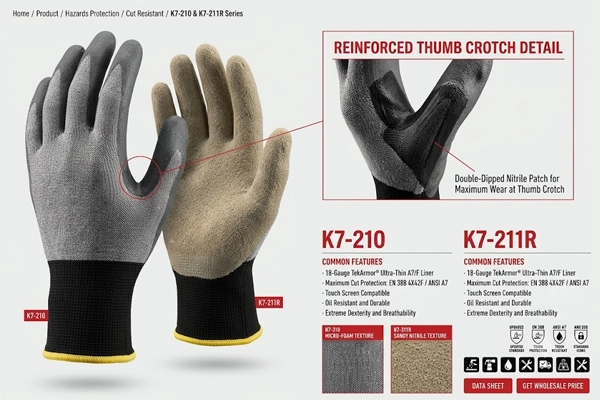
Practical Value of Reinforced Construction: To address this high-wear issue, we recommend deploying advanced composite protective gear—K7-210 Anti-cut Foam Nitrile Glove, 18-gauge seamless TekArmor® A7/F liner, palm-coated, reinforced thumb crotch.
A combination of ultimate flexibility and exceptional abrasion resistance: This model features an 18-gauge ultra-thin TekArmor® A7/F top-tier cut-resistant liner, paired with a high-adhesion foamed nitrile coating on the palm. More importantly, the thumb crotch area has undergone additional reinforced impregnation treatment (Reinforced Thumb Crotch), increasing its tear resistance and wear life by dozens of times. This eliminates the risk of localized premature failure at its source and significantly reduces overall replacement costs in the workshop.
Sandy Nitrile Coating Science: Heavy Oil and Heavy-Duty Grip
In workstations dealing with heavy oil spills, high-viscosity coolant wetting, and the handling of heavy metal parts with sharp burrs, standard foamed nitrile coatings are prone to reaching adsorption saturation due to excessively thick oil films. In such cases, the “Sandy Nitrile” process—which involves physically modifying the surface through roughening—has emerged as the core technological solution to overcoming the anti-slip bottleneck at the heavy oil interface.
Surface Roughness and Oil Channeling Physics
The exceptional grip of Sandy Nitrile on heavy oil stems from its unique micro-scale fluid dynamics-based drainage/oil-channeling grooves.
Unlike the microporous adsorption principle of foam coatings, Sandy Nitrile employs a special particle suspension process during the impregnation and curing stages to create a non-uniform, textured surface on the palm of the glove—similar to high-friction coarse sandpaper:
Physical Oil Channeling: When a worker firmly grips a metal pipe or gear component coated with heavy oil, the thick oil film on the contact surface is rapidly squeezed and channeled outward along the high-density microscopic grooves of the sandblasted coating under pressure.
Direct Physical Engagement: Once the oil film is instantly expelled, the hard and rough protruding particles on the sandblasted surface penetrate the residual film to directly engage the base surface of the metal workpiece, establishing extremely high static and dynamic coefficients of friction (CoF), thereby fundamentally preventing workpiece slippage under heavy-oil conditions.
Maintaining Tactile Sensitivity in High-Abrasion Metal Handling
Traditional heavy-duty, sanded gloves are typically bulky and stiff, whereas modern, advanced manufacturing processes have successfully achieved a balance between “high-abrasion grip” and “bare-hand-level sensitivity.”
In workstations involving heavy sheet metal handling, machining of large castings, and quality inspection of oil-coated components, workers wearing thick, coarse-knit gloves are highly susceptible to compensatory muscle fatigue in the hands due to excessive resistance when bending their finger joints, and may even experience gripping errors caused by impaired tactile sensitivity.
Synergy of the 18-gauge micro-liner and sanded coating: To address this industry pain point, we recommend deploying top-tier, heavy-duty, high-cut-resistant gear—the K7-211R Anti-cut Sandy Nitrile Glove, 18-gauge seamless TekArmor® A7/F liner, palm-coated, reinforced thumb crotch.
Hardcore, battle-ready configuration: This model compresses the top-tier TekArmor® A7/F cut-resistant liner—meeting ISO Cut Level F / ANSI Cut Level A7 standards—into an ultra-thin 18-gauge configuration, with the palm coated in a sandblasted nitrile coating that effectively repels oil. Additionally, the thumb crotch—the area most prone to wear—has undergone a reinforced impregnation treatment (Reinforced Thumb Crotch). This not only effortlessly withstands physical wear in heavy-oil, high-abrasion environments (meeting the highest abrasion resistance standard of EN 388 Level 4), but also allows the wearer to maintain keen fingertip sensitivity and precise control.
Multi-Hazard Environments: Integrating Impact Protection, Cut Resistance, and Grip
In complex working conditions such as oil and gas extraction, assembly of large electromechanical and heavy machinery, shipbuilding, and heavy-duty construction demolition, workers face not just a single risk of cuts or abrasions, but rather a combination of multiple hazards—including “crush injuries to the back of the hand,” “severe cuts to the palm,” “slipping on heavy oil,” and “liquid penetration”—resulting in multi-hazard environments. Traditional single-function protective gloves are highly prone to exposing protection blind spots when faced with such comprehensive risks; therefore, comprehensive protective equipment incorporating multi-dimensional physical structures is essential.
TPR (Thermo-Plastic Rubber) Impact Shielding for Back-of-Hand Hazards
Impact and crush protection for the back of the hand serves as a core safety barrier in multi-hazard work environments.
During heavy-duty pipe splicing, high-torque wrench operations, and heavy-load hoisting, the backs of workers’ hands and finger joints are highly vulnerable to impacts from falling objects, tool ricochets, or crush injuries in confined spaces.
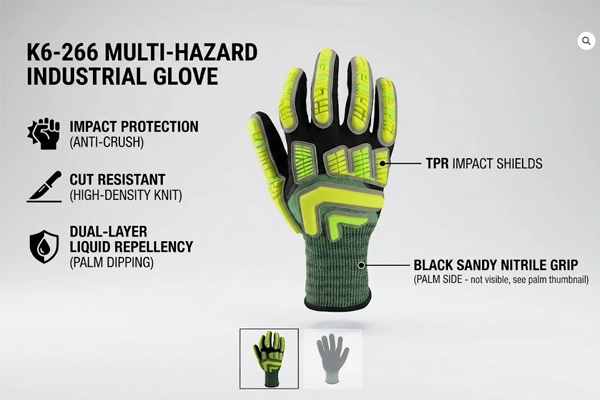
TPR (Thermoplastic Rubber) Physical Protection Mechanism: Highly elastic TPR shock-absorbing modules (Thermoplastic Rubber Pads) are molded and fused onto the back of the glove and finger joints. Utilizing their polymeric topological structure, these modules undergo rapid elastic deformation upon impact, absorbing localized concentrated impact energy and dispersing it to the surrounding areas, thereby effectively preventing fractures, joint dislocations, and severe soft tissue contusions.
Ergonomic Flexibility: The advanced TPR modules feature a segmented, streamlined grooved design that provides high-density protection without restricting the natural range of motion required for clenching and opening the fingers.
3/4 Double-Dipped Nitrile Coating Against Heavy Fluid Siphoning
Preventing heavy oil and cutting fluids from seeping through the knitted gaps on the back of the hand is key to ensuring a strong grip on the palm and protecting the skin.
Standard palm-coated gloves have a critical flaw when used in heavy oil or liquid spill environments: when a worker’s hand is submerged in a pool of oil or comes into contact with an oil-leaking pipe, the liquid creates a “siphoning effect” by traveling along the exposed knit fibers on the back of the hand and knuckles, rapidly seeping into the glove and causing dermatitis, as well as making the glove slippery on the inside.
3/4-Depth Double Coating Physical Barrier: To completely block liquid penetration pathways, these composite gloves utilize a 3/4-depth coating process. The base layer consists of a dense, non-porous, smooth nitrile that establishes a 360-degree liquid barrier covering a large area of the knuckles and the back of the hand; the outer layer is reinforced with a high-strength, textured nitrile to ensure a secure grip on heavy, oil-coated objects.
Recommended All-Around Protective Gear for Real-World Applications: For high-risk, extreme working conditions, we recommend deploying all-around heavy-duty protective gear—K6-266 Anti-cut Sandy Nitrile glove, 18-gauge seamless TekArmor® A6/F liner, 3/4 double-coated, TPR on the back. This model features an 18-gauge ultra-fine TekArmor® A6/F high-grade cut-resistant liner, integrating the highest level of abrasion resistance and cut resistance per ANSI/EN 388 standards; The back of the hand is equipped with dense TPR impact-resistant modules; the palm and knuckles feature a 3/4 double-layered matte nitrile coating, providing a comprehensive solution to the four major safety challenges: impact resistance, cut resistance, liquid penetration resistance, and slip resistance in heavy oil environments.
Industrial EHS Audit: Translating Test Scores into Total Cost of Ownership (TCO)
In day-to-day EHS management and procurement audits at manufacturing facilities, many companies tend to make the mistake of focusing solely on the purchase price, treating the EN 388 data in test reports as mere theory. In reality, laboratory test scores serve as a quantitative tool for predicting actual consumption costs on the shop floor. Converting EN 388 abrasion resistance ratings and grip strength test metrics into a Total Cost of Ownership (TCO) model provides a clear illustration of the commercial value of high-performance protective equipment in terms of cost reduction, efficiency improvement, and risk management.
Calculating Glove Turnover Rates: Level 3 vs. Level 4 Lifespan
The glove turnover rate directly determines how quickly a workshop’s PPE budget is depleted.
In high-friction work environments such as heavy-duty machining and stamping, the Martindale cycles from EN 388 testing can be directly mapped to the actual service life in the workshop:
The Quantitative Trade-off Between Unit Price and Lifespan: Assuming a Level 3 abrasion-resistant glove (breakthrough threshold of 2,000 cycles) costs 3 yuan per unit, it will be scrapped due to coating wear-through on average every 2 shifts under high-frequency friction at a stamping station; In contrast, Level 4 abrasion-resistant gloves (breakthrough threshold of 8,000+ cycles) cost 6 yuan each; due to their extremely high coating cross-linking density, they can reliably withstand 8 shifts of wear and tear.
TCO Cost Calculation: Over a 30-day production cycle, using Level 3 gloves requires 15 pairs, resulting in a direct procurement cost of 45 yuan; In contrast, using Level 4 gloves requires only about 3.75 pairs, with a direct procurement cost of just 22.5 yuan. Selecting Level 4 high-abrasion-resistant gloves not only does not increase the budget but actually reduces direct PPE consumption costs per workstation by 50%, while also significantly reducing labor costs associated with inventory management and warehousing.
Ergonomic Impact: Reducing Pinch Force via Certified Grip
The hidden costs associated with substandard grip strength are primarily reflected in ergonomic injuries and assembly quality defects.
When gloves fail to provide the required coefficient of friction (CoF) in oily or slippery conditions, workers unconsciously increase the pinch force exerted by their fingers and palms to prevent workpieces or tools from slipping:
Muscle Fatigue and Occupational Diseases: Frequent and excessive muscular compensation causes the tendons in workers’ hands to remain under prolonged high stress, making them highly susceptible to cumulative occupational diseases such as tenosynovitis and carpal tunnel syndrome, resulting in high costs for medical claims and workers’ compensation leave.
Quality Defects and Line Downtime: Muscle fatigue directly causes workers’ movements to become impaired, leading to quality incidents such as improperly tightened screws or parts slipping and damaging workpieces. Using certified high-grip gloves (such as foam or textured nitrile) can reduce the pinch force required to grip oily workpieces by more than 30%, thereby reducing line downtime and component scrap caused by slippage at the source.
Environmental Sustainability: Reducing Waste Streams through High-Durability PPE
Improving the physical durability of PPE is a core requirement for audits of modern zero-carbon factories and sustainable supply chains (ESG Compliance).
As global manufacturing companies fully implement waste reduction strategies, solid waste generated by PPE (waste streams) has become a key metric in factory EHS audits:
Source Reduction: Extending the lifecycle of a pair of gloves by 2 to 4 times directly reduces the total volume of discarded PPE sent to factory incinerators or landfills by 50%–75%.
Green Supply Chain Empowerment: Prioritizing the procurement of highly abrasion-resistant, long-lasting synthetic nitrile gloves during factory audits not only reduces hazardous and industrial waste disposal costs but also helps companies meet the mandatory compliance requirements for green supply chains under the ISO 14001 Environmental Management System and during customer factory audits.
Knowledge Base: Frequently Asked Questions (FAQs)
This section compiles the most representative technical answers to key questions that factory procurement managers, EHS officers, and shop floor supervisors have when evaluating test reports and selecting gloves, providing a basis for establishing standardized PPE configurations in the workplace.
How is the EN 388 Level 4 abrasion test officially conducted in certified laboratories?
The EN 388 Level 4 test requires that the palm coating of a glove successfully withstand more than 8,000 cycles of continuous, multi-directional abrasion against standard sandpaper without breaking through to expose the inner lining.
In standardized testing conducted by certified laboratories (such as CTC, SATRA, etc.), technicians cut circular test specimens from the palm of the glove, secure them to the test head of a Martindale Tester, and subject them to Lissajous pattern friction against Klingspoor PL31B 180-grit standard sandpaper under a constant downward pressure of 9 kPa. The tester automatically records the number of cycles until the coating is completely worn through and the inner knitted yarn bundle is exposed. Only gloves that achieve a minimum number of cycles of 8,000 or more in multiple parallel tests are eligible for authoritative certification at Level 4, the highest level under EN 388.
What is the difference between Foam Nitrile (such as K7-210) and Sandy Nitrile (such as K7-211R) in oily environments?
The key difference between the two lies in their “physical oil-repelling mechanisms” and the “applicable fluid viscosity/oil film thickness.”
Foam Nitrile (such as K7-210) features an open-cell micropore structure that uses capillary adsorption to draw trace oil films from the surface of components into the micropores and expel them, allowing the rubber-plastic matrix to make direct contact with the workpiece. This structure combines excellent breathability with fingertip sensitivity, making it the optimal choice for dry, low-oil, and precision assembly applications.
Sandy Nitrile (e.g., K7-211R), on the other hand, is modified with suspended particles to form microscopic, uneven grooves on the surface, resembling coarse sandpaper. When encountering heavy machine oil, high-viscosity cutting fluids, or thick oil contamination, these microscopic grooves—much like tire treads—rapidly squeeze the thick oil film outward in all directions (Fluid Displacement), using the hard protrusions to grip the metal substrate directly. As a result, Sandy Nitrile offers superior slip resistance in conditions involving heavy oil and spilled fluids.
Why is a reinforced thumb crotch crucial for high-abrasion applications?
A reinforced thumb crotch effectively addresses the physical weakness that makes gloves most prone to tearing, significantly extending the glove’s overall service life.
When handling sheet metal, pipes, castings, and high-frequency gripping tools, the edges of workpieces and tool handles exert intense, concentrated friction and shear forces on the thumb crotch area between the index finger and thumb. In actual workshop conditions, more than 60% of standard gloves are scrapped prematurely due to tears caused by friction in the thumb crotch area, even though the palm coating remains intact. By applying additional coating and reinforcement to the high-wear area of the web, the abrasion and tear resistance of this region can be increased several-fold, eliminating premature failure in this specific area and directly reducing the factory’s total cost of ownership (TCO) for PPE.
Call to Action (CTA)
In modern industrial workshops striving for both high productivity and zero accidents, selecting protective gear that combines the highest abrasion resistance certification, superior oil-repellent grip, and high-level cut resistance is key to reducing total cost of ownership (TCO) and improving assembly yield rates.
If you are evaluating industrial safety gloves that pass the rigorous EN 388 tests while balancing lightweight comfort with heavy-duty protection, feel free to explore our full range of certified protective gloves. Explore the full range of Certified Nitrile-Coated Industrial Safety Gloves.


