

Introduction: The Challenge of Solvent Contamination in Precision Manufacturing
Deploying waterborne nitrile cleanroom gloves in ultra-clean manufacturing environments is essential for eliminating solvent residues and controlling molecular contamination. Traditional industrial protective gloves excel in oil resistance, cut resistance, and abrasion resistance, but the organic solvents and volatile organic compounds (VOCs) left behind during their production process are becoming hidden threats to yield rates on high-tech production lines.
How Residual DMF and VOC Outgassing Affect Semiconductor and Optical Yields
During the dip-molding process for traditional nitrile gloves, organic solvents such as dimethylformamide (DMF) are often used to dissolve and disperse polymers.
When operators wear these gloves while working in Class 100 or Class 1,000 cleanrooms (ISO Class 5–7 Cleanrooms) or in vacuum environments, residual solvent molecules continuously outgas, causing severe molecular-level contamination:
Wafer and chip etching failures: Volatile DMF and organic amine gases adhere to the exposed surfaces of semiconductor wafers, leading to reduced photoresist adhesion and distorted circuit patterns, which can cause wafer breakdown or logic gate failures.
Optical lens fogging and reduced light transmittance: During the assembly of precision optical components, VOC aerosols form micron-scale organic deposit films on the surfaces of coated lenses, leading to reduced optical transmittance and refractive index deviations, which directly result in the scrapping of entire sets of high-end lenses.
The Regulatory Shift Toward Solvent-Free PPE in High-Tech Facilities
In addition to causing catastrophic damage to product yield, chemical residues in traditional solvent-based gloves are subject to increasingly stringent global environmental and EHS compliance regulations.
The EU’s REACH regulation has classified DMF as a Substance of Very High Concern (SVHC), imposing stringent limits on its residual concentration in finished gloves; simultaneously, RoHS certification and ESG supply chain audits conducted by major multinational electronics giants explicitly require the reduction of VOC emissions from PPE on production lines. Furthermore, when gloves containing solvent residues are worn for extended periods, residual DMF can easily penetrate the skin barrier and be absorbed by the body when hands sweat or become warm, leading to occupational contact dermatitis and chronic allergies.
Therefore, the transition to solvent-free/waterborne nitrile protective equipment has become an inevitable trend for the high-tech manufacturing industry to achieve dual compliance with production line pollution control and ESG audits.
Scope & Pillar Page Integration
This guide provides an in-depth analysis of how waterborne nitrile polymer systems (Waterborne Polymer Matrix) can completely eliminate organic solvent residues at the source, and systematically explains comprehensive application solutions for low-lint substrates (Low-Linter Substrates), electrostatic discharge (ESD) control, and low ionic extractables (Low Ionic Extractables) in cleanrooms.
Before evaluating solvent contamination control strategies for cleanroom and precision workstations, we recommend that you first consult our core category guide Nitrile-Coated Industrial Safety Gloves to gain a comprehensive understanding of the classification of industrial nitrile protective equipment, basic coating structures, and physical and mechanical properties, thereby better enabling you to develop a plan for upgrading your facility’s PPE.
Polymer Chemistry: Waterborne Nitrile vs. Traditional Solvent-Based Coatings
To understand why waterborne nitrile gloves can achieve “zero solvent residue,” one must begin with the underlying principles of polymer chemistry and the dip-coating process. Unlike traditional coatings that rely on organic chemical solvents, waterborne polymer technology has brought about a fundamental innovation at the molecular dispersion medium level.
Aqueous Dispersion Mechanics: Eliminating Organic Solvents in Dipping
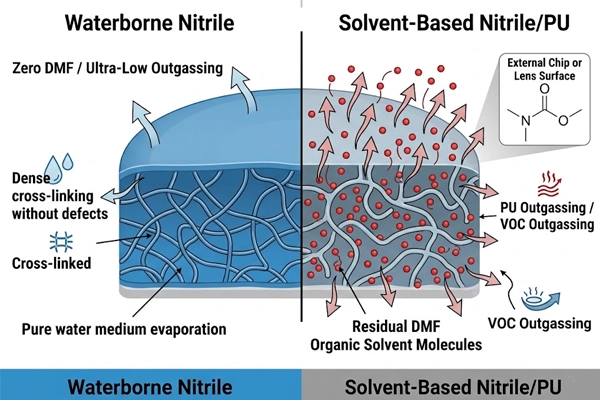
During the production of traditional solvent-based nitrile and PU (polyurethane) gloves, organic solvents such as dimethylformamide (DMF) and toluene must be used to forcibly dissolve solid polymer resins into a flowable state to facilitate lining impregnation. However, these organic solvents have high boiling points and are extremely difficult to volatilize completely; even after curing, a large number of solvent molecules remain trapped within the glove coating.
Aqueous Dispersion Mechanics, on the other hand, eliminates the use of organic solvents:
Water serves as a natural dispersion medium: Synthetic nitrile latex (NBR Latex) is uniformly suspended in pure water through the action of surfactants, forming a stable aqueous system.
Solvent-free thermal curing process: During the dipping and curing stage, heat is applied solely to evaporate water and trigger film formation and coagulation of the polymer latex particles. The entire production process requires no harmful organic chemical solvents such as DMF, thereby completely eliminating volatile organic compounds (VOCs) in the finished gloves at the source.
Skin Sensitization, Odor Reduction, and Worker Comfort During Extended Shifts
Frontline production workers are the ones who benefit most directly from the elimination of chemical residues inside gloves.
During high-intensity work on extended shifts lasting 8 to 12 hours, sweating on workers’ hands can cause local temperature increases and expansion of the stratum corneum. Residual DMF and chemical accelerators in traditional solvent-based gloves leach out with sweat, saturating the skin on the hands and easily triggering allergic contact dermatitis (skin sensitization), redness, swelling, and chemical-induced itching. In addition, the pungent odor emitted by volatile solvents can cause dizziness and nausea among workers in enclosed workshops.
Since water-based nitrile coatings contain absolutely no organic solvents, the finished product is virtually odorless (Low Odor), which significantly reduces the likelihood of skin sensitization and greatly enhances comfort during long shifts as well as job satisfaction.
Structural Differences in Polymer Cross-Linking
In addition to environmental and health benefits, water-based nitrile also exhibits unique physical properties in terms of microscopic mechanics and material continuity.
During the evaporation process, organic solvents tend to leave microscopic defects and phase-separation pinholes in the polymer network structure; in contrast, as water evaporates from a water-based dispersion, the nitrile latex particles move closer together, deform, and fuse. After covalent cross-linking and vulcanization, they form a highly uniform and dense rubber network structure. This macroscopically defect-free polymer continuity endows water-based nitrile coatings with outstanding tensile strength and abrasion resistance.
As analyzed in our Nitrile Coated vs. Polyurethane (PU) Gloves White Paper white paper, compared to the potential risks of chemical toxicity residues in traditional PU coatings due to incomplete solvent washing, water-based nitrile technology not only retains the high physical tensile strength of polyethylene/nitrile but also achieves clean, environmentally friendly physical properties, making it the ideal material choice for upgrading hand protection in modern high-tech workshops.
Cleanroom Ergonomics: Low-Lint Substrates and Outgassing Prevention
In high-cleanliness cleanrooms ranging from Class 100 to Class 10,000 (ISO Class 5–7), gloves serve not only as a physical barrier between the operator’s hands and the workpiece but also as a critical control point for particulate and ionic contamination within the cleanroom. To ensure that gloves do not compromise the cleanroom’s air cleanliness during frequent fine motor movements, strict cleanroom engineering standards must be implemented regarding the selection of lining materials and the control of surface ionic outgassing.
Continuous Filament Liners to Prevent Particle Shedding in ISO Class 5–7
In traditional staple fiber knitted liners, the fiber ends are highly prone to breaking and shedding during bending and friction during operations, resulting in significant micron-level particle shedding—which is disastrous for cleanrooms.
Continuous filament liners are the core standard for cleanroom glove liners:
High-density continuous filament knitting: Seamless knitting using ultra-fine, high-density polyester continuous filaments or ultra-high-molecular-weight polyethylene (UHMWPE); the continuous filament structure prevents the generation of broken fiber fragments during physical stretching and contraction.
Verified low particle shedding: Combined with a seamless, water-based nitrile coating, these gloves successfully pass the Helmke Drum particle shedding test, controlling particle release to extremely low levels and fully meeting the particle shedding specifications for ISO Class 5–7 cleanrooms.
Managing Surface Ion Contamination and Ionic Extractables
In semiconductor wafer manufacturing and high-precision magnetic head/sensor assembly workstations, in addition to visible airborne particulates, invisible “ionic contamination” can also cause catastrophic electrical failures in chips.
Sodium ions, chloride ions, sulfate ions, and heavy metal ions introduced by standard industrial gloves during processing can easily be transferred to the wafer surface through glove contact, causing electrical leakage or corrosion. Water-based nitrile gloves undergo multiple stages of cleaning with EDI ultra-pure water and deionized water during the later stages of production, reducing the total amount of ionic extractables to extremely low parts-per-million (PPM) levels, thereby preventing electrical short circuits and chemical contamination of sensitive materials.
Chemical Compatibility Under Cleanroom Wipedown Protocols
Work gloves used in cleanrooms must frequently come into contact with isopropyl alcohol (IPA), ultra-pure water, and specialized cleaning and disinfecting agents for hand wiping and equipment disinfection.
If the coating lacks adequate resistance to chemical wiping, IPA can break down the molecular network of the coating, causing the gloves to become sticky, stiff, or even leading to coating dissolution and peeling—which in turn triggers particulate contamination. Water-based nitrile coatings offer excellent resistance to swelling from organic solvents and superior durability against wiping.
As outlined in our guide on oil and chemical protection, The Chemical Resistance of Nitrile Coatings: Protecting Hands Against Oils and Solvents, the highly cross-linked molecular structure of nitrile can withstand continuous exposure to low-concentration alcohols and industrial cleaning agents, ensuring that the coating structure remains intact and free of particulate shedding during frequent wiping and disinfection procedures.
Technical Selection Matrix: Cleanroom Standards, Outgassing, and Tactile Precision
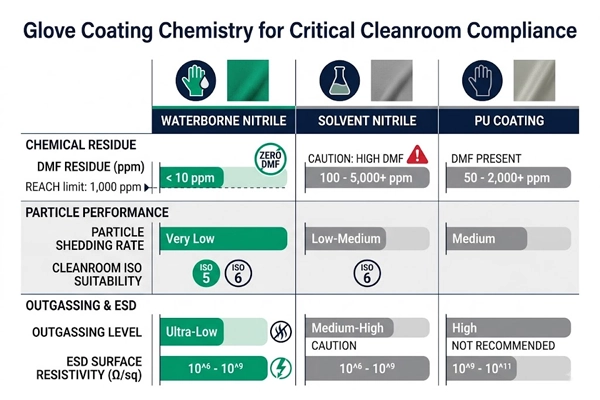
In EHS and Quality Assurance (QA) audits for the manufacturing of semiconductors, high-end electronic components, and optical devices, the “solvent residue,” “particle emission level,” and “outgassing” of gloves are key parameters that determine production line yield rates. To help procurement teams and quality engineers establish clear selection criteria, the table below compares the performance of water-based nitrile, solvent-based nitrile, and traditional PU (polyurethane) coatings across core cleanroom metrics.
Cleanroom Compliance & Solvent Residual Benchmark Table
| Coating Chemistry & Technology | Solvent Residue (DMF/VOC) | Particle Shedding Rate | Outgassing & Ion Extractables | ESD & Tactile Sensitivity | Recommended Workstation |
| Waterborne Nitrile (Aqueous) | Zero (< 5 ppm) | Extremely Low (ISO Class 5/6) | Ultra-Low Outgassing | Compatible with ESD yarns | Semiconductor packaging, wafer handling |
| Traditional Solvent-Based Nitrile | Moderate (50–200 ppm) | Low to Moderate (ISO Class 7) | Moderate Outgassing | Standard Tactile | General automotive, light machinery |
| Polyurethane (PU) Dip | High Potential for DMF Traces | Low (Continuous Filament) | Risk of Amine Outgassing | High Tactile Sensitivity | Electronics assembly, optical inspection |
Key EHS & Quality Audit Takeaways for Electronics Manufacturing
Based on the benchmark data presented above, the following three core guidelines can be derived for quality audits and procurement optimization in electronics and precision manufacturing facilities:
Strictly control DMF residues to prevent cross-contamination on production lines: Traditional PU and solvent-based nitrile gloves typically contain DMF residues ranging from 50 to 200 ppm, which continuously release volatile Organic Compounds (VOCs) in enclosed cleanrooms, contaminating sensitive optical components and semiconductor wafers. Waterborne nitrile gloves reduce residue levels to below 5 ppm, making them the standard configuration for Class 100 and Class 1,000 cleanrooms (ISO Class 5/6) to ensure zero molecular-level contamination.
Both anti-static and low-particle-shedding requirements must be met: at microelectronics assembly and chip packaging workstations, low-particle-shedding alone is insufficient. It is essential to select models that combine a waterborne coating with anti-static carbon fiber yarns (ESD Yarns) to maintain surface resistivity within a safe conductive range, thereby preventing electrostatic discharge (ESD) from damaging high-value electronic components.
Distinguish between general assembly and cleanroom contamination control requirements: As analyzed in our precision assembly guide, Best Nitrile Coated Work Gloves for Automotive and Precision Assembly Operations, traditional solvent-based nitrile gloves fully meet physical and mechanical protection needs for general automotive parts assembly and machining; however, for highly environment-sensitive workstations such as electronic display manufacturing, optical coating, and semiconductor packaging and testing, upgrading to solvent-free, water-based nitrile gloves is a key measure for reducing product scrap rates and achieving international ESG certification.
Eco-Friendly Lightweight Liners for Precision Assembly
At workstations for consumer electronics, micro-component assembly, and precision instrument inspection, workers must perform frequent fingertip operations for extended periods. Such scenarios not only place extremely high demands on glove sensitivity and lightweight design but also set new standards for the environmental sustainability of PPE materials against the backdrop of global carbon reduction efforts.
13-Gauge RPET Sustainable Liners with Solvent-Free Palm Dipping
Combining recycled fibers with solvent-free, water-based dipping technology is the key to achieving both low-carbon sustainability and dust-free, contamination-controlled environments.
Traditional synthetic fiber liners rely on virgin petroleum-based raw materials, whereas the new generation of eco-friendly gloves uses RPET (Recycled Polyethylene Terephthalate) as the knitted liner:
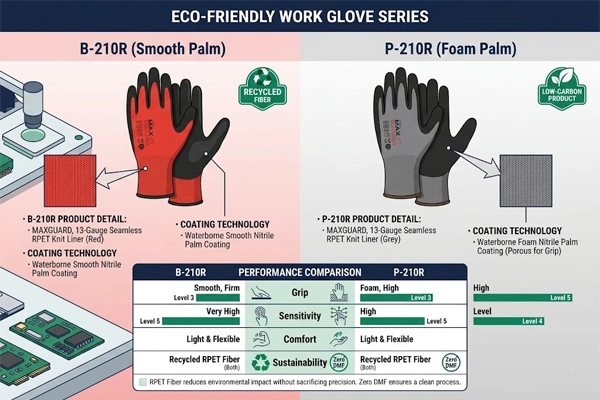
13-Gauge Seamless Recycled Liner: High-quality recycled polyester filaments produced by collecting discarded plastic bottles, followed by purification and melt-spinning. The high-density 13-gauge knit provides the gloves with excellent fit and elasticity, conforming to the contours of the hand’s muscles while significantly reducing the carbon footprint during the raw material production stage.
Solvent-Free Palm Dipping: A water-based nitrile coating is applied only to the palm and the front of the fingers, leaving the large RPET-knit area on the back of the hand completely exposed. This ensures physical protection for the fingertips and strong grip while preserving the natural airflow channels on the back of the hand, greatly enhancing comfort during long shifts.
Balancing Tactile Sensitivity with Zero Chemical Transfer
In the assembly of precision electronics and sensors, gloves must provide the fine-motor sensitivity of “bare-hand feel” while ensuring zero chemical transfer.
When operators handle highly sensitive transistors, printed circuit boards (PCBs), or precision optical components, trace amounts of chemical additives or oils remaining on the surface of ordinary gloves can transfer to the components, leading to subsequent soldering defects or circuit short circuits:
Recommended General-Purpose, Lightweight, Smooth Protection: For light-duty assembly lines requiring protection against dry particulates and basic physical protection, we recommend the eco-friendly smooth model—B-210R MAXGUARD, 13G seamless RPET liner, Smooth Nitrile palm coating. This model features a 13-gauge seamless, eco-friendly RPET liner paired with a dense, water-based, smooth nitrile dip-coated palm. Its smooth, even surface prevents flaking and ensures absolutely no solvent transfer, making it the benchmark for cost-effectiveness in general electronics assembly.
Upgraded Solution for High Breathability and Slip Resistance: For precision micro-assembly workstations where hands tend to sweat or where higher fingertip friction is required, we recommend upgrading to the foam-lined, breathable model—P-210R MAXGUARD, 13G seamless RPET liner, Foam Nitrile palm coating. The water-based foamed nitrile on the palm provides excellent breathability and a soft, matte grip while maintaining zero solvent residue, helping workers stay dry and in control during long hours of high-frequency assembly. This reduces assembly errors caused by chemical contamination or hand fatigue at the source.
Dual-Dipped Solvent-Free Fluid Barriers for Cleanroom Wet Processes
In wet process stations such as optical lens cleaning, semiconductor wafer wet etching, and the transfer of high-purity chemicals, gloves must not only ensure “zero solvent residue” to prevent contamination of the ultra-clean environment but also provide reliable physical barriers against liquids. Traditional single-layer coated gloves are highly susceptible to becoming saturated when exposed to strong cleaning solutions or liquid media due to leakage through micro-pores in the coating or siphoning effects, which can lead to production line contamination and skin burns on the hands.
Full-Coated Waterborne Sealant Layer for Fluid and Liquid Handling
Dual-Dipped Waterborne Technology provides the physical foundation for achieving “absolute impermeability” and “zero chemical contamination” in wet environments.
To establish a continuous, pore-free fluid barrier without using any organic solvents such as dimethylformamide (DMF), the composite dipping process is carried out in stages on a cleanroom production line:
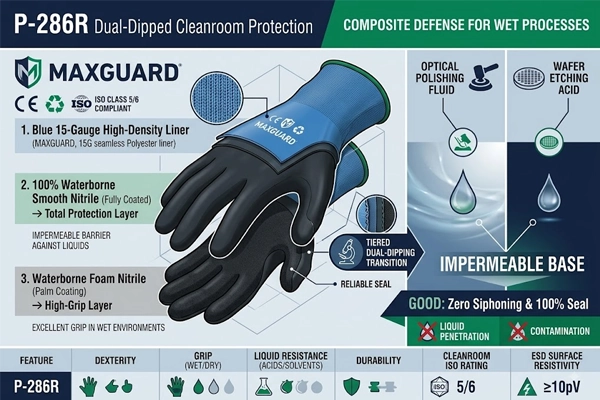
First Layer: Waterborne Smooth Nitrile Base Sealant: The base layer uses high-density waterborne smooth nitrile to provide 100% full coverage of the knitted lining. Polymer particles in the water-based dispersion system closely aggregate and cross-link to form a dense, 360-degree seamless rubber-plastic film, completely preventing the penetration of water-based cleaning agents, diluted acids and alkalis, and optical polishing solutions.
Second Layer: Water-Based Foam Nitrile Grip Overlay: A second layer of water-based foamed nitrile is applied over the sealing base coat in areas of the palm that come into frequent contact with high-frequency equipment. This layer’s flexible, micro-cellular foam structure rapidly displaces interfacial liquids upon contact with slippery wafer cassettes or glass substrates, providing a secure grip to prevent high-value components from slipping out of the hand and shattering.
Preventing Chemical Siphoning in Optics and Wafer Etching Stations
During liquid spills or high-frequency immersion operations, a fully enclosed, leak-proof structure completely prevents the chemical siphoning effect.
When operators work near wet cleaning tanks, if exposed knitted fibers remain on the back of the gloves or between the fingers, liquid will rapidly rise and spread into the gloves via the fibers’ microscopic capillaries. The infiltrating chemical liquid not only contaminates workpieces but also creates a highly concentrated soaking environment inside the gloves, leading to skin maceration and chemical dermatitis.
Top Recommendation for Fully Coated Water-Based Double-Dipped Gloves: For ultra-clean workstations involving fluid spills, chemical wiping, and high grip requirements, we recommend deploying the composite dual-protection model—P-286R MAXGUARD, 15G seamless polyester liner, smooth nitrile full coating, and foam nitrile palm coating.
Advanced Cleanroom Protection Configuration: This model features a 15-gauge high-density seamless polyester filament liner, ensuring low particulate shedding and excellent hand fit; the base layer is 100% fully coated with water-based smooth nitrile (Smooth Fully Coated), eliminating any liquid leakage or siphoning; The palm is overlaid with water-based foam nitrile (Foam Nitrile Palm Coated), balancing strong grip with zero VOC emissions, providing a comprehensive solution to the three major cleanroom safety challenges: fluid penetration, particulate generation, and solvent residue.
ESD and Mechanical Protection: Combining Static Dissipation with Physical Durability
In microelectronics manufacturing, chip packaging and testing, and high-precision instrument assembly workstations, protective gloves must not only ensure “zero solvent residue” and “absolute impermeability,” but also possess reliable electrostatic discharge (ESD) dissipation capabilities and basic physical abrasion resistance. The instantaneous high-voltage current generated by electrostatic discharge can easily cause breakdown in sensitive semiconductor PN junctions, resulting in highly latent electrical damage; meanwhile, if the coating lacks sufficient physical abrasion resistance, debris generated by rapid wear and peeling can lead to secondary particulate contamination.
Integrating Carbon / Anti-Static Yarns into Waterborne Polymer Matrices
Integrating conductive/anti-static yarns into waterborne polymer matrices is the key technology for establishing long-lasting electrostatic dissipation pathways.
Traditional anti-static gloves often rely on spraying anti-static agents onto the coating surface; such surface coatings quickly lose their effectiveness after repeated friction or wiping with isopropyl alcohol (IPA). Modern ESD protective equipment utilizes a more durable microscopic physical conductive network:
Anti-static composite yarn weaving: Conductive blended organic carbon fibers (Carbon Yarns) or metallic conductive filaments are woven into a seamless knitted lining at specific intervals. These conductive fibers form continuous charge conduction pathways within the lining.
Charge conduction compatibility of waterborne polymers: When water-based nitrile latex cures to form a film, it does not disrupt the physical conductive network of the carbon fibers. It rapidly and smoothly directs static charges generated by the human body to ground, maintaining surface resistivity within the safe dissipation range of 10⁶ to 10⁹ ohms, thereby preventing static buildup and instantaneous discharge sparks.
Mechanical Abrasion Resistance Without Solvent Degradation
Water-based nitrile coatings feature excellent covalent cross-linking density, enabling them to maintain high-level abrasion resistance without relying on solvent plasticization.
Some procurement professionals mistakenly believe that “solvent-free water-based coatings have lower physical strength than solvent-based coatings,” which is actually a misunderstanding of polymer physics. In the production of solvent-based coatings, if organic solvents do not evaporate completely, the residual solvent molecules can act as “plasticizers” within the rubber network structure, reducing the coating’s cross-linking density and causing the gloves to wear out and crack rapidly when subjected to sustained physical shear forces.
Through strict temperature-controlled vulcanization, water-based nitrile coatings form dense covalent cross-links between polymer chains, endowing the coating with extremely high physical abrasion resistance and scratch resistance.
As analyzed in the EN 388 Abrasion and Grip Test Breakdown for Nitrile-Coated Safety Gloves mechanical testing guide, water-based nitrile coatings consistently achieve the highest abrasion resistance rating (Level 4) in EN 388 mechanical testing. This ensures that the gloves maintain their structural integrity—without peeling or generating dust—when exposed to metal burrs, sharp PCB edges, and high-frequency abrasion, perfectly balancing ESD safety and mechanical durability.
ESG & Workplace Safety Audit: Zero-DMF Compliance and Total Cost of Ownership
As high-tech manufacturing companies implement global ESG (Environmental, Social, and Governance) audits and pursue dual ISO 14001/45001 certification, EHS and procurement departments are undergoing a profound shift from “low-cost procurement” to “green and sustainable procurement.” Reducing dimethylformamide (DMF) residues to zero is not only a social responsibility (S) to safeguard the health of production line workers, but also a hard-hitting financial strategy to optimize the factory’s total cost of ownership (TCO) by lowering production scrap rates and reducing carbon emissions (E).
Mitigating Solvent-Induced Contact Dermatitis in High-Tech Workforces
Eliminating solvent-induced occupational skin diseases is the fundamental logic behind safeguarding the productivity of high-tech workforces and reducing the hidden costs of workplace injuries.
In semiconductor and precision optics workshops, frontline operators must wear protective gloves for extended periods while performing high-intensity tasks. Organic solvents (such as DMF and toluene) and chemical accelerators remaining inside traditional solvent-based gloves are easily released in the warm, humid environment created by hand perspiration and can penetrate the skin barrier:
Hidden Costs of Occupational Dermatitis: Solvent exposure can trigger allergic contact dermatitis, causing workers’ hands to peel, become red and swollen, and experience severe itching. This not only directly reduces the stability of fine manual operations at high-precision workstations but also leads to frequent shift changes, lost work time (Lost Time Injuries), and potential disputes over medical compensation.
Zero-Solvent Health Protection: Water-based nitrile coatings completely eliminate organic solvents, thereby removing the chemical irritation to the skin caused by residual toxic substances. This prevents solvent-induced dermatitis at its source and significantly improves employee comfort and retention during long shifts.
Reducing the Carbon Footprint Through Aqueous Dipping Processing
Aqueous dipping processing has achieved significant reductions in energy consumption and carbon footprint at the production stage.
In the production of traditional solvent-based gloves, energy-intensive solvent recovery towers and high-temperature waste gas incinerators (RTOs) are required to volatilize and recover the expensive and toxic organic solvent DMF. This process consumes large amounts of electricity and natural gas while emitting volatile organic compounds (VOCs) into the atmosphere.
In contrast, aqueous polymer dipping technology uses pure water as the dispersion medium:
Production energy consumption is significantly reduced: The drying and curing stages do not require high-temperature desolventization processes, directly reducing emissions of greenhouse gases such as carbon dioxide (CO₂).
Supporting Green Supply Chain Audits: Adopting water-based gloves directly helps factories reduce their Scope 3 (supply chain) carbon footprint, enabling them to easily meet the stringent green supply chain and zero-VOC emission audit requirements set by multinational tech giants such as Apple and Intel for their suppliers.
Sustainable Sourcing: Lowering Scrap Rates in Yield-Sensitive Facilities
In wafer packaging and testing and optical manufacturing facilities where yield is critical, the reduction in scrap rates achieved by water-based gloves can generate significant TCO savings.
Many corporate procurement departments focus solely on the unit purchase price of the gloves themselves, while overlooking the high hidden scrap costs caused by outgassing and particulate shedding from traditional solvent-based gloves:
The Hidden Cost Equation: If a single pair of inexpensive solvent-based gloves emits trace amounts of VOCs, causing a high-value wafer or a set of optical lenses to become fogged and scrapped, the resulting loss is sufficient to purchase thousands of pairs of high-performance protective gloves.
Improving Yield and Reducing TCO: As we analyzed in our moisture and permeation management guide, Waterproof vs. Breathable Nitrile Coatings: Balancing Dexterity and Liquid Protection, precisely controlling the microscopic physical and chemical properties of gloves can significantly reduce cross-contamination on production lines and workpiece slippage rates. Deploying water-based nitrile gloves with zero solvent residue directly reduces product scrap rates, leading to a significant decrease in total cost of ownership (TCO) with an exceptionally high return on investment (ROI).
Knowledge Base: Frequently Asked Questions (FAQs) & Actionable Advice
To help EHS managers, quality assurance (QA) specialists, and cleanroom procurement managers quickly resolve questions regarding the selection of waterborne nitrile gloves, the following summarizes key answers and practical recommendations based on actual measurements in industrial cleanrooms and compliance audits.
What is the main difference between solvent-based and waterborne nitrile gloves?
The key differences lie in the dispersing medium and the concentration of chemical residues in the finished product.
Traditional Solvent-Based Nitrile Gloves: During the manufacturing process, organic solvents such as dimethylformamide (DMF) and toluene are used to dissolve and disperse the polymer. This inevitably results in a certain concentration of organic solvent residues remaining within the finished product (DMF typically ranges from 50 to 200 ppm), which continuously outgases in cleanrooms and can easily cause skin allergies in workers.
Waterborne Nitrile Gloves: Pure water is used exclusively as the dispersion medium; synthetic nitrile latex particles are suspended in an aqueous system for impregnation and film formation. The production process involves zero organic solvents, and the residual DMF/VOC levels in the finished product are near zero (less than 5 ppm), eliminating the risk of organic contamination and sensitization at the source.
Why Is DMF (Dimethylformamide) Residue Strictly Regulated in Cleanroom PPE?
The primary reasons for the strict regulation of DMF residue involve two key aspects: “the risk of chip/optical component scrap” and “occupational health compliance”:
Product Yield Loss: In semiconductor packaging and testing, wafer processing, and high-end optical component assembly, residual DMF is highly volatile and tends to deposit on the surfaces of sensitive materials, forming molecular-level films. This can lead to photoresist adhesion failure on wafers, circuit short-circuits, or fogging of optical lenses.
Health and Regulatory Restrictions: DMF is listed as a Substance of Very High Concern (SVHC) under the EU’s REACH regulation and is classified as a highly sensitizing and potentially toxic substance. When workers sweat, the pores on their hands open, allowing residual DMF to be easily absorbed through the skin, potentially causing occupational contact dermatitis and cumulative toxicity.
Can waterborne nitrile gloves pass ISO Class 5 cleanroom particle shedding tests?
Absolutely. Waterborne nitrile gloves typically pass ISO Class 5 (Class 100) and ISO Class 6 (Class 1,000) cleanroom particle shedding tests with ease.
The key to meeting these standards lies in the combination of “lining material” and “continuity of the impregnated film”:
Low-particle-emitting continuous filament lining: Made from seamless, high-density polyester continuous filaments or ultra-high-molecular-weight polyethylene filaments, this lining does not break or shed when physically bent, unlike traditional short fibers.
Dense, defect-free film formation: Water-based polymers form a uniform, continuous rubber-plastic film after cross-linking and vulcanization, free of pinholes caused by solvent evaporation. Combined with multiple rinses using ultrapure water (EDI water) during the final stages of production and clean packaging, this process keeps particle release (Helmke Drum test) and extractable ions within the ISO Class 5 tolerance limits.
Call to Action (CTA)
Upgrading to solvent-free, water-based nitrile protective gear not only eliminates molecular-level contamination and VOC emissions in cleanrooms but also significantly improves production yield at high-precision workstations and reduces the company’s total cost of ownership (TCO).
Whether you are looking for low-particle-emitting, ultra-sensitive gloves suitable for semiconductor and microelectronics assembly, or require a heavy-duty wet cleaning solution that combines 100% liquid impermeability with zero solvent residue, our team of technical experts can provide you with one-on-one cleanroom risk assessments and sample support:
Browse our full line of industrial nitrile-coated safety gloves certified to international standards: [Explore Full Range of Certified Nitrile-Coated Industrial Safety Gloves]
Request free factory sample kits and on-site EHS/QA cleanliness assessments: Contact SQG® for Free Sample Kits


