

Bio-based rpet pu gloves esg compliance has rapidly shifted from a peripheral corporate social responsibility (CSR) concept to an operational mandate for global manufacturing supply chains. In modern industrial operations, high-turnover PPE items like work gloves represent a significant yet frequently overlooked source of Scope 3 supply chain carbon emissions.
Introduction: Decarbonizing Industrial Hand Protection
Against the backdrop of the global manufacturing sector accelerating its decarbonization strategies and sustainable development efforts, the procurement decision-making logic of multinational corporations, Tier 1 suppliers, and large EMS contract manufacturers is undergoing a profound transformation.
The ESG Sourcing Transition (The Inevitable Shift Toward ESG Procurement in the Supply Chain): With the full implementation of the EU Corporate Sustainability Reporting Directive (CSRD) and the Supply Chain Due Diligence Directive (CSDDD), carbon emissions accounting by multinational procurement teams has expanded significantly beyond a factory’s direct emissions (Scope 1) and emissions from purchased energy (Scope 2) to include Scope 3 Category 1 emissions (purchased goods and services) across the entire supply chain. As high-consumption, high-turnover daily protective consumables, industrial safety gloves often see annual consumption of hundreds of thousands of pairs per factory. Neglecting the embedded carbon emissions of such consumables will directly result in companies failing to achieve compliance ratings in annual ESG audits and customer carbon footprint reviews.
Fossil-Fuel Dependency in PPE (High Reliance on Fossil Raw Materials in Traditional PPE Gloves): For a long time, mainstream industrial gloves have been highly dependent on the petrochemical industry chain. The linings of traditional PU-coated gloves are primarily woven from virgin polyester or virgin nylon fibers, while their palm coatings rely on traditional polyurethane resins synthesized from petroleum-based polyols. From crude oil refining and high-temperature cracking to polymerization, the “cradle-to-gate” carbon footprint throughout the raw material stage remains high, exacerbating fossil fuel consumption and greenhouse gas emissions.
The Closed-Loop Material Alternative (A Technological Breakthrough in Closed-Loop and Bio-based Materials): To achieve physical carbon reduction without compromising work safety or tactile feedback, a new generation of green glove engineering solutions breaks free from the reliance on fossil-based raw materials through dual material innovations. The lining uses recycled polyester filament (RPET) produced by physically purifying and spinning 100% post-consumer PET bottles, while the palm coating employs bio-based polyols derived from non-food crops to partially replace petrochemical raw materials. This composite process reduces the use of virgin plastic and crude oil consumption at the source, achieving a quantifiable reduction in the product’s carbon footprint (CFP) of 25% to 38%, while maintaining the excellent abrasion resistance and bare-hand-level dexterity of microporous PU.
For a comprehensive understanding of the specifications, parameters, and bulk procurement solutions for general-purpose precision assembly, eco-friendly water-based dipping, dust-free cleanrooms, and the full range of green and sustainable polyurethane work gloves directly from the source manufacturing facility, please refer to our core product matrix, Precision PU Palm-Coated Work Gloves Direct from Manufacturer, to receive comprehensive engineering selection support.
The ESG Imperative: Scope 3 Emissions & Decarbonization in PPE
As the global industrial decarbonization process enters uncharted waters, environmental, social, and corporate governance (ESG) compliance has evolved from a mere public relations exercise to a mandatory requirement directly linked to access to international contracts, green bank financing, and supply chain ratings. Against this backdrop, material selection and procurement strategies for industrial personal protective equipment (PPE) are undergoing a fundamental restructuring of standards.
Scope 3 Supply Chain Pressures on Consumable Sourcing
As defined by the GHG Protocol, the carbon footprint of manufacturing companies consists of Scope 1 (direct emissions), Scope 2 (indirect emissions from purchased energy), and Scope 3 (other indirect emissions across the entire value chain):
The focus of emissions accounting is shifting toward Scope 3 (Scope 3 Category 1): Most discrete manufacturing and electronics assembly companies have already achieved initial emissions reductions in Scopes 1 and 2 through the procurement of green electricity, the expansion of photovoltaic systems, and energy-saving retrofits of production lines. Currently, 70% to 85% of a company’s total carbon emissions are concentrated in Scope 3, with “purchased goods and services (Category 1)” accounting for a very high proportion.
The cumulative effect of hidden carbon emissions from high-frequency consumables: Industrial gloves are low-value consumables that are frequently issued on a per-person, per-day basis at automotive OEMs, 3C contract manufacturers, and heavy industry workshops. While the carbon emissions from a single pair of traditional petroleum-based gloves may seem limited, the cumulative carbon footprint from fossil fuel extraction and polymer synthesis becomes enormous when scaled to annual consumption of millions of pairs. If multinational buyers are to fulfill their SBTi (Science Based Targets Initiative) emission reduction commitments in their annual sustainability reports, they must extend their carbon reduction efforts to the source—specifically, by substituting the raw materials used in basic consumables such as protective gloves.
EU CSRD & CSDDD Regulatory Frameworks for B2B Supply Chains
A series of laws enacted in the European market in recent years has brought the era of “conceptual greenwashing” in the upstream supply chain to a definitive end, imposing strict legal obligations on export-oriented manufacturing companies and multinational purchasers:
The EU Corporate Sustainability Reporting Directive (CSRD)’s “look-through” requirement: The CSRD, which will be implemented in phases from 2024 to 2026, expands the scope of regulated entities. The legislation requires companies entering the EU market to disclose environmental data regarding their supply chains in accordance with the European Sustainability Reporting Standards (ESRS). When selecting suppliers of protective equipment, procurement departments must request traceable, third-party-certified life cycle assessment (LCA) data for raw materials; traditional petrochemical-based gloves that cannot provide verifiable proof of carbon emissions reductions will face immediate elimination from the market.
Supply Chain Joint Liability under the Corporate Sustainability Due Diligence Directive (CSDDD): The CSDDD further establishes the legal due diligence obligations of large enterprises regarding their global upstream and downstream value chains, covering the entire life cycle from raw material extraction and product manufacturing to waste disposal. Importers must ensure that the synthetic polymer and textile processing stages in their procurement chains comply with strict environmental emission reduction standards and labor safety regulations. Introducing bio-based and recycled eco-friendly gloves with authoritative certifications is a key practical solution for multinational buyers to avoid fines for supply chain violations and pass compliance audits by EU buyers.
Material Science of RPET Liners: Upcycling Post-Consumer Plastics
In the low-carbon transformation of protective gloves, replacing the knitted lining from virgin polyester to recycled polyester (RPET) is the most direct and well-established industrial approach to achieving physical carbon reduction in the glove body. By converting discarded post-consumer PET bottles into high-performance industrial-grade filaments, this process not only achieves a high-value, closed-loop physical recycling of waste plastics but also completely eliminates dependence on virgin petroleum extraction at the source.
Mechanical Bottle-to-Fiber Transformation & GRS Traceability
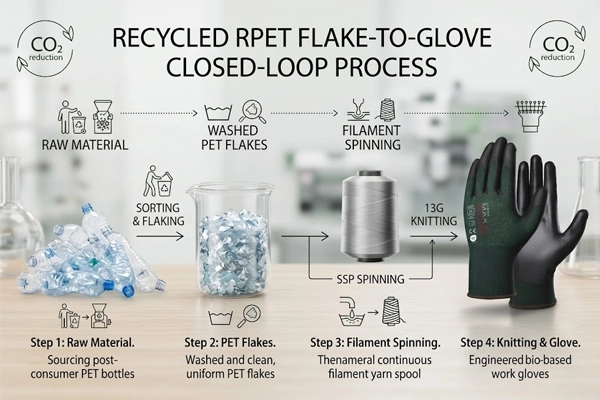
The production of industrial-grade RPET yarn involves a highly precise process of mechanical recycling and melt spinning, which requires standardized, rigorous procedures to ensure high purity and consistency:
Flake Sorting, Crushing, and Deep Decontamination: Recycled post-consumer PET beverage bottles first undergo optical sorting to remove labels and mixed-color plastics, then are fed into industrial crushers to be shredded into standardized flakes measuring 8 to 12 millimeters. The crushed flakes undergo multiple stages of high-temperature thermal washing, caustic alkali solution stripping, and flotation sedimentation to thoroughly remove residual beverage sugars, adhesives, and heavy metal impurities.
Solid-State Polycondensation (SSP) and Melt Extrusion Spinning: The high-purity, washed bottle flakes undergo vacuum drying to remove trace moisture, then enter a solid-state polycondensation (SSP) reactor to increase viscosity, restoring the polymer’s intrinsic viscosity (IV) to the virgin textile-grade level of 0.65 to 0.85 dL/g. The recycled PET resin in the molten state is extruded through an ultra-fine-pore spinneret, then undergoes multi-stage high-ratio heat stretching, cooling and setting, and winding to form industrial-grade seamless knitted continuous filaments with high tensile strength.
Global Recycled Standard (GRS) End-to-End Traceability: From waste plastic bottle collection stations, washing and pelletizing plants, and spinning mills to glove knitting workshops, the entire process is subject to rigorous audits under the Global Recycled Standard (GRS) Chain of Custody system. Each batch of raw materials is accompanied by a dedicated Transaction Certificate (TC), ensuring that the recycled polyester content in every pair of work gloves is 100% authentic in origin and physically traceable.
Tensile Strength and Lint-Free Integrity: RPET vs. Virgin Polyester
For a long time, industrial buyers have held the stereotype that recycled textiles are “insufficiently strong, prone to brittle breakage, and prone to pilling.” Modern physical spinning technology has completely dispelled these concerns at the microscopic molecular structural level:
Molecular orientation and mechanical tensile properties are equivalent to those of virgin materials: High-quality industrial-grade RPET is produced using a continuous filament spinning process rather than a staple fiber process. After precise thermal stretching and restructuring, the polyester macromolecular chains exhibit a highly ordered crystalline arrangement and orientation along the fiber axis. Actual test data shows that the single-yarn breaking strength and elongation at break of high-specification RPET filaments fully meet—and even slightly exceed—the industrial standards for conventional virgin polyester filaments. Once knitted into gloves, they can withstand repeated high-frequency stretching and finger joint bending, eliminating fiber breakage and holes during washing or wear.
The continuous filament structure eliminates the risk of particle shedding and linting: In dust-free workshops and high-cleanliness electronic assembly stations, linting from glove fabrics is a critical factor leading to component contamination and coating defects. Because RPET filaments feature a continuous, unbroken polymer structure internally, they lack the large number of exposed free fiber ends found in short-staple spinning, thereby eliminating the physical source of microfiber shedding at its root. When combined with a microporous polyurethane coating, the polyurethane elastomer firmly anchors the surface loops, achieving an ultra-low particle emission rate (Liquid Particle Count).
For information on the microscopic fiber-locking mechanism between continuous filament knitted liners and polyurethane coatings, as well as systematic technical standards for particulate emission control in semiconductor and optical cleanrooms, please refer to our technical white paper, Lint-Free PU Cleanroom Gloves: Preventing Particulate Contamination in Semiconductor Environments.
Bio-Based Polyurethane Chemistry: Plant-Derived Polyol Systems
The synthesis of traditional polyurethane (PU) resins relies heavily on fossil fuel-based raw materials. Polyurethane resins are typically produced through the reaction of isocyanates with polyols, with the polyol component accounting for a significant proportion of the final polymer’s mass. To achieve true decarbonization in coating technology, a new generation of eco-friendly gloves employs bio-based polyurethane chemistry, which centers on replacing petroleum-based raw materials with plant-derived polyol systems. This material innovation significantly reduces the product’s carbon footprint (CFP) while maintaining the exceptional abrasion resistance, slip resistance, and breathability of microporous PU coatings.
Synthesizing Polyols from Non-Food Renewable Feedstocks
The synthesis of bio-based polyols is a key step toward making PU resins sustainable. Traditional polyether or polyester polyols are derived entirely from petrochemical intermediates refined from crude oil.
Substituting Non-Food Renewable Feedstocks: To avoid the ethical risk of “competing with humans for food,” advanced bio-based polyol synthesis technologies focus on non-edible, renewable agricultural byproducts or dedicated cash crops. For example, through established chemical modification processes (such as epoxidation, ring-opening reactions, or ester exchange reactions), natural plant lipids can be converted into industrial-grade polyols.
Applications of Castor Oil Derivatives (Agricultural Derivatives, e.g., Castor Bean): Among these bio-based raw materials, castor oil extracted from castor beans is an ideal precursor for synthesizing high-performance bio-based polyurethanes due to its unique chemical structure (ricinoleic acid, which is rich in hydroxyl groups). Castor oil-based polyols not only impart excellent elasticity and mechanical strength to the final PU coating but also, due to their natural hydrophobic properties, maintain stable electrostatic dissipation performance in low-humidity workshop environments, thereby achieving dual improvements in both environmental friendliness and performance.
ASTM D6866 Radiocarbon (14C) Verification of Bio-Carbon Percentage
Faced with a wide range of sustainability claims on the market, corporate procurement and ESG audits require scientific, quantifiable evidence to verify the exact ratio of “modern bio-carbon” to “ancient fossil carbon” in glove coatings.
Leveraging Carbon-14 Isotope Testing: The internationally recognized standard for verifying bio-based content is radiocarbon (14C) analysis, which is based on the radioactive decay characteristics of the carbon-14 isotope. The atmosphere contains a specific proportion of radioactive carbon-14. Modern plants absorb carbon dioxide through photosynthesis, and the proportion of carbon-14 in their bodies remains consistent with that in the atmosphere. In contrast, carbon atoms in fossil fuels such as crude oil and coal have undergone decay over millions of years, and the carbon-14 within them has completely disappeared. Therefore, by measuring the residual amount of carbon-14 in the final polyurethane resin films, the source of the carbon atoms can be precisely distinguished.
ASTM D6866 Standard Certification (Verifying Bio-Based Carbon Content): Authoritative international testing laboratories (such as Beta Analytic) conduct these tests in accordance with the ASTM D6866 standard. The test results directly provide a percentage figure (e.g., 25% to 40% bio-based carbon content), which represents the proportion of modern carbon derived from renewable resources, such as plants, relative to the total carbon content of the product. This scientific verification at the atomic level provides companies with tamper-proof ESG data, helping multinational buyers successfully pass rigorous sustainability supply chain audits (such as those required for global sustainable product certifications like USDA BioPreferred or OEKO-TEX®).
Carbon Footprint Verification: Life Cycle Assessment (LCA) & ISO 14067
In modern supply chain ESG audits, any claims regarding “green carbon reduction” must undergo rigorous scrutiny using standardized quantitative models. Corporate procurement and sustainability departments no longer accept vague environmental claims; instead, they require suppliers to provide product carbon footprint (CFP) calculation reports based on internationally recognized standards. Quantifying greenhouse gas emissions at each stage of manufacturing for single- and double-layer industrial gloves through scientific life cycle assessment (LCA) serves as the data foundation for companies to accurately calculate their Scope 3 carbon emissions.
Cradle-to-Gate Life Cycle Assessment Methodology
The core method for assessing the carbon footprint of industrial protective gloves is the “Cradle-to-Gate” life cycle assessment model. This accounting system strictly defines the emission boundaries for the entire process, from the extraction of initial resources from nature until the final product leaves the manufacturing plant:
Raw Material Extraction & Processing: The accounting boundaries cover two main raw material streams. The first involves the cultivation, harvesting, pressing, and refining of non-edible plants (such as castor beans) in the agricultural sector, as well as the chemical synthesis of bio-based polyols; the second involves the collection, mechanical flaking, high-temperature washing, solid-phase polycondensation, and melt spinning of recycled polyester filament (RPET) from post-consumer plastic bottles (PET bottles). At this stage, the use of recycled plastics and bio-based raw materials avoids the high-energy-consumption emissions associated with virgin oil extraction and high-temperature petrochemical cracking.
Glove Body Manufacturing and Dipping Process (In-House Knitting & Dipping Manufacturing): The calculation accounts for electricity consumption in the seamless knitting workshop, thermal energy consumption in the water-based/bio-based polyurethane dipping production line, water recycling efficiency in the multi-stage desalination and washing system, and carbon emissions from the exhaust gas purification system.
Finished Product Packaging and Pre-Shipment Logistics (Packaging & Outbound Logistics): This phase accounts for the comprehensive energy consumption and the embodied carbon of packaging materials associated with the use of FSC-certified recyclable cardboard boxes, plastic-free biodegradable packaging bags, and the container palletizing and loading processes prior to shipment.
ISO 14067 Emission Reductions: Bio-RPET vs. Virgin Fossil-Based Systems
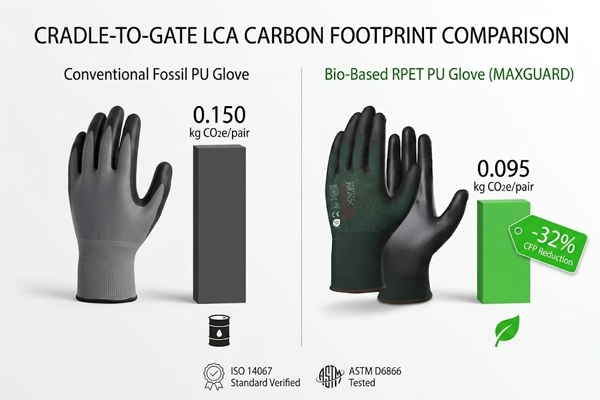
Based on the internationally recognized ISO 14067 standard (Requirements for the quantification and reporting of the carbon footprint of products), rigorous comparative testing and modeling calculations of standard 13-gauge bio-based recycled polyester PU gloves versus traditional fossil-based virgin polyester PU gloves yield clear, quantifiable emission reduction data:
Quantitative Comparison of Carbon Emissions per Pair: Manufacturing a pair of traditional, 100% petroleum-based virgin polyester PU-coated gloves results in cradle-to-gate carbon emissions of approximately 0.135 to 0.165 kilograms of carbon dioxide equivalent (kg CO₂e). In contrast, green gloves made with a 100% GRS-certified recycled polyester lining combined with PU resin containing at least 30% bio-based carbon can significantly reduce the full life-cycle carbon emissions per pair to 0.088 to 0.112 kilograms of carbon dioxide equivalent (kg CO₂e).
Overall greenhouse gas emissions are reduced by 25% to 38%: According to actual measurement data certified by an authoritative third-party auditing agency, bio-based RPET composite gloves achieve an average reduction in greenhouse gas (GHG) emissions of 25% to 38%. Of this reduction, the recycled polyester lining accounts for approximately 60%, while the bio-based polyurethane coating accounts for approximately 40%.
Providing compliant emission factors for corporate Scope 3 audits: These ISO 14067-certified carbon footprint data for individual products can serve as standardized “activity-based emission factors” in corporate greenhouse gas emission inventories . When a factory’s annual procurement volume reaches 500,000 to 1 million pairs, this single category of PPE—gloves—alone can directly reduce Scope 3 supply chain carbon emissions for multinational buyers by tens to hundreds of metric tons, directly supporting companies’ annual CDP Climate Questionnaire ratings and the achievement of their SBTi Science-Based Targets.
Chemical Safety & Clean Manufacturing: Beyond Carbon Reduction
In ESG procurement audits for PPE, while achieving carbon reduction targets is certainly central, it must never come at the expense of product chemical safety or clean manufacturing processes. True sustainability should be an organic combination of carbon neutrality, chemical safety, and clean manufacturing. For precision-fit gloves that come into close contact with the skin, the next generation of green glove engineering is committed to reducing the carbon footprint while, through innovative dipping processes and rigorous toxicological screening, fulfilling the promise of eliminating harmful chemical residues at the source.
Waterborne Formulation Synergy: Zero VOCs and REACH DMFa Compliance
The dipping process for traditional solvent-based polyurethane (PU) gloves relies heavily on highly polar organic solvents such as dimethylformamide (DMFa) or dimethylacetamide (DMAC). These solvents generate significant VOC (volatile organic compound) emissions during the cross-linking and film-forming process, which not only pollute the atmosphere but also, if not thoroughly washed off, leave DMFa—a Substance of Very High Concern (SVHC) with reproductive toxicity—residual in the gloves.
Synergy of Waterborne Technology (Waterborne Formulation Synergy): The SQG® bio-based RPET series of gloves completely eliminates traditional solvents, instead utilizing waterborne polyurethane dispersions with water as the medium. This process innovation not only achieves zero VOC emissions during manufacturing but also eliminates the use of toxic solvents such as DMFa. This technical approach successfully combines carbon abatement with strict chemical compliance.
Compliance with EU REACH Regulations (REACH DMFa Compliance): By completely eliminating polar solvents (DMFa/DMAC) from the dipping process, the finished gloves easily pass third-party authoritative testing for DMFa residue (typically less than 10 ppm, or even undetectable), fully meeting the latest REACH regulatory limits set by the EU. This not only protects production line operators from potential harm caused by hazardous chemicals but also helps multinational buyers avoid regulatory compliance risks associated with imported products.
For a systematic technical comparison and audit process regarding waterborne polyurethane (Waterborne PU) and solvent-based polyurethane in terms of polymerization mechanisms, DMFa residue standards, VOC control, and EU REACH regulatory limits, please refer to our specialized technical guide, Waterborne vs. Solvent-Based PU Gloves: Meeting EU REACH DMFa Limits in Industrial PPE Sourcing.
OEKO-TEX® Standard 100 Skin Contact & Cytotoxicity Standards
Since industrial protective gloves are typically worn tightly for extended periods, prolonged contact between the glove material and human skin makes the penetration of harmful substances into the skin a health risk that cannot be ignored. This is particularly true in high-temperature environments or when hands sweat, as sweat can cause soluble chemical residues in the material to migrate.
Verification of Zero Skin Allergens: Green gloves used in precision assembly workstations must pass rigorous toxicological screening. In accordance with the globally recognized OEKO-TEX® Standard 100 certification system, gloves must pass testing for hundreds of known harmful substances, including sensitizing dyes, carcinogenic dyes, formaldehyde, pH levels, heavy metals (such as nickel, chromium, and lead), and pesticide residues. Testing applies not only to the coating materials but also to the entire glove assembly, including the elastic cuffs.
Cytotoxicity and Skin Irritation Standards: In addition to routine testing, high-specification products also adhere to the ISO 10993 series of medical device biocompatibility standards, specifically undergoing in vitro or clinical evaluations for cytotoxicity, skin irritation, and sensitization when in contact with the skin. OEKO-TEX® certification not only verifies the chemical safety of the gloves but also ensures their long-term comfort and safety as products in close contact with the skin, truly achieving dual protection for both environmentally friendly consumables and the health of production line workers.
Sustainable PPE Benchmark Matrix: Bio-Based RPET vs. Conventional Gloves
As industrial manufacturing companies advance their green supply chain transformation, procurement teams and EHS departments often need to strike the optimal balance between “low-carbon sustainability,” “mechanical protection performance,” and “per-workstation procurement cost” when evaluating new eco-friendly consumables. Some companies worry that using recycled or bio-based materials will shorten the abrasion resistance and service life of gloves, leading to frequent tears and thereby driving up the overall cost of use on production lines.
To dispel these concerns with objective, quantifiable engineering data, the table below presents multidimensional comparative testing and a full life-cycle assessment of four mainstream protective glove solutions available on the market.
Comprehensive Carbon, Mechanical, and Cost Comparison Data
| Comparison Criteria / Key Technical Metrics | Bio-Based RPET PU Gloves (SQG® BIO Series) | Virgin Fossil PU Gloves (Traditional Virgin Fossil-Based PU) | Standard Nitrile Gloves (Standard Nitrile-Coated Gloves) | Disposable Biodegradable Gloves (PLA/PBAT) |
| Biocarbon Content (ASTM D6866) | 25% – 40% (plant-based polyols) | 0% (Pure Petrochemical Derivatives) | 0% (butadiene/acrylonitrile blend) | 50% – 100% (plant-based starch) |
| Recycled Fiber Content (GRS Certified) | 100% (post-consumer recycled PET bottle flakes) | 0% (Virgin Polyester Filament) | 0% (Standard virgin polyester lining) | N/A (film-nonwoven structure) |
| Single- and Double-Carbon Footprint (kg CO2e/pair) | 0.088 – 0.112 (25%–38% reduction in emissions) | 0.135 – 0.165 (Industry benchmark) | 0.220 – 0.380 (High-energy internal mixing) | 0.070 – 0.095 (low-carbon at source) |
| EN 388 Mechanical Abrasion Cycles | 2,000 – 8,000 uses (Level 2–4) | 2,000 – 8,000 cycles (Level 2–4) | 8,000+ cycles (Durable dip-coated style) | < 100 uses (extremely prone to tearing and punctures) |
| Tactile Sensitivity in Dry and Slightly Oily Conditions | Extremely high (microporous breathability, bare-hand-like fit) | Extremely high (high-sensitivity microporous anti-slip) | Medium to low (Rigid rubber film prone to fatigue) | Low (no elastic fit; poor resistance to tensile deformation) |
| Total Cost of Ownership (TCO) per Shift | Extremely low (supports 2–5 shifts of reuse, whether worn alone or in pairs) | Extremely low (abrasion-resistant but no Scope 3 carbon reduction benefits) | Medium to high (High daily consumption for disposable styles) | Extremely high (frequent breakage and requires stringent composting conditions) |
| International Certifications and Compliance Coverage | GRS, OEKO-TEX, ISO 14067 | CE, EN 388 | CE, EN 388, EN 374 | EN 13432 (Industrial Composting Certification) |
As shown by the above empirical data, Bio-Based RPET PU gloves not only fully retain the exceptional mechanical abrasion resistance and bare-hand-level tactile feedback of traditional virgin PU coatings but also achieve a reduction of approximately one-third in carbon footprint directly at the source. Compared to single-use plastic or short-lived biodegradable gloves, their long-term durability significantly reduces both solid waste generation and overall procurement costs for factories.
For a comprehensive comparative analysis of polyurethane (PU), nitrile rubber (Nitrile), and natural latex (Latex) in terms of underlying polymer film-forming mechanisms, oil resistance and slip resistance ratings, and microscopic abrasion resistance testing, please refer to our selection white paper, PU Coated vs. Nitrile vs. Latex Work Gloves: The Definitive B2B Selection Guide for Precision Manufacturing, to access comprehensive materials engineering data.
Ergonomic Performance & Assembly Workstation Integration
In frontline industrial operations, the adoption of any eco-friendly consumables must be based on the premise that workers’ operational efficiency and ergonomic comfort are not compromised. If gloves become thick, stiff, or lack elasticity due to the use of recycled or bio-based materials, frontline assembly workers will resist them due to hand fatigue and diminished tactile sensitivity, which in turn directly affects the assembly yield rate and cycle time on the production line. The SQG® bio-based RPET series of gloves achieves a balance between sustainability and ergonomic performance through the seamless integration of high-density knitting and micro-porous elastomer film technology.
13-Gauge Precision Weave: Balancing Green Materials with Micro-Flexibility
The weave density and fiber elasticity of the glove lining directly determine the wearer’s ability to perceive subtle changes in stress at the fingertips:
Second-Skin Tactile Sensitivity: The gloves are manufactured using a 13-gauge fully automated seamless circular knitting process, tightly interweaving high-strength continuous filament RPET with high-elasticity spandex-covered yarn. The finished lining perfectly conforms to the anatomical contours of the palm and finger joints, eliminating the “bulging” and “wrinkling” commonly found at the fingertips of traditional, bulky work gloves, and providing frontline workers with precise micro-pressure sensitivity that closely mimics that of bare hands.
Full-scenario adaptability for high-precision manual operations:
3C Electronics and Precision Assembly: When handling micro-cables, connecting camera modules, and tightening extremely small screws on motherboards, the 13-gauge lining clearly transmits the subtle tactile feedback of approximately 0.5 newtons required to engage latches, completely preventing false connections and cold solder joints caused by overly thick gloves.
Automotive Harness Routing: When threading through dense vehicle harnesses and performing blind-plug connections, the highly elastic lining provides flexible finger articulation, significantly reducing hand muscle strain during continuous, high-intensity work.
Light Industry Packaging and Small Hardware Sorting: The highly conformable knitted structure allows workers to pinch and sort small, thin parts with greater ease during high-frequency operations, significantly increasing productivity per hour worked.
For a systematic engineering analysis of how glove knit density (gauge) affects microscopic fabric thickness, finger joint flexion and extension resistance, and cycle time (CT) for micro-part assembly, please refer to our technical selection guide, 13-Gauge vs. 18-Gauge PU-Coated Gloves: Maximizing Tactile Sensitivity in Micro-Assembly Lines.
Microporous Bio-PU Grip Characteristics in Dry and Light-Oil Handling
In addition to the thin, form-fitting lining, the surface physical properties of the bio-based polyurethane coating on the palm are key to ensuring a stable grip on workpieces:
Microporous honeycomb matrix and natural convection ventilation: The bio-based PU coating, produced using a water-based foaming process, forms a uniform, dense, and interconnected micrometer-scale microporous honeycomb structure (Micro-Porous Matrix) internally after curing and film formation. These microporous channels allow moisture and heat from the hand to be rapidly dissipated into the external environment via molecular diffusion. Combined with the exposed knit mesh on the back of the hand—which is free of coating—this achieves excellent passive heat dissipation, preventing stickiness, redness, and sweat buildup during prolonged wear.
Superior Friction Performance in Dry and Light-Oil Conditions:
High Surface Coefficient of Friction: The microporous PU coating possesses natural micro-elastic deformation capabilities. When in contact with smooth plastic casings, polished metal parts, or glass substrates, the microporous edges generate a micro-vacuum adhesion effect under pressure, significantly increasing the coefficient of friction during dry grips and preventing workpieces from accidentally slipping and causing scratches.
Capillary Absorption of Light Oil Films and Slip Resistance: When in contact with metal hardware parts that have slight residues of rust-preventive oil or cutting fluid after stamping, the surface’s microporous structure acts like a miniature sponge, rapidly absorbing trace oil films at the contact interface and dispersing them into the pores. This prevents the oil film from forming a lubricating layer between the workpiece and the glove, ensuring anti-slip grip and operational safety fully equivalent to those of traditional top-tier solvent-based PU.

Strategic Sourcing: SQG® Sustainable BIO Series Lineup
To meet the diverse operational requirements of global industrial buyers and comply with stringent ESG procurement audits, SQG® has launched the BIO full product lineup, featuring a “100% GRS-certified recycled polyester lining + plant-based polyol polyurethane coating.” While maintaining high levels of abrasion resistance, tear resistance, and bare-hand-like tactile sensitivity, this glove series is professionally segmented to address different workshop environments, visual contrast management, and contamination levels, providing multinational manufacturing companies with a standardized bulk procurement solution that combines environmental benefits with economic practicality.
SQG® B-312-BIO-BL: Black 13G 100% RPET Liner with Bio-Based PU
As the flagship product in the entire green industrial product line, the SQG® B-312-BIO-BL is specifically designed for high-frequency use, moderate-to-heavy soiling, and industrial maintenance scenarios:
Industrial-grade soil resistance and extended service life: The gloves feature an all-black (Black), high-strength 13-gauge 100% RPET continuous filament liner, paired with a black bio-based microporous PU palm dip coating. The all-black color scheme provides excellent visual resistance to soiling when exposed to mechanical grease, metal cutting fluid dust, rubber carbon black, and toner, preventing the premature disposal of light-colored gloves caused by slight surface darkening and significantly extending the actual service life of single- and double-layer protective gloves.
Suitable Work Conditions and Production Line Configurations:
Automotive Tier 1/Tier 2 component assembly (chassis parts, brake system assembly, and tubing routing).
Routine maintenance and repair of industrial equipment; operation of heavy-duty machinery and hand tools.
Heavy-load handling in warehousing and logistics; handling of metal stampings and castings.
SQG® B-312-BIO-G: Grey Precision Line for Clean Technical Work
Designed in a classic industrial light gray (Grey) hue, the SQG® B-312-BIO-G offers a balanced solution for high-cleanliness, precision technical assembly, and neutral-contrast work environments:
Visual Control of Particles and Foreign Objects: The gray 13-gauge recycled polyester backing combined with a gray bio-based coating effectively conceals minor everyday dust while ensuring that critical metal debris or foreign objects (FOD) on the production line are not masked by a color that is too dark. The highly conformable microporous PU resin provides excellent finger flexibility, eliminating the stiffness often associated with prolonged, repetitive assembly tasks.
Suitable Applications and Production Line Configurations:
Assembly of white goods (air conditioners, refrigerators, washing machines) housings and internal control units.
Screw fastening of structural components in automated packaging lines and consumer electronics.
Surface quality inspection of dryer components, dry-type wiring harness splicing, and calibration of instruments and meters.
SQG® B-312-BIO-GBL: High-Contrast Green/Blue Inspection Standard
SQG® B-312-BIO-GBL innovatively incorporates a high-contrast visual management concept, specifically designed for optically assisted quality inspection, defect screening, and standardized safety wear inspections:
High-Visibility Identification and Inspection Assistance: Features a highly recognizable, vivid green/blue knitted backing paired with contrasting bio-based rubber coating. At precision quality control (QC) stations, the high-contrast background helps inspectors quickly detect even the slightest component pin deformations, scratches, and missing components through visual contrast. At the same time, the bright color scheme allows shop floor EHS safety supervisors to confirm from a distance during rounds whether workers are wearing personal protective equipment (PPE) in accordance with regulations.
Applicable Work Environments and Production Line Configurations:
Post-SMT high-density visual appearance inspection stations.
Sorting and quality assurance (QA) sampling stations for medical consumables and food-grade outer packaging.
Quality inspection and reject sorting lines for precision leather-upholstered automotive interiors and high-gloss injection-molded parts to ensure they are free of scratches.

ESG Procurement Checklist: Auditing Sustainable Safety Consumables
As global manufacturing industries face increasingly stringent compliance requirements for green supply chains, the procurement and sustainability departments of multinational corporations are facing a growing risk of “greenwashing” when screening protective consumables. Many suppliers market their products based solely on verbal claims or vague “environmental concepts,” yet fail to provide traceability documentation that meets international standards. To ensure that procured green safety consumables can successfully pass rigorous audits by third-party organizations and clients, corporate procurement teams should establish standardized due diligence and compliance verification processes.
Validating GRS Chain of Custody & Transaction Certificates (TC)
Under the Global Recycled Standard (GRS) certification system, any claim regarding the “use of recycled plastic or recycled polyester” must be cross-verified through complete Chain of Custody documentation. Corporate procurement personnel should follow these audit steps to verify supplier qualifications:
Verify the validity and scope of the Scope Certificate (SC): The Scope Certificate confirms that the manufacturing facility has passed the annual on-site audit under the GRS system and is qualified to process and produce recycled polyester textiles. Purchasers must specifically verify that the certificate was issued by an authorized international certification body (such as Control Union or Intertek) and that the product categories listed in the certificate’s appendix explicitly include specific classifications such as “Recycled Post-Consumer Polyester” and “Work Gloves.”
Request and Verify the Transaction Certificate (TC) for Each Batch: Unlike the Scope Certificate, the Transaction Certificate is a legally binding traceability document issued for each batch of goods actually purchased. Reputable manufacturers must provide a corresponding GRS Transaction Certificate for each batch of finished gloves delivered, clearly indicating the purchase invoice number, net weight, and actual physical percentage of recycled polyester (e.g., 100% Recycled Post-Consumer PET) for that order. By verifying the quantities on the TC against the actual weight of goods received into inventory, the risk of suppliers adulterating products with low-cost virgin fossil-based raw materials can be completely eliminated at the source.
Assessing True Material Decarbonization vs. Unverified Carbon Offsets
When evaluating the carbon-neutral or low-carbon attributes of glove products, companies must clearly distinguish between “insetting” and “carbon offsetting” to ensure that their procurement activities generate genuine, compliant value for Scope 3 emissions reductions:
Prioritize genuine physical carbon reduction at the material level (insetting): The low-carbon products with the greatest audit value are those that reduce fossil resource consumption in the physical product itself. Replacing petroleum-based polyols with plant-based bio-based polyols and substituting virgin petroleum-cracked polyester with filaments made from post-consumer recycled plastic bottles results in greenhouse gas (GHG) emission reductions that occur directly within the manufacturing segment of the supply chain. This physical carbon reduction is supported by measurable raw material traceability reports and ISO 14067 third-party life cycle assessment (LCA) data, and is considered indisputable, high-level core emissions reduction data in CDP Climate Questionnaires, SBTi Science-Based Targets, and EU CSRD reports.
Beware of third-party forestry carbon offsets lacking physical carbon reduction: Some manufacturers continue to produce traditional virgin petrochemical gloves—which are energy-intensive and highly polluting—and label their products as “carbon neutral” solely by purchasing low-cost, third-party afforestation credits or renewable energy certificates on the carbon market that are difficult to verify over the long term. As anti-unfair competition laws in Europe and the U.S., along with the Green Claims Directive, intensify efforts to crack down on false advertising, reliance on such unverified external carbon offsets is highly likely to be deemed “greenwashing” by regulatory authorities. Not only does this fail to provide buyers with a valid basis for Scope 3 deductions, but it also exposes the company’s brand reputation to compliance-related legal risks.
Knowledge Base: Frequently Asked Questions (FAQs) & CTA
To help global procurement managers, EHS safety compliance officers, and supply chain audit teams quickly address common questions regarding the practical implementation of eco-friendly protective gloves, the following summarizes authoritative technical answers related to material performance, certification traceability, and ESG emissions reduction accounting.
Do bio-based RPET PU gloves compromise on EN 388 abrasion durability?
There is no compromise in abrasion resistance or mechanical strength.
The SQG® bio-based RPET series of gloves utilizes a continuous filament reconstruction process in the manufacture of the base fibers; the breaking strength and elongation at break of the individual yarns are identical to those of virgin petroleum-based polyester filaments. As for the palm coating, the polyurethane elastomer—formed by the reaction of plant-derived bio-based polyols with isocyanates—features a highly uniform microporous cross-linked network and excellent tensile recovery. As verified by the international standard EN 388 for protection against mechanical hazards, this series of gloves can withstand 2,000 to 8,000 abrasion cycles (meeting Level 2 to Level 4 standards), and their abrasion resistance, tear resistance, and fingertip sensitivity are on par with those of traditional top-tier solvent-based PU gloves.
What percentage of fossil fuel content is realistically replaced in the BIO series?
The overall glove system achieves a significant reduction in the use of petrochemical materials.
The specific substitution ratio consists of two components: the “knitted liner” and the “palm coating”:
Knitted liner: Recycled polyester yarn derived from 100% post-consumer PET bottles is used, completely replacing virgin petroleum-based polyester in the glove’s main fabric.
Polyurethane coating: Plant-based bio-based polyols are used to replace traditional petrochemical polyols. According to the ASTM D6866 carbon-14 isotope radioactivity testing standard, the bio-based carbon content in the coating resin is consistently maintained within the range of 25% to 40%.
Combined, these measures reduce the full life-cycle greenhouse gas emissions (kg CO₂e) of finished single- and double-layer gloves by 25% to 38% compared to traditional, purely fossil-based gloves.
How do GRS Transaction Certificates (TC) verify the use of genuine recycled plastic?
Legally binding, tamper-proof batch tracking credentials prevent false claims.
The Global Recycled Standard (GRS) requires that every processing stage in the upstream supply chain—from plastic bottle collection and washing plants, through pelletizing and spinning mills, to finished glove knitting factories—must pass an annual on-site audit by a third-party accredited certification body and hold a valid Scope Certificate (SC). Based on this, for every batch of finished products actually shipped to the buyer, the certification body issues a unique Transaction Certificate (TC). The TC clearly states the information of both the buyer and seller, the purchase invoice number, the actual net weight, and the precise lot number of the 100% recycled polyester material, thereby forming a closed-loop, traceable, and legally binding chain of custody for authentic raw materials.
Can corporate buyers directly incorporate this glove’s LCA data into Scope 3 ESG audits?
Absolutely, and it is recognized as a valid third-party audit.
SQG® has established a comprehensive “Cradle-to-Gate” Life Cycle Assessment (LCA) quantification model for the BIO series of gloves in accordance with the internationally recognized ISO 14067 (standard for quantifying product carbon footprints). This data report details precise emission figures for each stage, from the agricultural extraction of raw materials, through the mechanical processing of waste plastic and seamless knitted rubber coating, to the packaging of the finished product. Multinational buyers can directly import these standardized product activity emission factors into their own greenhouse gas accounting systems. These serve as the legal basis for calculating annual Scope 3 Category 1 emissions reductions (purchased goods and services) and can be directly used to meet the disclosure and audit requirements of the EU CSRD Directive, the CDP Climate Questionnaire, and the SBTi Science-Based Targets.
H3: Call to Action (CTA)
Advancing the decarbonization of a company’s supply chain does not mean compromising between protective performance and procurement budgets. By incorporating rigorously certified bio-based and recycled polyester gloves into their daily consumables, companies can not only provide frontline operators with form-fitting, breathable, industrial-grade precision protection but also obtain verifiable Scope 3 carbon reduction audit documentation.
To request a complete sample of GRS Chain of Custody transaction certificates, a third-party ISO 14067 LCA carbon footprint calculation report, and a package of test samples for factory production lines, please feel free to contact our technical support team at any time: Request GRS Certificates, LCA Data Sheets & Free BIO Sample Kits.
To view more specifications and procurement guidelines for water-based polyurethane, high-gauge ultra-thin precision assembly, and our full range of high-performance eco-friendly industrial gloves, please browse our comprehensive product catalog: Explore the Complete Eco-Friendly & Industrial PU Gloves Matrix.


