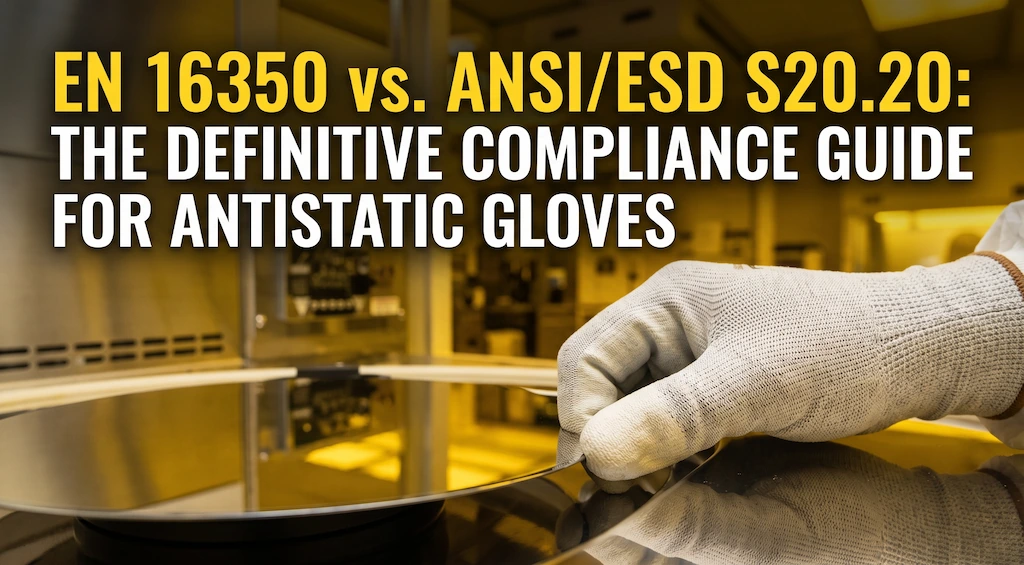
In high-precision manufacturing, deploying lint-free pu cleanroom gloves is critical across semiconductor wafer foundry, automotive camera module (CCM) packaging, micro-electro-mechanical systems (MEMS), and optical lens production. In controlled cleanrooms meeting ISO Class 5 (Fed Std 209E Class 100) or higher standards, a single 0.5-micrometer dust particle—invisible to the naked eye—falling onto photoresist or a wafer circuit is sufficient to cause pattern bridging or circuit short-circuits, resulting in the scrapping of the entire wafer and yield losses amounting to tens of thousands of dollars.
For a long time, ordinary knitted work gloves have been widely used on industrial assembly lines. Their natural short fibers are highly prone to breaking during the high-frequency flexing of finger joints and friction with workpieces, causing them to become airborne and become the primary source of human-generated particle contamination in cleanrooms. At the same time, low-end polyurethane (PU) coatings are highly prone to micro-cracking and flaking on the surface under repeated stretching, further increasing the risk of airborne particulate contamination (APC) and liquid-borne particulate contamination (LPC) exceeding permissible limits.
To completely prevent fiber shedding and coating flaking, high-end cleanroom work gloves have undergone engineering innovations in textile materials science and coating chemistry—by utilizing 100% seamless knitting of continuous filament yarn combined with microporous, elastic PU fiber-locking resin, they achieve a truly “zero-linting” physical barrier. Before delving into the microstructure of continuous filament yarn, cleanroom particle detection standards, and deionized water washing processes, we recommend first reviewing our main polyurethane category guide, Precision PU Palm-Coated Work Gloves Direct from Manufacturer, to gain a comprehensive understanding of our series of cleanroom, anti-static, and eco-friendly coated gloves designed to meet the stringent requirements of modern controlled environments.
The Threat of Micro-Contamination: Particulate Risks in Semiconductor and Optics Fab
In advanced semiconductor manufacturing and high-precision optical instrument production, controlling the cleanliness of the microenvironment directly determines the make-or-break factor for the entire production line—the product yield rate. As chip manufacturing processes evolve toward the micrometer and nanometer scales and the pixel density of optical lenses increases significantly, the tolerance for contact contaminants in production facilities has dropped to an extremely strict level, approaching zero.
Microscopic Defect Density and Yield Loss in High-End Fab Lines
In integrated circuit wafer fabrication and micro-optical module packaging processes, micron-sized particles suspended in the air or adhering to the surface of work gloves are the primary sources of wafer scrap and optical imaging defects:
Mechanisms of Short Circuits and Open Circuits Caused by 0.5-Micrometer Particles: During wafer lithography and thin-film deposition processes, a dust particle as small as 0.5 micrometers that lands on the exposed silicon wafer surface will block light transmission during the exposure stage, resulting in photoresist development defects. In subsequent dry etching or metallization and interconnect processes, this microscopic obstruction directly leads to abnormal bridging (bridge short circuits) or localized breaks (open circuits) between metal wires. In high-density chip layouts, the critical adhesion of a single particle can cause the entire die to fail electrical performance testing.
Diffraction and aberration distortion on optical lens surfaces: During the assembly and calibration of automotive camera modules (CCM), LiDAR lenses, and precision periscopic prisms, particles adhering to the surfaces of coated optical components disrupt the refractive continuity of the anti-reflective coating layers. Microscopic protrusions formed around dust particles cause anisotropic abnormal scattering of incident light, resulting in permanent bright spots, flare, or stray light on the image sensor, which severely compromises the Modulation Transfer Function (MTF) performance of high-end optical imaging systems.
Fiber Shedding vs. Coating Flaking: Root Causes of Airborne Particulates
During assembly operations on production lines, the hands are the body parts that come into contact with products most frequently. Particulate contamination generated by traditional protective gloves primarily takes two distinct physical forms, each of which compromises the controlled clean environment through its own mechanism:
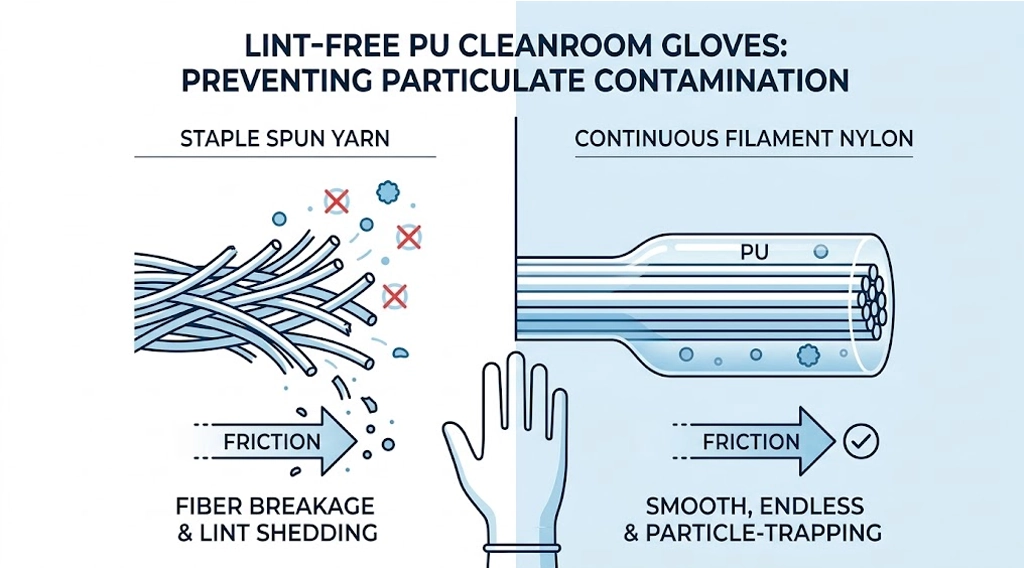
Fiber Shedding and Linting: Standard knitted gloves are typically spun from short fibers (spun yarn), with each yarn containing thousands of broken fiber ends. When operators perform frequent finger flexion and extension, pinching motions, or rub against metal fixtures, the mechanical cohesion within the yarn is disrupted, causing the short fiber ends to be pulled out of the fabric gaps, break off, and scatter. These lint particles are lightweight and remain airborne for an extremely long time, making them highly prone to spreading throughout the cleanroom via laminar airflow and becoming a major contributor to uncontrolled airborne particle counts (APC).
Coating Wear and Polymer Flaking/Micro-Debris: When low-quality polyurethane coatings lack sufficient shear resistance or are inadequately cured, mechanical scraping against the sharp edges of workpieces causes the polymer resin film to undergo plastic deformation and form microcracks. Under the fatigue stress caused by the repeated bending and stretching of the knuckles, the microscopic cross-linked network on the coating surface is torn apart, flaking off into irregular micron-sized polymer powder debris. This coating debris is often firmly pressed onto the surface of components through direct contact with operators, becoming a key factor in excessive Liquid Particle Counts (LPC) and irreversible chemical contamination of contact surfaces.
Fiber Architecture: Continuous Filament Nylon vs. Staple Yarn
The fiber architecture of glove fabric linings serves as the first line of defense in determining whether they meet cleanroom admission requirements. The fundamental distinction between traditional general-purpose gloves and high-end cleanroom gloves lies in whether the microscopic fibers are constructed as “discontinuous, interlocked staple fibers” or as “bundles of infinitely long monofilaments.”
The Physics of Linting: Why Staple Spun Yarn Fails to Meet Cleanroom Standards
In ISO Class 5 to Class 6 microelectronics manufacturing facilities, gloves woven from staple-based yarn (spun yarn) are a core hazard that triggers severe particulate contamination incidents:
The mechanisms of friction-induced linting and fiber end unraveling: Staple-based yarn is formed by forcibly binding together tens of thousands of short fibers, each only 30 to 50 millimeters long, through the friction generated by twisting. During the cyclic friction between the glove lining and the worker’s skin, or between the outer layer and the workpiece, the exposed free fiber ends on the yarn’s surface are subjected to alternating shear forces. These ends are highly prone to being pulled loose from the twisted yarn network, resulting in microscopic fuzzing.
Stress Fatigue Fracture and Particle Impact: As the fuzz is repeatedly pulled during assembly operations, the fiber roots rapidly fracture due to mechanical fatigue, shattering into tiny fiber fragments ranging from tens to hundreds of micrometers in size. These suspended particles not only have an extremely large specific surface area—making them prone to adsorbing metal ions and fine dust from the air—but they also penetrate the knitted pores of the gloves, becoming mobile sources of contamination that cannot be filtered out by the cleanroom’s laminar airflow system.
Endless Monofilament Weaving: Zero Fraying and High Tensile Integrity
To eliminate lint shedding at its physical source, it is essential to completely abandon short-fiber structures in textile engineering and adopt fully continuous filament polymers:
Physical Properties of 100% Continuous Filament Nylon (Zero-End-Point): Continuous filaments are produced through the melt extrusion of polyamide (PA66/PA6), high-ratio drawing, and precision spinneret forming. The entire yarn consists of dozens of filaments—theoretically infinite in length, smooth, and free of any breakage points—arranged in parallel and twisted together. Since there are absolutely no free ends within the yarn of the entire glove, the possibility of pilling, shedding, and linting is completely eliminated by the physical mechanism itself (Zero-Linting).
High tensile modulus and tear resistance: Continuous filament nylon offers excellent monofilament tensile strength and high abrasion resistance. When assembling and handling microcomponents or coming into contact with sharp-edged wafer carriers (FOUPs), the filament fibers will not undergo fibrillation or breakage even when subjected to intense localized abrasion. Combined with high-density weaving technology from seamless circular knitting machines, the fabric lining maintains a smooth, compact, and structurally intact surface even during high-frequency operations lasting several hours, providing a robust, particle-free physical barrier for semiconductor and optical-grade cleanroom production lines.
Coating Engineering: Microporous PU as an Elastic Particle Barrier
Even when a continuous filament liner is used, the glove’s particle-trapping performance during actual use remains highly dependent on the quality of the physicochemical bonding at the interface of the polyurethane (PU) coating on the palm. Microporous PU resin not only provides operators with precise grip and dexterity but also acts as a dense yet elastic physical fiber-locking barrier at the microscopic level.
Fiber Lock-In Technology: Polyurethane Resin Encapsulating Yarn Ends
In the dip-coating process for dust-free gloves, the interfacial bonding strength between the coating resin and the knitted liner directly determines the long-term stability against particle migration:
Microscopic Wetting and Deep Resin Encapsulation: High-quality polyurethane emulsions feature precisely formulated surface tension and rheological viscosity. Upon contact with the knitted liner, the resin penetrates in a controlled manner into the capillary pores between individual yarn filaments, rather than simply sitting on the fabric’s surface. After the resin cures, the polyurethane elastomer tightly encapsulates and seals the loops of the knit fabric and any microscopic fiber ends that may be present, forming a robust “anchored” composite structure.
Physical Fiber Lock-In Mechanism: This deep-penetration fiber-locking technology eliminates microscopic displacement and axial friction-induced slippage of individual fibers under stress. Even when the glove comes into contact with rough metal tooling fixtures or the high-friction edges of PCB boards, the fibers in the lining cannot penetrate the surface layer of the adhesive film and escape, ensuring that the glove remains lint-free (Zero-Linting) throughout its entire service life.
Flaking Resistance Under High-Frequency Assembly Friction
During high-intensity assembly shifts lasting up to 8 hours in electronic cleanrooms, the palms and fingertips of gloves are subjected to tens of thousands of high-frequency flexion-extension cycles and scraping against workpieces:
Shear Resistance and Fatigue Resistance of Microporous Elastomers: Advanced cleanroom PU coatings feature a homogeneously distributed honeycomb-like microporous structure (Micro-Porous Matrix). When subjected to localized high-pressure pinching or lateral shear stress, this porous elastic structure uniformly disperses mechanical loads through microporous deformation, preventing excessive stress concentration at the coating’s surface.
Prevents Microcrack Propagation and Coating Flaking (Zero-Flaking Resilience): Low-end or inferior PU films are prone to plastic fatigue and microscopic surface cracking under prolonged, repeated bending and stretching, which eventually leads to the flaking of micron-sized polymer powder particles. In contrast, highly cross-linked elastic polyurethane possesses exceptional elastic elongation and molecular cohesion, maintaining a smooth, crack-free coating surface free of flaking even after tens of thousands of bending tests.
For a detailed engineering analysis of microporous polyurethane coatings regarding the elimination of polar solvents, the prevention of volatile organic compound (VOC) emissions, and compliance with stringent European environmental limits, please refer to the technical guide Waterborne vs. Solvent-Based PU Gloves: Meeting EU REACH DMFa Limits in Industrial PPE Sourcing.
Cleanroom Standards & Compliance: ISO 14644-1 and IEST Protocols
In the procurement of cleanroom consumables and EHS system compliance audits, relying solely on suppliers’ verbal claims of “dust-free” or “anti-shedding” is insufficient to meet the acceptance criteria for semiconductor and optical manufacturing. Companies must establish quantifiable, traceable criteria for particle interception and emission levels based on internationally recognized cleanliness class specifications and industry-standard testing procedures.
ISO Class 5 to Class 8 (Fed Std 209E Class 100 to 100,000) Thresholds
According to the ISO 14644-1 cleanroom air cleanliness classification standard published by the International Organization for Standardization (corresponding to the U.S. Federal Standard Fed Std 209E), different manufacturing stations have extremely stringent mathematical limits on the maximum concentration of airborne particles per unit volume of air:
ISO Class 5 (Class 100 Cleanroom): Primarily used for core exposure processes such as wafer lithography, wafer probe testing, and high-precision LiDAR lens packaging. The standard stipulates that the number of particles with a diameter greater than or equal to 0.1 micrometers in one cubic meter of air must not exceed 100,000; the number of particles with a diameter greater than or equal to 0.5 micrometers is strictly limited to 3,520 or fewer; and the presence of large particles greater than or equal to 5.0 micrometers is absolutely prohibited. Gloves used in these operating conditions must feature full-length filaments without breakage points and a fully enclosed coating capable of trapping fibers.
ISO Class 6 to Class 7 (Class 1,000 to 10,000): Covers consumer electronics camera module (CCM) assembly, high-end display panel (OLED) lamination, and micro-motor assembly lines. The concentration of particles with a diameter greater than or equal to 0.5 micrometers must be controlled at 35,200 and 352,000 particles per cubic meter, respectively. Gloves must ensure that the coating does not peel or chalk under prolonged, high-frequency friction.
ISO Class 8 (Class 100,000 cleanroom environment): Workshops for general precision electronic hardware assembly, injection-molded part inspection, and outer packaging. These areas primarily intercept particles with a diameter of 0.5 micrometers or larger (upper limit of 3,520,000 particles per cubic meter) and coarse fibers larger than 5.0 micrometers (upper limit of 29,300 particles per cubic meter) to prevent large dust particles from causing mechanical jamming at electrical contact points.
Testing Methodologies: Helmke Drum (APC) & Liquid Particle Counts (LPC)
To quantitatively evaluate the actual tendency of gloves to shed particles under dynamic stress and in liquid environments, the International Institute of Electronics and Testing (IEST) has established IEST-RP-CC005.4, an authoritative test procedure specifically for gloves:
Helmke Drum Test (Airborne Particle Counts, APC): Used to evaluate the airborne particle emission of gloves during dry, dynamic movement. During the test, a specified number of glove samples are placed inside a stainless steel rotating drum designed for cleanroom use. The drum rotates continuously at 10 revolutions per minute, simulating the mechanical friction and flexing and folding that occur when gloves are worn during work operations. A laser optical particle counter at the drum’s opening continuously draws air samples at a constant flow rate of 1 cubic foot per minute, precisely counting the total number of suspended particles with a diameter greater than or equal to 0.5 micrometers released during a 10-minute rotation cycle to determine the glove’s cleanliness grade.
Liquid Particle Counts (LPC) Test: Used to measure insoluble microscopic deposits that can be shed from both the surface and deeper layers of the glove. The entire glove is fully submerged in ultrapure deionized water (DI water) and placed in an orbital shaker or ultrasonic cleaning tank set to a specified frequency and amplitude for vigorous agitation and extraction for a specified duration. Subsequently, a liquid laser particle sensor is used to take online samples of the extraction solution, counting the number of particles shed from the glove surface per square centimeter (counts/cm²). This metric directly reflects the risk of abrasion and powder shedding from the polyurethane coating, as well as the cleanliness of the deep-layer filaments. It serves as the most critical material release threshold for semiconductor foundries and hard disk drive (HDD) read/write head production lines.
Cleanroom Glove Benchmark Matrix: PU vs. Nitrile vs. Disposable Film
When selecting consumables for cleanrooms and microelectronics manufacturing facilities, procurement teams and contamination control engineers often weigh the pros and cons of knitted filament-coated gloves versus disposable film gloves. Different base materials have their own strengths and weaknesses in terms of particulate emission control, antistatic performance, tactile sensitivity, and total cost of ownership per shift; establishing a quantitative benchmark for material performance comparisons is key to achieving refined supply chain management.
Comprehensive Particulate, Tactile, and ESD Data Matrix
The table below objectively quantifies the measured performance of continuous filament dust-free polyurethane (PU) gloves, cleanroom nitrile gloves, cleanroom latex gloves, and disposable vinyl gloves in terms of core cleanliness and ergonomic parameters:
| Evaluation Dimensions | Continuous Filament PU-Coated Gloves (Continuous Filament PU) | Cleanroom Disposable Nitrile Gloves | Cleanroom Latex | Disposable PVC/Vinyl |
| Particle Release (LPC, ≥0.5 μm) | Extremely low (< 1,200 counts/cm², after washing with ultrapure water) | Extremely low (< 800 counts/cm², cleaning grade) | Low to medium (< 1,500 counts/cm²) | High to Very High (> 3,500 counts/cm², prone to releasing plasticizer particles) |
| Helmke Drum APC | Category I / II standards (no lint shedding) | Category I standard (zero fiber shedding) | Category I / II Standards | Category III (edges are prone to tearing and producing debris) |
| Surface Resistivity / ESD | 10⁶ to 10⁹ Ω (woven from antistatic continuous filament conductive fibers) | 10⁹ to 10¹¹ Ω (static-dissipative) | > 10¹¹ Ω (Prone to static buildup; requires antistatic treatment) | > 10¹² Ω (highly insulating; friction easily generates high static voltage) |
| Tactile Sensitivity | Extremely high (18-gauge ultra-dense seamless lining, feels nearly like bare skin) | Medium to high (depending on film thickness: 3–5 mil) | High (Excellent elasticity and fit) | Low (film material is hard and brittle, lacking elasticity) |
| Breathability and Fatigue Resistance | Excellent (exposed, breathable knit on the back of the hand, stays dry and sweat-free all day) | Zero breathability (fully sealed film; sweat accumulates during prolonged wear) | Zero breathability (Fully sealed film; may cause sweat buildup) | Zero breathability (stuffy and sticky, highly likely to cause skin redness) |
| Abrasion Resistance and Cost Per Shift | Extremely high abrasion resistance (suitable for 1 to 3 consecutive shifts, low total cost of ownership) | Single-use (prone to tearing on sharp edges of components; high daily consumption) | Single-use (Moderately high cost) | Single-use (extremely low unit price but very high breakage rate, resulting in higher overall costs) |
| Microporous Slip Resistance and Workpiece Grip Stability | Excellent (microporous PU physically adsorbs dry and lightly oily surfaces) | Good (textured fingertips for slip resistance) | Good (Natural tackiness for a secure grip) | Poor (smooth surface makes it slippery; low grip success rate) |
In actual high-precision manufacturing production lines, for workstations involving the assembly of precision machinery, lens assembly, and circuit board component insertion—where operators are not directly exposed to chemicals—continuous filament polyurethane gloves can significantly reduce operator hand fatigue and overall production line consumables procurement costs thanks to their excellent breathability and heat dissipation, exceptional fingertip tactile feedback, and durability that allows for continuous, all-day wear.
For further information on the overall differences between polyurethane (PU), nitrile rubber (Nitrile), and natural latex (Latex) in terms of the film-forming mechanisms of their underlying polymer matrices, resistance to oil penetration, and mechanical abrasion resistance ratings, please refer to the selection guide PU Coated vs. Nitrile vs. Latex Work Gloves: The Definitive B2B Selection Guide for Precision Manufacturing.
High-Gauge Flexibility: Optimizing Tactile Sensitivity in Micro-Handling
In ultra-clean workstations such as semiconductor packaging and testing and precision optical assembly, gloves must not only serve as a barrier against particulate contamination but also act as a physical extension of the frontline workers’ hands. When operations involve the handling of micrometer-scale micro-components, wafer probes, and micro-optical lenses, the thread count density of the glove fabric and the distribution of the coated areas directly determine the workstation’s operating cycle time and maximum yield.
13-Gauge vs. 18-Gauge Liners in Cleanroom Tweezing and Die Sorting
In the sorting of microcomponents, chip bonding and testing, and optical lens calibration, the gauge of the liner fabric has a decisive impact on the biomechanical tactile feedback at the fingertips:
13-Gauge Standard Filament Liners: Mechanical Protection and General Support: 13-gauge fabrics are made from relatively coarse, high-tenacity continuous nylon filaments with moderate weave density. After rubber coating, they offer excellent overall resistance to mechanical abrasion and puncture. This specification is ideal for general-purpose cleanroom workstations—such as wafer carrier handling, routine maintenance of cleanroom equipment, and module housing assembly—where both structural abrasion resistance and basic anti-shedding properties are required.
18-Gauge Ultra-Dense Seamless Liner for Micro-Manipulation Tactile Sensitivity: The 18-gauge fabric is woven at high density using ultra-fine denier (70D to 100D) filaments, resulting in an extremely high density of mesh openings per square inch; the finished single-layer composite thickness is reduced to less than 0.65 millimeters. When sorting dies (bare wafer particles) using vacuum pens or ultra-fine anti-static tweezers, the ultra-thin 18-gauge lining accurately transmits micro-pressure feedback from the fingertips, preventing the dropping of micro-components, bent pins, or crush damage caused by bulky, unresponsive gloves.
For in-depth engineering data on how different gauge sizes affect microscopic fabric thickness, fingertip biomechanical sensing efficiency, and single-unit assembly cycle optimization, please refer to the technical guide 13-Gauge vs. 18-Gauge PU-Coated Gloves: Maximizing Tactile Sensitivity in Micro-Assembly Lines.
Palm-Coated vs. Fingertip-Coated (Top-Fit) Breathability Balance
For different cleanliness levels and operational intensities, choosing between full-palm coating (Palm-Fit) and fingertip coating (Top-Fit) is a key strategy for balancing particle control and ergonomic comfort:
Palm-Coated: Large-area particle interception and full-palm slip resistance: A polyurethane coating completely covers the entire palm and the front surfaces of all five fingers, fully sealing and enveloping all high-stress areas that experience the most frequent contact. This design provides the largest possible surface area for physical fiber locking and a friction-resistant barrier. When handling large-size LCD substrates, large-aperture optical lenses, or frequently gripping metal fixtures, it prevents palm sweat and dead skin cells from penetrating the fabric while delivering exceptional dry-grip stability.
Fingertip-Coated / Top-Fit: Ultimate Heat Dissipation, Breathability, and Localized Precision Tactile Sensation: The PU coating precisely covers only the fingertips and the tips of the fingers, while the palm area remains completely exposed with a filament-knit mesh. This design significantly increases the palm’s passive air convection area. In relatively dry environments with extremely high-intensity operations, it rapidly dissipates palm sweat vapor, preventing slippage caused by sweat buildup inside the glove. However, for particle control, the exposed fabric must undergo a higher-standard deionized water wash to ensure that the open-cell areas maintain ultra-low dust emission even under dynamic stretching.
Post-Processing Engineering: Deionized Water Washing & Clean Packaging

In the manufacturing process of cleanroom gloves, the completion of dipping and curing merely marks the completion of the glove’s physical shaping. For gloves to truly meet the cleanliness standards required for entry into semiconductor wafer foundries and micro-optical packaging facilities, they must undergo rigorous post-processing purification washing and sterile sealing in a controlled environment to remove all free particles and extractable ions from both chemical and physical perspectives.
18 MΩ·cm Ultra-Pure Deionized Water Washing for Extractable Ions
Semiconductor manufacturing is extremely sensitive to anionic and cationic contamination. Even trace amounts of free chemical ions in the glove substrate can easily cause electrochemical corrosion of metals and breakdown of gate insulation layers upon contact with chips. Therefore, high-grade cleanroom gloves must undergo an ultra-pure water deep-elution process:
Continuous counter-current washing with 18 megohm-centimeter (18 MΩ·cm) ultra-pure deionized water: The production line utilizes an ultra-pure water system treated via reverse osmosis (RO) and mixed-bed deionization, with water resistivity strictly maintained at the electronic-grade standard of 18 megohm-centimeters. The gloves undergo high-frequency ultrasonic agitation and microporous high-pressure spraying in multi-stage washing tanks, allowing water molecules to fully penetrate deep into the knitted filament fibers and the polyurethane microporous network.
High-Efficiency Removal of Free Ions and Extractable Residues (Extractable Ions Removal): The purification washing process efficiently displaces and elutes corrosive cations and anions—such as chloride ions (Cl⁻), sodium ions (Na⁺), potassium ions (K⁺), sulfate ions (SO₄²⁻), and other corrosive cations and anions left over from glove manufacturing, while simultaneously washing away submicron-sized dust particles and trace amounts of processing additives floating on the surface, ensuring that the gloves meet the stringent safety standards for semiconductor wafer contact as determined by ion chromatography (IC) analysis.
ISO Class 4 Controlled Double-Bagged Anti-Static Packaging
Gloves that have undergone ultrapure water rinsing will become secondarily contaminated by airborne particulates within seconds if exposed to the air in a standard workshop. Therefore, the final drying and packaging processes must be performed within a strictly controlled, dust-free isolation area:
ISO Class 4 Cleanroom-Grade Positive-Pressure Drying and Automated Packaging: Gloves washed with ultrapure water are fed directly into an ISO Class 4 (Class 10) cleanroom drying tunnel and aseptic packaging workstation equipped with a HEPA/ULPA ultra-high-efficiency air filtration system. The facility maintains a constant positive pressure, temperature, and humidity environment to ensure that the deposition of airborne particles is reduced to zero during the drying and folding processes.
Double-Layered Anti-Static Vacuum Heat-Sealed Packaging: The gloves are vacuum-sealed and heat-fused using two layers of dust-free, anti-static polyethylene (ESD PE) bags—an inner and an outer layer. The inner bag is sealed directly within the ISO Class 4 facility to maintain microscopic cleanliness, while the outer bag provides secondary physical protection and an electrostatic dissipation barrier. According to cleanroom material handling procedures, the outer bag is removed when personnel enter the air shower and changing area, while the inner bag is carried directly into the core Class 100/1,000 clean production line for use, completely eliminating pathways for dust infiltration during storage and cross-area logistics transportation.
Strategic Sourcing: SQG® Cleanroom & Lint-Free Series
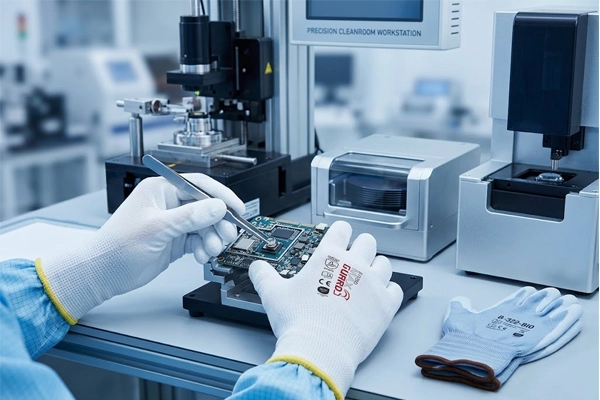
To meet the multidimensional and stringent requirements of global semiconductor packaging and testing giants, high-precision optical module manufacturers, and medical device clean assembly workshops—including particle interception, ergonomic comfort, and ESG-compliant green and low-carbon standards—the SQG R&D team has launched a range of low-lint protective gloves specifically designed for controlled clean environments. The entire product line strictly employs a 100% continuous filament seamless knitting process and microporous polyurethane elastomer fiber-locking technology, eliminating fiber breakage and coating peeling at the source to provide a high-end cleanroom solution that combines physical purity with excellent tactile sensitivity.
Optical & Clean Assembly Standard: B-312-BIO-WL (13-Gauge White Bio-PU)
Tailored for high-end in-vehicle camera module (CCM) encapsulation, optical lens assembly, liquid crystal display (LCD/OLED) lamination, and high-cleanliness dust-free inspection stations:
Deep integration of a 13-gauge high-tenacity continuous filament liner with white bio-based water-based PU: B-312-BIO-WL, featuring a 13-gauge continuous nylon liner and a white bio-PU palm coating, utilizes a high-grade, 100% seamless woven continuous nylon filament liner, eliminating the drawbacks of traditional short-fiber materials that are prone to pilling and breakage. Paired with a high-purity white bio-based polyurethane palm coating, it not only presents a visually clean and fresh appearance—facilitating rapid visual inspection for surface contaminants—but also effectively eliminates the odor associated with rubber vulcanization, meeting high-grade cleanroom standards for the control of airborne molecular contaminants (AMC).
Microscopic, dense fiber-locking structure and all-weather fatigue resistance: The gloves undergo multiple stages of ultra-pure water purification and post-treatment, strictly controlling the concentration of surface free particles and extractable ions. Its highly resilient, microporous PU membrane layer exhibits excellent resistance to chalking and cracking when subjected to high-frequency shear friction from tooling fixtures and the edges of rigid lens barrels, comprehensively preventing the escape of fiber lint and coating debris to ensure consistently stable assembly yield over extended periods.
Sustainable Low-Lint Precision Benchmark: B-322-BIO (18-Gauge RPET Fiber)
Designed specifically for die sorting, micro-SMT assembly, precision medical device packaging, and multinational smart manufacturing enterprises seeking deep decarbonization of their supply chains:
A closed-loop innovation combining 100% recycled polyester filament with an ultra-thin, flexible coating: B-322-BIO, an 18-gauge seamless RPET filament liner with a soft PU coating, utilizes high-purity recycled polyester (RPET) continuous monofilament certified under the Global Recycled Standard (GRS), paired with an ultra-thin, flexible bio-based PU coating. The smooth, knot-free monofilament structure eliminates the risk of short fibers rubbing off and causing lint (Zero-Linting) at the source, while significantly reducing carbon footprint emissions during the raw material extraction phase, providing solid data support for companies’ Scope 3 supply chain decarbonization targets.
0.65 mm ultra-thin lamination and a second-skin-like tactile sensation for precise manipulation: An ultra-dense 18-gauge weave minimizes the composite thickness on the palm, reducing finger-tip bending resistance to an imperceptible level. When wearing these gloves, operators can use ultra-fine anti-static tweezers to pick up tiny bare chips or adjust micron-level knobs while experiencing precise, subtle tactile feedback identical to that of bare hands, effectively preventing accidents such as workpiece slippage or pin deformation caused by clumsy glove handling.
To view physical and mechanical test data sheets and third-party laboratory dust emission test certificates for our full range of cleanroom anti-static, low-solvent-residue, and bio-based eco-friendly polyurethane protective gloves, or to obtain bulk custom procurement solutions directly from the manufacturer, please visit our main product category guide, Precision PU Palm-Coated Work Gloves Direct from Manufacturer, at any time for in-depth evaluation and sample selection.
Quality Assurance: Auditing Cleanroom Test Reports and SOPs
When reviewing material acceptance for precision electronics and semiconductor cleanrooms, simply verifying the “pass” stamp on test reports submitted by suppliers is far from sufficient. Due to differences among testing laboratories in sampling methods, agitation intensity, and instrument calibration standards, procurement quality engineers (SQEs) and microcontamination control specialists must master core methods for reviewing the underlying details of third-party test reports and establish scientifically rigorous standard operating procedures (SOPs) for cleanroom access and reuse.
How to Verify Third-Party Particle Shedding Certificates (LPC/APC)
When reviewing particle shedding test certificates issued by authoritative laboratories (such as SGS, TÜV, or specialized cleanroom testing organizations), it is essential to carefully compare the following key technical details:
Verify sample pretreatment and the purity of the extraction medium: A compliant liquid particle count (LPC) test report must explicitly state that ultrapure water with a resistivity of 18 megohms per centimeter (18 MΩ·cm) was used as the extraction medium, and the particle count in the test background blank (Blank Control) must be close to zero. Some non-compliant reports conceal the glove’s actual particle shedding by artificially inflating the initial background noise or using unpurified distilled water; such reports cannot serve as the basis for material release in high-grade cleanrooms.
Verify oscillation frequency, extraction time, and particle size channel coverage: Under the IEST-RP-CC005.4 standard procedure, glove samples must undergo physical immersion extraction for a sufficient duration in an orbital shaker set to a specified amplitude (e.g., 150 rpm). The report data should list the individual counts for all particle size channels—0.5 micrometers, 1.0 micrometers, 2.0 micrometers, and 5.0 micrometers—rather than simply providing a vague total particle count.
Compare the rotational speed of the dry dust generation test (Helmke Drum APC) with the sampling flow rate: When reviewing dry dust generation test certificates, it is essential to verify that the drum rotational speed is consistently maintained at 10 rpm and that the air sampling flow rate of the laser particle counter is the standard 1 CFM (28.3 L/min). Any low dust generation data resulting from shortening the test cycle or reducing the airflow velocity constitutes a distortion of the test method.
Cleanroom Gowning Protocols: Glove Laundering vs. Single-Use Limits
In controlling daily cleanroom operating costs, the decision on whether gloves should be treated as single-shift consumables or reused after cleanroom laundering must be based on a rigorous assessment of physical performance degradation:
Process boundaries and limitations of professional cleanroom laundering: High-quality continuous-filament polyurethane gloves can indeed restore surface cleanliness after being washed with deionized water, degreased with surfactants, and dried in a HEPA-isolated environment using a professional Class 100 cleanroom washer. However, the mechanical shear from water flow and high-temperature spin-drying during industrial laundering gradually weakens the physical cross-linking network of the microporous PU coating on the glove palms.
Coating Microcracking and Single-Use vs. Reuse Limits: Typically, the number of laundering cycles for filament PU gloves should be limited to 2 to 3. If this threshold is exceeded, the polyurethane film layer will undergo microscopic embrittlement after repeated swelling and drying, making it highly prone to secondary flaking during subsequent wear and stress, which can lead to sudden LPC exceedances on clean production lines.
Knowledge Base: Frequently Asked Questions (FAQs) & CTA
The following summarizes key answers and product selection recommendations addressing the practical technical questions that procurement engineers at semiconductor foundries, automotive camera optical assembly lines, and high-grade cleanrooms are most concerned about during the material introduction phase. Here are the essential technical answers regarding the deployment and maintenance of lint-free pu cleanroom gloves in controlled environments.
Can white PU gloves be used directly in ISO Class 5 cleanrooms?
Standard white PU gloves that have not undergone post-treatment must never be used directly in ISO Class 5 (Class 100) cleanrooms. Although their white appearance may seem clean, these standard gloves accumulate significant amounts of airborne dust and release agents on their surfaces during production, packaging, and transportation. Only professional-grade filament PU gloves—which have undergone multiple stages of deep washing with 18 megohms per centimeter (18 MΩ·cm) ultra-pure deionized water (DI Water) and have been double-layered and anti-static vacuum-sealed in an ISO Class 4 cleanroom—may be used directly in ISO Class 5 core production areas after passing LPC/APC testing.
What causes conventional PU gloves to shed microscopic particles?
Particle shedding in conventional gloves primarily stems from two underlying physical defects: First, the fabric lining is woven from short fibers (spun yarn). Under high-frequency bending and stretching of the fingers, as well as friction with workpieces, the ends of the short fibers break off, forming airborne lint; Second, the low-end polyurethane coating lacks sufficient abrasion and shear resistance or has a low degree of curing and cross-linking. When scraped by hard fixtures, the polymer film develops fatigue microcracks and eventually shatters and pulverizes into micron-sized polyurethane debris (flaking).
How does surface resistivity prevent ESD damage during PCB handling?
During SMT placement and PCB assembly, friction between ordinary insulated gloves and component surfaces can easily build up electrostatic charges of several thousand volts. When the gloves come into contact with the pins of sensitive chips, the electrostatic charge discharges instantaneously, causing the gate oxide layer to break down (ESD breakdown damage). By blending carbon fibers or conductive multifilaments into continuous filament nylon, the glove’s surface resistivity is precisely controlled within the electrostatic dissipative range of 10⁶ to 10⁹ ohms (Ω). This allows static charge generated by friction with the human body to dissipate in a controlled, gradual manner, preventing spark discharge and microcircuit breakdown damage at the source.
Is a fingertip-coated (Top-Fit) glove cleaner than a palm-coated glove?
Top-Fit gloves are not necessarily superior to Palm-Fit gloves in terms of dust control. The advantage of Top-Fit gloves lies in the large areas of exposed knitted mesh on the back of the hand and palm, which provide excellent heat dissipation and breathability; however, due to the lack of a dense PU coating—which acts as a physical barrier to lock in fibers—on the palm, if the base fabric has not undergone thorough purification with deionized water, the amount of particles released from the palm fabric during repeated stretching is actually higher than that of full-palm-coated gloves. Full-palm-coated gloves, on the other hand, completely seal and encapsulate all fibers on the palm with a full-surface polyurethane coating, providing a more thorough physical barrier against particle release.
Call to Action (CTA)
To help your engineering team quickly complete compliance assessments for cleanroom consumables, verify particle emission data, and conduct on-site production line sample testing, SQG industrial safety experts provide comprehensive technical support services:
To obtain detailed SGS/TÜV third-party LPC/APC particulate shedding test certificates, ion residue analysis data sheets, and free production line test sample kits, please contact our technical support team directly: Request Cleanroom Compatibility Data & Free Sample Kits.
View product specifications for our full lineup of 13- to 18-gauge continuous filament lint-free gloves, anti-static ESD conductive gloves, and bio-based, low-carbon PU-coated gloves: Explore Cleanroom & Lint-Free PU Gloves Lineup.