In precision manufacturing and microelectronics assembly lines, choosing between 13-gauge vs 18-gauge pu coated gloves is a critical engineering trade-off for frontline efficiency. At workstations in sectors such as 3C consumer electronics, semiconductor packaging, and precision medical devices, front-line operators face typical ergonomic challenges: Prolonged use of traditional 13-gauge gloves during operations causes the fabric’s thickness and flexural resistance to induce sustained fatigue in the hand’s micro-muscle groups during hours of high-frequency pinching. This leads to stripped threads when tightening M1.0 micro-screws, misalignment of FPC flexible cables, and minor scratches on product surfaces; However, indiscriminately switching to 18-gauge ultra-thin gloves across the entire production line can easily lead to premature wear-through and scrapping of gloves at general workstations involving sharp metal stamping edges or mild abrasion, thereby driving up consumable procurement costs.
To achieve the optimal balance between finger tactile sensitivity and abrasion resistance, companies must thoroughly analyze the profound impact of knitting gauge, yarn denier, and polyurethane (PU) resin penetration control on frontline worker efficiency. By scientifically defining the boundaries of workstation operations, factories can not only eliminate micro-downtime during assembly cycles but also significantly improve the production line’s first-pass yield (FPY).
Before delving into a detailed comparison of the physical and mechanical differences among various knitting gauges, we recommend visiting our core product category page Precision PU Palm-Coated Work Gloves Direct from Manufacturer to gain a comprehensive understanding of the standardized technical specifications and customization options for filament seamless-knit linings and eco-friendly bio-based PU coatings in high-end precision manufacturing.
Knitting Gauge Engineering: Needle Density and Denier Dynamics
In the industrial production process of seamless knitted gloves, the physical properties and microstructure of the glove lining are entirely determined by the needle density on the knitting machine’s cylinder and the yarn specifications. Knitting gauge not only represents the knitting density of the glove but is also the underlying physical parameter that directly determines the fit, elasticity, and tactile precision of the finished glove.
Gauge Mechanics: Calculating Needles per Linear Inch
In glove manufacturing, “gauge” refers to the number of knitting needles arranged per 1 inch (25.4 mm) of linear length on the knitting machine’s needle bed or cylinder:
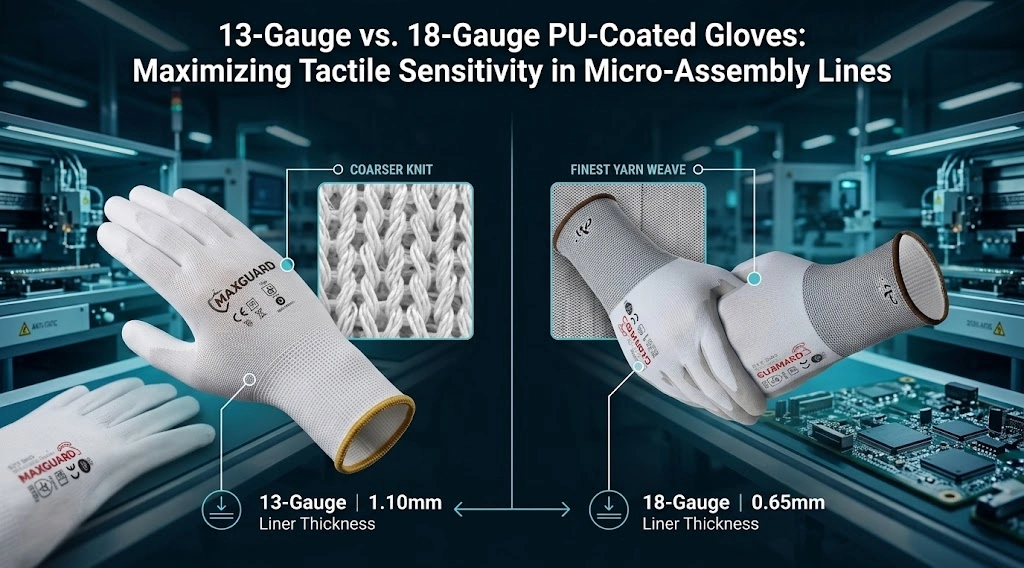
13-Gauge Needle Bed Configuration: A 13-gauge knitting machine arranges 13 needles per inch. Due to the relatively wide spacing between needles, the resulting loop structure is coarser and looser, with larger mesh apertures per unit area, making it suitable for accommodating thicker industrial-grade multifilament yarns.
18-Gauge Ultra-Dense Micro-Needle System: An 18-needle knitting machine arranges 18 precision needles within the same one-inch physical space, increasing needle density by approximately 38% compared to the 13-needle model. The dense needle arrangement results in extremely fine and compact microscopic loops in the knitted fabric, with the number of loop interlacing points per square centimeter increasing exponentially, yielding a microscopic density and smoothness comparable to that of silk fabric.
Yarn Denier Dynamics: 70–100D Fine Filaments vs. 200–280D Standard Fibers
The physical width of a knitting machine’s needle bed strictly limits the fiber denier (D, which refers to the weight in grams of a 9,000-meter-long fiber) that can pass through the needle eyes to participate in knitting. There is a strict correlation between the number of needles and yarn thickness:
200–280D Standard Industrial Yarns (13-Gauge): 13-gauge gloves typically use coarse-gauge nylon or polyester filaments ranging from 200D to 280D, or yarns plied from multiple strands of finer yarns. The thicker diameter of the individual yarns provides the glove lining with higher initial fiber mass and tensile strength, but inevitably increases the fabric’s stiffness and initial uncompressed thickness.
70–100D Ultra-Fine High-Strength Filaments (18-Gauge): The fine needle slots of an 18-gauge knitting machine cannot accommodate thick, heavy yarns, so ultra-fine, high-strength continuous filaments ranging from 70D to 100D must be used.
Cross-Sectional Thickness & Dimensional Compression
The cross-sectional thickness of a glove at the interface between the fingers and the palm directly determines the rate of force transmission attenuation when a worker is handling small components. From the uncoated liner to the finished, dipped glove, 13-gauge and 18-gauge materials exhibit completely different cross-sectional compression characteristics in terms of physical dimensions.
Uncoated Liner Thickness: 0.85 mm (13-G) vs. 0.45 mm (18-G) Baseline
Before any polymer dipping treatment is applied, the original thickness of the pure fabric glove liner forms the glove’s fundamental mechanical barrier:
13-Gauge Initial Uncompressed Thickness (0.80 mm – 0.90 mm): Due to the use of coarser multifilament fibers (200D or higher) and a large-loop structure, the average physical cross-sectional thickness of the 13-gauge uncoated liner is approximately 0.85 millimeters. The thicker fabric layer retains more air pockets on the back of the hand and at the finger joints; while it provides good cushioning and protection, it creates a noticeable physical barrier during fine motor tasks.
18-Gauge Ultra-Thin Base (0.40 mm – 0.50 mm): Thanks to the dense interlacing of 70D to 100D ultra-fine filaments, the cross-sectional thickness of the 18-gauge bare lining is compressed to approximately 0.45 mm—nearly 50% thinner than the 13-gauge lining. When worn, this base layer closely conforms to the contours of the fingers, leaving virtually no excess gaps or fabric bulges, laying the foundation for a second-skin-like fit.
Finished Product Microporous PU Palm Profile (0.65 mm vs. 1.10 mm)
After impregnating the palm and fingertips with an ultra-thin, microporous polyurethane (PU) resin film approximately 0.20 mm to 0.25 mm thick, the difference in the finished glove’s total cross-sectional thickness becomes even more pronounced:
13-Gauge Finished Palm Cross-Section (1.05 mm – 1.15 mm): When the PU resin penetrates and cures on the surface of the coarser 13-gauge fiber loops, the total thickness of the finished glove’s palm and fingertips typically exceeds 1.10 mm. When assembling microelectronic connectors smaller than 1 mm or adjusting micron-scale optical lenses, a medium layer exceeding 1 mm significantly impairs the fingertips’ ability to perceive minute changes in resistance.
18-Gauge Finished Palm Cross-Section (0.65 mm – 0.70 mm): After the ultra-thin 18-gauge lining is tightly bonded to the microporous PU resin, the total thickness of the finished palm is precisely controlled within the optimal range of 0.65 mm to 0.70 mm.
Tactile Sensitivity: Biological Mechanoreceptor Feedback
In high-precision manual assembly and micro-manipulation quality inspection stations, the precision with which workers control workpieces relies heavily on real-time signal feedback from subcutaneous biomechanical mechanoreceptors in the fingers. The thickness and elastic modulus of the glove material directly determine the degree of attenuation of pressure waves and microscopic vibrations as they pass through the fabric layer.
Signal Transmission Mechanisms of Meissner’s and Merkel’s Corpuscles
The fingertips of the human hand are densely populated with two types of tactile corpuscles that are crucial for micro-assembly:
Meissner’s corpuscles and microslip detection: Primarily located in the papillary dermis, they are extremely sensitive to low-frequency vibrations (10 to 50 hertz) and slight object displacements, and are responsible for real-time monitoring of workpiece slippage at the fingertip. The 0.65-millimeter composite thickness of the 18-gauge glove, achieved through extreme compression, transmits the shear forces generated by the workpiece’s micro-slip to the Meissner’s corpuscles with near-zero delay, allowing workers to maintain precise grip balance without having to grip the part too tightly; In contrast, 13-gauge gloves, due to their thicker fabric layers, exhibit significant damping and absorption of minute shear forces, which can easily lead workers to apply excessive grip force to prevent the workpiece from slipping.
Merkel Discs and Microscopic Contour Discrimination: Located in the basal layer of the epidermis, these discs are highly sensitive to sustained static pressure and spatial resolution, serving as the core sensory organs for identifying the sharpness of part edges, chamfers, and surface roughness. The high-density structure of 18-gauge ultra-fine fibers allows them to closely conform to fingerprint ridges, enabling Merkel discs to clearly perceive microscopic protrusions smaller than 0.5 millimeters in diameter; in contrast, the relatively coarse 13-gauge loops generate fabric texture interference when pressure is applied to the fingertips, disrupting workers’ ability to discern the microscopic geometric features of workpieces.
Tactile Perception of Micro-Components: M1.0 Screws and Sub-Millimeter Pins
In precision manufacturing, the alignment of micro-components often requires “blind operation”-level tactile confirmation:
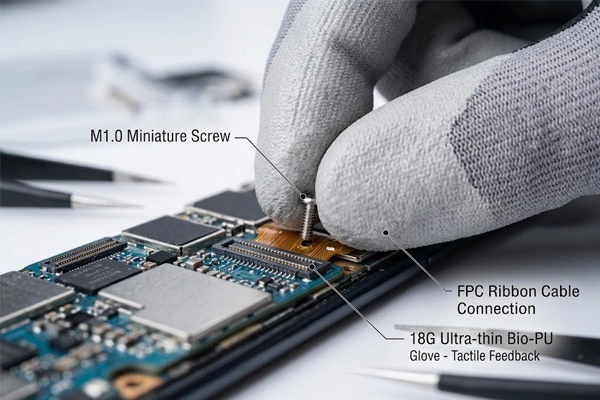
Anti-slip thread engagement for M1.0 to M2.5 micro-screws: At screw-tightening stations for 3C consumer electronics, workers need to perceive the “drop-in click” sensation when the screw threads engage with the hole using their fingertips. When wearing 18-gauge PU gloves, workers can clearly sense the slight resistance when the screw aligns with the center of the screw hole, preventing stripped threads and thread damage caused by forcing the screw in at an angle from the outset; wearing thick 13-gauge gloves, however, often requires workers to repeatedly rely on visual inspection or a microscope for alignment, slowing down the production cycle per unit.
Hand Ergonomics and Cumulative Musculoskeletal Fatigue
In labor-intensive precision assembly workshops, muscle fatigue in workers’ hands directly affects assembly speed and quality consistency during the latter half of a shift. The reverse elastic resistance generated by glove fabric during repeated finger flexion is a key factor contributing to musculoskeletal disorders (MSDs) in the hands and the distortion of operational movements.
Finger Flexion Resistance: Calculating Continuous Energy Expenditure
When fingers perform grasping, pinching, and rotating motions, the glove fabric and coating are forcibly stretched on the outer side of the finger interphalangeal joints (PIP and DIP joints), while compression wrinkles form on the inner side:
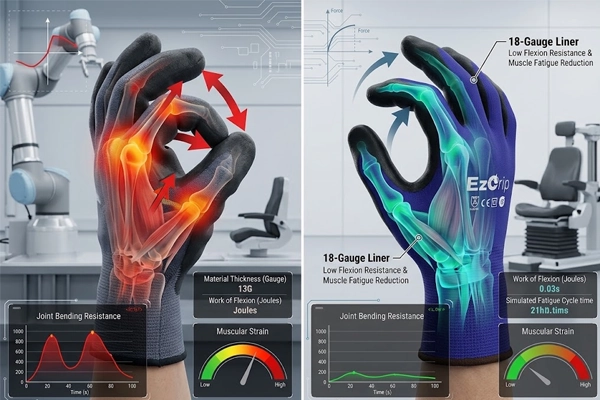
Mechanical resistance to deformation in 13-gauge fabric: Due to the thick loops of 200D coarse yarn and moderate weave density in 13-gauge gloves, the rebound resistance of the glove fabric that must be overcome for a single full finger joint flexion (90-degree flexion) typically ranges from 0.8 to 1.2 newtons. While this resistance is negligible in a single movement, a 3C assembly line worker must repeat pinching motions 8,000 to 12,000 times per shift; the cumulative extra work expended by the deep flexor muscles of the hand and the interossei muscles to overcome the glove’s resistance is considerable.
Low-energy performance of 18-gauge ultra-fine elastic yarn: 18-gauge gloves use 70D ultra-fine filaments with extremely low single-filament bending stiffness; when combined with a microporous PU film, the resistance to reverse deformation during finger joint flexion is reduced to 0.2 to 0.3 newtons, representing a reduction in resistance of over 60%. Workers barely feel the glove’s restrictive rebound force, allowing finger muscles to operate continuously in a natural, low-energy state similar to that of bare hands.
Mitigating Cumulative Trauma Disorders (CTD) in 8-Hour Assembly Shifts
Performing fine hand movements under high resistance over long periods can lead to cumulative trauma disorders (CTD):
Preventing Carpal Tunnel Syndrome and Tendonitis: When working with thicker 13-gauge gloves, workers unconsciously increase their grip pinch force to ensure small components do not fall due to reduced tactile feedback and flexion resistance. This leads to repeated excessive friction of the flexor tendons within the carpal tunnel, making them highly susceptible to tendonitis and carpal tunnel nerve compression.
Eliminating the Shift-End Fatigue Curve: Introducing 18-gauge ultra-thin PU gloves can effectively reduce the rate of lactic acid accumulation in the forearm muscle groups during an 8-hour shift. On-site testing has shown that during the final 2 hours of a shift, operators wearing 18-gauge gloves are still able to maintain a steady rhythm of fine-motor pinching motions, effectively reducing workpiece drops, misalignments, and minor production line downtime caused by hand soreness and numbness in the fingertips.
Polymer Interplay: Controlling PU Resin Strike-Through
On the dip-coating production line for seamless knitted gloves, the thinner the glove lining and the higher the gauge, the more stringent the rheological control between the polymer resin and the fiber substrate must be. Ensuring that ultra-thin polyurethane (PU) resin forms a continuous, uniform grip layer on the glove surface while completely preventing resin from penetrating the palm side of the lining (strike-through) is the defining process that distinguishes ordinary gloves from high-end precision assembly gloves. For information on the fundamental differences between PU, nitrile, and natural latex in terms of film-forming mechanisms and microscopic barrier properties, please refer to our basic selection guide PU Coated vs. Nitrile vs. Latex Work Gloves: The Definitive B2B Selection Guide for Precision Manufacturing.
Vulnerability to Strike-Through in High-Density 18-Gauge Knits
Strike-through (or penetration) refers to a manufacturing defect that occurs during the curing of the coating, where liquid resin seeps through gaps in the yarn, penetrates the fabric layers, and solidifies on the inner lining of the glove:
Microscopic Gaps and Capillary Suction: 18-gauge gloves are made from ultra-fine multifilament fibers ranging from 70D to 100D. Although the overall knit is dense, the individual filaments are extremely fine, and the total fabric thickness is only about 0.45 millimeters. As a result, liquid resin can easily trigger intense capillary suction the moment it comes into contact with the fabric surface. If the viscosity of the resin in the dipping tank or the immersion depth is not properly controlled, the resin will instantly penetrate the paper-thin fabric layer.
Internal hardening and skin abrasion: Once resin penetration occurs, the cured PU resin particles form microscopic hardened areas and rough granules inside the glove. This not only destroys the soft, skin-friendly feel of the 18-gauge knit fabric—causing localized hardening, deformation, and loss of elasticity in the gloves—but also repeatedly rubs against the skin’s surface when workers sweat during work, inducing contact dermatitis or red, swollen blisters, which directly leads to production line workers’ reluctance to wear the gloves.
Advanced Low-Viscosity Waterborne/Bio-PU Dipping Controls
To achieve “zero adhesive penetration” on ultra-thin 18-gauge and 15-gauge knitted fabrics while maintaining ultra-thin breathability on the palm, advanced manufacturing processes have thoroughly reengineered the dipping formulation and gel kinetics:
Precise control of shear viscosity and surface tension: Utilizing a new-generation bio-based PU or waterborne PU emulsion system, the precise addition of thixotropic agents and nonionic rheological modifiers ensures the coating slurry exhibits excellent leveling and spreading properties during pressure impregnation, while its viscosity rapidly recovers the moment it comes into contact with the fabric surface of the glove mold, preventing the coating from penetrating deeper into the fabric.
Microscopic Controlled Pre-impregnation and Shallow-Layer Gel Barrier Technology: Before the glove mold enters the PU resin tank, a micro-controlled amount of a harmless, environmentally friendly coagulant is applied via high-precision atomized spraying to create a microscopic chemical barrier layer on the outermost surface of the 18-gauge lining.
Mechanical Abrasion Limits & Fiber Mass Longevity
When evaluating the total life-cycle cost and replacement cycle of protective gloves, the fiber mass and mechanical abrasion longevity of the glove fabric are key metrics that procurement and engineering teams must quantify. Gauge not only affects the glove’s tactile feel but also directly defines the physical failure limits of the glove under mechanical friction and external pulling forces.
EN 388 Level 1–3 Abrasion Resistance vs. Knitting Density
Under the European EN 388 standard for mechanical protection, abrasion resistance (Martindale Abrasion Test) is determined by the number of cycles in which sandpaper is rotated against the glove’s palm until the coating is worn through and the fiber lining is exposed:
Long-term abrasion resistance of 13-gauge gloves (EN 388 Levels 2–3, 1,000–2,000 cycles or more): The 13-gauge lining uses coarse-gauge multifilament yarns of 200D or higher, resulting in a high fiber mass per loop, and features a thicker PU coating (typically exceeding 0.25 millimeters). As the surface PU resin gradually wears away during prolonged use, the coarser nylon or polyester fibers beneath continue to act as a secondary physical buffer layer, resisting continuous frictional shear forces and resulting in a longer overall abrasion resistance lifespan.
18-Gauge Precision Light-Duty Abrasion-Resistant Positioning (EN 388 Level 1–2, approximately 100–500 revolutions): To achieve ultimate fingertip dexterity, 18-gauge gloves feature a PU coating of approximately 0.20 mm and a 70D ultra-fine fiber lining. Although the dense loop arrangement provides a smooth contact surface, the thinner resin layer and smaller monofilament cross-sectional area result in an abrasion resistance rating lower than that of 13-gauge products. Therefore, 18-gauge gloves are specifically designed for light-duty workstations involving low mechanical friction and high-frequency fine motor tasks, rather than high-load workstations involving the grinding of rough parts.
Snag and Friction Failure Modes on Automated & Semi-Automated Lines
On automated and semi-automated industrial assembly lines, the physical damage modes experienced by gloves are typically divided into two categories:
Continuous Planar Friction Wear (Abrasive Friction Wear): At workstations on assembly lines where smooth plastic housings, polished glass lenses, or cylindrical metal parts are repeatedly handled, 18-gauge gloves—with their extremely smooth and dense surfaces—ensure even distribution of frictional stress, enabling a stable and long service life. However, on the rough edges of injection-molded sprues or the surfaces of stamped metal sheets, the ultra-thin coating of 18-gauge gloves wears through relatively quickly due to localized high-pressure friction.
Snagging and Micro-Tears: When handling parts with tiny metal burrs, fine spring tips, or the sharp corners of cable ties, the coarser loops of 13-gauge gloves—due to their relatively noticeable gaps between fibers—can sometimes get caught on sharp edges, leading to noticeable fraying and loop breakage;
Technical Benchmark: 13-Gauge vs. 15-Gauge vs. 18-Gauge Engineering Matrix
To help lean production engineers and occupational safety and health procurement managers at manufacturing plants move beyond relying solely on subjective try-on evaluations, engineering teams need to establish gauge selection criteria based on quantified material mechanical properties, weave physical metrics, and ergonomic test data.
Comprehensive Performance Benchmark Table
The table below summarizes key engineering parameters measured in both laboratory test environments and real-world production line conditions, clearly comparing the differences in physical structure and on-the-job performance among 13-gauge, 15-gauge, and 18-gauge PU-coated gloves:
| Key Engineering Metrics | 13-Gauge (Standard Industrial Assembly Grade) | 15-Gauge (High-Stretch Balanced Intermediate Level) | 18-Gauge (Ultra-Thin, Precision-Manipulation Grade) |
| Knit Density | 35–45 stitches per square centimeter | 50–60 stitches per square centimeter | 75–90 stitches per square centimeter |
| Yarn Denier | 200D–280D coarse-gauge multifilament | 140D–160D blended high-stretch yarn | 70D–100D ultra-fine, high-strength filament |
| Overall Thickness | 1.05 mm–1.15 mm | 0.85 mm–0.95 mm | 0.65 mm–0.70 mm |
| Dexterity Score (1–5) | 3.5 / 5.0 (General-Purpose Mechanical Agility) | 4.2 / 5.0 (Excellent Softness and Conformity) | 5.0 / 5.0 (bare-hand-level tactile sensitivity) |
| Flexion Resistance | 0.8 N – 1.2 N (High Damping) | 0.4 N – 0.6 N (Low to Medium Damping) | 0.2 N–0.3 N (Ultra-Low Resistance) |
| EN 388 Abrasion Level | Level 2–3 (1,000–2,000 RPM and above) | Level 2 (500–1,000 RPM) | Level 1–2 (100–500 RPM) |
| Unit Cost Index | Basic Model (Most Economical Price) | Mid-to-High-End Model (Balances Value and Performance) | Higher-end models (precision, high value-added) |
| Primary Workstations | Metal stamping assembly, home appliance housing assembly, large-item sorting and packaging | Precision automotive wiring harnesses, instrument cluster assembly, workstations requiring elastic conforming | Chip packaging, micro-flat cable bonding, camera module debugging, dispensing under a microscope |
Workstation-to-Gauge Allocation: Standard vs. Micro-Precision Assembly
Based on the above comparison of data flows, factories should follow the principle of precisely matched workstation allocation when developing standard operating procedures (SOPs) for manual labor protection:
Micro-operations and high-value-added precision workstations (mandatory use of 18-gauge gloves): Workstations involving tasks such as fastener tightening for components smaller than 2 millimeters, optical calibration, quality inspection of wafers and micro-display panels, and blind insertion of FPC flexible cables—which place extremely high demands on fingertip tactile sensitivity and fatigue resistance—must use 18-gauge ultra-thin gloves across the entire production line. Although the wear and tear rate for a single pair of gloves is slightly faster, the benefits to the production line’s first-pass yield—achieved by eliminating motion pauses and reducing cosmetic scratches on products—far outweigh the cost difference in consumable procurement.
Highly elastic, adaptive workstations for long shifts (15-gauge recommended): For workstations requiring both moderate tear resistance and a tight fit—such as the insertion and removal of complex automotive wiring harnesses and the assembly of instrument panel housings—15-gauge blended gloves offer an excellent balance between fatigue resistance and abrasion resistance.
General-purpose machinery assembly and light-load packaging/logistics workstations (standardized 13-gauge): For workstations involving the handling of large-particle components, final assembly of injection-molded housings, carton handling, and light hardware assembly, we continue to use standardized 13-gauge gloves. Their substantial fiber density enables lower monthly replacement frequencies and better control over procurement costs.
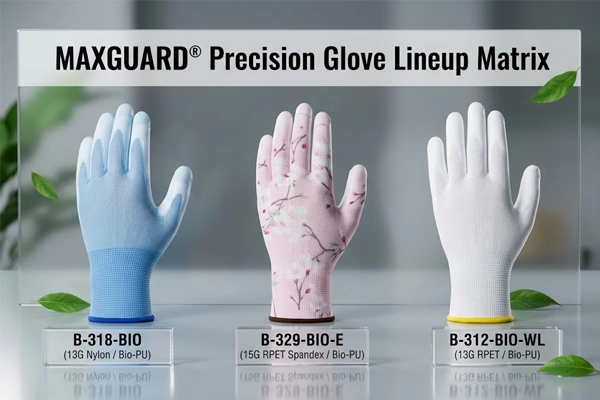
Strategic Deployment: SQG® MAXGUARD® High-Gauge Precision Series
To meet the dual stringent demands of global advanced manufacturing enterprises for improved ergonomic dexterity and a low-carbon transition in ESG supply chains, the SQG® R&D team has launched a new generation of MAXGUARD® high-gauge precision polyurethane protective gloves. This series deeply integrates microporous bio-based PU coating technology with high-density seamless knitting processes, providing tiered engineered protection solutions—ranging from standard long-lasting assembly to extreme precision tactile control—tailored to the needs of fine-motor operations across various workstations.
Standard Industrial Assembly Baseline: B-318-BIO (13-Gauge Seamless Nylon)
In routine workstations such as general machinery assembly, automotive parts assembly, and hardware tool handling, the glove’s mechanical abrasion resistance and long-term structural stability are key to reducing consumable turnover costs per workstation:
High-Tensile 13-Gauge Seamless Nylon Base: B-318-BIO, MAXGUARD, 13-gauge seamless nylon liner, bio-based PU coating. Woven from 13-gauge high-strength seamless nylon filaments, the fibers themselves possess excellent tensile strength and abrasion resistance, providing a solid foundation for mechanical protection of the palm and fingers.
Abrasion-Resistant, Eco-Friendly Coating and Low-Wear Operation: The bio-based PU coating applied to the palm maintains excellent dry-grip performance while effectively delaying coating wear caused by repeated handling of hard workpieces. This makes it the standard model of choice for factories seeking to balance durability, cost control, and 5S workplace management in large-scale bulk procurement.
High-Elasticity Adaptive Ergonomics: B-329-BIO (15-Gauge Seamless RPET/Spandex)
At precision assembly and wiring harness insertion/removal workstations that require prolonged continuous operation and frequent flexion and extension of finger joints at various angles, the dynamic elasticity of the gloves directly determines the rate at which workers’ hands accumulate fatigue:
15-gauge RPET and spandex high-elasticity blended system: B-329-BIO, MAXGUARD, a 15-gauge seamless RPET/Spandex fiber liner with a bio-based PU coating, innovatively interweaves highly elastic spandex fibers into recycled polyester filaments and employs a fine 15-gauge knitting process, giving the glove a snug, compression-garment-like fit.
Adaptive hand contouring and low-friction ergonomics: The highly elastic liner eliminates the loose, bunched fabric commonly found in traditional gloves at the web and palm areas. It stretches and contracts in real time with finger movements, reducing bending resistance to an extremely low level. This makes it ideal for precision electronic assembly lines with a high proportion of female operators and instrument assembly stations that demand a tight, skin-like fit.
Ultra-Sensitive Micro-Assembly Specialty: B-312-BIO Series (Precision RPET)
In ultra-precise micro-assembly workstations—such as those used in 3C consumer electronics, optical lens calibration, and dispensing under a microscope—there are nearly exacting requirements for lint-free filaments (Zero-Lint) and fingertip tactile sensitivity:
100% post-consumer recycled fiber (RPET) with dense, seamless weaving: The B-312-BIO, MAXGUARD, 13-gauge seamless RPET liner with a bio-based PU coating is woven from continuous monofilament long fibers, fundamentally eliminating the risk of short-fiber pilling and shedding. Combined with a dense, uniform, and smooth weave, this ensures an extremely high level of operational cleanliness.
Ultra-thin microporous film and bare-hand-like tactile feedback: Combined with controlled dipping in a low-viscosity, eco-friendly bio-based PU coating, the sensation of a barrier between the palm and fingers is minimized to the extreme, helping operators clearly detect micro-vibrations in the slots and surface textures of sub-millimeter parts, fully enabling high-precision, dust-free micro-assembly.
For more technical support regarding continuous filament specifications, ergonomic hand patterns, and bulk purchasing directly from the manufacturer, please visit our main product category page, “Precision PU Palm-Coated Work Gloves Direct from Manufacturer,” to view complete product specifications and engineering selection parameters.
Cleanroom & ESD Integration in Ultra-Dense Liners
In manufacturing environments for semiconductor packaging and testing, micro-electro-mechanical systems (MEMS), optical coating, and next-generation display devices (OLED / Micro-LED), workstation gloves not only protect operators’ fingers and enable precise manipulation but also serve as the first line of defense against contamination and static electricity in controlled cleanroom environments. Seamless knitted liners with high thread counts, thanks to their dense fiber structure and filament continuity, offer inherent technical integration advantages in both particulate control and electrostatic dissipation (ESD safety).
Continuous Filament Integrity: Zero-Lint Control in ISO Class 5–7 Lines
In ISO Class 5 to 7 controlled cleanrooms, microscopic airborne dust and fiber shedding are critical causes of wafer short circuits, poor chip pin soldering, and dead pixels on display panels:
Continuous Filament Eliminates Fiber Breakage and Shedding (Zero-Linting): High-gauge 18-gauge and premium 13-gauge gloves eliminate traditional cotton yarns spun from short fibers, instead utilizing 100% continuous monofilament nylon or polyester (RPET/Polyester) filaments. These filaments possess the structural integrity for infinite physical elongation, eliminating at the source the risk of short fibers breaking, shedding lint, and dispersing into the air during the friction and flexing of the gloves.
High-Gauge Dense Loops Combined with Physical Locking via PU Resin: The 18-gauge ultra-high-density weave significantly compresses the microscopic pores between yarns. Combined with microporous polyurethane (PU) resin that permeates and securely encapsulates the fiber nodes on the fabric’s outer layer, this eliminates pilling and wear-induced flaking caused by prolonged, high-frequency pinching motions, ensuring strict compliance with cleanroom airborne particle count standards (Helmke Drum Test).
For information on semiconductor-grade cleanroom particulate emission testing standards (ASTM/ISO) as well as cleaning and dust-free packaging controls for low-lint gloves, please refer to our technical guide Lint-Free PU Palm Coated Gloves: Preventing Particulate Contamination in Semiconductor Environments.
Interweaving of Conductive Carbon and Copper Filaments in High-Gauge Liners
At high-speed microelectronics assembly stations, friction between the human body and workpieces can easily generate static charges of thousands of volts; electrostatic discharge (ESD) can instantly cause breakdown in the gates of submicron-scale semiconductor devices:
Precise Blending of Conductive Composite Fibers at Microscale Spacing: Utilizing high-density 15-needle and 18-needle knitting technologies, the manufacturing process uniformly interweaves ultra-fine conductive carbon filaments or composite copper wires into the base fiber substrate, forming a microscopic conductive grid throughout the glove’s lining and across the palm and fingers.
Consistent Electrostatic Discharge (ESD) Dissipation and Arc Breakdown Protection: The dense arrangement of high-gauge threads reduces the physical spacing between conductive fibers, maintaining the glove’s surface resistivity within the safe ESD dissipation range of 10⁶ to 10⁹ ohms. When handling highly sensitive electrostatic components (ESDS), the gloves can quickly and safely dissipate static electricity accumulated on the body while preventing sudden, intense spark discharges, thereby comprehensively ensuring the assembly yield of high-end integrated circuit boards and high-value electronic modules.
B2B Economics & Line Yield: Unit Cost vs. Takt-Time Efficiency
In annual procurement audits at large discrete manufacturing and electronics assembly companies, personal protective equipment (PPE) is often simply categorized as “low-value MRO consumables,” and procurement decisions are frequently limited to comparing the unit price differences per pair of gloves. However, the tactile precision and ergonomic benefits provided by glove thread count are directly linked to production line takt time, first-pass yield, and the scrap rate due to micro-scratches on workpieces. Reconstructing the selection logic from the perspective of total cost of ownership (TCO) is the core path for lean production teams to achieve cost savings and efficiency gains in the millions.
The ROI of Tactile Precision: Slashing Assembly Micro-Stops and Part Scratches
The tactile dullness and operational resistance caused by glove thickness translate into hidden yet significant losses on automated and semi-automated micro-assembly lines:
Eliminating Micro-Stops and Reducing Cycle Time (Cycle Time Compression): At workstations for fastening M1.2 micro-screws or bonding FPC flexible cables, when workers wear 13-gauge thick gloves, the lack of immediate tactile confirmation when fingertips engage the slots causes each picking and alignment operation to take an average of 2.5 to 3.5 seconds, sometimes even requiring a pause for visual confirmation; After switching to 18-gauge ultra-thin PU gloves, the bare-hand-level tactile feedback allows for seamless blind insertion and alignment, reducing the cycle time per operation by 0.6 to 1.0 seconds. On high-speed assembly lines producing tens of thousands of units per day, this slight time reduction can directly unlock 8% to 12% of the line’s theoretical production capacity.
Prevention of Micro-Scratches on Product Surfaces and Secondary Rework (Scrap & Rework Prevention): During assembly and quality inspection of in-vehicle center displays, precision optical lenses, and high-gloss injection-molded housings, bulky gloves can easily slip and cause impacts when handling small tools or workpieces due to loss of grip control. Ultra-thin 18-gauge gloves provide exceptional micro-torque sensitivity, enabling workers to perform assembly tasks with the gentlest and most precise grip possible, significantly reducing the costs associated with appearance downgrades and rework caused by bumps and scratches during manual assembly.
Total Cost of Ownership (TCO) Calculation for Assembly Plants with 1,000 Workers
Taking a typical 3C electronics manufacturing plant with 1,000 front-line assembly workers as an example, this section compares a comprehensive economic model that uses a single, low-cost 13-needle glove across the entire production line with one that implements a refined workstation-based allocation of 13-needle and 18-needle gloves:
From a pure consumables procurement perspective (Direct Procurement View): The unit price of standard 13-pin gloves is approximately $0.40, with an average service life of 5 workdays; the total annual consumables cost for a 1,000-worker production line is approximately $20,800; The unit price of 18-pin ultra-thin gloves is approximately $0.65, with an average service life of about 3 workdays at workstations requiring high-frequency fine motor operations. If an entire production line with 1,000 workers were to switch to these gloves, annual procurement expenses would rise to $56,300, representing an increase in book procurement costs of approximately $35,500.
TCO from the Perspective of Overall Yield and Labor Hour Benefits (Total Cost of Ownership View): In a 1,000-person factory, precisely targeting 400 high-precision micro-operation and quality inspection workstations for the adoption of 18-gauge gloves (with an annual incremental consumables cost of only approximately $14,200). Thanks to the 18-pin gloves’ effective prevention of assembly slippage, flex cable damage, and cosmetic scratches, the first-pass yield rate for high-value finished products on this production line increased by an average of 0.35%. Based on a comprehensive assembly cost of $50 per unit and an annual production of 3 million units, the 0.35% improvement in yield directly offset $525,000 in losses from material scrap and rework. After deducting the increased cost of glove consumables, the refined sorting solution generates over $500,000 in net annual revenue for the factory, with a return on investment (ROI) exceeding 3,500%.

Knowledge Base: Frequently Asked Questions (FAQs) & CTA
Addressing the most common technical concerns businesses face when implementing refined categorization of hand protection and upgrading to high-gauge gloves, the following summarizes key technical answers and procurement decision recommendations.
Does an 18-gauge PU glove wear out faster than a 13-gauge glove?
Under equivalent high-load mechanical friction conditions, 18-gauge gloves do indeed wear out faster than 13-gauge gloves. 13-gauge gloves use coarser fibers of 200D or higher and have a coating thickness of approximately 0.25 millimeters or more, providing greater fiber mass reserves and higher abrasion resistance (EN 388 Levels 2 to 3); In contrast, 18-gauge gloves have a coating thickness of only about 0.20 millimeters and a 70D ultra-fine fiber lining, with abrasion resistance rated for light-load, fine-motor tasks (EN 388 Levels 1 to 2).
However, if 18-gauge gloves are strictly deployed in low-friction, high-precision workstations—such as chip alignment, lens assembly, or flexible flat cable bonding—their service life can easily reach 3 to 5 workdays. Furthermore, the yield benefits they provide by shortening cycle times and preventing small parts from slipping or colliding far outweigh the minor differences in the frequency of consumable replacements.
Why are 15-gauge spandex blends (such as B-329-BIO) becoming more popular than pure 13-gauge gloves?
Traditional 13-gauge pure nylon or polyester gloves tend to have stiff fabric recovery and are prone to bunching and sagging at the web between the fingers when worn for extended periods. 15-gauge high-elasticity blended gloves, such as the B-329-BIO, incorporate spandex into recycled polyester fibers to create a dynamic, compression-garment-like fit.
While maintaining an abrasion-resistance lifespan comparable to 13-gauge gloves, 15-gauge blended gloves reduce finger flexion resistance by nearly 50%. They adapt to the hand shapes and lengths of different workers, significantly alleviating muscle soreness and stiffness in the hands during the latter half of a shift. As a result, they are rapidly becoming the primary upgrade solution, replacing traditional 13-gauge gloves in high-frequency workstations such as the final assembly of precision automotive components and the assembly of instrument wiring harnesses.
Can high-gauge ultra-thin PU gloves be used to operate capacitive touchscreens?
Standard ultra-thin 18-gauge PU gloves can perform basic taps on capacitive industrial touchscreens (HMI); however, since pure polyurethane resin is an insulator, signal dropouts or lag may occur during high-frequency swiping, multi-touch operations, or when wearing liner gloves.
For automated production lines that frequently require operation of human-machine interfaces, handheld barcode scanners (PDAs), or tablet-based quality inspection stations, we recommend selecting custom electrostatic dissipative (ESD) models that incorporate ultra-fine conductive carbon fibers or conductive metal wires blended into the 18-gauge or 15-gauge lining. These gloves maintain an ultra-thin, “second-skin” feel while establishing a stable conductive path for the body’s static electricity, enabling millisecond-level, lag-free touchscreen operation on capacitive displays.
Call to Action (CTA)
Blindly purchasing a single type of thick glove for an assembly line can lead to a hidden decline in assembly yield, while the uncontrolled overuse of ultra-thin gloves will only increase waste of consumables. The first step toward achieving lean manufacturing is to begin with a scientific workstation ergonomics assessment.
View the complete product matrix: Visit Explore Full Range of SQG® Precision PU Work Gloves to browse the full lineup of bio-based, eco-friendly polyurethane protective gloves—ranging from 13-gauge heavy-duty abrasion-resistant models to 15-gauge highly elastic, adaptive gloves and 18-gauge gloves designed for precise micro-manipulation.
Request a workstation evaluation sample kit: Click Request Free B2B Sample Kits & Bulk Pricing to contact our industrial protection engineers. Based on your production line’s workpiece specifications, friction loads, and cleanliness levels, we will customize a free trial evaluation kit for you and provide comprehensive TCO cost-reduction analysis support prior to bulk procurement.