The HMI & Digital Dilemma in Modern Smart Factories
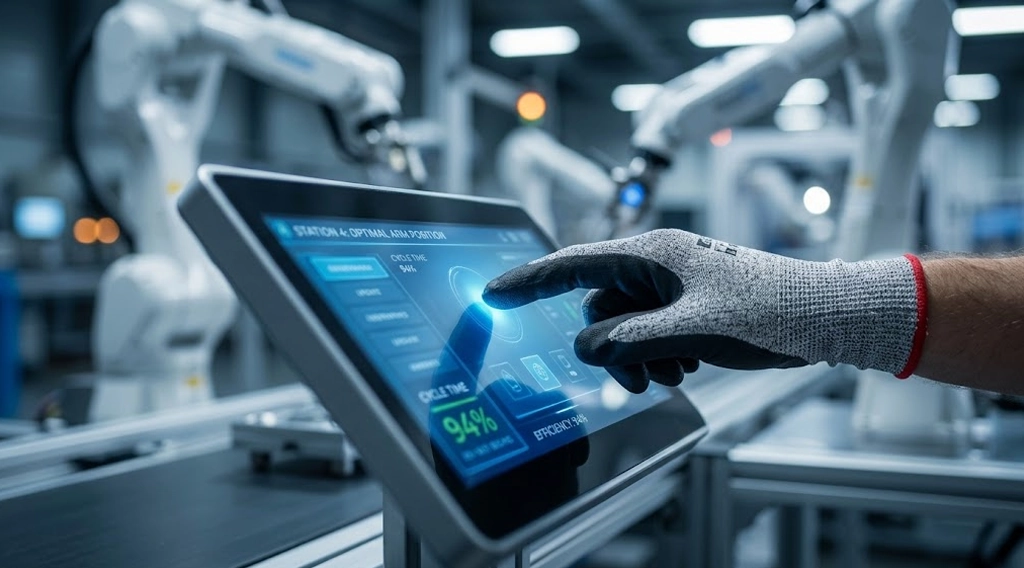
Deploying touchscreen compatible nitrile gloves in modern automated industrial workplaces is essential for eliminating micro-stops during HMI screen operations while maintaining hand protection. However, the physical conflict between traditional insulated industrial gloves and capacitive touchscreens is becoming a major hidden obstacle on automated production lines, slowing down production rhythms and compromising safety compliance.
The Hidden Downtime: “Glove Removal” Friction in Industrial Workflows
In highly automated automotive parts assembly, electronics manufacturing, and smart warehousing and logistics, workers often need to frequently confirm work orders, enter quality inspection data, or scan barcodes to verify part numbers on touchscreens after completing each process step.
Traditional nitrile-coated gloves are electrical insulators and cannot conduct the body’s electrical charge. To operate touchscreens, front-line workers are forced to repeatedly perform the sequence of “removing gloves—tapping the screen to enter data—putting gloves back on.”
These minor pauses, known as “glove removal friction,” may seem to take only 5 to 10 seconds each, but when repeated hundreds of times per shift at a single workstation, they accumulate into tens of minutes of lost productive time (downtime). This not only disrupts the assembly line’s takt time but also accelerates physical wear and tear on the glove cuffs and lining, shortening the gloves’ service life.
Safety Compliance Breaches: Exposing Bare Hands to Mechanical Hazards
Frequently removing gloves not only reduces efficiency but also directly leads to serious on-site safety compliance risks (EHS Non-Compliance).
To avoid the hassle of repeatedly putting on and taking off gloves, many operators leave one or even both hands bare for extended periods during work; some workers even go so far as to use scissors to cut away the coating and fingertips of the index finger and thumb on their gloves.
Such compromises leave workers’ hands directly exposed to sharp metal edges, pinch points on moving machinery, and cutting oil residue, leading to a sharp increase in on-site cuts and pinches. Neglecting basic physical hand protection while pursuing digital efficiency often results in factories facing hefty fines for non-compliance during external EHS safety audits.
Scope & Pillar Page Integration
To thoroughly resolve the conflict between digital operations and physical safety, it is essential to rely on industrial-grade touchscreen gloves that feature full conductive capabilities and high tactile sensitivity.
This guide will provide an in-depth analysis of how an 18-gauge ultra-thin seamless knitted lining, TekArmor® cut-resistant technology, conductive yarn weaving, and a microporous foamed nitrile coating work together to deliver advanced mechanical and physical protection while enabling precise and smooth touch control.
Before delving into the microstructure of touch-sensitive nitrile gloves and specific model selection, we recommend reviewing our comprehensive guide to industrial protection [Nitrile-Coated Industrial Safety Gloves] to gain a thorough understanding of the basic material classifications of nitrile coatings, differences in dipping processes, and fundamental mechanical protection certification standards.
The Physics of Touchscreen Compatibility in Industrial PPE
Enabling safety gloves—which are designed to be electrical insulators—to provide seamless touchscreen functionality is not merely a marketing gimmick, but rather a deep integration of materials physics and microelectronics engineering. To understand the mechanisms behind touch-sensitive gloves, one must first decipher the recognition principles of industrial screens and the microstructure of conductive materials.
Capacitive vs. Resistive Screens: How HMI Touch Technology Works
In industrial manufacturing environments, human-machine interfaces (HMIs) and operator terminals primarily use two types of touch technologies: resistive screens and capacitive screens.
Resistive Screens: These generate a signal by physically pressing the screen to bring two layers of conductive film into contact. This type of screen is insensitive to insulators, allowing operation even when pressing firmly while wearing very thick traditional nitrile gloves. However, due to their short lifespan, low light transmittance, and lack of support for multi-touch, resistive screens are gradually being phased out in modern smart factories.
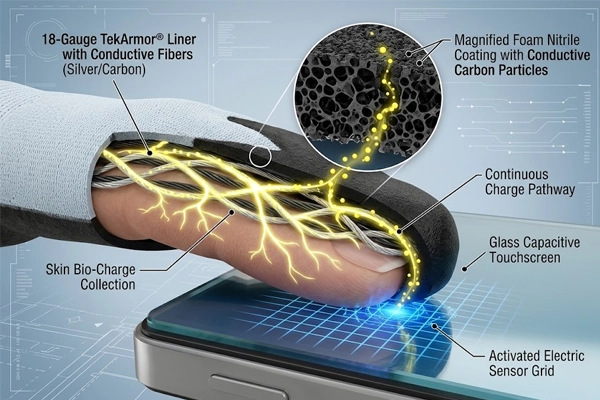
Capacitive Screens: These are currently the standard configuration for most industrial tablets, high-end CNC control panels, and smartphones. The surface of a capacitive screen is covered by a weak electrostatic field; it relies on the faint bioelectric current (charge) naturally present in human skin to absorb localized charges on the screen, thereby calculating precise touch coordinates. Since conventional cut-resistant yarns (HPPE, nylon) and industrial nitrile rubber are both highly insulating materials, they completely block the transfer of electrical charge between the skin and the screen, resulting in capacitive screens being completely unable to recognize fingers wearing ordinary gloves.
Conductive Yarns vs. Carbon-Infused Nitrile Dipping Technologies
To overcome this “insulation barrier,” high-performance industrial protective gloves must create a “charge highway” that conducts microcurrents from the body to the outer coating surface. The industry primarily relies on the following two core engineering technologies:
Conductive Yarn Blends: When weaving the base lining of gloves, manufacturers blend extremely fine copper wires, silver fibers, or carbon filaments with high-strength cut-resistant fibers (such as TekArmor® yarn) in specific proportions. These conductive fibers lie close to the worker’s skin and are responsible for collecting bioelectric charges.
Carbon-Infused Nitrile Dipping Technologies: Since the palms and fingertips of industrial gloves must be covered with a nitrile coating to provide oil resistance and cut protection, a standard insulating nitrile rubber surface would block the discharge of electrical charges from the lining. Modern touchscreen-compatible nitrile gloves achieve micro-conductivity in the rubber coating itself by uniformly dispersing nanoscale conductive carbon particles throughout liquid, water-based nitrile latex. This dual-action, synergistic design ensures that electrical charges can pass unimpeded through the thickness of the glove, enabling screen responsiveness.
Structural Continuity: Maintaining Signal Sensitivity Across 18-Gauge Liners
Behind the scenes of complex automated assembly lines or systems, operators need not only the ability to “tap” the screen but also extremely high tactile sensitivity and extremely low response latency to accurately select dense process parameters and tiny software buttons.
Traditional 13-gauge or coarser glove liners cause excessive wrinkling and air gaps in the fabric at the fingertips. Air is an excellent insulator that severely disrupts the continuity of electrical charge conduction, resulting in touchscreen disconnections or positioning drift.
High-Gauge Precision: 18-Gauge Liners and Tactile Sensitivity
At smart manufacturing workstations, workers not only need to operate touchscreens to enter data, but also frequently handle micro-screws, connect fine wire harnesses, and perform high-precision mechanical adjustments. If gloves only offer conductive touchscreen functionality but lack exceptional tactile sensitivity, workers will still experience sluggish handling when working with precision components. Therefore, the ultra-thin 18-gauge knitted structure has become the key bridge connecting digital human-machine interaction with high-precision assembly.
Micro-Motor Control: Why 18-Gauge Construction Matters for Smart Manufacturing
The knit gauge directly determines the thickness of the single yarn in the glove lining and the density of the fabric:
Eliminating Sensory Barriers at the Fingertips: Traditional 10-gauge or 13-gauge gloves are relatively thick and bulky; when the fingertips bend, the fabric tends to bunch up, severely impairing the perception of minute physical resistance, surface roughness, and edge gaps by the peripheral nerves in the fingers.
Enabling Precision Motor Control: The 18-gauge process uses ultra-fine filaments for high-density, seamless knitting, resulting in gloves that are typically 30% to 40% thinner than traditional styles. This ultra-snug, “second-skin” fit eliminates excess space between the fingertips and under the nails, giving operators the precision of bare hands when grasping micro-latches or tapping tiny parameter selection boxes on industrial touchscreens, thereby significantly reducing the error rate in fine motor tasks.
Balancing Mechanical Cut Resistance with Ultra-Thin Conductive Fibers
While achieving an ultra-thin 18-gauge thickness, the greatest engineering challenge lies in how to incorporate both high-strength cut-resistant fibers and conductive materials into an extremely limited yarn cross-section without sacrificing the glove’s softness and mechanical strength.
This relies on advanced engineered cut-resistant coated yarn technology (such as the patented TekArmor® fiber system):
Multifunctional fiber synergistic weaving: By co-stranding and coating high-molecular-weight cut-resistant staple fibers, ultra-fine conductive filaments, and high-elasticity spandex in precise proportions, each ultra-fine yarn strand possesses both the physical defense capability to absorb shear forces and a continuous pathway for conducting bio-microcurrents.
Balancing High Cut Resistance and High Sensitivity: This microstructure enables 18-gauge ultra-lightweight gloves to not only support seamless full-finger touchscreen functionality but also easily achieve high-level cut resistance ratings of ANSI A3 or even ANSI A5, eliminating the need for workers to compromise between “wearing thick gloves for cut protection” and “wearing thin gloves for touchscreen operation.”
As we discussed in detail in our Best Nitrile Coated Work Gloves for Automotive and Precision Assembly Operations guide, automotive electronics assembly and microelectronics manufacturing facilities impose dual stringent requirements for tactile feedback and cut resistance. Adopting 18-gauge high-density cut-resistant conductive gloves is a proven solution that achieves a win-win scenario for both human-machine interaction efficiency and physical safety on the production line.
Touchscreen Performance Benchmark Matrix in Industrial Environments
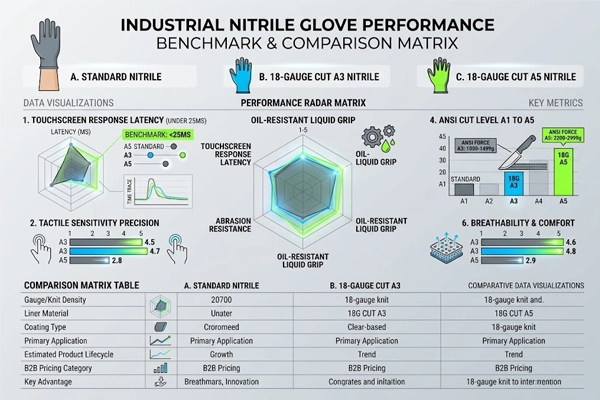
When making PPE procurement decisions for modern digital production lines, there are significant differences among workstations in terms of requirements for touchscreen response latency, mechanical cut resistance, and oil-resistant grip strength. To help EHS departments and production line managers visually assess the technical performance of gloves, the table below systematically compares the rigorous test data and real-world performance benchmarks for three typical types of industrial nitrile gloves.
Conductive Safety Glove Selection Benchmark Table
| Glove Classification | Screen Response Latency (Capacitive HMI) | Cut Level (ANSI / EN 388) | Grip Type & Palm Technology | Coating Coverage | Recommended Automation Workstation |
| Standard Non-Touchscreen Nitrile | Non-Responsive (Failure / Infinite) | ANSI A1–A2 / ISO Level B | Smooth or Micro-Foam | Palm Dipped (1/2 Coated) | Manual packaging, general dry sorting, non-digital assembly |
| 18-Gauge Touchscreen Cut A3 Nitrile | < 25 ms (Near-Zero Latency) | ANSI A3 / ISO Level C | Micro-Foam + Nitrile Dots | Palm / 3/4 Dipped | Robotic cell monitoring, warehouse barcode scanning, HMI data entry |
| 18-Gauge Touchscreen Cut A5 Nitrile | < 30 ms (High Precision) | ANSI A5 / ISO Level E | High-Grip Micro-Foam | Palm Dipped | CNC programming, automated stamping part inspection, oily touchscreens |
EHS Selection Criteria for Digitalized Assembly Lines
For workstations that are intensive in automation and human-robot collaboration (cobots), EHS administrators are advised to follow these three core criteria when establishing procurement standards for hand protection equipment:
Match touch sensitivity to the frequency of human-machine interaction: If a workstation involves frequent barcode scanner use, work order entry via industrial tablets, or minor parameter adjustments, it is essential to strictly select 18-pin conductive fiber gloves with a response latency of less than 30 milliseconds to prevent violations such as “workers removing gloves without authorization” caused by unresponsive touch inputs.
Precisely grade cut-resistance standards based on physical cutting risks: When handling automated assembly parts with minor burrs, ANSI A3 / TekArmor® linings provide a balance of high flexibility and safety protection; however, for high-risk touch-operated workstations with severe shear hazards—such as machine tool calibration or continuous stamping and blanking—upgrade to 18-gauge ANSI A5-level advanced cut-resistance configurations.
Select coating coverage and grip technology based on on-site lubrication conditions: In dry or low-oil environments, the foam nitrile palm with a “Dots” design provides superior abrasion resistance and slip resistance; if the workstation frequently experiences splashes of cutting fluid or oil-water mixtures, prioritize models with 3/4-depth coating coverage to prevent liquid penetration into the lining and disruption of electrical conductivity.
Anti-Cut & High-Grip Engineering: Foam Nitrile with Micro-Dots
In automated assembly and human-machine interaction workstations, gloves must not only provide sensitive conductive touch capabilities but also withstand the rigorous challenges posed by metal burrs, oily workpieces, and frequent physical friction. To simultaneously achieve reliable cut resistance, slip resistance, and exceptional wear resistance on an ultra-thin 18-gauge lining, a composite surface engineering solution combining micro-foam nitrile and a palm matrix of nitrile dots has become the industry benchmark.
Micro-Foam Surface Mechanics: Oil Displacement and Tactile Grip
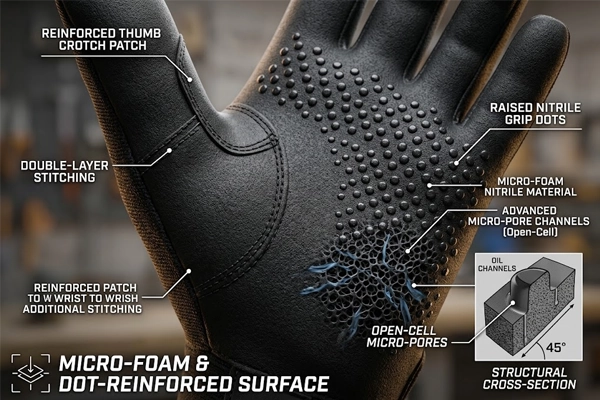
Traditional smooth nitrile coatings tend to be slippery and feel hard to the touch when in contact with oily metal or smooth glass screens. Micro-Foam Nitrile uses a physical foaming process to create countless open-cell pores on the coating surface:
Oil Film Dispersion and Micro-Adsorption: When workers handle parts coated with rust-preventive oil or cutting fluid, the micro-porous structure rapidly absorbs and disperses the oil film on the contact surface, eliminating the slippery lubricating layer and providing strong grip in both dry and lightly oiled conditions.
Breathability, Softness, and Tactile Feedback: The micro-foamed coating is lightweight and flexible, allowing for full range of motion and sensitivity at the fingertips. This enables workers to clearly perceive the edges of workpieces and the pressure applied to the screen, balancing excellent breathability with a comfortable operating feel.
Dot-Reinforced Palms and Thumb Crotches for Extended Wear Resistance
On automated production lines, workers frequently need to handle bins, operate robotic grippers, or use barcode scanners, which subjects the palms and thumb crotch areas to extremely high-frequency localized shear wear.
To enhance durability without increasing the overall thickness of the gloves or compromising touchscreen sensitivity, high-performance touchscreen gloves incorporate localized reinforcement designs:
Palm Matrix Dots (Nitrile Dots): A matrix of wear-resistant nitrile dots is layered over the foamed nitrile coating. These raised dots are the first to make contact with the workpiece surface, not only further enhancing physical friction and grip but also effectively absorbing friction impacts when handling workpieces with rough edges, thereby significantly extending the lifespan of the palm coating.
Reinforced Thumb Crotch: The thumb crotch is the weakest point most prone to tearing and abrasion when wearing gloves. By adding an abrasion-resistant reinforcement layer at the junction of the thumb and index finger, premature holes caused by frequent pulling on tools or gripping heavy objects can be significantly prevented.
As detailed in our EN 388 Abrasion and Grip Test Breakdown for Nitrile-Coated Safety Gloves standard testing guide, the palm adhesive application and thumb crotch reinforcement structure demonstrated several times the number of abrasion cycles compared to standard single-layer coatings during Martindale abrasion testing. This ensures an excellent 18-pin touchscreen experience while significantly reducing the daily wear-and-tear costs associated with the gloves.
High-Efficiency Showcase: Advanced Touchscreen-Compatible Models
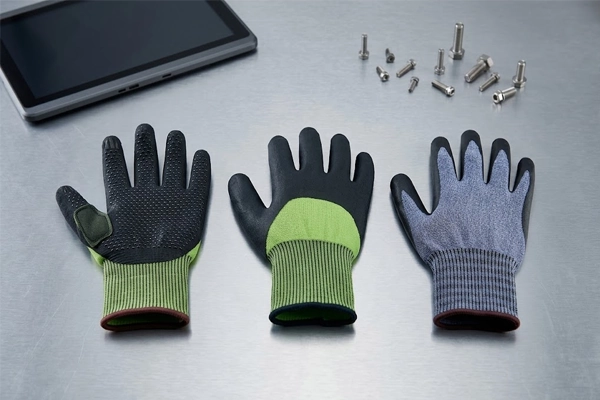
In automated manufacturing and human-machine collaborative production lines, different workstations have varying requirements for touch accuracy, wear resistance, penetration resistance, and physical cut resistance. The following three flagship models, built on an 18-gauge ultra-thin conductive platform, precisely address a wide range of operational needs—from general-purpose barcode scanning and assembly to heavy-duty cutting tasks involving touchscreen operation.
Precision Touchscreen Cut Defense with Nitrile Dots & Reinforced Crotch
In smart warehousing and logistics, high-frequency barcode scanning and automated assembly lines, workers must operate touchscreen devices for extended periods while frequently handling material bins and tools, placing extremely high demands on glove abrasion resistance and tear resistance at the web of the hand.
For workstations where high-frequency interaction and durability are equally critical, we recommend the benchmark model reinforced with adhesive dots—K3-215TD, Anti-cut Foam Nitrile Glove, 18-gauge seamless TekArmor® A3/C liner, palm coated with dots, reinforced thumb crotch.
18-gauge ultra-light touchscreen sensitivity and A3 cut resistance: Features an 18-gauge ultra-thin, seamless TekArmor® A3/C cut-resistant liner blended with conductive fibers, providing extremely sensitive touchscreen feedback and reliable medium-level cut protection.
Dot-Coated Palm and Reinforced Thumb Crease: A matrix of abrasion-resistant nitrile dots is applied to the foam nitrile-coated surface, significantly enhancing grip on materials; a reinforced patch has been added to the thumb crease area to effectively withstand frequent friction and tugging from tools, greatly extending the glove’s service life in digital warehousing and on assembly lines.
Extended Liquid Barrier Touchscreen Protection for Oily Industrial Screens
In CNC machine tool operating areas with trace amounts of cutting oil splashes, automotive powertrain assembly lines, and industrial flat-panel control consoles with oil-water mixtures, standard palm-only gloves are highly prone to leakage on the back of the hand and oil saturation, which disrupts the conduction of touch signals.
For touchscreen workstations with this risk of liquid penetration, we recommend the deep-seal, leak-resistant model—K3-255, Anti-cut Foam Nitrile glove, 18-gauge seamless TekArmor® A3/C liner, 3/4 coated.
3/4-depth foamed nitrile coating: The coating extends upward from the palm to cover 3/4 of the back of the hand. While maintaining the glove’s lightweight and breathable properties, it creates a leak-proof barrier for the back of the hand and knuckles, preventing oil and water splashes from machine tools from seeping into the liner.
Precise Touchscreen Interaction in Oily Conditions: The 18-gauge TekArmor® A3/C conductive liner, combined with a carbon foam coating, ensures stable and smooth multi-touch responsiveness even when the workpiece or touchscreen surface is slightly oily, balancing oil resistance with digital operation efficiency.
Heavy-Cut Touchscreen Precision Protection for Extreme Automated Production Lines
In automated sorting of large automotive stamped parts, continuous stamping blanking inspection, and precision machining stations involving high-risk metal burrs, workers face severe cutting hazards while frequently needing to enter quality inspection data or adjust robotic arm parameters on HMI screens.
For workstations where extreme cutting hazards and high-precision touchscreen operations overlap, we recommend deploying our flagship high-level cut-resistant model—K5-210, Anti-cut Foam Nitrile glove, 18-gauge seamless TekArmor® A5/E liner, Palm coated.
18-gauge ultra-thin ANSI A5 premium cut resistance: Leveraging advanced TekArmor® A5/E high-density cut-resistant yarn technology, this glove achieves top-tier resistance to powerful cutting forces despite its ultra-thin 18-gauge construction, completely breaking through the limitations of traditional high-cut-resistant gloves being bulky and stiff.
Micro-foamed Palm for Full-Finger, Smooth Touch Control: The high-resilience foamed nitrile coating, combined with a super-snug, ergonomic cut, not only ensures a secure grip on sharp metal burrs but also allows operators to precisely tap the densely packed parameter buttons on HMI screens without removing their gloves, achieving both safety and digital efficiency at high-risk workstations.
Time-Motion Study: Financial ROI and Productivity Breakdown
In Lean Manufacturing and smart factory management, even the slightest pause in movement directly translates into a delay in the production cycle. Many corporate procurement departments tend to underestimate the hidden labor time wasted by traditional gloves during digital human-machine interactions. By incorporating time-motion studies from industrial engineering, companies can intuitively quantify the direct productivity gains and financial return on investment (ROI) that touchscreen-compatible nitrile gloves bring to their operations.
Calculating Cycle Time Savings: Eliminating Micro-Stops Caused by Removing and Putting On Gloves
On automated production lines equipped with HMI terminals or industrial tablets, every time an operator enters process parameters, confirms a work order, or reviews inspection results, they must go through a cycle of “removing gloves—touchscreen input—putting gloves back on,” resulting in a micro-stop:
The cumulative effect of lost labor hours: Each instance of putting on and taking off gloves takes an average of 6 to 10 seconds. Assuming 80 screen interactions per workstation per shift, a single worker wastes 8 to 13 minutes of pure working time daily on this non-productive “glove removal and re-donning” action. In a medium-sized workshop with 100 front-line workers, this equates to the loss of thousands of hours of productive assembly time annually.
Takt Time Balancing and Productivity Improvement: After deploying 18-pin conductive touchscreen nitrile gloves, workers can perform instantaneous touchscreen interactions at the millisecond level, eliminating micro-pauses. The assembly line’s takt time is strictly maintained, directly improving overall production line efficiency and on-time delivery rates.
Reducing Glove Damage and Consumption Rates in Digital Scanning Tasks
In addition to recovering productive work hours, touch-sensitive gloves can significantly reduce abnormal PPE wear and tear rates:
Preventing wrist cuff tears and mechanical fatigue: Traditional gloves are subjected to vigorous tugging by workers dozens of times a day, making the cuff ribbing and fingertip seams highly susceptible to elastic fatigue or physical tearing, forcing workers to discard gloves prematurely before they reach their wear limit.
Eliminating Direct Scrap Caused by Unauthorized Finger Trimming: Many workers, for the sake of convenience, cut off the index finger or thumb of their gloves without authorization, causing the gloves to immediately lose their mechanical protection rating and rendering them unusable. Touch-sensitive gloves address human-machine interaction needs at the source, enabling the gloves to serve their full service life until the coating reaches its normal wear-out point.
As outlined in our Waterproof vs. Breathable Nitrile Coatings: Balancing Dexterity and Liquid Protection guide on breathability and liquid protection, equipment that combines a high-thread-count breathable lining with a long-lasting, abrasion-resistant coating not only provides excellent wearing comfort to reduce rejection rates but also delivers high total cost of ownership (TCO) savings and quantifiable financial returns for factories by substantially reducing the daily glove consumption rate.
EHS Audit, ESD, and Environmental Compliance for Smart Operations
In modern smart manufacturing and precision electronics workshops, the evaluation criteria for protective equipment extend beyond touch sensitivity and physical cut resistance to encompass micro-level safety and environmental compliance across the entire production environment. For corporate EHS management departments and supply chain auditors, whether gloves provide electrostatic discharge (ESD) protection and meet requirements for the absence of chemical solvent leaching are key criteria determining whether the equipment can be used on high-precision production lines.
Electrostatic Discharge (ESD) Protection and Touchscreen Responsiveness
At automated SMT placement, semiconductor component sorting, and automotive electronic control unit (ECU) assembly stations, human activity can easily generate electrostatic voltages of several thousand volts. If operators wearing insulated gloves directly touch sensitive touchscreens or electronic components, an instantaneous electrostatic discharge (ESD) can easily cause microchips to fail or burn out the integrated circuits (ICs) inside touch panels:
Safe Electrostatic Dissipation Pathway: High-performance touch-sensitive nitrile gloves precisely control the glove’s surface resistivity within the safe range for antistatic and dissipative properties by weaving a continuous network of conductive fibers into the 18-gauge lining. This structure smoothly conducts bio-microcharges to activate capacitive touchscreens while simultaneously and gradually dissipating excess static charge from the human body in a controlled manner, thereby preventing instantaneous static sparks.
Dual-Directional Protection Mechanism: The synergistic design of conductive fibers and a micro-conductive foamed nitrile coating ensures millisecond-level instantaneous response for industrial capacitive touchscreens while effectively preventing touch positioning drift caused by electrostatic attraction of workshop dust, thereby protecting precision components from hidden electrical damage.
Zero Chemical Contamination for High-Precision Electronics
In precision electronics and high-grade CNC workshops, even trace amounts of chemical leaching from glove surfaces can lead to serious yield rate issues:
Strict control of volatile solvent residues: If excessive amounts of DMF (dimethylformamide) or organic plasticizers remain after the glove impregnation process, when workers’ hands sweat and warm up, these chemicals not only penetrate the skin and cause occupational dermatitis but also adhere to industrial touch panels and electronic component contacts through fingertip contact, leading to fogging of the touch glass, electrode oxidation, and product insulation failure.
Multi-stage Deionized Water Washing and Low-Ion Control: High-quality touchscreen gloves undergo a multi-stage deionized water circulation washing process before demolding to thoroughly remove unreacted free chemical accelerators, ensuring the products meet ultra-low extractables and ultra-low volatile organic compounds (VOC) standards, and fully comply with the EU REACH Regulation’s limit requirements for SVHCs (Substances of Very High Concern).
As outlined in our cleanroom water-based guide, Waterborne Nitrile Coated Gloves: Eliminating Solvent Residues in Cleanroom Environments, as smart factories transition toward digitalization and automation, PPE must simultaneously align with standards for low electrostatic risk, zero chemical residues, and solvent-free environmental sustainability. Selecting touchscreen gloves that combine ESD dissipation safety with ultra-clean process capabilities provides a solid guarantee that factories will successfully pass EHS system audits within global high-end supply chains.
Knowledge Base: Frequently Asked Questions (FAQs) & Actionable Advice
To help EHS safety managers, lean production engineers, and procurement managers at automated factories quickly assess the technical feasibility of touchscreen-compatible protective gloves and establish scientific selection criteria, the following answers address the most common questions regarding human-machine interaction and physical protection in industrial settings.
Why do standard nitrile-coated gloves fail to register on industrial capacitive touchscreens?
The primary reason standard industrial nitrile gloves fail to register on industrial capacitive touchscreens is electrical insulation:
Industrial capacitive touchscreens rely on the faint bioelectric charge naturally present in the human body to alter the local electrostatic field on the screen, thereby calculating touch coordinates. Conventional industrial nitrile rubber, polyurethane (PU), and basic polyester/nylon knitted yarns are all high-impedance insulating materials; they form a physical insulating layer between the skin of the fingers and the screen glass, completely blocking the transfer of electrical charge. Advanced touch-sensitive gloves incorporate conductive metal or carbon fibers into the lining and disperse micro-conductive carbon black particles in the nitrile rubber coating solution. This creates a conductive pathway for the body’s bioelectric charge, enabling the capacitive screen to detect touch signals in real time.
Does oil, coolant, or grease on the palm of the glove compromise touchscreen accuracy?
Mild to moderate oil contamination will not cause touchscreen failure; the key lies in the glove’s microporous coating structure and its oil-resistant, leak-proof design:
Micro-Foam Oil-Repellent Mechanism: The Micro-Foam Nitrile coating features an open-cell microporous structure that rapidly squeezes, absorbs, and disperses a thin film of oil from the surface the moment a finger presses the screen. This maintains microscopic physical contact between the fingertip and the screen glass, ensuring stable electrical conductivity.
Deep-Penetration Protection: For workstations involving cutting fluid or heavy oil splashes, we recommend models with a 3/4-depth coating (such as the K3-255) to prevent liquids from seeping through the knitted fabric gaps into the inner lining and disrupting electrical conductivity, thereby ensuring sensitive touch accuracy even in oily conditions.
Can ultra-thin 18-gauge touchscreen gloves still provide high ANSI A3–A5 cut protection?
Absolutely. This is made possible by advanced engineered composite yarn technology (such as the TekArmor® patented fiber system):
Conventional wisdom holds that the higher the cut resistance rating, the thicker and heavier the gloves. Modern 18-gauge high-density knitting technology uses ultra-fine polyethylene staple fibers, micron-level alloy steel wires, or high-strength mineral fibers as the core, tightly wrapped in a layer of fine conductive filaments and highly elastic spandex. This microscopic wrapping structure, within the extremely compact 18-gauge ultra-thin profile, not only retains bare-hand-like tactile sensitivity and conductivity but also reliably withstands cutting loads ranging from 1,000 g to 3,000 g+, delivering high-level physical cut protection from ANSI A3 to ANSI A5.
Call to Action (CTA)
Deploying nitrile gloves in smart manufacturing workshops—which combine the ultimate tactile feedback of 18-gauge fabric, high-level ANSI cut resistance, and all-weather capacitive touchscreen compatibility—not only eliminates cycle time losses caused by workers putting on and taking off gloves but also prevents hand injuries resulting from non-compliant work practices involving glove removal at the source.
Whether you need to upgrade to highly abrasion-resistant dispensing touchscreen gloves for automated assembly lines or are seeking oil-resistant, leak-proof ANSI A5 high-cut-resistant touchscreen solutions for CNC machining stations, our engineering team can provide support for workstation cycle time assessments and sample testing:
Browse our full range of industrial touchscreen-compatible products: Explore Full Range of Touchscreen Compatible Nitrile Gloves
Request on-site sample testing and technical evaluation for your automated workshop: Contact SQG® for Free Sample Kits