The Multi-Hazard Challenge in Heavy Industrial Workstations
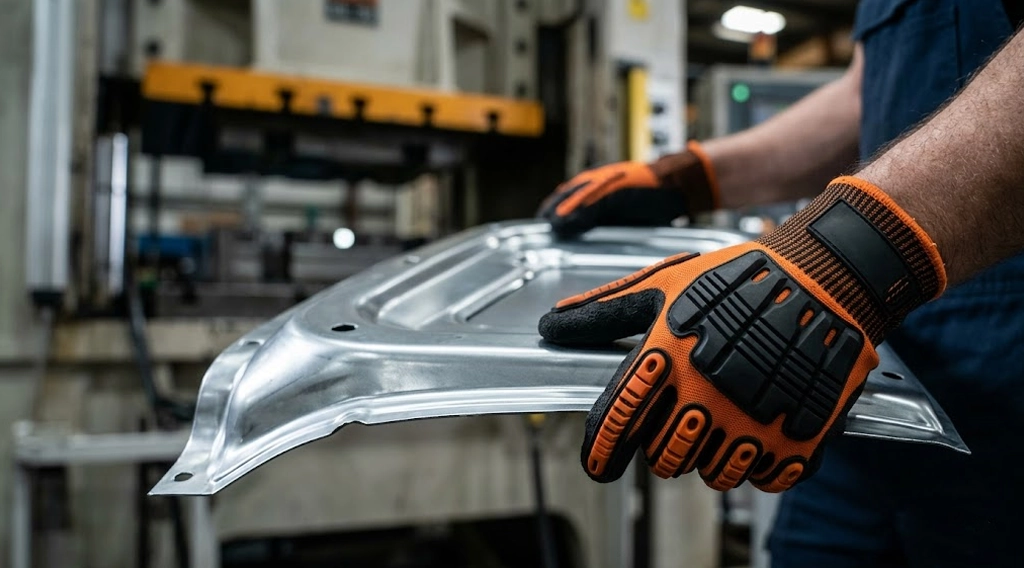
Deploying cut- and impact-resistant nitrile gloves in heavy industrial workstations is essential for defending against sharp edges, heavy crushing risks, and oil penetration. Instead, these workstations are rife with combined injury risks (multi-hazard risks) posed by sharp edges, impacts from heavy objects, and industrial lubricants.
Analyzing Combined Cut, Crush, and Liquid Risks in Metal Stamping
Taking a typical automotive sheet metal stamping workstation as an example, when operators handle steel sheets or aluminum alloy components that have just been sheared, micrometer-level metal burrs and rough edges are highly likely to form along the edges of the components. These extremely sharp edges generate immense shear forces during physical sliding, instantly cutting through ordinary fabric protective gloves.
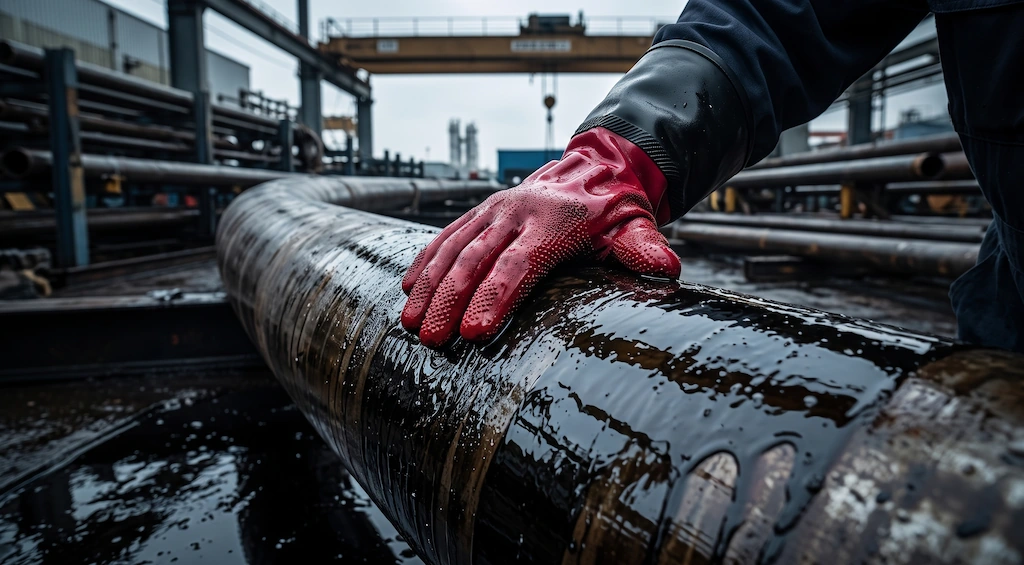
At the same time, the area surrounding stamping equipment contains numerous pinch points and hazards from falling heavy objects, making the backs of the hands and knuckles highly susceptible to injuries from heavy impacts or mechanical pinching. Furthermore, forming oils, drawing oils, and rust-preventive oils—used extensively to prevent cracking during metal sheet stamping—rapidly saturate the surface of the gloves. Oil penetration not only leads to a loss of grip and workpieces slipping, which can cause secondary impact injuries, but also continuously irritates the skin on the hands.
The Hidden Cost of Hand Injuries: EHS Audits and Lost Time Incident Rates
For corporate EHS (Environment, Health, and Safety) departments, the cost of hand lacerations and crush injuries far exceeds the cost of purchasing a pair of gloves.
Hand injuries are one of the primary causes of “Lost Time Incidents” (LTI) in the industrial manufacturing sector. A single serious hand laceration or fracture not only results in direct medical compensation and workers’ compensation claims but also leads to production line shutdowns, a sharp drop in productivity due to the temporary replacement of highly skilled workers, as well as rigorous external EHS compliance audits and hefty fines.
By deploying comprehensive protective gloves that simultaneously defend against high-level cuts, heavy-object impacts, and oil penetration, factories can significantly reduce the incidence of hand injuries and ensure they pass international buyers’ EHS system audits.
Scope & Pillar Page Integration
This guide will provide an in-depth analysis of how to build an integrated safety defense system for heavy-industry workstations through the synergistic engineering design of advanced cut-resistant fibers (Engineered Liners), thermoplastic rubber exoskeletons (TPR Impact Protection), and dual-layer permeation-resistant nitrile coatings.
Before evaluating specific configurations for heavy-duty cut- and impact-resistant gloves, we recommend first consulting our comprehensive industrial protection guide, Nitrile-Coated Industrial Safety Gloves,s to gain a thorough understanding of the basic coating structures, dip-coating process classifications, and physical and mechanical properties of nitrile safety gloves, enabling you to develop a more scientifically sound protection upgrade plan for your facility.
Cut Protection Mechanics: Engineered Liners vs. Extreme Physical Threats
To withstand heavy sheet metal, flash from stamped parts, and high-sharpness cutting hazards, simply increasing coating thickness does not fundamentally solve the problem. A glove’s cut resistance hinges on the microscopic material composition and structural engineering of its knitted liner.
High-Performance Fiber Technology: HPPE, Steel, and Glass Fiber Blends
Traditional cotton, polyester, or standard nylon liners are highly susceptible to instantaneous fiber chain severance when exposed to metal blades or sharp glass edges. Modern high-performance cut-resistant gloves rely on engineered fiber blend technology:
Ultra-High Molecular Weight Polyethylene (HPPE): As the base material for cut-resistant liners, HPPE possesses extremely high tensile strength and abrasion resistance; its long polymer chain structure effectively disperses and absorbs localized shear forces.
Stainless Steel and Glass Fiber Cores: To address medium- to high-level physical cutting threats, gloves incorporate high-strength stainless steel wire or microfine glass fibers as core strands, which are then wrapped in HPPE or nylon filaments. When a sharp edge cuts into the glove, the high-hardness steel wire or glass fibers inside forcefully block the blade from penetrating deeper, elevating the cut resistance rating to the highest level.
Deciphering ANSI A4–A9 and EN 388 Cut Level Performance
When selecting PPE for heavy industry, clearly understanding the correspondence between the North American ANSI/ISEA 105 and European EN 388 cut resistance levels is a critical step in assessing safety:
Moderate to Heavy Cut Protection (ANSI A4–A5 / EN 388 ISO Cut Level D–E): Withstands cutting loads of 1,500 g to 2,999 g. Suitable for general automotive parts assembly, machine tool operations, and handling sheet metal of medium thickness.
Extreme cut protection (ANSI A6–A9 / EN 388 ISO Cut Level F): Withstands cutting loads ranging from 3,000 g to 6,000 g+. These gloves are specifically designed for large-scale sheet metal stamping, heavy-duty glass manufacturing, and extreme workstations involving high-tensile metal burrs.
Structural Continuity: Maintaining Dexterity in Heavy-Duty Cut Protection
High-level cut resistance often comes with the physical drawbacks of thicker, stiffer gloves, which can restrict workers’ finger movement and significantly increase operational fatigue.
Through high-gauge (13-gauge or 15-gauge) seamless knitting technology and an optimized blend of covering yarns, modern high-performance cut-resistant linings can maintain the glove’s softness and resilience while providing exceptional cut resistance, thereby preventing fine-motor errors caused by excessive stiffness.
As detailed in the EN 388 Abrasion and Grip Test Breakdown for Nitrile-Coated Safety Gloves standard testing guidelines, precise measurements using the TDM-100 cut tester (ISO 13997) show that a properly balanced blend of steel wire and HPPE in the lining not only disrupts the blade’s penetration path at the microscopic level but also preserves the hand’s natural flexibility, achieving a balance between robust protection and operational dexterity.
Impact Protection: Thermoplastic Rubber (TPR) Ergonomics and Energy Absorption
In heavy equipment manufacturing, forging, and the handling of large metal components, hand injuries result not only from cuts and punctures to the palm but also from the back of the hand (Back-of-Hand), which is equally at high risk of blunt force impacts and crushing from heavy objects. Seamlessly integrating a thermoplastic rubber (TPR) protective exoskeleton into the back of the glove is a key engineering approach to protecting the back of the hand from severe trauma.
Biomechanical Principles of TPR Exoskeletons on Metacarpals and Knuckles
The metacarpal and knuckle regions of the back of the hand are covered only by a thin layer of skin and tendons, lacking thick muscle tissue for cushioning. When struck by a heavy object, these areas are highly susceptible to comminuted fractures and permanent soft tissue damage.
Biomechanical Protection Principles of the TPR Impact-Resistant Exoskeleton (TPR Exoskeleton):
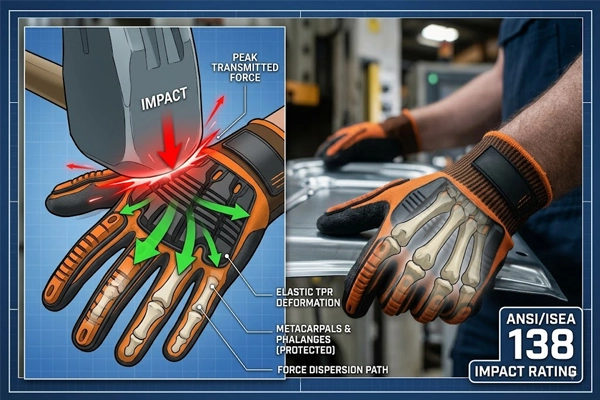
Stress Absorption and Dispersion: Highly elastic TPR material possesses excellent viscoelastic properties. Upon sudden impact, it rapidly transmits and disperses the concentrated force from a single point to surrounding structures, significantly reducing the peak impact force per unit area.
Ergonomic Segmented Design: The TPR patches feature an independent segmented structure (Segmented Design) cut along the movement trajectories of the finger joints. While ensuring full physical coverage and protection for the metacarpal and phalangeal bones, the wrist and fingers can still naturally clench into a fist and extend, avoiding the stiffness and resistance in the hand caused by traditional rigid impact-resistant components.
Mitigating Pinch Points on the Back of the Hand During Heavy Equipment Handling
When operating heavy machinery, attaching lifting chains, or moving metal components in confined spaces, the back of the hand is highly susceptible to being caught in “pinch points” between heavy workpieces and the equipment frame.
High-density TPR protective pads create a physical barrier across the back of the hand and the sides of the fingers. When a pinch occurs, the TPR blocks—which possess a certain thickness and toughness—act as “physical spacers,” resisting direct impact and clamping from hard objects on both sides. They convert mechanical compressive forces that could otherwise cause fractures into tolerable elastic deformation, significantly reducing the severity of workplace injuries.
ANSI/ISEA 138 Impact Resistance Standards (Levels 1–3) Explained
The North American ANSI/ISEA 138 standard establishes an extremely rigorous testing and classification system for evaluating the impact resistance of the back of the hand in gloves. This standard uses a drop-weight test to determine the average peak force (Peak Transmitted Force, unit: kilonewtons/kN) transmitted through the glove to the hand:
Level 1 (Basic Protection): Average Peak Transmitted Force ≤ 9 kN; suitable for routine handling and maintenance tasks involving low impact risks.
Level 2 (Moderate Protection): Average Peak Transmitted Force ≤ 6.5 kN; a common selection standard for automotive sheet metal stamping, heavy-duty component assembly, and mechanical manufacturing.
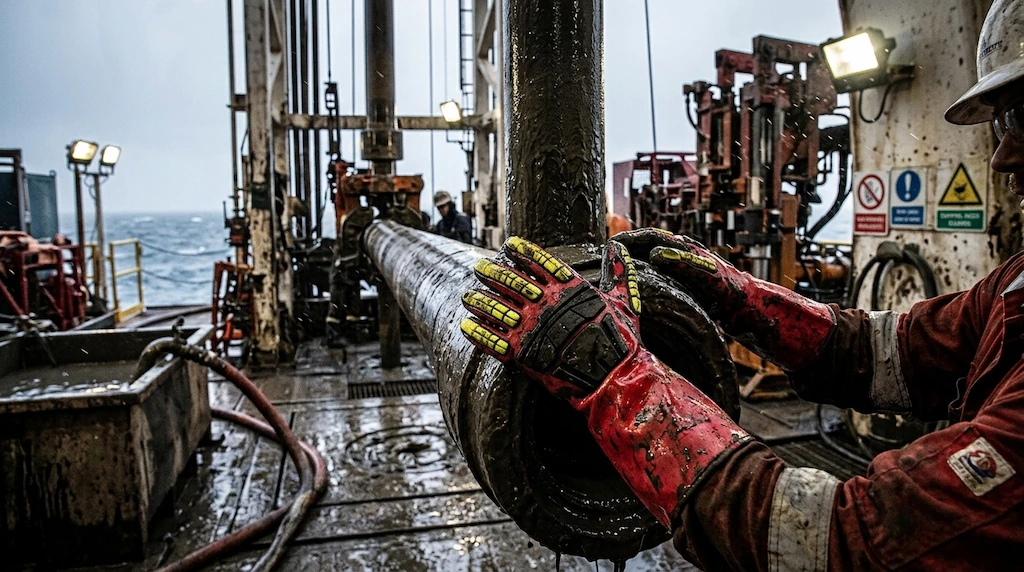
Level 3 (Extreme Heavy-Duty Protection): Average peak transmitted force ≤ 4 kN, representing the industry’s highest level of impact resistance, specifically designed for extremely high-risk scenarios such as oil and gas drilling, heavy-duty forging, and heavy-load hoisting at heights.
Technical Benchmark Matrix: Multi-Hazard Performance Comparison
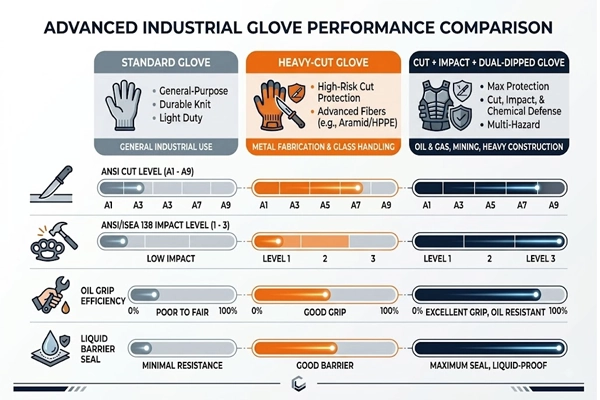
In heavy industry EHS procurement and safety compliance audits, accurately matching workstation risks with glove protection levels is key to controlling the workplace injury rate. Requirements for cut resistance, impact resistance, oil resistance, and impermeability vary greatly across different process environments. The table below summarizes the physical performance test data and applicable workstation benchmarks for three typical types of nitrile protective gloves.
Heavy-Duty Protective Glove Performance Benchmark Table
| Glove Classification | Cut Level (ANSI / EN 388) | Impact Rating (ANSI/ISEA 138) | Grip Finish & Surface Technology | Fluid Barrier & Coating Coverage | Recommended Workstation |
| Standard Nitrile | ANSI A1–A2 / ISO Level B | No Impact Protection (N/A) | Smooth / Micro-Foam | Palm Dipped (1/2 Coated) | Light warehousing, general assembly, handling of dry parts |
| Heavy-Cut Nitrile | ANSI A4–A5 / ISO Level D–E | No Impact Protection (N/A) | Sandy Nitrile Finish | Palm / 3/4 Coated Liquid Barrier | Metal sheet handling, CNC machining, glass processing |
| Cut + Impact + Dual-Dipped Nitrile | ANSI A6–A9 / ISO Level F | Level 2 / Level 3 TPR | Dual-Dipped Sandy Nitrile | 3/4 Smooth Base + Sandy Palm Coating | Heavy metal stamping, oil & gas, forging operations, demolition |
EHS Selection Rules for High-Risk Workstations
Based on actual performance benchmarks, EHS administrators should follow these three core criteria when making equipment selection and procurement decisions for high-risk workstations:
Avoid efficiency losses and workplace injury risks caused by “overprotection” or “underprotection”: At workstations involving light assembly and the handling of dry components, blindly implementing high-level impact-resistant gloves will increase hand weight and resistance to bending; conversely, in areas involving heavy-duty sheet metal stamping or where there is a risk of heavy objects falling, using ordinary gloves lacking TPR impact resistance and advanced cut resistance constitutes a serious compliance failure.
Liquid barrier protection and slip-resistant grip must be considered simultaneously: If a workstation involves forming oil, drawing oil, or coolant, single-layer cut-resistant gloves are highly susceptible to moisture penetration from oils and greases. It is essential to select styles featuring a 3/4-depth smooth nitrile barrier coating on the back of the hand, combined with a foam or “Sandy” grip layer on the palm, to prevent liquids from seeping into the glove or causing workpieces to slip.
Distinguish between general-purpose and high-risk workstations based on the overall risk level: As analyzed in our Best Nitrile Coated Work Gloves for Automotive and Precision Assembly Operations selection guide, general automotive parts assembly places greater emphasis on finger dexterity and fine motor control; however, for extreme workstations with complex injury risks—such as stamping shops, foundries, and heavy equipment dismantling operations—deploying heavy-duty gloves that integrate advanced cut resistance (ANSI A6+), ANSI 138-rated TPR impact protection, and double-layer leak resistance is a necessary measure to significantly reduce lost-time incidents (LTI) and lower the facility’s total cost of ownership (TCO).
Dual-Coated Liquid Barriers with Heavy-Duty Sandy Finish
In heavy-duty machining, sheet metal stamping, and other work environments involving large amounts of coolant and cutting oil, liquid penetration not only causes skin maceration and allergic reactions but also directly compromises the glove’s grip. To resolve the conflict between “liquid resistance” and “grip” in heavily oil-contaminated environments, a dual-dipped coating process (Dual-Dipped Coating Technology) is essential.
3/4 Smooth Base Sealant vs. Heavy Oil and Fluid Ingress
Single-layer dipped gloves (such as pure foam or single-layer matte finishes) have numerous microscopic pores on their surfaces. When exposed to highly fluid cutting oils or synthetic coolants, liquids quickly seep through these pores into the lining, causing the gloves to become saturated.
First Layer of Dual-Dipped Coating: 3/4-Depth Water-Based Smooth Base Sealant:
Comprehensive Liquid Barrier: The base layer uses high-density smooth nitrile latex, extending to cover 3/4 of the back of the hand (leaving only a small breathable area at the top of the wrist), creating a continuous, seamless rubber-plastic physical barrier on the outer side of the knitted liner.
Prevents Liquid Penetration and Capillary Suction: The high-density base coat effectively blocks direct penetration of industrial drawing oils, rust-preventive oils, and water-based coolants, preventing capillary suction through the knitted gaps on the back of the hand and ensuring hands remain dry and comfortable during prolonged use.
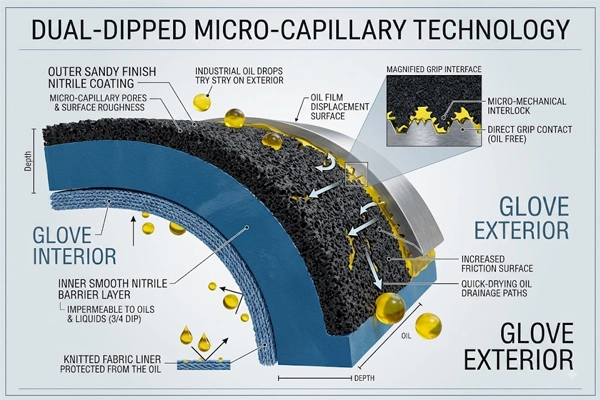
Sandy Nitrile Micro-Capillary Technology for Maximum Oil Grip
After applying the base coat for waterproof sealing, a second layer of Sandy Nitrile Finish is applied to the palm and high-wear areas, specifically designed to address grip challenges in heavy-oil environments.
On a standard smooth surface, when the glove comes into contact with an oily workpiece, grease forms a continuous “lubricating oil film” between the glove and the workpiece, causing the coefficient of friction to drop sharply. Through specialized physical pore formation and surface texturing, the Sandy Nitrile technology creates countless micron-scale, uneven adsorption pores (Micro-Capillaries) on the coating’s surface:
Oil Film Displacement and Siphoning Adsorption: When gripping oily metal parts or smooth glass, these microscopic pores rapidly displace the oil film at the interface outward and draw it into the micropores, eliminating the lubricating barrier.
Enhanced Physical Grip: The rough, sandblasted particles on the glove’s surface create a strong physical friction grip with the microscopic surface of the metal, allowing workers to handle heavily oiled components without excessive squeezing. This significantly reduces hand muscle fatigue and the risk of the workpiece slipping and falling.
As analyzed in our oil- and chemical-resistant guide, The Chemical Resistance of Nitrile Coatings: Protecting Hands Against Oils and Solvents, the dual-layer nitrile coating leverages the synergistic effect of a “smooth, impermeable inner layer + a textured, oil-repellent outer layer” to achieve excellent impermeability and friction control in complex oily and liquid environments.
High-Protection Showcase: Advanced Cut & Impact Defense Models
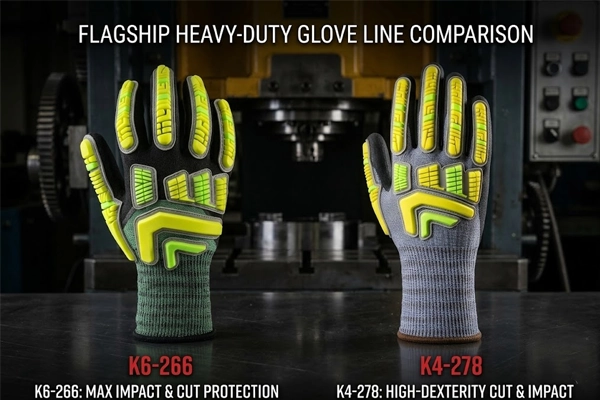
In heavy manufacturing environments involving complex mechanical cutting, impacts from heavy objects, and grease penetration, selecting field-tested, high-level protective gear is the most direct path to ensuring production line safety and compliance. The following two core heavy-duty protection models represent the technological benchmarks for extreme multi-hazard defense and advanced precision cut protection, respectively.
Extreme Multi-Hazard Defense: High Cut, 3/4 Double Dipping, and TPR Protection
In heavy-duty metal stamping, large sheet metal stretching, scrap metal dismantling, and oil and gas equipment maintenance workstations, workers face the triple risk of “high-intensity cutting + heavy impacts to the back of the hand + penetration by heavy industrial oils.”
For such extremely high-risk working conditions, we recommend deploying the flagship model in the Heavy-Duty Multi-Hazard series—K6-266, ANSI A6 / ISO F cut-resistant liner, 3/4 smooth nitrile base with sandy nitrile palm coating, TPR back-of-hand impact defense.
Advanced Cut Resistance: Features a high-gauge, seamless engineered cut-resistant liner that achieves ANSI A6 / ISO F-level cut protection, effectively blocking high-tensile metal burrs and intense shearing forces.
Dual-Layer Leak-Proofing and Textured Oil-Wicking: The base layer features a 3/4-coverage smooth nitrile seal coating that completely blocks the penetration of cutting oil and rust inhibitors; a second layer of textured nitrile (Sandy Nitrile) is applied to the palm, ensuring a reliable grip even under heavy oil lubrication.
TPR Skeletal Impact Protection on the Back of the Hand: A segmented TPR (thermoplastic rubber) exoskeleton fully covers the back of the hand, effectively absorbing and dispersing the impact and compression forces of blows and crushing, providing hard-core impact protection for the metacarpal bones and finger joints in compliance with the ANSI/ISEA 138 standard.
Precision Heavy-Cut Protection: High Cut Resistance with an Ergonomic Grip
For workstations that involve frequent exposure to medium-to-high cut risks—such as machining machine tool components, handling medium-thickness sheet metal, and glass manufacturing—but where there is no significant risk of impact to the back of the hand, the glove’s lightweight design, flexibility, and grip sensitivity are key to improving operational efficiency.
For these general-purpose, high-cut-resistance workstations, we recommend the industry-leading high-cut-resistance model—K4-278, ANSI A4 cut-resistant HPPE liner, Sandy Nitrile palm coating.
Balanced Cut Resistance: Featuring a high-density, seamless-knit lining made of ultra-high-molecular-weight polyethylene (HPPE), it provides stable and reliable ANSI A4-level cut protection, achieving an excellent balance between physical cut resistance and glove flexibility.
High-Performance Anti-Slip Grip: The palm is coated with a premium matte nitrile coating; its microscopic pore structure quickly dispels surface oil films, providing a secure, natural grip that conforms to the hand’s contours. The gloves are lightweight and comfortable overall, effectively reducing hand muscle fatigue during long shifts involving frequent handling and assembly tasks.
Financial TCO and ROI Breakdown: Injury Reduction vs. Glove Longevity
When making PPE procurement decisions in heavy manufacturing companies, many procurement departments tend to focus on the “unit price” of gloves, while overlooking the hidden costs of workplace injuries and the actual expenses incurred from frequently replacing low-quality gloves. From the perspective of financial and EHS risk management, evaluating the total cost of ownership (TCO) of equipment is the scientific method for measuring the return on investment (ROI) of a procurement decision.
Calculating Total Cost of Ownership (TCO) in High-Risk Manufacturing
The true TCO model for heavy manufacturing consists of both the “direct procurement cost of equipment” and the “hidden costs of workplace injuries”:
Direct and Hidden Costs of Workplace Injuries: On metal stamping and heavy-duty assembly lines, a single serious hand laceration or fracture incident can result in medical treatment, workers’ compensation, increased insurance premiums, production line downtime, and lost productivity due to temporary staff replacements—often amounting to tens of thousands or even hundreds of thousands of yuan. In contrast, the minimal additional budget required to purchase high-grade cut- and impact-resistant gloves (such as ANSI A6 / ANSI 138 Level 2) can directly eliminate the vast majority of risks of severe hand injuries, delivering an extremely high return on safety investment.
The “frequent wear-and-tear trap” of low-end gloves: When exposed to sharp burrs and heavy oil, low-end or single-layer gloves may tear or become saturated within a few hours, leading to a sharp increase in consumption per worker per shift.
Durability Over Time: Extended Glove Lifespan in Harsh Environments
High-performance heavy-duty composite gloves combine a high-density engineered lining, dual-layer nitrile coating, and an abrasion-resistant matte surface to significantly extend the gloves’ service life under harsh working conditions:
Abrasion Resistance and Tensile Strength: The high-quality nitrile coating features an extremely high covalent cross-linking density, making it resistant to tears and surface peeling when exposed to metal burrs, abrasive particles, and frequent physical friction.
Oil Resistance and Structural Stability: The double-layer coating structure completely blocks industrial oils from corroding or wetting the knitted liner, keeping the interior of the glove dry and preventing premature failure caused by the glove becoming heavy and soft due to oil absorption.
As analyzed in our liquid protection guide, Waterproof vs. Breathable Nitrile Coatings: Balancing Dexterity and Liquid Protection, achieving a balance between liquid barrier performance and abrasion resistance through precise structural design not only enhances workers’ operational efficiency but also significantly reduces the daily consumption rate of gloves, helping companies achieve a higher ROI while lowering their total cost of ownership.
EHS Compliance & Environmental Standards for Heavy-Duty PPE
As modern manufacturing imposes increasingly stringent ESG (Environmental, Social, and Governance) compliance requirements, the evaluation criteria for heavy-duty industrial protective equipment are no longer limited to physical protection against cuts and impacts. In today’s environment, where worker occupational health and environmental compliance are prioritized, the chemical safety of the gloves themselves and the low-carbon compliance of the production processes have become core assessment criteria for corporate EHS departments during procurement audits.
Zero Chemical Contamination in Heavy-Duty Manufacturing Lines
During prolonged periods of high-intensity labor, workers’ hands are prone to sweating, which causes the temperature of the palms to rise and the skin’s stratum corneum to expand. If excessive amounts of dimethylformamide (DMF), organic solvents, or chemical accelerators remain in protective gloves after the impregnation process, these harmful chemicals can leach out with sweat, penetrate the skin barrier, and be absorbed by the body, causing occupational contact dermatitis, skin redness and swelling, and chronic allergies.
High-quality heavy-duty protective gloves incorporate multiple stages of deionized water and purified water washing in the later stages of production to strictly control solvent residue levels in the finished gloves. By eliminating chemical toxicity residues and irritating odors at the source, this approach prevents workers from taking frequent sick leave or refusing to wear PPE due to hand allergies, ensuring the smooth and efficient operation of front-line production lines.
Meeting Global Workplace Safety Audit Standards
For multinational corporations and large Tier 1 suppliers serving global markets, selecting gloves that comply with international environmental and occupational safety standards is essential for successfully passing buyers’ EHS supply chain audits:
Strict Compliance with REACH and RoHS: Glove materials must comply with the concentration limits for SVHCs (Substances of Very High Concern) specified in the EU’s REACH regulation and meet RoHS requirements, ensuring that products are free of heavy metals and harmful plasticizers.
ISO 14001 / ISO 45001 System Support: The use of low-VOC (volatile organic compounds) dipping processes and recyclable packaging helps companies reduce their Scope 3 (supply chain) carbon footprint and directly supports factories in obtaining certification for environmental and occupational health and safety management systems.
As outlined in our Waterborne Nitrile Coated Gloves: Eliminating Solvent Residues in Cleanroom Environments, whether in cleanrooms with extremely stringent requirements for molecular-level contamination control or in harsh heavy-industry manufacturing facilities, driving the transition of PPE toward solvent-free, low-chemical-residue, and environmentally friendly solutions is an inevitable trend for factories seeking to meet both occupational health and safety standards and ESG environmental audit requirements.
Knowledge Base: Frequently Asked Questions (FAQs) & Actionable Advice
To help EHS safety managers, production line engineers, and procurement managers quickly evaluate the technical specifications and practical selection criteria for heavy-duty cut- and impact-resistant gloves, the following section addresses the most common questions regarding physical protection in heavy industry settings and provides selection recommendations.
What is the main difference between ANSI A4 and ANSI A6 cut protection?
The key difference between ANSI A4 and ANSI A6 lies in their respective upper limits for physical load resistance against cutting forces (Cut Load):
ANSI A4 (Moderate Cut Protection): Withstands cut loads ranging from 1,500 g to 2,199 g. Suitable for most routine machining operations, handling medium-thickness sheet metal, and component assembly; provides effective protection against cuts from dull blades and ordinary metal burrs.
ANSI A6 (Extreme Cut Resistance): Withstands cutting loads ranging from 3,000 g to 3,999 g (nearly double the load capacity of A4). Designed specifically for extreme workstations with a very high risk of cuts, such as high-tension large-scale sheet metal stamping, scrap metal shearing, handling of continuously stamped parts with severe flash, and heavy-duty glass manufacturing.
How does TPR back-of-hand protection absorb pinch and impact shocks?
The thermoplastic rubber (TPR) protective exoskeleton resists pinch and impact forces through biomechanical energy absorption and stress dispersion mechanisms:
When a heavy object strikes the back of the hand or the hand becomes trapped in a pinch point, the highly elastic TPR structure first undergoes reversible elastic deformation, rapidly absorbing the localized impact force that is momentarily concentrated on the metacarpal bones or finger joints; Subsequently, the segmented TPR block structure rapidly transmits and disperses the remaining impact force across a large surrounding area, significantly reducing the peak transmitted force to the hand and thereby preventing comminuted fractures and severe soft tissue contusions.
Can heavy-duty cut- and impact-resistant gloves maintain a flexible grip in oily environments?
Absolutely, provided you choose a composite structure featuring a high-gauge engineered lining and a double-layer, impermeable, sanded coating:
Traditional heavy-duty gloves often cause hand stiffness due to overly thick linings and hardened coatings. Modern heavy-duty protective gloves use a seamless, knitted lining made of 13-gauge or 15-gauge high-density covered yarn, maintaining the hand’s natural flexibility and range of motion. At the same time, the layered Sandy Nitrile on the palm features a microporous structure that quickly displaces forming oils and cutting fluid lubricant films from metal surfaces, creating a physical grip. This allows workers to grip heavily oiled parts without exerting excessive force while maintaining flexible control.
Call to Action (CTA)
Deploying heavy-duty protective gloves that combine advanced cut resistance, TPR impact protection, and dual-layer liquid resistance in heavy manufacturing and high-risk workstations not only significantly reduces hand injuries but is also a critical decision for lowering a factory’s total cost of ownership (TCO) and passing ESG compliance audits.
Whether you need to equip large sheet metal stamping lines with high-protection ANSI A6 heavy-duty protective gear or are seeking an upgraded solution that balances high grip strength with cut resistance for general machine tool machining applications, our technical team can provide one-stop workstation risk assessments and sample support:
Browse our full range of heavy-duty protective products: Explore Full Range of Heavy-Duty Cut & Impact Resistant Nitrile Gloves
Request on-site factory testing and technical evaluation: Contact SQG® for Free Sample Kits