

The “Unit Price” Illusion in Industrial PPE Procurement
Conducting a comprehensive nitrile gloves TCO analysis is essential for industrial procurement teams to uncover hidden costs beyond initial unit purchase prices. However, industrial protective gloves are not one-dimensional office supplies; actual expenses are directly determined by their service life at the workstation, replacement frequency, and on-site operational risks. Focusing solely on the unit price listed on the invoice often results in a massive hidden deficit in the factory’s annual operating budget.
Acquisition Cost vs. In-Use Consumption Reality
Equating “acquisition cost” with “in-use cost” is the root cause of PPE budget overspending:
The Discrepancy Between Durability and Replacement Cycles: Low-quality nitrile gloves priced at $0.80 per pair have poor coating adhesion and are prone to wear and peeling; at stamping, machining, or logistics workstations, workers typically have to discard and replace a pair within 1 to 2 days; In contrast, a pair of high-end engineering nitrile gloves priced at $2.00 each, featuring a dense, abrasion-resistant formulation and a tear-resistant knitted structure, can reliably last 2 to 3 weeks.
Actual consumption is magnified several times over: due to high wear rates, the monthly issuance volume of low-cost gloves increases exponentially. When the year-end accounts are tallied, it becomes clear that the total procurement expenditure for frequently issued low-cost gloves far exceeds that of high-quality gloves, which, despite their higher unit price, last several times longer.
The Hidden Multipliers of Low-Cost Glove Purchasing
The erosion of factory budgets by cheap, low-quality gloves is not only reflected in the frequency of replacements but is also hidden in multiple, hard-to-quantify “hidden cost multipliers”:
Work-related injuries, lost time, and medical claims: Substandard gloves often feature falsely labeled cut and puncture resistance ratings and lack sufficient grip in wet and oily conditions, making them highly prone to causing accidents such as hand slippage resulting in cuts or mechanical pinching injuries. This leads to high medical claim costs, OSHA fines for work stoppages, and lost production due to the absence of skilled workers.
Sluggish Movement and Production Takt Time Delays: Poor-quality coatings are stiff and bulky, causing rapid muscle fatigue in workers’ hands and increasing the error rate in fine motor tasks. If gloves lack conductive touchscreen capability, workers must frequently put them on and take them off to operate HMI screens, which directly disrupts the production takt time on the assembly line.
Warehousing, Logistics, and Waste Disposal Costs: A several-fold increase in scrap rates translates to greater pressure on warehouse turnover, higher internal distribution labor costs, and compliance expenses for industrial solid waste disposal.
Scope & Pillar Page Integration
To truly plug the PPE budget black hole, companies must adopt a Total Cost of Ownership (TCO) accounting model and reshape their procurement logic based on dimensions such as product lifecycle durability, human-machine interaction efficiency, workplace injury risk control, and washability for reuse.
This guide will thoroughly analyze the financial value of high-performance nitrile gloves in terms of material mechanics, abrasion-resistant coating reinforcement, double-layer protection against extreme cold, and high-thread-count cut-resistant technology, while providing a real-world TCO return-on-investment calculation formula tailored to industrial manufacturing scenarios.
Before establishing a TCO financial accounting system, we recommend first consulting our industrial-grade core classification guide, Nitrile-Coated Industrial Safety Gloves,s to gain a comprehensive understanding of the basic technical classifications of nitrile coating immersion formulations, cut-resistant fiber grades, and mechanical protection performance under different operating conditions.
Core Mathematical Formula for the Total Cost of Ownership (TCO) of Gloves in Manufacturing
In lean industrial operations, Total Cost of Ownership (TCO) is a quantitative model that monetizes all explicit and implicit expenses incurred throughout a glove’s entire lifecycle—from procurement and use to maintenance and final disposal. To dispel the misconception that “a low unit price equals low cost,” manufacturing companies must rely on a systematic mathematical accounting framework to re-evaluate the true financial impact of PPE.
The Five Pillars of Glove Lifecycle Cost Breakdown
The annual comprehensive TCO model for industrial safety gloves consists of five core cost pillars:
Annual Total Cost of Ownership (TCO) for Gloves = Base Procurement Expenditure + Internal Logistics and Warehousing Losses + Production Cycle Delay Losses + Workers’ Compensation and Lost-Time Costs – Residual Value from Recycled Gloves
Direct Acquisition Spend: Determined by the unit price multiplied by the total annual consumption of all workers in the plant.
Logistics & Handling Overhead: Includes order processing fees resulting from high-frequency procurement, warehouse space occupancy, and the labor costs of production line material handlers.
Micro-Downtime Cost: The monetary value of lost productive assembly hours accumulated when workers stop work to change gloves or adjust fine motor movements due to gloves being bulky and cumbersome, lacking touchscreen functionality, or frequently tearing.
Work-Related Injury Medical and Downtime Costs (Incident & Injury Risk Cost): Direct emergency medical expenses, intermittent production line downtime losses, increased insurance premiums, and regulatory penalties resulting from glove protection failure.
Laundering and Reuse Value: The total procurement cost is directly offset by extending the service life of high-quality gloves through professional industrial laundering, enabling multiple reuses.

Direct Wear Lifespan vs. Indirect Labor Downtime
When comparing low-cost gloves to high-end gloves, direct wear lifespan and indirect labor downtime exhibit a strong leverage effect:
The Hidden Costs of Downtime for Replacing Gloves: Workers using low-quality gloves must leave their workstations on average every 1 to 2 days to queue at the supply room for a new batch of gloves, with each round trip typically taking 5 to 10 minutes. In a factory with 100 workers, these frequent “interruptions” waste hundreds of work hours annually. When converted into lost wages and delayed production capacity, the resulting losses far exceed the price difference between a few pairs of gloves.
Takt Time Stability Through Extended Service Life: The coating and high-density cut-resistant lining of high-quality engineered nitrile gloves offer exceptional abrasion resistance, reliably extending the continuous service life of a single pair by 3 to 5 times. This fundamentally eliminates the waste of non-productive work time caused by workers frequently leaving their workstations to collect supplies.
Medical Claims, Lost-Time Injuries, and OSHA Penalty Factors
Workplace injury costs are the most destructive and unpredictable variable in the TCO structure:
Direct medical and claims costs: A seemingly minor hand scratch or laceration typically incurs direct expenses ranging from hundreds to thousands of dollars for emergency sutures, tetanus shots, and medication—directly exceeding the facility’s annual PPE budget for that workstation.
Lost-Time Injuries (LTI) and Associated Losses: More severe incidents, such as being caught in machinery or sustaining deep lacerations, can sideline skilled workers for weeks, forcing the shop floor to schedule costly overtime or temporarily assign less-skilled replacements, which in turn leads to increased product defect rates and an overall slowdown in the production line.
Regulatory Compliance and Safety Penalties (OSHA/EHS Penalties): If labor safety inspection agencies (such as OSHA) determine that a company has failed to provide adequate occupational safety protection due to the procurement of substandard or mislabeled gloves, the company will face substantial compliance fines and damage to its reputation. This systemic risk represents a hidden liability that cheap gloves cannot afford.
Durability & Abrasion Resistance: Extending Service Lifecycles
Abrasion resistance is the most fundamental physical indicator determining the service life of protective gloves, and it is also the key lever for reducing total cost of ownership (TCO). In high-friction work environments such as mechanical manufacturing, stamping and material handling, and logistics, the physical bond strength between the glove coating and the base lining directly determines whether a factory’s glove consumption is measured in “days” or “weeks.”
Martindale Abrasion Cycles and Coating Cohesion
To keep costs down, low-priced gloves on the market commonly use inferior nitrile latex with low rubber content and high levels of impurities such as calcium carbonate. The adhesive cohesion between the coating and the fabric fibers is extremely poor:
Microscopic Peeling and Premature Delamination: When inferior coatings come into contact with rough metal surfaces or wooden pallets, the surface rubber rapidly peels off, cracks, and flakes, losing its abrasion-resistant and slip-resistant properties.
High Abrasion Resistance and Structural Stability: High-quality engineered nitrile gloves, through optimized vulcanization cross-linking processes and molecular polymerization formulations, can easily withstand 8,000 or more friction cycles in standard Martindale abrasion testing (achieving the highest rating, Level 4). The dense rubber molecular network interlocks deeply with the high-density knitted fibers, ensuring a tight fit even under high-load friction—without rubber peeling or delamination—which significantly extends the glove’s service life.
Preventing Premature Seam and Thumb Crotch Failure
Many workers discard their gloves before the coating has completely worn away, primarily because the gloves suffer premature structural damage in areas subject to localized shear stress:
Thumb Crotch Tear Bottleneck: The thumb crotch—the area between the thumb and index finger—is the weakest point subjected to the greatest stress when handling panels, gripping tools, and pulling materials. Without targeted reinforcement, the knit loops in standard gloves are highly susceptible to breaking and unraveling in this area, rendering the entire glove unusable due to localized holes.
Local Reinforcement Engineering Design: High-performance gloves feature abrasion-resistant patches or localized thickened adhesive reinforcement in the core stress area of the thumb crotch, and the hand cut is upgraded to an ergonomic 3D pre-curved structure. This design eliminates stress concentration at the seams, effectively preventing premature failure caused by localized thread breakage.
Structural Integrity and Consumption Ratio
Improvements in glove structural integrity directly reshape a factory’s per-worker consumption ratio:
On actual stamping or material handling lines, a pair of high-quality gloves featuring high abrasion resistance and reinforced thumb areas typically lasts 3 to 5 times longer per service cycle than inferior gloves. This means a factory’s annual glove consumption can drop sharply by 60% to 80%, significantly reducing the frequency of purchase orders, logistics and warehousing turnover, and the workload associated with solid waste disposal.
As we have analyzed in depth in the EN 388 Abrasion and Grip Test Breakdown for Nitrile-Coated Safety Gloves standard testing guide, the number of abrasion test cycles under the EN 388 standard is not merely abstract data from a laboratory; it directly maps to the consumption conversion curve in industrial settings and serves as an indispensable core technical basis for enterprises when formulating scientific procurement budgets.
Financial TCO Comparison: Budget Gloves vs. Premium Formulations
To fully uncover the gap between “purchase price per unit” and “true operating costs,” we developed a full life-cycle financial accounting model based on a typical medium-sized mechanical manufacturing and assembly workshop with 100 employees (calculated based on 250 working days per year). This model not only accounts for direct procurement expenses but also incorporates lost labor hours due to replacement, warehousing and logistics handling fees, as well as workers’ compensation claims and lost productivity (calculated based on the industry average comprehensive cost of a single mild-to-moderate cut injury of approximately $1,500) into the net operating costs.
Annualized Financial Modeling Table for a 100-Worker Plant
| Glove Classification | Unit Price ($/pair) | Average Wear Lifespan (Days/pair) | Annual Glove Consumption (pairs/year) | Annual Purchase Spend ($) | Estimated Annual Hand Injuries | Net Annual Operating Cost ($) |
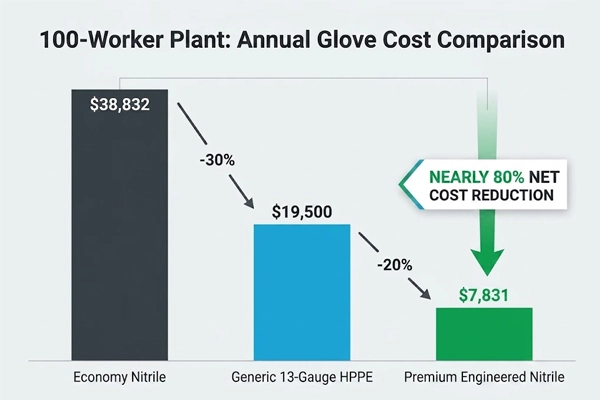
| Standard Economy Nitrile | $0.80 | 1.5 Days | 16,666 pairs | $13,332 | 8 Incidents | $38,832 |
| Generic 13-Gauge HPPE Glove | $1.50 | 5.0 Days | 5,000 pairs | $7,500 | 4 Incidents | $19,500 |
| Premium Engineered Nitrile Glove | $2.60 | 15.0 Days | 1,666 pairs | $4,331 | 0–1 Incidents | $7,831 |
Return on Investment (ROI) and Payback Period Analysis
Based on the comparison of the hard financial data presented above, the return on investment (ROI) and payback period for high-grade nitrile gloves clearly demonstrate a path to cost reduction:
Declining direct procurement costs: Although the unit price of the high-end gloves ($2.60) is more than three times that of the economy gloves ($0.80), thanks to their exceptionally long service life of 15 days, the factory’s annual glove consumption has been significantly reduced from 16,666 pairs to 1,666 pairs. In terms of direct procurement invoice amounts alone, the factory achieved annual net savings of $9,001 (a 67.5% reduction).
A dramatic drop in total cost of ownership (TCO): Taking into account downtime for glove changes, order management and processing, and a significant reduction in the workplace injury rate, the factory’s total annual net operating expenses plummeted from $38,832 to $7,831, representing an overall savings rate of nearly 80%.
Extremely Short Payback Period: After deploying high-performance nitrile gloves, the company was able to fully offset the initial unit price difference within the first one to two months of the equipment switch—thanks to a sharp reduction in the frequency of glove changes and the immediate improvement in grip strength and cut resistance—rapidly achieving positive cash flow optimization.
Labor Productivity, Dexterity, and Reduction of Micro-Stops
The physical properties of protective gloves have a significant impact on the muscle load and operating speed of assembly line workers. A pair of poor-quality gloves—whether bulky, stiff, or lacking in dexterity—acts like an invisible dampener, slowing down every grasping, assembly, and data-entry motion, and continuously accumulating lost work time through seemingly minuscule millisecond-level delays.
Minimizing Hand Fatigue and Repetitive Motion Drops
On precision manufacturing and automotive parts assembly lines that require high-frequency repetitive hand movements, the flexibility and fit of gloves are directly linked to workers’ ergonomic performance:
Reducing Muscle Resistance (Hand Fatigue): Inferior gloves use coarse knitted structures and hard latex coatings, forcing fingers to overcome the glove’s own mechanical elastic resistance every time they clench or extend. After several hours of continuous work, workers’ hand muscles experience severe soreness and fatigue, leading to reduced grip strength and diminished grasping precision.
Reducing Component Drops and Defect Rates: High-end engineering gloves utilize a 3D pre-curved process designed for an anatomical hand shape, combined with a highly elastic spandex-blend lining, to perfectly conform to the natural curvature of the palm and fingers. The ultra-lightweight design allows fingers to perform precise micro-motor control movements with ease, significantly reducing the loss or damage of micro-screws and expensive electronic chips caused by loss of control due to hand fatigue.
Eliminating Micro-Stops in Touchscreen Interfaces
In modern manufacturing facilities filled with collaborative robots (cobots) and digitized workstations, the frequent need to put on and take off gloves to operate touchscreens is a common cause of production line bottlenecks:
Eliminating Micro-Stops: If gloves are not treated with conductive touchscreen technology, workers must go through the disjointed sequence of “removing gloves—operating the screen—putting gloves back on” every time they enter production data or review work orders on the HMI screen, a process that takes 6 to 10 seconds per instance. When these non-productive micro-stops occur hundreds of times during a single shift, they severely disrupt the assembly line’s takt time.
Seamless Digital Interaction Throughout the Process: By incorporating continuous conductive fibers into the lining and combining them with a carbon-infused foamed nitrile coating, high-quality gloves enable zero-latency multi-touch responsiveness, allowing workers to seamlessly transition from physical assembly to digital terminal operations the moment they complete a task.
As detailed in our touchscreen technology guide, Touchscreen Compatible Nitrile Gloves: Improving Efficiency in Automated Industrial Workplaces, eliminating the micro-downtime caused by frequent glove donning and doffing not only directly recovers thousands of hours of pure assembly time across the entire plant but also eliminates at the source the high-risk workplace injury hazards caused by workers removing their gloves without authorization to operate equipment for the sake of convenience.
Premium Model Deployments: Multi-Scenario Budget Optimization
When implementing TCO cost optimization strategies in different operational areas of a factory, it is crucial to avoid a “one-size-fits-all” procurement approach. High-end nitrile gloves with targeted engineering protection advantages must be precisely deployed based on the mechanical load, friction frequency, liquid contact media, and ambient temperature at each workstation to achieve the best return on investment for the facility’s overall PPE budget.
High-Frequency Precision Automation & Reinforced Wear Model
In modern smart warehouses, high-frequency barcode scanning assembly lines, and human-machine collaboration workstations requiring frequent interaction with HMI screens, gloves must not only offer ultra-thin touchscreen compatibility and cut resistance but also withstand severe localized wear caused by tool friction.
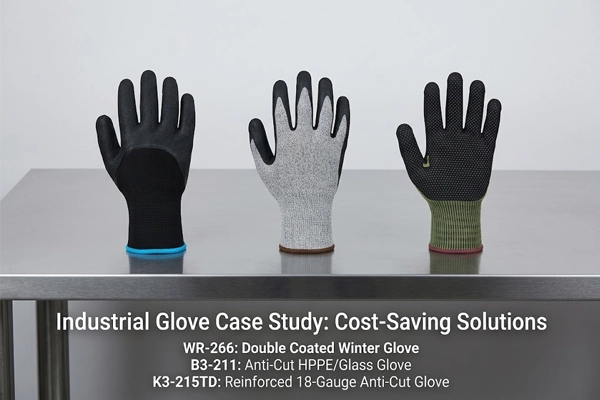
For these digital workstations characterized by high-frequency interactions and extremely demanding tear resistance requirements, we recommend the flagship model reinforced with dot-coating—K3-215TD, Anti-cut Foam Nitrile Glove, 18-gauge seamless TekArmor® A3/C liner, palm coated with dots, reinforced thumb crotch.
18-gauge high-density cut resistance and zero-delay touch sensitivity: Featuring an 18-gauge ultra-thin, seamless TekArmor® A3/C conductive liner, this glove provides workers with a precise, bare-hand-like experience for fine motor control when assembling micro-components or operating industrial tablets, eliminating micro-pauses.
Dots-Coated Wear-Resistant Matrix and Thumb-Crotch Tear-Resistance Reinforcement: A three-dimensional nitrile dot (Dots) pattern is layered over the foamed nitrile coating on the palm. Combined with a reinforced patch at the thumb-crotch area between the thumb and index finger, this design significantly enhances shear resistance when handling bins and gripping tools, extending the service life of a single pair of gloves several-fold and significantly reducing replacement costs for high-frequency workstations.
General Industrial & Heavy-Duty Mechanical Handling Model
In high-oil and high-friction work environments—such as metal stamping, sheet metal handling, automotive chassis assembly, and heavy machinery maintenance—gloves must not only offer excellent resistance to severe cuts but also provide a firm and reliable grip in heavy-oil conditions.
For these heavy-duty industrial mechanical operations, we recommend the long-lasting, wear-resistant benchmark model—B3-211, Anti-cut Sandy Nitrile Glove, 13-gauge Seamless HPPE/Glass Liner, Palm Coated.
13-gauge HPPE/glass fiber high-cut-resistant liner: Provides robust physical shear protection, effectively shielding workers’ hands from deep cuts caused by sharp metal edges and stamping burrs.
High-friction sanded nitrile (Sandy Nitrile) coating: The dense, micro-particle sanded surface penetrates oil films the moment it comes into contact with heavy-oil-coated workpieces, generating excellent physical grip and friction. This prevents injuries from slipping workpieces and eliminates scrap losses, significantly reducing workplace injury compensation costs and defect rates.
Cold-Storage & Wet Outdoor Thermal Dual-Dipped Model
In low-temperature cold-chain logistics, winter outdoor equipment repairs, and damp, muddy loading and unloading areas, frozen hands not only cause a sharp drop in operational dexterity but can also lead to serious accidents due to loss of grip control. Traditional single-layer gloves tend to become hard and brittle in low temperatures, failing to meet the dual requirements of cold protection and oil resistance.
For harsh working conditions where low temperatures and liquid exposure overlap, we recommend the double-layer cold-resistant and waterproof model—WR-266, Sandy Nitrile winter glove, 15-gauge seamless polyester shell with 10-gauge seamless acrylic terry liner, 3/4 double-coated.
Dual-Layer Temperature Control Structure (Dual-Liner System): The outer layer of 15-gauge polyester fabric provides flexibility and basic abrasion resistance, while the inner layer of 10-gauge acrylic terry forms a dense, heat-trapping air layer that continuously blocks cold air from penetrating in extremely cold environments, preventing workers’ hand muscles from freezing and losing function.
3/4-Depth Double-Layer Impregnated Waterproof Barrier: The fully sealed, smooth inner coating completely blocks the penetration of icy water and condensed oil residue, while the matte nitrile outer coating provides a strong, slip-resistant grip in icy and wet conditions, ensuring comprehensive protection for work efficiency and safety in extremely cold environments.
Industrial Laundering, Reusability, and Extended Cycle Life
Under traditional, extensive management practices, gloves are often discarded as single-use waste as soon as their surfaces become contaminated with oil or dust. In fact, high-quality engineered nitrile gloves possess excellent resistance to mechanical fatigue and hydrolysis. By implementing a specialized industrial laundering protocol, companies can safely reuse a single pair of gloves multiple times, extending the service life of each pair from a few days to several months and fundamentally reshaping the factory’s consumables expenditure model.
Washability Protocols That Preserve Nitrile Cohesion
Many factories attempt to wash gloves but encounter peeling or flaking of the coating, primarily due to the use of low-quality gloves or incorrect washing processes. To achieve efficient cleaning and reuse of gloves, strict standard cleaning procedures must be followed:
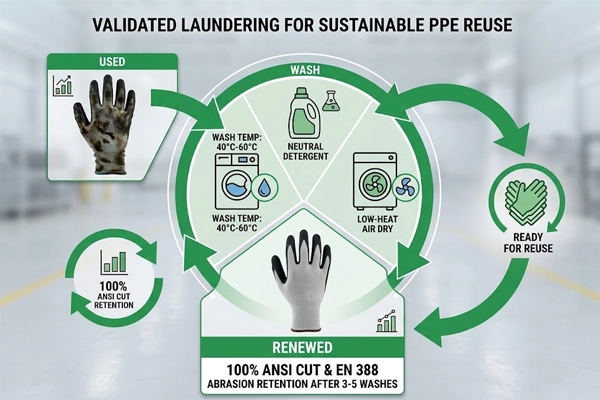
Neutral Water Quality and Temperature Control: The washing water temperature must be strictly maintained between 40°C and 60°C; avoid using strong acids, strong alkalis, or chlorine bleach. Excessively high temperatures and strong oxidizing agents accelerate the aging and embrittlement of synthetic rubber, whereas mild, neutral industrial detergents can thoroughly emulsify and remove heavy oil stains while fully preserving the cohesive bond (Coating Cohesion).
Low-Temperature Tumble Drying and Shrinkage Control: It is recommended to keep the drying temperature below 50°C or to air-dry naturally. Avoid high-temperature drying, which can cause spandex and high-molecular-weight cut-resistant fibers to shrink and deform due to heat, ensuring that the gloves retain their original ergonomic fit after washing.
Mechanical Retention Across Multiple Cycles of Industrial Washing
The key difference between high-quality engineering gloves and low-cost gloves lies in the retention rate of mechanical protection (Mechanical Retention) after multiple cycles of industrial washing:
Zero degradation in cut resistance and abrasion resistance: In low-quality gloves, the coating cracks and peels off after just 1 to 2 washes, and the fabric lining becomes loose and frayed; In contrast, high-end gloves featuring cross-linked vulcanized nitrile coatings and high-density engineering fibers (such as TekArmor® or high-grade HPPE) maintain their actual cut resistance rating and EN 388 abrasion cycle count within the original certification standards even after 3 to 5 standard industrial wash cycles.
Significant budget savings through value recovery: Each successful wash and reuse of a single pair of gloves directly saves the cost of purchasing an entire new pair. Based on an annual consumption of 5,000 pairs per factory, implementing a 3-cycle wash-and-reuse system can directly reduce annual procurement needs by more than 60%.
Optimizing Breathability and Glove Service Life
Industrial cleaning not only removes external grease but also thoroughly cleanses the worker’s sweat, sebum, and metabolic salts that have been absorbed by the glove lining over time:
Regularly removing grease and grime from the pores of the inner lining restores the glove’s microporous, breathable structure to its original state, eliminates odors and the risk of bacterial growth, significantly improves wearer comfort, and prevents workers from discarding gloves prematurely due to stuffiness and unpleasant odors.
As detailed in our Waterproof vs. Breathable Nitrile Coatings: Balancing Dexterity and Liquid Protection, gloves that combine a highly breathable microporous structure with a high-adhesion coating not only provide a dry and comfortable microclimate during daily operations but also withstand the rigors of heavy-duty industrial washing, resulting in significant optimization of the cost-per-use over the product’s lifecycle.
EHS Risk Mitigation, Clean Chemistry, and ESG Waste Reduction
In modern industrial manufacturing, companies can no longer limit their total cost of ownership (TCO) calculations to material flows and procurement invoices; environmental, health, and safety (EHS) audit risks and corporate social responsibility (ESG) compliance costs are becoming financial variables that cannot be ignored. Adopting environmentally friendly, clean processes and long-lasting engineering protective gloves can help factories avoid potential occupational health lawsuits and directly reduce industrial solid waste disposal costs.
Preventing Contact Dermatitis and VOC-Induced Downtime
Occupational contact dermatitis is a common yet often overlooked occupational health hazard in manufacturing companies:
The Invisible Killer of Harmful Chemical Residues: Low-cost, substandard nitrile gloves often use large amounts of inexpensive organic solvents (such as DMF and toluene) and excessive amounts of chemical vulcanization accelerators (such as thiourea and dithiocarbamates) during the production process. When workers sweat profusely and their hands become warm during high-intensity tasks, these harmful residues leach out and penetrate the skin barrier, triggering persistent redness, swelling, itching, peeling, and allergic dermatitis.
Avoiding Work Stoppages, Job Reassignments, and Medical Compensation: When a skilled assembly worker must take time off for medical treatment or be reassigned to a non-contact workstation due to severe hand dermatitis, this not only incurs direct medical reimbursement costs but also disrupts the production rhythm at that workstation and increases temporary training costs. Adopting high-grade, water-based, eco-friendly processes and premium gloves that have undergone multi-stage deionized water desalination and rinsing ensures zero solvent leaching and ultra-low free substance residues, eliminating the occurrence of occupational skin diseases at the source.
As we elaborated in our Waterborne Nitrile Coated Gloves: Eliminating Solvent Residues in Cleanroom Environments cleanroom guide, upgrading the PPE supply chain to eco-friendly, clean gloves that comply with the EU REACH Regulation’s SVHC limit standards not only provides robust protection for worker health but also serves as an essential compliance asset for factories to successfully pass EHS supply chain social responsibility audits conducted by international brand clients.
Landfill Waste Reduction: Slashing Annual Scrap Volume
The global manufacturing industry is currently facing increasingly stringent ESG carbon reduction requirements and landfill restrictions. As a high-frequency consumable, the disposal costs for industrial protective gloves are rising year by year:
Landfill volumes are plummeting: Take a large machinery manufacturing plant with 500 employees as an example. If the plant uses low-end gloves with a service life of only 1 to 2 days, it will generate more than 60,000 pairs of scrap gloves contaminated with cutting oil annually (equivalent to approximately 3 metric tons of oil-contaminated hazardous/industrial solid waste); However, by fully switching to high-quality nitrile gloves—which have a service life 3 to 5 times longer and can be washed and reused—the total annual volume of discarded gloves can be reduced to less than 12,000 pairs, directly cutting the volume of solid waste sent to landfills by 80%.
Reducing Solid Waste Disposal Costs and Carbon Footprint: The costs associated with the compliant transportation and destruction of hazardous and industrial waste are fixed operating expenses for factories. Significantly reducing the volume of discarded gloves not only directly lowers the annual invoiced amounts for hazardous waste removal and treatment but also provides companies with compelling, hard data on “Source Waste Reduction” for their ESG annual reports, thereby improving their overall scores in green and low-carbon supply chain audits.
Knowledge Base: Frequently Asked Questions (FAQs) & Actionable Advice
To help corporate procurement directors, plant operations managers, and EHS managers overcome traditional price comparison barriers and quickly establish a scientific, quantitative PPE audit system, the following answers address key practical issues regarding high-grade nitrile gloves in TCO cost accounting, industrial cleaning and reuse, and on-site testing.
How does a glove with a 2x higher unit cost reduce total annual PPE expenditure by 30%?
The key to how a glove with double the unit price can actually reduce total annual expenditure by more than 30% lies in the “Lifespan Multiplier” combined with the simultaneous reduction of comprehensive hidden costs:
A precipitous drop in consumption: A pair of high-end engineering gloves priced at $2.00 typically lasts 3 to 5 times longer than a pair of low-cost gloves priced at $1.00. Even assuming a lifespan three times longer, the total annual glove issuance across the entire plant would be reduced by 66.7%. In terms of direct procurement invoice amounts, total expenditure would already see a net decrease of approximately 33.3%.
Comprehensive Reduction in Indirect Operating Costs: Accompanying the sharp drop in total usage, costs related to material storage space, internal material issuance labor hours, procurement process costs associated with frequent orders, and waste disposal fees all decreased significantly by the same proportion, ultimately resulting in net savings of well over 30% on the year-end income statement.
Can premium cut-resistant nitrile gloves be industrially laundered without losing their ANSI ratings?
Absolutely, provided that you select engineered polymer cut-resistant gloves featuring a cross-linked chemical modification process and follow standard washing procedures:
Inherent Stability of Physically Cut-Resistant Fibers: The shear resistance of high-grade cut-resistant liners (such as TekArmor® or high-density, high-molecular-weight polyethylene [HPPE] composite yarns) stems from the microscopic molecular chain strength of the fibers themselves, rather than from surface chemical coatings; their mechanical cut resistance ratings will not degrade due to water rinsing.
Avoid high temperatures and strong alkalis to protect the coating: As long as industrial cleaning strictly adheres to warm water washing (40°C to 60°C), uses neutral synthetic detergents, and strictly prohibits high-temperature tumble drying, the cohesive strength between the vulcanized nitrile coating and the fabric fibers will not be compromised. After 3 to 5 wash cycles, the gloves will still fully retain their factory-certified ANSI cut resistance and EN 388 abrasion resistance ratings.
What key metrics should EHS teams track during a 30-day site trial?
When conducting a 30-day on-site trial of high-end gloves in the workshop, EHS and Lean Manufacturing teams should focus on quantifying and tracking the following four key metrics:
Average Days per Pair: Record the actual number of days a pair of gloves is in service before a worker requests a replacement due to tears, peeling, or fraying, and directly compare this to the replacement cycle of existing low-cost gloves.
Incident & Near-Miss Rate: Monitor changes in the number of reported incidents within the test work area, including minor cuts, puncture wounds from burrs, injuries from slipping or falling objects, and cases of hand dermatitis or redness.
Micro-Stop Frequency: Tracks the number of brief work interruptions and resulting lost work hours when workers leave their workstations to put on or remove gloves due to difficulties operating touchscreens or severe glove slippage.
Frontline Worker Satisfaction and Fatigue Feedback (Worker Satisfaction Score): Assess workers’ hand muscle soreness, fit, and breathability/moisture-wicking experience at the end of each shift to ensure procurement decisions are grounded in solid frontline execution data.
Call to Action (CTA)
Breaking the procurement mindset that “low price equals savings” and fully implementing efficient protective strategies guided by TCO is the only way for manufacturing companies to achieve a win-win outcome of lean cost reduction and EHS safety compliance.
Whether your facility needs to upgrade to high-frequency automated dispensing tear-resistant touchscreen gloves, HPPE matte-finish cut-resistant gloves for heavy-duty machining, or double-layered cold-resistant and waterproof gear for cold-chain operations, our team of technical consultants can provide on-site operational assessments and financial ROI calculations:
Explore our full range of premium industrial nitrile protective gloves: Explore Premium Industrial Nitrile Glove Series.
Request a 30-day on-site TCO cost-reduction audit and free sample kits: Contact SQG® for an On-Site TCO Audit & Free Sample Kits.


