

In modern heavy industry—including steel smelting, automotive body stamping, and high-risk specialty glass manufacturing facilities—frontline workers’ hands are in daily close combat with extremely sharp mechanical burrs and knife edges. Faced with these high-risk, zero-tolerance working conditions, evaluating and selecting high-quality cut resistant glove materials has become a core task for corporate EHS directors and supply chain procurement teams. However, many traditional factory safety management practices often fall into a very common intuitive fallacy—the belief that gloves are more cut-resistant simply because they are “thicker and heavier.”
On modern, digitized lean production lines that prioritize high utilization rates, blindly relying on thicker traditional gloves not only causes severe stiffness in the hand joints and operational fatigue but also fails to provide fundamental protection against the instantaneous sliding shear forces generated by tens of kilograms of mechanical tension. When a sharp blade sweeps across the surface with extreme pressure, thick, heavy fabrics lacking core technological support are highly susceptible to being instantly cut through, exposing gaps in intrinsic safety defenses.
True ultimate protection actually occurs within microscopic yarns that are invisible to the naked eye. In the underlying logic of compliance upgrades for hand safety in heavy industry, the generational leap in protective strength is essentially determined by the crystal lattice structure of the woven materials. Only by introducing the advanced concept of Micro-material Engineering—which involves the molecular- and micrometer-level geometric grading of high-strength polymer fibers, metal wires with high Mohs hardness, and specialized inorganic nonwoven materials—can we establish the first line of intrinsic safety for an entire fully automated production line without sacrificing the dexterity and sensitivity of workers’ fingers. In the following sections, we will systematically explore the physical mechanisms underlying these core composite yarns, revealing the invisible architecture behind high-performance hand protection.
Tri-Matrix Engineering: Deconstructing the Big Three Materials
In today’s vast and diverse market for specialized personal protective equipment, standing out in technical bids from major global manufacturers requires first breaking down the foundational building blocks of advanced physical protection for centralized procurement decision-makers. Today’s cut-resistant glove materials—globally recognized as the strongest and most technologically advanced—essentially form a “protective iron triangle” matrix composed of three core materials. At the microscopic level, each performs a specific function, playing an irreplaceable role at different stages of a blade’s penetration.
HPPE Fiber: The Flexible High-Tensile Shield
As the undisputed leader in the field of high-performance polymer protection, HPPE (ultra-high-molecular-weight polyethylene fiber) possesses a nearly perfect structure of ultra-long, parallel linear molecular chains at the microscopic level. This unique polymeric crystal lattice structure endows it with an extraordinarily high tensile strength at the macroscopic level. According to calibration data from mechanical testing laboratories, when compared side-by-side with materials of equivalent weight, the tensile strength of high-performance HPPE fiber can exceed that of high-quality industrial mild steel by more than 10 times.
In real-world workshop conditions, HPPE primarily serves as the glove’s outermost “flexible protective shield.” Thanks to its naturally exceptional strength-to-weight ratio and the microscopic smoothness of its fiber surface, it provides frontline workers with seamless tactile sensitivity, much like a second skin. Its core physical defense lies in blocking and mitigating extensive high-frequency surface abrasions, as well as minor sharp cuts in their initial stages. HPPE’s extremely high tensile flexibility efficiently absorbs the tear energy from external impacts as the macromolecular chains stretch, preventing the woven mesh from suffering structural collapse upon the first penetration by a sharp blade.
Steel Wire Matrix: The Rigid Shear Backbone
However, when workers on-site encounter extremely heavy sheet metal plates with irregular, sharp edges, metal stamping scraps, or the edges of high-risk specialty glass and experience sudden vertical slippage, relying solely on the molecular tensile ductility of polymer filaments makes the gloves highly susceptible to being instantly severed by sharp edges due to excessive localized pressure.
Under these zero-tolerance, high-risk shear conditions, the micron-level ultra-fine stainless steel wire matrix (Steel Wire Matrix), deeply embedded at the very core of the composite yarn, acts as a rigid backbone to hold the line. The ultra-fine metal wires serve as an absolutely unbendable “reinforcing skeleton” throughout the entire three-dimensional protective mesh. Through advanced wire-drawing and annealing processes, the SQG® R&D team has successfully compressed the stainless steel wires to a micrometer-level equilibrium point.
This process not only eliminates the critical drawbacks of traditional coarse steel wires—such as being prickly, stiff, and prone to breaking—but also leverages the metal’s extremely high Mohs hardness and powerful geometric shear resistance. When a sharp blade mercilessly presses down on the palm, the robust microscopic metal mesh forcefully withstands the intense vertical downward pressure. It forcibly blocks kinetic energy at the surface layer of the glove fabric, thereby eliminating, at the physical source, the risk of serious workplace injuries caused by sharp blades penetrating the lining and piercing the dermis, tendons, and nerves.
Structural Fiberglass: The Sacrificial Friction Barrier
In traditional centralized procurement of personal protective equipment (PPE) for supply chains, many factory logistics managers lacking basic knowledge of materials science often severely underestimate the protective contribution of high-rigidity structural fiberglass, even mistakenly believing that fiberglass is brittle, easily broken, and worthless. However, according to advanced systematic research in tribology—the study of friction and contact mechanics—fiberglass is actually an exquisitely designed “top-tier tactical sacrificial barrier.”
The defensive mechanism of fiberglass is truly revolutionary: when a sharp blade with high impact force and tensile strength cuts into and slides across the glove yarn at a specific angle, the fiberglass at the microscopic level undergoes micro-crystalline fracture—a process fully controlled during research and development—at extremely small, localized friction contact points. This active, high-density micro-fracturing instantly releases a massive amount of inorganic microscopic resistance.
This is akin to suddenly scattering a large handful of hard gravel onto an ice rink, which can rapidly “dull” the blade’s sharp edge within one ten-thousandth of a second, significantly reducing the blade’s cutting power. At the same time, this micro-crystalline fracture efficiently absorbs and dissipates the immense shear kinetic energy carried by the blade’s instantaneous downward movement through energy conversion. Furthermore, the natural thermal insulation and high fire resistance of glass fiber perfectly isolate the localized, instantaneous high temperatures caused by high-frequency mechanical sliding friction, preventing the entire composite cut-resistant yarn from experiencing chain segment displacement and thermal deformation due to heat. It serves as an invisible guardian, deeply embedded within the fabric.
Core-Spun Science: How Wrapping Defeats Edge Shearing
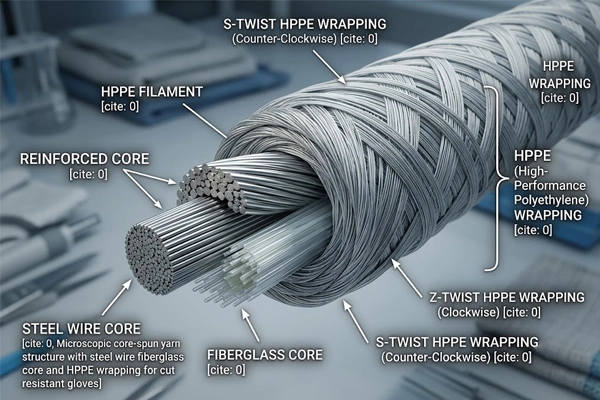
In state-of-the-art manufacturing facilities for specialty personal protective equipment, combining these three complementary cut-resistant glove materials is by no means a simple, haphazard physical blending process like that found in traditional, rudimentary workshops. If the weaving process does not meet standards, the internal stainless steel wires will shift, protrude, or break after just a few cycles of high-frequency physical stretching or industrial washing—potentially piercing the worker’s skin. To eliminate this industry-wide pain point, it is essential to introduce high-dimensional Core-Spun (composite core-spun twisted) precision textile technology, which maximizes the physical protective capabilities of dissimilar materials through precise spatial geometric locking.
The Geometry of Mechanical Wrapping: Z-Twist vs. S-Twist Core Stability
From a microscopic longitudinal cross-section of the yarn, high-stiffness micron-scale stainless steel wires and structural glass fibers are positioned at the absolute central axis (Central Core). If, at this stage, the outer fibers were simply physically wound in the same direction, severe “friction slippage” would occur within the yarn due to uneven stress distribution whenever a worker clenches their fist or frequently bends their finger joints. This would cause the metal wire to bulge outward instantly and pierce through the inner lining.
Therefore, advanced manufacturing processes must employ fully automated, high-precision twisting machines to tightly wrap countless strands of high-strength HPPE flexible filaments around the steel wire and glass fiber core in multiple layers and in opposite directions (with Z-twist clockwise and S-twist counterclockwise twists interlaced to counteract each other) at frequencies as high as tens of thousands of revolutions per minute.
This bidirectionally balanced mechanical geometric structure creates a perfect mechanical interlock in the outer layer. No matter how frequently the fingers undergo flexion or extreme twisting, the internal hard-core metal wire and glass fiber core remain firmly anchored at the very center of the yarn, ensuring that no structural loosening or localized exposure occurs. This provides workers with stable, non-irritating safety protection throughout the product’s entire lifecycle.
The Three-Stage Energy Dissipation Mechanism During Edge Impact
This precision composite core-wrap structure creates a perfect three-stage synergistic energy dissipation mechanism when subjected to sliding shear forces from metal stamping or glass handling:
Stage 1: Outer-layer HPPE slippage energy dissipation. When the outer edge of a sharp steel plate or blade first comes into contact with the palm, the outermost layer of dense HPPE fibers utilizes its excellent elongation toughness and naturally smooth surface to convert most of the intense longitudinal cutting pressure into a harmless sliding force.
Stage Two: Active Blunting by the Middle Glass Fiber Layer. As the blade penetrates slightly, the instantaneous high pressure directly triggers microscopic fractures in the middle glass fiber layer. Through microcrystalline fracture, this releases significant resistance, forcibly and rapidly blunting the sliding blade and depriving it of the kinetic energy needed for deeper penetration.
Stage 3: Inner Layer Steel Wire Hard Core Defense. Finally, the residual destructive force—having lost the vast majority of its kinetic energy—strikes the innermost stainless steel wire matrix. Relying on their extremely high geometric hardness and shear strength, the metal wires form the ultimate line of defense against penetration, completely blocking the risk of cuts from reaching the skin.
Global Standards: Translating EN 388 vs. ASTM F2992-16
For central procurement officers, supply chain compliance officers, and global EHS experts at multinational corporations, simply understanding the composition of the cut-resistant materials inside gloves is far from sufficient. When drafting technical bid specifications for bulk personal protective equipment (PPE) procurement, the ability to translate the mechanical advantages of these microscopic materials into quantifiable parameters under internationally recognized testing standards is the key weapon for preventing low-end suppliers from taking advantage of the situation. Currently, there are two mainstream mechanical cut-resistance testing standard systems in the global PPE ecosystem. A deep understanding of the differences in their mechanical calibration can help companies establish an airtight technical audit process during the bid evaluation phase.
Eliminating the Blade-Dulling Bias in the European Coup Test
In the previous version of the European standard EN 388 testing system, the Coup Test (cyclic rotating blade test) was the traditional method for evaluating gloves’ cut resistance. The test principle involves using a circular rotating blade to apply a fixed force of 5 newtons (N) to make back-and-forth cuts on the material’s surface and determining a protection level from 1 to 5 by calculating the number of cycles required to penetrate the lining.
However, when applied to modern specialty high-performance core-spun yarns, this outdated testing method reveals a critical physical blind spot: blade-dulling bias.
Since high-performance gloves commonly contain structural glass fibers and stainless steel wires, when the rotating blade rubs against these inorganic materials with high Mohs hardness at high frequency during testing, the blade edge undergoes severe localized fracturing in a very short time and quickly becomes dull. This prevents the testing equipment from cutting through the lining using purely mechanical cutting force, resulting in artificially inflated cut resistance ratings in the test reports (for example, “cheating” by rating private-label consumables with only mild cut resistance as the maximum Level 5).
To eliminate this technical loophole, the new European standard mandates the adoption of ISO 13997 (TDM-100 linear cutting test method). When test materials cause blade dulling during the Coup Test, calibration must be performed using TDM-100 equipment instead. This device uses a straight-sliding blade with strictly calibrated sharpness; a brand-new blade is mandatory after every cut. This eliminates the interference caused by blade dulling from glass fibers, thereby restoring the most accurate and practically relevant pure shear resistance data (in Newtons) rated on a scale from A to F.
Gram-Force Evaluation: Understanding the ANSI/ISEA 105 Rating Hierarchy
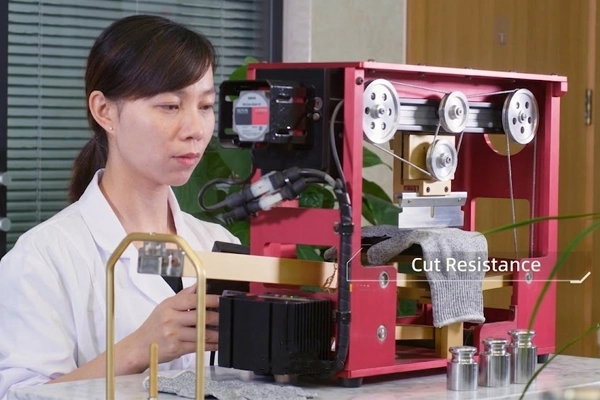
Compared to the dual-path testing of the European standard, the design of the U.S. standard ASTM F2992-16 / ANSI/ISEA 105 is more straightforward and uncomplicated. The U.S. standard system eliminates the traditional cyclic blade test, which is prone to interference, and uniformly adopts TDM linear cutting test equipment across the board as the sole mandatory calibration benchmark.
The core rating logic of the U.S. standard is based on precise quantification through gram-force evaluation. During testing, experimenters gradually apply different normal loads in grams to a standardized blade sliding in a straight line. The standard’s benchmark is extremely stringent: it measures the exact number of grams required to completely cut through the glove’s inner lining within a straight-line sliding distance of 20 millimeters (mm).
Based on the maximum force in grams that the glove can withstand before penetration, the American standard establishes a rigorous nine-tier defense hierarchy (Rating Hierarchy) ranging from A1 to A9:
A1–A3 Levels: Penetration resistance ranges from 200g to 1000g, primarily relying on standard polyester or low-density nylon; suitable for light warehouse work or fast-paced general electronics assembly.
A4–A6 Levels: The puncture resistance jumps to between 1,500 g and 3,999 g. At this level, high-performance HPPE fibers and an appropriate amount of glass fiber must be incorporated, specifically targeting automotive component assembly and high-frequency sheet metal part sorting.
A7–A9 Grades: Representing the ultimate pinnacle of physical defense, the cut-through resistance soars directly to 4,000g to 6,000g+ and beyond. Each leap in grade signifies a geometric progression in the technical integration of the internal ultra-fine stainless steel wire lattice density and the precision twist count of the outer HPPE Core-Spun layer.
The entire SQG® flagship cut-resistant series has passed the highest-level joint certification under both European and American standards, ensuring no inflated or fabricated data. By publicly disclosing the most transparent and rigorous original Gram-Force test reports to major global manufacturers, we use hard-hitting international data to build an unbreakable moat of trust for your high-risk front-line workplaces.
Parameter Matrix: Material Contribution to Defense
Under complex and variable heavy industrial operating conditions, the relationship between the mechanical mechanisms of the three core protective materials in real-world workshop applications and their correspondence with international mechanical protection test standards is as follows:
| Material Component | Primary Mechanical Function | Microscopic Defense Mechanism | Alignment for Heavy-Duty Applications | Recommended Models (Hyperlinked) |
| HPPE Fiber Matrix | High Tensile Strength & Dexterity | Absorbs kinetic energy, provides seamless flexibility, and reduces weight | Fast-paced sheet metal sorting, general high-flex assembly lines | SQG® K6-618 |
| Stainless Steel Core | Rigid Shear & Ultimate Cut Protection | Prevents structural blade penetration through a high hardness-to-thickness ratio | Heavy steel foundries, metal stamping blanks, high-load rigging | SQG® K9-610 |
| Specialty Fiberglass | Micro-Friction & Blade Dulling | Dissipates instantaneous cutting pressure through microcrystalline fracture | High-risk glass manufacturing, heavy mechanical maintenance | SQG® K7-682 |
Procurement Technical Audit Tips:
When evaluating third-party bids, high-performance cut-resistant glove materials are by no means simply a haphazard combination of single components. For cut-resistant solutions that truly offer high TCO (Total Cost of Ownership) benefits, it is recommended that bids mandate suppliers to fully include the aforementioned three-dimensional material matrix and clearly disclose the twist ratios of each material in a seamless, high-gauge configuration.
High-Gauge Knitting: Eliminating Hand Fatigue
By understanding the underlying physical mechanisms of materials science, procurement managers at major multinational manufacturers can truly grasp why upgrading materials can finally break the industry’s long-standing myth that “cut-resistant gloves must be bulky.” Due to outdated yarn technology, traditional PPE manufacturers have had to rely on piling up coarse, low-density yarns to meet higher ANSI cut-resistant ratings, resulting in finished gloves that are typically made of coarse 7-gauge or 10-gauge fabrics. These technical limitations directly lead to workers’ unsafe practices and safety gaps on the job site.
The Physiology of Hand Strain: How Fabric Rigidity Drives Non-Compliance
In industrial physiology and ergonomics assessments, the bending rigidity of glove fabric directly determines workers’ fatigue levels. Low-gauge gloves, in an effort to boost physical protection metrics, feature extremely thick linings. As a result, when workers frequently grip heavy tools or handle precision sheet metal parts, their finger joints must constantly overcome significant elastic rebound resistance from the fabric.
During high-intensity shifts lasting 8 to 12 hours, this high-frequency mechanical resistance leads to severe hand muscle fatigue and joint strain injuries. To escape this uncomfortable, tight, and suffocating sensation, frontline workers often take risks by removing their gloves in violation of safety protocols, thereby instantly plunging into the abyss of serious workplace injuries.
15-Gauge vs. 18-Gauge Engineering: Achieving Bare-Hand Tactile Sensitivity
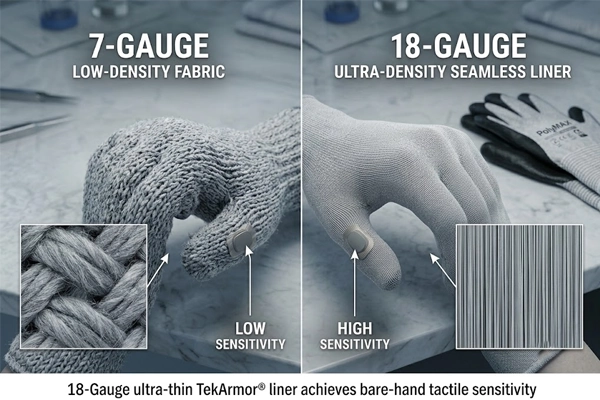
Through a sophisticated process that involves micron-level core-sheath composite technology combining stainless steel wires and glass fibers, the diameter of the protective fibers is reduced to the absolute minimum, enabling the perfect application of high-density, seamless, ultra-fine 15-gauge or 18-gauge micro-knitting techniques.
This high-gauge, dense mesh fabric makes safety equipment that feels like bare hands a reality. The gloves perfectly conform to every subtle movement of a worker’s natural hand contours, significantly reducing resistance during joint flexion. This exceptional hand flexibility, derived from the fundamental properties of the material, encourages front-line employees to wear the gloves 100% voluntarily and at all times, fundamentally eliminating the risk of work stoppages caused by safety violations on the shop floor.
Wash Durability: Industrial Washing vs. Microfibers
When making bulk purchasing decisions, major manufacturers consider not only the cost per purchase but also the total cost of ownership (TCO) over the product’s entire lifecycle. Even if a glove has exceptionally high cut-resistance ratings, it remains an inefficient, low-quality consumable if, after just one or two industrial washes, it suffers physical shrinkage, the internal steel wire breaks, the coating cracks, or the lining becomes stiff and brittle. Under the combined onslaught of high temperatures and high-concentration chemical degreasers in industrial laundry operations, the glove’s microstructural stability will be pushed to its limits.
Preventing Friction Slippage and Wire Breakage in High-Temperature Cycles
In centralized industrial laundry operations, gloves are subjected to prolonged high-temperature drying and high-frequency agitation and friction within the drum. Conventional core-spun gloves, lacking a microscopic locking process, are highly prone to friction slippage between the polymer filaments in the outer yarn layer and the metal wires in the core.
As the wrapping layer loosens, the stainless steel wires—no longer constrained by the outer layer—undergo fatigue fracture due to frequent bending stress, forming countless tiny “steel wire spikes” that pierce the inner lining, leading to serious hand-piercing accidents and widespread worker complaints. SQG®, on the other hand, employs a precision heat-setting process after knitting. This process uses a physical energy field to induce microscopic contraction in the outer-layer fibers, thereby firmly locking the internal metal lattice in place. This ensures that even after repeated heavy-duty industrial washing, the internal steel wires retain excellent ductility and geometric anchorage.
Chemical Inertness of the UHMWPE Matrix Against Heavy Industrial Lubricants
In addition to mechanical wear, cutting fluids, stamping and drawing oils, and high-concentration chemical degreasers—which are commonly found in workshops—are constantly eroding the chemical structure of the gloves. Ordinary nylon or low-molecular-weight polyester fibers are highly susceptible to hydrolysis and stress swelling at the macromolecular chain level, leading to a loosening of the fiber lattice and a precipitous decline in protection levels after washing.
In contrast, UHMWPE (ultra-high-molecular-weight polyethylene), which serves as the core of the blended matrix, possesses exceptionally strong chemical inertness. Its high-density amorphous lattice structure provides complete immunity to penetration and corrosion by strong acids, strong alkalis, and heavy industrial oils, ensuring that even after exposure to harsh, oily working conditions and intensive washing, the glove’s inner lining does not shrink or harden, and its physical protective performance remains as effective as new.
Audit Protocol: On-Site Workplace Hand Hazard Assessment
Once the full scientific theory behind materials and standards is understood, the key to the success or failure of a factory’s safety upgrades lies in how this complex knowledge is applied to real-world production lines. Before updating PPE configurations, EHS directors and on-site supervisors at multinational corporations should follow this three-step approach to conduct a systematic on-site hand safety risk assessment, thoroughly aligning the microscopic properties of cut-resistant glove materials with the macro-level working conditions on the shop floor.
Trace Analysis: Engineering Backwards from Scrap and Used Glove Markings
The first step in a technical audit is to conduct “microscopic scratch reverse engineering.” On-site managers should not limit themselves to passively observing the specifications on machine nameplates; instead, they should go directly to the front-line workstations to collect and examine—under bright light—discarded and replaced gloves, as well as the edges of scrap generated during the production process.
By observing the patterns of high-frequency scratches on the palms, fingertips, or thumb creases of used gloves, as well as the density of pilling and the fracture characteristics of material damage, it is possible to reconstruct with extreme precision the actual levels of mechanical shear force and stress-strain points experienced on the shop floor during dynamic production. This provides firsthand, indisputable, and objective physical evidence for determining whether to select ANSI A4 or ANSI A9 grade cut-resistant gloves.
Fluid Dynamics: Mapping the Boundary Matrix of Cutting Fluid and Chemical Splashes
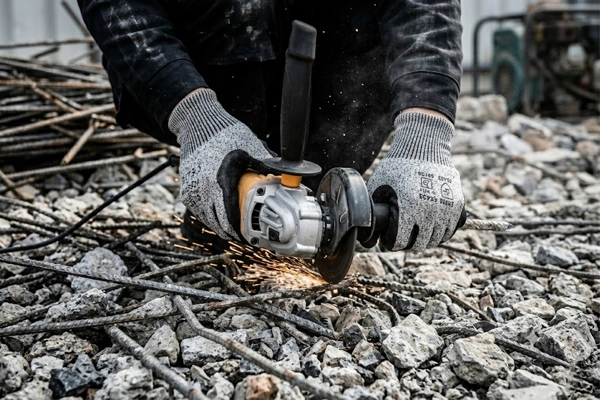
In heavy industrial production, purely mechanical cutting rarely occurs in isolation; it is often intertwined with complex fluid conditions. EHS teams must comprehensively analyze and delineate the fluid boundary matrix within the workshop, documenting in detail the frequency, concentration, and duration of contact at each workstation for cutting fluids, stamping and drawing oils, fully synthetic motor oils, and even strong acid and alkali cleaning agents.
Oily and dry operating conditions impose entirely different requirements on the coefficient of friction of material surfaces. In environments with high levels of oil and other fluids, it is mandatory to use gloves equipped with a hydrodynamic drainage structure (such as Sandy Nitrile matte nitrile) in combination with a chemically inert polymer anti-cut blended lining. This prevents secondary injuries from slipping on fluids, as well as localized chemical swelling and hydrolysis, thereby eliminating secondary hazards caused by liquid penetration.
Ergonomic Profiling: Aligning Glove Gauge with Finger Flexion Frequencies
The final step in the evaluation is to establish an ergonomic profile for the job. Managers need to calculate in detail the proportion of total working hours spent by front-line workers on fine finger movements during a standard shift—such as picking up tiny 3mm bolts, tapping the HMI digital control screen of automated equipment, or arranging precision circuit connections.
The higher the frequency of these movements and the more demanding the requirements for tactile sensitivity, the stricter the minimum gauge requirement for standard gloves becomes. It is essential to replace low-end, coarse fabrics with a high-density, micro-knit lining of 15 or 18 gauge to perfectly accommodate the physiological flexion during high-frequency gripping, thereby eliminating the risk of workplace injuries caused by employees improperly removing their gloves due to muscle overload and fatigue.
Conclusion: Rebuilding Your Production Line as the First Line of Defense
With global Tier-1 supply chain technical specifications and ESG sustainability metrics becoming increasingly stringent, ensuring intrinsic safety for hand protection is no longer a traditional occupational safety issue that can be resolved simply by increasing material thickness. By understanding the interplay of mechanical forces and energy dissipation mechanisms at the microscopic level in high-performance materials, corporate procurement decision-makers and EHS managers can thoroughly discern, when reviewing technical bid documents, those low-end consumables on the market that rely on excessive thickness—which are prone to shrinkage and fraying after repeated washing—and even lack support from linear cut weight testing.
The true first line of defense on the production line often hinges on the geometric stability of that single micrometer-scale composite core within the cut-resistant yarn. By strictly specifying the crystal lattice structure of raw materials and the Core-Spun composite core-wrap process parameters in procurement technical specifications, and by comprehensively deploying high-tech, high-performance cut-resistant safety gloves built on 3D materials engineering, companies are not only establishing an impenetrable physical defense network for the palms of every frontline employee but also fundamentally eliminating the “black hole” of unplanned downtime caused by workplace injuries.
Deeply integrating materials science innovations into the on-site safety management matrix not only significantly reduces the company’s annualized total cost of ownership (TCO) for PPE but also minimizes labor compliance risks, building an impenetrable risk-immunity moat for the entire factory’s digital, high-efficiency, lean production.
Sourcing FAQ: Resolving Material Engineering Concerns
To help companies address potential technical concerns in global supply chain procurement, this chapter provides rigorous technical clarifications regarding physical and chemical stability for common material-related issues most frequently raised by procurement teams and frontline employees.
Q1: Will the stainless steel wires break and puncture the skin after repeated washing?
In industrial high-frequency washing environments, low-end braiding processes can indeed cause internal metal wires to fracture due to fatigue, breaking through the outer shell and injuring employees. However, high-performance cut-resistant liners utilize precision annealing and wire-drawing technology during production to compress the stainless steel wires to a micrometer-level diameter, significantly enhancing the bending fatigue limit of the metal crystal lattice.
More importantly, through a dual-direction (Z-twist and S-twist) core-spun twisting process combined with heat-setting treatment, the outer layer of flexible HPPE fibers generates a lasting mechanical interlocking force on the inner core as the fabric shrinks during washing. This ensures that even after tens of thousands of finger flexion cycles and repeated industrial washes, the micron-level steel wires remain firmly anchored at the core of the yarn, preventing any structural displacement or reverse penetration.
Q2:Does the addition of fiberglass cause contact dermatitis on sensitive skin?
Traditional coarse-spun fiberglass is highly prone to filament breakage when subjected to high-frequency physical friction, resulting in microscopic debris that can penetrate the human dermis and cause extensive contact dermatitis.
To completely block the allergen, high-performance protective gloves utilize inorganic glass fibers with a high-rigidity, continuous filament structure. During microscopic twisting, these high-performance inorganic filaments are 100% fully encapsulated by multiple layers of dense, ultra-high-molecular-weight polyethylene (UHMWPE) filaments. While wearing the gloves, the skin comes into contact only with skin-friendly polymer materials, while the glass fibers are completely isolated deep within the core to absorb physical forces, ensuring zero-contact safety for employees at the fundamental level.
Q3:How do composite yarns withstand chemical degradation caused by lubricants?
High-concentration fully synthetic cutting fluids, drawing oils, and chemical degreasers—commonly found in heavy industrial workshops—can rapidly hydrolyze or swell ordinary nylon and polyester materials, leading to mechanical degradation and breakage of the yarn’s macromolecular chains.
In contrast, a blended matrix composed of ultra-high-molecular-weight polyethylene (UHMWPE) fibers, micron-scale metal wires, and specialty inorganic glass fibers is inherently highly inert from both a chemical and mechanical standpoint. It contains no organic ester bonds that are susceptible to oil contamination or acid-base attacks. Even when immersed for extended periods in various heavy industrial hydrocarbons and synthetic lubricants, the symmetrical lattice structure of their molecular main chains maintains exceptional chemical stability—without shrinking or hardening—ensuring that the gloves do not degrade throughout their entire service life under harsh, oil-laden fluid conditions.
Ready to Optimize Your Shop Floor Safety Matrix?
The safety of frontline shop-floor workers’ hands should not be left to chance with traditional, cumbersome, and mechanically unsupported occupational safety measures. From the microscopic stability of blended yarns to the macroscopic precision of high-gauge, lean manufacturing processes, every rigorous improvement in physical metrics directly reduces your production line’s violation rate and overall total cost of ownership (TCO).
As a source technology provider specializing in global heavy industry protection, SQG® stands ready to assist your company in completing comprehensive compliance audits and technical upgrades to eliminate protection gaps in high-risk, high-tensile-force shear environments.
If you are facing challenges such as frequent workplace injuries on production lines, excessively high wear-and-tear rates for traditional gloves, or employees violating safety protocols by removing gloves due to hand fatigue, we recommend that you immediately initiate an intrinsic safety assessment:
Request a Heavy-Duty Sample Pack —Receive a sample pack tailored for heavy industries such as automotive stamping, steel smelting, and specialty glass, and verify on-site the mechanical performance—including Gram-Force (cut resistance) and bare-hand-level sensitivity with high needle counts—under your most demanding real-world production conditions.
Contact the SQG® Industrial Technical Team —Work directly with our on-site safety engineers. We will conduct systematic trace analysis (injury reverse engineering) and ergonomic profile assessments at your front-line workstations to develop a comprehensive PPE configuration plan that fully meets the requirements of bid audits.


