Introduction: ESG Pressures and Shop Floor Realities
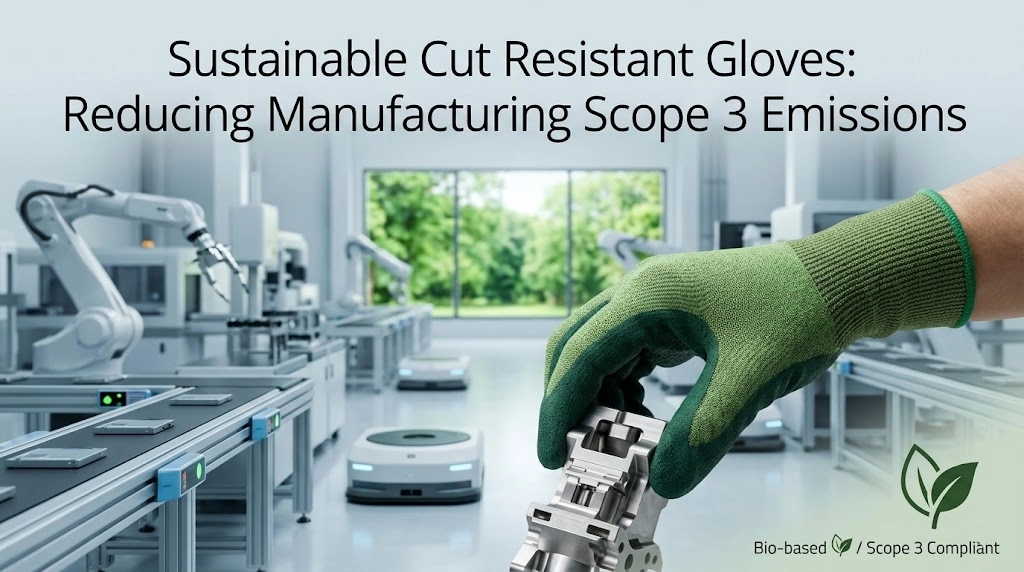
Sustainable cut resistant gloves are reshaping modern production lines and setting new benchmarks for environmental compliance. In today’s globalized manufacturing supply chains, multinational manufacturing giants—such as Apple, BMW, and other top-tier supply chain systems—have, after fully achieving direct emissions reductions within their factories (Scope 1 & 2), shifted their carbon audit focus entirely to Scope 3 emissions in manufacturing (Scope 3 of the Greenhouse Gas Protocol: hidden carbon footprints across the upstream and downstream value chain). This means that procurement departments and EHS (Environmental, Health, and Safety) directors at each factory are now not only responsible for maintaining low cut-injury rates among front-line workers but also for meeting rigorous quarterly ESG compliance ratings for suppliers issued by headquarters.
Among the many industrial consumables used in high volumes on a daily basis, protective gloves are a “carbon black hole” that is all too easily overlooked. Traditional high-performance protective gear relies heavily on synthetic nylon, high-strength polyester, and petroleum-based polyurethane (PU) coatings derived from crude oil extraction and cracking. Given the massive annual volume of these materials procured, these low-end, traditional PPE products—manufactured using fossil fuels—are continuously accumulating a heavy carbon debt for Tier-1 supply chain companies.
To make matters worse, traditional gloves (such as conventional 13-gauge or 15-gauge gloves) often rely on repeated layering of coarse, low-quality chemical adhesives to artificially inflate their cut resistance ratings. This directly results in bulky gloves, causes excessive sweating, and offers extremely high resistance to joint flexion. Due to severe “muscle fatigue” and “tactile blindness” in their fingertips, front-line workers often take risks by removing their gloves in violation of safety protocols during operations, thereby triggering the vast majority of deep-cut injuries in the workshop.
To completely break this compliance deadlock, manufacturers must implement lean upgrades to low-carbon protective equipment. Introducing a new generation of high-gauge cut-resistant work gloves that integrate bio-based PU coatings with recycled polyester liners represents the ultimate sustainable supply chain strategy for modern factories. This approach enables them to achieve both “100% on-site, full-time behavioral safety” and a “green light” on Scope 3 environmental audits—all without compromising safety compliance standards.

The Carbon Liabilities of Conventional Industrial PPE
The Reliance on Petrochemicals in Traditional Knits
When assessing the carbon footprint of global industrial manufacturing facilities, many procurement and EHS directors often overlook traditional protective gloves, which are consumed at a high rate on a daily basis. A detailed analysis of the widely available 13-gauge or 15-gauge traditional industrial cut-resistant gloves currently on the market reveals that their underlying textile materials have an extremely high carbon intensity. To achieve a certain thickness and tensile strength, the knitted linings of these common gloves rely almost entirely on crude oil cracking and energy-intensive chemical refining processes.
In the upstream chemical manufacturing system, the process of synthesizing virgin nylon or traditional polyester fibers from fossil raw materials releases large amounts of greenhouse gases, such as carbon dioxide. This means that even before these petrochemical-based filaments enter fully automated knitting machines, a single pair of traditional work gloves has already accumulated a heavy “initial carbon debt” at the very beginning of its life cycle.
This supply chain model, which relies excessively on fossil fuels, is directly lowering the compliance scores of multinational suppliers when they undergo audits by major modern manufacturers. If companies continue to purchase large quantities of these petroleum-based gloves that have not undergone low-carbon modification, they will face the predicament of failing to meet data requirements in their Scope 3 emissions manufacturing (GHG Accounting Standard Scope 3: hidden carbon footprints across the upstream and downstream value chain) material consumption audits, thereby increasing the company’s overall sustainability compliance liabilities.
The High-Turnover Material Waste Penalty
In addition to the fact that carbon emissions at the raw material source cannot escape reliance on fossil fuels, the extremely short service life of traditional, low-end PPE under actual workshop conditions is further causing a severe “material turnover penalty.” Due to their low weave density, conventional petrochemical gloves have a relatively loose fiber structure at the microscopic level. This physical flaw makes them extremely vulnerable when subjected to the intensive central laundry processes (Industrial Laundering) common in modern factories.
When these traditional gloves are exposed to high-temperature chemical cleaning at 40°C to 60°C and high-speed mechanical friction, the loose molecular chains of the petrochemical fibers undergo disordered curling. The direct consequence is that after just one or two washes, the gloves shrink significantly, become misshapen, and harden like stone, completely losing their basic comfort and grip elasticity.
Unable to withstand frequent washing cycles, frontline workers often have no choice but to discard them as soon as they become unusable. To maintain protective standards, workshops are forced into a vicious cycle of “mass disposal and mass purchasing.” This vicious cycle of material waste caused by the premature scrapping of gloves not only keeps the company’s monthly centralized procurement budget high but also exponentially amplifies indirect greenhouse gas emissions across the factory’s upstream and downstream operations—including logistics, warehousing, and solid waste incineration and landfilling—becoming a major stumbling block for manufacturing companies seeking to achieve comprehensive emissions reduction targets
The Mechanics of Green Polyurethane and Recycled Liners
Bio-Based PU: Replacing Petroleum with Plant Derivatives
To break the deadlock of high carbon emissions caused by fossil fuels, modern protective gear is undergoing a green transformation in materials science. The core of the new generation of sustainable gloves lies in the use of bio-based polyols extracted from renewable resources such as vegetable oils and starch to replace more than 30% of the petroleum-based raw materials in traditional palm dip coatings. This process breaks the heavy reliance on traditional fossil fuels at the source of production, fundamentally optimizing the carbon footprint metrics of upstream material consumption.
Even more impressive is that this upgrade to green materials has not compromised physical protective performance. During the curing phase, this bio-based PU coating undergoes a precise chemical cross-linking reaction, forming a high-density “three-dimensional lattice” skeletal structure at the microscopic level. This three-dimensional molecular lattice possesses exceptional energy dissipation efficiency. When the glove encounters high-pressure scraping from external sources, metal burrs, or friction from rough workpieces, it instantly dissipates and disperses localized concentrated friction forces. This means that the glove can easily pass rigorous physical abrasion tests solely through its refined molecular toughness, without relying on thick layers of adhesive, achieving the perfect balance between a lightweight, bare-hand feel and hardcore abrasion resistance.
Micro-Mechanical Integrity of Recycled Matrices
In addition to the low-carbon revolution in coatings, the knitting process for glove structures has also undergone a lean redesign. The new generation of low-carbon protective gloves extensively utilizes post-consumer recycled polyester liners certified under the international GRS (Global Recycled Standard). Purchasing directors at many major manufacturers often harbor stereotypical biases against eco-friendly materials, believing that recycled or bio-based fibers are inherently “short-lived” and will inevitably compromise core cut-resistance safety metrics under high-intensity industrial operations.
However, test data from SQG®’s in-house laboratory strongly refutes this misconception. When recycled or bio-based eco-friendly filaments are fed into advanced 18-gauge or 21-gauge ultra-high-density seamless knitting machines, the high-precision mechanical knitting achieves a tight interlocking of fibers at the microscopic level. This extremely high knitting density naturally restricts the yarn’s ability to deform, eliminating the possibility of yarn displacement or slippage under stress. This microscopic mechanical restructuring endows the eco-friendly lining with exceptional tear resistance and a robust cut-resistant barrier, enabling it to easily meet and align with international cut-resistant safety standards such as ANSI A3 to A5 and EN 388 without adding bulk. The high-gauge, fine-interlock weaving process demonstrates that eco-friendly protective gear not only boasts an exceptionally long physical lifespan but also builds a robust, round-the-clock, and damage-free line of defense for the hands of assembly-line workers.
Aligning with Global ESG Frameworks and Green Audits
GRS and Higg Index Compliance in Sourcing
In modern B2B centralized procurement systems, the supplier qualification mechanisms of multinational manufacturing giants have undergone a fundamental transformation. Procuring industrial protective gloves certified under the Global Recycling Standard (GRS) and endorsed as compliant with the Higg Index is no longer merely a matter of environmental consciousness; it has become a mandatory requirement for Tier-1 core suppliers to retain orders from major manufacturers.
When industry giants such as Apple and BMW—which have extremely stringent ESG metrics—conduct on-site environmental and social responsibility audits across their supply chains, these industrial consumables, backed by internationally recognized green certifications, provide a complete and traceable data chain regarding origin and supply chain compliance. By specifying these internationally certified green-endorsed protective products in their standard bid specifications, suppliers can directly demonstrate to major manufacturers’ auditors their substantial efforts to reduce the consumption of virgin petrochemical resources and ensure clean production. This enables them to easily secure a “green light” rating during cumbersome on-site ESG audits and compliance evaluations, thereby establishing a solid barrier to entry in centralized procurement.
Quantifying Lifecycle Product Carbon Footprints (ISO 14067)
To ensure that low-carbon procurement goes beyond mere lip service, manufacturing companies need to adopt a scientific, tool-based approach to transform abstract environmental slogans into quantifiable emissions reduction assets that are recognized by finance and compliance departments. In accordance with ISO 14067 (the product carbon footprint standard), companies can conduct precise quantitative inventories of the full lifecycle greenhouse gas emissions for single- and double-layer protective gloves—from raw material sourcing and factory processing to final disposal.
Through rigorous carbon footprint reconciliation, procurement departments can clearly quantify exactly how many grams of indirect greenhouse gas emissions each pair of low-carbon cut-resistant gloves reduces for the factory. This data-driven, quantitative management approach provides objective and credible underlying data to support companies’ year-end ESG reports and financial audits. When the emissions reduction per pair of protective gear is multiplied by the factory’s massive annual consumption volume, the previously invisible Scope 3 emissions from material consumption are transformed into tangible, quantifiable emissions reduction performance on financial statements, effectively helping companies demonstrate the green profitability benefits of their supply chains to headquarters and capital markets.
Sourcing Matrix: The SQG® Sustainable High-Gauge Fleet

To help multinational manufacturing companies transform abstract ESG metrics into quantifiable emissions reduction assets on the factory floor, SQG® has leveraged innovative material mechanics to create a precision protection matrix infused with sustainability throughout its entire product line. The following three flagship models strike the perfect balance between extreme safety and low-carbon supply chain audit standards:
SQG® BFK3-610: The Precision Assembly Benchmark
In the field of high-precision industrial assembly, even the slightest hand fatigue can directly impact production line yield. The SQG® BFK3-610 innovatively employs an ultra-thin, seamless 18-gauge knitting process, micro-blending the unique, patented TekArmor® yarn with bio-based fibers. This model is designed to deliver ultimate fingertip tactile sensitivity and virtually zero resistance to joint flexion, providing workers with physical feedback that feels just like bare hands.
To complement the lightweight, thin construction, the palm dip coating utilizes a curing process with a plant-based, bio-derived PU coating. Designed specifically for precision assembly of 3C electronics, semiconductor cleanrooms, and fine instrument inspection workstations, it not only achieves lightweight protection against cuts and punctures but also eliminates the safety management “blind spot” where operators voluntarily remove gloves due to sweaty hands and impaired fine motor skills.
SQG® BFK6-620: The Heavy-Duty Low-Carbon Workhorse
In demanding heavy-duty applications such as automotive final assembly and heavy sheet metal handling, protective gear must simultaneously address the dual challenges of “extreme cut resistance” and “grip in oily conditions.” The SQG® BFK6-620 features an extremely flexible 18-gauge heavy-duty eco-friendly blended lining and incorporates an innovative, proprietary patented bio-based PU coating with a nano-sandy (Nano-Sandy) dip-coating modification process on the outer palm layer.
During actual operations, this unique microporous, sanded rubber surface functions much like the drainage grooves on car tires in the rain: the moment it comes into contact with the workpiece, it rapidly pierces through and disperses heavy oil residue or stamping and drawing oils adhering to the metal sheet surface, enabling a secure, non-slip grip with minimal effort. While providing front-line heavy industry workers with a high-level ANSI A6 extreme heavy-duty cut-resistant safety barrier, this model significantly extends the service life of heavy-duty gloves, directly setting a new record for Scope 3 emissions reductions in heavy industry logistics equipment.
SQG® BFX4-689C: The 21-Gauge Fine Liquid Shield
For CNC machining and precision metal cutting applications involving frequent exposure to cutting fluids, cooling water, and industrial emulsified oils, gloves must not only provide cut resistance but also feature a robust liquid barrier. The SQG® BFX4-689C pushes the physical limits of modern textile machinery, utilizing a 21-gauge (21-needle) ultra-fine seamless knitted matrix to precisely fuse bio-based fibers, high-strength HPPE, and ultra-fine metal fibers into the core.
Even more groundbreaking is its 360-degree fully coated Bio-based X-Plus eco-friendly coating process. This fully enclosed protective design not only completely blocks the penetration of harsh industrial liquids and prevents skin inflammation caused by prolonged exposure to chemicals, but—thanks to the material’s inherently high proportion of plant-based components—it also completely shatters the industry’s traditional perception that “fully coated gloves are inevitably stiff, stuffy, and a high-carbon burden.” While maintaining ANSI A4 advanced cut resistance, it offers a lightweight, natural-feeling experience as thin as a second skin.
On-Site Traceability: Visual Management for EHS Audits
Color-Coded Sustainability Systems
In large multinational manufacturing plants, relying solely on green compliance at the procurement document level is far from sufficient. The true test of an EHS (Environmental, Health, and Safety) Director’s managerial acumen lies in ensuring that low-carbon protection strategies are fully implemented—100%—on the noisy and complex production floor. To address this challenge, the SQG® Green Protection Matrix has fully integrated innovative on-site visual management technology.
By precisely weaving a unique color-coding system into the glove cuffs or printing a distinctive, eye-catching green label on the back of the hand, the physical characteristics of the gloves themselves are transformed into highly effective on-site audit tools. During actual shop floor inspections, EHS inspection directors no longer need to approach workers individually to remove gloves and check labels. Instead, by conducting a quick visual inspection from 5 meters away, they can instantly identify—based on the cuff color—whether frontline employees at that workstation are wearing gloves with the required cut-resistance rating and whether they have actually switched to the latest green, low-carbon models mandated by the company. This extremely low-cost management technique plugs safety loopholes at both the administrative and on-site traceability levels. Not only does it significantly improve the efficiency of daily compliance audits, but it also establishes an efficient and intuitive culture of low-carbon safety behavior within the workshop.
Technical Parameter Matrix: Petrochemical vs. Bio-Based Gloves
In the technical bid audits and supply chain compliance ratings conducted by major multinational manufacturers, procurement decisions must not rely on vague marketing slogans but must be based on rigorous mechanical performance metrics and carbon footprint comparisons. To provide objective, structured comparison criteria for corporate central procurement decision-makers and CFOs, this chapter presents a comprehensive breakdown of the underlying parameters comparing traditional petrochemical-based gloves with the SQG® Green High-Gauge Protective Glove Matrix.
Through an intuitive comparison of performance metrics, it becomes clear that upgrading to high-end green gloves is not only a demonstration of a company’s commitment to environmental responsibility but also a necessary technical measure to fundamentally optimize the product’s carbon footprint and the overall total cost of ownership (TCO) in the workplace.
| Performance Evaluation Criteria | 13/15-Gauge Traditional Petrochemical Gloves | SQG® Sustainable High-Gauge Fleet (BFK3 / BFK6 / BFX4) |
| Liner Material Source | 100% Virgin Nylon / Petroleum-derived Polyester | Blended Bio-based fiber & GRS-certified Recycled Polymers |
| Coating Chemical Formulation | Crude Oil-Derived Polyurethane / Standard Nitrile | Bio-based PolyMax / X-Plus Plant-Derived Polymer |
| Scope 3 ESG Carbon Contribution | Accumulates continuous carbon debt for Tier-1 supply chains | Slashes upstream product carbon footprint; ensures green audit compliance |
| Laundering Cycle Durability | Loosely knit meshes deform, shrink, and stiffen after 1-2 washes | High-density interlocked grids lock shape retention across dozens of wash cycles |
| Hand Muscle Fatigue Index | High flexion resistance triggers unsafe “5-second glove removal” | Near-zero flexion resistance; provides 100% natural bare-hand feedback |
Industrial Laundering Resilience: Lifecycle Extension
Thermal Displacement and Shape Retention
The lifecycle of industrial protective equipment directly determines the overall turnover rate of material consumption and procurement in factories. In heavy industry and precision manufacturing, gloves inevitably undergo frequent central laundry processing (Industrial Laundering). After undergoing high-temperature chemical washing at 40°C to 60°C, traditional low-end protective gloves—made of disorganized petrochemical fibers—are highly prone to severe “thermal displacement.” This causes the molecular chains in the glove lining to curl extensively, shrink, and harden overall, rendering the gloves unusable and turning them into waste.
To completely overcome this drawback, the SQG® Green High-Gauge Matrix incorporates innovative mechanical thermal stability control into its structure. By utilizing ultra-high-density seamless knitting technology with 18 and 21 stitches per inch, the eco-friendly bio-based natural filaments form an airtight “physically interlocked mesh” at the microscopic level.
This ultra-high-density warp-and-weft knit mesh naturally establishes a robust mechanical stress constraint for the gloves. When subjected to high-temperature washing in industrial laundering equipment, stripping by chemical detergents, and high-load rotational spin-drying friction, this fine mesh framework strongly resists the risk of thermal deformation. Experimental data confirms that even after dozens of repeated industrial chemical washing cycles, SQG® green gloves maintain a high degree of stability in their overall dimensions, fit, breathability, and—most critically—their ANSI/EN388 mechanical protection rating. This effectively overcomes the quality limitations of traditional materials—which often become unusable or stiff after just one wash—and significantly extends the service life of equipment in industrial settings.
Financial Sourcing Realities: Unlocking the TCO Dividend
Tangible Material Savings through Durability
When making centralized procurement decisions at multinational corporations, CFOs and procurement directors often fall into the trap of focusing solely on the “initial purchase price” when calculating work safety budgets. SQG® aims to help corporate procurement teams calculate a tangible return on investment: by introducing an innovative bio-based PU coating, the gloves achieve exceptional energy dissipation efficiency during the microscopic cross-linking stage, endowing the product with a rugged, long-lasting service life that far exceeds that of traditional petrochemical-based PPE.
In actual production line operations, the turnover cycle for bulk glove consumption has been extended by 2 to 3 times. This means that workstations that previously required a pair of gloves to be replaced every 3 days can now operate smoothly for 7 to 10 days. Accounting data shows that after upgrading to the Green Protection Matrix, the factory’s monthly procurement volume for bulk gloves was cut in half. This not only reduced direct procurement costs but also eliminated significant indirect expenses—including upstream logistics and packaging, bulk cross-border transportation, internal warehouse space occupancy, and subsequent carbon emissions from the incineration and landfilling of solid waste—resulting in immediate, tangible cost savings through lean management.
Invisible Risk Mitigation and Workplace Compliance
Beyond visible material cost records, the “invisible risk mitigation benefits” provided by advanced protective gear are the ultimate weapon helping multinational giants hedge against supply chain compliance risks. Traditional cut-resistant gloves are bulky and stiff, making them highly likely to cause hand muscle fatigue. To tap on screens or handle tiny hardware components, workers often take risks by removing their gloves in violation of safety protocols—a practice that is the root cause of more than 90% of deep cut injuries in the workshop.
The SQG® flagship lineup, featuring an exceptionally seamless fit achieved through 18-gauge and 21-gauge knitting, provides frontline workers with excellent zero-bend resistance feedback and a constant bare-hand feel, thereby spontaneously achieving a 100% voluntary wear rate at all times on the shop floor. This leap forward in behavioral safety helps the EHS departments of multinational corporations eliminate at the source the ripple effects of costly workplace injuries—such as severe cuts and severed fingertips—including hundreds of thousands of dollars in workers’ compensation claims, audits resulting in production halts and rectification orders, production line delivery delays, and subsequent skyrocketing commercial insurance premiums. Using high-end, eco-friendly equipment to mitigate risks across the entire value chain has become a dual-core strategy for modern manufacturing giants to ensure supply chain safety and low-carbon compliance.
Sourcing FAQ: Overcoming Barriers to Sustainable Procurement
Q1: Do bio-based or recycled fibers compromise the physical abrasion resistance of the glove?
This is by far the most common misconception in the field of industrial PPE procurement. Many buyers are accustomed to the crude logic of traditional PPE—that “the thicker, the more abrasion-resistant”—and mistakenly believe that lightweight, eco-friendly materials are bound to wear out easily and expose the fingers during high-intensity operations in heavy industry.
However, the fundamental factor determining a glove’s abrasion resistance is the molecular structure of the coating, not its thickness. The bio-based PU coating used by SQG® undergoes a precise cross-linking reaction during the microscopic curing stage, forming an extremely robust “three-dimensional mesh framework” molecular lattice. This structure naturally possesses exceptional energy dissipation and pressure cushioning efficiency; when scraped by rough external workpieces, it instantly distributes the friction force evenly.
In the industry-recognized EN 388 Martindale rotary abrasion test, the SQG® Green High-Denier Series demonstrated physical durability that even surpassed that of traditional, heavy petrochemical gloves. These hard data prove that green safety equipment not only provides a sensitive “second-skin” experience but also offers an ultra-high abrasion-resistance barrier with an exceptionally long service life.
Q2: How do sustainable cut-resistant work gloves justify a higher initial unit purchase price?
If we look solely at the initial purchase price on the purchase order, the unit price of green gloves is indeed slightly higher than that of traditional, resource-intensive petrochemical gloves. However, for corporate CFOs and experienced procurement directors, what truly determines procurement efficiency is the total cost of ownership (TCO) over the entire lifecycle.
Let’s do a quick calculation: The true cost of a glove depends not only on how much it costs to buy but also on how long it lasts on the shop floor and whether it can prevent workplace injuries. Although traditional gloves are cheap, they become unusable after just one wash, resulting in massive procurement volumes over the course of one or two months. Furthermore, because they trap sweat and become stiff when worn, workers are prone to violating safety protocols by removing their gloves—which can lead to cuts. Once a workplace injury occurs, the medical compensation and losses from work stoppages and corrective actions faced by the company are extremely high.
After introducing the SQG® Advanced Low-Carbon Protective Matrix, thanks to its outstanding physical abrasion resistance, the actual material turnover rate for bulk orders has increased by 2 to 3 times, meaning the factory’s monthly procurement volume has been cut in half. At the same time, the zero-bend resistance feedback provided by the 18-gauge and 21-gauge versions resulted in a 100% voluntary wear rate at all times, directly reducing the risk of cuts caused by improper glove removal in the workshop to zero. When these two lean metrics are factored in, the factory was able to slash its overall PPE expenses significantly in a single quarter, achieving an explosive return on investment (ROI) and turning the low-carbon upgrade into a tangible cost-saving tool.
Q3: Is the bio-based coating formulation strictly silicone-free for automotive applications?
Yes, we can confirm with absolute certainty that the entire line of SQG® green, low-carbon gloves strictly adheres to the industry’s highest “silicone-free” standards in both polymer synthesis and the palm-dipping curing process.
In automated high-end spray painting facilities—such as automotive final assembly, white body stamping, and aerospace operations—the presence of silicon is a deal-breaker that constitutes a technical violation. Even the tiniest trace of residual silicon molecules can cause severe “fish eyes” and “crater defects” on the high-value paint finishes of automated production lines, resulting in the entire batch of car bodies being scrapped and requiring repainting.
SQG® eliminates the introduction of any silicone-containing additives, such as silicone oil, at the source, ensuring that gloves never release any volatile organic silicone contaminants during frequent contact with workpieces in automotive paint shops and high-precision assembly lines. While perfectly aligning with major manufacturers’ Scope 3 emissions manufacturing standards (hidden emissions reduction metrics in the supply chain), it 100% safeguards the surface finish quality—the core asset of manufacturing enterprises.
Conclusion: Ensuring Green Supply Chain Resilience
Amid the dual trends of automated smart manufacturing and the global transition toward carbon neutrality, hand safety standards in industrial settings are no longer merely an isolated topic concerning occupational safety and health supplies. Specifying core technical requirements—such as bio-based PU coatings, bio-based fibers, and recycled polyester liners—in technical bid documents for centralized procurement is no longer a mere optional environmental trend, but rather a long-term competitive moat that global manufacturing giants are building to ensure round-the-clock behavioral safety and lean production.
By phasing out traditional, resource-intensive protective gear—which is high in carbon emissions and prone to causing fatigue—from the source, companies can not only fully close the compliance loop for Scope 3 emissions in manufacturing (hidden emissions reduction metrics in the supply chain) but also, by leveraging the ultimate comfort of 18-gauge and 21-gauge fabrics, boost on-site employee compliance rates to optimal levels. This lean upgrade—which deeply integrates eco-friendly materials with workplace behavioral safety—not only protects the hands of frontline workers but also quietly builds an irreplaceable green value chain barrier for Tier-1 core suppliers.
When facing future supply chain audits and geo-carbon tariff assessments, these digital emissions-reduction assets—embedded in daily workshop material consumption—will become the trump card for multinational corporations to ensure supply chain resilience and secure long-term orders from key clients. Take action now and let the new generation of high-performance cut-resistant work gloves serve as the powerful engine that propels your factory into a new era of low-carbon efficiency.
Ready to Audit Your Hand Protection Carbon Footprint?
Don’t let outdated, traditional PPE—which is high in carbon emissions, causes fatigue, and doesn’t hold up to repeated washing—continue to erode your factory’s lean procurement budget and ESG ratings. SQG® has prepared a practical, real-world comparison of next-generation eco-friendly materials and invites your workshop to put them through the most rigorous on-site, real-world testing.
Click now to get your [Eco-Friendly Sample Pack]—a free, low-carbon sample kit—and equip your front-line workstations, automated spray painting lines, or CNC machining teams with the industry’s top-of-the-line 18-gauge/21-gauge lightweight, bare-hand-feel, voluntary-wear solutions. Experience molecular-level green protection firsthand.
If your global core production lines require customized protection level calibration, TCO lifecycle analysis, or Scope 3 supply chain carbon footprint audits, please click Contact the SQG® International Sourcing Team to connect with our international technical procurement advisory team and unlock a tailored green supply chain risk mitigation and upgrade pathway for your enterprise.