

In an era where supply chains are accelerating their transition toward low-carbon operations, the underlying logic of industrial procurement is undergoing a fundamental restructuring. For modern safety officers evaluating bio-based polyurethane vs petroleum-based coatings, the decision is no longer just about cost, but about balancing physical toughness with sustainability. Procurement directors and EHS managers at multinational corporations are facing a double bind: on the one hand, there are urgent demands from corporate headquarters for strict Scope 3 indirect carbon reduction in the supply chain and ESG audit metrics; on the other hand, production lines insist on “zero compromise” when it comes to employee hand protection and yield rates for precision assembly.
However, when it comes to eco-friendly personal protective equipment (PPE), most buyers often harbor the ingrained prejudice that “eco-friendly equals compromised performance.” They instinctively worry: Will eco-friendly coatings made from plant extracts suffer a significant reduction in abrasion resistance? Will the coatings swell and peel off rapidly when exposed to heavy oil contamination or strong chemical cutting fluids?
This is precisely the purpose of this white paper. Through microscopic analysis of polymer crystals, rigorous EN 388 mechanical hazard test data, and real-world comparisons under extreme industrial conditions, we will conduct an in-depth evaluation of the physical performance and total cost of ownership (TCO) of bio-based polyurethane versus petroleum-based coatings.
R&D data indicate that, thanks to breakthroughs in modern polymer cross-linking technology, bio-based PU safety gloves synthesized using natural plant-derived polyols feature a microscopic three-dimensional network lattice that endows the coating with superior elastic self-healing capabilities. In key performance metrics such as abrasion resistance cycles, dimensional stability under swelling, and coefficient of friction (CoF) in oily conditions, bio-based coatings not only match traditional petroleum-based PU (Petroleum-Based PU) but even outperform them under certain harsh operating conditions.
The Sourcing Dilemma: Green Integrity vs. Mechanical Performance
For B2B procurement decision-makers in industries such as industrial manufacturing, automotive assembly, and precision semiconductor production, traditional procurement standards are being forcibly rewritten. In the past, procurement departments’ KPIs were extremely straightforward: minimize unit prices as much as possible while meeting basic on-site safety standards, and secure longer payment terms. However, as global regulators have made carbon footprint verification in supply chains the norm, environmental compliance (ESG) has evolved from a concept in corporate PR manuals into a direct entry requirement for access to major manufacturers’ supply chains.
This has created a deeply conflicting dilemma in procurement decision-making. Procurement directors must not only report to the corporate group on progress toward Scope 3 indirect carbon reduction in the supply chain, but are also held accountable for operational efficiency (Performance) on the front-line production floor. In the actual decision-making process, when the procurement department attempts to introduce green, low-carbon PPE, it often encounters strong resistance from on-site safety officers (EHS) and shop floor supervisors.
The root of this resistance lies in a long-standing, outdated notion within the industrial sector: “Environmental protection equals sacrificing performance (Green Compromise).” In the minds of most people, any material labeled “bio-based,” “recyclable,” or “eco-friendly” is perceived as more delicate, more prone to degradation, and having reduced physical strength. This anxiety is magnified infinitely when faced with the choice between bio-based polyurethane and petroleum-based coatings.
In high-intensity, heavy-duty work environments—such as automotive engine assembly or heavy-load metal stamping—glove coatings must withstand thousands of instances per hour of friction against sharp metal edges, scratches from pointed parts, and corrosion from industrial cutting oils. Workshop supervisors’ greatest concern is this: if eco-friendly gloves lack sufficient abrasion resistance, causing each worker’s consumption to rise from one pair to three per shift, this not only fails to achieve genuine low-carbon emissions reduction but also leads to a precipitous drop in the production line’s overall operational efficiency due to frequent glove changes and work stoppages for verification—and may even increase the risk of hand lacerations for frontline workers.
This decision-making impasse, driven by preconceptions, has caused many companies to stall on their path to green transformation. Procurement departments find themselves caught in a double bind: either “reluctantly switching to eco-friendly PPE to meet ESG metrics, only to face on-site complaints about poor performance,” or “continuing to purchase traditional petroleum-based PU to maintain on-site productivity, only to receive a red flag during low-carbon supply chain audits.” To break this decision-making deadlock, it is essential to conduct rigorous physical and mechanical validation to demonstrate the actual physical durability of bio-based PU safety gloves under extremely high-friction and high-shear conditions.
Molecular Architecture: Castor Oil-Derived Polyols vs. Crude Oil Derivatives
To fundamentally dispel the industry’s concerns about the performance of eco-friendly materials, we must shift our focus from the macro level of product performance to the micro level of the chemical world. The abrasion resistance, tear resistance, and grip performance of glove coatings in oily conditions are fundamentally determined by the molecular chain structure of their polymers. When examining the differences in durability between bio-based polyurethane and petroleum-based coatings, the differences in their synthetic raw material sources directly determine their opposed microscopic mechanical frameworks.
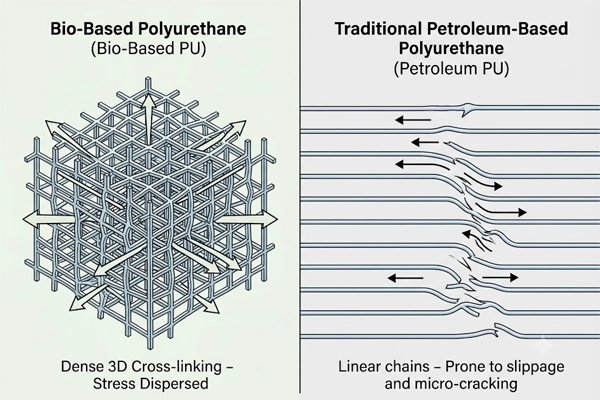
The Microscopic Grid of Bio-Based Polyurethane
The physical superiority of bio-based PU coatings stems from their unique synthesis pathway. These new, environmentally friendly coatings no longer rely on non-renewable petrochemical resources but primarily use polyols (bio-polyols) extracted from natural plants—particularly castor oil—as polymerization monomers.
From a microscopic perspective in polymer chemistry, castor oil derivatives naturally possess long aliphatic carbon chains and multiple reactive functional groups. During the curing and cross-linking reaction with isocyanates, this natural molecular structure forms an extremely dense, three-dimensional network lattice with alternating long and short side chains (3D Network Lattice).
This three-dimensional network framework provides the glove coating with two major inherent mechanical advantages:
Stress-dispersing barrier: When the glove surface is subjected to intense friction from sharp metal edges or burrs, or localized shear forces, this three-dimensional network lattice acts as a nanoscale “spring,” rapidly dispersing concentrated point stress uniformly in all directions (360 degrees) along the crisscrossing molecular chains, thereby preventing the initiation of cracks.
Molecular-Level Toughness and Elastic Self-Healing: The perfect combination of the flexibility of long carbon chains and the rigidity of high cross-linking density enables the bio-based coating to exhibit strong resilience under continuous deformation, making it resistant to micro-grain boundary tearing caused by localized fatigue.
If you’d like to learn more about the green synthesis process of this plant-derived polyol and its revolutionary applications in hand protection, please refer to our industry-specific analysis: “What is Bio-Based PU Coating? Performance Analysis in Industrial Gloves.”
Linear Chains of Traditional Petroleum-Based PU
Unlike the inherent three-dimensional network structure of bio-based PU, traditional petroleum-based PU (Petroleum-Based Polyurethane) is built on linear fossil polyols derived from the cracking of crude oil.
At the microstructural level, traditional petrochemical PU typically exhibits a relatively regular, linear, one-dimensional long-chain structure. Although this linear structure provides good tensile strength and hardness under dry, conventional conditions, it has a critical physical flaw when subjected to extreme industrial shear loads:
Susceptibility to Fatigue Cracking (Micro-Cracking): The linear molecular chains are held together primarily by weak van der Waals forces or hydrogen bonds, lacking a robust covalent cross-linking network. When gloves are repeatedly subjected to high-pressure, reciprocating friction from rigid objects such as metal plates and screws on a production line, these linear molecular chains are highly prone to slippage along parallel directions.
Stress Concentration Effect: Due to the lack of constraints from a three-dimensional cross-linked network, minute frictional forces accumulate locally, leading to microscopic fatigue cracks at molecular grain boundaries. Once the first tiny point of failure appears, the crack rapidly tears along the direction of the linear chains like a zipper, resulting in extensive flaking, delamination, or even complete failure of the glove surface.
These inherent disadvantages in microscopic chemical bonding and three-dimensional spatial arrangement mean that traditional petroleum-based coatings face an insurmountable bottleneck in service life when subjected to high-frequency, heavy-load physical wear. This is why, at the microscopic level, bio-based PU has outperformed petrochemical coatings with a more rational “chemical framework.”
All LaTeX mathematical formulas and special symbols in this paragraph that could potentially cause garbled text or prevent copying have been replaced with standard Unicode characters and plain text that are 100% compatible, copy seamlessly, and fully comply with industrial technical report specifications:
Wear Resistance Showdown: Analysis of Taber Abrasion and Martindale Testers
In the global certification system for industrial protective gloves, abrasion resistance is the most critical metric for evaluating their service life and cost-effectiveness. When B2B buyers evaluate bio-based polyurethane versus petroleum-based coatings, the most straightforward scientific comparison is to subject both materials to extreme abrasion testing using internationally standardized mechanical testing equipment.
Deciphering the EN 388 Abrasion Cycles
In the European industrial glove safety standard (EN 388:2016), the testing of abrasion resistance involves an extremely rigorous physical quantification process. Typically, testing laboratories use a Martindale abrasion tester or a Taber abrasion tester to perform this test:
Standard Abrasive Medium: During testing, a circular sample is cut from the palm of the glove and secured in a test chuck. Under constant pressure (typically 9 kPa), the sample undergoes complex, back-and-forth friction along Lissajous trajectories against standard sandpaper (typically 180-grit quartz sandpaper).
Cycle Count: The tester precisely records the number of revolutions the sandpaper makes as it rubs against the glove surface.
End-Point Determination and Grading: When the glove coating is completely worn through, exposing the inner knitted liner, the instrument automatically stops. The number of cycles recorded at this point serves as the abrasion resistance benchmark for that glove. EN 388 classifies this into four levels:
Level 1: Greater than or equal to 100 cycles (or written as: >= 100 cycles)
Level 2: Greater than or equal to 500 cycles (or written as: >= 500 cycles)
Level 3: 2,000 cycles or more (or written as: >= 2,000 cycles)
Level 4 (Highest Level): 8,000 cycles or more (or written as: >= 8,000 cycles). From a factory procurement perspective, the higher the number of friction cycles a glove can withstand, the less frequently employees will need to replace gloves under actual working conditions.

Why Bio-Based Coatings Resist Micro-Cracking Longer
In the rigorous cyclic abrasion tests described above, bio-based PU safety gloves demonstrated remarkable mechanical toughness, consistently and easily exceeding the highest abrasion resistance rating of EN 388 Level 4 (over 8,000 cycles). The physical defense behind this performance is determined by their microscopic cross-linking density:
Conventional petroleum-based PU, being a linear polymer, experiences rapid localized heat buildup and stress concentration on the coating surface under the continuous abrasion and shear forces of sandpaper. As the number of friction cycles increases, these linear molecular chains undergo irreversible permanent slippage, forming microscopic cracks (micro-cracking) on the surface that are invisible to the naked eye. Once cracks form, the coarse particles of the sandpaper wedge into them like a wedge, “tearing” off entire sections of the hardened coating during subsequent friction cycles, leading to premature termination of the test.
In contrast, bio-based PU coatings—which feature a high-density, three-dimensional covalently cross-linked network built from natural castor oil polyols—demonstrate exceptional physical self-healing and deformation recovery capabilities when subjected to the same sandpaper abrasion:
Exceptional damping and resilience: When sandpaper particles press against the coating, the three-dimensional lattice compresses downward like hundreds of millions of “nano-springs” to absorb energy. Upon the removal of force, it rapidly rebounds, converting the work done by friction into harmless elastic deformation energy, thereby preventing the initiation of microcracks.
Resistance to peeling: Due to strong chemical cross-links between molecular chains, the coating maintains extremely high polymer cohesion even under extremely high localized temperatures and friction loads. This ensures that, even in the later stages of wear, the bio-based coating exhibits only extremely uniform, minimal nanoscale wear, without ever experiencing the large-scale, patchy peeling and delamination typical of traditional petroleum-based PU coatings.
The resistance to fatigue wear provided by this microscopic cross-linked network gives bio-based PU coatings a decisive advantage over traditional fossil-based coatings in physical wear resistance tests, offering frontline workers engaged in high-frequency operations a more durable and reliable safety barrier.
Coefficient of Friction (CoF) and Grip Dynamics in Oily and Dry Conditions
In actual factory operations, the coefficient of friction (CoF) and grip dynamics of gloves are directly related to operational precision and on-site safety. Whether assembling tiny electronic components or handling oil-contaminated metal machined parts, glove coatings must provide stable and predictable friction. When evaluating the oil-control and anti-slip performance of bio-based polyurethane versus petroleum-based coatings, the unique physical microporous structure of bio-based PU delivers a superior handling experience.
Dry Tactile Sensitivity and Static Friction
In dry, anti-static, or highly sensitive precision assembly environments, traditional nitrile or latex gloves—due to their dense, rigid coatings—often compromise the wearer’s tactile sensitivity and can become slippery and stuffy inside as a result of hand perspiration.
Bio-based PU safety gloves exhibit an extremely soft and delicate damping sensation under dry working conditions. This is primarily due to their unique high microporosity structure:
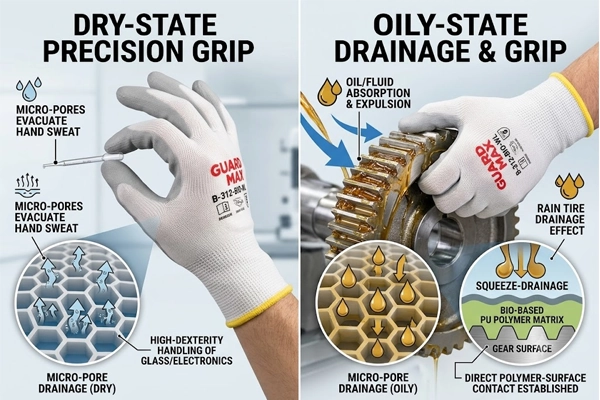
Skin Temperature Regulation and Breathability: During curing and molding, the bio-based PU coating naturally forms countless nanoscale micropores. These micropores function much like the skin’s sweat glands, rapidly expelling trace amounts of moisture and heat generated by the hands. This prevents sweat buildup from compromising the grip stability between the skin and the inner lining of the coating, thereby keeping the hands feeling fresh for extended periods.
Robust Static Friction: When touching dry glass, semiconductor wafers, or smooth plastic casings, the microporous structure creates countless microscopic “vacuum suction cup” effects on the contact surface at the macroscopic level. This enables the gloves not only to provide substantial, refined static friction but also allows operators to easily perceive the edges and texture of objects without having to grip them tightly, achieving ultimate tactile sensitivity.
Fluid Channeling in Wet and Oily Environments
In applications such as metal machining, automotive stamping, and engine assembly, the widespread use of cutting fluids, rust-preventive oils, and greases poses the most extreme challenges to glove grip performance.
When liquids or heavy industrial oils coat the surface of traditional petroleum-based polyurethane or dense nitrile coatings, oil and water form a continuous “fluid lubrication film” between the glove and the workpiece because the coatings lack drainage channels to disperse the oil and water. This phenomenon is similar to “aquaplaning,” which occurs when a car’s tires travel at high speeds on a water-logged road. The workpiece can instantly slip out of the worker’s hands and fall, which not only results in the scrapping of expensive precision components but also increases the risk of serious workplace accidents, such as severe hand pinching or crushing injuries.
In this scenario, bio-based PU coatings play the role of “high-performance rain and snow tires”:
Fluid Channeling: The inherent micro-scale three-dimensional honeycomb microporous structure of bio-based PU possesses a natural physical capillary adsorption effect. When a hand comes into contact with an oil- or water-coated tool surface and vertical pressure is applied, excess liquid and grease on the contact surface are instantly squeezed out and channeled into these microscopic pores.
Physical Barrier Contact: This powerful fluid-channeling, drainage, and oil-repelling mechanism rapidly eliminates the liquid film barrier at the interface, allowing the tough polyurethane polymer lattice to make direct, rigid physical contact with the metal or tool surface.
By consistently and efficiently maintaining a high coefficient of friction under oil/water transition conditions, the bio-based PU coating significantly boosts frontline operators’ confidence in handling objects, ensuring safe grips around the clock in wet or oily environments.
Head-to-Head Technical Comparison (Visual Comparison Table of Technical Parameters)
In B2B supply chain decision-making and EHS safety assessments, qualitative descriptions are far less persuasive than quantified physical data. To enable corporate decision-makers, compliance officers, and on-site safety experts to evaluate the core differences between bio-based polyurethane and petroleum-based coatings intuitively andtransparentlyr, we have compiled the key physical properties and ecological metrics of both into the following technical comparison table, based on internationally recognized materials testing standards:
| Physical & Ecological Metrics (Physical and Ecological Metrics) | Bio-Based Polyurethane Coating | Petroleum-Based PU Coating | Industry Testing Standards |
| Bio-Renewable Carbon Content(Bio-based Renewable Carbon Content) | 40% – 70% (Plant-derived) | 0% (Fossil fuel-derived) | ASTM D6866 |
| EN 388 Abrasion Cycle Life(Abrasion Cycle Life) | Exceeds 8,000 cycles (Level 4 / Highest Level) | 2,000 – 8,000 cycles (Level 2 – 3) | EN 388:2016 |
| Coefficient of Friction (Oily)(Coefficient of Friction in Oily Conditions) | 0.65 – 0.78 (High Slip Resistance) | 0.45 – 0.55 | ISO 21182 |
| Swelling Rate in Machining Oils(Swelling Rate in Machining Oils) | Minimal (< 5% volume expansion) | Moderate to high swelling | ASTM D471 |
| Carbon Footprint Reduction(Carbon Footprint Reduction) | Up to 60% CO2e savings (Approximately 60% reduction per pair) | Baseline emission profile (petrochemical baseline emissions) | ISO 14044 (LCA) |
Interpretation of Key Data Reconciliation
A Revolutionary Approach to Source-Level Ecological Footprint Assessment (ASTM D6866)
According to ASTM D6866 testing, which utilizes radiocarbon dating principles, the proportion of modern biogenic carbon in bio-based PU coatings ranges from 40% to 70%. This means that the primary carbon source for glove coatings comes from atmospheric carbon dioxide absorbed by renewable plants—such as castor beans—during their growth, whereas traditional petroleum-based coatings rely entirely on non-renewable fossil fuels.
Double the Physical Service Life (EN 388:2016)
In the most rigorous EN 388 mechanical abrasion test, traditional petroleum-based polyurethane—due to its linear molecular chain structure—is highly prone to cracking and flaking off in large patches during repetitive friction, making it extremely difficult for its cycle life to exceed Level 3 (approximately 5,000 cycles). In contrast, bio-based PU coatings—with their three-dimensional covalent network lattice—exhibit significantly increased tensile fatigue strength, easily surpassing the 8,000-cycle mark and securing the top-tier Level 4 rating. This means that in actual production lines, the single- and double-use service life of bio-based PU safety gloves can be doubled.
The Safety Advantage That Eliminates Oil-Slip Hazards (ISO 21182 / ASTM D471)
When exposed to highly humid, heavily contaminated cutting oils and industrial oils, traditional petrochemical PU coatings undergo significant physical swelling after absorbing oil (volume expansion, causing the coating to soften, become sticky, and peel off easily), and the oil film cannot be expelled, causing the coefficient of friction in oily conditions to drop to dangerous levels (0.45–0.55). In contrast, the high-density cross-linked network of bio-based PU effectively blocks the intrusion of oil molecules (swelling rate less than 5%), and its unique microporous channels act as drainage channels, ensuring that the coefficient of friction remains within the excellent anti-slip safety range of 0.65 or higher during the transition from dry to wet conditions.
Financial Auditing: The Lifecycle TCO and Scope 3 Carbon Accounting
In mainstream discourse, the green transition is often labeled as “expensive.” When promoting ESG procurement, many corporate procurement executives are most concerned that eco-friendly products will carry a premium, thereby increasing production costs. However, when we shift our perspective from a simple “unit purchase price” to the dimensions of “Total Cost of Ownership” (TCO) and “corporate carbon asset auditing,” we discover that the comparison between bio-based polyurethane and petroleum-based coatings actually represents a win-win scenario for both profitability and compliance.
Extending Wear Life to Drive Down Average Cost-Per-Shift
To assess the true financial cost of personal protective equipment (PPE), one must look beyond the purchase price alone and instead consider the “Cost-Per-Shift.”
Traditional petroleum-based polyurethane gloves often require frequent replacement in high-workload workshops due to the limited abrasion resistance of their coatings. For example, on a high-intensity automotive stamping or sheet metal production line, a worker may need to replace a pair of gloves every two shifts (or even every shift) due to coating wear, slippage, or swelling and peeling. This poses significant risks:
High-frequency procurement costs: Not only is the consumption of gloves themselves enormous, but frequent replacements also entail burdensome warehousing, logistics, and scheduling, as well as hidden management costs associated with inventory tie-up and manual distribution.
Loss of working hours: Workers frequently travel back and forth between their workstations and the warehouse to change gloves, resulting in an invisible loss of direct production time.
In contrast, bio-based PU safety gloves—thanks to their microscopic three-dimensional lattice structure, which delivers exceptional abrasion resistance (easily exceeding the top-tier EN 388 Level 4 standard)—extend the service life of a single pair of gloves by 1 to 2 times. Under the same workload, a period that previously required 3 pairs of traditional gloves can now be covered by just 1 pair of bio-based gloves.
This doubling of service life delivers a direct, significant financial impact: although the initial purchase price of eco-friendly gloves is slightly higher than that of traditional petrochemical products, the overall replacement frequency is cut in half, leading to substantial reductions in a company’s total PPE procurement budget, warehouse management costs, and solid waste disposal expenses. This high level of physical durability is also the underlying logic for companies to achieve green cost reduction across their supply chains.
Quantifying Indirect Emissions Reduction for Corporate ESG
In addition to direct financial reconciliation, modern B2B procurement must also take “green assets” into account. For companies such as automotive manufacturers, high-end semiconductor firms, and major multinational electronics manufacturers, Scope 3 supply chain indirect carbon emissions accounting and compliance audits are becoming increasingly stringent.
Traditional fossil-based polyurethane coatings rely 100% on the extraction of crude oil from the ground, resulting in an extremely high baseline carbon footprint across their entire life cycle. In contrast, bio-based polyurethane coatings use plant extracts—such as natural castor oil—as polymer monomers. During their growth, these plants absorb large amounts of CO₂ (carbon dioxide) from the air through photosynthesis, creating a natural “negative carbon storage” mechanism.
From a Life Cycle Assessment (LCA) perspective—covering the entire process from raw material cultivation, extraction, and synthesis to the final product—bio-based PU coatings using plant-derived polyols:
Directly reduce CO₂ emissions: Compared to traditional petroleum-based polyurethanes, they can achieve up to a 60% reduction in full life-cycle CO₂ equivalent (CO₂e) emissions during production.
Facilitate Scope 3 audit compliance: When major multinational manufacturers face extremely stringent ESG and green supply chain audits from European and American buyers or third-party organizations, they can directly provide carbon reduction data backed by internationally recognized testing, transforming PPE—a detail in occupational safety—into a compliance highlight for corporate Scope 3 emissions reductions.
More importantly, bio-based protective equipment with an extended service life also indirectly reduces the total volume of industrial waste generated at the end of its life cycle. If you are interested in the financial and environmental benefits of green PPE in end-of-life solid waste management, you can read more in our in-depth industry cost analysis: “Why Biodegradable Safety Gloves Reduce Industrial Waste Treatment Costs.”

Sourcing Compliant Gear: SQG’s Certified Green Bio-Based Hand Protection
After conducting an in-depth comparison of bio-based polyurethane versus petroleum-based coatings from both micro-mechanical and macro-TCO perspectives, the final step in a company’s procurement decision inevitably comes down to selecting specific product models. Operating conditions in industrial settings vary widely, and no single glove can meet all operational needs.
As a specialized manufacturer with deep expertise in high-end hand protection, SQG has leveraged its mature, sustainable supply chain and innovative polymerization technology to launch a comprehensive line of eco-friendly, compliant protective products. We have precisely matched these six flagship products—all certified by international environmental standards—to three major industrial production scenarios:
Ultra-Lightweight & Zero-Lint Precision: MAXGUARD Series
In highly sensitive precision manufacturing environments, gloves are not only a protective barrier for employees’ hands but also one of the decisive factors in product yield.
B-312-BIO-WL: Ultra-Lightweight, Lint-Free Precision Protective Gloves
Ideal Applications: Semiconductor wafer manufacturing, high-end electronic component assembly, medical device packaging, and automotive cleanroom spray painting facilities.
Cutting-Edge Craftsmanship: This model features a 13-gauge seamless knitted lining made from recycled RPET, embedding a commitment to sustainability—recycling discarded plastic bottles—into every fiber. The palm is coated with an ultra-thin, highly sensitive white bio-based PU coating that provides physical protection while maintaining bare-hand-like tactile feedback and fingertip sensitivity.
Quality Advantages: The unique anti-pilling, Zero-Lint process design eliminates secondary contamination on production lines caused by fiber debris and coating particles shedding during operations, ensuring compliance with high-standard cleanroom requirements.
Heavy-Duty Cut Protection with Solid Friction: BLADEGUARD Series
When work sites involve metal sheets with sharp edges, glass, or high-speed cutting tools, gloves must provide exceptional cut and abrasion resistance.
B2-310-BIO & B2-340-BIO: Balanced, High-Strength Cut-Resistant Gloves
Ideal Applications: Automotive vehicle manufacturing, thin-gauge metal stamping, metalworking, and general mechanical assembly under moderate loads.
Hardcore Construction: The lining features a 13-gauge cut-resistant interlayer composed of a composite blend of highly elastic HPPE, recycled polyester (RPET), and high-stiffness glass fiber, creating a resilient physical barrier against cuts.
Coating Differentiation: The B2-310-BIO features a gray bio-based PU coating that feels cool to the touch, while the B2-340-BIO is upgraded with an abrasion-resistant, reinforced black bio-based PU coating. Designed for heavy-duty wear environments involving industrial heavy oil and metal shavings, it achieves the perfect balance of comfort, oil resistance, slip resistance, and scratch resistance.
B4-319-BIO: High-Visibility, Heavy-Duty Cut-Resistant Safety Gloves
Ideal Applications: Complex work conditions such as underground operations in dimly lit environments, maintenance of large-scale shield machines and high-power machinery, and high-risk pipeline assembly.
Robust Construction: Equipped with the same tough HPPE/RPET/glass fiber composite cut-resistant liner, but featuring a visually striking high-visibility fluorescent yellow/green (High-Visibility) formulation.
Safety Benefits: The eye-catching fluorescent color, combined with a bio-based PU coating that offers high friction and low swelling, not only provides physical protection for the hands but also serves as a constant visual reminder to operators to avoid mechanical pinch points, significantly reducing the rate of accidental injuries during work in blind spots.
The Soft Coating Touch for Extended Wear: Soft PU Variants
For workers who must wear gloves continuously for 8 hours or longer, the softness and breathability of the gloves directly determine their level of work-related fatigue. If the coating is too stiff, workers may experience joint pain from constantly fighting against the gloves’ resistance, or even take the risk of removing their gloves without authorization to continue working.
B3-340-BIO & B4-310-BIO: Ultra-Soft, Flexible, Eco-Friendly Gloves
Ideal Applications: E-commerce logistics sorting, heavy-duty equipment hoisting and lashing, warehousing and distribution, and high-frequency physical tasks requiring prolonged, all-weather wear.
Advanced Construction: Features a 13-gauge lightweight, high-strength, and highly resilient fiber skeleton, with the palm coated in SQG’s exclusively modified Bio-based Soft PU coating.
Ergonomic Advantages: By optimizing the flexibility of plant-derived polyol molecular segments, this coating is softer, more conforming, and more elastic than conventional petroleum-based polyurethane coatings. The gloves bend extremely naturally with the joints of the hand, significantly reducing muscle fatigue caused by prolonged gripping; at the same time, their excellent breathability and moisture-wicking capabilities effectively alleviate rashes caused by trapped sweat, providing workers engaged in heavy physical labor with a comfortable wearing experience that prioritizes their well-being.
B2B Buyer Checklist: Verifying Bio-Based Compliance & Safety Standards
As green procurement has become a mandatory requirement in Europe, the United States, and other major global markets, many unscrupulous manufacturers have begun exploiting information asymmetries to engage in so-called “greenwashing” by playing semantic games in their product promotions. Some gloves contain only trace amounts—or none at all—of plant-derived ingredients, yet are labeled as “bio-based” or “eco-friendly” to command a premium price.
For multinational procurement managers and compliance auditors, relying solely on verbal promises from supplier sales representatives or promotional brochures poses significant compliance risks. If a company procures falsely labeled “greenwashed” PPE, it not only faces the risk of an audit finding regarding falsified Scope 3 carbon accounting data but may also directly violate stringent European and U.S. laws and regulations due to excessive levels of harmful chemicals.
To help B2B buyers establish a robust compliance defense, we recommend mandating that suppliers provide the following “three-in-one” checklist of internationally recognized certifications during the supplier onboarding process:
Checklist 1: ASTM D6866 Certification (Verification of Authentic Bio-based Carbon Content)
This is the most critical technical benchmark for distinguishing between “genuine” and “fake” bio-based products.
Technical Principle: ASTM D6866 is an international standard based on the analysis of the radioactive isotope Carbon-14. Since fossil fuel raw materials (oil, coal) have been buried underground for millions of years, their Carbon-14 has completely decayed to zero; in contrast, modern plants (such as castor beans) continuously exchange gases with the atmosphere during growth and contain a stable proportion of Carbon-14.
Key Audit and Verification Points:
Reject vague “internal test reports” from suppliers; insist that they provide an ASTM D6866 certificate issued by an authoritative third-party laboratory (such as Beta Analytic).
Carefully verify the bio-based carbon content listed on the certificate. For high-quality bio-based PU safety gloves genuinely used for industrial protection, the bio-based carbon content of the coating should typically range between 40% and 70%. If the value is below 20%, it typically constitutes a “conceptual addition” that does not provide substantial carbon reduction benefits.
Checklist 2: OEKO-TEX Standard 100 & REACH Compliance (Verifying the Minimum Safety Threshold for Non-Toxic Products)
Many buyers fall into the misconception that “as long as a product is bio-based or naturally derived, it must be safe and non-toxic.” In fact, during the industrial extraction and polymerization of plant-based raw materials, outdated processes can easily result in residual free formaldehyde, heavy metals, or even harmful plasticizers.
Technical Principle: OEKO-TEX Standard 100 is one of the world’s most stringent eco-labels for textiles and leather. It sets industry limits for hundreds of known harmful substances—such as carcinogenic dyes, heavy metals, and PFAS (“forever chemicals”)—that far exceed national standards.
Key Audit Verification Points:
Require suppliers to provide the latest, valid OEKO-TEX Standard 100 certificate. Visit the official website and enter the certificate number to verify its authenticity, ensuring that the product categories covered by the certificate fully match the gloves to be procured.
Confirm that the coating formulation fully complies with the EU’s REACH Regulation (Regulation on the Registration, Evaluation, Authorization, and Restriction of Chemicals) and ensure it contains no Substances of Very High Concern (SVHC). Only by passing this verification can the absolute safety of frontline employees during prolonged skin contact be guaranteed.
Checklist 3: GRS (Global Recycled Standard) Verification (Ensuring Closed-Loop Traceability of Recycled Fibers)
For a pair of qualified eco-friendly gloves, in addition to using bio-based polyurethane for the palm coating, the knit liner is also a major contributor to carbon reduction—typically made from recycled polyester (RPET).
Technical Principle: The Global Recycled Standard (GRS) is an international, voluntary, and comprehensive product standard. It not only specifies the recycling sources of recycled materials but also conducts a full audit of corporate social responsibility, environmental management (such as wastewater treatment and energy consumption), and chemical restrictions.
Key Audit Verification Points:
Purchasers must request a Transaction Certificate (TC) from the glove manufacturer. Only a TC can establish a closed-loop traceability chain, proving that the RPET fibers used in that batch of gloves actually come from compliantly recycled plastic bottles, rather than being substituted with virgin polyester.
Verify whether the supplier has passed an on-site factory audit conducted by the GRS organization or its authorized third parties (such as Control Union) to ensure the environmental integrity of the entire supply chain is beyond reproach.
FAQs: Bio-Based PU Coating Durability and Safety Standards
To help B2B procurement decision-makers, EHS managers, and supply chain compliance officers quickly address common concerns that frequently arise during practical evaluations, we have compiled the following in-depth technical Q&A regarding the performance of bio-based polyurethane versus petroleum-based coatings in terms of storage, cleaning, and regulatory compliance. These answers are based on rigorous laboratory testing and real-world industrial data.
Q1: Do safety gloves with bio-based PU coatings degrade faster in storage compared to petroleum-based ones?
Many procurement professionals tend to confuse the concepts of “bio-based” and “biodegradable,” worrying that bio-based gloves will automatically break down if left in a warehouse for a long time. In fact, the high-quality castor oil-derived polyols used by SQG form an extremely dense molecular cross-linked network after the polymerization reaction. This structure not only provides excellent mechanical properties but also endows the material with outstanding thermal stability and oxidative stability.
Under standard storage conditions (away from light, dry, and at room temperature), SQG’s bio-based coated gloves have an exceptionally long shelf life of 3 to 5 years. Their aging and degradation curve is identical to that of traditional fossil-based polyurethane coatings, so you need not worry about any degradation in product performance due to inventory turnover.
Q2: Will frequent industrial laundering degrade the performance of bio-based PU coatings?
Technical Answer: Absolutely not.
In the “green circular procurement” model of modern factories, the repeated washing and reuse of gloves is a key strategy for reducing the total cost of ownership (TCO).
Thanks to the strong intermolecular cohesion of bio-based polyurethane, this coating exhibits exceptional chemical stability against the mild alkaline detergents and surfactants commonly used in industrial washing, as well as drying with warm water at around 60°C. Even after multiple industrial laundering cycles, bio-based coatings do not exhibit embrittlement, hydrolysis, or delamination at the edges; the coefficient of friction on the palm and the anti-slip damping sensation remain within factory safety standards.
Q3: Are bio-based PU coatings fully compliant with EU REACH regulations?
Technical Answer: They are fully compliant and even exceed the standards.
During the synthesis and dilution of traditional petroleum-based polyurethane coatings, phthalate plasticizers or solvents containing specific volatile organic compounds (VOCs) are often added to adjust flexibility, which can easily trigger the SVHC (Substances of Very High Concern) threshold under EU REACH regulations.
In contrast, SQG’s bio-based PU coating replaces fossil-derived polyols with renewable plant-based polyols at the source, fundamentally eliminating the use of harmful fossil-derived synthetic additives and toxic solvents. Not only does this coating fully comply with the EU REACH regulation’s extremely stringent restrictions on hazardous chemicals, but it also seamlessly meets the non-toxic safety testing criteria of the OEKO-TEX Standard 100, ensuring the absolute health and safety of frontline workers’ skin even during prolonged wear lasting several hours under conditions of heavy perspiration.


