When sourcing thin cut resistant gloves, EHS directors and procurement managers often face a frustrating vicious cycle: even though the company spends a fortune on high-specification protective gear, workers still secretly take them off while on the job.
This isn’t because workers are intentionally violating safety protocols; it’s simply because traditional protective gloves are too thick and bulky. Wearing them makes the fingertips feel as if they’ve “lost their touch,” making it impossible to grasp tiny screws, and causing the palms to ache and go numb within two hours of work. To work faster and with less effort, workers are forced to take the risk of “taking off their gloves for five seconds”—and it is often during these critical seconds that serious workplace cuts occur.
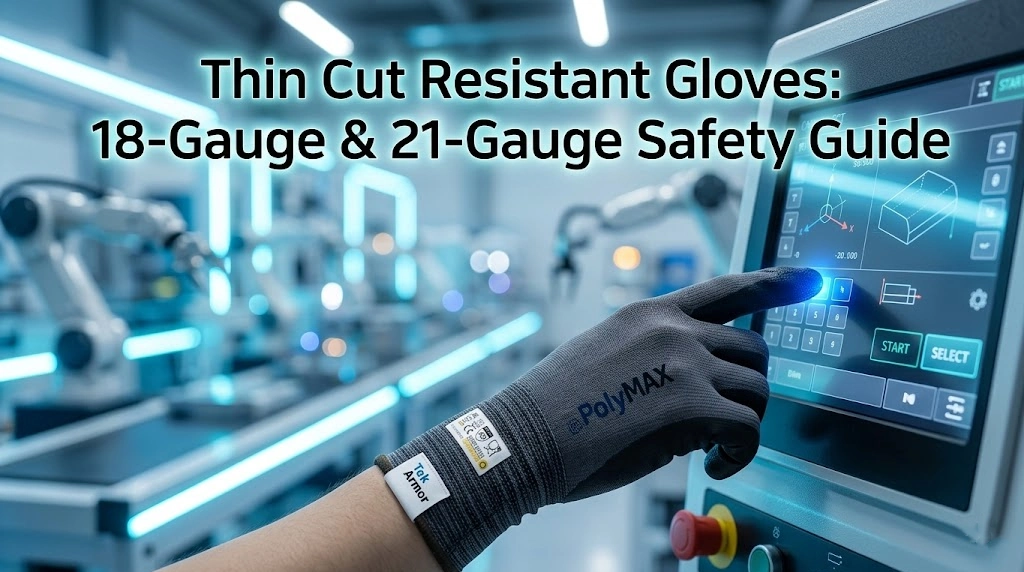
To completely resolve this compliance dilemma, a new generation of thin cut resistant gloves utilizing 18-gauge and 21-gauge weaving technology has been developed. As thin as a worker’s “second skin,” these gloves maintain high-level ANSI cut resistance while completely eliminating resistance to hand joint flexion, effectively eliminating hand fatigue.
Understanding the protective logic behind this high-gauge technology not only helps multinational corporations ensure 100% on-site safety compliance but also serves as a key strategy to drastically reduce the hidden financial burden of workplace injuries at the source.
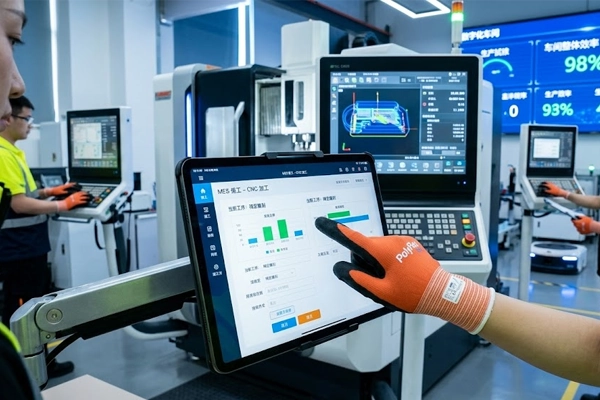
The Cost of Bulky Gloves & PPE Compliance
Understanding Tactile Blindness in Workers
Human fingertips are densely populated with nerve endings, making them the body’s most sensitive tactile receptors. However, when operators work on precision assembly lines, CNC machines, or in complex wiring harness workshops, traditional bulky protective gear often creates a cold, physical barrier that severely dulls workers’ fine-tuned tactile sensitivity. This phenomenon is known in safety management as “tactile blindness.”
In actual operations, to securely grip tiny screws and washers, or to detect micron-level burrs and defects on metal sheet surfaces, workers’ brains—lacking clear tactile feedback—instinctively force their finger muscles to “double their effort” to grip the workpiece. This high-frequency, sustained overuse rapidly causes the muscles in the operator’s forearms and palms to become sore and cramped, leading to severe cumulative muscle strain. This is why, when multinational manufacturers select the next generation of tactile sensitivity safety gloves, cut resistance is merely a baseline requirement; the ability to provide “natural, bare-hand tactile feedback” is the core factor determining their selection for frontline use.
The 5-Second Risk of 13/15-Gauge Gloves
Due to limitations in traditional knitting techniques, conventional 13-gauge or 15-gauge gloves are typically made from coarser fibers. When workers perform high-frequency hand movements such as “clenching” or “pinching,” the fabric on the palms and knuckles tends to bunch up and stiffen over large areas. This physical resistance significantly drains workers’ hand strength, inadvertently reducing overall lean production efficiency.
To escape this frustrating bulkiness and speed up their work, workers often take a gamble and risk “taking off their gloves for 5 seconds.” According to data from multinational manufacturers using Behavioral Safety methodologies, it is precisely this seemingly insignificant 5-second blind spot that accounts for the peak incidence of occupational injuries—such as lacerations from cutting parts or sudden tears—on the shop floor.
Evidence shows that relying solely on performance deductions and administrative penalties is fundamentally incapable of truly eliminating safety violations on assembly lines. Only by comprehensively upgrading traditional PPE in the workshop to lightweight, high-cut-resistant gloves—and using high-gauge knit liners to eliminate resistance to finger flexion—can companies truly eliminate this high-risk “compliance black hole” on both physiological and psychological levels.
Textile Mechanics of High-Gauge Liners
What Is Knitting Gauge?
In the technical specifications for industrial glove procurement, a key parameter that is frequently mentioned but often misunderstood is “gauge.” To put it simply, gauge refers to the number of needles on the needle bed per inch. The lower the gauge, the thicker the yarn used in knitting, and the looser the fabric structure; conversely, the higher the gauge, the tighter and finer the resulting fiber mesh.
To help workshop supervisors or procurement staff visualize this more clearly, imagine a traditional 13-gauge glove as a thick, chunky winter sweater. With its coarse structure and wide gaps, it offers little inherent physical protection. The only way for a factory to make it cut-resistant is to apply an extremely thick rubber coating. This results in gloves that are ultimately as stiff as a shell, making even basic finger flexion extremely difficult for workers.
In contrast, the new generation of 18-gauge and 21-gauge gloves is more like high-end silk shirts. Through advanced high-density seamless knitting technology, we are able to pack multiple times the number of “ultra-fine, high-performance fibers” into the exact same surface area. This generational leap in physical density has completely redefined the physical form of protective gloves, laying the textile foundation for the widespread adoption of high-gauge knit liners.
Why Thinner Liners Offer Superior Protection
During actual centralized procurement wear trials, many non-technical procurement staff or front-line supervisors often have an instinctive concern: “Can gloves this thin really withstand the sharp metal shavings or edges of stamped parts on the assembly line?”
The answer is not only that they can fully withstand such hazards, but that in actual working conditions, they are even safer than thicker gloves. This confidence stems from two core physical mechanisms:
Complete elimination of fiber gaps: Take 21-gauge seamless knitted mesh, for example. Due to the extremely tight knitting, the looped mesh formed at the microscopic level is completely impervious. When a sharp metal edge accidentally cuts toward the glove, there is simply no physical space at the micrometer level for it to “penetrate.” This ultra-high-density fiber barrier eliminates the possibility of sharp edges cutting through gaps and directly injuring the skin at the source.
Bulletproof-style force dispersion: When subjected to external force, the fine fiber mesh behaves very similarly to the force-absorption logic of modern military body armor. The moment it encounters the shearing force of a blade, this tightly interwoven network prevents the force from concentrating on a single point; instead, it dissipates and disperses the localized destructive energy lightning-fast across the entire fiber grid of the glove.
It is precisely this micro-mechanical support that allows the overall structural thickness of the lining to be significantly reduced by 30% to 50%. The company not only maintains a “second-skin fit” that feels as light and natural as bare hands, making work easier for workers, but also ensures that the entire line of thin cut-resistant gloves delivers extremely robust, reliable, and top-tier cut resistance without compromising any mechanical performance metrics.
High-Gauge Liners vs. Traditional Gloves
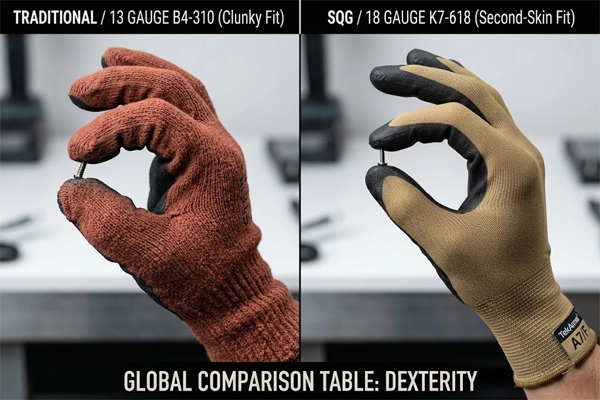
When conducting technical bid audits and equipment compliance assessments within multinational supply chains, procurement decision-makers often require hard data to support decisions regarding the upgrade of personal protective equipment (PPE). To help global procurement officers and EHS departments quickly understand the impact of different knit densities on actual working conditions, we have conducted a multi-dimensional comparison of the mechanical properties of mainstream protective gloves based on stitch count.
Through the following intuitive side-by-side comparison table, technical auditors at major manufacturers can clearly assess the overwhelming advantages that upgrading to high-gauge knit liners brings in terms of physical thickness, fatigue resistance, tactile feedback, and core safety performance metrics:
| Performance Evaluation Criteria | 13-Gauge Traditional Style | 15-Gauge Industry Standard | 18-Gauge Precision High-Gauge Needles (SQG Flagship) | 21-Gauge Ultra-Fine (SQG Ceiling) |
| Lining Fiber Thickness | Bulky (1.20 mm – 1.50 mm) | Medium (0.95 mm – 1.15 mm) | Ultra-thin (0.65 mm – 0.80 mm) | Micron-level thinness (0.45mm – 0.55mm) |
| Hand Muscle Fatigue | Very high (high risk of violating glove-removal regulations) | Medium (may cause hand fatigue with prolonged use) | Ultra-low (zero joint bending resistance) | Near-zero thickness (for an ultra-smooth, bare-hand feel) |
| Tactile Sensitivity | Clumsy (unable to handle small parts) | Suitable for general heavy-duty handling | Excellent (sensitive fingertip nerve feedback) | Top-tier quality (ideal for precision electronic wires in 3C devices) |
| Achievable ANSI Cut Resistance Rating | ANSI A1 to A3 ratings | ANSI A2 to A4 grades | ANSI A3 to A6 heavy-duty protection | ANSI A2 to A5 high-shielding protection |
This comprehensive parameter matrix directly outlines the technical approach for modern lean factories to enhance behavioral safety on production lines. When companies are developing high-value centralized procurement specifications, using this data for verification allows them to quickly identify high-quality solutions that truly possess the attributes of tactile sensitivity safety gloves, thereby eliminating substandard products—which rely on crude material piling and sacrifice flexibility—during the bidding phase. Selecting a more scientifically sound system of thin cut-resistant gloves is a critical technical safeguard for achieving high-precision operations and round-the-clock compliance in digital workshops.
SQG® TekArmor® Yarn Technology
Bulky Material Stacking vs. Advanced Core-Spinning
In the traditional work glove market, many technologically backward workshops, in an attempt to artificially inflate their products’ cut resistance ratings, often resort to the most primitive method of “brute-force material stacking.” They simply stuff coarse glass fiber or stiff, low-quality steel wire into the coarse yarn lining. This low-tech manufacturing method not only robs the gloves of their natural elasticity and grip but, more critically, after prolonged and frequent bending and friction during frontline work, these extremely brittle, low-quality linings are highly prone to metal fatigue fractures. Exposed broken wires can directly puncture or irritate workers’ skin, creating hidden risks of skin allergies and secondary workplace injuries in the workshop.
TekArmor®: The Science of Invisible Protection

To put an end to this industry-wide problem—where safety is prioritized at the expense of comfort—SQG® Laboratories independently developed the patented TekArmor® reinforced yarn (TekArmor® liner). Under industrial high-magnification microscopy, this innovative yarn breaks away from traditional, crude weaving methods by employing an extremely precise “three-layer composite core-sheath structure,” completely reengineering the defense mechanism of thin cut-resistant gloves at the microscopic level:
Core Defense: The innermost layer of the yarn consists of ultra-fine metal microfibers (Metal Fiber) that are virtually invisible to the naked eye. This micron-scale metal core is specifically designed to resist hard shear forces from blades, sharp edges, and the edges of high-rigidity steel plates at the microscopic level.
High-Strength Flexible Support (The Structural Strength): The middle layer of the yarn incorporates ultra-high molecular weight polyethylene (UHMWPE). As a core material in modern ballistic protection, it provides the entire glove with exceptional tensile and tear resistance, ensuring the glove maintains structural integrity during repeated cutting attacks.
Skin-Friendly Interface: The outermost layer of the yarn is wrapped in an extremely soft, highly breathable, and eco-friendly filament with exceptional flexibility. This layer physically isolates the internal hard fibers, ensuring 100% comfort against the worker’s skin—free from itchiness and hypoallergenic.
This revolutionary core-spun technology reduces the yarn’s overall physical diameter by 30%, enabling the new generation of high-gauge knit liners to achieve the mechanical marvel of being “as light and thin as silk, yet as strong and resilient as a shield.” It perfectly resolves the technical conflict between maintaining hand dexterity and providing top-tier mechanical protection.
Enhancing Tactile Sensitivity for Industrial Productivity
Reducing Defect Rates in Precision Assembly
In high-precision manufacturing environments such as modern 3C electronics, automotive final assembly, and semiconductor cleanrooms, even minor misalignments or positioning errors at assembly line workstations can directly result in high component scrap rates and rework costs. When companies introduce tactile sensitivity safety gloves with extreme sensitivity, this loss of tactile sensitivity is eliminated.
In actual frontline operations, workers’ fingertips can precisely detect microscopic component displacements, tactile feedback from tiny fasteners, and the exact engagement status of threads through the high-density, lightweight lining. This acute tactile feedback significantly enhances workers’ ability to make manual fine-tuning adjustments, ensuring a substantial increase in the “first-pass yield” for high-precision assembly and eliminating quality losses caused by operational errors at the very source of lean manufacturing.
Eliminating Financial Risks Associated with Workplace Injuries
In addition to directly improving assembly line yield rates, superior haptic feedback plays an irreplaceable role in safeguarding a company’s financial and regulatory compliance assets. When protective gear seamlessly integrates with the worker’s palm and eliminates resistance to joint flexion, operators no longer feel the urge to remove their gloves during an 8-hour shift.
This physiologically lightweight experience truly helps factories establish a 100% real-time on-site safety compliance ecosystem. At the same time, it enables EHS directors at multinational corporations to eliminate at the source work stoppage investigations, production line remediation audits, high medical compensation costs, and potential labor law disputes caused by hand lacerations. Reducing the hidden compliance risk costs in the workshop to zero is a strategic key for multinational manufacturing supply chains to mitigate operational risks.
When evaluating cut-resistant work gloves for precision assembly, prioritizing an 18-gauge or 21-gauge matrix is critical to eliminate worker non-compliance caused by hand fatigue.
The SQG® High-Gauge Precision Fleet
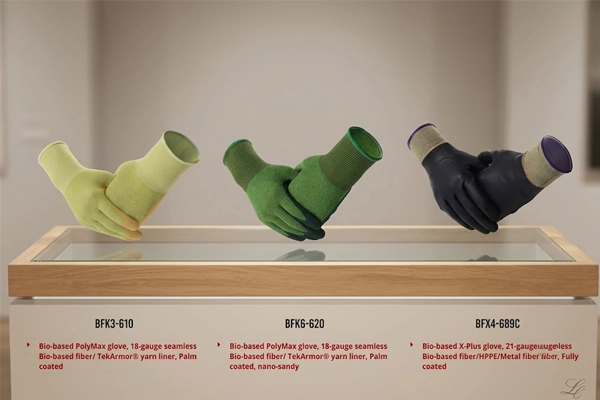
To translate cutting-edge materials science theories from the laboratory into frontline productivity in the digital workshop, SQG® has developed a portfolio of high-gauge, precision protective gloves designed for zero fatigue under various industrial operating conditions. These flagship products not only completely disrupt the traditional market paradigm of “piling on materials for cut resistance,” but also provide global supply chain procurement with high-standard, compliant assets that can be directly included in bid specifications:
SQG® BFK3-610: The Precision Assembly Standard
Designed specifically for high-precision electronic component assembly, semiconductor cleanrooms, and aerospace precision wiring harness installation, the SQG® BFK3-610 represents the pinnacle of lightweight protective technology.
Materials and Craftsmanship: This model features an ultra-thin 18-gauge TekArmor® patented seamless knit liner and an ultra-thin, eco-friendly Bio-based PolyMax coating on the palm.
Protection and User Experience: While maintaining balanced physical protection to ANSI A3 / EN388 Cut Level C standards, the glove delivers exceptional tactile feedback at the fingertips. With virtually zero resistance to joint flexion, it allows workers to maintain exceptional sensitivity and agility during hours of microchip handling and precision fine-tuning tasks.
SQG® BFK6-620: The Heavy-Duty Workhorse for Heavy Oil and Shear Applications
Designed for high-shear, heavy-oil environments such as automotive final assembly, high-stress sheet metal stamping, welding shops, and CNC machining centers, the SQG® BFK6-620 is a heavy-duty defense solution for shop EHS departments.
Materials and Construction: Features an 18-gauge heavy-duty SUPPLE high-tensile flexible core, paired with a proprietary, patented Nano-Sandy surface modification process.
Protection and Performance: This micro-porous, sandblasted surface works like the drainage grooves on a car tire, instantly piercing and dispersing heavy-duty stamping oil films on metal surfaces to establish a secure mechanical grip. While meeting the ANSI A6 extreme heavy-duty cut-resistant safety standard, the BFK6-620 maintains a lightweight, flexible, and highly finger-flexible profile, putting an end to the historical perception that heavy-duty industrial cut-resistant gloves must be bulky.
SQG® BFX4-689C: The Absolute 21-Gauge Liquid Shield
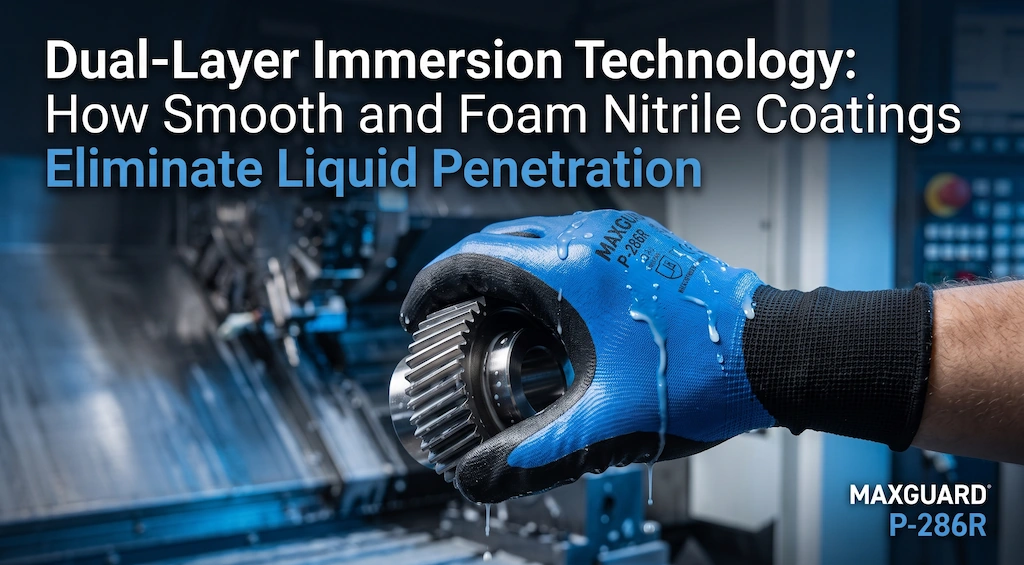
The SQG® BFX4-689C pushes the physical limits of modern textile machinery, combining a 21-gauge ultra-fine, high-density matrix with a fully coated process to create the pinnacle of technology in the protective glove industry.
Materials and Process: Utilizing nearly invisible metallic microfibers, it weaves an extremely dense, micron-level ultra-thin protective barrier. Combined with a 360-degree fully coated process, it envelops the entire hand in a protective layer with no blind spots.
Protection and Experience: Designed specifically for high-risk machining stations involving frequent contact with cutting fluids, cooling water, or emulsions, this model builds a robust barrier against water and industrial liquid penetration. Even while achieving the high-level physical cut resistance of ANSI A4 / EN388 Cut Level D, it remains as thin as a “second skin,” completely breaking away from the traditional drawbacks of fully coated gloves—stiffness, sweating, and lack of breathability—and ensuring that safety compliance is truly realized at all times in harsh liquid environments.
Expert FAQ: Overcoming Workplace Sourcing Challenges
As companies work to upgrade their occupational safety supplies, procurement teams and shop floor supervisors often face pressure from frontline workers’ feedback and cost scrutiny from financial audits. To break down the final psychological barriers to implementing these upgrades, SQG® addresses the most common concerns encountered in large-scale centralized procurement:
Q1: If 18-gauge and 21-gauge cut-resistant gloves can be made this thin, won’t the rubber surface wear through easily?
Answer: Absolutely not. This is a common misconception in industrial procurement—the idea that “thickness equals durability.” Low-end, workshop-made gloves do rely on thick layers of coarse adhesive to achieve durability, but this process is highly prone to localized hardening, aging, and cracking.
Energy Dissipation Mechanism: The bio-based polyurethane coating used in the SQG® flagship series undergoes a precise cross-linking reaction during the molecular curing stage, forming a high-density three-dimensional lattice structure. This molecular framework possesses exceptional “energy dissipation efficiency”; when subjected to high-pressure rotational friction from sandpaper, metal spikes, or rough workpieces, it instantly dissipates and disperses localized concentrated friction forces across a large-area fiber layer.
Standard Certification and Self-Validation: In the rigorous EN 388 Martindale high-load rotational abrasion test, the SQG® high-thread-count fleet easily achieves top-tier physical durability ratings of Level 3 or even Level 4. This means its physical abrasion resistance is exceptionally robust, ensuring that the thin lining will never lead to the embarrassing situation of “tearing or exposing the fingers.”
Q2: Will these high-gauge cut-resistant gloves shrink significantly or become stiff and misshapen after frequent industrial laundering?
Answer: They are fully capable of withstanding the high-intensity cyclic chemical cleaning performed by central laundry facilities. Many companies hesitate to wash gloves in bulk because ordinary work gloves shrink significantly and become rock-hard after just one wash. This is due to their low-density lining, which has an overly loose weave. When exposed to high-temperature chemical cleaning solutions ranging from 40°C to 60°C, the fiber molecules undergo disordered curling.
Steric Hindrance Effect: SQG®’s 18-gauge and 21-gauge high-density knit structures are extremely dense on a physical scale, with the fibers interlocking tightly to lock out thermal displacement and deformation of the yarn. Combined with the extremely high chemical inertness of TekArmor® patented yarn, the gloves maintain excellent dimensional stability even after dozens of wash cycles, ensuring no shrinkage, no deformation, and rock-solid cut resistance, which significantly reduces the frequency of replacement within the facility.
Q3: Why is purchasing high-gauge gloves at a higher unit price actually helping manufacturing companies significantly reduce their total cost of ownership (TCO)?
Answer: Experienced procurement experts and corporate CFOs always calculate the total cost of ownership (TCO) over the entire lifecycle, rather than simply the “purchase price.” Upgrading to a system of high-gauge thin-cut resistant gloves delivers clear cost savings for companies in two key areas:
Tangible material savings: Due to the gloves’ exceptional abrasion resistance and durability against industrial washing, the actual turnover cycle for bulk glove orders is extended by 2 to 3 times. This not only reduces monthly procurement frequency but also significantly cuts hidden management costs associated with warehousing and logistics.
Invisible compliance risk mitigation: This is the real financial savior. Because the high-gauge lining eliminates hand fatigue, workers no longer feel the urge to voluntarily remove their gloves during an 8-hour shift. For multinational manufacturers, a single workplace injury on the assembly line—such as a severed finger or deep ligament laceration caused by glove removal—can trigger emergency shutdowns, production line audits, increased insurance premiums, and potential labor arbitration costs that easily run into the tens of thousands of dollars. Choosing high-gauge tactile sensitivity safety gloves is a highly cost-effective supply chain risk mitigation strategy.
Building a Sustainable Defense in Modern Supply Chains
At this critical juncture, as global supply chains transform digitalization and low-carbon operations, the margin for error in on-site safety management is being drastically reduced. Replacing traditional, bulky work gloves with a system of thin cut-resistant gloves—typically 18-gauge and 21-gauge—is no longer a simple “material procurement” decision but rather an essential strategic choice for achieving round-the-clock behavioral safety and efficient lean production in modern workshops.
Relying solely on administrative penalties after the fact will never truly close the safety violation gap caused by physical discomfort on the shop floor. Only by proactively upgrading the technical specifications in centralized procurement tenders and introducing innovative solutions featuring higher-density, high-gauge knit liners can multinational manufacturing giants build a robust, round-the-clock safety barrier against on-site risks while simultaneously improving first-pass yield rates on the assembly line. This not only provides deep-seated protection for employees’ occupational health but also serves as a long-term risk mitigation barrier to ensure the sustainable compliance of corporate assets in the face of global industrial competition.
Ready to Redefine Your Workshop’s Behavioral Safety?
Don’t let bulky, outdated PPE compromise your plant’s productivity and compliance metrics. Click here to request a customized Free Sample Pack of our next-gen 18-gauge and 21-gauge tactile sensitivity safety gloves (BFK3/BFK6/BFX4) for real-world field trials.
Contact the SQG® International Sourcing Team today to configure a high-efficiency, zero-fatigue hand safety system for your enterprise facilities.