

Introduction: The True Cost of Intermediary Procurement in Heavy Industry
In transnational deepwater oil and gas exploration, large-scale open-pit and underground mining operations, super-heavy bridge and tunnel infrastructure projects, and the annual centralized procurement lists of the world’s leading industrial safety brands (PPE Brands), high-performance impact- and cut-resistant gloves are strategic supplies that are consumed frequently yet have an extremely low margin for error. However, for decades, the traditional personal protective equipment (PPE) procurement model in the heavy industry sector has been mired in a multi-tiered intermediary chain comprising multi-level traders, regional distributors, and overseas transshipment agents.
This cumbersome distribution process imposes unbearable hidden costs on corporate supply chains. First is the obvious financial burden: each layer of intermediation adds costs for warehousing, exchange rate hedging, and channel markups, resulting in the unit price paid by the purchaser for an entire batch of gloves often including a pure channel premium of 20% to 35%. Even more damaging than the financial premium is the “information gap” between on-site operating conditions and the manufacturing process.
When frontline drilling crews report that “impact-resistant rubber becomes brittle at minus 20 degrees Celsius,” shield machine assemblers note that “the adhesive strip on the back of the glove causes numbness and soreness in the grip tendons,” or brand manufacturers need to adjust the knuckle protection area according to new standards, this critical engineering feedback is often distorted into vague complaints as it passes through layers of interpretation by sales representatives, trade managers, and overseas buyers. Production lines are unable to obtain precise stress test data or recommendations for mold modifications, and the feedback cycle can take as long as several months, resulting in subsequent batches still failing to address the pain points on the front lines. More seriously, multi-tiered intermediaries frequently switch downstream contract manufacturers across different batches to profit from price differentials. This results in inconsistent dip coating thickness between batches, a sharp decline in the bond strength of TPR armor, and—when facing rigorous third-party safety audits—an inability to provide authentic inspection logs that correspond one-to-one with production batch numbers.
To put an end to the dual challenges of uncontrolled procurement costs and quality discrepancies, multinational energy engineering agencies and brand supply chain decision-makers are spearheading a transformation of the procurement paradigm: a comprehensive shift toward an impact gloves bulk sourcing factory-direct strategy.
The essence of factory-direct procurement goes far beyond simply bypassing multi-tiered traders to eliminate a layer of markups; it involves deeply aligning the procurement side with source manufacturing entities that possess independent engineering and R&D capabilities. By establishing direct connections with source super-factories—which possess in-house capabilities for developing precision injection molds, high-count automated seamless knitting, multi-axis synchronized impregnation production lines, and heavy-duty aramid sewing—companies can not only eliminate inflated channel markups at the source but also directly leverage the original manufacturer’s engineering and R&D resources: From custom tooling tailored to specific workstations and one-piece molded brand logos, to creep-resistant, high-density 3D loading optimization based on the internal space of a 40-foot high-cube container (40HQ), to the establishment of rigorous total cost of ownership (TCO) calculation models based on actual work shift service cycles.
For procurement directors and engineering EHS decision-makers who are reshaping supply chain resilience and striving to achieve precise control over annual bulk expenditures while ensuring high standards of physical protection, we recommend thoroughly reviewing our source-factory-level product matrix and manufacturing baselines covering defense across all operating conditions: Impact Resistant Work Gloves.
The Factory-Direct Paradigm: Dismantling Tier-2 and Tier-3 Margin Layers
In supply chain audits of multinational infrastructure and mining conglomerates, the procurement of personal protective equipment (PPE) is often categorized as a “low-value, high-consumption” peripheral category. However, a detailed review of annual financial statements reveals that the frequent wear and tear of heavy-duty impact-resistant gloves, combined with fragmented procurement, often results in a staggering financial drain. In traditional distribution chains, Tier-2 wholesalers and Tier-3 regional traders have skimmed off massive profits through markups, information barriers, and the repackaging of generic civilian PPE gloves as “specialized impact-resistant work gloves.” The essence of a comprehensive shift to the Factory-Direct Paradigm is to tear open the price “black box” of intermediaries, reclaim control of the supply chain from speculative traders, and return it to the manufacturing entities and procurement engineering teams.
Transparent BOM Cost Architecture and Direct Polymer Sourcing
To establish overwhelming pricing dominance in group-wide procurement negotiations, procurement directors must go beyond simply comparing final quotations from various traders and instead delve into the Bill of Materials (BOM) at the manufacturing level:
Procurement Benchmarks for Polymer Monomers and Engineering-Grade Raw Materials:
The physical cost of a pair of high-performance industrial impact-resistant gloves is entirely anchored by the procurement cost of its base polymer. The molecular weight distribution and fineness of ultra-high-molecular-weight polyethylene (HPPE) masterbatch, the purity of para-aramid staple fiber, the styrene-butadiene block ratio in medical-grade thermoplastic rubber (TPR) modified pellets, and the cross-linked solid content of acrylonitrile in modified nitrile rubber (NBR) all determine the base cost per square meter of fabric and per gram of damping rubber strip. Intermediaries often create confusion at this stage by fabricating “patented modified materials” or obscuring raw material grades, thereby marking up raw material costs by 40% to 60%;
Direct Sourcing from Original Manufacturers Eliminates Raw Material Markups and Ensures Process Transparency:
Source super-factories with the capacity for large-scale independent procurement to work directly with leading domestic and international petrochemical giants and specialty fiber spinning mills, locking in the lowest futures prices for raw materials through annual purchase volumes in the thousands of metric tons. Under this direct-from-manufacturer procurement framework, the factory can provide buyers with a fully transparent breakdown of BOM costs: from the cost per gram of seamless knitted liners and the net weight loss of injection-molded materials for the back of the hand, to the chemical additive ratios and electricity cost amortization for automated dipping production lines. Every penny paid by the buyer is precisely mapped to specific physical materials and manufacturing labor hours, completely eliminating the inflated warehousing and handling fees and exorbitant channel markups that arise from multiple layers of distribution.
Unfiltered Engineering Communication for Technical Specification Audits
Beyond eliminating price markups, the greater strategic value of direct procurement from original manufacturers lies in eliminating “information impedance” during the transmission of technical specifications:
Eliminating the “black box” and distorted interpretation by distributors:
In traditional procurement, specific technical requirements for operating conditions proposed by a company’s EHS engineers—such as “the static coefficient of friction on the palm must remain above 0.5 in a drilling mud immersion environment, while the residual force transmitted to the back of the knuckles under a 5-joule impact must not exceed 4 kilonewtons”—are often simplified to “must be slip-resistant and impact-resistant” as they pass through sales representatives without a technical background. To secure orders, sales representatives often make sweeping promises, then blindly place orders without technical validation from the production line. As a result, the equipment ultimately delivered to the site frequently fails rapidly under real-world operating conditions;
Direct Engineering Collaboration with the Manufacturer’s Materials Mechanics Experts:
Under the direct-to-manufacturer mechanism, the group’s procurement decision-makers and frontline safety engineers can sit directly across from the manufacturer’s polymer process engineers and mechanical testing engineers. Both sides can engage in direct technical discussions based on CAD drawings and material formulation sheets: if on-site conditions involve cutting with high-frequency, fine metal burrs, engineers can immediately increase the number of composite strands of micron-level glass fibers and tungsten filaments in the inner liner; If frontline workers report that back-of-hand armor hardens and fractures in extremely cold weather, the polymer laboratory can specifically adjust the plasticizer formulation in the TPR elastomer to ensure the material retains its rubber-like elastic recovery even at -25 degrees Celsius. This zero-lag, engineering-level communication ensures that products precisely meet the maximum requirements of major global safety regulations during both production line prototyping and mass production.
To help procurement and technical teams discern actual mechanical and dynamic performance when evaluating factory test reports, they can thoroughly review the comparative guide on the differences between the two international protective standards: ANSI/ISEA 138 vs. EN 388.
Custom Tooling & OEM Engineering: From CAD Blueprint to Injection Molding
For globally renowned PPE brand owners and multinational engineering contracting groups, impact-resistant gloves are not only a physical line of defense for frontline workers but also a tangible embodiment of the company’s visual identity system (VIS) and proprietary industrial design assets. Under traditional distribution and low-end contract manufacturing models, customers are often limited to choosing bland, generic designs from a factory’s standard mold library or are forced to accept substandard mold trimming. Such compromises not only weaken brand recognition but also directly create safety hazards—such as foreign objects getting lodged on the back of the hand or restricted movement—due to insufficient mold precision. Source super factories equipped with advanced in-house mold-making and injection molding capabilities can seamlessly transform a client’s industrial design sketches or 3D CAD engineering drawings into custom hardware assets that balance mechanical damping with exquisite aesthetics.
Precision Mold CNC Machining and Thermal Shrinkage Tolerance Control
The foundation of precision in crafting a TPR exoskeleton that balances ergonomic freedom with impact protection coverage begins at the cutting edge of a five-axis machining center:
Precision mold steel selection and multi-axis high-speed machining paths:
Heavy-duty TPR injection molds never use cheap, easily deformable cast aluminum molds; instead, we select pre-hardened, high-quality P20 mold steel or aerospace-grade 7075 ultra-hard aluminum alloy billets. Utilizing a five-axis CNC high-speed milling machine, the cutting tools meticulously carve the curved surfaces of the finger bones, the segmented flex hinges (Flex Grooves) between the fingers, and the main protective arch of the metacarpal bones with micron-level precision. Precision machining eliminates microscopic tool marks and undercut dead corners at the mold cavity corners, ensuring molecular-level uniform filling of the molten thermoplastic polymer when it is injected into the mold cavity at high speed and high pressure;
Thermal shrinkage compensation and geometric tolerance control within ±0.1 mm:
Thermoplastic elastomers (TPRs) exhibit an inherent physical volumetric thermal shrinkage effect during the process of injection into the mold cavity, holding pressure, cooling to room temperature, and demolding. Our mold engineers incorporate Moldflow analysis during the 3D CAD phase to pre-set precise reverse shrinkage compensation allowances for TPR formulations of varying hardness (Shore 35A to 55A). Through high-precision EDM mirror-finishing and high-pressure precision lapping, the mating gap at the mold parting line is strictly controlled to within 0.02 mm, ensuring that the geometric tolerances of the finished injection-molded parts are consistently maintained within ±0.1 mm. This manufacturing precision completely eliminates the sharp flash commonly found on the edges of rubber injection-molded parts, preventing the flash from scratching workers’ hands, while also eliminating internal shrinkage voids and porosity defects caused by uneven cooling, ensuring that the energy-absorption density of every piece of impact armor remains absolutely uniform.

Dual-Color Co-Injection and Brand Identity Thermal Bonding Integration
In harsh heavy-industry operating environments, traditional brand markings and cosmetic finishes are highly susceptible to wear and tear after just a few shifts. Direct sourcing from the original manufacturer has completely resolved this issue through advanced injection molding processes:
Integrated dual-color co-extrusion eliminates material delamination:
Traditional small workshops producing multi-color protective gear typically rely on manual assembly or secondary adhesive bonding. Under conditions involving oil-water separation or extreme cold that causes material distortion, cracks and delamination frequently occur at the seams between color blocks. Our state-of-the-art super factory is equipped with advanced rotary multi-nozzle dual-color injection molding systems (Dual-Color Co-Injection). Within a single closed cycle of a precision mold assembly, the impact-resistant base material for the main structure is injected first. The mold core then rotates, and the second nozzle instantly injects a second custom-colored elastic polymer. The two polymers, in their molten state, achieve seamless self-fusion at the molecular chain level. After cooling and curing, they form a single, integrated unit with a tear-resistant bond strength identical to that of a homogeneous base material, eliminating the risk of interlayer cracking;
Integrated 3D Embossed Logo and Long-Lasting Oil-Resistant, Wear-Resistant Properties:
To meet the corporate branding needs of multinational brands and large engineering firms, the two-color injection molding process allows a company’s precise, proprietary Pantone standard color to be directly injected into the mold’s surface layer, while simultaneously forming a 3D embossed brand logo with micron-level clarity directly on the knuckle of the thumb or the outer side of the index finger. This color and structure, embedded at the molecular level, eliminates the problem of traditional screen-printed ink rapidly blurring and peeling off when exposed to crude oil, diesel, drilling fluid, or friction from rough steel cables, ensuring that the company’s industrial design assets and professional safety image remain as pristine as new throughout months-long heavy-duty operation cycles.
For an in-depth exploration of how the flexible exoskeleton on the back of the hand achieves microscopic dissipation of impact kinetic energy and dynamic cushioning under mold hinge tolerance control, we recommend consulting the specialized literature on the mechanical properties of the underlying material: TPR Exoskeleton Engineering.
Technical Portfolio Alignment: Deploying the SQG 6-Model Matrix
In tenders for bulk protective equipment and cross-border procurement decisions, the most significant waste of budget does not stem from the unit price itself, but rather from premature batch-level wear and safety degradation caused by “mismatches between models and operating conditions.” If lightweight, knitted gloves are used to handle a 100-metric-ton steel cable with burrs, the palm coating will be worn through and fail within minutes; conversely, forcing precision instrument technicians to wear fully coated liquid-tight gloves will result in a loss of tactile sensitivity in the fingertips, leading to frequent, unsafe removal of the gloves. The true advantage of a factory-direct supply chain lies in a comprehensive engineering matrix that fully covers extreme mechanical cutting, immersion in chemical fluids, and friction from heavy-duty rigging.
By categorizing six flagship models into three major engineering product series, procurement decision-makers can establish centralized procurement quotas precisely allocated by workstation, based on clear mechanical and medium-specific logic.
Engineering Specifications Across the Complete 6-Product Spectrum
To provide global EPC general contractors and procurement directors of personal protective equipment (PPE) brands with precise, quantifiable criteria for product selection, SQG’s Technical Engineering Department conducted a cross-sectional analysis of the physical architecture and compliance protection parameters for all six benchmark models in the series:
| Safety Engineering Metric | Precision / High Cut (K-Series) | Chemical & Fluid-Tight (P-Series) | Heavy Rigging & Extraction (BM Series) |
| Model SKU | SQG® K4-278 / SQG® K7-682 | SQG® P-901 / SQG® P-902 | SQG® BM-701 / SQG® BM-702 |
| Shell & Lining / Fabric | 18-Gauge TekArmor® Ultra-Thin Knit | Seamless Nylon / Glass Knit Shell | Heavy Corded Cotton Flannel Canvas |
| Cut Level (ANSI / EN) | ANSI A4 / ANSI A7 (Extreme Shield) | ANSI A2 / ANSI A4 (Mechanical Cut) | ANSI A4 (BM-701) / ANSI A2 (BM-702) |
| Grip Coating & Texture | Sandy NBR / Micro-Foam PolyMAX® | PVC Particles / Sandy-Finished PVC | High-Density Corded Friction Cotton |
| Impact Exoskeleton | Low-Profile Segmented Flex TPR | Dual-Density Chem-Bonded TPR Armor | High-Mass TPR Knuckle and Metacarpal Pads |
| Primary Industry Deployment | Automotive Assembly, Metal Stamping | Offshore Drilling Mud, Chemical Refineries | Underground Tunnels, Heavy Crane Rigging |
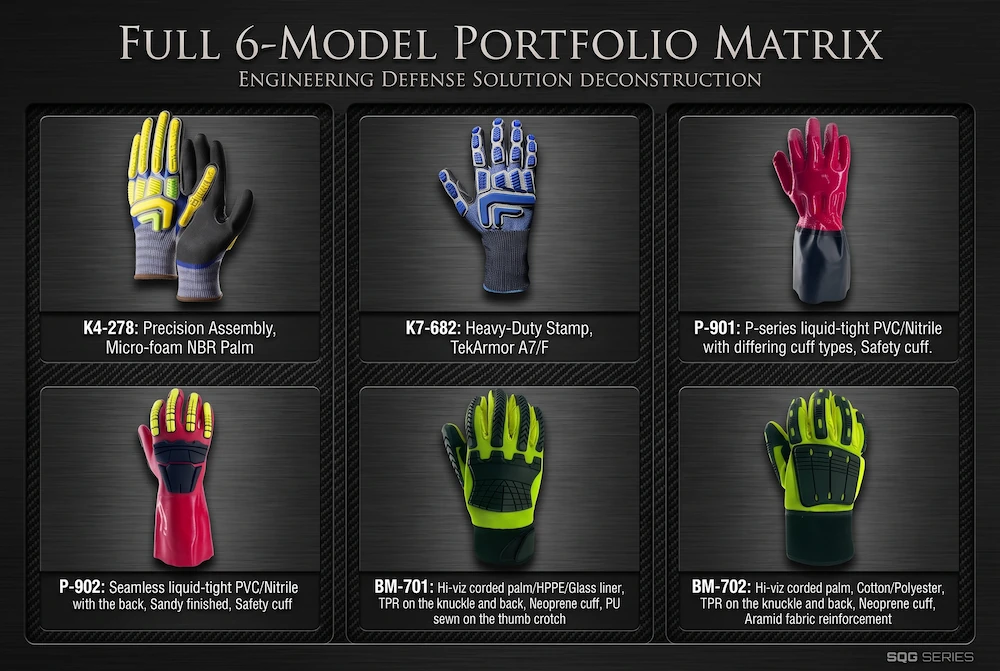
This product matrix clearly illustrates the underlying material technology distinctions across the three major product lines:
Precision and Ultra-High Cut-Resistance Series (K-Series): Utilizing an 18-needle, micron-level, ultra-fine, high-density knitted structure, this series strikes a balance between the tactile sensation of bare fingertips and protection against mechanical cuts. The K4-278 focuses on microporous breathability and oil drainage in oil-based assembly applications, while the K7-682 pushes mechanical shear resistance to the ANSI A7 protection level by leveraging the blunting effect of tungsten wires and composite polymer core yarns under microscopic stress;
Chemical Protection and Liquid-Tight Impact Resistance Series (P-Series): Designed to create a fully sealed barrier layer for deep-immersion fluid applications. P-901 and P-902 rely on multiple continuous PVC impregnation layers to completely isolate workers’ hands from chemical erosion caused by oil-based mud, strong acid decontamination solutions, and hydrocarbons. They also feature a chemically bonded damping exoskeleton on the back of the hand, providing integrated protection against chemical corrosion and heavy impact;
Heavy-Duty Rigging and Underground Mining Series (BM-Series): Completely eliminating the slippage issues associated with traditional coatings in thick, oily mud, this series employs a highly absorbent, heavy-duty all-cotton rope-textured structure. The rope-textured palm surface uses capillary siphon channels to break up and drain slurry floating on the rope’s surface. Combined with high-grammage TPR armor on the knuckles and abrasion-resistant reinforcement at the thumb gusset, this design is specifically engineered for high-load conditions requiring extreme resistance to twisting and crushing.
Tailored Workstation Matching: Navigating the K-Series, P-Series, and BM-Series
By precisely mapping the specific hazards at each workstation on the production line, bulk procurement can completely break away from the crude practice of “purchasing only one type of glove for the entire factory,” enabling precise allocation of the occupational safety and health budget and control over consumption:
Precision Assembly and Metal Stamping Sections (Priority Allocation: K-Series):
In automotive white body welding, heavy-duty transmission gear assembly, precision pneumatic tool fastening, and large-scale sheet metal blanking and stamping workshops, workers’ hands constantly navigate between high-speed stamping presses and the sharp edges of thin metal sheets. If workers at these stations are issued bulky gloves, it will severely impair their tactile sensitivity and reduce assembly cycle times. The procurement list should prioritize the ultra-high-dexterity SQG® K4-278, whose 18-gauge ultra-thin liner provides control flexibility comparable to bare hands. For specific ergonomic and micro-manipulation test data, refer to: 18-gauge high-dexterity cut and impact gloves. If workstations are located at the discharge points of heavy-duty automotive stamping lines, in scrap metal recycling and shredding operations, or involve the handling of large cold-rolled steel sheets with severe flash, the flagship model SQG® K7-682—featuring ANSI A7-level cut resistance and resistance to shearing and tearing—must be mandated. In-depth mechanical evaluations of the cut-resistant fibers can be found in: ANSI A7 extreme cut resistance gloves.
Deepwater well control, oil slurry settling, and petrochemical decontamination workshops (priority allocation of P Series):
In the sand discharge areas of vibrating screens on offshore drilling platforms, during the cleaning of oil-based shale gas mud circulation tanks, when installing or removing blind flanges on large petrochemical refining units, and at work surfaces in acid pickling, rust removal, and anti-corrosion tanks, workers’ hands are exposed to fluid media for extended periods or are even submerged in deep liquid. Under these conditions, the issuance of any woven or breathable gloves is strictly prohibited. The centralized procurement catalog must mandate the use of P-901 (PVC granule anti-slip) and P-902 (fine-sand surface with micro-vacuum adsorption), which provide a completely impermeable barrier, to prevent chemical liquids from seeping through fabric capillaries into the palms and causing severe chemical burns and dermatitis.
Heavy-duty truck maintenance in mines, rigging and hoisting operations, and shield machine advancement workstations (priority given to the BM series):
In extremely demanding work segments—such as replacing steel wires on electric shovel drums in open-pit mining, attaching and detaching rigging for 100-metric-ton floating cranes at ports, and tightening cutterhead bolts on urban underground shield machines—ground-based rigging workers must not only navigate blind spots and high-risk areas involving heavy loads under low-light conditions but also endure continuous pressure on their hands from high-frequency friction against rough steel cables. To address the high-heat friction and wear caused by the traction of heavy-duty steel wires and the engagement of pulley blocks, the flagship model SQG® BM-702—featuring a high-strength, wear-resistant aramid layer heavily overlapped and welded in the thumb area—must be selected in large quantities. Its unique quick-release elastic neoprene cuff provides workers with a vital escape route in the event of accidental cable entanglement. For calculations regarding the fatigue strength limits of this model’s rigging, please refer to: heavy-duty rigging gloves aramid; meanwhile, at tunnel work sites requiring protection against cuts and falling debris, the BM-701—equipped with an adjustable, sealed cuff—is deployed to establish a fully enclosed protective barrier.
Quality Assurance & Laboratory Traceability: Auditing Chinese Tier-1 Plants
In the global industrial glove manufacturing landscape, China boasts an extremely comprehensive polymer chemical supply chain and automated knitting clusters. However, for supply chain audit teams at multinational mining groups, deepwater drilling contractors, and global PPE brands, the most critical technical hurdle in direct sourcing from the source lies in looking beyond the surface-level factory size to identify top-tier manufacturing facilities (Tier-1 Plants) with genuine “aviation-grade” batch quality control capabilities. Low-end workshops often use expensive imported raw materials for samples submitted for testing, but mix in recycled materials during mass production of large orders, causing the impact and cut resistance of the bulk shipment to plummet significantly.
Establishing a closed-loop on-site quality assurance (QA) and laboratory traceability mechanism is the critical defense line for ensuring that hundreds of thousands of pairs in bulk orders maintain absolutely consistent performance throughout a delivery cycle spanning several months.
On-Site Impact Testing Rigs: Verifying Drop-Tower Transmitted Force
The core safety redundancy of impact-resistant gloves lies in absorbing and dissipating kinetic energy from impacts. During on-site factory audits, procurement technical experts must verify whether the factory has established its own physical and mechanical laboratory with national or internationally recognized accreditation, with a particular focus on reviewing the operating procedures for its impact test rigs:
On-site verification of dynamic drop-tower impact test rigs:
Benchmark-level manufacturing facilities must equip their quality inspection workshops with vertical drop-hammer impact test rigs compliant with ANSI/ISEA 138 and EN 388 standards. The test rigs must be fitted with high-frequency dynamic piezoelectric force sensors, with a response frequency of several thousand hertz or higher, capable of capturing peak force response curves of impact transients at the millisecond level. The audit team should randomly select finger-joint and knuckle TPR strips fresh off the production line or from the injection molding shop, place them directly on a semicylindrical or flat anvil, and perform 2.5 joules (finger) and 5 joules (knuckle) gravity drop-weight impact tests;
Lock-in of Batch Peak Transmitted Force Data:
Use an on-site data acquisition system to review the impact load data fed back by the sensors in real time. For qualified batches under a rigorous quality control system, the average transmitted force of the knuckle guard after withstanding a 5-joule impact must be strictly maintained within the thresholds specified by ANSI/ISEA 138 (Level 3 requires a transmitted force of no more than 4 kN, Level 2 no more than 7 kN, and Level 1 no more than 9 kN). The factory must establish corresponding mechanical testing records for each injection-molding batch. It is strictly prohibited to rely on estimates or use one-time “type test reports” from external agencies as substitutes for routine batch sampling inspections, ensuring that every shipment delivered to overseas ports is backed by tamper-proof, actual mechanical test data.
Raw Material Batch Traceability and Chemical Migration Audits
The microstructural stability of polymers and specialty fibers directly determines the rate of aging and physical durability of gloves under harsh operating conditions. The audit process must trace back through the production process to the underlying raw material supply chain:
Batch-by-batch traceability of raw material Certificates of Analysis (COA):
Purchasing auditors must verify each item in the original COA reports for every batch of core raw materials received at the facility. For modified nitrile rubber latex (NBR), the focus is on verifying the latex’s solids content, acrylonitrile content, and vulcanization cross-linking density to prevent the addition of low-cost inorganic fillers that cause premature cracking of the rubber surface. For pure PVC dipping compounds, the chemical composition of plasticizers must be rigorously reviewed. The use of environmentally friendly, non-toxic plasticizers is mandatory, and restricted substances such as phthalates are strictly prohibited to ensure full compliance with the EU REACH Regulation and global environmental compliance standards;
Stability Review of Batch-by-Batch Tensile Elongation for Seamless Liner Yarns:
The knitted liner serves as the glove’s “mechanical skeleton.” Factories must conduct constant-speed tensile rupture tests on every batch of ultra-high-molecular-weight polyethylene (HPPE), glass fiber core yarn, and high-strength polyester yarn received at the facility, strictly controlling the tolerance limits for fluctuations in yarn linear density (Dtex), tensile strength, and elongation at break. The weight deviation of each liner batch must be controlled within ±3% to prevent inconsistent liner tightness, which could cause the rubber solution to penetrate the inner side of the glove during subsequent dipping, resulting in a rough inner surface that abrasively rubs against the worker’s hand.
For an in-depth understanding of how polymer impregnation coatings create micro-vacuum adsorption channels in drilling mud and viscous hydrocarbon liquids under controlled microscopic cross-linking, please refer to the fluid dynamics report: Sandy Finish vs. PVC Dot Grip Gloves: Palm Friction Mechanics in Viscous Fluids.
Global Supply Chain & Container Logistics: Optimizing Freight Cube Efficiency
In the cost structure of multinational centralized procurement for heavy-duty workwear, ocean freight forwarding and inland trunk logistics often become hidden cost drivers that eat into the procurement budget. Unlike traditional knitted latex gloves or lightweight personal protective equipment, impact-resistant gloves feature a high-density, three-dimensional TPR (thermoplastic rubber) exoskeleton on the back of the hand, which inherently results in a significantly thicker profile.
If traditional methods of throwing items into containers in bulk or stacking them loosely are used, the entire container will be filled with large amounts of air gaps, leading to severe “volumetric bloat.” In bulk international container shipping, this low-density packaging directly triggers volume-based weight (Cube Out) penalties in international shipping, causing a sharp rise in per-unit and per-pair shipping costs. Deeply integrating modern packaging engineering mechanics with three-dimensional container stowage calculations is a core engineering approach used by direct-from-manufacturer supply chains to help multinational buyers significantly reduce their comprehensive costs upon arrival at the port.
Volumetric Compression Packaging vs. TPR Deformation Thresholds
The key challenge in consolidating high-density exoskeleton gloves lies in the trade-off between volumetric compression ratio and the material’s elastic memory:
Freight penalties and space waste caused by traditional packaging that “ships air”:
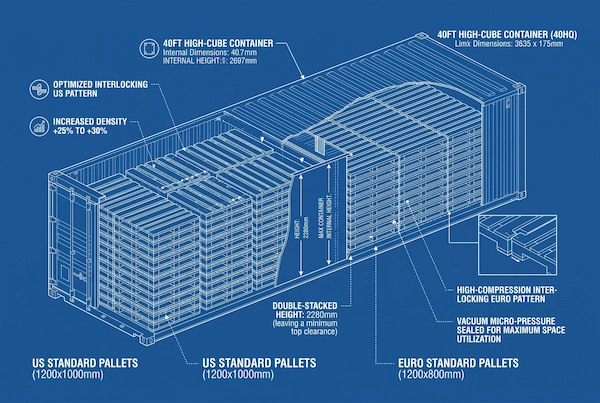
If gloves are not arranged using an engineering-grade interlocking pattern during factory packing, the protruding knuckle peaks and finger bone armor will clash with one another and remain suspended in the air. A standard 60×40×40 cm export corrugated cardboard box typically holds only 40 to 50 pairs of heavy-duty impact-resistant gloves, with over 45% of the box’s volume completely occupied by wasted air. For multinational corporations that purchase hundreds of thousands of pairs annually, this is equivalent to paying several times the premium for shipping empty containers;
Micro-pressure Multi-Row Interlocking and the Critical Threshold of Polymer Plastic Deformation:
At the source manufacturing plant, precision packaging jigs are used to implement a neat, multi-row arrangement process featuring “staggered interlocking and complementary palm-back alignment,” enabling the finger bone grooves and protruding armor of adjacent pairs of gloves to form a self-locking, complementary fit. Combined with soft packaging sealed under moderate vacuum, excess air is pre-evacuated before boxing. Within this process control, the polymer engineering laboratory strictly defines the material’s compressive stress relaxation limit: The static micro-pressure applied by the outer packaging is precisely controlled to remain below the elastic yield point of the rubber material, ensuring that during up to 45 days of high-temperature transoceanic shipping and static pressure during warehousing, the TPR armor will not exceed the critical point of plastic deformation and will absolutely not develop permanent creases, indentations, or molecular chain fatigue. This solution ensures that the product instantly returns to its original, plump shape upon unpacking, while increasing the number of pairs per box to 60–72, resulting in a net increase in container loading density of 25% to 30%.
Standard 40-foot High Cube (HQ) Container Palletization Schemes
The unloading, storage, and inland transshipment of cargo upon arrival at overseas deep-water terminals rely heavily on the efficient handling of standardized palletized units:
Space calculations for European and U.S. standard pallets within a 40-foot high-cube container (40HQ):
Depending on the infrastructure at different ports of destination, the engineering and logistics team must tailor the container stowage plan:
North American Mainline (U.S. Standard Pallets, 1200 × 1000 mm): Within a 40-foot high-cube container with a volume of approximately 76 cubic meters, the bottom layer features 20 pallets arranged in two rows in a staggered pattern, stacked vertically in two layers. The container precisely accommodates 40 fully loaded pallets, eliminating any shifting or space within the container;
European and Middle Eastern Hubs (European-standard pallets, 1200 × 800 mm): A compact, side-by-side longitudinal layout is used, with 24 to 25 pallets arranged on the bottom layer of the container. After stacking in two vertical layers, the total number of pallets increases to 48 to 50, pushing the container’s volume utilization rate to its theoretical limit of over 92%;
Five-layer high-strength corrugated cardboard for compression resistance and six-sided wrap reinforcement to prevent stack collapse:
When ocean-going containers encounter rough seas and heavy swells, the cartons on the lower layers must withstand dynamic shear forces of over 1,000 kilograms. The manufacturing plant uses extra-rigid five-layer double-wall cartons (BC flute) containing high-strength corrugated base paper, with edge crush strength (ECT) and burst strength both increased by more than 40%, completely preventing the bottom-layer cartons from softening, collapsing, or bursting under the erosion of humid ocean winds during transoceanic voyages. After pallet stacking is complete, an automated turntable stretch-wrap machine is used to apply high-tension sealing wrap to all six sides. High-strength rigid cardboard corner protectors are installed at all four corners, and a rain cover is placed over the top. Even after enduring harsh sea conditions and multiple forklift transfers, the entire pallet of goods maintains absolute vertical rigidity, completely preventing pallet collapse and carton deformation.
For petrochemical construction general contractors requiring full-container direct shipments to offshore platforms or deepwater oil production sites—and who have stringent chemical resistance requirements for full sealing, waterproofing, sand resistance, and heavy oil resistance—we recommend reviewing the pallet packing and fluid penetration resistance specifications for the flagship heavy-duty liquid-tight SQG® P-901 model: chemical liquid-proof impact gloves.
The True Total Cost of Ownership (TCO) Model: Beyond the Unit Purchase Price
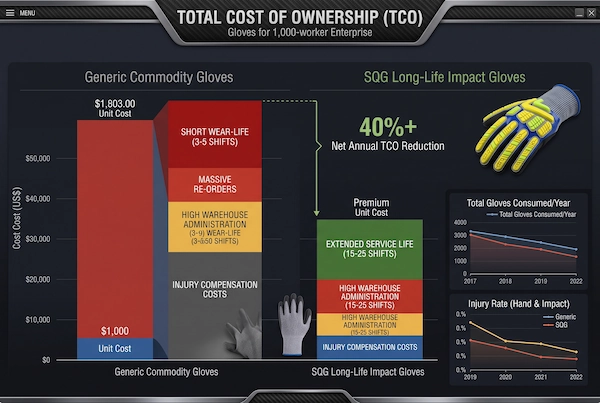
When procuring heavy engineering equipment and mining supplies, many procurement departments are chronically trapped in the financial fallacy of “awarding contracts based on the lowest unit price.” On budget statements, ordinary gloves priced at $8 per unit appear to save nearly half the cost compared to high-quality, factory-direct impact-resistant gloves priced at $14 per unit; However, once this batch of equipment is distributed to open-pit mines or offshore platforms, the resulting frequent damage and scrapping, high costs associated with frequent warehouse restocking and outbound shipments, and even work stoppages caused by finger amputations resulting from compromised protection often completely overwhelm the project’s annual budget within just a few months.
To assess the actual cost-effectiveness of personal protective equipment, one must move beyond the narrow perspective of the single purchase price and adopt a total cost of ownership (TCO) accounting system that considers the entire lifecycle.
Quantitative TCO Mathematical Formula and Parameter Breakdown
Measuring the true cost of heavy-duty hand protection hinges on quantifying and breaking down all hidden expenses in relation to the actual service life. In the economics of engineering protection, the true service cost of a single pair of gloves per actual work shift can be comprehensively calculated using the following quantitative engineering formula:
Comprehensive Cost per Work Shift = (Factory Direct Purchase Price per Pair + Allocated Sea Freight Logistics Cost per Pair + Warehousing and Inventory Holding Cost per Pair) / Average Number of Effective Work Shifts per Pair + Work Injury Risk Reserve per Pair + Implicit Losses from Work Efficiency Delays per Pair
Breaking down the key variables of this model into frontline operations:
Factory-direct purchase price per pair and logistics/warehousing allocation: The “Factory Direct” model eliminates the 20% to 35% markup charged by traders. Simultaneously, utilizing high-density pallet loading in 40-foot high-cube containers (40HQ) reduces shipping and customs clearance costs per pair, establishing a low financial baseline;
Average Effective Shifts per Pair: This is the core lever on the denominator side. If a glove’s abrasion and tear resistance are inadequate, its service life per shift will be severely shortened. Consequently, even with a low purchase price, dividing it by the limited number of service days will still result in a sharp spike in the usage cost per shift;
Workplace Injury Risk Reserve and Lost Productivity Costs per Pair: Pinch or cut injuries resulting from insufficient impact resistance and cut resistance in gloves not only lead to direct medical claims and higher insurance premiums but also trigger work stoppage and corrective action fines from regulatory agencies such as OSHA. Converting the injury rate per million work hours into a hidden safety premium per pair of gloves allows management to clearly see the high hedging costs associated with low-end gloves.
Wear-Life Multipliers: How 3x Durability Slashes Operational Expenditures
Glove wear-life multipliers have a decisive, transformative impact on a company’s annual operating expenses (OPEX):
The financial black hole of “frequent replacement” caused by low-cost, low-quality gloves:
Many low-cost impact-resistant gloves on the market—made from a patchwork of recycled cotton and low-purity PVC coatings—suffer from palm fibers that fray and pill within a very short time upon contact with crude oil from drilling, rough ore, or high-tensile steel cables. The rubber coating rapidly swells and delaminates due to oil penetration, while the rubber on the back of the hand peels off and cracks after just a few instances of low-temperature compression. Under heavy-duty conditions, the average service life of such gloves barely lasts 3 to 5 work shifts (approximately 24 to 40 working hours). To maintain operations, frontline crews must continuously request new gloves from the warehouse, resulting in the project department not only having to endure year-round redundant warehouse management tasks—such as frequent stockouts, distribution, and inventory counts—but also creating a vicious cycle where gloves are repurchased 60 to 80 times within a single year for the same workstation;
Source-level long-life gloves with a threefold service life and a proven 40% reduction in overall costs:
Engineering-grade gloves manufactured using high-quality long-fiber high-density blended yarns, aramid-reinforced knuckles, and automated precision dipping processes exhibit significantly enhanced surface abrasion resistance and structural integrity. Taking heavy-duty drilling and underground excavation operations as an example, the flagship model SQG® BM-701—featuring a high-density, highly saturated cotton cord texture and a premium cut-resistant liner— offers exceptional physical mud-shedding capability and fiber shear strength on the palm. Under extremely harsh conditions, its stable service life easily exceeds 15 to 25 full work shifts, with an abrasion resistance lifespan more than 3 to 5 times that of ordinary low-end products.
Based on annual consumption estimates for a heavy-duty mining section with a workforce of 1,000, annual consumption of low-end gloves can reach as high as 60,000 pairs. When factoring in the shipping and warehousing costs associated with frequent, small-batch, multiple-shipment purchases from inland suppliers, the actual annual expenditure often exceeds $400,000. However, after fully transitioning to the long-lasting BM-701, the actual annual issuance volume is reduced to fewer than 15,000 pairs. Even though the original purchase price per pair of high-quality gloves from the manufacturer is slightly higher, the significant reduction in total consumption, combined with the cost savings from direct bulk shipments via full container loads by sea, resulted in a net decrease of more than 40% in the company’s annual comprehensive protective equipment expenditure.
For further details on the fluid-repellent and abrasion-resistant mechanisms of all-cotton corded palms in oilfield drilling and production mud environments and high-slip rigging conditions, please refer to the specialized engineering report: Corded Palm Oil and Gas Gloves.
Enterprise Compliance & Risk Mitigation: Navigating Tariffs, Incoterms, and Certifications
In cross-border energy projects, transoceanic mining operations, and ultra-large-scale EPC infrastructure turnkey projects, the procurement of impact- and cut-resistant gloves is by no means a simple “pay and receive” commercial transaction; rather, it is a systematic process involving customs compliance, international trade terms, and cross-border product liability insurance. When pursuing direct cross-border procurement, many companies tend to focus solely on the unit price of the product, while neglecting to define the boundaries of responsibility for international freight handover and to verify the authenticity of certification reports. If containers are detained at the port of destination due to the improper selection of trade terms, or if customs authorities in the importing country seize, inspect, or even destroy the shipment on the spot because of counterfeit certification reports, the company will not only face exorbitant daily demurrage charges—amounting to thousands of dollars—but may also see the delivery schedule of the entire project delayed due to a disruption in the supply of frontline safety equipment.
Establishing rigorous compliance review and risk control measures is the legal and operational baseline for ensuring that bulk goods sourced directly from original manufacturers clear customs smoothly and are safely stored in warehouses.
Decoupling Incoterms: FOB, CIF, vs. DDP for Heavy Industry EPC Projects
For different cross-border project operation models, procurement and engineering teams must, based on their own logistics management capabilities and customs clearance resources at the port of destination, thoroughly decouple the rights, responsibilities, and risk transfer points of mainstream Incoterms:
FOB (Free on Board): Autonomous Container Control and Consolidated Scheduling:
Suitable for large multinational energy groups or well-known industrial safety equipment brands with established global freight forwarding networks and negotiated freight rates. Under this term, the manufacturer is only responsible for safely delivering the container to the port of shipment and completing customs clearance and loading; the buyer assumes full responsibility for ocean freight costs and all risks at the destination port. The FOB model grants the buyer the autonomy to control shipping schedules and container space, as well as the initiative to consolidate shipments from multiple suppliers (Buyer’s Consolidation). This maximizes the avoidance of hidden markups on ocean freight charges by suppliers and enables centralized accounting of the group’s logistics resources;
CIF (Cost, Insurance, and Freight): Caution Regarding Mismatched Risk Transfer:
Under the CIF terms, the manufacturer is responsible for paying the main ocean freight and purchasing basic cargo insurance to deliver the goods to the buyer’s designated overseas port of destination. However, many procurement teams fall into a cognitive blind spot, mistakenly believing that “risk does not transfer until the goods arrive at the port.” In fact, according to the latest international trade rules, the risk of damage or loss of goods under CIF terms transfers to the buyer the moment the goods are loaded onto the vessel at the port of shipment. Furthermore, some unregulated freight forwarders who accept low-cost CIF contracts often collude with terminal and warehousing companies at the port of destination to maliciously charge the consignee exorbitant document release fees (D/O Fee), port charges, and unpacking fees. When signing a CIF contract, the purchasing party must strictly require the supplier to provide a clear and transparent schedule of local charges (Local Charges Schedule) to plug loopholes for hidden fees;
DDP (Delivered Duty Paid) “Turnkey” All-Inclusive Service and Customs Clearance Risk Management:
For EPC project teams executing turnkey infrastructure projects at remote overseas mines or in countries along the route, the DDP model is typically the most prudent strategy, as project sites often lack professional import customs clearance teams and specialized labor protection clearance qualifications.
Independent Third-Party Certification Audits: SATRA, CTC, and Intertek Verification
In the international occupational safety and health (OSH) trade market, “counterfeit certifications,” “fake reports,” and “misrepresentation in reports” are all too common. Some intermediaries routinely use a generic PPE test report filed a decade ago, altering the product model number to falsely claim dual certification for impact and cut resistance. Corporate legal counsel and EHS audit experts must master engineering-level anti-counterfeiting verification procedures for third-party certification bodies:
Conduct in-depth verification of the Notified Body database:
For CE certification—which is essential for market access in the EU—it is imperative to conduct a thorough review of the original technical documentation issued by EU Notified Bodies. Genuine, factory-produced impact- and cut-resistant gloves, which involve both mechanical hazards (EN 388) and impact resistance testing, fall under the stringent Category II or, for specific high-risk environments, Category III personal protective equipment (PPE). Purchasers must require suppliers to provide an EU Type-Examination Certificate (Module B) issued by internationally recognized top-tier laboratories such as SATRA (Notified Body No. NB 2777), CTC (Notified Body No. NB 0075), or Intertek (Notified Body No. NB 0362). Upon receiving a scanned copy of the certificate, do not rely solely on a visual inspection of the seal; instead, log in to the official verification database of the aforementioned Notified Bodies (such as SATRA’s official online certificate verification portal), enter the unique certificate number and the holder’s legal English company name, and verify the issuance date, validity status, and whether the color photographs of the product’s appearance attached to the certificate exactly match the physical product currently being procured;
Analysis of Module C2/D Production Line Quality Control and ANSI Test Data Raw Curves:
For glove products with the highest safety protection levels, procurement audits must further verify whether the factory possesses annual inspection reports demonstrating ongoing compliance with Module C2 (internal production control plus random product sampling) or Module D (statistical audit of the production process quality assurance system), to eliminate the “workshop-style” practice of “samples meeting standards but mass production cutting corners.” When conducting compliance reviews for ANSI/ISEA 105 cut resistance and ANSI/ISEA 138 impact resistance for the North American market, it is mandatory to request a complete test report accompanied by detailed mechanical test curves. Special attention must be paid to verifying whether the measured values at each force measurement point in the drop-weight impact test (peak force at the finger bones and peak force at the metacarpal bones) are accurate and provide sufficient safety margins. It is strictly prohibited to accept single-page third-party certificates that omit test details and that merely state “Pass.”
While ensuring physical performance meets mandatory international standards, to transform high-visibility impact-resistant gloves into dynamic on-site management tools and establish a closed-loop anti-pinch mechanism throughout the entire project workflow, we recommend referring to the on-site behavioral safety and visual engineering guidelines: Hi-Viz Impact Gloves Safety Program.
Technical FAQ: Procurement, Tooling, and Global Freight Dynamics
For multinational engineering materials departments and safety brand supply chain decision-makers who are bypassing intermediate distributors for the first time to initiate direct procurement from original manufacturers, the procurement process has shifted from simply “reviewing samples and placing orders” to “end-to-end engineering collaboration.” Faced with practical challenges such as tooling development cycles, material bond strength in extremely cold environments, strategies for mixed-load shipping of multiple container types, and production scheduling to ensure supply during peak seasons, procurement teams often require clear, quantifiable decision-making criteria.
Drawing on years of frontline engineering experience handling large-volume orders for the global heavy industry sector, this section provides technical analysis and operational solutions for the four core issues most commonly encountered by overseas buyers when executing impact gloves bulk sourcing factory direct programs.
What is the typical lead time and MOQ for custom-tooling TPR impact gloves?
Customizing the appearance and mechanical structure of TPR exoskeletons is a highly precise mold engineering process, and its delivery cycle and minimum order quantity strictly adhere to the physical rhythms of the injection molding industry:
Custom Mold Engineering Development Cycle (Custom-Tooling Milestones):
Phase 1: 3D CAD Structural Optimization and Mold Flow Analysis (3 to 5 business days): The manufacturer’s mold engineering team receives the customer’s design drawings, optimizes the depth and angle of the flex grooves based on finger flexion and extension kinematics, and completes wall thickness uniformity analysis and shrinkage compensation calculations;
Phase 2: CNC Mold Precision Machining and Trial Molding/Trim (15 to 20 business days): High-hardness P20 die steel or 7075 aerospace-grade aluminum billets are subjected to multi-pass milling using a 5-axis CNC machining center. Combined with high-precision mirror-finish EDM, micron-level anti-slip textures and three-dimensional brand embossing are engraved. This is followed by the first round of injection molding trials and fine-tuning of clamping tolerances;
Phase Three: Rapid Production of Engineering Prototypes and Sample Approval (5 to 7 business days): The first batch of physical samples is injection-molded and assembled with sewn glove liners. These are then expedited via air freight to the client for ergonomic and wear-testing evaluations. The entire mold-making process, from drawing confirmation to pre-mass-production sample approval, is typically completed within 25 to 35 calendar days.
Tiered Minimum Order Quantity (MOQ) Structure:
To balance the costs of mold commissioning and debugging with the efficiency of high-volume mass production, original manufacturers typically establish flexible, tiered MOQ policies. For standard ODM orders involving simple brand printing or customization with a company’s proprietary Pantone colors using the factory’s existing high-precision standard molds, the minimum order quantity per style is typically 1,200 to 2,400 pairs (corresponding to the optimal setup quantity per batch on the production line); for in-depth OEM customization projects involving the development of a complete set of proprietary injection molds (covering independent cavities for all sizes from S to 2XL), the minimum order threshold per style is typically 6,000 to 12,000 pairs. When annual bulk purchase volume exceeds 30,000 pairs, the manufacturer typically refunds the full amount of the initial mold development costs, effectively relieving long-term customers of the burden of heavy capital investment in molds.
How do you prevent TPR armor from detaching from nitrile or PVC gloves during storage in extreme cold?
In operations at the North Slope oil fields in Alaska, the Canadian Far North oil sands, or during the bitterly cold winters of Northern Europe, many impact-resistant gloves purchased from general traders have suffered major quality incidents—such as the impact-resistant rubber strips on the back of the hand peeling off entirely from the knuckles—when unpacked on the front lines after prolonged storage in containers at -20 degrees Celsius. Direct-from-manufacturer procurement and manufacturing technology completely prevents low-temperature embrittlement and delamination through two core processes:
Formulation modification for extreme cold-weather-resistant thermoplastic elastomers:
Ordinary, low-cost TPR compounds often contain large amounts of inexpensive mineral oil plasticizers, which are highly prone to “blooming” at low temperatures. This causes the rubber molecular chains to harden and become brittle, resulting in a loss of adhesive activity. The original manufacturer’s injection molding process utilizes a medical-grade polymer matrix, specifically formulated with high-flow, cold-resistant plasticizing additives and low-temperature compatibilizers. This lowers the material’s glass transition temperature (GTT) to below -45 degrees Celsius, ensuring the exoskeleton maintains a rubber-like state with high resilience even in extremely cold storage and high-wind-resistance, frozen environments, thereby preventing brittle fracture due to freezing;
High-Frequency Ultrasonic Welding and Self-Fusion of Modified Two-Component Polyurethane Molecules:
For knit liners and nitrile-coated gloves, the bonding of the exoskeleton to the back of the hand does not rely on manually applying low-grade white latex, but rather employs industrial-grade high-frequency hot-melt welding or a low-temperature-resistant, two-component modified polyurethane (PU) structural adhesive system. Under precisely controlled high-frequency energy and slight pressure, the elastomer base layer micro-dissolves and deeply penetrates to anchor itself within the molecular framework of the liner’s textile fibers or the liquid-tight PVC coating, forming an interlocking molecular-level interpenetrating network (IPN). After a continuous 72-hour freeze test at -30 degrees Celsius, peel strength tests showed that the tear resistance between the protective layer and the glove substrate remained greater than 35 newtons; even when subjected to forced external pulling, the base material would fracture first, eliminating the risk of delamination and adhesive failure during storage and transportation in extreme cold or under frequent tearing stress.
Can we consolidate different models (e.g., K-series, BM-series) into a single container order?
Heavy-duty infrastructure projects and integrated mining operations often involve a variety of complex conditions simultaneously, such as precision maintenance, deep wells with strong acid slurry, and heavy-duty lifting rigging. Procuring a single model can easily lead to a reduction in process safety standards or an excess of equipment at certain workstations.
The direct-from-manufacturer supply chain offers highly flexible “Mixed FCL Consolidation” operational support:
Cross-series mixed loading eliminates the pain point of excess inventory:
Buyers are not forced to stockpile tens of thousands of pairs of a single model just to fill a full container. In a single bulk direct purchase of a full container (20GP or 40HQ), the procurement team can freely combine quotas across product lines based on the actual consumption ratios at each work site. For example, in a 40HQ container, they can combine 40% of the precision-assembled cut-resistant models (K-Series), 30% of the heavy-duty liquid-tight and chemical-resistant models (P-Series), and 30% of the heavy-load rope-textured models for rigging (BM-Series) as needed;
Modular Pallet Units and Barcode-Level Precision Tracking of Multiple Products per Container:
The factory’s Manufacturing Execution System (MES) supports modular physical packing at the pallet level. Each model and size follows an independent box marking system and adheres to the international GS1 barcode traceability standards. During the container loading process, the factory issues a clear three-dimensional stowage plan, arranging different product lines in layers and rows according to the unloading sequence, and precisely noting the internal SKUs, container numbers, and gross weight/volume details for each pallet on the packing list. Upon arrival at the buyer’s central distribution center or overseas project site, warehouse staff can directly perform “direct-pick” transshipment without unpacking the containers based on the container markings, significantly improving the efficiency of material allocation and turnover across the Group’s various operational segments.
How does direct procurement mitigate supply chain disruption risks during peak production seasons?
The period from the end of the third quarter to the fourth quarter of each year marks the peak season for global heavy-duty equipment manufacturing and cross-border ocean freight. During this time, small processing plants that rely on orders routed through multiple layers of traders often find themselves on the brink of collapse, facing “overloaded production lines, skyrocketing raw material prices, supply disruptions, and indefinitely delayed delivery dates.” Establishing direct strategic procurement partnerships with large-scale source factories can help companies build a round-the-clock safety buffer for their supply chains:
Strategic Order Lock-In and MES Digital Production Scheduling Priority Guarantees:
Direct connection to the original manufacturer means the buyer’s annual bulk purchase orders are entered directly into the factory’s core Manufacturing Execution System (MES). The factory signs an annual Capacity Reservation Agreement with long-term bulk-purchasing key accounts, reserving fixed flexible capacity and automated assembly lines for strategic orders on the production schedule. Even during traditional peak production seasons when lead times are generally extended across the industry, the factory maintains a high benchmark of over 98% for the On-Time Delivery (OTD) rate of main production lines handling bulk orders through dual-line hot standby redundancy and three-shift automated rotation;
Strategic Reserves of Thousand-Meter-Class Core Polymers and Specialty Fibers:
Leading manufacturing plants, leveraging their strong cash flow and bulk purchasing advantages, have established routine strategic raw material reserves. For strategic key materials such as ultra-high-molecular-weight polyethylene (HPPE) master filament, high-strength para-aramid, seismic-damping TPR pellets, and high-purity nitrile rubber latex, the factory maintains a minimum safety inventory level of 60 to 90 days year-round and has signed long-term futures direct-supply hedging agreements with major upstream petrochemical raw material suppliers. This in-depth stockpiling of materials at the source not only completely prevents the passive passing on of costs resulting from sudden, sharp increases in international bulk raw material prices, but also ensures that—even under extreme market conditions where the industry is widely facing “production halts due to material shortages”—the company’s bulk direct-purchase production lines can continue to operate at high speed and with stability, guaranteeing that key overseas infrastructure and energy extraction projects experience no material shortages or production cuts.
Initiate Factory-Direct Sourcing & Custom Tooling Consultation (CTA)
In the restructuring of the bulk supply chain for heavy-duty industrial safety equipment, the core of strategic decision-making is always “eliminating uncertainty.” For supply chain leaders at multinational mining engineering firms, deepwater oil and gas contractors, and globally renowned workwear and PPE brands, the procurement process should no longer be hampered by ambiguous technical translations from multi-tiered distributors, uncontrolled delivery delays, and exorbitant channel markups. True supply chain transformation begins with seamless engineering collaboration between procurement decision-makers and the source polymer manufacturing entities.
The SQG Manufacturing Center has officially launched a direct factory-to-engineering collaboration channel, opening its mold R&D center, physical and mechanical testing laboratory, and bulk international trade logistics engineering team to global strategic procurement clients. Whether you are planning to develop a brand-new flagship glove featuring an exclusive design patent and custom drag-reducing hinges, or hoping to optimize the abrasion resistance and cut resistance formulations of existing gloves for specific extreme working conditions, our team of engineering experts will provide you with comprehensive technical support right at the production line level.
Schedule an Engineering Consultation for OEM Customization & Tooling
To help brand clients and large engineering general contractors rapidly transform cutting-edge industrial designs into mass-produced hardware with high impact resistance, SQG’s senior mold engineers and polymer process team offer an in-depth, one-on-one “Engineering Consultation for OEM Customization & Tooling”:
In-Depth One-on-One Engineering Review of 3D CAD Drawings:
The buyer’s design team can liaise directly with our mold engineers to jointly review the microscopic topological structures of finger bone curvature, metacarpal protective arches, and interdigital flex grooves on 3D CAD models. Our engineering team uses Moldflow simulation software to precisely calculate the melt flow paths, vent location, and shrinkage compensation allowances for TPR formulations with different Shore hardness levels, thereby eliminating shrinkage pits, flash, or premature fatigue fractures caused by injection molding stress concentrations at the source;
3D Printing for Rapid Prototyping and Mechanical Tolerance Validation:
Before formally commencing production with expensive CNC steel molds, SQG’s digital manufacturing workshop can rapidly produce 1:1 engineering prototypes of the back-of-hand exoskeleton within 48 hours using industrial-grade stereolithography (SLA) and multi-jet fusion (MJF) high-precision 3D printing technologies. Combined with human hand models for fit testing, we evaluate rebound damping during joint flexion and the range of motion of the fingers to ensure that all ergonomic geometric dimensions are finalized before initiating the production of precision 5-axis CNC-machined molds.
Request Master Swatch Books, Production Samples, and Container Direct Quotations
To ensure that procurement decision-making teams have access to comprehensive physical verification and financial analysis support before launching bulk procurement tenders or initiating formal mass production scheduling, SQG has established a global, direct channel for requesting strategic procurement samples and data packages:
Original engineering sample kits (Master Production Samples) for the full range of flagship products:
This collection precisely includes physical samples of all six flagship models from SQG’s full operating condition lineup—including the ultra-agile, precision-assembled SQG® K4-278; the extreme cut-resistant, heavy-duty stamped SQG® K7-682; the heavy-duty, liquid-tight, chemical-resistant, and impact-resistant SQG® P-901 and SQG® P-902, as well as the flagship heavy-duty mining and rigging traction models SQG® BM-701 and SQG® BM-702. Companies can conduct real-world field tests lasting several weeks in actual work crews to evaluate wear resistance and resistance to oil sludge;
Transparent BOM Cost Breakdown and Direct Container Quotation:
We reject vague, all-inclusive quotes from traders and instead provide bulk-purchase customers with a transparent Bill of Materials (BOM) breakdown, clearly indicating the net weight costs of polymer fibers, TPR pellets, modified latex, and sewing supplies, as well as machining labor rates; Additionally, we provide detailed 20GP and 40HQ container stowage plans for both U.S. and European standard pallets, and issue precise direct container supply quotations—including FOB, CIF, or DDP with full customs clearance and taxes included—based on available shipping schedules.
If you would like to schedule a technical evaluation by an in-house mold mechanical engineer for your company, or directly request a complete set of physical sample boxes and a factory-direct quote, please feel free to contact our engineering supply chain team at any time: Request a Worksite Evaluation Kit & Direct Quote.


