

Introduction: The Dexterity Penalty in Precision Assembly
In modern passenger car final assembly shops, heavy-duty truck powertrain production lines, and assembly stations for large high-voltage electrical cabinets, the manufacturing industry is facing a serious ergonomic challenge. Deploying certified 18 gauge impact cut resistant gloves has become an essential engineering requirement across high-risk assembly lines to protect technicians against sudden impact trauma and sharp metal lacerations. On the one hand, instantaneous cuts from burrs on stamped sheet metal, sudden pinching during vehicle subassembly, and mechanical recoil from high-torque pneumatic wrenches are forcing corporate EHS departments to continually raise mandatory procurement standards for hand protection; on the one hand, frontline workers endure a costly “dexterity penalty” in their day-to-day precision operations.
For a long time, industrial-grade impact-resistant gloves have been unable to shake off the common flaw of being bulky and stiff. Traditional 10-gauge or even 13-gauge coarse-knit glove liners paired with heavy, homogeneous solid rubber blocks often result in a total glove thickness exceeding 1.8 millimeters. When workers are inside the cramped confines of an engine compartment, attempting to pinch and align an M6 fastener coated in lubricant with their fingertips, fine-tune a high-pressure sensor connector, or insert and remove extremely fine vehicle wiring harness clips, the thick glove fabric completely cuts off the fingertips’ naturally sensitive tactile feedback. To hold small parts securely, workers are forced to increase the static gripping force of their knuckles several-fold; and, frustrated by repeatedly failing to align threaded holes or parts slipping out of their grasp, many workers—in order to keep up with the assembly line’s production cycle (Takt Time)—choose to take the risk of removing their gloves out of the foreman’s sight to perform “blind operations with bare hands.” This widespread compromise has led to a persistent stream of accidents involving comminuted fractures and deep tendon lacerations at stamping press pinch points, despite repeated bans.
To put an end to this zero-sum game—where “safety comes at the expense of dexterity, and dexterity comes at the expense of safety”—at its root, hand protection engineering must break through the physical limitations of materials and structures. The emergence of the new generation of 18-gauge impact- and cut-resistant gloves marks the full-scale entry of industrial hand protection into the era of precision miniaturization. This technological approach completely overturns the traditional, crude logic of relying on thick layers of rubber to absorb energy. Instead, it uses precision computerized knitting machines to weave an ultra-dense, ultra-fine, seamless liner with 18 stitches per inch, reducing the thickness of the fabric base to less than 0.8 millimeters; simultaneously, through topological optimization, the impact-resistant exoskeleton is miniaturized and segmented, ensuring compliance with ANSI A4 / EN ISO Class D mechanical cut resistance and core impact protection thresholds while allowing the gloves to retain fingertip dexterity that is extremely close to that of bare hands.
For industrial manufacturing and supply chain teams seeking to balance front-line assembly production rhythms, ergonomic comfort, and stringent impact-resistant compliance standards, we invite you to learn more about our core protective architecture and technological foundation: Impact Resistant Work Gloves.
Kinematics of Precision Assembly: Hand Fatigue and Tactile Deficits
At high-cycle-rate precision assembly stations, gloves serve not only as a passive physical barrier but also as a medium of motion that directly participates in the biomechanical work performed by the hand. Traditional heavy-duty protective gear often simply layers protective materials, neglecting the dynamic kinematic principles of the frequent fine adjustments, alignment, and gripping motions required during assembly work. Thick fabrics and stiff rubber create a physical barrier between the hand and the workpiece, directly disrupting the natural balance between neurotactile reflexes and muscle contractions, and continuously imposing latent fatigue loads on the motor nervous systems of frontline workers.
The 1.4 mm Sensory Barrier in Bulky 10G/13G Liners
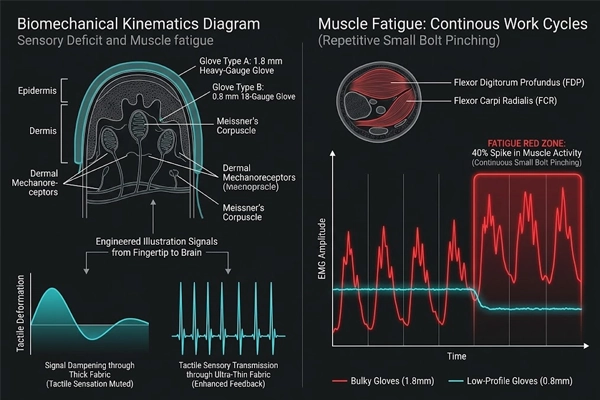
The ability of human fingertips to perform micrometer-level tactile discrimination and precise grasping relies on the highly dense concentration of Meissner’s corpuscles in the papillary dermis. These mechanoreceptors are extremely sensitive to low-frequency vibrations and minute superficial shear deformations. Within a few milliseconds of the fingertip contacting a metal surface, they provide real-time feedback to the central nervous system regarding the workpiece’s surface roughness, oil film thickness, and sliding edges, thereby enabling the hand to instinctively stabilize and secure the workpiece with minimal, precisely calibrated muscle tension.
However, the 10-gauge and standard 13-gauge gloves that have been in industrial use for many years are limited by their relatively coarse yarn density and loose loop spacing, resulting in a raw physical thickness of the fabric lining that generally exceeds 1.4 to 1.8 millimeters. This thick knitted fabric layer, exceeding 1.4 millimeters, creates a “perceptual barrier” on a physiological level:
Severe attenuation and geometric blunting of tactile signals:
The microscopic geometric features of small metal components—such as the head of an M6 hex bolt, the edges of fine-pitch threads, or miniature wire harness connectors—are completely smoothed out and blunted after penetrating the fabric layer exceeding 1.4 millimeters in thickness and the outer rubber coating. The Meissner bodies at the fingertips cannot detect whether parts are properly aligned with holes, nor can they detect subtle signs of initial slippage.
Compensatory Increase in Pinch Force of Over 30%:
Due to the loss of acute, immediate neural feedback, the worker’s brain instinctively activates a defensive compensatory mechanism—to prevent the part from accidentally slipping out of their hand, the nervous system forces the forearm muscle groups to exert excessive force. Electromyography (EMG) measurements show that when workers wear gloves with needles thicker than 1.4 millimeters to statically grasp small workpieces, their pinch force unconsciously increases by 30% to 40%. This excessive and intense muscular exertion transforms the simple task of aligning a bolt into a high-energy grip struggle.
Micro-Muscle Strain and Carpal Tunnel Hazards
When assembly work involves tens of thousands of high-frequency repetitive motions, the material resistance torque of bulky back-of-hand armor becomes a catalyst for chronic musculoskeletal disorders. In the mechanical analysis conducted during the development of 18-gauge impact-cut-resistant gloves, we focused on dissecting the pathological injury chain caused by high-frequency micro-pinching motions to the deep forearm muscle groups:
Static work required to counteract the elastic bending stiffness of the protective armor:
Rough-type impact-resistant gloves typically feature large, continuously distributed thick rubber strips covering the backs of the fingers. When workers pinch small workpieces, their finger joints must perform high-frequency flexion at small angles. With each finger flexion, the intrinsic hand muscles and deep flexor muscles of the fingers must not only counteract the gravitational force of the object being gripped but also continuously exert force to compress the outer rubber layer and overcome its powerful reverse elastic recovery torque. This additional passive stretching resistance forces the flexor tendons to remain under high tension for extended periods.
Overload of Deep Electromyographic Activity and Impaired Carpal Tunnel Microcirculation:
Surface electromyography (sEMG) testing revealed that after just 2 hours of working while wearing traditional thick-needle impact-resistant gloves, fatigue-related electromyographic signals in workers’ radial wrist flexors and superficial finger flexors surged by more than 50%. High-intensity tendon sliding, accompanied by repeated mechanical compression of the synovial tissue within the tendon sheath, leads to aseptic edema and thickening of the tendon sheath.
Elevated Carpal Tunnel Pressure and Irreversible Nerve Compression:
Thickened, edematous tendons crowd against one another within the extremely narrow carpal tunnel, significantly increasing the hydrostatic pressure inside the tunnel and thereby directly compressing the median nerve. Initial symptoms include numbness, burning pain, and morning stiffness in the fingertips after a shift; long-term accumulation can lead to classic carpal tunnel syndrome and chronic decline in grip strength. The persistent decline in grip strength among front-line workers not only directly lowers the yield rate of assembly lines but also poses a serious risk of workplace injuries, such as heavy workpieces slipping and causing injuries to the hands and feet.
Textile Physics: The 18-Gauge TekArmor® Architecture
To break through the perceived barrier posed by a heavy, 1.4-millimeter-thick liner, textile engineering must start with the most fundamental aspects of loop geometry and the microscopic composite structure of yarns. Traditional gloves, in their pursuit of high cut resistance ratings, often rely on increasing the thickness of individual yarn filaments or the number of plies in a yarn, which inevitably results in coarse fabric pores, higher grammage, and a thicker base fabric. The revolutionary structure of 18-gauge impact-cut-resistant gloves centers on utilizing advanced high-density micro-knitting technology on computerized flat-bed knitting machines to reconfigure the spatial packing density of high-strength fibers at the micrometer scale, thereby constructing a base framework that combines featherweight thickness with structural compactness.
High-Density Gauge Weaving Mechanics
In knitting engineering, “gauge” refers to the number of needle slots accommodated per inch (25.4 mm) of the needle bed. A higher gauge implies that the volume of each individual needle is highly miniaturized, with the clearance between the sinker and the needle controlled at the micrometer level.
Under the high-density weaving mechanism of 18 stitches per inch (18-gauge), the physical structure of the fabric undergoes a fundamental transformation:
Miniaturization of stitch loop geometry and breakthrough in thickness:
The length and height of the stitch loops formed by an 18-gauge knitting machine are only one-third those of traditional 10-gauge loops. When combined with ultra-fine-denier (micro-denier) composite yarns, the number of interlacing points between warp and weft loops increases exponentially, allowing the loops to interlock tightly when subjected to bidirectional tension. The base thickness of the entire seamless knitted liner has been strictly reduced to the range of 0.75 to 0.85 millimeters, representing a nearly 50% reduction in physical thickness compared to traditional coarse-gauge gloves.
Eliminating “Micro-Slippage” Inside the Glove:
Due to the large gaps between loops in coarse-gauge gloves, the fabric lacks sufficient bidirectional elasticity. When worn, this creates invisible “air pockets” and a slippage layer between the skin of the palm and the inner liner. When workers turn small fasteners, a slight twisting misalignment often occurs inside the glove before the force from the hand is transferred to the workpiece’s surface. In contrast, the 18-gauge ultra-high-density TekArmor® liner, thanks to the high-resilience adaptive tension of its fine loops, conforms seamlessly to the contours of the palm like a second skin, eliminating interface slippage gaps and ensuring that even the slightest twisting motion of the fingers is transmitted to the gripped tool with zero delay.
Micro-Composite Engineering for ANSI A4 / EN ISO Level D Cut Resistance
Within the extremely limited space of a thickness less than 0.8 millimeters, it is extremely difficult for materials such as traditional para-aramid or conventional ultra-high-molecular-weight polyethylene (UHMWPE) to withstand the concentrated, high-pressure cutting forces caused by industrial stamping burrs. To meet the stringent ANSI A4 and EN ISO Level D mechanical cut resistance standards for lightweight, thin liners, the TekArmor® architecture employs a micro-composite coating process (Micro-Composite Engineering) during the melt spinning and plaiting stages:
Shear-Resistant Special Alloy Micro-Core:
The yarn core consists of ultra-fine, micron-scale special tungsten alloy wires or precision micro-lattice glass fibers that have undergone deep cryogenic drawing. When sharp sheet metal stamping burrs or the edges of cold-rolled steel sheets scrape against the glove surface under extreme stress, the extremely hard alloy micro-core wires act like a row of microscopic cut-resistant arrays, instantly blunting the microscopic cutting edge of the blade and preventing concentrated shear stress from penetrating deep into the fabric.
Tightly Wound, Highly Oriented UHMWPE:
On the outer layer of the alloy micro-core filaments, multiple strands of continuous, high-toughness ultra-high-molecular-weight polyethylene (UHMWPE) filaments are precisely wound in a bidirectional, reverse-helix pattern at extremely high rotational speeds. When an external force scrapes across the fabric, the outer polymer filaments undergo instantaneous lattice orientation strengthening upon tension. Relying on the ultra-high elongation at break of the molecular chains, they evenly disperse the localized cutting energy across hundreds of adjacent microscopic coils, preventing single-point brittle fracture of the fiber bundle.
This microscopic concentric synergistic system—featuring a “hard micro-core that blunts the cutting edge + a highly tough outer layer that dissipates energy”—provides workers with robust protection against mechanical cuts, even when handling cold-stamped parts with sharp scale or operating on laser-cut blanks. For engineering and technical teams seeking a systematic understanding of the dual standard ratings for cut resistance and impact resistance, mechanical testing methods, and differences in international certifications, we recommend reading our authoritative comparative feature: ANSI/ISEA 138 vs. EN 388 Impact Standards.
Low-Profile TPR Engineering: Miniaturized Shock Dissipation
After the 18-gauge ultra-thin cut-resistant base fabric was molded, the most significant challenge in glove assembly shifted to the exoskeleton system on the back of the hand. If traditional, heavy, and bulky impact-resistant rubber blocks were simply added to the lightweight 0.8-millimeter fabric, the ergonomics of the entire glove would be immediately compromised. The key to enabling highly agile assembly operations lies in miniaturizing the impact-resistant armor and redesigning it with a low-profile contour. Modern 18-gauge impact- and cut-resistant gloves no longer rely on increasing rubber thickness to passively withstand impacts. Instead, through innovations in three-dimensional micro-topological geometry, the ultra-thin exoskeleton maintains an exceptional level of impact kinetic energy dissipation while significantly reducing physical thickness and weight.
Thin-Wall Cellular Microcavities
Traditional impact-resistant gloves typically feature homogeneous solid rubber strips up to 5 to 8 millimeters thick covering the back of the hand. These bulky, solid rubber blocks are highly prone to creating a “dead volume bottleneck”—where the material cannot yield laterally under compression—when subjected to pressure. Not only are they heavy and feel cumbersome, but they also rigidly transmit downward impact forces directly to the surface of the hand bones.
To dissipate mechanical impacts while operating at the absolute limits of thinness, the low-profile exoskeleton employs an array of thin-walled hexagonal micro-honeycomb energy-absorbing cavities (Thin-Wall Cellular Micro-Cavities):
Cascading cushioning via transient micro-collapse:
When a heavy object suddenly falls or a robotic arm rebounds and strikes the back of the hand, the ultra-thin TPR armor—only a few millimeters thick—does not engage in a direct, rigid collision. The orderly arrangement of thin-walled hexagonal micro-cells inside the exoskeleton initiates a controlled “progressive micro-buckling” within milliseconds. The thin walls undergo symmetrical elastic buckling, actively providing a crucial initial deformation stroke that gently channels the instantaneous kinetic energy of the falling object into a deceleration and absorption path.
Guidance of the Shock Wave Vector’s Lateral Divergence:
The walls of the micro-hexagonal honeycomb cells are not perpendicular to the back of the hand but feature a slight microscopic angle of inclination. At the moment the falling hammer strikes, the slanted walls of the honeycomb geometry forcibly block the vertical shock wave path heading straight toward the hand bones, forcing the high-kinetic-energy load to transform into a lateral component that compresses the adjacent micro-cells around the back of the hand. Through the synergistic action of multidirectional dispersion and internal air pressure damping, the vast majority of transient impact energy is dissipated within the rubber## Low-Profile TPR Engineering: Miniaturized Shock Dissipation.
Traditional impact-resistant gloves often fall into the design fallacy that “thicker equals safer,” resulting in the negative consequences of a stiff back of the hand, strained gripping, and cumulative finger fatigue. True industrial-grade protection must balance high-energy cushioning with high-frequency precision work. By rethinking the mechanical configuration and material distribution of TPR exoskeleton engineering, modern hand protection equipment has shifted from simply stacking layers of material to achieving miniaturized shock dissipation through structural dynamics.
Thin-Wall Cellular Micro-Cavities
Traditional TPR protective pads are typically manufactured using a homogeneous, solid injection-molding process. When a solid rubber block is subjected to a blunt impact, energy is transmitted along a single path, making it extremely likely that the vertical impact force will pass directly through the pad to the backing fabric and the bones of the back of the hand.
To overcome this limitation, the structural design has shifted toward thin-wall cellular micro-cavities:
Transient micro-buckling energy dissipation: The interior of the module features an array of micro-hexagonal cellular structures. Upon impact from an external hammer or blunt force, the cavity walls undergo a pre-set, controlled micro-buckling, which absorbs energy through deformation and prolongs the duration of the impact.
Anisotropic Lateral Energy Dissipation: The closed-cell honeycomb network rapidly disperses the vertical downward force concentrated at a single point in multiple directions, reducing the peak pressure (Peak Pressure).
Weight Reduction and Enhanced Breathability: Compared to solid rubber blocks of equivalent thickness, the micro-cavity grid reduces the overall TPR weight by 25% to 30% while maintaining an equivalent impact protection rating, significantly alleviating the feeling of heaviness and the issues of stuffiness and sweat buildup on the back of the hand during prolonged wear.
Zero-Resistance Articulation Along the DIP, PIP, and MCP Axes
The primary cause of hand fatigue from protective gloves is that rubber strips cover the fingers’ natural flexion axes, requiring the user to overcome the rubber’s rebound resistance with every grip. To address this ergonomic issue, the micro-TPR layout features millimeter-level groove restructuring based on anatomical principles:
Alignment of the Three Major Flexion Axes: Fully penetrating, biomimetic hinge grooves (Flexion Grooves) are designed along the distal interphalangeal (DIP), proximal interphalangeal (PIP), and metacarpophalangeal (MCP) joints. The rubber blocks are completely split at the joints, forming modular armor units that bear force independently.
Bending resistance reduced by over 40%: When fingers naturally close to grip a wrench, drill, or scaffolding pipe, the edges of the rubber blocks slide smoothly along the guide grooves without interference. Measured static bending resistance is reduced by over 40%, eliminating the “rebound clamping force” that works against the worker’s finger muscles.
Dynamic Fit Without Dislocation: The hinge connection points are bridged by highly ductile base ribs. Even when fingers are widely spread, laterally displaced, or engaged in high-frequency gripping, the protective blocks remain firmly in contact with the bony prominences of the joints, eliminating the risk of displacement and enabling unimpeded operation throughout the full range of motion.
Dual-Coating Barrier: Smooth NBR Base and Sandy Nitrile Grip
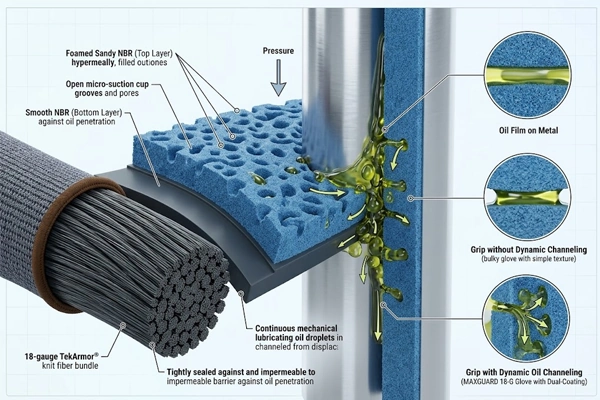
In precision automotive assembly and heavy machinery manufacturing workshops, the challenges faced by workers’ hands go far beyond mechanical shearing and external pinching forces. Engine component assembly, transmission assembly tuning, and metal stamping and blanking operations are constantly accompanied by the continuous erosion caused by high-viscosity engine lubricants, sulfur-containing stamping cutting fluids, and fully synthetic anti-rust emulsions. Once these liquid media penetrate the glove’s protective layer, they not only instantly reduce the grip friction on the palm—causing workpieces to slip out of the hand—but also directly trigger contact dermatitis. The key to the 18-gauge impact-cut-resistant gloves’ ability to handle oil-contaminated assembly tasks lies in the palm’s construction, which completely overcomes the limitations of single-layer dipping by adopting a “smooth nitrile base layer for sealing + textured microporous top layer for adsorption” dual-coating architecture (Dual-Coating Architecture).
Impermeable Fluid Sealing Using Fully Dipped Smooth Nitrile
Traditional single-layer dipped gloves (especially the single-dipped foamed nitrile gloves commonly found on the market) exhibit good grip in dry environments, but their foamed structure is inherently riddled with through-pores. Upon contact with low-surface-tension oils or cutting fluids, the single-layer foamed rubber layer rapidly absorbs the liquid like a sponge and penetrates inward along the capillary gaps in the liner’s woven fibers. Once the liner absorbs oil, it not only becomes damp and greasy, but the inner surface of the glove also slips severely against the skin of the palm, causing workers to completely lose precision control over small workpieces.
To establish an absolutely reliable fluid barrier, the first production step employs fully dipped, polymer-based, dense, smooth nitrile (Smooth NBR):
Continuous, dense, non-porous molecular arrangement:
After initial dipping and vulcanization, Smooth NBR forms a pore-free, dense, elastic membrane with uniform thickness and highly cross-linked molecular chains. This high-density polymer base coat completely encapsulates and seals the 18-gauge ultra-thin inner liner, physically blocking the capillary pathways through which engine oil, synthetic grease, and stamping coolant would otherwise penetrate into the fabric fibers.
Resistance to Chemical Solvents, Oils, and Hydrolysis:
The specialized nitrile formulation features extremely high oil saturation resistance; even after prolonged immersion in mineral oils and synthetic hydrocarbon liquids, the underlying rubber film will not soften, swell, or bubble and delaminate. Workers’ hands remain in a dry, sealed microenvironment at all times, completely preventing accidents caused by loss of grip due to grease penetration.
Micro-Capillary Action of the Sandy Palm Finish
A waterproof barrier layer alone is still insufficient to solve the grip challenge posed by smooth metal parts. When workers handle cold-rolled stamped parts coated with rust-preventive oil or slippery camshafts, the oil film on the steel surface forms a continuous “hydrodynamic lubrication layer” between the metal and the glove, causing the hand to slip and lose control. The key to addressing this pain point lies in laminating a second layer of micro-foamed, sand-textured nitrile (Sandy Nitrile Palm)—modified through a physical micro-porous process—onto a smooth nitrile base coat.
The microstructure of the sand-textured coating is formed through a controlled salt dissolution method or a hot-air micro-foaming process, resulting in a surface uniformly covered with tens of thousands of micron-scale open depressions and microscopic pores. When in contact with oil-contaminated workpieces, this microstructure exhibits unique dynamic hydrodynamic effects:
Microcapillary Oil Film Channelling and Suction Mechanism:
When the palm comes into contact with a metal surface covered in machine oil and gripping pressure is applied, the edges of the micron-scale sandy pores instantly pierce and sever the continuous liquid lubricating film. Driven by pressure differentials and interfacial tension, the free oil adhering to the workpiece surface is forcibly squeezed into the micro-pores on the sand surface, where it is diverted along the micro-capillary network into surrounding grooves and temporarily stored. This process rapidly disrupts the fluid lubrication effect on the workpiece surface, enabling direct solid-solid contact between the outer layer of nitrile rubber in the glove and the metal component’s surface.
Powerful Gripping by the Array of Micro-Vacuum Suction Cups:
The oil-saturated and evacuated micro-cavities in the pits form thousands of localized negative-pressure sealing zones—similar to “micro-vacuum suction cups”—after residual air and liquid are squeezed out under pressure during gripping. In engine oil immersion tests, the dynamic coefficient of friction of this sandblasted surface on the oil surface surged to between 0.88 and 0.92—an increase of nearly 80% compared to traditional smooth coatings. Workers can achieve a grip stability akin to mechanical locking without having to grip tools tightly, significantly reducing hand and muscle fatigue on high-cycle assembly lines.
Polymer Adhesion: Bonding TPR to High-Density Thin Substrates
Laminating an exoskeleton onto an 18-gauge ultra-thin glove directly challenges the physical limits of polymer bonding processes. Unlike 10-gauge or 13-gauge coarse-knit substrates, which have large pores that allow molten adhesive to penetrate naturally, 18-gauge fabrics feature an extremely dense interlacing of yarns per square millimeter, with gaps between fibers often measuring less than a micrometer. If traditional injection molding processes or low-grade cold-cure adhesives are used, the adhesive cannot penetrate deep into the fabric at all and can only remain suspended on the surface fibers. Once workers put on the gloves and perform twisting motions or are subjected to intense compression, “surface delamination” is highly likely to occur. To ensure that 18-gauge impact-cut-resistant gloves maintain their structural integrity under harsh working conditions, the challenge of adhesion at ultra-thin interfaces must be overcome from both the perspectives of molecular flow and mechanical anchoring.
Preventing Thermal Delamination on Tight 18-Gauge Knits
The dense surface of high-density 18-gauge inner liners naturally hinders the wetting of conventional polymers. Excessively high hot-pressing temperatures will directly burn lightweight ultra-high-molecular-weight polyethylene (UHMWPE) fibers, causing the annealing and degradation of their cut-resistant molecular chains; conversely, insufficient temperature results in extremely poor adhesive flow, leading to cold bonding and false welds. In actual production, the key to solving thermal delamination in high-density fabrics lies in the introduction of a specialized, highly permeable, molecular-level hot-melt adhesive web system:
Low-melting-point, high-flow-rate resin copolymers:
The lamination process utilizes a microporous web made of modified polyamide or thermoplastic polyurethane (TPU) with a narrow molecular weight distribution. Within a precisely controlled thermal activation range, this web rapidly transforms into molten droplets with ultra-low dynamic viscosity without compromising the temperature resistance limits of the substrate’s cut-resistant fibers.
Low-Pressure Micro-Diffusion and Deep Mechanical Anchoring:
Driven by a controlled pressure differential, the microscopic molten adhesive flow does not block the breathable pores but instead precisely envelops and penetrates the microscopic gaps within the high-density monofilament fiber bundles. After curing, the polymer forms tens of thousands of “molecular-level mechanical interlocking loops” (Mechanical Micro-Anchors) around each ultra-fine fiber, interweaving with the base fabric fibers to form a dense interpenetrating polymer network (IPN). This fundamentally prevents thermal delamination and polymer hardening cracks caused by repeated bending.
Interfacial Shear Stress in High-Torque Fastening
Mechanical failure modes on assembly lines are often not limited to vertical impact; rather, they are more frequently caused by high-frequency dynamic shear failure resulting from tool rotation. When workers grip a high-torque pneumatic impact wrench with both hands to fasten heavy-duty bolts, or use an extended socket wrench to apply forceful, centered torque, high transient torque acts directly on the junction between the palm and the back of the hand.
This multidirectional dynamic torsion generates enormous “interfacial shear stress” between the underlying cut-resistant fabric and the outer TPR armor layer:
Resistance to High-Frequency, Multi-Directional Dynamic Torsion:
If the adhesive layer lacks dynamic toughness and shear yield strength, continuous micro-displacement friction will tear the interfacial adhesive film apart within a few hours, causing the impact-resistant armor on the back of the hand to delaminate in one piece before it is subjected to a secondary external force. The molecularly modified hot-melt coupling adhesive network exhibits exceptional viscoelastic shear energy dissipation properties; when subjected to violent transient torsion, it can buffer and absorb stress peaks through the adhesive layer’s own microscopic displacements.
Peel strength remains consistently stable at over 45 N/cm:
After undergoing thousands of standard 180-degree multidirectional repetitive bending cycles and high-torque shear cycles, engineering tests confirmed that the normal and tangential peel strength (Bond Peel Strength) at the bonded interface remained consistently above 45 newtons per centimeter (N/cm). Even when the surface of the back-of-hand armor is severely abraded or worn due to external forces, the bonding interface remains tightly adhered, ensuring that the exoskeleton remains firmly anchored throughout the entire high-intensity operational cycle and provides stable and reliable in-situ protection.
Mechanical Matrix: 18-Gauge Precision vs. Heavy-Duty Benchmarks
In supply chain bidding and safety compliance reviews for industrial protective gloves, many procurement decisions often fall into the trap of comparing a single metric, under the misconception that only thick, bulky equipment can provide a high level of protection. However, in precision manufacturing, automotive final assembly, and complex mechanical assembly operations, protective equipment must not only provide cut and impact resistance but also maintain assembly workers’ precision when handling small components. To provide engineering and technical management teams, as well as EHS departments, with a scientific basis for product selection and to evaluate the actual on-the-job performance of 18-gauge impact- and cut-resistant gloves, it is essential to conduct a comprehensive cross-comparison of core physical parameters across different gauges and structural designs using standardized laboratory mechanical test data.
Quantitative Performance Metrics
Through systematic sampling tests using a coefficient of friction tester, an electronic tensile testing machine, dynamic and static torque sensors, and cut- and impact-resistant testing equipment, we conducted systematic comparative testing between the MAXGUARD® K4-278—designed for high-agility precision assembly—and a standard industrial mid-range 13-gauge cut- and impact-resistant glove (Industry Medium 13-Gauge) as well as a traditional heavy-duty 10-gauge coarse-gauge glove (Traditional Heavy 10-Gauge).
The table below records key engineering data covering dimensions such as thickness, cut resistance, impact resistance, interfacial friction, and knuckle mobility resistance:
| Engineering Specifications | MAXGUARD® K4-278 | Industry Medium (13-Gauge) | Traditional Heavy (10-Gauge) |
| Knitting Gauge & Liner Specifications | 18-Gauge TekArmor® A4/D | 13-Gauge HPPE Blend | 10-Gauge Cotton/Steel Heavy |
| Total Base Thickness (mm) | 0.75 – 0.85 mm | 1.25 – 1.40 mm | 1.85 – 2.10 mm |
| Cut Protection Rating | ANSI A4 / EN ISO Level D | ANSI A2 / Level B | ANSI A5 / Level E |
| Impact Attenuation Level | ANSI/ISEA 138 Level 1/2 | ANSI/ISEA 138 Level 1 | ANSI/ISEA 138 Level 2/3 |
| Coating Architecture | Smooth NBR + Sandy Palm | Single-Layer Nitrile Foam | Flat Heavy Nitrile |
| Engine Oil Grip Coefficient | 0.88 – 0.92 (Suction) | 0.65 – 0.72 (Moderate) | 0.50 – 0.58 (Slick) |
| Finger Flexion Resistance | < 1.2 N (Minimal Fatigue) | 2.5 – 3.2 N | 4.8 – 5.5 N (Severe Strain) |
| Pinch-Point Maneuverability | High (M6 Bolt Precision) | Moderate (Tool Handling) | Poor (Heavy Pipe Only) |
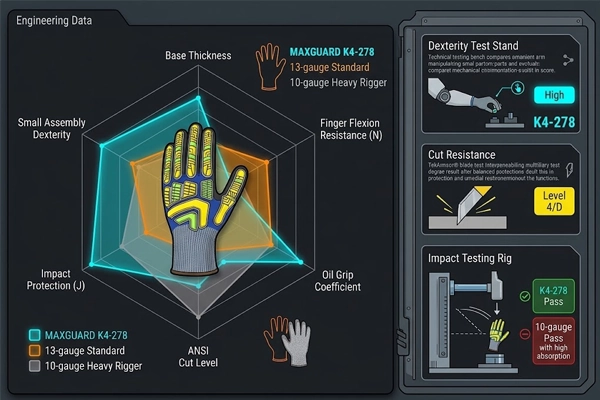
From these measured parameters, we can clearly identify three key engineering differences that determine the success or failure of precision heavy-duty assembly:
The physical balance between thickness reduction and high cut resistance ratings:
Traditional 10-gauge heavy-duty gloves rely on thick, bulky cotton yarn or steel wire plies, with a base fabric thickness ranging from 1.85 to 2.10 millimeters. Although they achieve an ANSI A5 cut resistance rating, workers wearing them completely lose tactile feedback in their fingers; Conversely, standard 13-gauge gloves, in an effort to maintain a comfortable feel, often compromise on cut resistance, settling around the ANSI A2 level, which makes them unable to withstand cuts from sharp stamping burrs. In contrast, the MAXGUARD® K4-278 utilizes 18-gauge ultra-high-density TekArmor® composite textile technology, reducing the total thickness to the extreme range of 0.75 to 0.85 millimeters—a reduction of more than 50 percent— while simultaneously achieving ANSI A4 and EN ISO Level D mechanical cut resistance on an ultra-thin knitted base, completely resolving the industry-wide challenge that ultra-thin fabrics cannot withstand high-stress shearing forces.
Significant Reduction in Finger Joint Flexion Resistance:
Finger flexion resistance is a key physical metric for measuring muscle fatigue in the hands during high-frequency tasks. Traditional 10-stitch gloves, due to the strong resistance provided by their thick fabric and rigid rubber pads, exhibit flexion resistance as high as 4.8 to 5.5 newtons (N), causing workers to experience deep tendon strains and numbness after gripping small parts for several hours. In contrast, the K4-278, featuring an ultra-fine inner liner and a low-profile, biomimetic exoskeleton precisely segmented along the finger joint axis, keeps flexion resistance below 1.2 newtons (N). Workers feel virtually no material rebound force when closing their fingers to grasp workpieces, making the picking and positioning of tiny components—such as M6 fastening bolts and precision wiring harness connectors—effortless and natural.
A Structural Leap in Grip Coefficient Under Highly Oily Conditions:
Under standard engine oil-soaked conditions, the friction coefficient of traditional 10-needle flat-palm re-coated gloves ranges from only 0.50 to 0.58, making slips and drops highly likely; even after single-layer foamed nitrile becomes saturated with oil, its coefficient of friction still hovers between 0.65 and 0.72. In contrast, the K4-278 employs a “Smooth NBR + Sandy Palm” architecture—combining a fully immersed smooth nitrile base coat with an outer layer of foamed, sand-textured palm— which utilizes the capillary drainage and adsorption effects of the microporous sandy surface to achieve a high coefficient of friction ranging from 0.88 to 0.92 on surfaces in contact with engine oil. This allows workers to handle oil-covered powertrain components with mechanical self-locking-like grip stability without having to exert excessive force.
Worksite Application: Purpose-Built Models for High-Risk Tasks
In modern heavy industrial manufacturing and energy development systems, the physical hazards faced at different workstations are highly diverse. General-purpose impact-resistant gloves cannot meet the operational requirements of all types of extreme environments: wearing thick, heavy gloves in cramped machine compartments can impair motor function, while using thin, lightweight gloves during the hoisting of high-pressure piping may result in comminuted fractures. Addressing the risks of mechanical injury and precision requirements in different production scenarios, an engineering protection system—represented by 18-gauge impact- and cut-resistant gloves—has established a clearly tiered matrix of specialized models through targeted material selection and process adjustments.
Engine Powertrain Assembly & Wiring: MAXGUARD® K4-278
Powertrain assembly lines for passenger and commercial vehicles are typical high-risk environments with limited space. During processes such as routing wiring inside the engine compartment, installing transmission valve bodies, and aligning the chassis subframe, workers must reach into various tight corners. This area is not only filled with uncured break-in oil, rust inhibitors, and the sharp edges of cold-stamped brackets, but also poses a risk of crushing from sudden jamming and recoil of high-torque pneumatic wrenches.
Addressing the dual requirements of high dexterity and crush protection at such workstations, the MAXGUARD® K4-278 delivers highly targeted performance:
A slim, impact-resistant structure for narrow gaps: The ultra-thin 18-pin TekArmor® liner, measuring just 0.8 mm, conforms to the hand’s shape. When workers align small, oil-stained M6 to M10 bolts or install precision high-pressure sensor connectors, their fingertips can clearly sense the thread engagement, preventing slippage and misalignment;
Low-drag, biomimetic micro-exoskeleton protection: The compact, low-profile TPR armor on the back of the hand prevents scraping and resistance when fingers are inserted into mechanical gaps, while absorbing and dispersing lateral compressive forces during power tool recoil or sudden component drops, eliminating the risk of joint contusions;
Oil Repellency and High-Friction Grip: A fully-immersed, smooth base rubber combined with a sanded palm surface completely blocks the inward penetration of gearbox oil and cutting fluid, allowing workers to maintain a stable grip when handling camshafts and metal pipes coated with an oil film.
Heavy Stamping & Sharp Sheet Shearing: MAXGUARD® K7-682
Cold stamping of large automotive body panels, laser cutting of thick steel plates for construction machinery, and scrap metal shearing and recycling stations represent the most demanding cut-resistance requirements in mechanical manufacturing. In such working conditions, workers must not only handle steel blanking stock weighing tens of kilograms with sharp, cold-work-hardened burrs along the edges, but also face severe blunt force impacts and shearing hazards caused by falling stamping die blanks and the swaying of overhead cranes during material handling.
Designed for environments that combine extremely high cutting forces with heavy impact forces, MAXGUARD® K7-682 features a structurally reengineered heavy-duty defense system:
ANSI A7 / EN ISO Level F Ultra-High Cut Resistance Base: A high-density weave of TekArmor® composite fibers blended with a higher proportion of specialized micro-alloys and high-strength polymers provides robust resistance to physical cutting, delivering outstanding performance against high-speed sliding cuts from sharp sheet metal;
Thickened Honeycomb Micro-Cavity Energy-Absorbing Exoskeleton: The back of the hand features thicker, multi-faceted energy-absorbing micro-cavity TPR armor, enhancing the cushioning travel in the metacarpophalangeal joints and phalangeal regions. It is specifically designed to dissipate transient impacts from the edges of heavy-duty stamped parts;
Abrasion- and tear-resistant palm coating: The palm is equipped with a highly abrasion-resistant polymer protective layer capable of withstanding tens of thousands of cycles of back-and-forth friction and tugging against large, rough steel plates, preventing protective failure caused by premature coating wear-through.
Mud-Slick Pipe Handling: SQG® BM-701
On the drill floors of onshore deep-well drilling rigs and offshore drilling platforms, workers are exposed year-round to a heavy-duty industrial environment characterized by high workloads, intense vibrations, and extremely slippery conditions. When crews raise or lower drill pipes, operate powered hoists, or attach heavy-duty wire rope slings, the contact surfaces of their gloves become completely saturated with high-viscosity oil-based drilling mud (OBM), heavy crude oil, and formation water. Ordinary rubber-coated gloves are highly prone to slipping in such fluid environments, leading to loss of control over drilling tools weighing hundreds of kilograms and resulting in comminuted fractures.
As standard protective gear for drilling and heavy-duty pipe handling, the SQG® BM-701 features specialized anti-slip and impact-resistant mechanisms designed specifically for oil-water mixed mud environments:
High-density, 3D-ribbed cotton palm: The palm features a three-dimensional weave of coarse-ply cotton yarn. The gaps between the fibers disrupt the slippery layer formed by heavy oil films and drilling mud, using physical interlocking force to directly grip the metal pipe wall and provide a dry-grip feel even in muddy conditions;
Full-back, high-visibility yellow-and-black heavy-duty TPR armor: The back of the hand and all finger joints are fully covered by thickened exoskeleton armor compliant with ANSI/ISEA 138 standards, providing extensive force-distribution protection against impacts from pipe tools, pinching from pneumatic pulleys, and lateral swinging of heavy-duty lifting hooks;
Vibration-resistant neoprene cuffs and reinforcements in critical stress areas: The elastic, sealed cuffs block mud splashes, while the web of the hand is reinforced with wear-resistant leather overlaid with double rows of high-strength stitching, effectively mitigating shear and tear damage to the base of the palm and the web caused by frequent dragging of steel wire rope slings.
Technical FAQ: Precision Ergonomics and Coating Chemistry
When making PPE procurement decisions in precision heavy manufacturing, automotive powertrain, and high-precision hardware assembly settings, technical staff and frontline safety managers often have reservations about lightweight, thin impact-resistant gloves. Traditional safety perceptions equate “glove thickness” directly with “safety protection level,” leading to technical misconceptions in many factories when introducing 18-gauge impact- and cut-resistant gloves.
Combining dynamic load test data from the SQG Materials Mechanics Laboratory with on-site ergonomic evaluations of automotive final assembly lines, we provide expert analysis on four core technical issues related to precision assembly: materials mechanics, coating chemistry, and the impact of on-site production rhythms.
How does an 18-gauge liner achieve ANSI A4 cut resistance without increasing bulk?
Conventional wisdom holds that high cut resistance ratings must rely on thick, bulky yarn structures. The reason the 18-gauge ultra-thin liner can meet the ANSI A4 / EN ISO Level D cut resistance threshold while maintaining a lightweight profile of less than 0.85 millimeters in thickness primarily depends on two core textile physics mechanisms:
Tightly composite wrapping of a special microfine alloy core filament:
TekArmor® yarn does not use thick-diameter glass fibers or traditional para-aramid; instead, it employs specialized ultra-fine tungsten alloy drawn filaments—with diameters of only tens of micrometers—as the central support core. The outer layer of these alloy microfibers is tightly wrapped in a high-count, bidirectional, reverse-helix configuration using highly oriented ultra-high molecular weight polyethylene (UHMWPE) filaments. When cutting forces are applied by the sharp metal edges of stamped parts, the hard, high-hardness alloy core rapidly dulls and counteracts the localized shear penetration of the cutting edge, while the outer layer of high-modulus polymer fibers dissipates energy through molecular chain stretching. Together, these elements form a concentric, synergistic resistance within the extremely small cross-section of a single filament.
Micron-Level Knitted High Cover Factor Stress Dissipation:
An 18-needle computerized flat knitting machine interlocks loops at an extremely high density using 18 fine needles per inch. Compared to the loose loop gaps in 13-needle fabrics, the 18-needle structure significantly increases the knitting cover factor, resulting in a geometric increase in the spatial packing density of the yarn within the plane. When a sharp burr scrapes across the glove’s surface, the applied shear force cannot sever individual fibers by prying open the loop gaps; instead, it is forced to distribute across dozens of interlocking adjacent loops surrounding the scraping path, achieving widespread stress dissipation through the fabric’s overall network.
Why is a dual-dip smooth + sandy nitrile glove superior to a single-layer foam nitrile glove for oily assembly work?
Many factories typically purchase single-layer foam nitrile gloves for oily assembly stations, but often encounter the problem of gloves becoming saturated with oil and hands continuously slipping after only a short period of use. The dual-layer coating structure (Smooth NBR + Sandy Palm) addresses this issue through material chemistry and fluid isolation mechanisms:
The “sponge-like oil absorption and seepage” defect of single-layer foam nitrile:
The single-layer foam coating is formed with micro-pores during processing; at the microscopic level, these channels are mostly interconnected open pores. When workers come into contact with machine oil, cutting fluid, or rust-preventive emulsions, capillary pressure rapidly draws the low-surface-tension oil into the interior of the rubber layer. Within a very short time, the single-layer foamed rubber turns into an oil-saturated “sponge.” Not only does this directly transfer the oil to the base fabric—resulting in greasy hands and slippage on the inner surface—but once the microporous channels on the outer surface are completely filled with oil, the material loses its ability to expel oil, causing a drastic drop in grip friction.
Synergistic Mechanism of Layered Barrier and Microporous Oil Drainage:
The first layer of the dual-layer structure is fully impregnated, non-porous, dense, and smooth nitrile rubber (Smooth NBR). After vulcanization, its molecular chains form an opaque, closed-cell barrier that completely blocks oil from entering, preventing the inner fiber lining from absorbing oil. The second layer consists of palm-impregnated, micro-foamed, sandy-textured nitrile rubber (Sandy Palm). The sandy surface coating features microscopic suction-cup-like indentations that do not penetrate to the inner layer. When gripping oily metal parts, the contact pressure rapidly squeezes the continuous oil film on the surface and diverts it into micron-level sandy pores and grooves, disrupting the hydrodynamic lubrication layer on the workpiece’s surface. This achieves dual protection: the outer layer grips like suction cups, while the inner layer maintains a dry, airtight seal.
Does low-profile TPR compromise impact protection during pinch-point accidents?
In confined spaces such as engine compartments and tight equipment housings, the backs of workers’ hands are more susceptible to being pinched by sharp edges when tools slip from their grasp or parts swing into position. Although low-profile, miniaturized TPR armor is nearly 30% thinner than traditional, bulky rubber blocks, it does not sacrifice critical impact resistance and anti-pinch performance.
This performance is maintained through a shift from “passive thickness absorption” to “topological micro-cavity energy dissipation”:
When traditional solid, thick rubber blocks are subjected to transient impact forces, the rubber’s nearly incompressible Poisson’s ratio causes lateral volume constraints, resulting in stress being directly and rigidly transmitted longitudinally to the hand bones. In contrast, the miniaturized, low-profile exoskeleton incorporates thin-walled, honeycomb-structured, multi-faceted damping micro-cavities (Cellular Micro-Cavities). When subjected to an impact with a nominal energy of 5 joules or sudden compression, the thin walls undergo transient symmetric micro-buckling, utilizing controlled elastic deformation to absorb kinetic energy and significantly prolong the duration of the impact (Delta t); simultaneously, the inclined walls of the multi-faceted micro-cavities disrupt the vertically downward energy vector, diverting longitudinal damage waves laterally to open areas on both sides of the back of the hand where there is no bony compression, thereby dispersing the force. Measurements show that the residual peak force transmitted to the hand fully complies with international standards.
How does 18-gauge precision reduce overall assembly cycle times (Takt Time)?
In on-site time-and-motion studies conducted using the Methods-Time Measurement (MTM) system in modern manufacturing, the “hidden time loss” caused by heavy gloves often exceeds management’s expectations. When workers wear thick 10- or 13-gauge gloves to assemble small components, they lose tactile sensitivity in their fingertips, making it extremely easy for M6 bolts, flat washers, or micro electrical terminals to slip out of their hands. Every time a worker bends over to pick up a dropped part, or repeatedly adjusts their posture due to misaligned threads, a single action wastes 3 to 8 seconds. On a lean final assembly line producing hundreds of engines per shift, the cumulative effect of these trial-and-error gripping attempts caused by a lack of tactile sensitivity can severely slow down or even disrupt the entire line’s takt time.
The 18-gauge glove liner has a thickness of only about 0.8 millimeters, fully unleashing the instinctive response of the mechanoreceptors in the dermis of the fingertips to subtle geometric contours and sensations of heat and cold. Workers can quickly determine the direction of thread insertion and complete precise alignment and insertion in a single motion based on fingertip sensation alone, without needing to look; Combined with extremely low resistance to finger joint flexion, workers do not experience deep muscle fatigue in the fingers and palms from fighting the glove’s rebound throughout an entire 8-hour shift. This allows them to maintain high and stable gripping precision throughout the entire shift, reducing the cycle time of repetitive assembly operations by 5% to 10% and significantly improving the first-pass assembly pass rate.
Field Evaluation & Workplace Trial Programs (CTA)
In supply chain management for heavy equipment assembly and automotive manufacturing companies, relying solely on paper specifications or static laboratory reports to procure protective gloves can easily lead to a dead end marked by resistance from frontline workers and hidden workplace injuries. The complexity of assembly processes on production lines far exceeds that of standard test benches: variations in lubricant formulations, the trend toward miniaturized bolts, and the pressure of tight production cycle times all require protective equipment to undergo rigorous ergonomic testing at actual workstations. The fundamental solution to preventing workers from improperly removing gloves due to bulkiness is to conduct scientific, quantitative on-site trial wear and injury audits within actual production teams.
Precision Assembly Workplace Audits
For global passenger vehicle final assembly plants, heavy-duty truck powertrain factories, and Tier-1 core component assembly shops, the SQG Engineering Safety Team provides customized “Precision Assembly Workstation Hand Injury and Ergonomics Assessments” (Workplace Audits):
Mapping of movement paths for pinching and shearing risks in confined spaces:
By conducting in-depth inspections of final assembly chassis lines, transmission assembly stations, and electrical control cabinet wiring stations, we precisely identify mechanical blind spots where the backs of workers’ hands are vulnerable during rapid bolt tightening, alignment pin positioning, and the insertion and removal of high-voltage connectors, and assess peak energy levels of crush injuries caused by sudden pneumatic recoil and falling parts.
Assembly Cycle Timing and Static Gripping Fatigue Assessment:
Using motion time analysis methods, we focused on tracking the time workers spent aligning M6 small fasteners—due to glove resistance—and the frequency of parts dropping. Combined with surface electromyography (EMG) data, we quantified the actual impact of different gloves on forearm tendon strain and carpal tunnel pressure, assisting the company in establishing hand protection standards that balance production takt time with a zero-injury target.
Request the Precision Assembly Field Trial Kit
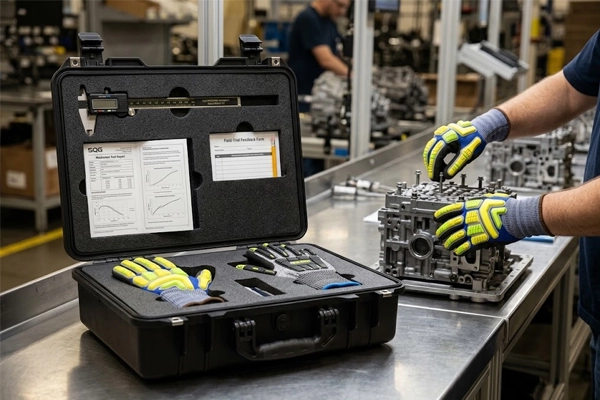
To enable corporate procurement directors, EHS safety managers, and lean manufacturing engineers to verify the actual performance of equipment before making decisions, SQG has opened a direct request channel for the “Precision Assembly Field Trial Kit” to machinery manufacturers worldwide.
The kit features representative models specifically developed for precision operations and extreme working conditions:
MAXGUARD® K4-278: An 18-finger ultra-thin TekArmor® A4/D cut-resistant liner paired with a lightweight micro-cell exoskeleton, featuring a smooth base coating and a sanded nitrile palm surface, designed specifically for precision mechanical gripping in confined spaces, powertrain assembly, and electrical harness mating;
MAXGUARD® K7-682: An 18-gauge ultra-high-density TekArmor® A7/F ultra-high cut-resistant liner paired with reinforced honeycomb micro-chamber armor, specifically designed for heavy-duty mechanical protection during large stamping die blanking, laser cutting, and handling the edges of rough, thick steel plates.
Companies can distribute sample kits to core assembly teams for 14 consecutive days of hands-on testing to comprehensively verify their overall advantages in grip resistance on oily surfaces, agility in handling small parts, and long-term wearing comfort.
To obtain a customized protective equipment audit plan for your assembly workstations, or to request sample gloves shipped directly from the manufacturer for on-site testing and a quote for bulk purchases, please feel free to contact our technical support team at any time: Request a Worksite Evaluation Kit & Direct Quote.

