

In bulk procurement of materials by multinational corporations and heavy manufacturing industries, the technical specifications for hand protection equipment directly determine the operational safety of frontline workers and the long-term costs of consumables. However, faced with the wide variety of coating formulations on the market, EHS (Environment, Health, and Safety) teams and procurement directors often find themselves in a “blind spot” when making selections based solely on experience. How exactly can we scientifically and quantitatively define the absolute performance boundaries of the three mainstream coatings—natural latex, synthetic nitrile, and polyurethane (PU)? To thoroughly address this industry pain point, we must shift our focus from the macro-level appearance of gloves to the microscopic molecular chain topological networks of the materials themselves.
This article will strip away conventional marketing rhetoric and, starting from the fundamental principles of physical chemistry, provide a hard-hitting analysis of the natural latex vs nitrile vs pu work gloves performance boundaries. We will conduct a comparative analysis of macromolecular networks such as cis-1,4-polyisoprene (natural rubber) and acrylonitrile-butadiene (nitrile), and by introducing key laboratory measurement data—including tensile elongation, stress-strain hysteresis loops, and tear propagation rates, we’ll reveal a truth often overlooked by the modern synthetic industry: during rough mechanical handling and high-frequency finger flexion and extension tasks—where interference from heavy industrial oils is eliminated—the ultimate elastic fit and exceptional resistance to blunt impact and puncture damping provided by natural latex remain the irreplaceable gold standard in the occupational safety industry.
For supply chain decision-makers seeking to systematically trace the evolution of polymer impregnation technology and gain a comprehensive overview of production lines, we recommend consulting the core technical documentation on Latex Coated Work Gloves established by the source super factory, which serves as technical validation for optimizing annual PPE procurement standards.
The Micro-Molecular Topology of Glove Polymers
In the field of industrial hand protection, the macroscopic mechanical performance of any coating material—whether its flexibility under tension or its tear resistance when exposed to sharp objects—fundamentally stems from the geometric arrangement of its microscopic molecular chains and its cross-linking density. Therefore, moving beyond superficial differences in tactile feel and gaining a deep understanding of the underlying topological structures of these three core polymers is the first step in scientifically evaluating the suitability of work gloves.
Natural Rubber (cis-1,4-polyisoprene) Dynamics
The core chemical component of natural rubber is cis-1,4-polyisoprene. At the microscopic level, its molecular chains exhibit a highly coiled, helical structure. This naturally occurring macromolecular structure endows the chain segments with extremely high spatial freedom and low rotational energy barriers.
It is precisely this unique long-chain topological network that endows natural latex with two physical properties highly valued in the industry: first, an extremely low glass transition temperature (Tg), ensuring that gloves remain flexible even in extremely cold environments; and second, an unparalleled capacity for strain-induced crystallization. When the coating is subjected to strong external tension, the originally disordered and coiled molecular chains rapidly align in the direction of the tensile force, forming microscopic crystalline regions. This instantly unleashes extremely high mechanical strength, thereby resisting damage from external stress.
Synthetic Nitrile and Polyurethane Structures
Unlike the dynamic flexibility of natural materials, the topological structure of synthetic polymer materials exhibits distinct performance characteristics.
Synthetic nitrile is a copolymer of acrylonitrile and butadiene. The abundance of rigid cyano groups (-CN) in its molecular chains forms an extremely strong chemical barrier, providing gloves with excellent resistance to oils and solvents. However, this bulky and rigid side-chain structure also significantly restricts the range of slippage and deformation of the molecular segments when subjected to force, causing the material to feel noticeably stiff during physical stretching.
The mechanical basis of polyurethane (PU) coatings is entirely different. It relies on a microphase-separated structure formed by the interweaving of hard segments (polyisocyanates) and soft segments (polyethers or polyesters). This unique architecture allows PU to be processed into extremely thin, microporous coatings that provide an excellent bare-hand feel. However, from a materials energetics perspective, the initial bond energy and cohesive energy density of PU macromolecular chains are, by their very nature, incomparable to the dense three-dimensional cross-linked network formed by natural rubber after high-temperature vulcanization. This directly accounts for its physical weakness: extreme susceptibility to damage when subjected to heavy loads and rough mechanical friction.
Tensile Elongation Metrics in Hand Protection
When evaluating the mechanical durability of industrial gloves, tensile elongation is a core metric that cannot be overlooked. It directly determines whether a glove coating—when subjected to external mechanical tension or compression from rough, heavy objects—can effectively dissipate destructive stress through large-scale flexible deformation, or whether it will fail instantly through brittle fracture upon reaching its physical yield point.
Why Latex Achieves >700% Elongation
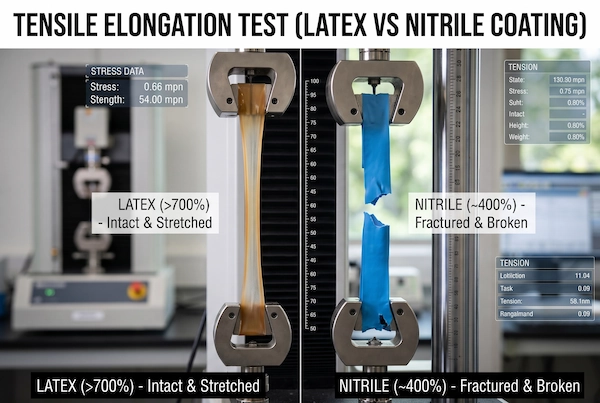
Thanks to the unique physicochemical property of “stress-induced crystallization” mentioned earlier, high-quality natural latex coatings typically achieve an astonishing tensile elongation of well over 700% in standard laboratory tensile strength tests. In real-world, rugged heavy-industry settings, this extreme elongation capability translates into exceptionally high engineering protection value. When frontline workers spread their palms wide to grip large, irregular, and rough construction stones, or when the glove surface is accidentally snagged by a protruding blunt edge on scaffolding, the natural latex layer acts like a second skin, conforming to the hand’s violent deformation and undergoing a very high degree of elastic stretching. This supple stretching process instantly absorbs and disperses destructive mechanical stress, ensuring that the coating maintains its structural integrity even after undergoing extreme dynamic deformation, thereby fundamentally preventing structural tearing and peeling of the coating.
The 400% Limit of Nitrile Coatings
In contrast, the physical tensile limits of conventional industrial synthetic nitrile coatings are relatively limited, with their elongation at break generally capped at around 400%. This is primarily due to the presence of a large number of rigid groups in their molecular chains—which provide oil resistance—significantly reducing the flexibility and deformation capacity of the entire three-dimensional polymer network. When nitrile gloves are subjected to sudden traction during heavy-duty handling scenarios, and the external force instantly exceeds the material’s yield strength, this rigid molecular network cannot relieve stress through large-scale chain segment slippage, as natural rubber can. Instead, irreversible physical fractures occur at the microscopic level, which manifest macroscopically as cracking, crazing, or even large-scale brittle delamination of the coating surface. This makes nitrile gloves extremely prone to premature failure under non-oily, heavy-load mechanical tensile conditions.
Elastic Memory and Hysteresis Loops
Operations on industrial production lines are never static; they involve workers flexing and extending their fingers and gripping objects at extremely high frequencies. Under these high-frequency dynamic cyclic stresses, the ability of the coating material to instantly return to its original shape after each deformation—without requiring excessive muscular energy from the worker during this cycle of expansion and contraction—has become the most critical mechanical indicator in ergonomics for assessing “hand fatigue.” In polymer science, this not only affects the lifespan of gloves but also concerns the actual impact of elastic memory and stress-recovery hysteresis characteristics on human physiological function.
Mitigating Hand Fatigue with High Elasticity
In specialized loading-unloading stress cycle tests, natural latex exhibits an extremely narrow stress-rebound hysteresis loop. From a physical and mechanical perspective, this indicates that the material possesses nearly perfect elastic memory.
When frontline construction workers exert force to grip bricks or heavy pipes and then instantly release their fingers, the natural latex coating can instantly recover with an extremely high rebound rate approaching 100%, without producing any residual strain. This highly efficient energy feedback mechanism means that the coating experiences virtually no energy loss due to internal friction during the stretching and rebound process. For workers who must perform tens of thousands of repetitive gripping motions every day, the smooth, resistance-free flexing and extending experience provided by natural latex can significantly reduce the biological energy expenditure of the small muscle groups in the hands and the tendons in the wrists. This fundamentally alleviates the deep hand fatigue caused by long, high-intensity shifts, truly achieving the goal of mitigating hand fatigue for frontline workers.
Risks of Permanent Deformation in Synthetic PU
In contrast, polyurethane (PU) gloves often give the illusion of being extremely thin and form-fitting when first worn. However, once they are subjected to prolonged constant-strain stress on a real industrial assembly line, the physical limitations of their molecular topology become glaringly apparent.
When the macromolecular chains in synthetic PU coatings are continuously subjected to external forces that stretch and bend them, the soft and hard segments within them are highly prone to irreversible slippage at the microscopic level. This molecular-level structural slippage directly leads to a sharp increase in the material’s hysteretic loss, causing what should be dynamic elastic deformation to gradually transform into permanent relaxation deformation (Permanent Deformation Risks). On a macroscopic level, this perfectly explains a widespread industrial phenomenon: why, after just a few shifts of use, the coatings on the palms and knuckles of many standard PU gloves purchased by workshops develop numerous irreversible creases, and why the gloves themselves become loose and saggy. This irreversible coating detachment not only severely impairs fingertip sensitivity when gripping precision components, but the sagging creases also increase the potential safety hazard of accidental entanglement in mechanical shafts or conveyor belts.
Tear Propagation Resistance (TPR) Analysis
Tear resistance plays an extremely important role in the engineering evaluation of the EU EN 388 standard for mechanical hazards. For protective coatings in heavy industry, the core focus of mechanical evaluation is often not limited to how difficult it is to initially cut through the surface physical barrier, but rather centers on a far more critical real-world scenario: once the coating sustains a microscopic tear due to extreme external forces, can the molecular network beneath the material effectively prevent the crack from propagating further and causing complete failure?
Preventing Micro-Cuts in Harsh Environments
The three-dimensional polymeric cross-linked network formed by natural latex after high-temperature vulcanization possesses a tear propagation resistance that synthetic polymers cannot match. In rugged civil engineering construction sites, when workers forcefully handle rough-surfaced rebar or heavy structural components with sharp metal edges, microscopic notches inevitably form on the palms of their gloves.
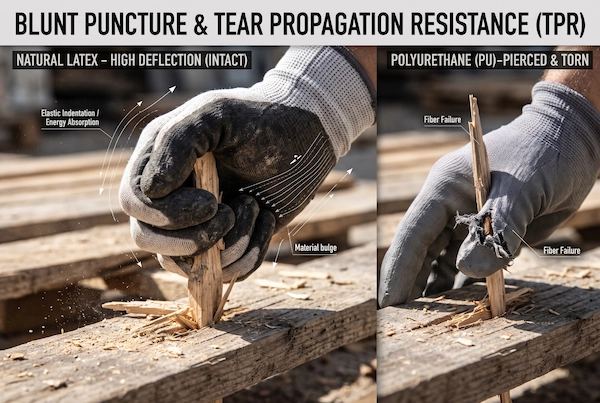
At this point, the exceptional elastic stress-conduction mechanism of natural latex plays a decisive role: when a micro-notch is subjected to sustained secondary pulling forces, the high elastic stress within the latex material rapidly disperses, unloads, and dissipates into the intact rubber network on both sides of the notch. This microscopic stress dispersion forcibly halts the continued tearing of the micro-cuts under subsequent stress (Stopping Micro-Cuts). This material-level physical blocking effect fundamentally prevents fatal accidents caused by extensive glove damage and long, dangling strips of fabric, which could lead to a worker’s hand being accidentally caught in rotating machine shafts or conveyor belts.
Blunt Puncture Deflection Mechanics
When faced with blunt puncture threats such as wooden splinters from discarded wooden pallets, wire burrs, and rough edges with sand and gravel, the physical mechanisms of puncture resistance in different polymer coatings reach a fundamental turning point.
Natural latex can fully leverage its extremely high dynamic deformation capacity to significantly absorb external puncture energy. In laboratory puncture mechanics tests, it exhibits an extremely long stress-yield curve. This unique physical damping characteristic instantly transforms external sharp vertical penetration forces into a flexible, localized indentation damping mechanism (Blunt Puncture Deflection Mechanics), forcibly dissipating the destructive force of the wooden splinter through large-scale deformation or encapsulating it on the outer surface.
In contrast, thinner polyurethane (PU) or conventional nitrile coatings, when subjected to blunt force compression and puncture of the same magnitude, cannot generate a noticeable energy-absorbing indentation effect in the stressed area due to the excessive rigidity of their molecular chains and a lack of sufficient space for deformation buffering. This physical phenomenon—where stress is highly concentrated at an extremely small contact point—results in the synthetic coating being immediately penetrated the moment it comes into contact with a sharp or blunt object, exposing frontline workers’ hands to an extremely high risk of puncture wounds and subsequent tetanus infection.
Performance Data: Natural Latex vs. Nitrile vs. PU (Table)
In supply chain safety assessments conducted by multinational corporations, subjective trial-on experiences must give way to objective, quantitative laboratory data. To provide B2B procurement directors and on-site EHS teams with an intuitive, scientific engineering benchmarking system, we have quantitatively compared the core mechanical and chemical parameters of these three mainstream polymer coatings in a cross-tabulation matrix, translating abstract molecular topologies into concrete physical test results.
Mechanical Testing Parameters
Any material comparison conducted outside a controlled environment lacks engineering value. The collection of this set of mechanical data and permeability metrics was based on a strictly standardized physical laboratory environment: the test temperature was maintained at 23°C, and relative humidity (RH) was controlled at 50%. To completely eliminate interference from physical variables caused by coating thickness, test samples were strictly selected from vulcanized/cured coating specimens of uniform thickness. This set of data focuses on evaluating the physical tensile limits of the coatings when subjected to external forces, as well as the chemical resistance to permeation and swelling of their polymer networks upon contact with typical industrial greases.
Comparative Polymer Data Matrix
The quantitative benchmark table below clearly illustrates the true performance boundaries of the three major polymers across key industrial dimensions:
| Types of Polymers | Elongation at Break | Stress Rebound Rate (Elastic Memory) | Crack Propagation Resistance (TPR) | Impact and Puncture Resistance | Industrial Oil Resistance |
| Natural Latex | > 700% (Excellent) | 95%+ (Excellent) | High (effectively inhibits crack propagation) | Excellent (High elasticity absorbs stress) | Poor (swells when exposed to strong solvents) |
| Nitrile | ~ 400% (Moderate) | 80% (Average) | Medium (cracks tend to continue propagating) | Good (Rigid physical barrier) | Excellent (resistant to gasoline and cutting fluids) |
| Polyurethane (PU) | ~ 300% (Low) | 70% (Low) | Low (prone to extensive delamination) | Poor (Thin layer is easily punctured) | Good (mild resistance to oil stains) |
This engineering data matrix reveals an undeniable truth regarding material selection: in terms of pure mechanical resistance (such as tensile strength, high-frequency rebound, tear propagation resistance, and blunt-force penetration resistance), natural latex offers an overwhelming performance advantage; Synthetic nitrile, on the other hand, achieves an absolute barrier against petroleum-based chemical solvents by sacrificing nearly half of its elastic elongation and dynamic rebound performance. Polyurethane (PU) ranks last in all key mechanical performance metrics and is primarily suited for light-duty assembly environments where mechanical protection requirements are extremely low but tactile comfort is paramount.
Non-Oily Heavy Mechanical vs. Chemical Oil Applications
Based on the aforementioned matrix of quantified polymer physical and chemical data, we can draw an extremely clear engineering conclusion: the suitability of different material coatings for addressing specific industrial hazards is defined by very distinct physical and chemical boundaries. In enterprise-level bulk procurement of personal protective equipment, the most serious mistake is a “one-size-fits-all” approach that blindly ignores the specific types of hazards present on the front lines.
The Irreplaceable Role of Latex in Construction/Masonry
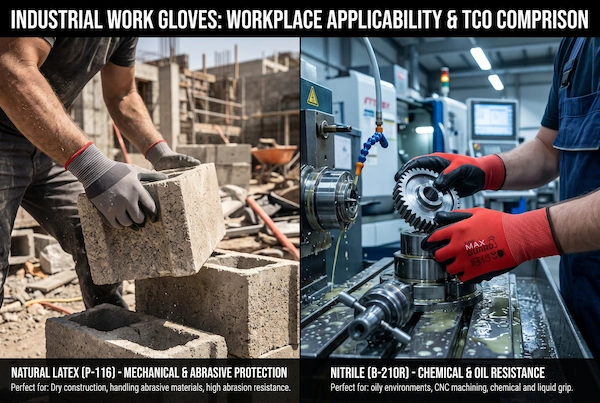
At the vast majority of outdoor civil engineering and construction sites, rough masonry work sites, heavy log-handling operations, and high-altitude scaffolding erection sites, the work environment typically involves extremely high levels of mechanical friction, compression, and blunt puncture hazards, but does not involve severe penetration by industrial chemical oils or greases. In these heavy-duty yet non-oily environments characterized purely by mechanical stress, natural latex demonstrates its irreplaceable engineering dominance.
Thanks to its extreme stretch-wrap feel—as validated earlier—its excellent resistance to crack propagation when subjected to minor cuts, and its unique dynamic damping and shock-absorbing properties, natural rubber coatings establish a flexible yet extremely resilient physical buffer barrier for workers’ hands when heavy objects are suddenly dropped or when violent mechanical friction occurs. In these demanding work environments, where grip strength and mechanical protection are critical, it is the unparalleled choice for safeguarding frontline heavy-industry crews from severe mechanical abrasion and tissue contusions.
When to Choose Nitrile or PU
However, the key to industrial safety protection lies in “treating the problem at its root.” If the work site is a CNC machining shop, an automotive engine component stamping and assembly line, or an enclosed work environment filled with high concentrations of cutting fluid and heavy-duty grease, natural latex is highly susceptible to severe volume swelling and molecular chain breakdown when exposed to strong petroleum-based solvents. In such cases, procurement specifications must unconditionally switch to synthetic nitrile coatings with rigid molecular chains, leveraging their exceptional chemical inertness to create an absolute barrier against oil penetration.
On the other hand, if the workstation involves the sorting of precision electronic components or the assembly of optical lenses in a cleanroom—where there is virtually no risk of severe mechanical abrasion and the demand for fine tactile sensitivity on bare fingertips is at its peak—then selecting extremely thin and transparent polyurethane (PU) gloves is the most cost-effective and reasonable decision. For detailed microscopic differences between these two synthetic polymer coatings in terms of oil resistance and precision handling scenarios, we recommend that supply chain engineering teams refer to our published authoritative comparison guide: Nitrile vs. Polyurethane (PU) Gloves Comparison.
Ergonomics and Microfiber Integration: The P-116 Model
No matter how exceptional a polymer coating may be, it cannot provide both physical protection and wearing comfort during real-world, long-term industrial operations without a high-quality textile framework. Pure polymer material engineering must be deeply integrated with advanced textile weaving technologies to thoroughly address the challenges of hand microclimate regulation and dynamic flexibility in complex working conditions. In this regard, the P-116 is undoubtedly a benchmark masterpiece from the source factory in the integration of material synergy engineering and ergonomics.
Synergizing 15-Gauge Microfiber with Sandy Latex
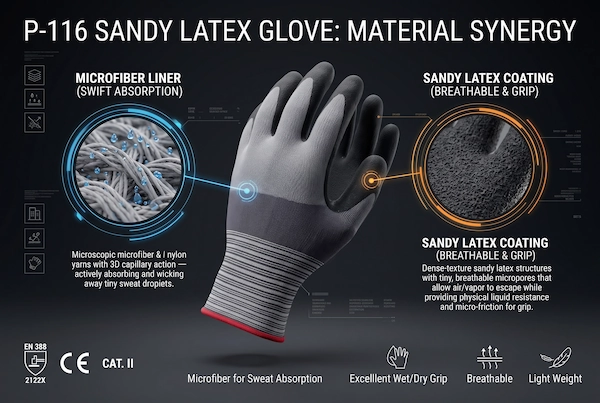
Modern logistics operations and light assembly workplaces place extremely high demands on the tactile feedback of work gloves. The P-116 innovatively achieves a perfect physical bond between a high-density, 15-gauge seamless microfiber/nylon blend liner and a fine-grit microporous latex (Sandy Latex) coating.
This ultra-fine microfiber material provides the glove with an extremely lightweight skeletal structure. Even when handling tiny parts or operating machine panels, workers are completely free from the bulkiness of traditional gloves and maintain exceptional dexterity. At the same time, the Sandy Latex coating on the palm utilizes the sponge-like microporous structure formed on its surface to provide excellent grip in both dry and wet environments. It is precisely this synergy between the textile framework and the polymer coating—combining rigidity and flexibility—that enables the extremely lightweight and form-fitting P-116 to easily meet the stringent EU EN388:2122X (CAT. II) basic mechanical protection certification. While protecting hands from minor cuts and abrasions, it maximizes operational efficiency.
Breathability and Sweat Management
Addressing the industry challenge of excessive hand perspiration during long day shifts—which causes the hands to slip inside the gloves and can even lead to contact dermatitis—the P-116 offers a targeted solution for regulating the hand’s microclimate.
Compared to traditional coarse-weave polyester or low-count cotton yarns, the high-performance microfiber lining used in the P-116 significantly increases the capillary surface area of the yarn, resulting in exponentially improved capillary sweat absorption (Microfiber for better sweat absorption). Combined with a precise palm-dipping process, the back of the hand features a completely exposed, adhesive-free fabric mesh, enabling the glove to deliver exceptional breathability and heat dissipation (Breathable). Even more ingeniously, the palm and fingertips—which are fully coated with fine-grit latex—retain reliable physical water resistance (Water resistance), effectively blocking the penetration of light mud, water, and dirt during handling operations. This composite structure, which balances moisture absorption and sweat wicking on the back of the hand with waterproofing and protection against penetration on the palm, makes it an ideal bulk-purchase solution for diverse work environments such as forklift logistics, lawn and garden maintenance, warehouse packaging and sorting, and general light-duty construction.
Strategic B2B Sourcing: Matching Polymers to Hazards
When multinational corporations’ supply chain and on-site EHS departments conduct annual centralized procurement tenders for personal protective equipment (PPE), they must not limit themselves to superficial comparisons of glove appearance and unit price. To eliminate protective failures and high hidden costs at the source, procurement decision-making teams must move beyond empirical approaches and mandatorily incorporate the intrinsic properties and physical topological structures of polymer materials into the technical specifications of procurement bids.
Assessing Site TCO (Total Cost of Ownership)
The true financial black hole in occupational safety consumables often lies hidden in abnormal scrapping caused by incorrect technical selection. In real industrial settings, if nitrile gloves—intended for oil resistance—are improperly issued to outdoor work crews handling rough masonry, their relatively low elongation at break and tear resistance will cause the gloves to quickly wear thin and develop holes after just a few hours of high-intensity abrasion; Conversely, if highly elastic natural latex gloves are mistakenly issued to a heavy-oil workshop filled with industrial cutting fluids, the latex’s polymer network will rapidly swell upon contact with strong solvents, completely losing its physical barrier function and rendering the gloves unusable.
Therefore, modern supply chains must accurately assess the core hazard sources at the worksite—whether they involve purely heavy mechanical friction or chemical contamination from oil—in order to match workers with coated polymers that possess the correct molecular topology. This scientific, targeted approach—based on material mechanics data—can completely eliminate rapid wear caused by abnormal delamination, brittle fracture, or swelling, thereby significantly reducing the total cost of ownership (TCO) resulting from incorrect product selection by more than 30%.
Standardizing Glove Portfolios
To achieve a closed-loop system of centralized procurement that reduces costs and improves efficiency at the group level, large enterprises should proactively partner with source manufacturers that possess strong R&D capabilities to establish highly segmented standard procurement catalogs (Glove Portfolios) for polymer gloves.
In the actual implementation of this initiative, the procurement catalog should maximize overall protective efficiency through strict adherence to the “dedicated funds for dedicated purposes” principle: For example, lightweight, fine-grit latex gloves—such as the P-116, which feature a microfiber lining—should be specifically allocated to teams handling indoor warehousing and logistics, product packaging and sorting, and tasks requiring fine motor skills, to ensure optimal flexibility and breathability for sweat wicking during long day shifts; For teams handling heavy construction materials, working in quarries, or erecting scaffolding, thick, puncture-resistant crinkle-textured latex gloves should be mandated as standard equipment; meanwhile, nitrile-coated gloves should be strictly restricted to positions involving oil-based machinery maintenance and CNC metal machining operations. Through this precise, matrix-style management of supply categories, multinational corporations can completely move away from traditional, haphazard models of personal protective equipment distribution.
Frequently Asked Questions (FAQ)
Why not just use nitrile for everything?
Many purchasing managers have a misconception: Since synthetic nitrile offers excellent oil resistance, why not simply adopt it across all work processes? In fact, the rigidity of nitrile’s molecular chains means its elongation at break and dynamic elasticity are far inferior to those of natural latex. In heavy-duty grinding environments where chemical oils are not present at all (such as open-air civil engineering or masonry work), workers need to flex and extend their fingers frequently. If nitrile gloves are blindly adopted under such conditions, the material’s inherent stiffness will significantly increase work-related fatigue in the hand muscles. Even more critical is that nitrile has a weak resistance to crack propagation. Once a microscopic notch is scored by a sharp object on the rough surface of rebar, the crack can easily spread rapidly in all directions under subsequent tensile stress, rendering the glove instantly and completely unusable.
Does PU offer better dexterity than latex?
In traditional industrial perceptions, early smooth-finish natural latex coatings were indeed relatively thick and heavy, which long gave polyurethane (PU) an advantage in terms of thinness and bare-hand feel. However, modern polymer impregnation processes have long since broken down this barrier. Advanced gloves, such as the P-116, incorporate a 15-gauge lightweight liner and a “Sandy Latex” composite process featuring fine-grained, microporous latex. This not only achieves an ultra-thin coating but also provides the palm with microscopic shock absorption and wet-grip traction—features that PU simply cannot match—all while maintaining exceptional dexterity.
How does microfiber improve the P-116?
Conventional low-count polyester or standard nylon linings have very limited moisture-wicking capabilities during prolonged, high-intensity work, and the accumulation of hand sweat can easily cause the gloves to become slippery and uncontrollable. The P-116 innovatively incorporates ultra-fine microfiber material, which significantly increases the capillary surface area of the yarn through its physical weave structure. This microstructural upgrade enables the material to rapidly absorb sweat secreted from the palms and wick it away to the outer layer (Microfiber for better sweat absorption), completely resolving the long-standing industry pain point of stuffy, sticky, and slippery conditions inside latex gloves in high-temperature workshops or high-intensity logistics environments.
Can latex alone withstand sharp glass edges?
Absolutely not. Supply chain EHS teams must clearly define the protective limits of the material: While the polymer network of natural latex is strong against blunt impact and puncture and offers high damping, cushioning, and energy absorption, it does not inherently possess the physical properties to resist cuts from sharp blades. If industrial operations involve handling extremely sharp curtain wall glass edges or performing stamping and cutting operations on sharp metal sheets, a latex coating alone cannot prevent physical cuts. When faced with such extremely high-risk mechanical cutting hazards, the latex coating must be laminated with a specialized cut-resistant liner—such as HPPE (ultra-high-molecular-weight polyethylene) or Kevlar (aramid fiber)—to establish an absolute safety barrier using ultra-high-strength cut-resistant yarns in the base layer. In this case, the latex layer serves only as an auxiliary measure to prevent slippage and cushion pressure.

