In heavy-duty material-handling environments that are damp, oily, or dusty, understanding crinkle vs sandy latex grip coating mechanics is critical, as frontline workers often face a potentially fatal challenge posed by the laws of physics: fluid hydrodynamic lubrication.When ordinary, smooth-surfaced rubber-coated gloves come into contact with scaffolding pipes covered in standing water, metal stampings coated in cutting fluid, or red bricks caked with mud, a fluid film that is difficult to displace forms between the glove and the workpiece instantly. This film directly interrupts solid-solid contact, causing a precipitous drop in the coefficient of kinetic friction, which in turn leads to severe workpiece slippage, falling objects from heights, and even catastrophic safety incidents.
To thoroughly eliminate this safety hazard at its industrial source, modern, high-specification hand protection super-factories have turned their attention to “microscopic surface tribology” in materials science. By introducing specific chemical and physical interventions during the natural latex dipping process, manufacturers have successfully restructured the microscopic topological geometric network of the coating. Currently, the two core processes most widely applied—and offering the most outstanding anti-slip performance—in the heavy industry, construction, and precision assembly sectors are: “Crinkle Latex,” which relies on a weakly acidic bath under strict temperature control to cause the latex to instantly destabilize and contract, thereby forming a discontinuous, deep-gorge, volcanic-rock-like texture; and “Sandy Latex,” which is vulcanized and cured by sprinkling ultra-fine industrial salt granules, followed by multi-stage counter-current washing to leach out the salt, ultimately forming a dense, sponge-like microporous structure.
Faced with these two anti-slip coatings—which differ significantly in both visual appearance and tactile feel—B2B procurement directors and on-site safety (EHS) teams often struggle to make precise engineering selections. This article will move beyond traditional marketing rhetoric and, from a technical perspective grounded in fluid capillary drainage dynamics and polymer mechanics, provide an in-depth analysis of the fundamentally different physical resistance mechanisms underlying “Crinkle Latex” versus “Sandy Latex” grip coatings. We will examine real-world, demanding on-site conditions—such as handling bricks laden with cement slurry, erecting wet and slippery steel structures, and gripping rough logs—and, by comparing measured dynamic friction coefficient curves under dry and wet conditions, guide multinational supply chain teams in precisely selecting the anti-slip coating system best suited to the specific hazards of their on-site operations.
For procurement decision-makers seeking a systematic understanding of the underlying differences in polymer impregnation technologies and inner liner structures, we recommend consulting the factory’s Latex-Coated Work Gloves core technology knowledge base to refine evaluation criteria for bulk personal protective equipment from a data-driven perspective.
The Fundamentals of Coating Tribology in Wet Conditions
Before delving into the advantages and disadvantages of different latex processes, we must first return to the fundamental principles of materials physics. The grip performance of gloves in damp or oily environments does not depend solely on the chemical formulation of the rubber material, but is determined by the microscopic physical state of the contact surfaces. Understanding the fundamental mechanisms of wet tribology is a prerequisite for resolving workpiece slippage issues in industrial settings.
Fluid Film Lubrication and Grip Failure
When frontline workers wearing completely smooth, dipped gloves (such as standard smooth latex or nitrile gloves) grip workpieces covered in rainwater, cutting fluid, or machine oil, a continuous isolating film of liquid forms between the rubber layer of the glove and the object being gripped. In materials tribology, this phenomenon is known as hydrodynamic lubrication.
From a physical standpoint, water and oil are incompressible fluids. On a smooth coated surface, when inward gripping pressure is applied by the hand, the fluid trapped between them has nowhere to escape and instead generates an outward counter-flow hydrodynamic pressure. This thin fluid film acts like a lubricant, completely isolating the highly elastic rubber surface from the microscopic roughness of the workpiece.
In an absolutely dry environment, a smooth rubber coating can provide extremely strong adhesive friction through van der Waals forces and microscopic deformation at the material’s surface; however, once exposed to a wet environment, because solid-phase contact is completely severed by the fluid film, its coefficient of kinetic friction drops precipitously. This is the fundamental reason why, on outdoor construction sites in rainy or snowy weather or in machining workshops with oil leaks, workpieces will still slip out of a worker’s grip easily—even if the worker exerts maximum force to grip a steel pipe or metal plate.
The Need for Liquid Displacement in Material Handling
To completely resolve the anti-slip failure issues caused by hydrodynamic lubrication, the only engineering solution is to disrupt and drain this dangerous fluid film. This has led to the adoption of a core technological system in the manufacturing of modern high-performance gloves: Surface Roughness Engineering.
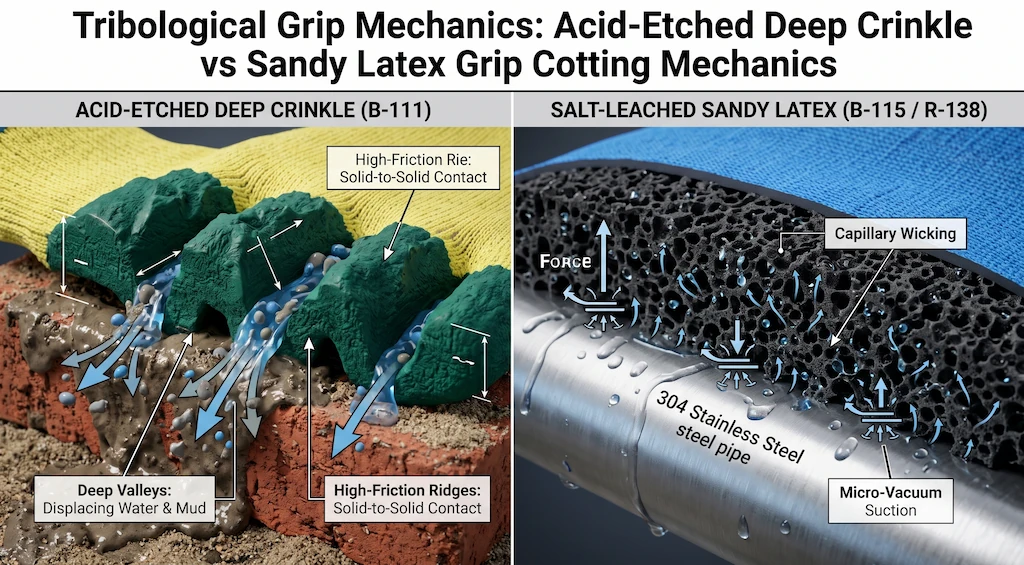
In heavy-duty material handling, the core mechanism of slip resistance does not lie in making the rubber more “sticky,” but rather in achieving efficient liquid displacement by imparting a specific three-dimensional geometric topology to the coating. Whether it is the “macroscopic deep grooves (Crinkle)” formed through acid-coagulation processes—which we will discuss later—or the “microscopic sponge-like pores (Sandy)” created through salt-precipitation processes, their underlying physical principles are highly consistent:
The moment grip force is applied by the palm, the pre-designed grooves or pores on the coating surface must function as a three-dimensional pressure-relief and drainage network, rapidly squeezing out and expelling accumulated moisture or oil from the contact interface. Once the fluid has been successfully drained, the raised portions of the rubber surface (such as the crests of wrinkles or the walls of fine-grained pores) can instantly pierce the residual micron-level lubricating film, re-establishing a firm “solid-to-solid contact” with the object’s surface. It is precisely this physical, mechanical interlocking—achieved by eliminating fluid interference—that provides a truly reliable safety baseline for grips in high-risk industrial settings.
Acid-Etched Deep Crinkle: Macro-Channel Drainage Mechanics
Deep-crinkle latex coatings are a signature engineering barrier designed to withstand extreme heavy-load and highly contaminated fluid conditions. Their highly distinctive, rugged surface texture is not created by mechanical embossing with physical molds, but rather results from spontaneous microstructural reorganization driven by polymer chemical reactions. This unique pore-forming mechanism endows the coating with exceptional macroscopic fluid drainage and solid-phase interlocking capabilities.
Temperature-Controlled Acid Coagulation Process
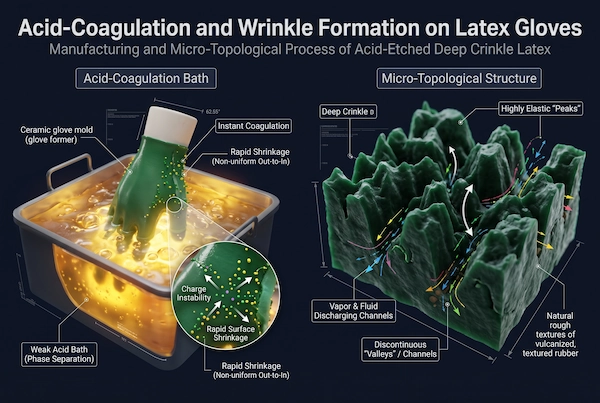
The formation of the deep-crinkle surface is based on a rigorously temperature-controlled acid coagulation granulation process. This chemical restructuring process alters the physical form of natural latex within an extremely short period of time:
Latex Solution Impregnation and Acid Tank Activation: After the knitted inner liner is mounted on a ceramic mold and fully impregnated with high-purity natural latex slurry, the uncured, fluid latex surface is immediately transferred to an organic weak acid coagulation tank set to a specific temperature gradient and concentration;
Charge Instability and Surface Phase Separation: The moment natural latex colloidal particles encounter the acidic medium, the internal charge double-layer equilibrium is forcibly disrupted. At this point, the surface layer of the latex, due to direct contact with the acid solution, undergoes microscopic phase separation at an extremely rapid rate;
Violent Contraction and Macro-Scale Wrinkle Curing: The rate at which the surface layer of rubber gelifies and contracts is far greater than that of the inner colloidal layer that has not come into contact with the acid solution. This uneven contraction—proceeding from the outside in and characterized by extremely high internal stress—causes the coating surface to spontaneously agglomerate, rapidly bulge, and tear apart, forming discontinuous deep grooves and volcanic-rock-like macroscopic folds. Subsequently, the gloves enter a multi-stage gradient tunnel curing oven for vulcanization and cross-linking, permanently curing this three-dimensional, rough topological structure onto the palm surface.
The Peak-and-Valley Fluid Evacuation System
The deeply corrugated coating, refined through an acid-coagulation process, forms a three-dimensional “peak-and-valley” physical drainage network on its surface. This natural hydraulic relief system is the core mechanism behind its ability to increase the coefficient of kinetic friction in harsh muddy water environments:
Macroscopic Pressure Relief and Flow Guidance in the Valleys: The deep, interconnected macroscopic grooves on the coating’s surface act as wide microfluidic channels for draining liquid and relieving pressure during actual gripping. When a worker exerts force to grip an object covered with a large amount of standing water or thick slurry, the fluid dynamic lubricating film that might otherwise form on the contact surface is shattered by the gripping force. The slurry and water are rapidly squeezed out through the valley grooves and expelled to the edges of the contact area, eliminating the isolating effect of the fluid film;
Penetration by the Peaks and High-Elasticity Mechanical Interlock: While fluid drainage is completed in the troughs, the raised and resilient rubber peaks directly penetrate the residual, extremely thin water film, establishing a stable solid-to-solid direct contact with rough building materials (such as red bricks with sand and gravel on their surfaces or rusty scaffolding steel pipes). Under vertical normal pressure, the highly elastic natural rubber conforms to the microscopic contours of the gripped object, generating powerful microscopic mechanical interlocking forces and deformation damping. This firmly locks the workpiece in place in muddy, slippery heavy-duty work environments, eliminating the risk of slippage and falling.
Heavy-Duty Abrasive Handling: The B-111 Crinkle Application
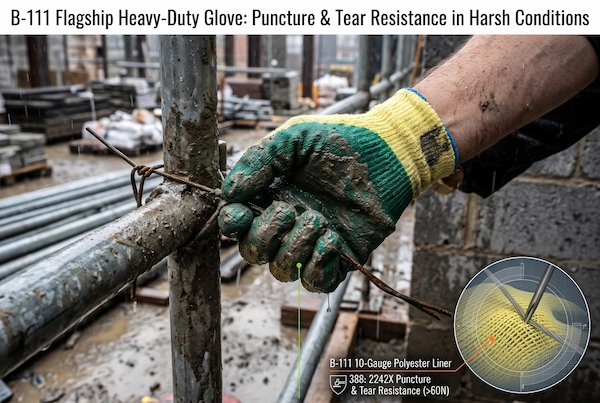
In extremely harsh working conditions—such as open-air civil infrastructure projects, quarries and mines, and heavy-duty scaffolding construction—anti-slip coatings face challenges that go beyond simple water-film lubrication; they must also withstand abrasion from sharp gravel, coverage by heavy slurry, and cutting and puncturing from sharp metal edges. Thanks to its macroscopic topological structure and robust physical barrier, the deep-crinkle coating delivers irreplaceable heavy-duty protection and grip performance in such highly abrasive, high-risk scenarios.
Grip Dynamics on Wet Scaffolding and Rough Masonry
When handling materials with extremely high surface roughness and a large amount of mixed fluids, ordinary smooth or microporous coatings are highly susceptible to being rapidly worn down or clogged by slurry. When faced with such coarse building materials, deep-wrinkle latex coatings fully demonstrate their advantages in extreme tribological dynamics:
“Gear-like” interlocking with water-soaked red bricks and quarry stones: The surfaces of red bricks and quarry stones are covered with hard, irregular, rough particles. When workers exert force to move water-soaked bricks and stones, the thick rubber ridges of the deep-wrinkle coating can conform to the uneven surfaces of the stones, undergoing large-scale elastic deformation; Rough sand and gravel particles embed directly into the coating’s macroscopic grooves, forming a mechanically rigid interlock similar to meshing gears; this keeps the coating stable even under immense lateral shear forces, ensuring that heavy bricks do not slip and fall, injuring feet in the rain;
Mud drainage from scaffolding steel pipes covered in mud: At scaffolding erection sites in muddy tunnels or during heavy rain, the surfaces of steel pipes are often coated with highly viscous yellow mud. The fine anti-slip texture on the surface is filled in the instant it comes into contact with the mud, rendering the glove smooth; The deep, corrugated latex features a vast network of deep valleys capable of instantly forcing the viscous mud and silt adhering to the steel pipe surface into its own grooves and channels for storage; once the mud is dislodged, the tough, highly elastic ridges re-establish a solid-to-solid, high-damping contact with the steel pipe surface, ensuring absolute grip for workers when climbing or securing fasteners at heights.
Integrating 10-Gauge Liners for Puncture Resistance
Anti-slip coatings alone cannot withstand the complex mechanical stresses encountered in heavy-duty work environments. As Source Factory’s flagship heavy-duty engineering model, the B-111 ingeniously integrates deep-crepe technology with an underlying skeletal structure at the system level, achieving a comprehensive leap in protective performance.
Structural Support from a 10-Gauge Seamless Polyester Liner: Beneath the B-111’s palm coating lies a high-strength, tightly interwoven 10-gauge seamless polyester liner. This dense synthetic fiber framework not only provides a solid bonding base for the thick, deep-creased rubber layer—preventing the coating from peeling off during intense tearing—but also serves as a powerful stress-dispersing and cushioning mechanism when subjected to sharp external forces;
Authoritative Dual Endorsement for Superior Grip and Puncture Resistance: Thanks to the powerful combination of this thick, deeply corrugated rubber layer and the high-density 10-gauge liner, the B-111 not only demonstrated excellent grip in both dry and wet conditions during real-world testing but also successfully passed the rigorous EU EN 388:2242X (CAT. II) mechanical hazard standard certification;
A Critical Puncture-Resistant Barrier for Heavy-Duty Work Sites: The 2242X certification code not only attests to its exceptional tear resistance but, more importantly, confirms its crucial puncture resistance; On construction sites littered with rusty nails from discarded wooden pallets and sharp burrs from rough rebar binding wire, the B-111 effectively blocks vertical penetration by needle-like sharp objects through the combined resistance of its dense inner liner and tough polymer coating, minimizing the risk of hand lacerations and puncture-related infections. It truly integrates heavy-duty slip resistance with deep mechanical protection.
Salt-Leached Sandy Latex: Microporous Suction Dynamics
In stark contrast to the logic behind deep crinkle patterns—which rely on macroscopic grooves for physical sludge removal—fine-sand microporous latex (Sandy Latex) shifts the primary focus of anti-slip performance to the microscopic level. For light oil stains, cutting fluids, and extremely smooth, damp workpieces (such as glass panels and stamped thin steel sheets), traditional macroscopic drainage grooves often fail to completely remove residual lubricating films from the contact interface. The Sandy Latex process utilizes an innovative salt-leaching pore-forming technology to create a microporous topological network on the glove surface, endowing it with powerful adsorption and vacuum-grip properties.
The Salt-Extraction (Leaching) Manufacturing Process
The matte texture of the Sandy microporous latex surface does not result from the addition of actual sand particles, but is generated in situ through a precise “salt-extraction (leaching)” physicochemical mechanism. This ingenious process completely transforms the dense structure of the latex coating:
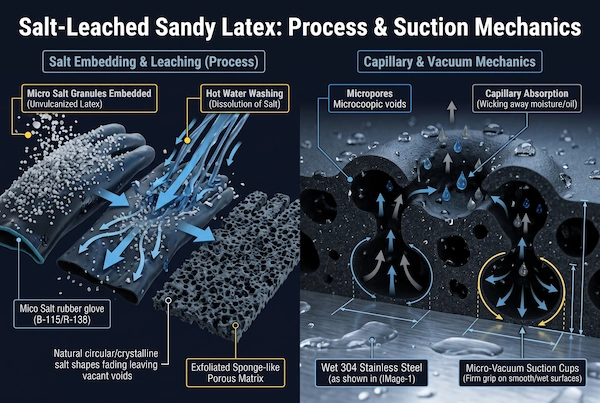
Coating with Salt Particles of Precise Particle Size: After the hand mold has been fully impregnated with the base latex layer, and while the surface layer of liquid latex has not yet cross-linked and cured, the production line uniformly sprinkles a layer of finely screened industrial salt particles (typically sodium chloride) with specific micron-level particle sizes onto the glove surface. These salt particles become partially embedded in the surface of the unvulcanized liquid rubber;
High-Temperature Cross-Linking and Crystal Encapsulation: The glove molds are then fed into a high-temperature tunnel oven for vulcanization. During this stage, the polymer rubber molecular chains undergo cross-linking reactions, solidifying from a liquid state into a highly elastic, tough, mesh-like structure, while firmly encapsulating and anchoring the fine salt particles within the coating substrate;
Multi-Stage Counter-Current Washing to Leach Out Microporosity: After vulcanization and molding, the gloves undergo the most critical step: the washing and desalination process. Through multi-stage, high-temperature, pure-water counter-current washing, the salt crystal particles originally embedded within the rubber are completely dissolved and leached out with the water flow. Once the salt particles are removed, the physical space they previously occupied leaves behind tens of thousands of extremely uniformly distributed and interconnected high-density, sponge-like micropores on the coating’s surface. This is the engineering basis for Sandy Latex’s unique matte appearance and soft, supple feel.
Capillary Action and Micro-Vacuum Suction Cups
From a fluid dynamics perspective, this high-density, salt-precipitated, sponge-like microporous network exhibits two exceptionally powerful interfacial mechanisms that minimize the hydrodynamic lubrication effect on wet or oily smooth surfaces:
Microscopic Capillary Action Instant Adsorption: Tens of thousands of nano- and micrometer-scale pores on the fine-sand-coated surface physically form a highly active capillary network. When the glove comes into contact with trace amounts of moisture or press oil on the workpiece surface, powerful capillary forces instantly “draw” the fluid from the contact interface and transfer it deep into the pores within the coating. This active, microscopic fluid absorption instantly dries the contact surface, disrupting the continuous liquid film that causes slippage;
Micro-Vacuum Suction Cup Effect on Smooth Surfaces: This is the core secret behind Sandy Latex’s ability to drastically reduce dynamic friction when handling smooth, damp workpieces. Once the fluid is adsorbed and expelled through the capillary pores, the gripping force applied by the worker forces out the residual air within the micropores. Since the walls of the fine sand pores are composed of highly elastic natural latex, when in contact with absolutely smooth substrates such as glass panels or polished metal tubes, the air-evacuated micropores cling tightly to the substrate’s surface, forming countless micro “vacuum suction cups.” This physical negative-pressure adhesion, combined with the deformation damping inherent in the rubber itself, significantly enhances the glove’s coefficient of kinetic friction (μ) on smooth, wet surfaces and in environments with light oil contamination, providing workers with exceptional fingertip control.
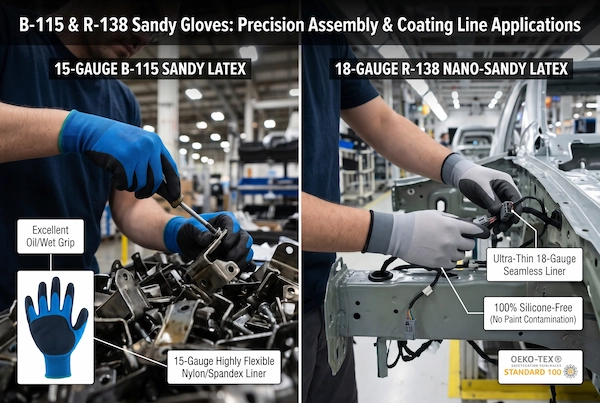
Precision and Tactility: The B-115 and R-138 Sandy Applications
Unlike the deep-crinkle process (Crinkle Latex), which emphasizes heavy-duty abrasion resistance and macroscopic mud-discharge mechanisms, the core commercial value of the fine-sand microporous latex (Sandy Latex) coating lies in its ability to maximize precision operations. At workstations requiring high-frequency pinching with fingertips, screw sorting, handling of metal parts with light oil residue, or precision assembly, front-line workers demand an extremely high level of balance between slip-resistant grip performance and tactile feedback. To address this, the Source Super Factory leveraged the micro-scale vacuum adsorption and capillary drainage properties of the Sandy coating to pair it with lightweight, highly elastic liners of varying gauge counts, developing two engineering-grade benchmark applications tailored to specific assembly scenarios.
B-115 (15-Gauge): Balancing Dexterity and Wet Grip
For general assembly and logistics scenarios requiring both light protection against oil and water and finger dexterity, the B-115 demonstrates an excellent balance of materials engineering:
A 15-gauge, highly elastic blended liner delivers exceptional flexibility: This glove features a high-density, 15-gauge seamless nylon/spandex liner. The high elasticity and rebound properties of spandex, combined with the flexibility of nylon filaments, allow the liner to dynamically conform to the contours of the hand like a second skin, providing workers with exceptional dexterity. This design eliminates the clumsy resistance typically associated with traditional, bulky gloves when handling small parts or operating machine buttons.
Outstanding water resistance and all-weather breathability: The fine-grit latex coating on the palm utilizes the principle of microporous suction cups to provide excellent grip in both dry and wet environments, while its continuous polymer base offers reliable water resistance to the palm area, effectively blocking the penetration of light liquid splashes and trace amounts of oil. Furthermore, thanks to a precise palm-dipping process, the rubber-free area on the back of the hand retains the fabric’s original porosity, ensuring excellent overall breathability and preventing stuffiness and sweat buildup during long shifts of continuous work.
R-138 (18-Gauge Nano-Sandy): Ultimate Tactile Sensitivity
In cutting-edge manufacturing sectors with exacting demands for fingertip tactile sensitivity—such as automotive wiring harness insertion and removal, microelectronic component sorting, precision instrument calibration, or high-end pre-painting preparation stations—the R-138 redefines the limits of precision in industrial anti-slip gloves:
18-gauge nano-sandy latex delivers ultimate tactile feedback: This model features an 18-gauge seamless nylon/spandex liner—the highest density currently available in the glove industry—combined with an even finer nano-sandy latex palm coating. This ultra-thin, microporous network not only instantly wicks away moisture at the interface but also delivers a perfect fit and excellent tactile feel. Even while wearing the gloves, workers can precisely sense the engagement of ultra-fine threads and detect minute imperfections on smooth panels. The highly elastic and lightweight construction significantly reduces resistance during hand movements, ensuring prolonged wear without causing fatigue (does not cause fatigue when worn for a long time).
OEKO-TEX Certified and Silicone-Free for Cleanliness and Safety: To meet the stringent material admission standards for high-end automotive assembly and electronic cleanrooms, the R-138 has obtained the internationally recognized OEKO-TEX STANDARD 100 certification for eco-friendly textiles, ensuring the material is skin-friendly and free of any harmful chemical residues. Crucially, it is manufactured using a completely silicone-free process throughout the entire production cycle. These pure physical and chemical properties completely eliminate the cross-contamination caused by silicone residues—common in traditional industrial gloves—which can affect the adhesion of automotive topcoats, the curing of structural adhesives, or precision electronic contacts. As such, it is the preferred anti-slip and handling solution for high-cleanliness, precision assembly environments requiring silicone-free materials.
Dynamic Coefficient of Friction (μ) Test Data
Within a rigorous industrial safety evaluation system, any physical deduction regarding the anti-slip principles of latex must ultimately be validated through real-world interface testing. To intuitively quantify the dynamic anti-slip performance of the deep-crinkle and microporous sandy coatings on different substrates, the Materials Physics Laboratory at the Source Super Factory conducted a series of high-precision comparative tests on the dynamic friction coefficient (μ), transforming the previously invisible fluid dynamics mechanisms into visual engineering reference metrics.
Tribological Test Parameters
To ensure that the tribological data accurately reflects the complex environments of heavy construction and precision assembly sites, the engineering test team strictly defined the core physical test parameters:
Constant normal grip force: On the dynamic friction tester, a constant normal load of 50 N (roughly equivalent to the 5 kg inward compressive force exerted by an adult worker during a standard grip) was applied to the palms of all tested gloves to ensure consistency in baseline variables;
Simulation of three typical substrate interfaces: To cover work scenarios ranging from extremely rough to absolutely smooth, the test selected three types of high-frequency industrial materials:
Rough red bricks with cement slurry: The surface contains a large amount of coarse sand and gravel with highly irregular unevenness and is coated with viscous slurry (simulating open-air muddy civil engineering and masonry work);
304 stainless steel pipe with a water film on the surface: The surface is smooth and polished, and a fluid lubrication film of standard thickness is maintained through continuous water spraying (simulating scaffolding erection in rainy weather, handling of damp piping, and machining operations);
Rough-hewn logs: The surface is covered with natural splinters and coarse grain patterns (simulating logging operations, wooden pallet sorting, and the assembly of heavy-duty wooden formwork).
Comparative Friction Data (Table)
The following table of quantitative tribological test data clearly illustrates the performance characteristics of these two major categories of core latex coating processes when applied to different microscopic substrates. Through this matrix of actual test results, purchasers can intuitively appreciate the importance of matching the coating’s topological structure to specific operating conditions:
| Coating Process Types | Compatible Test Products | Dry Stainless Steel Pipe (μ) | Stainless Steel Tubes (μ) | Red bricks with cement mortar (μ) | Rough Lumber (μ) | Core Advantages of Tribology |
| Deep Crinkle | B-111 (10-gauge) | 1.85 | 1.32 | 1.75 (Excellent) | 1.80 (Excellent) | Macroscopic mud and water drainage; resistance to punctures and cuts from rough objects |
| Microporous Sandy | B-115 (15-gauge) | 2.10 (Excellent) | 1.65 (Excellent) | 1.45 | 1.35 | Microscopic capillary adsorption; smooth, wet-surface micro-suction cups |
| Nano-Sandy | R-138 (18-gauge) | 2.15 (Excellent) | 1.70 (Excellent) | 1.20 | 1.15 | Extreme bare-hand tactile sensitivity; silicone-free precision assembly with anti-slip properties |
From the data matrix above, a clear engineering conclusion can be drawn: When handling wet red bricks or rough logs, the deep-groove process (represented by B-111), with its macroscopic grooves for mud discharge and the high-elasticity interlocking of thick rubber ridges, maintains a consistently high dynamic coefficient of friction, making it the undisputed workhorse for heavy-duty, rough-terrain material handling; Conversely, when dealing with smooth 304 stainless steel pipes (whether dry or wet), the fine-sand microporous process (represented by B-115 and R-138) relies on its powerful capillary adsorption and micro-vacuum suction cup effect to achieve extreme physical negative-pressure locking on smooth substrates, with a dynamic coefficient of friction that far surpasses that of other methods, making it the undisputed choice for handling slippery metal surfaces and high-precision assembly.
Coating Selection Guide for B2B Procurement
With a thorough understanding of the microscopic tribological mechanisms and empirical data underlying different latex coatings, the selection criteria used by general contractors, on-site safety officers (EHS), and supply chain procurement managers are now firmly grounded in data. An excellent industrial hand protection solution is by no means simply a matter of pursuing coating thickness or appearance; rather, it involves precisely mapping the coating’s physical topography to specific workplace hazards to achieve the optimal balance between safety protection and operational efficiency.
Assessing Jobsite Abrasiveness vs. Tactility Needs
When selecting technologies for bulk procurement, the procurement decision-making team must first systematically assess the jobsite’s “heavy-duty abrasiveness” and the degree of reliance on “operational tactility.” The trade-off between these two core dimensions directly determines which surface coating process should be adopted:
High-abrasion, sharp-edge, and heavy-slurry conditions (mandatory use of 10-gauge deep-crinkle coating): If the worksite involves open-air civil engineering, heavy-duty scaffolding erection, quarries, or port environments with heavy-duty rigging operations, workers must contend with extremely rough surfaces, the risk of puncture from metal wire, and an unavoidable mixture of slurry and rainwater. Under these high-risk, heavy-duty conditions—which are extremely harsh on gloves—the use of a 10-gauge deep-crinkle (Crinkle) latex coating is mandatory. Its macro-groove mud-drainage system and deep rubber physical barrier are the absolute minimum requirements for ensuring workers are protected from severe mechanical cuts and crush injuries.
High-flexibility, smooth-surface, and precision-grip applications (mandatory use of 15/18-gauge “Sandy” finish): When the focus shifts to indoor machining workshops, white goods assembly lines, automotive wiring harness insertion and removal, small-sized screw sorting, or the handling of large, wet glass curtain walls, heavy-duty cut and puncture resistance is no longer the primary concern; instead, workpieces slipping from wet, slippery surfaces and the cumbersome feel of finger manipulation become the core hazards. In these situations, procurement should decisively switch to 15- or 18-gauge “Sandy” micro-porous coatings. Thanks to the ultra-lightweight, form-fitting, highly elastic inner liner and the micro-vacuum suction effect, workers can securely grip wet, slippery, and flat workpieces while maintaining exceptional fingertip dexterity, thereby eliminating downtime and assembly errors caused by stiff gloves.
Breathability and Clean Environment Certifications
In addition to mechanical protection and dry/wet tribological performance, long-cycle heavy-duty shifts and specialized cleanroom environments impose even more stringent compliance requirements on the hidden engineering specifications of industrial gloves:
Hand Microclimate and Sweat-Wicking & Breathability: During continuous 8- to 10-hour shifts in enclosed workshops or during hot seasons, if hand perspiration cannot be wicked away promptly, it can easily trigger contact dermatitis and cause the hands to slip inside the gloves. Compared to heavy, traditional dip-coated gloves, 15-gauge and 18-gauge fine-grit-coated gloves typically use high-quality nylon and spandex blends. Their foamed microporous structure inherently provides additional breathability, resulting in superior sweat-wicking and quick-drying performance (superior breathability, sweat-wicking, and quick-drying). This excellent microclimate regulation ensures that workers’ hands remain dry even during prolonged wear, significantly improving compliance with safety requirements.
Mandatory “Silicone-Free” Standards for Specialized Coating Workshops: In the welding and pre-painting workshops of modern automotive OEMs, as well as on cleanroom assembly lines for high-end 3C electronics, even trace amounts of silicone residue can trigger catastrophic quality incidents (such as widespread fish-eye defects in automotive topcoats or poor contact in precision electronic components). Ordinary, low-cost gloves often involve the extensive use of silicone-based release agents during the demolding process. Therefore, for such clean manufacturing environments, procurement managers must strictly verify—when soliciting bids for fine-grit latex gloves—that the products carry an absolute “Silicone-Free” cleanliness declaration and relevant OEKO-TEX environmental certification. Only by completely eliminating silicone oil contamination at the source of the manufacturing process can the coating ensure truly safe and harmless assembly while providing maximum friction.
Frequently Asked Questions (FAQ)
Why does Crinkle latex outperform Sandy latex when handling muddy bricks?
The surface of muddy red bricks is not only wet but also coated with a large amount of high-viscosity, coarse-grained mud and sand mixture. The wide, macroscopic grooves on the surface of Crinkle latex provide a large physical volume that can effectively accommodate and disperse these large particles of mud the moment a worker grips the brick, allowing the raised, thick rubber ridges to directly grip the rough surface of the red brick. In contrast, the anti-slip performance of the “Sandy” latex relies entirely on micron-scale sponge-like pores. When exposed to heavy mud, these micropores are completely filled and tightly clogged by mud and sand in a very short time, causing the micro-suction cup effect to fail. The coating instantly becomes smooth and loses its anti-slip effectiveness. Therefore, in heavy-duty, muddy, and rough working conditions, the “Crinkle” latex’s macroscopic mud-discharge mechanism is essential.
Can the R-138 Nano-Sandy coating be used in automotive paint shops?
Absolutely, and it offers significant engineering advantages. Modern automotive OEMs’ pre-painting treatment facilities enforce strict “zero-tolerance” standards for silicone residue. Conventional anti-slip gloves often leave silicone oil residues during the demolding process. These microscopic particles, invisible to the naked eye, can easily transfer to metal body surfaces, leading to critical defects such as extensive “fish-eye” pitting and loss of adhesion during subsequent paint curing. R-138 Nano-Sandy gloves undergo strict quality control throughout the entire manufacturing process and are explicitly certified as silicone-free. Not only do they provide exceptional kinetic friction for handling smooth metal panels, but they also eliminate the risk of cross-contamination from silicone at the physical and chemical level, ensuring the safety of high-end painting operations.
Does the 15-gauge B-115 offer puncture resistance?
The core engineering objective of the B-115 is to balance mild oil and water resistance with maximum hand dexterity; its protection level is rated as Basic Mechanical Protection (CAT. I). The 15-gauge, highly elastic, lightweight liner is primarily designed for precision slip resistance and stain protection and does not feature a composite mechanical structure capable of withstanding vertical penetration by sharp objects. If field operations involve frequent contact with rusty construction scaffolding, wire ties with steel burrs, or exposed nails in wooden planks, purchasers must switch to the B-111, which features a thick 10-gauge polyester core and a deep-creased, acid-cured polymer coating. This model is CAT. II certified and offers specialized puncture resistance, effectively establishing a robust mechanical and physical barrier.
How does salt leaching affect the durability of the latex?
From a materials science perspective, the salt leaching process is a double-edged sword. By leaching salt particles from within the coating to form a microscopic honeycomb-like sponge network, it significantly enhances the rubber coating’s flexibility, tactile feedback, and shock-absorbing properties, while also imparting a micro-vacuum suction force on smooth surfaces. However, this porous structure also means that the physical density of the rubber material is effectively reduced. Therefore, when subjected to severe abrasion conditions—such as high-frequency friction against rough concrete or dragging against raw timber—the physical wear life of fine-sand coatings is objectively slightly shorter than that of dense, thick, deep-crinkle solid latex that has not undergone salt leaching foaming. When selecting products, it is necessary to strike a technical balance between maximum on-site wear life and precise, flexible grip.
Requesting Specialized Samples & Tribology Data
Tribology data and fluid discharge theories generated in any laboratory setting must ultimately withstand the rigorous test of real-world, high-risk industrial conditions. For procurement directors and on-site safety (EHS) managers at multinational corporations, destructive testing based on actual frontline operating scenarios is the sole benchmark for establishing centralized procurement standards for bulk personal protective equipment. The source super factory has opened an end-to-end direct channel for global enterprise-level customers, covering everything from sample quality control to bulk container shipments.
Securing B-111, B-115, and R-138 Trial Kits
We strongly recommend that enterprise-level bulk buyers move beyond the mere negotiation of specifications on paper and directly request from the factory’s supply chain engineering team custom physical test kits (Trial Kits) covering the full range of latex coating processes. This engineering evaluation kit comprehensively includes three benchmark matrix models:
The 10-gauge deep-creased flagship model B-111, designed to withstand heavy-duty abrasion in muddy conditions and punctures from sharp objects;
the 15-gauge fine-grit general-purpose assembly model B-115, which perfectly balances dry and wet slip resistance, mild water resistance, and extremely high operational flexibility;
and the 18-gauge nano-fine-grit model R-138, featuring an exceptional bare-hand feel and a silicone-free clean manufacturing process.
By deploying these test samples directly to actual workstations within your facilities—allowing front-line heavy-duty assembly teams and precision assembly workers to personally conduct high-intensity physical abrasion tests on wet red bricks, oil-stained steel pipes, or precision-finished panels—your procurement team will gain a firsthand understanding of the extreme grip differences between the macro-scale mud-expulsion capabilities of the deep-cord pattern and the micro-vacuum suction effect of the fine-grit pattern when interacting with real-world fluid interfaces. This will enable you to make the most scientifically sound decision regarding material procurement.
Factory-Direct Bulk Sourcing Consultation
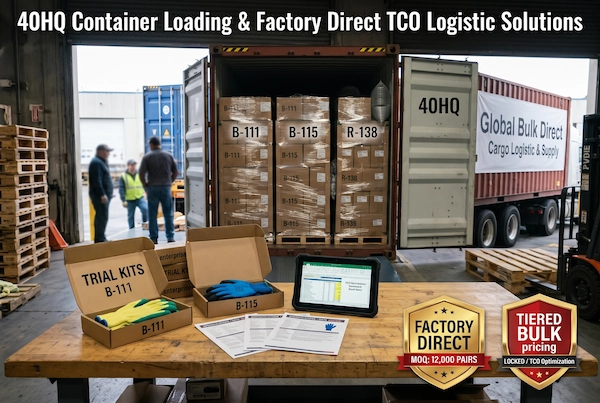
After completing on-site wear testing and selecting the appropriate anti-slip technology, corporate procurement departments can work directly with the sales and business teams at the source factories to obtain direct-from-source supply chain solutions that eliminate all markups from intermediate distributors:
Secure Tiered Pricing Based on MOQ and Authoritative Factory Data: Based on batch requirements for engineering projects or annual consumption plans, our business team will provide a precise tiered pricing system based on standard minimum order quantities (MOQ) and simultaneously deliver to your quality control department a complete technical data sheet containing original EN 388 test reports, OEKO-TEX ecological certification, and other relevant information;
40HQ LCL/FCL Logistics Optimization and Annual Framework Agreements: To address the massive demand from large-scale multinational turnkey projects and multinational automotive parts manufacturers, our supply chain team will tailor a three-dimensional palletizing and moisture-proof loading solution for each 40HQ ocean container. By entering into multi-year centralized procurement framework agreements, buyers can not only effectively hedge against price inflation risks associated with natural rubber as a bulk raw material but also ensure stable, low-cost cross-border material supply during global shipping market fluctuations through phased production scheduling.