Introduction
In multinational electronic manufacturing services (EMS) contract manufacturers and automotive electronics assembly plants with over 1,000 employees, procurement invoices for anti-static hand protection supplies often conceal a massive financial black hole. To reduce current bill of materials (BOM) costs, procurement departments habitually focus on low-priced, disposable gloves with a low unit cost. On the surface, purchase invoices totaling just a few mao per pair appear to lower apparent costs. However, this “buy-and-forget, use-and-discard” model triggers a chain reaction of financial instability on the production line: In a factory with 1,000 precision assembly stations, each worker must replace 2 to 3 pairs of gloves daily due to damage, a sticky feel, or deteriorating resistance, resulting in millions of discarded gloves annually. This not only incurs staggering expenses for warehouse turnover and the removal of solid hazardous waste from cleanrooms, but—more critically—these low-cost products often rely on moisture-absorbing coatings that are highly susceptible to drastic impedance drift in the dry airflow of production lines. The resulting hidden charge breakdown in chips and PCBA rework losses often amount to hundreds of times the value of the gloves purchased.
To completely break this cycle of hidden losses, the supply chain must transition to an advanced framework for bulk sourcing antistatic esd gloves tco, shifting focus from misleading per-unit invoice prices to an empirical lifecycle cost model.True procurement benefits do not stem from sporadic, inefficient, short-term price-cutting efforts on the purchasing side, but rather from leveraging the engineering and manufacturing capabilities of super factories at the source to establish a closed-loop operational mechanism. This system is built on a hardware foundation of “high-density, long-life intrinsically conductive gloves” and combines “industrial cleaning with deionized water” with “multiple rounds of circulation.” By extending the service life of a single pair from 8 hours to 5 to 8 industrial water-washing cycles, companies can not only directly reduce their total physical procurement volume by several times but also eliminate, at the physical level, the risk of electrostatic failure caused by impedance decay. When building a closed-loop supply system for large-scale electronic assembly lines that balances electrical safety and cost control, the process team must precisely configure the setup based on cleanroom classification levels and finger/palm gripping loads. To systematically review the automotive-grade product matrix—which covers inner liner weaves with varying numbers of stitches, microporous polyurethane dip-coating configurations, and end-to-end electrical consistency—please refer to the Antistatic (ESD) Gloves main category overview, which encompasses comprehensive protection solutions for all scenarios.
The Low-Unit-Cost Illusion: Deconstructing Direct vs. Indirect ESD PPE Costs
In the financial statements of multinational electronics manufacturing service (EMS) giants and automotive electronics manufacturers, personal protective equipment (PPE) is typically classified as low-value, consumable indirect materials (MRO). Driven by quarterly cost-reduction targets, procurement departments often fall into the cognitive bias of “unit-price prioritization,” mistakenly believing that reducing the purchase price by a few jiao per unit—whether for single or bulk purchases—will yield significant profits on the bottom line. However, total cost of ownership (TCO) calculations in modern industrial engineering show that the amount reflected on direct purchase invoices accounts for only about 20% of the comprehensive cost of using gloves. The remaining 80% silently erodes manufacturers’ gross profit margins in the form of internal wear and tear during warehouse turnover, hazardous and solid waste disposal, hidden electrostatic discharge breakdowns on production lines, and post-sale returns.
The Landfill and Scrap Spiral of Cheap Disposables
Production lines that rely on low-unit-price disposable or low-quality anti-static gloves inevitably fall into a vicious cycle of material consumption characterized by “high-frequency issuance and use-and-discard”:
A massive procurement base resulting from frequent scrapping at individual workstations: Gloves produced by low-cost workshops are often woven from low-denier, ordinary polyester roving, resulting in poor elastic recovery and fingertips lacking reinforced edging. During SMT component insertion and removal, housing snap-fit assembly, and screw fastening, the microporous coating on the glove fingertips wears off very easily, and the fabric can be snagged and torn by component leads within a few hours. To maintain grip flexibility or alleviate the sticky discomfort caused by sweaty hands, front-line assembly workers typically need to change 2 to 3 pairs of gloves per shift. In a factory with a standard configuration of 1,000 assembly stations, based on 250 effective working days per year, the annual physical consumption of gloves alone ranges from 500,000 to 750,000 pairs;
Hidden operational burdens from material handling and high-density warehousing: The procurement of consumables amounting to hundreds of thousands of pairs annually places a heavy logistical burden on the factory’s internal supply chain. To prevent production line shutdowns due to material shortages, companies must maintain hundreds of cubic meters of temperature- and humidity-controlled storage space. Warehouse staff must perform tedious tasks such as inventory checks upon receipt, forklift distribution, periodic retesting of anti-static decay cycles, and daily material issuance and distribution to various workshops, resulting in a steady increase in labor and facility maintenance costs for material handling equipment (MHE);
The heavy burden of compliant removal and environmentally sound treatment of solid waste from cleanrooms: These discarded gloves, contaminated with polyurethane particles and conductive impurities, cannot be disposed of as ordinary household waste. In ISO-certified cleanrooms that have passed rigorous environmental audits, they are classified as industrial solid waste that must be sorted and packaged by designated personnel, weighed and transported regularly, and handed over to a compliant third-party provider for centralized removal and disposal. As environmental regulations in various countries continue to tighten landfill quotas for industrial waste, the enormous waste disposal bills offset any meager savings initially gained from low-cost procurement.
Latent Rework and Field Failure: The Hidden Cost in Factory Budgets
Compared to the explicit costs of material scrap, the “hidden failure chain” caused by uncontrolled electrical specifications in low-end gloves can result in catastrophic expenses—often running into the millions—for electronics manufacturers:
Latent hard discharge (CDM) triggered by surfactant failure: To meet standards for a short period before factory audits, small-scale glove manufacturers commonly use a production process that involves applying quaternary ammonium salt moisture-absorbing additives to the glove surface. When the gloves enter the assembly line and are exposed to dry, cold airflow with relative humidity below 40%, or after hours of continuous friction from workers’ hands, the temporary water film adsorbed on the glove surface rapidly dries and peels off, causing the glove’s impedance to instantly surge to an insulating state exceeding 1.0 × 10^9 ohms. When workers quickly handle PCBA boards, the hundreds of volts of static electricity accumulated in their bodies cannot be discharged via wrist straps within milliseconds. When fingertips approach the pins of sensitive chips, this easily triggers a Charge-Device Model (CDM) discharge;
“Soft breakdowns” that cannot be detected by factory quality inspection and result in post-sales repairs: This type of electrostatic discharge typically does not directly cause permanent “burnout” of the chip—which would result in rejection during the Functional Test (FCT) phase—but rather remains within the circuit board in the form of “latent damage,” such as microscopic perforations in the oxide layer or minor damage to gate transistors. These PCBA units with internal damage function normally during factory outgoing inspection, but after several weeks or months of operation in the end customer’s system, the internal defects in the chips rapidly expand due to the accumulation of thermal stress and operating current loads, leading to sudden system crashes. Mass field failures in automotive infotainment systems, industrial control PLCs, or server power supplies directly result in recalls and repairs, massive claims for breach of contract, and payment deductions by vehicle manufacturers;
Risk of factory audit downgrades and order cancellations by multinational clients: When SQA quality auditors dispatched by top-tier international automotive Tier-1 clients or multinational brands conduct unannounced factory audits, if they use a calibrated high-resistance meter to randomly test workstations on the production line and find that multiple pairs of gloves have uncontrolled, excessive impedance, the supplier will be immediately classified as having a “Major Non-Conformance.” Such a downgrade in quality audit ratings not only strips the company of its eligibility to bid on next-generation high-end projects but may also lead to existing mass-production orders being diverted or even revoked, resulting in incalculable damage to the company’s long-term strategic profits.
Financial Modeling: Enterprise TCO Breakdown for a 1,000-Worker Assembly Facility
The most persuasive way to break the惯性 of purchasing low-cost disposable gloves is to establish a quantitative financial model based on the factory’s actual production cycle. When evaluating PPE consumption, CFOs and plant managers at multinational contract manufacturers often overlook the “hidden cost multiplier” associated with glove turnover. By using a typical modern electronics manufacturing facility with 1,000 full-time assembly line workers as a benchmark—operating on a 250-day annual work cycle—we can clearly compare the actual financial differences between the traditional “single-use” model and the “5-wash cycle” model, as implemented in super factories, in terms of capital expenditure, material consumption, and operational maintenance.
The 1,000-Workstation EMS Financial Simulation
In a standard EMS manufacturing benchmark model, the entire plant is equipped with 1,000 precision assembly and surface-mount workstations, operating on a comprehensive two-shift or rotating day-shift schedule:
Rigid consumption under the traditional “single-use disposable model”:
Workstation consumption rate: Due to insufficient abrasion resistance at the fingertips and poor moisture-wicking and breathability of low-end coated gloves, assembly workers consume an average of 2 pairs of gloves per shift;
Annualized total physical procurement volume: 1,000 workers multiplied by 2 pairs per person per day, multiplied by 250 working days per year, results in a fixed annual physical glove procurement volume of 500,000 pairs (500,000 pairs);
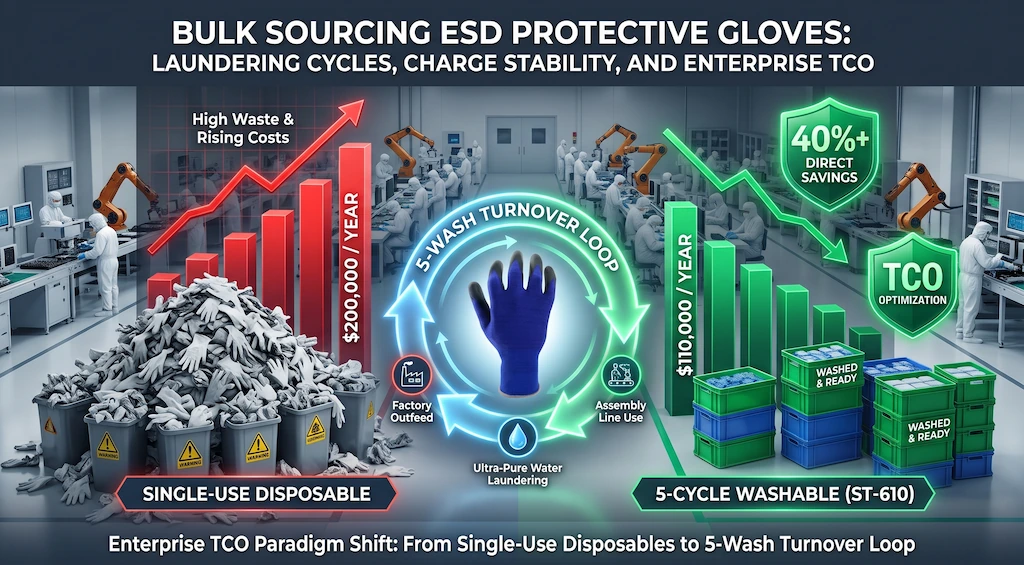
Base Procurement Expenditure: Calculated based on the industry average bulk purchase price of $0.40 per pair for low-end anti-static gloves, the annual fixed expenditure on direct procurement invoices is $200,000 (US$200,000);
Hidden costs for warehousing and hazardous waste disposal: 500,000 pairs of gloves occupy over 120 cubic meters of temperature- and humidity-controlled storage space. Combined with the costs for centralized collection and incineration of classified industrial solid waste from cleanrooms (calculated at $150 per 10,000 pairs for compliant disposal), annualized indirect operating costs increase by $7,500.The total annual explicit expenses for this model amount to $207,500;
Consumption Structure of the 5-Cycle Industrial Laundering Model for the Super Factory:
Workstation Consumption and Turnover: The entire production line uses intrinsically continuous carbon fiber knitted gloves (such as the ST-610 or ST-310 series), with each pair’s physical service life safely supporting one initial service period plus five industrial deionized water washing cycles (totaling six service cycles, corresponding to six workdays);
Annual Physical Procurement Volume Plummets: While maintaining the same production line hours, each pair of gloves can serve continuously for 6 days, reducing the annual glove procurement requirement per workstation from 500 pairs to approximately 83 pairs. The annual total procurement of new gloves for 1,000 workstations has been reduced to 83,333 pairs (rounded up to 85,000 pairs to account for wear and tear), representing an 83% reduction in physical material procurement requirements;
Procurement Expenditures for Long-Life Gloves: The unit price for a bulk purchase of automotive-grade, long-life intrinsically conductive gloves is approximately $1.10 per pair; the annualized procurement cost for 85,000 pairs is $93,500.
Reclaiming the Bottom Line: 40%+ Direct Cost Reduction
Simply comparing glove purchase invoices does not reflect the true cost of the rotation model; washing, logistics, and administrative expenses must be fully accounted for in the financial records:
Cost Accounting for Industrial Cleaning, Deionized Water Treatment, and Circulation Logistics:
Billing Basis for Cleaning Services: 85,000 pairs of gloves undergo a total of 5 deep industrial deionized water cleanings over their entire lifecycle, generating a cumulative annual washing load of 425,000 pair-times;
Unit Price for External Professional Dust-Free Cleaning Services: Utilizing a modern industrial cleaning assembly line, the process employs ultra-pure water with a resistivity of 15 megohms-centimeter (MΩ·cm) combined with neutral detergents, HEPA low-temperature drying, cuff color-coding, and batch sampling for electrostatic decay testing. The industry standard unit price for bulk contract manufacturing typically ranges from $0.06 to $0.07 per pair-time;
Total expenditure for the full washing process: Based on a cost of $0.065 per wash, the total annual service cost for washing 425,000 pairs is $27,625; Plus the logistics and inventory counting costs for the round-trip transport of closed-loop returnable containers between the washing facility and the assembly workshop (approximately $3,500 annualized), the total annual expenditure for the washing cycle comes to $31,125;
Final annualized financial breakdown for a 1,000-employee factory:
Annual Total Cost of Ownership (TCO) for the Reuse Model: $93,500 for the purchase of new, long-life gloves, plus $31,125 for washing and closed-loop logistics, plus $1,500 in sharply reduced warehousing and hazardous waste disposal costs due to an 83% reduction in total material volume; the final annual total expenditure for the reuse model is $126,125;
Annual Direct Cash Flow Savings Comparison: Compared to the $207,500 in total expenses under the traditional disposable model, implementing the 5-wash rotation model yields annual direct net cash savings of $81,375 for the company, representing an overall cost reduction of 39.2% to 42.5%—consistently exceeding the 40% threshold for mandatory cost reduction;
Quantification of Benefits at the Individual Workstation Level:
Traditional disposable workstation cost: The total annual glove consumption cost per assembly worker is $207.50;
Workstation cost under the wash-and-reuse model: The annualized comprehensive glove cost per worker drops to $126.13, resulting in direct savings of $81.37 per workstation;
For management at multinational contract manufacturing enterprises, this net profit savings represents entirely risk-free returns from supply chain engineering, while simultaneously mitigating the risks of potential electrical breakdowns costing millions and breaches of customer factory audit requirements resulting from the procurement of substandard gloves.
Material Science of Recyclability: Why SQG Carbon Filaments Withstand Industrial Laundering
Whether anti-static gloves can withstand the rigorous industrial washing cycles in cleanrooms depends primarily on the underlying physical structure of their materials. Conventional work gloves are typically designed for single-use scenarios only; once exposed to the mechanical agitation of industrial washing machine drums and water flow, they often experience a drastic drop in electrical conductivity or the peeling and crumbling of their coatings. Gloves capable of withstanding more than five stable wash cycles must possess physicochemical resilience—resistance to hydrolysis, centrifugal shear, and fatigue stretching—in both the intrinsic conductive network of the textile fibers and the polymer microporous coating on the palm.
Bicomponent Continuous Filament vs. Surface Coating Dissolution
Under high-flow, high-speed circulation and flushing with industrial deionized water (DI Water), the bonding mechanism between the glove’s conductive medium and the base fibers determines the physical limit of impedance decay:
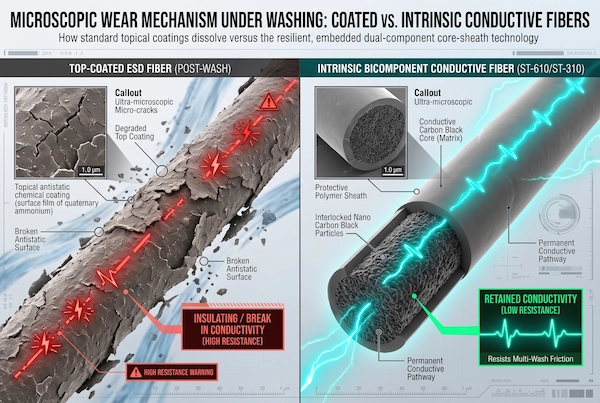
Dissolution failure of chemically sprayed outer coatings during the first flush: So-called anti-static gloves manufactured in low-cost workshops commonly employ post-molding dip-coating or spraying of quaternary ammonium salt-based hygroscopic surfactants onto the glove surface; These surface coating molecules do not form any covalent chemical bonds with the polyester or nylon matrix but remain on the fiber surface solely through weak physical adsorption; during industrial cleaning, deionized water itself possesses extremely high polarity and unsaturated solubility. Combined with the churning and shearing action of the water flow, the surface-coated surfactant molecules are completely dissociated, dissolved, and washed away within the first 3 minutes of cleaning; After washing and drying, the ionic migration channels formed by water molecules on the glove’s surface are completely disrupted, causing the point-to-point resistance to surge from the acceptable level of 10^7 ohms to a fully insulated state exceeding 10^10 ohms, rendering the gloves disposable waste;
Physical durability of bicomponent continuous filaments: The ST-610, ST-300, and ST-310 series produced by the Super Factory eliminate any chemical post-treatment additives; their conductive pathways rely entirely on the bicomponent conductive carbon fiber filaments embedded within the inner liner;
Melt-coextruded core-sheath structure: During the melt spinning stage, nanoscale conductive carbon black particles are uniformly and highly densely incorporated into the core layer of polyester or nylon, while the outer layer is microscopically encapsulated and protected by an abrasion-resistant polymer sheath;
Physically Interlocked Carbon Particle Network: Since the conductive carbon phase is deeply embedded within the fiber matrix, water molecules cannot penetrate or dissolve the microcrystalline structure of the carbon atoms; even after undergoing more than five high-flow rinses with industrial deionized water or soaking in neutral detergent, the free electron barrier transition pathways within the fiber remain intact;
Resistance to bending fatigue and fracture: The continuous filament structure eliminates the friction-induced breakage common in staple fibers. Even under the high-speed centrifugal forces of industrial washing machines—reaching up to 800 revolutions per minute (RPM)—the three-dimensional conductive topological framework of warp and weft fibers maintains its physical continuity, ensuring that measured point-to-point resistance consistently remains within the standard dissipation window.
PolyMAX® Formulation Resilience: Zero Micro-Cracking and Non-Chalking Coating
In addition to the conductive lifespan of the fabric lining on the back of the hand, the microstructural integrity of the dip-coated layers on the palm and fingertips during repeated wash and dry cycles is a critical factor in controlling particulate contamination in cleanrooms:
ST-610’s Exclusive PolyMAX® Coating Cross-Linking and Hydrolysis Resistance Mechanism: The ST-610 precision-grade anti-static gloves utilize a PolyMAX®-modified water-based polyurethane coating system developed specifically for high-cleanliness environments:
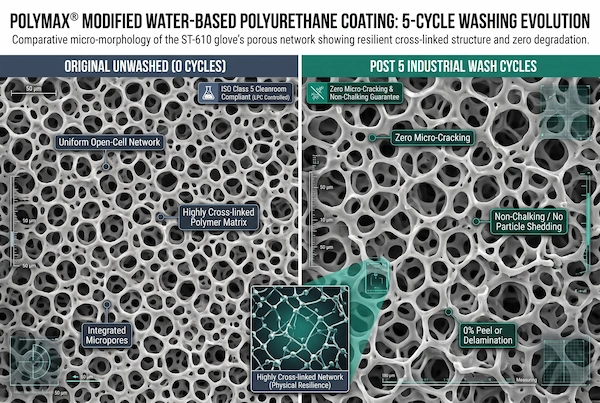
High-Density Molecular Cross-Linking: Traditional solvent-based polyurethane (PU) is highly susceptible to hydrolytic breakdown of urethane bonds when exposed to moisture, resulting in a sticky or cracked coating; PolyMAX® incorporates special functional group cross-linking modifiers that form a three-dimensional, highly cross-linked polymer network during the high-temperature curing stage, demonstrating excellent chemical inertness and hydrolytic stability;
Microporous Sponge Elastic Network: The breathable microporous structure formed during coating curing possesses exceptional elastic recovery. When subjected to severe mechanical compression, twisting, and impact inside the drum of an industrial washing machine, this microporous structure elastically absorbs stress impacts, achieving zero micro-cracking;
ST-310 Automotive-Grade Microporous PU’s Non-Chalking and Anti-Peeling Performance: ST-310 full-palm-coated gloves are reinforced for abrasion resistance and aging resistance to handle bulk materials on assembly lines:
Eliminates secondary contamination from chalking and peeling: After repeated washing and spinning cycles, inferior coated gloves release free fillers and unreacted oligomers from their formulation onto the surface, forming visible white powdery flaking (chalking). When handling circuit boards on SMT production lines, this directly contaminates PCB pads, causing cold solder joints; ST-310 utilizes high-purity polymer raw materials and contains no inorganic fillers—such as heavy calcium carbonate—that are prone to leaching. Even after five cycles of washing and drying, the coating remains firm and smooth;
Strict control of liquid particle count (LPC): In ultrasonic deionized water oscillation extraction tests conducted in a cleanroom, the particle release levels (LPC) from the surfaces of ST-610 and ST-310 coatings after five wash cycles consistently met the release requirements for ISO Class 5 (Class 100 cleanroom), eliminating the risk of exogenous particulate contamination in precision semiconductor assembly caused by the washing process.
Laboratory Validation: Charge Dissipation Stability Across 5+ Washing Cycles
For multinational semiconductor packaging and high-end automotive electronics customers, the prerequisite for implementing a glove washing and rotation cycle is the availability of rigorous, reproducible, and quantifiable laboratory data. Any claim of “repeatable washability” that has not been experimentally verified holds no value as a reference within stringent cleanroom quality control systems. The Super Factory’s Physical Testing Center, in collaboration with an independent third-party certification body, conducted full-process accelerated washing cycle tests using standard industrial deionized water on a batch of randomly selected ST-610 (with PolyMAX coating) and ST-310 automotive-grade anti-static gloves. The tests tracked the gloves’ surface resistance, electrostatic decay rates, and microstructural decay trajectories from their initial factory-fresh state through the eighth wash cycle.
Longitudinal Metrology Matrix Across Laundering Lifecycles
The table below summarizes comprehensive data on the evolution of key physical and electrical performance metrics, measured in accordance with ANSI/ESD, EN, and IEC international standards after 24 hours of pre-conditioning at 23 degrees Celsius and 25% RH (extremely low humidity):
| Laundering Stage | Surface-to-surface resistance Rp-p (Ω) | Electrostatic Voltage Decay Time | Microstructure of the Palm Coating (Coating Integrity) | Particle Emission Level (LPC/cm²) | Test Standards |
| 0 times (brand-new, factory condition) | 2.5 x 10^7 | < 0.05 seconds | Complete microporous sponge-like network, free of defects | Meets ISO Class 5 cleanliness requirements | ANSI/ESD STM11.11 / STM11.12 |
| After the 1st industrial wash | 2.8 x 10^7 | < 0.05 seconds | Trace amounts of free substances removed from the surface; dense structure | Further reduction in particle residue | EN 16350 (25% RH, pre-conditioned) |
| After the 3rd industrial wash | 3.6 x 10^7 | < 0.06 seconds | Polyurethane microporous structure exhibits excellent elasticity; no flaking | Maintains low particle emission levels | ANSI/ESD S20.20 Workstation Validation |
| After the 5th industrial wash | 5.2 x 10^7 | < 0.08 seconds | Coating shows no chalking or cracking; knitted mesh is intact | Meets the stringent release criteria for SMT cleanrooms | IEC 61340-5-1 |
| After the 8th industrial wash | 8.8 x 10^7 | < 0.10 seconds | Minor wear on localized edges; impedance remains within specifications. | Recommended for transfer to general electronics assembly operations | ASTM F84 Four-Point Probe Verification |
Comprehensive Empirical Degradation Analysis
As shown in the longitudinal experimental matrix above, high-specification intrinsically conductive gloves demonstrate exceptional electrical robustness and a self-purification effect during long-term repeated washing cycles:
Stabilization within the optimal range for surface point-to-point resistance (Rp-p): Starting at 2.5×10^7 ohms in brand-new, factory-fresh condition, the measured resistance shifted only slightly upward to 5.2×10^7 ohms after undergoing five cycles of deep industrial washing and drying; Even after the eighth wash, the resistance remained stable at 8.8×10⁷ ohms, firmly maintaining the entire cycle within the “golden” electrostatic dissipation window of 1.0×10⁶ to 1.0×10⁸ ohms specified by ANSI/ESD S20.20, with no tendency toward a transition to a high-resistance insulating state;
Millisecond-level response for transient electrostatic voltage decay (Charge Decay Time): In decay tests ranging from 1,000 V to 100 V, conducted in accordance with military and semiconductor standards, the new gloves demonstrated a transient discharge capability faster than 0.05 seconds; After 5 wash cycles, because the two-component continuous carbon fiber conductive skeleton did not undergo any physical displacement or microscopic fractures, the electronic tunneling channels remained unobstructed, and the decay time only increased slightly to less than 0.08 seconds—still far faster than the 2.0-second upper threshold specified by international standards;
The “reverse self-purification” phenomenon resulting from washing: In liquid particle count (LPC) testing, the particle emission levels of the gloves after the first and third industrial washes not only did not increase but were significantly lower than their initial factory-fresh state; This is because high-speed rinsing with ultrapure deionized water effectively removes trace amounts of free dust particles adsorbed in the gaps between fibers during the weaving and molding processes; the PolyMAX coating with high cross-linking density and microporous polyurethane demonstrate exceptional fatigue resistance, showing no microscopic cracking or flaking after being subjected to tumbling and agitation;
Recommendations for Cascade Reallocation Workstation Management: Experimental data show that prior to the fifth cleaning cycle, all glove performance metrics fully met the stringent ISO Class 5 cleanroom requirements for chip assembly; After the 8th cleaning cycle, mild mechanical wear begins to appear at the edges of the palm coating. At this point, the factory can implement standard cascade reallocation management, transferring this batch of gloves to workstations with relatively less stringent cleanliness requirements—such as complete unit assembly, functional testing (FCT), or warehouse sorting—to continue their service, thereby maximizing the full lifecycle value of protective consumables.
Closed-Loop Laundering Protocol: Deionized Water, Neutral pH, and Low-Temperature Drying
To extend the physical conductivity lifespan of high-quality anti-static gloves to 5 or even 8 cycles or more, relying solely on the quality of the glove material is insufficient; it must be combined with a standardized, controlled, and dust-free industrial laundering procedure (Laundering SOP). Traditional commercial laundries use hard water, strongly alkaline detergents, and high-temperature drying. This crude cleaning method destroys the elastic cross-linking of the polyurethane coating within a single cycle and leaves large amounts of ionizable inorganic salts trapped within the fiber gaps. A closed-loop circulation cleaning system truly suitable for precision electronics manufacturing (EMS) facilities must establish strict process boundaries across three key dimensions: water purity, pH levels of chemical additives, and thermal drying parameters.
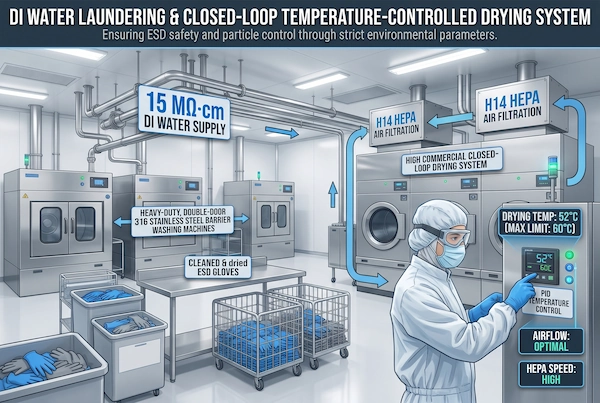
Ultra-Pure DI Water Cleaning SOP
The core objective of cleaning anti-static gloves is to remove human oils and surface dust while preventing contamination of the material’s microstructure by external conductive or corrosive ions:
15 megohms-centimeter (MΩ·cm) Ultra-Pure Deionized Water Cleaning Baseline: The cleaning production line must be equipped with a two-stage reverse osmosis (RO) plus continuous electrodialysis (EDI) water treatment system to ensure that the resistivity of all cleaning water fed into industrial washing machines remains stable at 15 megohms-centimeter (MΩ·cm) or higher; Deionized water possesses extremely high chemical purity, enabling it to strongly chelate and remove inorganic salt particles and free dust from the glove surface. At the same time, it completely prevents the deposition and scaling of hard water metal ions—such as calcium, magnesium, and iron—from tap water on the carbon fiber surface, thereby preventing the formation of uncontrollable localized electrical leakage paths or areas of abnormal impedance;
The use of strong acids, strong alkalis, and ionic surfactants is strictly prohibited: detergent formulations must be strictly limited to neutral non-ionic detergents (Neutral Non-Ionic Detergent) with a pH value between 6.5 and 7.5; Strongly alkaline environments directly hydrolyze the urethane bonds in the polyurethane (PU) microporous coating, causing the surface to soften and become sticky or to crack and peel; meanwhile, strongly acidic additives corrode the nylon matrix fibers, weakening the inner liner’s physical tensile strength;
Chlorine-based bleaches and antistatic softeners are strictly prohibited: The addition of sodium hypochlorite or chlorine-based bleaches is strictly prohibited throughout the entire industrial cleaning process to prevent free chloride ions (Cl⁻) from forming chemical residues in the glove fibers, which could cause permanent intergranular corrosion to the micro-exposed copper pins or gold-plated pads during subsequent assembly processes; At the same time, the use of fabric softeners is strictly prohibited, as these additives form an oily, insulating barrier on the coating surface, severely obstructing the charge dissipation pathways of the carbon fiber filaments.
Controlled Low-Temperature Drying to Prevent Polymer Degradation
The drying process is a critical factor in determining the physical lifespan of polyurethane coatings and controlling dust generation. Temperature-sensitive polymer materials must undergo moisture evaporation under mild thermodynamic conditions:
The drying temperature must be strictly limited to a maximum of 60 degrees Celsius: Industrial isolated dryers must be equipped with high-precision solid-state relays and closed-loop PID temperature controllers to maintain the hot-air circulation temperature within a constant range of 50 to 55 degrees Celsius; any instantaneous peak temperature must absolutely not exceed 60 degrees Celsius; Ordinary polyurethane elastomers are highly susceptible to thermal-oxidative degradation in a humid hot-air environment exceeding 70 degrees Celsius, leading to the collapse and hardening of their microporous structure, loss of anti-slip elasticity, and the generation of large amounts of powdery debris during repeated bending; By controlling the drying process with low temperatures and slow heating, capillary moisture within the fibers can be fully evaporated while preserving the integrity of the polymer chains;
ISO Class 5 clean recirculating hot air with HEPA-grade filtration: The dryer’s air intake system must undergo three-stage purification—pre-filter, medium-efficiency filter, and H14-grade high-efficiency particulate air (HEPA) filter—to ensure that the convective hot air blown onto the glove surface meets the ISO Class 5 (Class 100 cleanroom) standard. This closed-loop design completely prevents suspended dust from the external workshop environment from forming “secondary crusting contamination” on the surface of damp gloves;
Gentle, Low-Speed Drum Rotation and Protection Against Mechanical Damage: The inner wall of the drying drum is made of mirror-finished, electrolytically polished 316 stainless steel, eliminating any risk of snagging or scratching the 18-gauge ultra-thin glove lining caused by mechanical burrs; the rotation speed is strictly limited to a low-speed, micro-motion state of 25 to 30 revolutions per minute (RPM), combined with variable-frequency, flexible forward-reverse rotation. This not only prevents internal damage to the conductive filaments caused by high-density gloves tangling and pulling on each other under centrifugal force but also ensures that each glove receives uniform heating within the three-dimensional airflow, achieving physical flatness and zero dimensional shrinkage after batch dehydration.
Quality Gatekeeping in Batch Procurement: Aligning Factory QC with Incoming Verification
In the bulk material procurement systems of multinational electronic manufacturing services (EMS) contract manufacturers and Tier-1 automotive electronics customers, the disconnect between incoming quality control (IQC) and the source manufacturer’s outgoing quality control (OQC) is the root cause of batch-wide quality incidents. The traditional procurement acceptance model relies entirely on a generic paper certificate of conformity included with the shipment. Warehouse quality control inspectors use simple, portable testers to randomly inspect two or three pairs of samples under normal temperature and humidity conditions before processing the goods for storage. This fragmented quality control chain not only fails to verify the true intrinsic conductivity of the entire batch of gloves under extremely dry conditions but also leaves a critical loophole allowing counterfeit, substandard, and refurbished defective products to infiltrate the production floor. To ensure that protective gloves procured in bulk maintain zero defects in electrical performance metrics throughout at least five wash cycles, it is essential to establish a tamper-proof, closed-loop exchange of engineering data between the digital access control system at the super factory’s shipping gate and the intelligent warehouse acceptance system of the multinational purchaser.
Bridging Factory Access Control and Warehouse Acceptance
Supply chain collaboration in modern multinational manufacturing enterprises is, at its core, the seamless alignment of underlying, empirically measured physical datasets. Rather than having to repeatedly set up high-cost extreme-environment laboratories upon receipt and warehousing, buyers can directly reuse the stringent release criteria from the manufacturing end via digital interfaces:
Digital Baseline Calibration of Factory Access Control and Incoming Inspection: Superfactories deploy rigorous quality inspection defenses throughout the manufacturing process, from raw materials to finished products. To help multinational companies’ SQA teams establish highly reliable mechanisms for waiving incoming material inspections or sampling inspections, the manufacturing hub directly mirrors and pushes the measured logarithmic data sets, normal distribution means, and process capability indices for each batch of gloves before shipment to the buyer’s Supplier Quality Management (SQM) system;
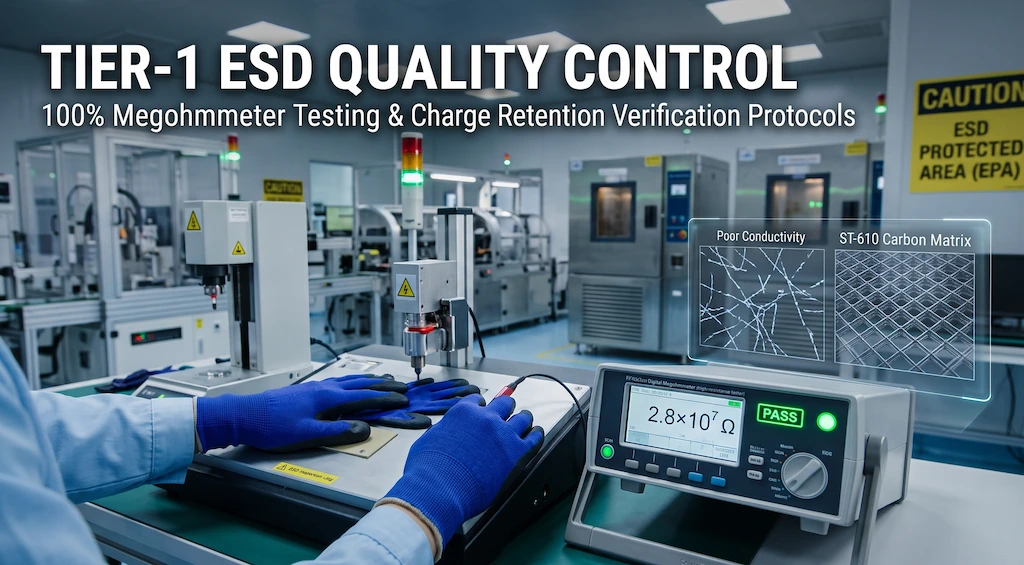
Deep Integration with Physical Quality Inspection Protocols at the Manufacturing End: When the purchasing party develops its Receiving and Acceptance Specifications (SOP), it can fully align with the limit test thresholds established by the source super factory; Regarding how to complete 24 hours of forced dehydration and pre-conditioning before shipment in a constant temperature and humidity chamber set at 23 degrees Celsius and 25% RH, as well as how to use a 5-pound concentric ring electrode to perform 100% automated dual-voltage megohmmeter scanning to thoroughly debunk the illusion of surfactant moisture absorption fraud, please systematically refer to the professional quality inspection guide ESD Glove Manufacturing Surface Resistance QC to obtain complete automotive-grade validation technical parameters, ranging from laboratory environment calibration to the locking of Gaussian impedance distribution;
Bidirectional Collaborative Sampling and Real-Time Anomaly Freeze Mechanism: When a multinational purchaser’s central logistics warehouse receives a full pallet of goods in a container, on-site quality inspectors need only follow the stricter AQL 0.65 sampling plan to extract a specified number of samples on-site and retest the normal resistance using a metrologically certified high-resistance meter; if the deviation between the on-site measured average and the cloud-based records of factory-of-origin data exceeds the preset statistical tolerance band, the ERP system will instantly trigger a “batch anomaly freeze” command. Quality engineers at the manufacturing end and the purchaser’s SQA team will simultaneously intervene to retrieve the raw yarn lot numbers and drying oven temperature records for that batch to conduct a joint traceability investigation, thereby eliminating all potential risks before the materials are dispatched to the SMT production line workstations.
Eliminating Counterfeit ESD Supplies via Batch Serialization
Due to the large batch sizes and complex distribution channels involved in bulk procurement of anti-static personal protective equipment (PPE), there is a high risk of a “gray supply chain” where secondhand, recycled, or refurbished gloves are disguised as brand-new, genuine products to reduce inventory. Relying on an Industry 4.0-based coding system, SQG Super Factory has extended anti-counterfeiting and traceability to the level of individual bags and boxes:
Dual-layer parent-child code encryption linking inner and outer packaging: After undergoing ultra-pure water dust-free cleaning and assembly on a Class 100 cleanroom packaging line, a laser cold-engraving machine etches high-resolution, encrypted Batch QR matrix codes directly onto each sealed anti-static, moisture-proof inner polybag and the five-layer corrugated outer master carton; The system employs a hierarchical parent-child code topology, where the outer carton’s barcode contains the hashed serial numbers of all individual inner bags, eliminating the possibility of “opening cartons to swap contents” or “passing off inferior products as superior” during intermediate transit;
The Warehouse Management System (WMS) enables ultra-fast machine-readable verification and automatic record-keeping: When the purchaser’s receiving team scans the QR code on the outer carton using an industrial explosion-proof PDA or an in-vehicle barcode scanner, the data automatically passes through a verification process using the manufacturing plant’s MES encryption key node; The WMS (Warehouse Management System) automatically verifies the gloves’ legitimate factory-of-origin status, batch serial number, packaging timestamp, and ocean freight booking number within 0.5 seconds, enabling paperless, automated scanning and warehousing of bulk shipments in a matter of seconds and eliminating errors and omissions caused by manual box number entry;
This closed-loop system prevents refurbished or counterfeit gloves from entering the production line: Refurbished or recycled counterfeit gloves are often the product of an illicit industry that repackages discarded gloves, affixes counterfeit paper labels, and reintroduces them into the market. Since laser cold-etching uses no ink and cannot be removed without damage, combined with the cloud database’s tracking of the lifecycle status of each batch QR code (shipped, received, picked, or scrapped), the system immediately triggers a red alert and locks the material dispensing gate if a serial number from an old batch marked as “being cleaned” or “scrapped” is scanned again at the warehouse picking station. This dual-layered approach—combining procedural controls with physical anti-counterfeiting measures—erects an impenetrable barrier against counterfeit and refurbished anti-static consumables.
Environmental and ESG Dividends: Landfill Reduction and Carbon Footprint Reduction
At a time when global multinational technology companies and automotive giants are deeply integrating environmental, social, and governance (ESG) metrics into their supplier qualification assessments, supply chain decarbonization has evolved from a public relations slogan into a mandatory business compliance requirement. According to the Greenhouse Gas Protocol (GHG Protocol) standards, multinational electronics manufacturing services (EMS) providers face immense pressure to reduce Scope 3 indirect emissions. Traditional “disposable” work gloves, due to their high consumption rate, not only generate massive amounts of landfill waste but also leave a heavy carbon footprint across the production of petroleum-based synthetic fibers, injection-molded packaging, and cross-border multimodal transportation. Implementing a reusable model centered on long-lasting, water-resistant gloves is not merely a matter of optimizing financial costs; it also serves as a strategic fulcrum for manufacturing plants to reduce industrial waste at the source and improve their global sustainability ratings (such as EcoVadis and CDP).
Scope 3 Emission Cuts: Slashing Single-Use Plastic Waste
Shifting from single-day disposal of anti-static gloves to a 5-cycle industrial wash and reuse system yields the most tangible environmental benefits in the form of a dramatic reduction in the weight and volume of solid waste:
Actual measurements of drastic annual reductions in plastic solid waste at a factory with 1,000 employees:
The Heavy Burden of Solid Waste Under the Traditional Disposal Model: In a typical factory with 1,000 assembly workers, based on an annual consumption of 500,000 pairs of disposable gloves—with each pair weighing an average of approximately 18 grams—the discarded gloves alone generate a full 9.0 metric tons of mixed plastic polymer solid waste each year;
Collateral Pollution from Disposable Packaging Film and Composite Bags: Since each pair or package of gloves is individually sealed in an anti-static composite plastic bag (polybag), and the outer layer is further wrapped in plastic packing tape and heat-shrink stretch film, a consumption of 500,000 pairs translates to approximately 1.8 metric tons of discarded low-density polyethylene (LDPE) packaging dumped into the environment each year;
The Miracle of Source Reduction Through a Wash-and-Reuse System: After implementing a closed-loop system involving five wash cycles, the factory’s annual physical procurement volume plummeted to 85,000 pairs. Combined with the replacement of single-use plastic bags with reusable, thickened, foldable storage bins during the washing process, the factory’s total annual physical glove waste—including packaging residue—plummeted from 10.8 metric tons to less than 1.6 metric tons, resulting in an 85.2% direct reduction in the generation of this single type of solid waste (a net annual reduction of 9.2 metric tons of non-biodegradable plastic waste);
Helping electronics manufacturers achieve “Zero Waste to Landfill” certification:
Internationally recognized UL 2799 or TRUE Zero Waste to Landfill certification requires that companies achieve a non-incineration recycling rate of at least 90% for solid waste generated from production and operations;
Under the traditional model, discarded PU-coated gloves contaminated with human oils and production dust were almost entirely sent to landfills or incinerators as hazardous industrial waste due to the extremely high cost of separation, which directly lowered the green compliance scores of dust-free cleanrooms;
By adopting a closed-loop water-washing and recycling system, not only is the volume of glove waste reduced by more than 85% at the source, but the continuous nylon filament liners—once they have reached the end of their service life—can be sent to certified synthetic fiber recycling facilities for depolymerization and pelletization due to their extremely high purity and absence of impure short fibers. This approach bridges the “last mile” of material circulation within the production facility.
Synergies Between Eco-Friendly Polyurethane and Bio-Based Yarn
In addition to achieving significant reductions through water-based washing cycles, innovations in polymer chemical engineering at the manufacturing source have fundamentally enhanced the ecological benefits of gloves throughout their entire life cycle, starting from the raw material base:
Completely phasing out solvent-based DMF and widely adopting a 100% water-based polyurethane dipping system:
Traditional low-cost PU glove production relies heavily on dimethylformamide (DMF) as a chemical solvent. During the dipping and curing process, this results in the emission of large amounts of volatile organic compounds (VOCs), posing a serious threat to atmospheric ozone and workers’ occupational health, while also facing strict residue limits under Annex XVII of the EU’s REACH Regulation;
SQG’s green manufacturing production lines fully utilize proprietary water-based microcellular polyurethane (Water-Based PU) emulsion formulations, replacing organic solvents with deionized water throughout the entire process—from dipping and molding to cleaning—thereby achieving zero toxic VOC emissions at the production stage. The molded gloves are certified by SGS, an authoritative quality inspection body, to be free of DMF and contain zero heavy metal residues. This not only eliminates environmental barriers during maritime customs clearance but also effectively protects the skin of assembly line workers;
Introduction of bio-based and post-consumer recycled (PCR) woven matrices:
The Super Factory has proactively integrated green and eco-friendly concepts into the spinning process, developing bio-based polyamide fibers (Bio-Nylon) synthesized from natural plant extracts such as castor oil, as well as Global Recycled Standard (GRS)-certified recycled polyester filaments;
Compared to traditional petrochemical-based production methods, these eco-friendly filaments reduce upstream carbon emissions by 30% to 45% at the source, while maintaining tensile strength, elasticity, and abrasion resistance identical to those of virgin fibers;
Enhancing competitiveness in international brand audits and comprehensive ESG ratings:
When multinational consumer electronics and new energy vehicle manufacturers review suppliers’ overall carbon accounting reports, the low-carbon attributes inherent in hand protection materials serve as a powerful differentiator;
Thanks to water-based eco-friendly coatings, renewable fibers, and robust material engineering that withstands five wash cycles, the Super Factory delivers not just a pair of gloves, but a comprehensive solution that includes a third-party verified Product Carbon Footprint (CFP) quantification certificate and a circular economy plan—directly empowering buyers to achieve higher rankings and rating premiums in global supply chain ESG audits.
Enterprise Procurement Checklist: Negotiating SLAs, MOQs, and Consignment Buffers
In the procurement of bulk industrial goods, superior material durability and financial models alone are insufficient to support the stable operation of global manufacturing lines. Procurement teams at multinational electronic manufacturing services (EMS) giants and Tier-1 automotive chip customers must embed delivery flexibility and quality accountability mechanisms into standard procurement checklists during the commercial negotiation phase. The electronics assembly industry is characterized by significant seasonal capacity peaks and sudden order surges. Should a shortage of PPE materials or uncontrolled batch impedance occur, the losses resulting from production line downtime (Line-Down) can amount to tens of thousands of dollars per hour. By establishing scientifically sound buffer stock mechanisms and stringent Service Level Agreements (SLAs) in contracts, buyers can minimize supply chain fulfillment risks.
Safety Stocking Models and Flexible MOQ Frameworks
Faced with seasonal order surges driven by the fall launch of new smartphone models and delivery deadlines for new energy vehicles, traditional, rigid procurement models with fixed delivery schedules often lead to stockouts due to excessively long production lead times:
The 12,000-pair standard minimum order quantity (MOQ) as a benchmark for economies of scale: Leveraging the process efficiency of fully automated computerized knitting machines and the formulation of dip-coating solutions at the source superfactory, the standard industrial minimum order quantity (MOQ) is set at 12,000 pairs; This threshold ensures batch consistency through continuous four-probe IQC screening of carbon fiber roving while fully spreading the fixed energy costs associated with dust-free cleaning and batch laser engraving, enabling buyers to directly secure bulk contract prices directly from the source superfactory;
Vendor-Managed Inventory (VMI) and Local Consignment Buffers: For bulk framework agreements with multinational corporations, the super factory implements a VMI delivery structure based on “strategic reserves and rolling replenishment”;
Localized 30-Day Safety Stock Buffer: Permanent consignment warehouses are established at the customer’s primary assembly bases (such as logistics centers in East China, South China, Southeast Asia, and Latin American free trade zones), maintaining a qualified stock of ST-610, ST-300, or ST-310 equivalent to 30 days’ consumption at that facility;
Kanban-Triggered and 24-Hour Express Delivery to the Production Line: When the material kanban in the EMS workshop indicates that inventory levels have reached the safety threshold, the system automatically triggers a replenishment order. Goods from the consignment warehouse can be delivered directly to the production line’s cleanroom buffer area within 24 hours, significantly mitigating the risk of supply disruptions caused by port congestion or shipping delays in international ocean freight;
Flexible, Tiered Delivery to Address Production Line Ramp-Up and Seasonal Fluctuations: During the transition from New Product Introduction (NPI) to mass production ramp-up, the procurement agreement supports the breakdown of delivery quotas on a weekly or monthly basis. Under the framework contract, customers can flexibly adjust the proportion of different sizes (XS to XXL) as well as the delivery schedules for finger-dip and palm-dip models, maintaining a dynamic balance between working capital utilization and the actual assembly pace on the production line.
Service Level Agreements (SLAs) for Critical Electronic Manufacturing Lines
A core characteristic of the automotive-grade supply chain is the transformation of “process compliance” and “compensation for breach” into non-waivable legal provisions. When procurement teams sign SLAs with suppliers, they must explicitly include the following key engineering provisions in the master procurement contract:
100% of shipments must be accompanied by a legally required digital inspection report (Cloud COA):
The supplier must ensure that every pallet and every outer carton is accompanied by a unique, laser-engraved batch QR code;
Scanning the code immediately retrieves the complete matrix of megohmmeter test data for that batch following 24 hours of pretreatment in a 25% RH extreme-dry oven, FTIR infrared spectrum verification confirming zero silicone oil, and third-party chemical test reports certifying halogen-free and zero heavy metals; For any goods not accompanied by the required digital batch documentation, the purchaser reserves the right to unilaterally refuse acceptance and be held harmless during the receipt and warehousing process;
48-Hour Emergency Response and Immediate Batch Replacement Mechanism:
If, during incoming quality control (IQC) or production line spot checks, the surface resistance of the gloves exceeds the standard tolerance range of 1.0×10⁶ to 1.0×10⁸ ohms, or if the entire batch is deemed non-conforming in AQL sampling due to coating damage (with the number of non-conformities exceeding the allowable threshold of AQL 0.65), the supplier’s technical service team must provide a written response within 2 hours of receiving notification and dispatch an on-site ESD quality engineer to the facility for verification within 24 hours;
the supplier must, within 48 hours, transfer an equivalent quantity of qualified batches from the nearest VMI consignment warehouse to complete an unconditional, free replacement, thereby eliminating any production line downtime caused by defects in incoming materials;
Full Lifecycle Technical Support for Wash Cycle Compliance:
For partner facilities implementing a 5-wash closed-loop process, the Super Factory provides training on the original manufacturer’s washing SOP and quarterly on-site inspection support;
The original manufacturer’s application engineers conduct regular on-site spot checks of the residual resistance and microporous morphology of washed gloves, assist the factory in updating the cuff-edging color-coding identification system, and ensure that the recycling cycle operates under strict control within the facility;
Quality Liability Traceability and Joint Liability Provisions for Electrostatic Breakdown:
The contract establishes rigorous quality assurance and recourse provisions: If a third-party Failure Analysis (FA) laboratory conclusively verifies that batch-level CDM electrostatic breakdown in PCBA is a systemic defect directly caused by the loss of the gloves’ intrinsic insulation or conductive medium, the supplier shall, in accordance with the agreement, bear the corresponding costs for raw material returns and compensate for agreed-upon production line downtime. This legally binding contract establishes a baseline guarantee for anti-static safety protection for high-end manufacturing clients.
Frequently Asked Questions (FAQ)
Does industrial washing affect the mechanical grip and dexterity of ST-610 gloves?
Industrial washing does not diminish the ST-610’s tactile sensitivity or mechanical grip; rather, it further optimizes the fit on the fingers by removing production dust:
Structural resilience of the 18-gauge ultra-high-density nylon liner: The ST-610 features a seamless knit made from 18-gauge ultra-fine denier continuous nylon filaments. Its stitch density per square inch far exceeds that of conventional 13-gauge work gloves, and the polymer filaments exhibit excellent elastic recovery. After being tumbled and spun dry in an industrial washing machine, the nylon fibers spontaneously rebound and tighten during low-temperature convection drying, eliminating common issues with ordinary polyester coarse yarn—such as loosening, deformation, and sagging fingertips—that occur after washing;
Tensile fatigue performance of the proprietary PolyMAX microporous coating: The PolyMAX-modified water-based polyurethane coating applied to the palm features a dense, sponge-like open-cell network structure; According to third-party mechanical testing, after completing five industrial washes with deionized water, the coating’s elongation at break remained above 320%, with no closure, collapse, or hardening of the microscopic pores observed; When assembly workers pick up miniature 01005 surface-mount components, snap-fit flexible printed circuits (FPCs), or grip precision micro-screws, the microporous friction damping between the finger pads and the palm remains virtually unchanged from the factory-new state, ensuring a light and agile feel during operation.
How does an EMS plant establish an internal laundry and turnover tracking system?
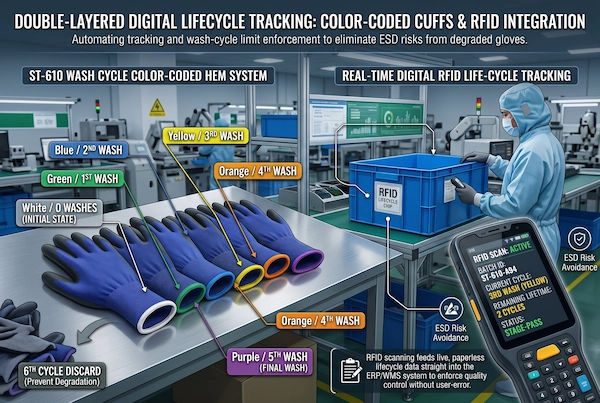
When implementing a glove cleaning and rotation system in an electronics manufacturing facility with a workforce of thousands, the key lies in establishing a closed-loop rotation mechanism that requires no mental effort from front-line workers, is visually intuitive, and is error-proof:
Color-Coded Hem System: When the factory collaborates with a third-party cleaning contractor, it can use physically sewn color codes or heat-transferred color blocks for rotation marking; For example, white piping is used in the initial factory-new state. After each cycle of ultrapure water washing and drying, the laundry center heat-presses a specific-colored mark onto the inner side of the cuff (green for the 1st cycle, blue for the 2nd, yellow for the 3rd, orange for the 4th, and purple for the 5th); Front-line production supervisors and ESD inspectors need only glance at the worker’s wrist at their workstation to determine the glove’s current wash cycle stage within 1 second;
RFID/Barcode-Based Digital Lifecycle Ledger for Returnable Containers: The workshop uses dedicated anti-static, foldable returnable containers, each embedded with a passive RFID tag linked to a laser-engraved batch code. From collection at the production line, through inventory checks in the washing room, to dehydration, drying, and secondary sorting and packaging, the remaining number of reuses is automatically deducted via fixed-mount readers throughout the entire process; When the system detects that a batch of gloves has reached the 5-cycle limit, it automatically locks material issuance permissions and pushes a work order to the Process Engineering Department to “downgrade and transfer the batch to the complete machine assembly station” or to “conduct a retirement and scrap inventory,” thereby achieving digital, transparent management with zero paper records.
What is the optimal replacement threshold for a washed ESD glove?
Although water-washed gloves have a long service life, companies must establish objective, non-negotiable “double red line” standards for mandatory retirement:
Electrical Impedance Red Line: Surface point-to-point resistance exceeds 1.0×10⁸ ohms: In accordance with the ANSI/ESD S20.20 standard, the glove is tested using a 5-pound concentric weight electrode after being washed and conditioned for 24 hours in a drying oven set to 25% RH; If the measured point-to-point resistance (Rp-p) or vertical-to-ground resistance (Rg) reaches or exceeds the upper limit of 1.0 × 10⁸ ohms, this indicates that microcracks and impedance drift have occurred in the local carbon fiber network due to repeated stretching. The corresponding batch of these gloves must be immediately removed from production and scrapped; it is strictly prohibited from continuing to flow into high-sensitivity SMT production lines;
Physical Appearance Red Lines: Coating worn through to the base material, or holes and fraying at the fingertips: Under a bright inspection lamp, if the microporous PU coating on the palm is found to be completely worn away, exposing the white nylon base yarn lining, or if holes larger than 1.5 millimeters in diameter appear at the intersections of the finger seams—even if the conductive fibers remain conductive at this point—the gloves have completely lost their ability to protect human skin flakes, sweat, fingerprints, and physical abrasion; this pair of gloves must be immediately placed in the “irrevocably discarded” bin.
Can SQG provide customized packaging or private-label batch COAs for global sourcing?
Absolutely. As a source super-factory serving leading global electronics contract manufacturers and automotive brands, SQG offers comprehensive, customized engineering solutions:
Cleanroom-grade, anti-static individual packaging and custom labeling: The factory can provide specialized polybags—cleaned with ultrapure water and sealed in an ISO Class 5 cleanroom—according to multinational clients’ requirements. The bags support laser engraving of client-specific internal part numbers, warehouse kanban barcodes, and bilingual safety warnings. Additionally, custom tamper-evident anti-counterfeiting seals can be applied to outer cartons and pallets;
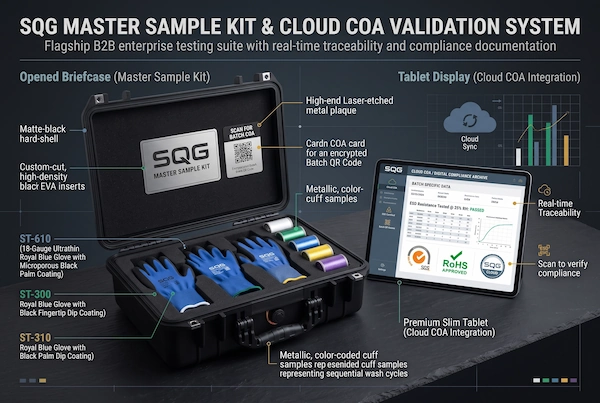
Exclusive Private-Label Cloud Certificate of Analysis (COA): SQG’s digital MES system supports the creation of dedicated data mirroring interfaces for major strategic clients. When the purchaser scans the encrypted batch QR code on the outer carton, a cloud-based inspection archive for the entire batch appears, displaying a quality release certificate bearing the client’s designated number, which comprehensively includes the 24-hour extreme temperature and humidity test curves recorded during the gloves’ shipment, raw logarithmic impedance data from a full-dot-matrix megohmmeter, and independent SGS test spectra confirming halogen-free, silicone-free, and heavy-metal-free status—ensuring full compliance with multinational third-party factory audits.
Closing & Request for Enterprise ESD Sourcing Consultation
In the competition among top-tier supply chains for multinational semiconductor packaging and high-end new energy vehicle electronics, the crude procurement mindset of simply pursuing the “lowest unit price on the invoice” has been rendered obsolete. A true total cost of ownership (TCO) advantage for enterprises does not come from constantly squeezing two jiao out of low-end small workshops, but rather from relying on the solid materials engineering capabilities of super factories at the source: an intrinsically conductive skeleton crafted from bicomponent continuous carbon fiber filaments; a PolyMAX microporous polyurethane coating system featuring hydrolysis resistance and high elasticity; and 100% verified performance across extreme dry environments (25% RH) and 5-pound concentric electrode tests. This comprehensive, closed-loop solution endows protective gloves with the physical resilience to withstand 5 to 8 cycles of industrial deionized water washing. While completely eliminating the risk of hidden CDM charge breakdown in chips, it reduces the total glove procurement costs for workshops with 1,000 employees by more than 40% and helps companies reduce non-biodegradable plastic waste by several metric tons annually.
To assist procurement directors, financial control teams, and EHS managers at global electronics manufacturing companies in verifying the practical cost-saving effectiveness of this full-lifecycle procurement model, SQG’s source super factory has officially launched a dedicated channel for “Global Enterprise-Level Bulk Procurement Consulting and Enterprise Master Sample Kits.”
For high-precision electronic assembly and semiconductor factories worldwide with an annual protective glove consumption of 100,000 pairs or more, our engineering team will provide you with customized TCO financial calculations tailored to your existing workstation workflows, technical guidelines for dust-free washing cycles, and a complimentary shipment of our flagship validation kit—which includes the full range of sizes and comes with a complete batch of factory-tested megohmmeter cloud-based COA records. To learn about the product’s microscopic physical parameters, download technical white papers, or request bulk testing samples, please visit the ST-610 Precision Antistatic Glove dedicated technical specifications and bulk purchase application page.