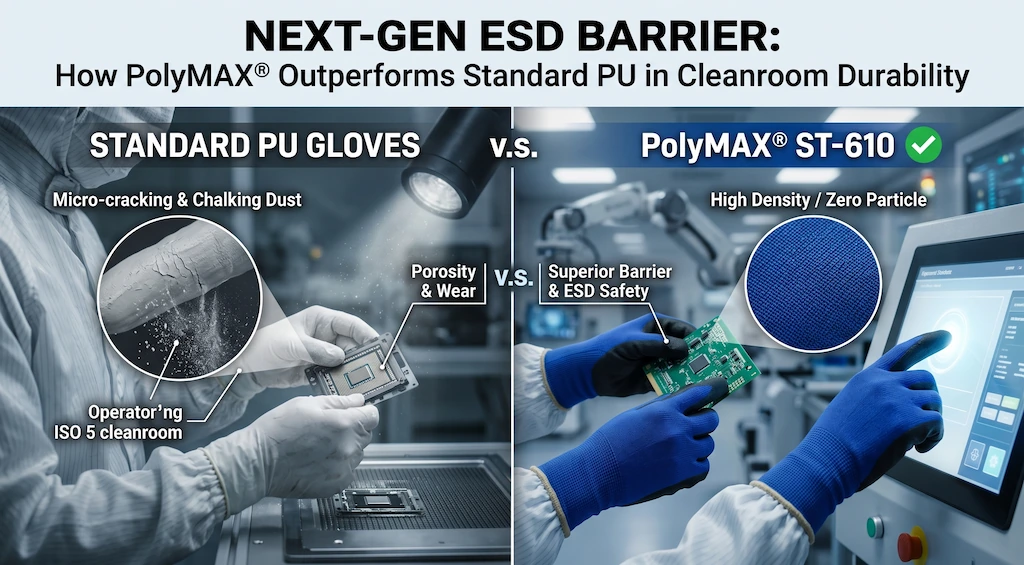
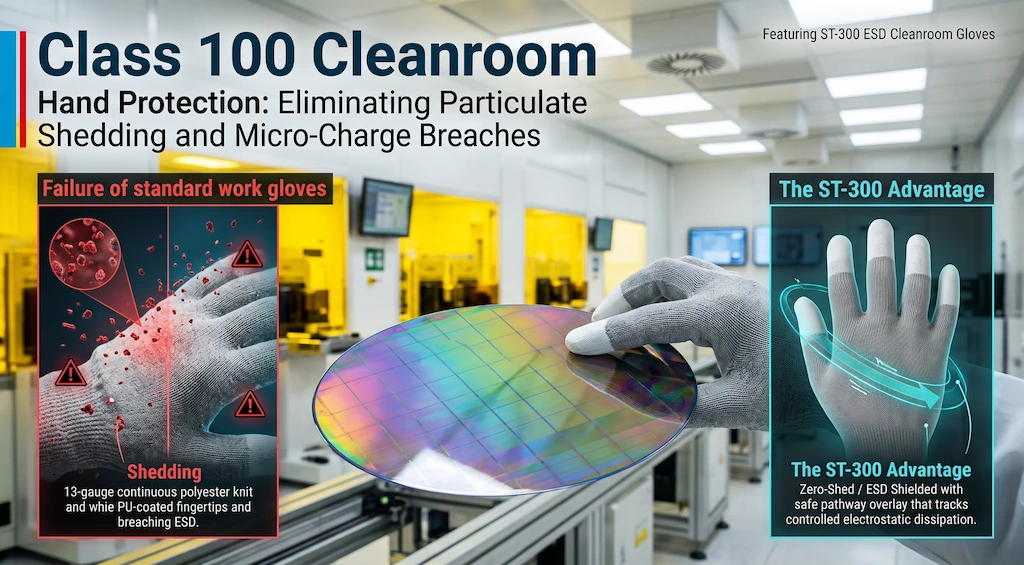
In advanced semiconductor packaging, wafer fabrication, and optical display assembly, adopting class 100 cleanroom esd gloves lint free standards is essential for safeguarding chip yields against microscopic defects. In Class 100 controlled cleanrooms compliant with the ISO 14644-1 Class 5 standard, manufacturing processes have an almost intolerant tolerance for environmental microcontamination: any airborne particles (APC) or liquid-borne particles (LPC) as small as 0.3 micrometers or even at the submicron level, once they settle on a photolithography reticle, an exposed wafer substrate, or on ultra-fine circuits with a pitch of less than 0.4 mm, will directly cause pattern transfer distortion, dielectric breakdown, or hidden micro-short circuits, resulting in the scrapping of large batches of wafers.
However, many manufacturing companies still have critical blind spots when selecting cleanroom consumables, attempting to use standard industrial anti-static gloves as substitutes for specialized cleanroom protective gear. These low-end gloves typically use a blend of short-fiber polyester or cotton yarn for their woven lining. Under the frequent flexing of the operator’s hands and friction from workpieces, broken short fibers are highly prone to shedding, forming visible fuzz and lint (linting). More critically, ordinary gloves that lack a controlled ultra-pure water rinsing process often retain significant amounts of sodium ions (Na⁺), chloride ions (Cl⁻), and chemical volatiles on their surface, causing irreversible ion migration corrosion and optical fogging defects when they come into contact with bare wafers and precision lenses.
Faced with the dual extreme requirements of “zero shedding” and “stable dissipation of transient charges” in high-grade cleanrooms, materials engineering and dipping geometry have provided a clear solution. As the industry-leading protective glove in this field, the ST-300 Antistatic PU glove eliminates the dust-prone short-fiber structure and has fully adopted a seamless knitting system using 100% endless continuous filament polyester across its entire product line. Combined with a minimalist, precision “finger-coated” process, this approach eliminates fabric breakage and fuzz while reducing dust generation from coating compression during hand gripping by 45%. In modern ultra-clean microelectronics manufacturing systems, glove qualification is by no means a simple matter of single-point protection; it must be incorporated into standardized, parameterized engineering considerations. To systematically understand cleanroom protection systems covering different cleanliness levels, conductive grid spacings, and coating configurations, please refer to the ESD Safe & Antistatic Gloves Overview of Professional Protective Products for Electronics Manufacturing at any time.
Cleanroom Classification Dynamics: The Stringency of ISO 14644-1 Class 5
In microelectronics manufacturing and semiconductor front-end processes, the level of environmental control directly determines the upper limit of fault tolerance for production line yield. Compared to conventional industrial assembly workshops, Class 100 cleanrooms impose nearly extreme physical constraints on the dynamic control of particle concentration. As the end interface that comes into frequent mechanical contact with precision workpieces, the material stability and dynamic particle emission rate of the protective gear worn by operators directly determine whether the local microenvironment in the work area can be maintained within controlled tolerances.
Airborne Particle Count Limits in Class 100 Environments
According to the ISO 14644-1 cleanliness classification system established by the International Organization for Standardization (ISO), ISO Class 5 (i.e., Class 100 as defined by the U.S. Federal Standard FED-STD-209E) sets extremely stringent upper limits for airborne particle concentrations:
Airborne Particle Concentration (APC) Threshold: Under dynamic operating conditions for ISO Class 5, the total number of airborne particles greater than or equal to 0.5 micrometers per cubic meter of air must be strictly controlled to 3,520 or fewer; for particles with diameters greater than or equal to 0.1 micrometers and 0.3 micrometers, there are also strictly defined, progressively decreasing tolerance limits. This threshold implies that the particle balance in the workshop air is maintained almost entirely by the ultra-high-efficiency air filters (HEPA/ULPA) in the laminar flow purification systems (FFUs) and the controlled airflow patterns;
Risk of transient peak particle emissions during dynamic operations: In actual production, gloves easily pass coarse screening tests when held statically; however, when operators perform high-frequency flexion and micro-bending movements of the finger joints—such as pinching, sorting, and assembly—the material undergoes alternating shear stress. Low-end occupational safety gloves or substandard anti-static gloves, due to uneven material elastic modulus and short fibers that are prone to breaking and shedding, are highly susceptible to sudden bursts of particle emission (Burst Emission) during finger movements. These localized, instantaneous dust emission peaks can directly disrupt the local clean airflow field, causing the airborne particle concentration on the downwind side of the workstation to surge several-fold within a short period, directly exceeding the environmental threshold for Class 100 cleanrooms.
Micro-Contamination Risks on Bare Silicon Wafers
In high-precision chip manufacturing and advanced 3D stacked packaging processes, microscopic foreign particles that become dislodged and settle on the surface of a wafer or substrate can directly cause catastrophic interface failures:
Submicron particles induce photolithographic pattern distortion: When resin dust or fiber lint—measuring just 0.3 to 0.5 micrometers in size—drifts with airflow and adheres to the wafer surface or a photolithographic reticle, it creates shadowed areas or causes light diffraction distortion during the exposure and development process. These minute geometric deviations are sufficient to cause pattern transfer defects, resulting in open circuits in nanoscale circuit traces or short circuits due to bridging at pattern edges;
Dielectric breakdown and micro-short circuits at pin pitch (Pitch): In ultra-fine pads with a pitch of less than 0.4 mm, flip-chip bumping, and the stress zones of fine-pitch wire bonding, detached micro-conductive dust or organic insulating particles can become directly embedded between adjacent pins. Residual organic insulating impurities can prevent lead-free solder paste from forming a dense metallurgical eutectic, leading to cold solder joints or cold soldering; meanwhile, carbon-containing particles are highly prone to causing localized dielectric breakdown when subjected to operating voltages, resulting in hidden failures during subsequent high-temperature burn-in testing and leading to costly batch scrapping.
Fiber Architecture: Continuous Filament Polyester vs. Staple Yarn
In the engineering design of cleanroom gloves, the geometric morphology of the liner fabric fibers is the fundamental physical factor determining its dust-shedding lifespan. While traditional industrial work gloves and high-grade cleanroom gloves may feel similar to the touch at the macroscopic level, at the microscopic level of fiber topology, staple yarn and continuous filaments give rise to two distinctly different mechanisms of fiber breakage and dust shedding.
The Linting Mechanism of Short-Staple Fibers
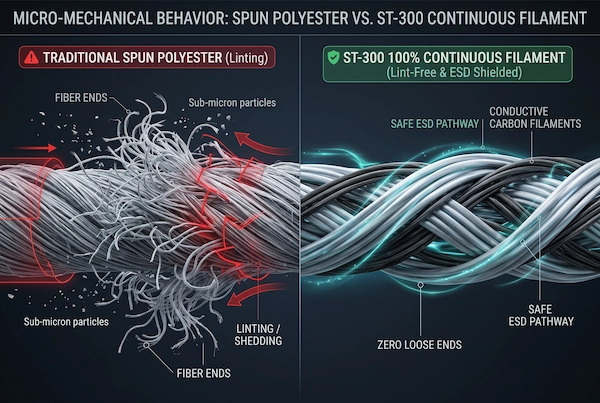
Traditional, low-cost anti-static gloves are commonly knitted using short-staple polyester (spun polyester) or cotton-polyester blended yarns. These yarns are formed by twisting and interlocking discrete short fibers that are only a few dozen millimeters in length. Their inherent discrete fiber structure makes them unsuitable for high-cleanliness applications:
Loose Fiber Ends and Fuzzing Risks: On the surface of short-staple yarns, there are tens of thousands of loose fiber ends that have not been fully incorporated into the center of the twist. When at rest, these ends lie flat against the yarn’s surface due to the compressive force of the twist; however, once the gloves are put into actual use, the internal twist angle of the yarn undergoes dynamic deformation due to the frequent stretching of the operator’s hands, causing these free ends to rapidly curl up and protrude, forming a dense layer of fuzz on the glove’s outer surface;
Mechanical friction-induced breakage and linting: Upon contact with rough material bins, PCB edges, or metal guide rails, the exposed short fiber ends are subjected to periodic tangential frictional shear forces. Since individual short fibers lack macromolecular bonds extending their entire length, the exposed ends rapidly undergo fatigue pull-out and fracture under slight tensile stress, resulting in visible, scattered fiber lint (linting). Airflow turbulence causes these lint particles to settle on the surface of wafers or photolithographic masks, directly causing irreversible optical masking and physical microcontamination.
100% Endless Continuous Filament Polyester in ST-300
To fundamentally eliminate the physical mechanism causing short fibers to break and shed, the ST-300 completely revolutionizes traditional short-staple spinning logic by incorporating full-length continuous filaments as the core backbone of its dust-free protection system:
100% Endless Continuous Filament Polyester Architecture: The inner lining of the ST-300 is woven from filament fibers produced using high-purity continuous polymerization spinning technology. Across the entire macro-length of the yarn, each micro-filament is a seamless, infinite-length single filament with no joints or break points. This structure physically and geometrically eliminates the possibility of fiber breakage, eliminating the risk of fuzz and pilling caused by exposed ends;
High Interlacing Self-Locking Force Ensures Zero-Lint Performance: Through an ultra-fine, high-density, seamless knitting process, continuous polyester filaments are tightly interlocked with bicomponent conductive carbon fibers, forming extremely high fiber interlacing force and a microscopic self-locking network at the interfaces. Under harsh operating conditions involving tens of thousands of high-frequency bends, pinching, and scraping against panel edges, the macromolecular segments within the fiber bundles work together to withstand tensile strain. This prevents not only the slippage and extraction of individual microfibers but also breakage and disintegration under stress and abrasion, consistently maintaining a smooth, flat, mirror-like fiber contour and establishing a physical “Zero-Lint” defense line that meets Class 100 cleanroom standards.
Geometry Innovation: Why Finger-Coated (ST-300) Gloves Reduce Particle Emission by 45%
In the design of gloves for semiconductor packaging and testing and Class 100 cleanrooms, controlling particle emission depends not only on the purity of the polymer resin formulation but also on the spatial distribution geometry of the dip-coating. Many process engineers often mistakenly believe that “the larger the coated area and the tighter the fit, the better the glove’s particle emission suppression.” However, in real-world dynamic operating environments, the mechanical deformation caused by flexing and extending the palm completely overturns this intuitive assumption.
Palm-Coating Flexural Compression Mechanics
Although palm-coated gloves excel in mechanical abrasion resistance and slip-resistant grip, their large, continuous polymer coating layer acts as a hidden accelerator of dynamic particle shedding in ultra-clean, controlled workshops:
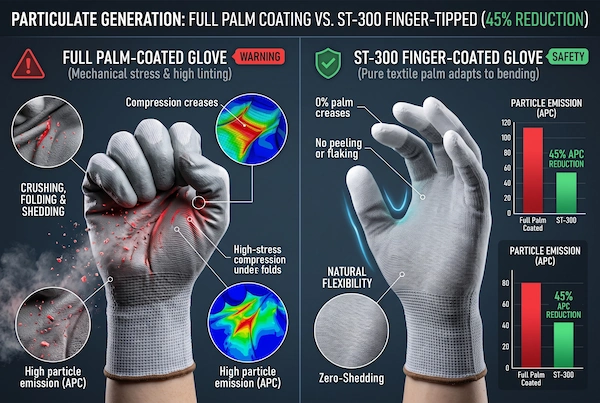
Bidirectional Compression Folding and Stress Concentration: When workers clench their fists, grip the handles of wafer baskets, or transport material containers, the skin of the palm and the inner liner fabric undergo severe area contraction; the solid polyurethane (PU) coating covering the palm consequently experiences bidirectional compressive strain in both the transverse and longitudinal directions. Since the cured polymer film cannot contract uniformly under pressure, the adhesive surface is forced to develop dense raised creases and microscopic folds;
Micro-compression delamination and fatigue cracking of the film layer: In areas of peak stress within the creases, the molecular chains of the film undergo intense localized compression shear. After thousands of dynamic bending cycles, stress concentration at the microscopic folds rapidly tears the dense phase of the film surface, triggering the propagation of microscopic microcracks. As the hand repeatedly opens and closes, adjacent creases rub against and grind each other, causing resin debris to be forcibly “squeezed off” from the weak edges of the micropores. This generates a high concentration of submicron dust, which is directly discharged into the cleanroom environment due to airflow turbulence.
Finger-Coated Geometry and Reduced Surface Shear
To break the vicious cycle between polymer fatigue compression in the palm and dynamic dust generation, the ST-300 employs a radical approach to simplifying the coating structure, utilizing a precise “finger-coated” geometric topology:
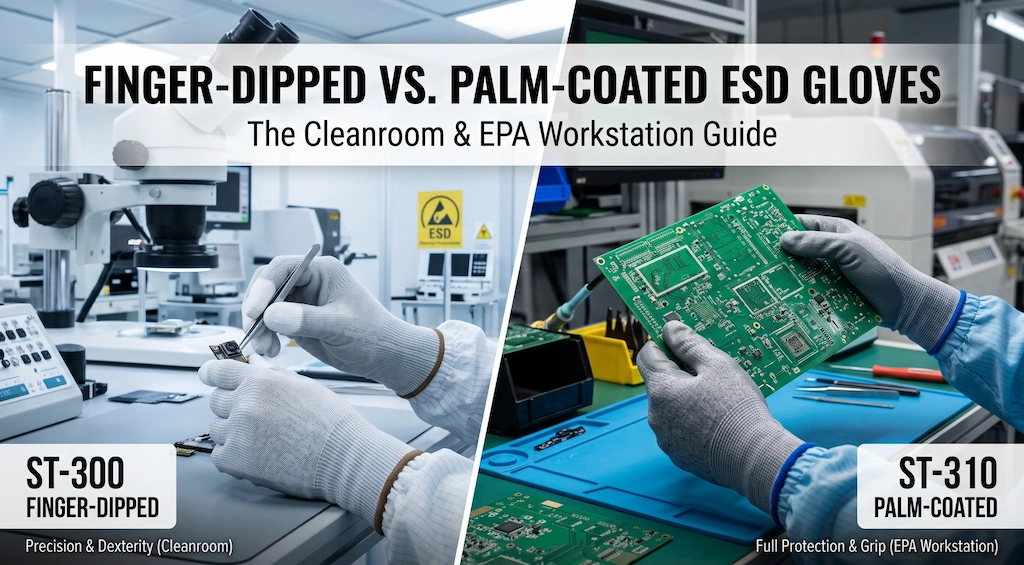
Localized Coating in Key Contact Areas: The ST-300 strictly limits the polyurethane coating to the pads and tips of the five fingers (Finger-coated), while completely omitting the coating from the entire palm and heel areas, preserving the original, pure-knit surface of 100% continuous filament polyester and carbon fiber;
Elimination of palm shear stress and a 45% reduction in particulate dispersion: Since there is no large-area hard polymer coating on the palm, when workers frequently clasp their hands, make fists, or grasp objects, the palm fabric relies solely on the adaptive sliding of flexible fiber loops to absorb deformation. This fundamentally eliminates the physical conditions that cause the coating to develop creases, become brittle, or peel off due to compression. In the Helmke Drum dynamic particulate emission calibration—conducted in strict accordance with the IEST-RP-CC003.4 standard—the ST-300, which lacks a palm coating, demonstrated a 45% reduction in the total dynamic emission of airborne particulates (APC) greater than or equal to 0.5 micrometers compared to full-palm coated gloves of the same material and specifications;
Ultra-clean contact and high breathability: The localized micro-coating on the fingertips not only provides precise, non-slip friction for handling tweezers, fine coaxial cables, and micro-pins, but also maintains an excellent sweat-wicking and breathable microclimate (air permeability) on the palm using all-natural fabrics, balancing the Class 100 cleanroom’s stringent zero-shedding standards with comfortable handling during extended wear.
Deionized (DI) Water Washing & Class 100 Vacuum Packaging Protocol
In a manufacturing process that meets ISO Class 5 cleanroom standards, the glove knitting and fingertip dipping processes merely establish the basic physical form of the gloves. Gloves fresh off the production line that have not undergone rigorous post-processing still retain large amounts of machining dust, release agent residues, and airborne particles adhering to the fiber interstices and the surface of the coating. The key challenge in transforming basic gloves into high-yield, wafer-grade protective gear lies in the ultra-pure water deep-rinse and controlled vacuum dust-free packaging procedures that must be performed prior to shipment.
18-Megohm Ultra-Pure DI Water Multi-Stage Cascading Rinse
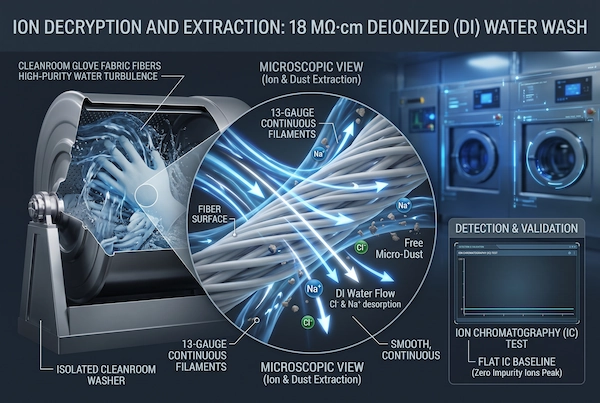
Conventional industrial gloves are only subjected to a rough wash using ordinary municipal tap water or simply softened water. The large amount of mineral ions dissolved in the water crystallizes and remains on the fiber surface after drying, becoming a hidden source of chemical contamination in cleanrooms. The ST-300’s purification process strictly relies on an industrial-grade, double-door, isolated dust-free washing machine system and is carried out in a fully enclosed, controlled environment:
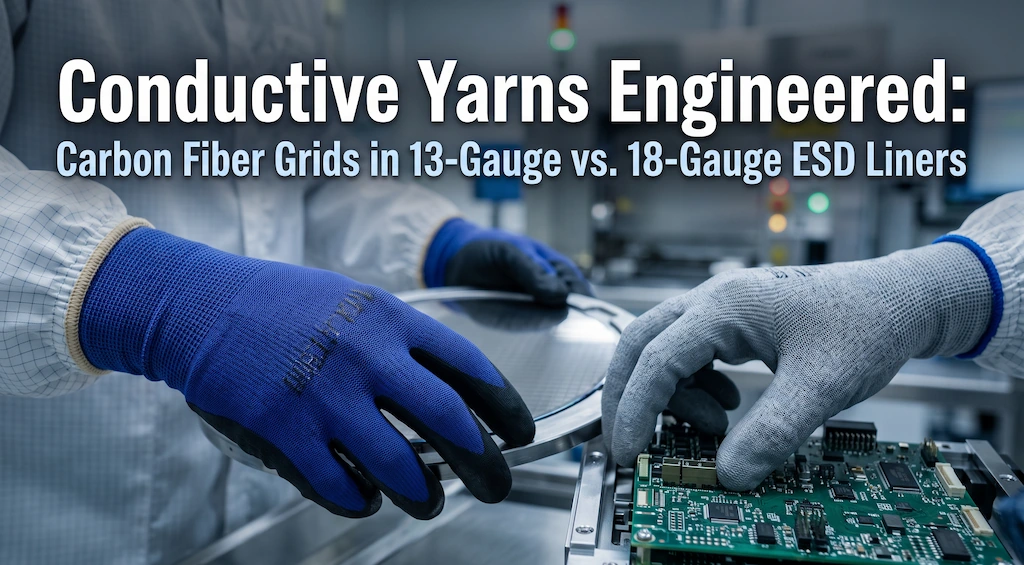
18-Megohm Ultra-Pure Deionized Water (18 MΩ·cm DI Water) Multi-Stage Counter-Current Rinse: The cleaning medium consists entirely of 18-megohm ultra-pure water prepared through multi-stage reverse osmosis (RO) and continuous electrodialysis (EDI) systems. Ultra-pure water possesses extremely high chemical purity and a high capacity for dissolving unsaturated ions. During the multi-stage cascading rinse process, it penetrates the microscopic pores of 13-gauge continuous filaments and polyurethane adhesive layers, powerfully extracting and displacing microscopic processing impurities deeply embedded within the fiber interlacing points;
Molecular-Level Elution of Corrosive Anions and Cations: In semiconductor front-end processes, chloride ions (Cl⁻) are the primary cause of intergranular electrochemical corrosion in aluminum-copper interconnect wires, while light alkali metal cations such as sodium ions (Na⁺) and potassium ions (K⁺) are critical mobile ionic contaminants that cause gate leakage in transistor gate oxide layers. By continuously monitoring the conductivity of the eluent using an ion chromatograph (IC), the ST-300 undergoes 4 to 6 cycles of dynamic flushing with high-resistance ultrapure water, reducing the total concentration of trace chloride ions, nitrate ions, sulfate ions, and sodium and potassium ions on the glove surface and in the leachate to within the limit tolerances of micrograms per gram (ppm or even ppb);
Thorough desorption of microscopic suspended particles (LPC): Through the synergistic action of gentle shear forces from deionized water flow and controlled mechanical agitation, free dust particles ranging from 0.2 to 0.5 micrometers—which were adsorbed by environmental static electricity during the glove’s knitting process—are continuously stripped away, suspended, and flushed out through a counter-current flow into the wastewater system, thereby eliminating the risk of secondary particle transfer when operators handle wafers with their hands.
HEPA-Filtered Clean Drying and Double-Bag Vacuum Sealing
Once the washing cycle is complete, if the gloves are exposed to an unpurified, conventional environment or subjected to uncontrolled thermal drying, all the results of the preceding cleanroom processes will be completely nullified. The ST-300’s post-wash thermal drying and final packaging procedures adhere to strict dust-free physical control protocols:
Strictly controlled low-temperature dehumidification drying (<60°C thermal limit): After being discharged from the clean side of the isolated washing machine, the wet gloves are directly loaded into a dedicated clean recirculating air dryer. All drying air undergoes continuous, multi-stage purification through H14-grade ultra-high-efficiency particulate air (HEPA) filters (with a filtration efficiency of 99.995% at 0.3 microns). The equipment strictly maintains the hot air exhaust temperature between 50°C and 55°C, strictly prohibiting any exceedance of the 60°C upper limit. Excessively high drying temperatures not only cause thermal-oxidative degradation and microscopic embrittlement of the polyurethane resin—leading to accelerated chalking of the coating during subsequent use—but may also cause thermal shrinkage and deformation of the conductive carbon fiber layer woven into the inner liner. Controlled low-temperature drying thoroughly removes moisture from deep within the fabric while fully preserving the high elasticity, toughness, and ductility of the PU coating, as well as the geometric stability of the conductive mesh;
Anti-static double-layer vacuum packaging in an ISO Class 4 environment: Once drying is complete, the gloves are transferred directly through a sealed, dust-free pass-through window to the ISO Class 4 (Class 10 laminar flow protection zone) final packaging workstation without ever leaving the cleanroom environment. After inspectors wearing powder-free nitrile gloves conduct 100% laser particle and visual spot checks, the gloves are immediately placed flat into an inner anti-static clean bag, vacuum-sealed, and heat-sealed to prevent the ingress of external air and moisture; they are then placed into an outer, thickened anti-static shielding bag for a secondary vacuum seal (Double-Bag Vacuum Sealing). This double-layer clean packaging not only ensures that the gloves remain protected from external dust and electrostatic fields during long-distance logistics and storage but also allows users to remove the contaminated outer bag upon entering the Class 100 cleanroom gowning room, bringing the absolutely clean inner bag directly into the core work area and preventing any external micro-contamination from entering the production core zone.
Workstation Purity & ESD Specification Matrix
In vendor qualification for material introduction into ISO Class 5 cleanrooms and advanced process production lines, the engineering and technical team’s evaluation criteria for anti-static gloves have long gone beyond simply comparing unit prices for single- or double-layer gloves. If ordinary personal protective equipment (PPE) gloves or standard industrial anti-static gloves are mistakenly used in a Class 100 environment, the risks posed by particle shedding and electrostatic micro-discharges will directly result in costly wafer scrap. To establish clear technical admission thresholds, the table below provides an engineering-based, quantitative side-by-side comparison of three mainstream glove categories based on physical microstructure, chemical purity, and electrical dissipation standards.
Cleanroom Hand Protection Benchmark Table
| Evaluation Metrics | Standard, low-end work gloves / PU gloves | Standard EPA Anti-Static Palm-Coated Gloves | ST-300 Ultra-Clean Finger-Coated ESD Gloves | Industry Test Standards (Protocol) |
| Cleanroom Classification (ISO Class) | Not suitable for controlled environments (extremely high dust generation) | ISO Class 7–8 (Class 1,000 to Class 10,000 cleanrooms) | ISO Class 5 (Class 100 Cleanroom) | ISO 14644-1 Airborne Particle Cleanliness |
| Yarn Base | Standard polyester staple fiber/cotton yarn blend | 13-gauge polyester staple fiber + conductive carbon filaments | 100% continuous, seamless polyester filament + conductive carbon fiber | Microscopic Cross-Section and Fiber Breakage Length Analysis |
| Coating Style | Full-palm foamed latex / low-end solvent-cured PU | Palm-coated | Precision finger-coated | Geometric Distribution Specifications for Dipping Stations |
| Dynamic Particle Control (LPC/APC) | Extremely high dust generation, prone to forming fine particulate dust | Moderate lint shedding (lint falls off when the palm is bent or squeezed) | Ultra-low dust emission (45% reduction in resin extrusion particles) | IEST-RP-CC003.4 Helmke Drum |
| Ionic Leaching | Not rinsed with controlled ultrapure water; ion levels exceed standards | Standard industrial water washing; trace ionic residue remains | 18 MΩ Multi-stage washing with ultra-pure deionized water | IC Ion Chromatography Assay |
| Surface Resistivity (Rs) | 1.0 × 10^10 ohms or higher (prone to static buildup) | 1.0×10⁶ to 1.0×10⁸ ohms | 1.0×10^6 to 1.0×10^8 ohms | ANSI/ESD STM11.11 Heavy Hammer Test Method |
| Low-Humidity Electrical Compliance (25% RH) | Resistance rises uncontrollably under dry conditions, reaching an insulating state | Partially dependent on humidity; impedance is prone to drift | Strictly compliant with EN 16350 nominal technical specifications | EN 16350:2014 Low-Humidity Pretreatment Test |
| Digital Human-Machine Interface (HMI) | No touch functionality or requires firm pressure to activate | Thicker coating blocks static charge, resulting in sluggish tactile response | Full-sensitivity Micro-Capacitive touchscreen compatibility | Microampere Current Touch Response for Industrial Capacitive Touchscreens |
Synthesis of Critical Yield Parameters
As can be seen from the engineering data matrix above, the synergy between material selection and geometric design in the ST-300 directly eliminates critical failure paths in semiconductor front-end and advanced packaging processes:
Synergistic dust protection provided by microfibers and finger-dipped topology: The reason traditional anti-static gloves are limited to Class 7–8 (ISO Class 7–8) cleanrooms lies in inherent defects in their material mechanics and fabric architecture. When subjected to slight stretching, the ends of short fibers continuously peel off and fuzz, while the large-area PU coating on the palm generates sustained mechanical folding and compression stress as the operator repeatedly flexes their hand. This forces the hardened microporous structure to rupture, ejecting submicron-sized resin dust outward. The ST-300 utilizes 100% continuous, endless polyester filaments, eliminating free fiber ends at the source; Combined with a fingertip-dipping structure that eliminates the coating on the palm, it prevents the self-abrasion effect of the coating during hand flexion, reducing dynamic APC dust emission by 45% and effectively meeting the ISO Class 5 cleanroom standard of no more than 3,520 particles of 0.5 microns per cubic meter;
Ultra-pure water rinsing prevents chemical corrosion caused by metal ions: In wafer-level packaging and testing processes, controlling physical dust alone is insufficient to ensure yield. Gloves that have not undergone deep rinsing with 18 megohm ultra-pure deionized water contain large amounts of sodium (Na⁺), potassium (K⁺), and chloride (Cl⁻) ions adhering to the pores of their fibers. These ions can cause trace molecular-level transfer when workers handle wafer cassettes or lead frames. During subsequent high-temperature reflow soldering and environmental aging, chloride ions can directly cause intergranular corrosion and open circuits in metal interconnects, while alkali metal ions can migrate into the semiconductor oxide layer, inducing fatal leakage currents. The ST-300 undergoes rigorous multi-stage counter-current rinsing with deionized water, ensuring that ion leaching levels remain within microgram-level tolerances and providing chemical-level inert protection;
Controlled impedance range prevents discharge-induced damage: Standard work gloves have surface resistances as high as 1.0×10^10 ohms or more, making them highly prone to generating thousands of volts of uncontrolled static charge through friction; conversely, some low-quality metal-blend conductive gloves have excessively low impedance (below 1.0×10^5 ohms), which can trigger transient high-current discharge arcs (Spark Discharge). The ST-300 utilizes a three-dimensional continuous carbon fiber mesh to stabilize surface resistance within the optimal dissipation range of 1.0×10⁶ to 1.0×10⁸ ohms, ensuring microsecond-level elimination of electrostatic transients while eliminating the risk of current breakdown in sensitive gates, while maintaining long-term reliability even under the extreme low-humidity conditions (25% RH) specified in EN 16350.
Electrostatic Discharge Integrity: Controlled Dissipation vs. Arc Discharge
In the assembly and testing processes for electrostatic-sensitive devices (ESDS), many production line managers hold the serious misconception that “the higher the conductivity of the gloves and the lower the resistance, the safer it is.” In fact, the physical damage caused by electrostatic discharge depends not only on the total amount of charge but also on the peak current and the rise time of the pulse energy during discharge. At nanoscale semiconductor process nodes, hard grounding without buffering impedance can cause far greater damage than slowly accumulated electrostatic induction.
Avoiding Hard Grounding and Spark Discharges
As the thickness of transistor gate oxides has been reduced to less than a few nanometers, the threshold for a chip’s tolerance to transient currents has dropped to the nanosecond range. During bare wafer handling and the assembly of sensitive components, the use of conductive gloves with excessively low surface resistance (less than 1.0×10^5 ohms) can easily trigger catastrophic Charged Device Model (CDM) failure:
Transient high-current pulses and localized Joule heating: When a device carries induced charge during process handling and comes into contact with a hard-grounded interface with a resistance lower than 1.0×10⁵ ohms, the charge undergoes an avalanche-like transient neutralization in less than 1 nanosecond. The extremely steep current rise rate (di/dt) generates transient discharge pulse currents as high as several amperes. According to Joule’s law, as this pulse energy passes through the micrometer-scale interconnects and PN junction interfaces inside the chip, it instantly produces intense localized thermal effects;
Arc Discharge and Microscale Melting: At the instant the micrometer-scale air gap between the fingertip and the device is broken down, the resulting micro-spark arc (Spark Discharge) not only causes electromigration in the metal interconnects—and even their physical vaporization and melting—but also breaks down the fragile insulating dielectric layer. Compared to immediate catastrophic failures, such micro-discharges often trigger more subtle latent defects, allowing the chip to barely pass routine functional electrical testing before shipment, only to suddenly fail after several weeks of service at the end-user’s site due to the progression of microcracks. Therefore, strictly avoiding conductive gloves with excessively low resistance that act as hard grounds is the primary safety principle for front-end and packaging workstations.
Carbon Grid Continuity under EN 16350 Certification
To achieve a precise engineering balance between “eliminating spark discharge” and “preventing charge buildup,” the ST-300 strictly regulates electrostatic discharge within a controlled range through the synergy of materials and weaving systems:
Locking in the optimal dissipation range (1.0×10⁶ to 1.0×10⁸ ohms): The ST-300’s inner lining is made from a homogeneous blend of 13-gauge continuous filament polyester and high-purity bicomponent conductive carbon fibers. The conductive carbon fiber filaments are tightly interlocked at microscopic, equidistant intervals within the fabric’s three-dimensional loops, endowing the finished product with an extremely uniform surface resistivity that remains stable over the long term within the “golden window” for electrostatic dissipation (1.0×10⁶ to 1.0×10⁸ ohms). This resistance range acts like a precise high-frequency damping absorber connected in series within the charge dissipation path, causing electrostatic charges to decay to ground via a smooth, controlled nanoampere-level microcurrent at the moment of contact (charge decay time less than 0.1 seconds), thereby eliminating the physical possibility of spark discharge and overcurrent melting;
EN 16350 Compliance Verification for Extremely Low Humidity (25% RH): In modern temperature- and humidity-controlled cleanrooms, intense air exchange often results in locally low relative humidity. The ST-300 strictly adheres to the pre-conditioned humidity testing requirements of the EN 16350:2014 standard; even in extremely dry environments of 25% RH, its vertical resistance (Rv) remains below the compliance threshold of 1.0 × 10⁸ ohms, maintaining a drift-free dissipation path without relying on electrolytes from workers’ hand sweat;
Closed-Loop Safe Discharge in a Finger-Dipped Architecture: The impact of glove coating immersion coverage on electrostatic fields and charge discharge geometries has been thoroughly discussed in the earlier technical paper, Finger-Dipped vs. Palm-Coated ESD Gloves. The ST-300 employs a precision finger-coated geometric topology, ensuring that when operators use their fingertips to grip the edges of wafers or micro-tweezers, the point of contact aligns directly with the composite discharge interface consisting of conductive carbon fibers and an ultra-thin PU coating. Charge is rapidly conducted through the microporous structure on the fingertip into the continuous carbon mesh of the inner liner, then unimpeded to the back of the hand and a standard grounded wrist strap system, establishing a safe, closed-loop discharge system with zero blind spots and zero charge retention in the fingertip work area.
Ergonomics and Tactile Sensitivity for 0201 Components & Wafer Sorting
In the placement of miniaturized passive components and wafer-level sorting operations, the thickness and elasticity of protective gear directly determine the precision of an operator’s tactile perception at the fingertips. As component package sizes shrink to their limits, operators may lose sensitivity to subtle pressures due to bulky gloves or stiff fingertip coatings, making it highly likely that workpieces will fracture during delicate picking operations. At the same time, the stuffy, sweaty conditions caused by prolonged glove wear pose a hidden hazard, as they can lead to micro-leaks of sweat and component oxidation.
Tactile Transmission in Vacuum Tweezers and Cassette Handling
At workstations for ultra-micro component assembly and bare die transfer, operators typically rely on precision vacuum tweezers, anti-static Teflon tweezers, or their bare hands to stabilize and transport wafer carriers, which places extremely high demands on the ability to perceive minute displacements with the fingertips:
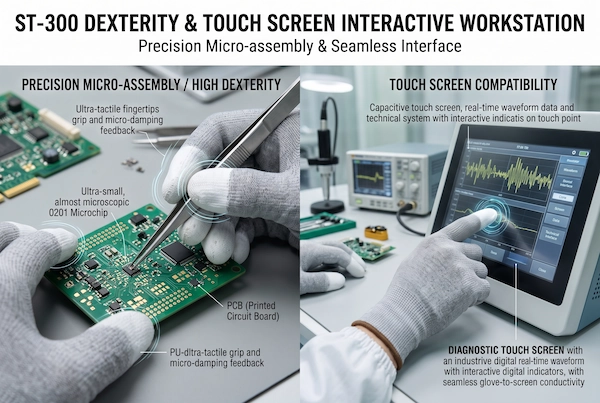
Micro-damping force transmission enabled by 13-gauge seamless knitting: The ST-300 utilizes a 13-gauge high-density seamless knitting process, eliminating seam bulges on the inner side of the fingertips and hard knots from loose threads along the edges. The soft, form-fitting continuous filament base snugly wraps around the finger muscles, virtually eliminating slippage caused by gaps between the fabric and the skin. This allows workers to perceive changes in finger pressure at the gram level when pressing the vacuum tweezers button or manually tightening the fine-tuning screws on clamps;
A micro-coating on the fingertips prevents cracking due to mechanical overpressure: The ultra-thin polyurethane coating applied to the fingertips and pad provides excellent microporous resilience and anti-slip grip properties. When handling ultra-thin silicon wafers with a thickness of only 100 to 150 micrometers or 0201 micro-capacitor components measuring just 0.6 mm × 0.3 mm, the fingertip coating acts as a microscopic elastic cushion, preventing direct, rigid impact between the hard finger and the fragile, brittle wafer. Operators can precisely control the force applied by the tweezers, preventing workpieces from slipping and falling due to insufficient grip while also avoiding edge chipping or internal microcracks caused by excessive force;
Stable force feedback during wafer cassette transfer: When manually handling quartz or PEEK cassettes filled with unsliced 12-inch wafers, the ST-300’s fingertip coating provides a reliable coefficient of kinetic friction, allowing operators to maintain balance with only moderate lifting force and eliminating the risk of an entire cassette of wafers shattering due to gloves slipping off.
Breathability: Preventing Sweat Seepage
During full-shift cleanroom operations lasting more than 8 consecutive hours, hand microclimate control directly affects product cleanliness and operational stability:
Full Natural Convective Air Permeability (Air Permeability) on the Palm: Unlike fully sealed palm-dipped gloves, the ST-300 features only localized dipping at the fingertips, while the entire palm, lower palm edge, and back of the hand remain completely open with a pure fabric structure. The microporous fabric mesh, composed of 13-gauge continuous filament polyester and carbon fiber, offers excellent air convection and water vapor diffusion properties (air permeability). As the fingers and palm move, they naturally drive airflow in and out, rapidly dissipating the moist heat generated by body temperature to the outside of the glove, thereby preventing the high-humidity, clammy “greenhouse effect” that results from a sealed palm;
This eliminates the risk of contamination from electrolyte-rich sweat seeping out: inside fully sealed coated gloves, sweat remains on the skin’s surface and is highly prone to accumulating under high pressure at the needle-hole gaps in the fingertips or at the wrist opening. When frequently handling workpieces, sweat vapor—which contains large amounts of sodium ions, lactic acid, and oils—is highly prone to being forced outward through microscopic pores under pressure, leaving irreversible corrosive droplets and sweat stains on precision optical lenses, laser windows, or gold-plated solder pads. The ST-300 maintains the operator’s hands in a dry state at all times through highly efficient moisture wicking in the palm area, physically blocking the pathways for the outward migration of sweat electrolytes at the source and ensuring the absolute cleanliness of highly sensitive optical components.
Deployment of High-Yield Semiconductor Workstations
In semiconductor manufacturing and micro-optical packaging systems, the proper configuration of protective gear must precisely align with the physical cleanliness tolerances and process operations of specific workstations. Unlike heavy-duty machining, operations in ultra-clean, controlled workshops are characterized by high-frequency handling, extremely low particle tolerances, and absolute sensitivity to chemical marks. With its 100% continuous filament seamless inner liner, localized fingertip coating, and microcapacitive touch support, the ST-300 has established standard operating procedures at the following three key high-yield semiconductor workstations.
Photolithography Reticle & Wafer Cassette Inspection
The photolithography process is the physical core of front-end chip manufacturing and is classified as an ultra-high-pressure zone requiring strict particle and electrostatic control:
High-magnification inspection and handling of photolithography reticles: In the yellow-light zone, next to high-magnification deep ultraviolet (DUV/EUV) defect inspection stations and quartz reticle cleaning machines, technicians must manually unpack, inspect, and transfer specialized sealed containers (RSPs) loaded with chrome-coated reticles. Any submicron dust particles landing on the surface of the chromium layer or protective pellicle will result in permanent pattern defects during repeated micro-exposure cycles on a stepper. The ST-300’s continuous filament fabric eliminates the risk of fiber breakage and shedding at the ends, while its ultra-clean micro-coating on the fingertips provides stable static friction for gripping the reticle’s outer edges, preventing tool slippage and collisions;
Wafer Cassette Transfer and Macro Visual Inspection: During back-end processes such as chemical mechanical planarization (CMP) and thin-film deposition, quality control inspectors must securely support cassette carriers loaded with multiple 12-inch uncut wafers. The ST-300’s 13-pin-fit inner liner, combined with its anti-slip fingertip design, allows operators to clearly sense the force balance point on the carrier handle. This enables smooth material transfer while avoiding the risk of gloves slipping off due to excessively thick coatings and eliminating localized particle generation.
Cleanroom SMT Placement & AOI Automated Inspection
Ultra-high-density surface mount technology (SMT) production lines are evolving toward ultra-miniature passive components such as 0201, 01005, and even 008004. This process requires exceptional dexterity and the ability to coordinate with digital machinery:
Precise component pickup and tape feeding by micro-component feeders: When operating ultra-fine-pitch SMT placement machines, operators must frequently perform tape cutting, copper clip crimping, and feeder feeding operations. The ST-300 applies precision coating only to the fingertips, leaving the palms free of thick, restrictive layers of adhesive. This allows workers’ fingers to flexibly perform extremely fine alignment and film-peeling actions, preventing bulky gloves from crushing micro resistors and capacitors or causing feeding failures;
Touchscreen Interaction for AOI (Automated Optical Inspection) Systems: Modern Class 100 SMT inspection stations are widely equipped with projected capacitive (PCAP) touchscreens and industrial control terminals. The ST-300’s conductive carbon fiber network, combined with a thin layer of PU on the fingertips, forms a micro-capacitive coupling that directly enables the gloves to interact with touchscreens in real time. When inspectors verify solder joint defects on circuit boards and calibrate defective component parameters on the tablet, they do not need to frequently put on and take off their gloves. This not only improves the workstation cycle time (UPH) but also completely eliminates the risks of grease contamination and static electricity from handling components with bare hands after touching the screen.
Precision Laser Diode & Optical Transceiver Packaging
The packaging stations for optical transceiver modules and automotive-grade LiDAR emitter chips are among the areas most sensitive to microscopic dust and volatile substances at the interface:
Protection of the semiconductor laser (laser diode) lens output aperture: During the micrometer-level micro-assembly process for 400G/800G optical communication silicon photomodules, the output aperture of the semiconductor laser chip is typically only a few micrometers wide. When operators repeatedly grip tweezers to align components while wearing standard dip-coated gloves, the creases in their palms compress and disperse resin particles, which easily become airborne and settle on the surfaces of gold-tin solder, isolators, or microlenses. This directly causes refraction and scattering in the optical path, leading to severe attenuation of the light output power (LOP);
Preventing photochemical fogging inside hermetically sealed packaging chambers: The ST-300 employs a multi-stage elution process using ultrapure deionized water and a controlled drying process to thoroughly remove volatiles and free particulates from polymer coatings. At the same time, the fingertip micro-coating design reduces resin extrusion-induced dust generation by 45%, ensuring that no microscopic organic dust remains inside the cavity when assembling tube caps and optical windows (TO-Can) under nitrogen-protected glove boxes or Class 100 laminar flow hoods. This eliminates at the source the catastrophic optical decay and failure caused by dust carbonization and fogging during long-term continuous operation and heating of the laser.
Quality Verification: Helmke Drum and Particle Counter Testing SOP
In semiconductor manufacturing and high-precision optical packaging qualification systems, the quality assessment of anti-static, dust-free gloves must never rely solely on verbal assurances from suppliers or single-page test reports. Incoming Quality Control (IQC) and production line Quality Assurance (QA) teams must establish standardized, repeatable, closed-loop testing standard operating procedures (SOPs) to conduct rigorous batch sampling for active particle count (APC) and electrical impedance continuity, ensuring that every batch of protective gear introduced into Class 100 cleanrooms remains within controlled technical thresholds.
IEST-RP-CC003.4 Standard Drum Testing Procedure
The IEST-RP-CC003.4 standard, established by the International Society for Environmental Science and Technology (IEST), is the globally recognized benchmark for dynamic particle emission testing in the semiconductor and cleanroom consumables industries. This procedure quantifies the emission rate of airborne particles by simulating the rolling, impact, and friction-induced deformation of gloves during actual operations:
Sample pretreatment and test environment calibration: Sampling must be conducted under a vertical unidirectional laminar flow hood rated at ISO Class 4 or higher to ensure that the background particle count in the test environment is close to zero. Randomly select 10 ST-300 gloves (5 pairs) from sealed, cleanroom-grade packaging and allow them to equilibrate for 24 hours in a constant-temperature (20°C to 25°C) and controlled-humidity environment;
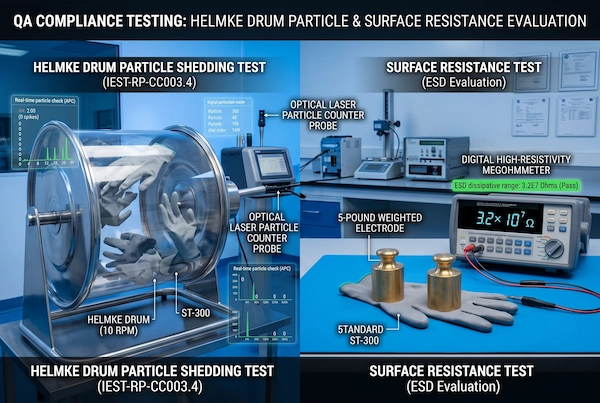
Test drum mechanical parameters and motion settings: Place the gloves to be tested entirely into a dedicated stainless steel Helmke Drum with a polished inner surface. The drum rotates clockwise at a constant speed of 10 RPM (10 revolutions per minute). Driven by the internal blades of the drum, the gloves are rhythmically lifted and dropped from the top, creating uniform, controlled, and gentle folding impacts that precisely replicate the high-frequency hand movements of production line operators;
Isokinetic Sampling Probe and Laser Counter Configuration: The sampling bell-mouth probe of the optical laser particle counter must be strictly positioned directly over the center of the drum’s axial exhaust port to maintain isokinetic suction sampling. The counter’s sampling flow rate is set to the standard 1.0 cubic feet per minute (CFM, or 28.3 liters per minute), and cumulative data is collected continuously for at least 10 minutes after the drum begins rotating;
Acceptance Thresholds and Classification: In accordance with the IEST-RP-CC003.4 Cleanroom Classification Matrix, for gloves used in Class 100 (ISO Class 5) controlled workshops, the average release rate per minute of airborne particles (APC) with a diameter greater than or equal to 0.5 micrometers must remain consistently below the control limit for IEST Category 1. Thanks to its 100% continuous filament construction and dipped-tip design, the ST-300 prevents dust generation caused by large-area creasing and compression on the palm. During a continuous 10-minute drum impact test, the emission of particles 0.5 micrometers or larger consistently remained stable within an extremely low detection baseline, completely eliminating the risk of particle emissions exceeding standards.
In-House Resistance and Linting Inspection Protocol
In addition to drum particle testing conducted by professional laboratories, factory QA must also employ rapid, non-destructive on-site inspection procedures during incoming material inspection and routine patrols to perform dual closed-loop verification of resistance and linting:
ANSI/ESD STM11.11 standard heavy-hammer electrode surface resistance re-inspection:
Test Equipment Configuration: Use a high-precision digital high-resistance meter with a measurement range covering 1.0×10³ to 1.0×10¹² ohms, equipped with two standard 5-pound (2.27 kg) drop-weight electrodes, each with a conductive rubber pad on the bottom surface;
Test Geometry Points: Place the ST-300 flat on a Teflon-insulated test mat. The first test point is located between the rubber-coated fingertip and the adjacent fingertip (point-to-point resistance Rp); the second test point is located in the uncoated continuous filament palm area; the third test point spans from the fingertip to the base of the palm (surface resistance Rs);
Voltage Step and Criteria: Apply a 10 V test voltage (when the impedance is greater than or equal to 1.0×10⁶ ohms, the voltage automatically steps up to 100 V and remains stable for 15 seconds). The resistance values at all three core stress points of the ST-300 must fall within the optimal dissipation window of 1.0×10⁶ to 1.0×10⁸ ohms, and the difference in resistance between the fingertips and the palm must not exceed one order of magnitude, to verify the uniform connectivity of the three-dimensional conductive carbon fiber network;
Microscopic Flaking Rapid Spot-Check Procedure Using the Dust-Free Adhesive Tape Method (Tape Test):
Clean pressure-sensitive adhesive tape sampling: Use high-grade, dust-free, anti-static polyester film tape that has been calibrated for particle background, and cut a standard length of 50 mm;
Contact Application and Rapid Peel: Apply the tape smoothly to the junction between the pure-knit palm area and the coated fingertip edge of the ST-300 glove. Roll over the area twice back and forth using a 1-kilogram rubber-covered roller, then peel the tape off smoothly and quickly at a 90-degree angle;
Microscopic Flaking Quantity Verification: Affix the peeled tape to a clean microscope slide and examine it under a 100x optical microscope or a dark-field optical inspector. No discrete broken fibers or fuzz longer than 50 micrometers are permitted within the field of view (indicating an intact filament structure), and no debris particles larger than 10 micrometers are permitted on the coated peel surface. This verifies that the batch of gloves meets the acceptance criteria for abrasion resistance and zero shedding.
Frequently Asked Questions (FAQ)
What makes a glove strictly certified for Class 100 (ISO 5) cleanrooms?
Gloves that meet the requirements for admission to ISO 14644-1 Class 5 cleanrooms must overcome three physical and manufacturing hurdles: First, the inner liner must be made entirely of 100% seamless knitted endless continuous filament polyester, eliminating short-staple yarns that contain broken fiber ends to prevent lint and pilling at the source; Second, the formed gloves must undergo multi-stage counter-current rinsing with 18 megohm·cm ultra-pure deionized water (18 MΩ·cm DI Water) to thoroughly remove adhering particulate dust and corrosive free sodium and chlorine ions; Finally, glove drying and inspection must be conducted in a controlled laminar flow cleanroom, and the gloves must be vacuum-sealed in double-layered anti-static clean bags to ensure they remain free from any external microscopic contamination before opening.
Why does the ST-300 finger-coated glove generate fewer particles than palm-coated gloves?
In gloves with full-palm coating, when workers clench their fists or grasp objects, the large, continuous polyurethane (PU) coating layer undergoes intense bidirectional compression and folding, creating dense microscopic creases and folds. With repeated flexing and extending, these microscopic creases grind against and compress one another, causing the hardened microporous edges to crack and disintegrate, resulting in the outward dispersion of submicron resin debris. The ST-300 employs a finger-coated geometric design, with the coating strictly limited to the micro-contact stress zones at the fingertips, while the palm remains a pure filament fabric surface. By eliminating the micro-compression shear forces generated by the compression and folding of large areas of polymer on the palm, the amount of airborne particulate matter (APC) released during dynamic operations is directly reduced by 45%.
Does the 13-gauge liner provide sufficient ESD protection compared to 18-gauge?
It is more than sufficient. Although 18-gauge gloves offer a more delicate tactile sensation during ultra-fine manual assembly, in terms of physical continuity for charge dissipation, the 13-gauge high-density liner used in the ST-300 is made from a homogeneous blend of high-purity continuous polyester filaments and bicomponent conductive carbon fibers. Its conductive carbon fibers are tightly locked in a three-dimensional coil structure at microscopic, equidistant intervals, ensuring not only a stable resistance within the optimal dissipation range of 1.0×10⁶ to 1.0×10⁸ ohms under normal temperature and humidity conditions, but also passing the pre-conditioned humidity test per EN 16350: 2014, achieving controlled and gradual decay of transient charges and completely preventing spark discharge.
Can ST-300 cleanroom gloves be recycled or laundered?
Yes. ST-300 gloves may be washed and reused in a dedicated Class 100 cleanroom laundry facility. The washing solution must consist of ultra-pure deionized water with a resistivity of 18 megohms, combined with a neutral, non-ionic surfactant, and multi-stage counter-current rinsing must be performed to remove surface impurities accumulated during use. It is particularly important to note that the temperature during hot-air drying after washing must be strictly limited to below 60°C (typically set between 50°C and 55°C) to prevent excessive heat from causing thermal-oxidative aging and embrittlement of the polyurethane resin or compromising the geometric stability of the carbon fiber coating. After drying, surface resistivity (Rs) and dynamic Helmke drum dust emission must be randomly inspected by batch; the gloves may only be put back into service after compliance is verified.
Closing & Engineering Specification Advisory
Actionable Execution Plan: Transition Protocols to Zero-Lint Alternatives
In response to yield fluctuations caused by lint shedding from gloves in wafer dicing, advanced packaging and testing, and high-precision optical lamination workshops, the Engineering and Quality Control departments recommend implementing the following four-step standardized replacement plan:
Precise Identification of Workstations with Lint Risk: Conduct a comprehensive review of key process steps in the photolithography area—including photomask handling, wafer cassette handling, 0201/01005 feeder feeding, and laser lens assembly—and immediately suspend the use of standard cotton yarn gloves and short-fiber polyester antistatic gloves containing loose short fibers or fiber ends;
Measurement of dynamic particle emission and micro-discharges in small batches: Introduce a trial batch of ST-300 Antistatic PU gloves, conducted 10 RPM dynamic drum particle monitoring in an ISO Class 5 cleanroom in accordance with IEST-RP-CC003.4, while simultaneously using an ANSI/ESD STM11.11 drop-weight tester to verify point-to-point resistance, ensuring that both particle emission levels and impedance remained within controlled baseline limits after 8 consecutive hours of operation;
Establish SOPs for controlled washing and temperature control: If the production line has procedures for reusing cleanroom consumables, the Standard Operating Procedures must include “washing with 18 megohm deionized water,” “low-temperature dehumidification drying at <60°C,” and “discharge into double-layered antistatic vacuum bags” to prevent metal ion adsorption and resin thermal embrittlement caused by ordinary water washing;
Standardize cleanroom protective gear material records: Establish 100% continuous, seamless filaments, precision fingertip coating (reducing particle emission by 45%), compliance with EN 16350 for low-humidity antistatic standards, and capacitive touchscreen functionality as core technical specifications, and incorporate them into the company’s factory-level secondary consumables procurement specifications.
To obtain complete LPC/APC particle emission test reports, ion chromatography analysis data sheets, or to request production line testing samples for semiconductor manufacturing, micro-optical modules, and ISO Class 5 cleanrooms, please refer to the Antistatic ESD Gloves Electronic Manufacturing Protection Product Overview, or visit the ST-300 Antistatic PU Glove product page to request detailed engineering specifications.