Selecting between finger coated vs palm coated esd gloves is critical in semiconductor packaging, precision surface-mount technology (SMT), and high-grade cleanroom assembly lines where process yield depends on precise control of operational interfaces. Operators’ hands are not only the physical agents for assembling precision components but also the most active interfaces for charge transfer and sources of micro-contamination within the entire Electrostatic Protection Area (EPA). In microelectronics manufacturing, the potential generated by triboelectric charging on the human body can often reach several thousand volts; once this penetrates exposed pins or gate oxide layers, it can cause irreversible latent breakdown. At the same time, sebum, sweat electrolytes, and particulates emitted from bare hands or substandard protective gear are also major culprits behind pad oxidation, corrosion, and optical contamination.
However, when implementing standardized personal protective equipment (PPE) on production lines, engineering managers and EHS personnel commonly face a dilemma in process selection: choosing between finger-coated and palm-coated ESD gloves.
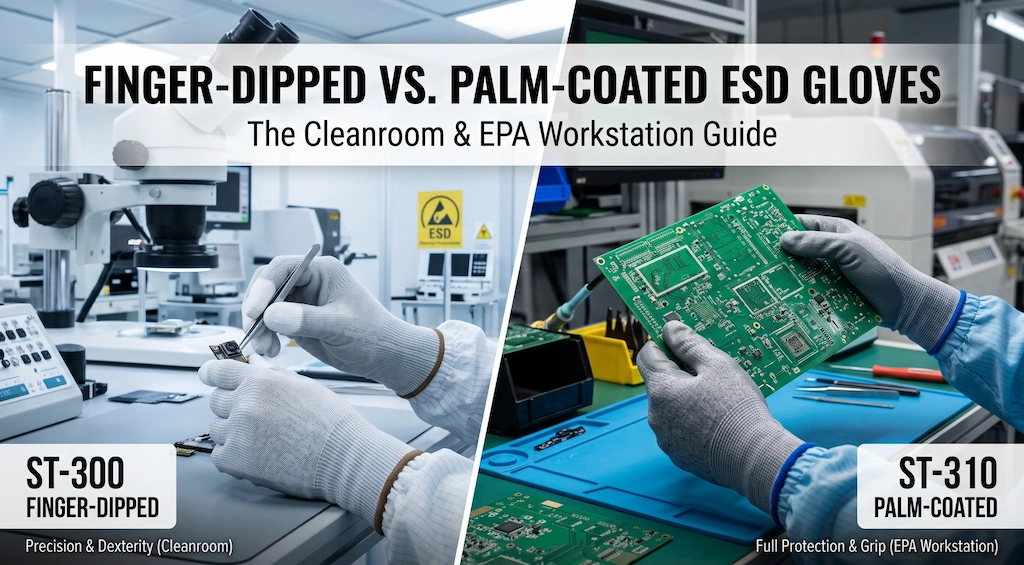
Finger-Dipped Solution: A microporous polyurethane (PU) coating is applied only to the fingertips, while the palm remains fully open-knit. This design offers extremely high breathability and heat dissipation, as well as tactile feedback comparable to bare hands. However, it lacks overall friction damping when gripping heavy workpieces or large circuit boards, and cannot physically prevent accidental contact between the palm and the edges of components;
Palm-Coated Design: The PU coating extends continuously from the fingertips to the base of the palm, providing a continuous mechanical barrier against abrasion, excellent anti-slip friction, and the ability to isolate sebum. However, during 8 hours of continuous operation, the sealed coating blocks natural air convection in the palm, making it highly prone to inducing the accumulation of hand sweat and causing stuffiness and fatigue in the hands.
This tug-of-war between “breathability and dexterity” and “comprehensive protection” directly impacts operators’ compliance with procedures and the actual product failure rate. To completely break the deadlock in product selection, decisions cannot rely solely on workers’ subjective tactile sensations but must be based on quantifiable engineering standards.
This article will conduct a systematic quantitative analysis of the ST-300 (white-gray finger-immersed model) and the ST-300 (gray palm-immersed model) across three engineering dimensions: Tactile Ergonomics, hand microclimate humidity dynamics, and dynamic charge dissipation pathways—to systematically and quantitatively analyze the technical differences between the white/gray finger-dipped ST-300 and the gray palm-dipped ST-310, thereby establishing scientific selection criteria for electronic assembly processes of varying precision levels.
For a systematic comparison of the certified conductive fiber protective products across the entire product line and their anti-static specifications, please refer to the ESD Safe & Antistatic Gloves category technical overview at any time.
Anatomy of Finger Coated vs Palm Coated ESD Gloves: Coating Geometry
The protective boundary and dexterity of anti-static gloves are fundamentally determined by the microscopic geometric topology of the polymer coating. In electronic manufacturing environments, the coating not only serves mechanical functions such as abrasion resistance and slip resistance but also acts as a physical interface directly involved in charge transfer and thermal-moisture exchange. To meet varying requirements for assembly precision, the white-and-gray ST-300 and the all-gray ST-310 exhibit distinctly different structural orientations in the engineering layout of their dipping zones.
Structural Layout of the Dipping Zones
In terms of process control for the dipping molds, the coating’s coverage area directly defines the glove’s physical protection zone and natural ventilation zone:
ST-300 Process (Finger-Dipped): Using a controlled micro-dip process, the microporous polyurethane (PU) coating is precisely confined to the distal phalanges of the fingers. The coating covers only the load-bearing points on the fingertips and the sides of the fingers, while the palm, thenar eminence, and metacarpophalangeal joints remain completely exposed in their original filament-knit state. This open-cell geometric layout preserves 100% of the original filament fabric’s air gap convection, reducing mechanical resistance inside the glove to its physical limit without sacrificing fingertip grip and tactile sensitivity.
ST-310 Process (Palm-Coated): Utilizes a fully anatomical palm impregnation scheme, with the PU coating extending seamlessly from the front of the fingertips to cover the inner sides of all five fingers, the load-bearing area of the palm, and down to the first transverse crease below the wrist. This continuous polymer barrier eliminates leakage gaps caused by exposed fabric, creating a uniform, sealed mechanical barrier that comprehensively blocks abrasion of the palm’s skin caused by sharp edges of workpieces and prevents direct physical contact between the palm and electronic components.
1.2 Base Yarn Integration
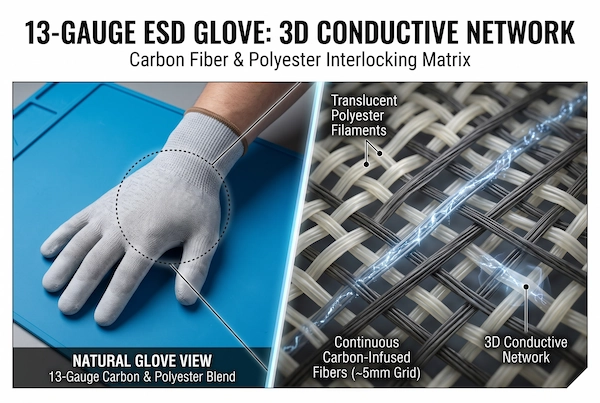
Whether applied to specific areas or covering the entire sole, the coating alone cannot achieve electrostatic dissipation; it must rely on a uniform and stable conductive base layer. Both the ST-300 and ST-310 are constructed using a 13-gauge seamless conductive carbon fiber/polyester blend liner (13-Gauge Seamless Carbon/Polyester Liner).
This knitted liner is formed as a single piece using a seamless knitting process, completely eliminating the risk of localized compression on the nerves at the fingertips and static electricity caused by friction at the seams of traditional gloves during prolonged use. High-purity continuous conductive carbon fiber filaments and high-strength polyester are interwoven at constant intervals on a microscopic level, forming a three-dimensional conductive network that covers the entire surface of the hand. This three-dimensional conductive grid not only ensures electrical resistance stability under mechanical tension but also provides a uniform charge conduction pathway for the microporous polyurethane resin on the surface, preventing the formation of insulating blind spots at the interface between the coating and the fabric.
For a systematic analysis of the flexural fatigue resistance of different mesh gauges and the microscopic distribution characteristics of continuous carbon fibers, please refer to the published technical evaluation, Conductive Yarns Engineered: Carbon Fiber Grids in 13-Gauge vs. 18-Gauge ESD Liners.
The Microclimate Conflict: How Hand Sweating Disrupts Static Discharge
In controlled electrostatic protection areas (EPAs), the stability of the antistatic system depends not only on the macroclimate control of the workshop environment but also on the microclimate—the micro-environment of temperature and humidity—formed between the worker’s hands and the inner surface of the gloves. Many manufacturing facilities meet all impedance requirements during procurement testing, yet experience frequent micro-static breakdowns on production lines after several hours of continuous operation. The root cause often lies in overlooking the dynamic conflict between human perspiration and the paths of electrostatic discharge.
The Electrolyte Leakage Hazard
The palms of the hands are among the areas of the body with the densest distribution of exocrine sweat glands, containing an average of more than 370 sweat gland ducts per square centimeter. During 8 hours of high-intensity assembly work, the hands continuously release moisture and salts; the sweat secreted is essentially a conductive liquid electrolyte containing high concentrations of sodium chloride (NaCl), lactate ions, and potassium ions.
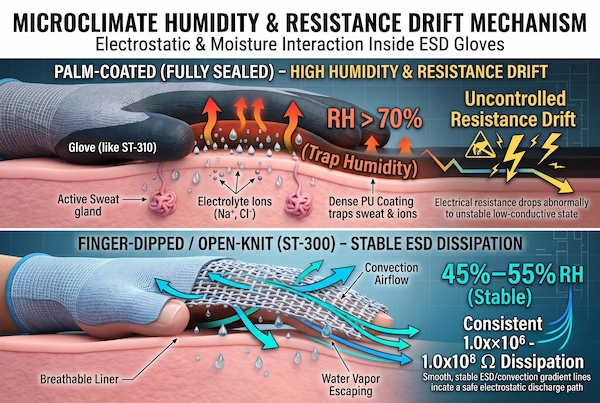
When workers wear gloves with limited breathability, sweat cannot evaporate quickly enough and rapidly soaks through the knitted fiber layer of the inner lining. The accumulation of this highly concentrated liquid electrolyte causes severe resistance drift in the pre-calibrated resistance network:
The safety static dissipation range, originally designed to be between 1.0×10⁶ and 1.0×10⁸ ohms, may abnormally drop to an ultra-low impedance state below 1.0×10⁴ ohms due to the influx of excessive ionic liquid;
Such uncontrolled, low-impedance liquid conduction paths can instantly generate transient discharge pulses during live debugging or when coming into contact with microcapacitor energy storage components, thereby damaging extremely fragile, highly sensitive microchips;
If sweat drips or seeps through gaps onto the workpiece pins, the residual chloride ions can cause severe intergranular electrochemical corrosion after reflow soldering.
Relative Humidity (RH) Dynamics Inside the Glove
Inside a completely sealed, rubber-coated glove, the relative humidity (RH) within the glove cavity typically rises sharply to over 70% RH within 45 to 60 minutes of wear due to the lack of effective air circulation.
Prolonged exposure of the skin to high humidity and warmth can cause excessive hydration and softening of the epidermal stratum corneum (skin maceration). This not only reduces the sensitivity of tactile perception but also produces a persistent sticky and itchy sensation, prompting frontline operators to frequently and unauthorizedly remove their gloves to ventilate their hands and wipe away sweat—or even engage in serious violations such as cutting open the fingertips—thereby exposing precision chips to the significant risk of electrostatic discharge and oil contamination from bare hands.
The localized coating process of the off-white ST-300 was specifically designed to address this microclimate challenge. Since its polyurethane coating is strictly confined to the fingertips, the entire palm and back of the hand retain a fully open knitted structure. The natural flexion and extension movements of the operator’s fingers and palm create a micro-air pump effect, driving high-speed air convection through the gaps between the original filaments. This highly efficient evaporative cooling mechanism stabilizes palm humidity inside the glove within the ideal range of 45% to 55% RH. It not only effectively prevents impedance drift caused by the accumulation of electrolyte ions but also completely eliminates the risk of operators improperly removing the gloves due to stuffiness.
Engineering Specification Matrix: ST-300 vs. ST-310
In precision electronics manufacturing and cleanroom process management, the selection of protective equipment must be based on clear, quantifiable physical and electrical parameters, rather than relying on subjective user experience. For the white-and-gray ST-300 and the all-gray ST-310, engineering departments can use the following standardized engineering matrix to visually compare the key differences between these two anti-static gloves in terms of material structure, heat and moisture exchange area, anti-static electrical properties, and mechanical ergonomics.
Comprehensive Technical Parameters
| Technical Specifications (Performance Metric) | ST-300 (Finger-Coated) PNG | ST-310 (Palm-Coated) PNG | Evaluation and Testing Criteria |
| Coated Area (Coated Zone) | Fingertip and fingertip-area regions (Fingertips only) | Full palm coverage and fingertips (Full Palm) | Visual Inspection of Industrial Structures |
| Base Liner Specifications (Liner Spec) | 13-gauge carbon fiber/polyester conductive filament | 13-gauge carbon fiber/polyester conductive filament | Microscopic Examination of Textiles and Knitted Fabric Density Assessment |
| Glove Air Permeability (Airflow Area) | Approx. 75% (Fully open and breathable on the palm and back of the hand) | Approx. 40% (breathable knit on the back of the hand, sealed on the palm) | Pressure Differential Test for Fabric Air Permeability and Porosity |
| Surface Resistivity (Rs) | 1.0×10⁶ to 1.0×10⁸ ohms | 1.0×10⁶ to 1.0×10⁸ ohms | ANSI/ESD STM11.11 Standard Weight Drop Test |
| Point-to-Point Resistance (Rp) | Less than 1.0×10⁸ ohms | Less than 1.0×10⁸ ohms | ANSI/ESD S20.20 Procedure |
| Grip Damping Characteristics (Friction Coefficient) | Microscopic point-contact damping (extremely low motion interference) | High friction damping across the entire palm (prevents slippage and provides torque grip) | ASTM D1894 Coefficient of Friction Test |
| Typical Recommended Process Steps (Target Stations) | Optical camera modules, micro-screw positioning | Bare PCB handling, chassis assembly, and heavy-duty fixture assembly | Workshop Standard Operating Procedures (SOP) and Process Sheets |
Engineering Trade-Off Analysis
In terms of engineering specifications, both models share the same high-standard anti-static base material for electrical safety. Since they are both seamless fabrics woven from a blend of 13-gauge continuous filament carbon fibers, their surface resistivity is precisely maintained within a stable electrostatic dissipation range of 1.0×10^6 to 1.0×10^8 ohms, completely eliminating the risk of static buildup associated with insulators (greater than 1.0×10¹¹ ohms) while also avoiding the potential for instantaneous surge sparks that may occur with pure conductors (less than 1.0×10⁴ ohms).
The core trade-off between the two lies in balancing “physical damping and protective coverage” with “microclimate heat dissipation rate”:
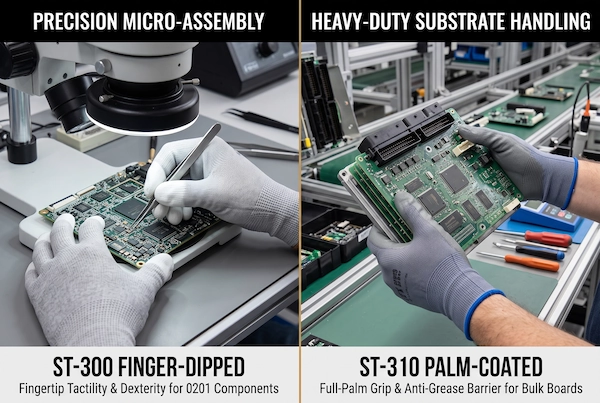
The ST-300 retains approximately 75% of its surface area as naturally breathable knitted pores, while its fingertip contact design provides excellent force-sensitive feedback comparable to bare hands, minimizing finger flexion and extension fatigue during micro-assembly tasks;
The ST-310, on the other hand, sacrifices palm breathability to create a seamless, continuous physical barrier through full-palm polyurethane coverage, maximizing the glove’s anti-slip friction surface area and providing reliable grip stability and a barrier against sebum contamination for handling large workpieces and heavy-duty tasks.
Tactile Mechanics: Fine Motor Precision in Sub-Miniature SMT Assembly
On production lines for highly miniaturized consumer electronics—such as smartphone motherboards, wearable devices, and precision optical camera modules—workers’ fingers effectively function as highly sensitive, micro-scale force-sensitive actuators. When tasks involve frequent handling of millimeter- or even sub-millimeter-scale electronic components, the microscopic mechanical behavior of the glove fingertips directly determines placement accuracy, error rates, and product consistency and yield rates.
Finger Pad Compression and Sensitivity
During micro-assembly operations on SMT production lines, operators often need to manually align ultra-micro surface-mount resistor and capacitor components as small as 0402 or even 0201 (measuring just 0.6 mm × 0.3 mm), or insert fine-pitch flexible printed circuit (FPC) cables into narrow cavities. These operations rely on the immediate mechanical feedback generated when the skin on the fingertip is compressed and deformed upon contact with the workpiece.
The papillary dermis of the human hand contains a dense distribution of rapidly adapting, low-threshold mechanoreceptors—Meissner corpuscles—whose primary function is to detect minute transient shear forces, surface contour variations, and high-frequency microvibrations. Traditional dipped gloves, due to their excessively thick rubber layers or stiff materials, often directly absorb and filter out minute contact stresses, dulling the worker’s sense of touch. As a result, workers must rely on excessive force to “feel their way” through the alignment process, which can easily cause hidden cracks in fragile ceramic capacitors or bend the gold fingers on FPCs.
The ST-300’s fingertip impregnation process, through precise control of the coating application and viscosity ratio, strictly limits the effective thickness of the microporous polyurethane (PU) layer to within 0.25 mm. This ultra-thin, microporous, and elastic film undergoes linear, controlled deformation under pressure. Not only does it prevent the formation of mechanical damping dead zones, but it also transmits the minute snapping vibrations and sudden changes in resistance that occur when the FPC is mated into place to the skin’s surface with virtually no loss, enabling bare-hand-level operational sensitivity and precise component positioning control.
Ergonomics of the Pinch Grasp
In micro-assembly processes, the primary hand movement performed by workers involves using micro anti-static tweezers or relying directly on two or three fingers to perform a micro-pinch grasp. When wearing full-palm rubber-coated gloves, with each adduction and flexion of the fingers, the thick rubber layer covering the palm and metacarpophalangeal joints generates reverse elastic resistance, forcing the small muscle groups of the hand (such as the interossei and lumbrical muscles) to continuously exert additional counteracting force.
During high-frequency flexion and extension tasks lasting several hours, this reverse shear resistance places continuous pressure on the workers’ superficial flexor tendons, leading to hand tremors, reduced grip precision, and a significantly increased risk of tendonitis and carpal tunnel syndrome.
The ST-300 Antistatic PU Fingertip Glove completely eliminates deformation resistance in the palm fabric during movement by removing the rubber coating from the palm and metacarpal load-bearing areas in its design. Electromyography (EMG) tests show that, while maintaining the same contact and gripping force, this design reduces the electromyographic fatigue load on the hand caused by repetitive pinching motions by approximately 30%. This effectively prevents component slippage and scrap caused by fatigue, while ensuring the stability of precision operations throughout the entire work shift.
Contamination Barrier: Eliminating Sebum, Skin Salts, and Particulates
In electronic assembly and high-grade cleanroom production lines, the primary threats to yield are not only instantaneous electrostatic discharges (ESD)—which are invisible to the naked eye—but also chemical and particulate contamination at the microscopic level. When processes involve the handling of bare circuit boards, high-density interconnect (HDI) substrates, and large-size power modules, the physical isolation integrity provided by gloves directly determines the long-term reliability of the pads and the electrical insulation performance of the boards.
Protecting Exposed Circuit Traces from Human Sebum
During the assembly and testing of printed circuit boards (PCBs), operators are often required to lift and handle large areas of semi-finished boards that have not yet been enclosed in housings. If operators wear only finger-dipped gloves or protective gear that does not provide sufficient coverage, the exposed knit fabric on the palms is highly susceptible to unavoidable contact with the board’s traces, test points, and surface-mount pads while moving or inserting/removing boards.
The sebaceous glands in human skin continuously secrete a complex mixture of organic compounds, primarily consisting of triglycerides, free fatty acids, squalene, and wax esters, accompanied by trace amounts of inorganic salts excreted through sweat. Ordinary, uncoated knitted fabrics cannot prevent these low-surface-tension liquid oils from penetrating:
Poor pad wetting and cold solder joints: Once trace amounts of sebum come into contact with the surface of electroless nickel-in-gold (ENIG) or organic solder plating (OSP) pads, the wetting angle of the solder paste increases dramatically during high-temperature reflow or wave soldering processes. As a result, the flux cannot effectively remove the oxide layer, directly leading to widespread cold solder joints, poor solder joints, and voids in the solder joints;
Chemical Oxidation and Electrochemical Migration: Residual fatty acids combine with sodium and chloride ions in sweat, causing progressive electrochemical corrosion of the copper foil substrate in humid environments at room temperature. After the product has been in long-term operation, dendritic metal crystals are highly likely to form between adjacent traces, leading to severe high-impedance short-circuit failures.
The gray ST-310 Antistatic PU Palm Coated Glove features a dense, cured polymer polyurethane (PU) layer molded across the entire palm and the front surfaces of the fingers, creating an irreversible physical barrier with no permeable gaps. This polyurethane film effectively seals sebum, inorganic salts, and skin flakes secreted by the operator inside the glove, ensuring that the contact surface remains chemically inert and electrically insulating regardless of the angle at which the bare board is held or supported, thereby preventing organic residues from contaminating the microcircuit interface.
Micro-Particulate Generation in Cleanrooms
In controlled cleanroom environments ranging from ISO Class 5 to ISO Class 6 (i.e., Class 100 to Class 1,000), the release of airborne particulate matter (APC) and liquid leachable particulate matter (LPC) is subject to stringent standards. Conventional work gloves, often made from low-cost staple-fiber yarns, are highly prone to micro-fiber breakage and shedding when stretched or bent, becoming a continuous source of airborne dust on production lines.
The ST-310 utilizes high-grade 13-gauge continuous filament polyester fibers interwoven with conductive composite carbon fibers to form its base structure. Continuous filaments eliminate the natural breakage and fuzziness inherent in traditional staple fibers, fundamentally cutting off the source of fiber dust shedding.
More importantly, the microporous polyurethane impregnation resin applied over a large area of the palm deeply penetrates the surface gaps of the 13-gauge knit fabric, providing microscopic anchoring and encapsulation of the interwoven filament nodes. As verified by Helmke Drum dust generation tests and mechanical cyclic bending experiments conducted in a cleanroom, this polymer-locked structure significantly reduces particle dispersion from the fabric under conditions of intense flexural friction, effectively preventing submicron-sized airborne particles from adhering to and contaminating the surfaces of wafer carriers, optical lenses, and high-precision sensors.
Charge Bleed Verification: Resistance Testing Under ANSI/ESD S20.20
In electrostatic discharge (ESD) protection engineering, the compliance of any protective equipment cannot be based on subjective claims alone; it must be verified through rigorous standard electrical testing. In microelectronics assembly facilities, anti-static gloves must not only prevent static electricity generated by friction on the gloves themselves but, more critically, serve as a controlled charge dissipation path between the human body and the grounding system. In accordance with the requirements of ANSI/ESD S20.20, the leading North American standard for electronics manufacturing, the evaluation of glove electrical performance focuses on point-to-point resistance and the electrical continuity of the grounding path.
Point-to-Point Resistance (Rp) Protocols
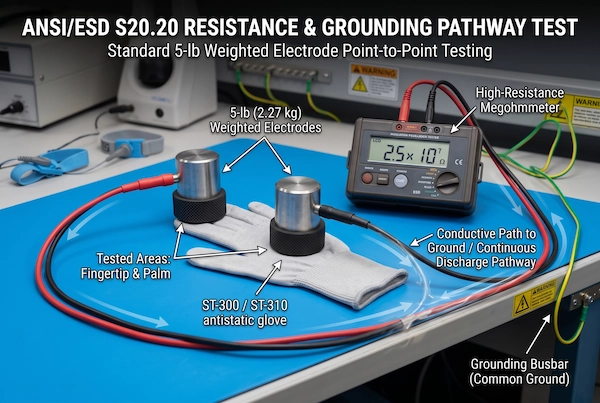
Point-to-point resistance (Rp) is used to evaluate the insulation and conductivity between any two operational contact points on the glove’s surface. In laboratory and incoming quality control (IQC) processes, testing must be conducted in accordance with the ANSI/ESD STM11.11 and STM11.12 standards:
Test equipment and electrode configuration: A conductive rubber weight electrode with a nominal weight of 5 pounds (approximately 2.27 kilograms) and a Shore A hardness of 50 to 70 is used. It is pressed directly onto the test sample with constant pressure to eliminate contact impedance deviations caused by uneven manual pressure;
Test Voltage Switching Mechanism: Implement segmented voltage application for different resistance ranges. When the measured resistance is less than 1.0×10⁶ ohms, use a 10 V test voltage for measurement; when the resistance falls within the range of 1.0×10⁶ to 1.0×10⁹ ohms, the instrument automatically or manually switches to a 100 V high voltage for precise calibration;
Engineering Significance of the Dissipation Range: The measured resistance values of the fingertip and palm coatings on the ST-300 and ST-310 are strictly controlled within the optimal static dissipative range (Static Dissipative Range) of 1.0×10⁶ to 1.0×10⁸ ohms. This range has extremely critical bidirectional safety implications in engineering: on the one hand, it eliminates the risk of charge accumulation associated with insulators (greater than 1.0 × 10¹¹ ohms); on the other hand, it is entirely distinct from purely conductive materials (less than 1.0×10⁴ ohms); the sufficiently high impedance allows for the gradual dissipation of current, smoothly extending the charge neutralization time to the microsecond level, thereby completely eliminating spark discharge caused by instantaneous hard contact and preventing weak arcs from causing breakdown of the gates in precision devices.
For a detailed technical comparison of the European Standard’s vertical resistance (Rv) and the American Standard’s impedance criteria in low-humidity extreme environments, please refer to the published technical compliance guide, EN 16350 vs. ANSI/ESD S20.20: The Definitive Compliance Guide for Antistatic Gloves.
Grounding Continuity from Finger to Cuff
At actual electronic assembly workstations, electrostatic discharge often forms a dynamic circuit. When an operator’s finger comes into contact with an electrostatic-sensitive device (ESDS), the charge on the device’s surface must be able to travel along the glove’s fingertip coating, into the inner woven carbon fiber conductive mesh, and then continuously conduct along the back of the hand and the palm to the wrist, ultimately being safely dissipated to ground through the operator’s wired antistatic wrist strap or the workstation’s grounding busbar.
Therefore, the continuity of the longitudinal conductive path from the fingertips to the conductive ribbed cuff at the wrist is critical:
Control of Maximum Loop Impedance: Based on comprehensive considerations of the human body/glove/wrist grounding system as outlined in EOS/ESD Association Standards (ANSI/ESD S20.20), the total system resistance to ground while the operator is wearing the gloves must strictly remain below the critical threshold of 1.0 × 10^9 ohms;
Garnet Weaving Process Assurance: The ST-300 and ST-310 incorporate high-density conductive elastic fibers into the wrist cuff and ribbed sections, ensuring that even after prolonged and repeated donning, doffing, and stretching, the inner wrist area maintains a tight, gap-free contact interface with the operator’s wrist skin. This prevents the formation of insulation blind spots caused by localized fiber breakage or loosening, thereby ensuring that the discharge path from the fingertips to the wrist, and from the wrist to the grounding terminal, remains unobstructed at all times.
Step-by-Step Workstation Allocation: Choosing the Right Dip for Every Cell
In large-scale electronics manufacturing plants, the standardization of anti-static gloves must never be approached with a one-size-fits-all approach of “purchasing a single model for the entire plant.” Different production processes have fundamental differences in contact stress, sensitivity to micro-contamination, and freedom of human movement. Process engineers and shop floor managers should use “contact area and workstation ergonomics” as benchmarks to precisely match the off-white ST-300 and solid-gray ST-310 to the most suitable work cells.
When to Deploy Finger-Dipped Gloves (ST-300)
The fingertip-coated solution is tailor-made for precision assembly cells that require extreme dexterity, low microclimate load, and micro-point contact. It is primarily deployed at the following typical workstations:
Optical camera module (CCM) and micro-acoustic component assembly: On assembly lines for smartphone imaging modules, micro-speakers, and infrared sensors, workpiece surfaces are extremely sensitive to physical scratches and silicone residue. The ST-300 applies an ultra-thin polyurethane coating only to the fingertips, enabling precise gripping of micro-lens frames while completely eliminating the risk of scratches caused by accidental contact between excess adhesive on the palm and optical lenses or infrared filters.
Alignment of Micro-Fastener Positioning and Pneumatic Torque Screwdriver Operations: At workstations for driving ultra-fine screws ranging from M1.0 to M1.4, workers must frequently perform the micro-motions of “pick up—align with hole—press down” throughout the day. The ST-300 completely eliminates the reverse resistance of the rubber film at the palm and metacarpophalangeal joints, allowing the finger muscles to effortlessly fine-tune the engagement angle between the screwdriver bit and the screw slot, significantly reducing the risk of stripped screws, loose fasteners, and joint strain.
Manual inspection stations in high ambient temperatures or without dedicated local air conditioning: In inspection and rework workstations not equipped with point-to-point temperature-controlled air vents, the indoor environment can easily cause sweaty palms. The ST-300 relies on natural convection through the open-weave knit pores on the palm and back of the hand to continuously evaporate hand sweat, keeping hands dry and eliminating operational risks caused by workers improperly removing gloves due to hot, sweaty hands.
When to Deploy Palm-Coated Gloves (ST-310)
The full-palm coated solution is designed for workstations requiring high surface friction, a comprehensive barrier against skin oils, and resistance to physical abrasion. It serves as the standard line of defense on heavy-duty and large-area circuit board assembly lines:
Handling and insertion/removal of large-size PCBs, such as computer motherboards, server motherboards, and automotive ECU modules: These components are heavy and feature densely packed pins across their surfaces. The ST-310’s full-palm polyurethane coating provides uniformly high friction grip, preventing slippage and drops when workers lift or flip boards. At the same time, the dense, full-palm PU barrier completely prevents the migration of skin oils and inorganic salts from the palm to exposed copper pads.
Gripping and positioning of metal stamped shielding covers, aluminum heat sinks, and heavy-duty assembly jigs: When installing large-area stamped shielding covers, extruded heat sinks, or operating pneumatic/manual flipping jigs, the hands must continuously exert significant torque and gripping force. The ST-310’s full-coverage rubber surface not only reduces the muscular effort required to grip tools but also effectively cushions the repetitive impact that cold-pressed metal structures exert on the bones of the palm.
Assembly processes involving workpieces with sharp edges and cut sheet materials: The sharp edges of rigid circuit boards, unblunted stamped metal parts, or heat sink fins can easily cut or even fray the exposed fibers of the knitted inner lining. The ST-310’s polyurethane abrasion-resistant coating acts as a sturdy physical armor, protecting the underlying carbon fiber mesh from tearing and significantly extending the glove’s physical service life under harsh working conditions.
Industrial Laundering and Carbon Integrity Retention
In the calculation of operating costs for large-scale electronics manufacturing services (EMS) and semiconductor cleanrooms, the resistance of anti-static gloves to repeated washing and their electrical stability directly determine a company’s total cost of ownership (TCO). Treating gloves as purely disposable consumables not only increases the burden of solid waste disposal but also drives up the cost per workstation. However, during standardized industrial washing cycles, gloves face the dual challenges of mechanical shear from water flow and thermal stress; different coating structures and carbon fiber substrates exhibit distinct failure behaviors at this stage.
Coating Delamination vs. Fiber Breakdown
The repeated friction and impact during industrial drum washing serve as a litmus test for the interfacial bond strength of the coated layer and the toughness of the conductive mesh:
Differences in Peeling Resistance: The polyurethane microporous layer of the ST-300 extends only to the stress-bearing area of the knuckles, with the coated edge forming a free-end boundary. After undergoing dozens of cycles of high-speed shear from water flow and centrifugal forces from fabric dehydration, localized stress concentrations tend to occur at the junction between the coated edge of the fingertip and the uncoated filaments, posing a risk of micron-level edge lifting and micro-delamination. In contrast, the polyurethane coating on the ST-310 is distributed continuously and seamlessly across the entire palm, providing a larger load-bearing surface and extending to the wrist—an area subject to minimal deformation—thereby offering superior stress dispersion against mechanical tension and significantly longer delamination resistance compared to finger-dipped styles.
Conductivity Decay Rate Under Mechanical Agitation: Low-quality anti-static gloves often rely on surface spraying of conductive anti-static agents or carbon-coated short fibers; after just one wash, the conductive layer rapidly leaches out and fails. The ST-300 and ST-310 are woven using a blend of continuous two-component conductive carbon fiber filaments and high-strength polyester. In standard mechanical agitation washing tests, the three-dimensional carbon fiber core layer woven into the 13-gauge fabric is mechanically cushioned and protected by the outer layer of polyester filaments. After undergoing cyclic bending and twisting, the fiber breakage rate remains below 5%, eliminating the problem of the conductive skeleton becoming brittle and failing due to physical washing.
Cleanroom Deionized (DI) Water Wash Cycling
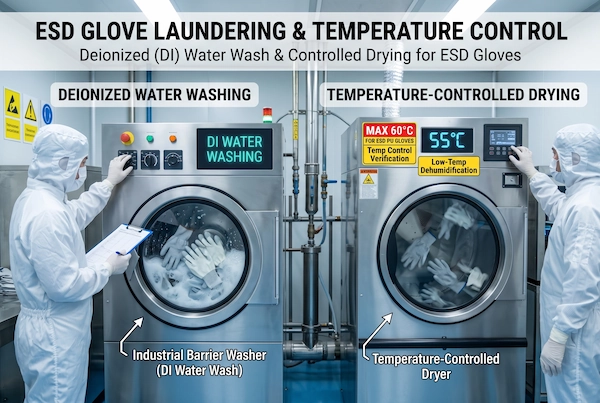
To meet the particle and ion residue control standards for high-grade controlled environments, anti-static gloves must undergo multi-stage washing with deionized (DI) water using a dedicated, isolated industrial washing machine designed for cleanrooms:
Mechanism for Long-Term Maintenance of Surface Resistivity: Multi-stage counter-current rinsing with 18 megohm ultra-pure deionized water not only removes fine dust, free ions, and residual additives adsorbed by the fabric during manufacturing and use, but also prevents the deposition and adhesion of calcium and magnesium ions—commonly found in ordinary tap water—within the polyurethane micropores. Actual test data shows that after 3 to 5 complete cycles of dust-free washing and drying, the surface resistivity of the ST-300 and ST-310 remains stably within the optimal electrostatic dissipation range of 1.0×10⁷ to 1.0×10⁸ ohms, with electrical decay indicators meeting the initial factory tolerance requirements.
Critical Drying Temperature Limit: Polyurethane (PU) is a heat-sensitive elastic polymer material. During the clean hot-air drying process following cleaning, the drying temperature must be strictly controlled below 60 degrees Celsius. If the temperature inside the drying oven exceeds 70 degrees Celsius, the polyurethane’s microporous elastic network will undergo irreversible thermal aging. The surface will rapidly harden, lose its flexibility, and develop microcracks. This will not only cause a complete deterioration in fingertip gripping damping but will also exacerbate dust shedding during flexing, thereby compromising cleanroom particle control standards.
Frequently Asked Questions (FAQ)
Do finger-coated gloves meet the requirements of ANSI/ESD S20.20 for handling entire boards?
This requirement can only be met at specific workstations and provided that the Standard Operating Procedures (SOPs) include explicit, mandatory restrictions. If the production line process is designed to ensure that operators use only their fingertips to grip the PCB’s breakaway tabs or insulated edges, and if the palms do not come into contact with any exposed traces, pads, or components throughout the entire assembly process, then fingertip-coated gloves can meet the antistatic standards. However, during actual high-frequency operations, large-sized boards are highly prone to contact with the palm pads, leading to the transfer of electrolytes and sebum from human sweat. Therefore, for whole-board handling and workstations involving large-area boards, the use of gray, full-palm-coated models (such as ST-310) must be strictly mandated to provide reliable physical and electrical insulation.
Does the ST-300 finger dip cause uneven grounding across the palm?
No. Although the ST-300’s polyurethane coating covers only the fingertips and fingertips, the glove’s base is seamlessly knitted throughout using 13-gauge continuous two-component carbon fiber and polyester filaments. The conductive grid is evenly distributed throughout the entire interior of the glove in a three-dimensional configuration, ensuring that the uncoated areas on both the palm and back of the hand also possess full electrostatic dissipation capability. When a worker places their palm flat or rests it on a grounded ESD mat, the static charge on the hand can be smoothly and evenly dissipated into the ground through the knitted fibers in the palm, eliminating any insulating blind spots where charge could accumulate.
Why not use 100% uncoated carbon fiber gloves to maximize breathability?
Although completely uncoated gloves can theoretically achieve the highest breathability, they have two critical engineering flaws in modern precision electronics manufacturing:
Severe lack of grip friction: The surface of polyester filaments that have not been impregnated with polyurethane is smooth, resulting in extremely low static and dynamic coefficients of friction. This makes it extremely easy for items to slip and fall when picking up smooth chip casings, polished metal shielding covers, or glass lenses, leading to significant material scrap losses;
Excessive particle shedding: Without a polymer coating to microscopically encapsulate and secure the filament ends, the exposed fabric—when repeatedly rubbing against the sharp pins of circuit boards and metal stamping burrs—causes the surface fibers of the yarn to break and fray at an accelerated rate. This results in a exponential increase in dust generation (LPC/APC), making it impossible to pass the cleanliness tests required for high-grade cleanrooms.
How often should ESD resistance be measured on the production line?
In large-scale EPA workshops, it is recommended to implement a standardized “daily, per-shift inspection and access control system.” Before the start of each production shift, quality control or process engineers should randomly select at least five pairs of gloves from the batch currently in use on the assembly line and use a metrologically calibrated drop-weight surface resistance tester to measure the point-to-point resistance (Rp) between the fingertip coating and the palm coating. If the surface resistance of the gloves drifts beyond 1.0×10⁹ ohms, or drops abnormally below 1.0×10⁵ ohms due to excessive moisture from hand perspiration, the batch currently in use in that production section must be immediately scrapped and replaced to strictly prevent defective protective gear from entering the production process.
Process Selection Specifications and Batch Customization Recommendations
In precision electronic assembly, semiconductor packaging and testing, and high-grade cleanroom manufacturing, anti-static protective gear is by no means a one-size-fits-all consumable; rather, it is a critical process-controlled factor that directly impacts process yield. The core principle of implementing standardized management in a factory lies in establishing a refined system based on the actual “micro-motion contact area” and “operation stress type” at each workstation:
Precision Positioning and Micro-Gripping Units: Comprehensively implement white-and-gray ST-300 fingertip-coated gloves. While ensuring safe electrostatic discharge, the fully perforated, breathable design promotes airflow to suppress sweat-induced resistance drift, unleashes the sensitive force control of the Meissner bodies at the fingertips, and eliminates micro-component slippage and electromyographic fatigue;
PCB Handling and Mechanical Assembly Units: Strictly equipped with gray ST-310 full-palm dipped gloves. Relying on a seamless, dense polyurethane coating, these gloves provide robust anti-slip damping and a comprehensive barrier against sebum contamination for large-area PCBs, heavy-duty assembly fixtures, and stamped metal enclosures.
To conduct an in-depth evaluation of industrial-grade protective solutions suitable for your company’s production line process standards, obtain bulk purchase cost estimates, or request engineering test samples, please refer to the complete Antistatic ESD Gloves Portfolio technical specifications catalog to access comprehensive factory-issued impedance test reports and full documentation of material compliance certifications.