

Introduction: The Hidden Risk of Winter Electrostatic Discharge in Cleanrooms
In supply chain management for multinational electronic manufacturing services (EMS), semiconductor wafer packaging and testing, and precision microelectronics cleanrooms, technical evaluations of esd safety gloves en 16350 standards directly determine the yield rate of finished products and the electrostatic discharge (ESD) control baseline for the entire automated production line. However, the EHS departments and quality control (QC) teams of many multinational manufacturing companies have long faced a hidden seasonal failure issue: While the same batch of anti-static gloves fully meets all electrical specifications when tested in the hot and humid conditions of summer, during the winter heating season or in dry environments—once the relative humidity in the cleanroom drops below 30%—MOS gate oxides and microintegrated circuits on the production line begin to experience frequent, unexplained breakdown failures.
The root cause of these seasonal quality incidents lies in the fact that traditional procurement standards overlook the severe challenges low humidity poses to anti-static barriers. Many standard anti-static gloves, which rely heavily on low-cost manufacturing processes, derive their conductivity entirely from hygroscopic surfactants applied via surface dipping or spraying. When relative humidity is high, the chemical coating adsorbs water molecules from the air to form a temporary hydrated conductive film, thereby producing acceptable impedance readings during routine spot checks. Once the dry winter sets in and the concentration of water molecules in the air drops sharply, the chemically hygroscopic film rapidly dehydrates and dries out. The original conductive network is immediately severed, and the surface resistance of the gloves skyrockets to $10^{11}\ \Omega$ or higher—the range of high insulators. When frontline workers handle wafer trays, insert or remove flexible printed circuits (FPCs), or operate SMT placement fixtures, even the slightest movement can generate thousands of volts of triboelectric potential, which is released as a lethal transient surge the moment they come into contact with the pins of sensitive components.
To completely eliminate the risk of hidden discharges in low-humidity environments, technical procurement teams must clearly distinguish between the testing environment and the intrinsic properties of the materials. The European standard EN 16350 and the North American standard ANSI/ESD S20.20 clearly establish the technical thresholds and acceptance criteria for modern anti-static equipment under extreme low-humidity conditions. A rigorous compliance system not only evaluates a glove’s impedance performance under standard ambient temperatures but also mandates that materials undergo prolonged pre-conditioning in extremely low-humidity environments to verify whether they possess an intrinsic, continuous charge dissipation pathway. For engineering and procurement managers currently working to eliminate the risk of electrostatic breakdown in the workshop and rebuild cleanroom compliance systems, we recommend first systematically reviewing our industrial antistatic protection framework: Antistatic (ESD) Gloves.
Standard Architectural Discrepancies: European vs. North American Mandates
In large-scale procurement involving the manufacturing of electronic components and personal protective equipment for cleanrooms, a key prerequisite for a thorough understanding of the EN 16350 standards for ESD safety gloves is recognizing the structural differences in the underlying testing logic between European standards and the North American system. Buyers in multinational supply chains often fall into the misconception that gloves are universally acceptable worldwide simply because they bear the ESD logo on the packaging.
In fact, from the very inception of their development, the European standard system and the North American ANSI/ESD system have adopted entirely different perspectives on protection engineering: European standards focus on the “maximum vertical resistance” of the glove material itself, while North American standards evaluate gloves comprehensively within a system-level discharge path comprising “person–glove–workbench–ground.” Failure to clarify these technical differences may result in purchased gloves being deemed non-compliant during cross-border factory audits or third-party laboratory retesting.
The Core Physics of EN 16350: Vertical Resistance (Rv < 1.0 x 10^8 Ohms)
As an independent standard developed by the European Committee for Standardization specifically for the electrostatic performance of protective gloves, EN 16350:2014 establishes what is currently recognized as the most stringent single physical metric in the global occupational safety and health industry:
Single Absolute Performance Metric: Vertical Resistance (Rv): This standard completely abandons surface resistance—which is easily affected by surface moisture—and mandates the measurement of the longitudinal impedance as the test current travels from the polymer coating on the glove’s outer surface, through the fabric liner, to the inner surface in contact with the skin;
Extremely Strict Upper Impedance Threshold: EN 16350 explicitly stipulates that the vertical resistance at each test point on the glove must be strictly less than 1.0 × 10⁸ ohms (i.e., 100 megohms);
Screening for Intrinsic Physical Antistatic Properties: The establishment of this threshold has clear physical significance—it requires that the glove material itself possess extremely high charge dissipation capability. Even if a worker is not wearing an antistatic wrist strap, as long as the glove comes into contact with a grounded work surface or metal component, the static charge accumulated on the hand can be vertically conducted through the thickness of the glove to ground within milliseconds, thereby preventing charge buildup at the fingertips.
The System-Level Scope of ANSI/ESD S20.20: Resistance to a Groundable Point
Unlike European standards, which focus on the physical properties of individual protective gloves, the ANSI/ESD S20.20 standard issued by the North American Electrostatic Discharge Association defines protective gloves as an integral part of the “Electrostatic Discharge Control Program (ESD Control Program)” for the entire electronic assembly workshop:
System-Level Resistance-to-Groundable Point (Rgp) Assessment: The North American system not only tests the gloves themselves but also focuses on the total impedance of the entire path when the wearer is connected to a grounding facility via the gloves;
Relatively lenient but more closed-loop-oriented resistance limits: In the ANSI/ESD S20.20 standard, the resistance-to-ground requirement for the grounding path—comprising the glove or finger cot, the human body, and the wrist strap—is typically set at less than 1.0 × 10^9 ohms (i.e., 1,000 megohms);
Human-machine collaborative testing mechanism: The ANSI system emphasizes charge dissipation in dynamic scenarios. Test engineers typically require operators to wear an antistatic wrist strap, don the gloves under test, and hold a metal probe to determine whether charge can be stably conducted to ground through a closed-loop circuit encompassing the entire workbench. While its permissible upper impedance limit is one order of magnitude broader than that of EN 16350, it imposes stricter requirements on the consistency of full-path grounding across all workstations in the operational environment.
The 25% Relative Humidity Threshold: Separating Real ESD Protection from Chemical Illusions
The most critical distinction between the two standards in practical engineering applications lies in the pre-test environmental relative humidity (RH) requirements—this is the key to solving the mystery of “gloves passing tests in summer but frequently breaking down in winter”:
EN 16350’s Mandatory Pre-equilibration at an Extremely Low 25% Humidity: The European standard mandates that all test samples must be placed continuously for at least 48 hours in an extremely dry, controlled humidity chamber maintained at 23 degrees Celsius and 25% relative humidity, followed by high-resistance measurements completed within 5 minutes; Under these extremely dry conditions, the auxiliary contribution of environmental water molecules to the material’s conductivity is eliminated; only gloves that truly incorporate continuous conductive carbon fibers or intrinsically conductive microfibers into the fabric can consistently maintain a resistance value within 1.0 × 10⁸ ohms;
The broad temperature and humidity range specified by ANSI/ESD: In contrast, some North American testing procedures or internal company spot checks permit testing under conventional controlled environments with relative humidity ranging from 30% to 50%; Within this humidity range, many low-quality gloves that rely solely on surface-coated hygroscopic quaternary ammonium antistatic agents can pass testing by forming a temporary conductive film through the adsorption of trace amounts of water molecules in the air, thereby fraudulently obtaining a certificate of compliance;
Real-world barrier failure in dry winter conditions: Once winter sets in, indoor relative humidity in cleanrooms in northern or dry, cold regions often plummets to 20% to 25% due to continuously operating HVAC systems; gloves that rely on chemical hygroscopic agents to maintain conductivity rapidly lose moisture, causing their hydrated ionic pathways to be completely disrupted and their surface resistance to skyrocket to over 1.0 × 10^11 ohms—entering the range of pure insulators; When workers handle sensitive components on the assembly line, the gloves completely lose their ability to dissipate static electricity, causing chips and circuit boards worth thousands of dollars to be rendered unusable due to hidden breakdowns the moment they come into contact.
A Deep Dive into Test Methodology: Electrode Physics and Conditioning Protocols
In the compliance tug-of-war between multinational buyers and third-party laboratories, reviews of ESD safety gloves under the EN 16350 standards must not rely solely on a test summary stating “pass”; instead, they must delve into the physical configuration of the test fixtures on the lab bench and the control of the measurement environment. Many gloves submitted for testing by non-specialized contract manufacturers appear to meet resistance requirements under the laboratory’s specific controlled conditions; however, once the electrode configuration is changed or the test voltage is altered, the data can fluctuate dramatically by several orders of magnitude.
Electrostatic measurements are, by their very nature, highly sensitive detections of minute leakage currents (typically in the microampere or even nanoampere range). Any minor disturbance—whether in probe geometry, normal contact pressure, or relative humidity in the microenvironment—can alter the contact topology of the microscopic conductive fibers inside the glove, thereby completely changing the resistance measurement results. Mastering standard laboratory testing methodologies is a core skill for overseas technical procurement professionals to see through suppliers’ exaggerated claims.
Cylindrical Electrodes vs. Concentric Ring Probes
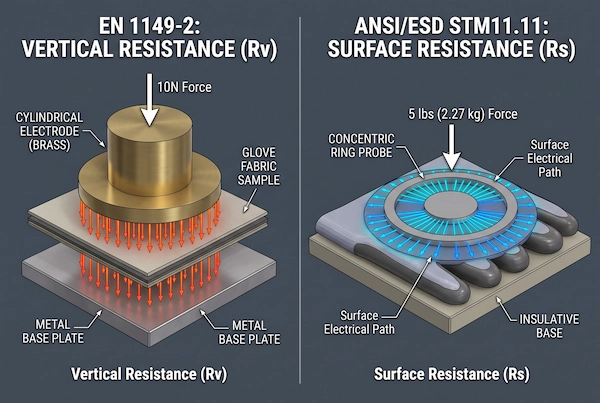
The physical structure and pressure application method of the test probe determine whether electric field lines “penetrate longitudinally” or “diffuse laterally across the surface” inside the glove:
EN 1149-2 / EN 16350 Vertical Penetration Measurement Using Cylindrical Bipolar Electrodes: The European standards system focuses on testing vertical impedance in the thickness direction of the glove. During testing, the glove is laid flat with its outer surface facing upward on a smooth, highly conductive metal base plate (lower electrode). A cylindrical brass weight electrode—with a specific cross-sectional area and a conductive rubber cushion embedded at its base—is placed on the upper surface; the standard applies a constant mechanical pressure of 10 newtons (N) to the upper electrode to ensure tight contact between the electrode and the glove fabric and its microscopic coating; The high-resistance tester applies an electric field between the upper and lower electrodes, forcing current to directly penetrate the entire thickness of the glove—from the “polymer-coated layer ➔ knitted fiber liner ➔ inner lining bottom surface”—accurately reflecting the vertical resistive barrier that either conducts charge outward from the worker’s palm or prevents external static electricity from penetrating inward;
ANSI/ESD STM11.11 Concentric Ring Probes for surface lateral dissipation measurement: The North American standard uses a high-precision set of concentric ring electrodes to measure the surface impedance of flat materials; This probe consists of a central cylindrical electrode and an outer annular electrode arranged coaxially; the two electrodes are precisely isolated from each other by ultra-high-insulation materials such as polytetrafluoroethylene (PTFE), and the total weight of the entire probe is strictly calibrated to 5 pounds (approximately 2.27 kilograms); During measurement, the electrodes are pressed flat against the outer surface of the glove. Current flows from the central electrode along the polymer coating and conductive fiber network on the glove’s surface toward the outer ring, specifically capturing microscopic dissipation pathways of charge in a two-dimensional plane;
Fundamental Differences in Testing Mechanics and Electric Field Distribution: Cylindrical electrodes assess the “intrinsic penetration impedance” of the material; any defects in the inner lining fabric, localized thickening of the polymer layer, or breaks in the conductive fibers will be immediately revealed along the vertical path; whereas the concentric-circle electrode evaluates “surface continuous conductive flux”—if the glove’s surface coating lacks conductive additives, the concentric-circle electrode will measure insulation values exceeding the standard, even if the inner lining contains carbon fibers.
The 48-Hour Pre-Conditioning Chamber Requirement
The most rigorous and highest-failure-rate step in anti-static testing is the pre-conditioning protocol for samples:
Temperature and humidity benchmarks for the extreme-dry chamber (23 degrees Celsius, 25% relative humidity): In accordance with the mandatory EN 16350 standard, all gloves to be tested must not be placed directly into the testing machine after cutting and sampling. Instead, they must be removed from all sealed packaging and laid flat or hung in a specialized industrial-grade environmental chamber. The chamber must maintain a temperature of 23 degrees Celsius (with a permitted fluctuation of ±1 degree Celsius), and the relative humidity must be strictly maintained at 25% (with a permitted fluctuation of ±5%) for a full 48 hours;
Forced removal of moisture to achieve material equilibrium: The core physical objective of this process is to force the material to reach a state of desorption and moisture equilibrium; Natural cotton fibers, nylon filaments, and porous polyurethane coatings readily adsorb free water vapor from the air under normal environmental conditions; in an extremely dry environment with 25% relative humidity, water molecules trapped in the glove’s micropores and fiber gaps are forcibly extracted and desorbed, bringing the material to its thermodynamic absolute equilibrium moisture content;
Minute Rapid Test for Resistance to Environmental Moisture Re-absorption: After 48 hours of extreme dehydration treatment, the gloves must undergo resistive pressure testing at all measurement points within 5 minutes of being removed from the environmental chamber; if the test is not completed within this extremely short timeframe, external moisture from the laboratory will rapidly re-penetrate the fabric, resulting in falsely low resistance readings.
Test Voltage Selection: 10V vs. 100V Megohmmeter Calibration
The selection of test voltage for high-resistance megohmmeters is the aspect of quality inspection most prone to tampering; selecting the wrong voltage can result in insulation gloves being falsely deemed “compliant”:
Correspondence between international standard impedance values and applied test voltages: Standard test protocols require automatic or manual switching of the open-circuit voltage based on the material’s actual resistance range; when the material’s resistance falls between 1.0 × 10^4 ohms and 1.0 × 10^6 ohms (the conductive to low-impedance dissipation range), the instrument must use a low test voltage of 10 volts (V) to prevent high-current thermal effects from damaging the fine conductive filaments; When the material’s resistance is greater than or equal to 1.0 × 10⁶ ohms, the instrument must reliably switch to a 100-volt (V) DC test voltage;
Be wary of “false pass readings” caused by high-voltage breakdown: Low-end glove manufacturers often use excessively high voltages to create the illusion of compliance. If high test voltages of 250 volts or even 500 volts are directly applied to insulated gloves whose surface resistance is already at the threshold of 1.0 × 10^10 ohms, the excessively high electric field strength will directly force the breakdown of the microscopic polymer insulating layer, inducing field emission or surface ionization discharge at microscopic defects. This causes the meter to instantly detect a faint discharge current, thereby erroneously displaying a “pass” reading of 1.0 × 10⁷ ohms;
Strictly adhere to the 100-volt linear, non-destructive measurement threshold: Authoritative testing in accordance with EN 16350 and ANSI/ESD guidelines must ensure that, under a stable 100-volt DC voltage, the material smoothly dissipates charge through inherently continuous internal carbon fiber conductive pathways, rather than relying on abnormal currents generated by high-voltage breakdown of the dielectric. This establishes a truly safe and reliable intrinsic antistatic barrier for cleanroom components.
Quantitative Compliance Matrix: Cross-Standard Threshold Comparison
In technical reviews for the procurement of mass-produced electronic manufacturing and high-end cleanroom personal protective equipment, systematically quantifying the technical differences between the EN 16350 standard for ESD safety gloves and mainstream international electrical standards serves as the core basis for multinational engineering firms to mitigate compliance risks. Many procurement teams are prone to falling into the trap of “merely checking whether a box is ticked on a test report, without examining the specific test parameters and experimental constraints.”
Electrostatic protection is not a black-and-white concept, but rather a range of impedance balance that spans multiple orders of magnitude and is strictly constrained by microscopic physical environments. A multidimensional, side-by-side analysis of key physical test metrics from European standards, North American specifications, and common gloves on the market can intuitively reveal why low-end products repeatedly cause batch-wide wafer scraps in harsh industrial settings.
Side-by-Side Electrical Performance Metrics
To provide engineering procurement committees, cleanroom quality control (QC) managers, and EHS auditors with an intuitive basis for side-by-side comparison, the table below systematically compares the key technical parameters of the European standard EN 16350, the North American standard ANSI/ESD S20.20, and generic personal protective gloves commonly available on the market, based on internationally recognized testing methods:
| Evaluation Criteria | European Standard (EN 16350:2014) | North American Standard (ANSI/ESD S20.20-2021) | General-Purpose Industry Gloves (Standard Shop Gloves) |
| Tested Physical Quantities | Vertical Resistance (Rv) | Resistance to Groundable Point (Rgp) | Surface Resistance (Rs) |
| Minimum Acceptable Resistance Threshold | Less than 1.0 × 10⁸ ohms (strict threshold) | Less than 1.0 x 10^9 ohms (system-level upper limit) | Typically greater than 1.0 x 10^11 ohms (within the high-insulation range) |
| Mandatory Relative Humidity Test | 23 degrees Celsius, relative humidity 25% ± 5% (extremely dry, controlled humidity) | 23 degrees Celsius, relative humidity 12% to 50% | 50% to 60% relative humidity (typical humid environment) |
| Anti-Static Mechanism | Intrinsically conductive carbon fiber three-dimensional continuous network | Conductive fiber network combined with a closed-loop electrostatic grounding system at all workstations | Surface-applied, short-acting, moisture-absorbing quaternary ammonium surfactants |
| Performance Retention After Washing | Remains stable and compliant with standards even after multiple washes with industrial-grade ultrapure water | Depends on the material substrate and the fibers’ fatigue resistance | Are completely washed away after just one wash, effectively turning the gloves into insulators |
| Resistance to Micro-Arc Discharges | Stable within the optimal dissipation range of 1.0 × 10⁶ to 10⁸ ohms | Stable charge dissipation, eliminating transient surge currents | Highly prone to accumulating static charges of several thousand volts, causing an electric arc upon contact |
The data matrix above clearly shows that EN 16350 is currently the most stringent standard worldwide for evaluating a single glove material. Its mandatory requirements for “pre-equilibration at 25% relative humidity” and “a maximum vertical resistance of 1.0 × 10⁸ ohms” eliminate the possibility of ordinary, low-end gloves relying on trace amounts of moisture in the ambient air to achieve “false conductivity,” thereby establishing the entry threshold for truly high-quality industrial anti-static protective equipment.
Interpreting the Data: Why Lower Resistance Is Not Always Safer
When analyzing the electrical parameters of anti-static gloves, technical procurement personnel often fall into another cognitive trap: “Since static electricity needs to be discharged quickly, isn’t it true that the lower the resistance of the gloves, the better? Isn’t a resistance value that is as close to that of a conductor as possible the safest?”
The answer is no. In microelectronics and industrial ESD engineering, excessively low resistance (such as less than 1.0 × 10⁵ ohms) not only fails to protect components but also creates fatal risks of electric shock and hard discharge arcing:
Sudden hard discharge (Hard Discharge) induces secondary micro-arc damage: When a charged object with a static potential of several thousand volts comes into instantaneous contact with a highly conductive material with extremely low resistance, the charge is not discharged smoothly but instead undergoes an avalanche-like instantaneous hard discharge (Hard Sparking) within nanoseconds. The high current released during this transient event instantly generates intense localized Joule heating at the microchip’s contact pins, directly causing metal interconnects in micro- and nano-scale semiconductor chips to melt or form thermal breakdown craters;
Risks of electrical breakdown and electric shock when operating charged test stations: At SMT (Surface Mount Technology) live-test lines, automotive power battery module ribbon cable maintenance stations, and industrial power distribution control cabinet commissioning stations, the work environment contains live conductive rails and test probes carrying tens or even hundreds of volts; if workers wear metal-fiber gloves with excessively low resistance (less than 1.0 × 10⁵ ohms), the gloves effectively act as a bare, highly conductive wire; If a worker accidentally touches a live test point or an equipment leakage occurs, the current will instantly and unimpeded pass through the gloves, flow through the body, and into the ground, causing severe electric shock injuries or even fatal electric shock;
Targeting the “Golden Static Dissipative Range” of 1.0 × 10⁶ to 1.0 × 10⁸ ohms: High-end anti-static gloves that truly align with the logic of industrial intrinsic safety do not aim to be “good conductors”; rather, their core technical objective is to precisely target this “static dissipative range”; This impedance range not only provides a sufficient conductive path—allowing the weak static charges accumulated on the human body and workpieces to be safely discharged to ground within a charge half-life of 0.01 seconds—but also acts like a high-precision current-limiting safety valve, firmly restricting leakage current during sudden, unexpected contact to an absolutely safe threshold in the nanoampere to microampere range, thereby ensuring both component breakdown protection and the electrical safety of workers.
The Ergonomic Factor: The Sweaty Hand Paradox and Dynamic Impedance
Meeting the EN 16350 standards for ESD safety gloves in static laboratory bench tests is merely the first step toward compliance. Once introduced into microelectronics production lines, ESD gloves face a microenvironment full of dynamic changes: front-line workers must endure 8 consecutive hours of high-intensity manual assembly, during which their hands continuously undergo autonomic thermoregulation and perspiration while working in a confined space for extended periods.
The electrical performance of gloves is by no means a static, unchanging value. Workers’ sweat secretion, heat accumulation within the glove’s microclimate, and the moisture-absorption and expansion of the knitted liner fibers cause continuous dynamic disturbances to the glove’s resistance network. Many gloves that pass resistance tests during factory inspection often experience unplanned impedance distortions—and even secondary risks of electrostatic discharge—by the third or fourth hour of a work shift due to internal sweat accumulation. Understanding the ergonomics of anti-static gloves is a critical step in addressing fluctuations in electrical performance on the job site.
Electrolytic Shift: How Perspiration Alters Liner Conductance
During continuous shift work, the “electrolytic shift” that occurs at the interface between human skin and glove fabric is the primary factor that disrupts the impedance balance of glove design:
Formation of a Sweat Electrolyte Film and Ion-Mediated Conductivity: The palms of the human hands are covered with an extremely dense network of eccrine sweat glands, which secrete sweat rich in sodium chloride, lactate, urea, and trace amounts of potassium and calcium ions. As work continues, sweat permeates the glove lining, and free water molecules and dissolved inorganic salt ions rapidly spread across the surface of the fabric fibers, forming a highly conductive hydrated electrolyte film;
The parallel resistance effect causes a precipitous drop in contact impedance: From the perspective of a physically equivalent circuit, this hydrated electrolyte film forms a parallel path with the glove’s original conductive fiber network; in low-end gloves, which lack moisture-management design, the inner contact resistance can plummet from the originally specified 1.0 × 10⁷ ohms to below 1.0 × 10⁴ ohms in as little as two hours; Gloves that were originally within the safe dissipation range become abnormally short-circuited due to sweat saturation, effectively turning them into near-perfect conductors;
The risk of uncontrolled transient inrush current surges increases sharply: When the glove’s resistance becomes too low due to sweat saturation, its original “current-limiting safety valve” function fails; Once a worker’s fingertip comes into contact with a microelectronic component carrying a floating electrostatic potential, the charge no longer decays gradually at a controlled rate. Instead, it is released as an instantaneous surge through the low-resistance path created by sweat, triggering a hidden micro-arc hard discharge that directly burns through the component’s sensitive gate structure.
Micro-Climate Thermal Management Inside Cleanroom Liners
To prevent the destructive drift in electrical resistance caused by excessive accumulation of hand perspiration, high-performance anti-static gloves must incorporate systematic “Micro-Climate Thermal Management” into their micro-knit structure:
Three-Dimensional, Breathable Pore-Based Moisture-Wicking Channels: High-quality cleanroom gloves abandon traditional sealed, calendered weaving processes and instead incorporate a microporous, breathable weave structure within the liner; moist, warm air emitted by the hand can rapidly diffuse outward via convection through the three-dimensional capillary gaps between the fabric fibers along the uncoated areas of the back of the hand, preventing moisture from stagnating in the palm and condensing into liquid droplets;
Air Convection on the Back of the Hand Prevents Excessive Temperature and Humidity Rises: Through a rational coating layout (such as fingertip coating or a design with large exposed areas on the back of the hand), a subtle balance of air pressure and humidity is maintained between the glove’s interior and the controlled cleanroom environment; the temperature inside the glove remains stable within a comfortable range for an extended period, effectively suppressing the body’s urge to sweat profusely and reducing total sweat secretion at its physiological source;
Eliminates localized charge accumulation and electrical conductivity “islands”: Controlled moisture-venting channels ensure uniform humidity distribution throughout the glove interior, eliminating the coexistence of “high-conductivity wet spots” formed by localized sweat accumulation and surrounding “high-insulation dry zones,” thereby maintaining highly stable impedance output across the entire glove throughout a full work shift.
Breathability vs. Barrier Integrity in High-Gauge Weaves
In the engineering of anti-static fabrics, the choice of gauge represents a precise trade-off between breathable microporosity and electrical conductivity:
Mechanical Balance and Moisture-Wicking Properties of Classic 13-Gauge Fabrics: The 13-gauge inner lining is woven from a blend of relatively coarse polyester filaments and bicomponent composite carbon fibers. Due to the larger diameter of the individual yarn filaments, the fabric naturally forms a mesh with relatively wide pores, providing excellent breathability and moisture-wicking capabilities along with high tensile strength. The spacing between the conductive carbon fibers is typically maintained at around 5 millimeters, which is sufficient to provide a stable charge dissipation path during routine electronic material handling; however, in ultra-precise micro-assembly applications, the fabric’s thickness (approximately 0.9 millimeters) creates a certain degree of barrier to fingertip tactile feedback;
18-Gauge High-Density Ultra-Thin Fabric: Bare-Hand Tactile Sensation and Continuous Conductivity: The 18-gauge fabric is a blend of ultra-fine, high-density nylon filaments and micron-scale nano-carbon fibers, significantly reducing the fabric thickness to less than 0.55 millimeters; The ultra-high-density knitting arrangement multiplies the number of interlacing nodes of carbon fibers in three-dimensional space, reducing the spacing between conductive networks to within 3 millimeters and eliminating macroscopic static discharge blind spots; even under high-frequency bending and stretching, the conductive pathways remain highly continuous, and the surface resistance of the glove exhibits minimal variation;
Engineering the Balance: Although the 18-gauge ultra-dense weave leaves minimal gaps between fibers, the use of a modified ultra-fine nylon matrix—which offers high elasticity and excellent moisture-wicking properties—enables rapid vaporization and permeation of water molecules through the fabric’s extremely thin cross-section. For a deeper technical analysis of how ultra-fine yarn geometries preserve mechanoreceptor tactile feedback during micro-assembly, review our comparative study on the engineering mechanisms of 18-gauge high-density tactile sensitivity. While providing frontline assembly workers with tactile sensitivity approaching that of bare hands, it balances microclimate temperature control with the ultra-low-moisture vertical conductivity continuity required by EN 16350, making it the optimal ergonomic solution for modern micro-precision electronic manufacturing processes.
Workstation Engineering Assets: The SQG Certified ESD Lineup
In the practical implementation of EN 16350 standards for ESD safety gloves in manufacturing facilities, generic anti-static gloves cannot cover all specialized work scenarios. Workstations on microelectronics and semiconductor manufacturing production lines are highly specialized: from Class 100 lithography wafer sorting, which requires zero tolerance for particle generation, to 3C camera assembly, which demands micron-level precision, to the handling of large printed circuit boards (PCBs) that endure continuous mechanical wear—different processes place distinctly different emphases on physical friction, particle control, and charge dissipation pathways.
To address these workstation differences, SQG has leveraged intrinsically conductive fiber textile technology and low-particle-emission dipping processes to develop three core engineering solutions that have passed the rigorous dual certification requirements of the European standard EN 16350 and the U.S. standard ANSI/ESD S20.20. Through a clear material architecture and optimized distribution of dipped areas, these solutions provide modern cleanrooms with a workstation protection matrix that ensures batch-to-batch consistency.
ST-610: 18-Gauge PolyMAX® Palm-Coated Precision Defense

As a flagship model specifically developed for high-precision manufacturing in the modern 3C consumer electronics industry, the ST-610 addresses the industry’s long-standing challenge of balancing high-level anti-static protection with exceptional tactile dexterity:
18-Needle Ultra-High-Density Conductive Lining: The lining utilizes an 18-needle, ultra-high-density, ultra-fine nylon seamless knitting process, with micron-level nano-composite carbon fiber filaments three-dimensionally woven into the fiber matrix, reducing the conductive spacing to within 3 millimeters; The dense three-dimensional mesh arrangement eliminates charge dead zones found in traditional coarse knits; even after extreme drying pretreatment at 25% relative humidity, the vertical resistance remains stably locked within the optimal dissipation range of 1.0 × 10⁶ to 1.0 × 10⁸ ohms;
PolyMAX® Ultra-Thin Modified Palm Dip Coating: The palm surface is coated with a proprietary, ultra-thin PolyMAX® modified polymer coating, reducing the overall wall thickness to approximately 0.55 millimeters; this coating eliminates the aging and chalking defects common in traditional solvent-based polyurethanes, providing excellent anti-slip friction while ensuring zero silicone oil and zero plasticizer leaching;
A benchmark in ergonomics with a bare-hand-like feel: The ultra-thin, lightweight profile provides workers with authentic, subtle tactile feedback at their fingertips, making it particularly suitable for precision crimping of smartphone flexible printed circuits (FPCs), calibration of micro-camera modules, and the tightening and assembly of M1.0 micro-screws. Workers experience no tightness or fatigue in their hands even when worn throughout an entire shift.
ST-300: 13-Gauge Finger-Coated Cleanroom Low-Particulate Barrier
In high-cleanliness environments such as semiconductor packaging and testing, wafer sorting, and high-precision optical lens assembly, the ST-300 achieves a perfect balance between particle emission control and electrostatic protection:
100% continuous, seamless filament polyester base: The glove lining features a carefully selected weave of 13-gauge high-strength filament polyester and bicomponent composite carbon fiber, eliminating the risk of short-fiber breakage and pilling at the textile source. The particulate shedding performance meets the stringent admission requirements of ISO 14644-1 Class 5 (Class 100 cleanroom);
Precision Micro-Coating Process for Fingertips: A high-quality polyurethane (PU) coating is strictly limited to the five stress-bearing areas of the fingertips, while the fabric on the palm and back of the hand remains naturally exposed to facilitate all-around air circulation. This localized coating structure not only prevents friction-induced particulate shedding caused by repeated bending and compression of large coating areas but also rapidly dissipates moisture from the worker’s hands, preventing electrolytes in hand sweat from disrupting electrical impedance balance;
Wafer-Grade Micro-Scratch Protection During Handling: The PU coating on the fingertips features moderate elasticity and low peel strength. When gently handling the edges of silicon wafers, optical filters, and microlenses, it instantly dissipates static electricity from the fingertips (vertical resistance less than 1.0 × 10⁸ ohms) while preventing micro-scratches or rubber residue marks on the workpiece surface.
ST-310: 13-Gauge Palm-Coated Workhorse for Electronics Handling
Designed for heavy-duty material handling and general assembly applications on electronics manufacturing assembly lines, the ST-310 delivers rugged, industrial-grade comprehensive protection:
High-Strength, Abrasion-Resistant Composite Knitted Skeleton: Features a tear-resistant, high-density 13-gauge polyester and carbon fiber blended inner lining that offers excellent resistance to snagging and mechanical tearing, capable of withstanding prolonged, high-frequency handling of metal workpieces;
Full-Palm PU Polyurethane Abrasion-Resistant Coating: The palm and the front surfaces of all five fingers are fully covered with a dense, conductive PU coating, providing reliable grip damping and a physical abrasion barrier for workers handling metal chassis enclosures with sharp edges, industrial power modules, and heavy-duty jigs and fixtures;
Wide, continuous system grounding contact surface: Compared to finger-dipped styles, the full-palm coated structure provides a significantly larger effective contact surface area when in contact with anti-static transport bins, grounded test bench mats, or metal fixture handles. The hand-to-ground system resistance fully complies with the ANSI/ESD S20.20 limit of less than 1.0 × 10^9 ohms; In scenarios requiring extensive contact—such as the final assembly of automotive ECUs and post-wave-soldering inspection of industrial control motherboards—it serves as a stable and reliable grounding path.
Failure Analysis (FA): Component Vulnerability Under Non-Compliant Gloves
In the global electronics manufacturing and automotive semiconductor supply chains, the ultimate driving force behind the implementation of the EN 16350 standards for ESD safety gloves stems from the alarming damage data collected in microscopic component failure analysis (FA) laboratories. Many factory managers often harbor a false sense of security: as long as workers do not see open flames or sparks during operations, or hear the crackling sound of electrical discharge, they assume the gloves are safe.
However, modern Very Large Scale Integration (VLSI) and high-frequency power semiconductor manufacturing processes have long entered the nanoscale. Destroying microelectronic chips often does not even require high-voltage static electricity in the thousands of volts; a faint, imperceptible static charge of just tens of volts is sufficient to trigger irreversible physical structural collapse within a silicon wafer. Using substandard gloves that have not been certified for low-humidity environments is essentially planting random, time-bomb-like quality risks on high-value production lines.
Gate Oxide Dielectric Breakdown in MOSFETs and SMT ICs
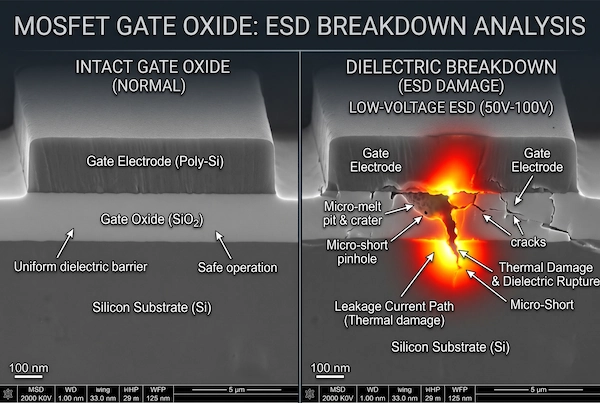
In the physical structure of a chip, the input gates of metal-oxide-semiconductor field-effect transistors (MOSFETs) and various digital logic chips are the most vulnerable targets to electrostatic discharge:
The microscopic limits of nanoscale silicon dioxide insulating gates: In advanced high-density manufacturing processes, the physical thickness of the transistor gate oxide layer (primarily silicon dioxide, SiO₂) has typically been reduced to between 2 and 5 nanometers, and the breakdown electric field strength that the dielectric material can withstand is generally around 10 megavolts per centimeter. This means that when the potential difference applied across the gate reaches just 30 volts to 50 volts, the local electric field will exceed the dielectric insulation limit;
Dielectric avalanche breakdown induced by weak electrostatic pulses: If an assembly worker is wearing non-compliant gloves with surface resistance exceeding the specified limit, the 50 V to 100 V of latent static charge accumulated through slight friction on the hands will be instantly transferred when handling SMT trays or touching exposed pins; Although this voltage is far below the discharge threshold perceivable by the human nervous system (a static shock is typically felt at 2,000 to 3,000 volts or higher), for a nanoscale gate, it is equivalent to a high-voltage lightning strike;
Melting perforations and excessive leakage current observed under the microscope: Under a focused ion beam (FIB) and high-resolution scanning electron microscope (SEM), it can be clearly observed that electrostatic overstress (EOS) creates localized nanoscale micro-melt pits at the moment silicon dioxide breaks down; The originally highly insulating gate forms permanent microscopic short-circuit pinholes, inducing severe subthreshold leakage current, which directly leads to disrupted logic operations, an abnormal surge in standby power consumption, and even thermal lockup.
Latent Defects vs. Catastrophic Failures in Automotive ECUs
In quality control for automotive electronics (such as Electronic Stability Control (ESC) ECUs, Advanced Driver Assistance Systems (ADAS) domain controllers, and Battery Management Systems (BMS)), the most critical form of electrostatic discharge (ESD) damage is not “immediate burnout,” but rather “latent defects”:
The difference between catastrophic hard failures and latent defects: If a component is completely destroyed by a strong electrostatic discharge on the assembly line, test equipment (ICT/FCT) can immediately intercept it before it leaves the factory. Although this results in the loss of the cost of a single component, the risk is contained within the production floor; However, non-compliant gloves in low-humidity environments often trigger weak secondary electrostatic discharges. This electrical stress merely causes lattice distortion, microscopic cracks, or localized dielectric thinning within the gate oxide layer; as a result, the chip’s electrical parameters still appear “normal” during functional testing at the end of the factory production line;
Severe Deterioration and Sudden Failures Under Harsh In-Vehicle Conditions: Once a circuit board with latent damage is assembled into a vehicle’s ECU and installed in the vehicle, the microscopic cracks at the damaged sites rapidly propagate outward along the silicon lattice under the prolonged vibrations from driving, fluctuating high temperatures in the engine compartment, and thermal cycling stress. After several months or a year of service, components may suddenly experience hard breakdown and open-circuit failure while the vehicle is traveling at high speeds, directly causing the in-vehicle electronic control unit to fail and shut down;
Unbearable Costs of Post-Sales Recalls and Brand Reputation Damage: Such latent failures are extremely difficult to trace during post-sales investigations. The resulting global vehicle recalls, massive claims from original equipment manufacturers (OEMs), and damage to brand reputation often result in economic losses hundreds of times greater than an entire factory’s budget for protective gloves over several years.
Secondary Mechanical Hazards: Linking ESD with Cut Protection
In real-world electronics assembly workshops and electromechanical equipment manufacturing lines, the safety risks faced in the workstation environment are never one-dimensional. In addition to the invisible threat of electrostatic discharge, front-line workers are constantly exposed to the danger of mechanical and physical injuries:
Risk of cuts from sharp stamped sheet metal and pointed enclosures: During the assembly of server cabinets, the final assembly of industrial PCs, and the pressing process for automotive electronic metal shielding covers, workers must frequently handle sheet metal parts that have undergone laser cutting and high-speed stamping; Stamped edges and burrs that have not undergone thorough passivation and polishing are extremely sharp. Ordinary ultra-thin anti-static polyester gloves can be instantly cut or torn upon contact with these metal edges, resulting in open lacerations on workers’ hands;
Secondary destruction of the antistatic barrier due to physical damage to the gloves: Once the glove’s surface fabric and conductive network are cut or severed by sharp edges, the originally closed-loop carbon fiber conductive pathways develop physical breaks; microscopic charges in the damaged area can no longer be dissipated outward through the fabric network, causing the affected area of the glove to instantly become a static dead zone and directly compromising the entire workstation’s compliance defenses;
Systematic Extension of Composite Safety Defenses: For high-load mixed processes—such as electronic assembly inside metal enclosures or cabling in large racks—where severe mechanical cutting risks are present, on-site safety engineers must, in addition to ensuring adequate electrostatic dissipation, select composite safety equipment featuring high-density cut-resistant linings and tear-resistant properties. For an in-depth selection guide on the micro-engineering of cut-resistant fibers and ANSI mechanical cut-resistance ratings, we recommend consulting our Heavy-Duty Cut-Resistant Benchmark Guide: Cut Resistant Work Gloves.
Vendor Audit Protocols: Verifying Factory-Level Testing Capabilities
For multinational electronics manufacturing services (EMS) giants, semiconductor outsourcing packaging and testing (OSAT) facilities, and Tier-1 automotive electronics suppliers, the real challenge in evaluating ESD safety gloves to EN 16350 standards does not lie in how impressive the parameters appear on the technical data sheets (TDS) submitted by distributors, but rather in conducting in-depth on-site factory audits to review their quality inspection and acceptance systems, as well as the underlying chain of test evidence.
An unwritten rule prevalent in the work glove contract manufacturing industry is that “samples pass testing, but mass-produced batches fall short.” Many small, workshop-style factories purchase high-quality conductive carbon black filament blends only for sample production when obtaining certification, but significantly reduce the proportion of expensive conductive filaments in subsequent mass production—or even switch to low-cost, temporary surface anti-static dipping agents. If technical buyers lack the expertise to identify such issues using professional laboratory equipment and do not follow traceability audit procedures during the factory inspection phase, they are highly likely to approve substandard anti-static equipment—which has systemic batch defects—for use in critical cleanroom production lines.
Verifying Third-Party Testing Dossiers: SATRA, TÜV, and Intertek
When reviewing third-party testing reports provided by suppliers, the procurement team must verify the test constraints within the reports with the same rigor as when reviewing financial statements, and reject any vague claims of compliance:
Verify the issuing organization and its accreditation status (ILAC-MRA / CNAS): Only accept bilingual (Chinese-English) reports bearing the International Laboratory Accreditation Cooperation (ILAC-MRA) mutual recognition mark and issued by SATRA, TÜV, SGS, Intertek, or an authoritative national occupational safety and health quality inspection institute; under no circumstances accept “declarations of conformity” issued by unaccredited trade intermediaries or bearing the supplier’s own seal;
Strictly enforce the core provisions regarding pre-testing conditioning (48-hour pre-conditioning at 25% relative humidity): Directly review the “Conditioning Environment” section in the body of the report; It must be explicitly stated in black and white: “Samples pre-conditioned at 23°C (+/- 1°C) and 25% RH (+/- 5% RH) for a minimum of 48 hours in accordance with EN 16350:2014”; If the report specifies a conditioning environment with 50% relative humidity or a standard room-temperature environment, the report is invalid evidence under the European standards system, regardless of how excellent the final resistance values may be;
Randomly sample discrete data from multiple test points rather than a single average value: EN 16350 explicitly requires pressure testing to be conducted separately on different areas of at least five gloves (including fingertips, palms, and cuffs); Inspectors must review the data for each test point individually to ensure that the vertical resistance of every single sample point is strictly less than 1.0 × 10^8 ohms. Suppliers are strictly prohibited from using the arithmetic average of a few isolated low-resistance points to mask defects caused by insulation exceeding the limit at other points.
On-Site Laboratory Verification: In-House Megohmmeter Testing Rigs
A state-of-the-art manufacturing facility with core competitiveness in anti-static gloves must have a high-specification ESD laboratory on-site capable of independently replicating standard testing procedures:
On-site verification of high-precision constant-temperature and humidity test chambers: Small assembly plants and trading intermediaries simply cannot afford the procurement and calibration costs of industrial-grade precision environmental test chambers. Upon entering the laboratory, the auditor’s primary task is to verify whether the facility is equipped with a fully sealed, programmable constant-temperature and humidity chamber; to confirm that its control panel is capable of maintaining the internal humidity at a stable 25% relative humidity with fluctuations not exceeding ±3%; and to review the chamber’s third-party metrological calibration certificate from the past year;
Review of Engineering Specifications for Test Fixtures and High-Resistance Meters: Verify that the test equipment used by the factory consists of calibrated, professional high-resistance megohmmeters (e.g., the test range must stably cover 1.0 × 10³ ohms to 1.0 × 10¹² ohms), and confirm that the test voltage can automatically switch precisely between 10 volts and 100 volts based on the impedance under test; Verify that the glove test fixtures comply with the 10-Newton drop-weight brass cylindrical electrodes specified in EN 1149-2, as well as the 5-pound concentric drop-weight probes specified in ANSI/ESD STM11.11, and investigate any attempts to deceive the audit by using inexpensive handheld testers or simple two-terminal pointer voltmeters;
On-site blind sampling and retesting with immediate power-on verification: Audit personnel should randomly select 3 dozen finished gloves from the stacks of products awaiting shipment in the workshop and require the factory’s quality control engineer to conduct sampling tests on the spot. Similar to the inspection criteria applied in our factory-level quality audit frameworks and enterprise TCO models, this real-time validation visually verifies whether the resistance readings for the palm and fingertips match the issued test reports, eliminating the risk of unverified contract manufacturer claims.
Batch Traceability via Laser-Printed QR Codes
Faced with the massive monthly consumption of tens of thousands of dozen gloves at large high-tech manufacturing facilities, the ultimate safeguard against the mixing of raw materials from different batches and of varying quality lies in “digital, item-level, full-lifecycle traceability”:
Laser-marked, encrypted batch traceability QR codes (Batch QR-Code) on both the inner and outer packaging: High-quality source manufacturers must use industrial high-speed laser printers to print a unique, encrypted traceability QR code and production lot number (Lot Number) on the seal of the composite bag for each dozen gloves’ outer packaging, as well as on the side label of each corrugated cardboard carton;
Closed-loop data chain at the raw material level: By scanning the batch QR code, the factory’s Manufacturing Execution System (MES) can directly retrieve the complete production records, including the incoming quality control (IQC) inspection reports for the conductive composite carbon fiber yarn suppliers used in that batch of gloves, micro-ohm tensile conductivity test records for the raw yarn, temperature and humidity process logs from the automated dipping production line’s curing ovens, and a summary of the high-resistance meter test data from the random samples taken off the line during that shift;
Elimination of Batch and Material Mix-Ups and Rapid Customer Complaint Response Mechanism: This transparent and rigorous chain-of-evidence system not only completely eradicates, at the source, unauthorized practices in production workshops—such as the unauthorized mixing of low-cost, non-conductive polyester yarn—but also empowers multinational buyers to, in the event of rare quality disputes, precisely pinpoint the defective raw material roll number within 2 hours, identify the affected packing lists, and execute a batch-specific isolation and recall—truly establishing a zero-tolerance cleanroom safety firewall.
Technical & Compliance FAQ: Navigating ESD Glove Standards
In the day-to-day operations of semiconductor foundries, automotive electronics, and high-grade cleanrooms, technical staff and procurement teams frequently encounter specific questions regarding the implementation of the EN 16350 standard for ESD safety gloves. To help engineers quickly identify key risk areas during production line audits and daily use, we have compiled the following four most common and frequently asked technical questions.
Do gloves certified under EN 388 automatically meet ESD requirements?
No. EN 388 and EN 16350 are two completely independent testing systems; there is no overlap or substitution between their testing criteria.
EN 388 focuses on physical and mechanical protection: it evaluates the mechanical limits of glove fabrics in terms of abrasion resistance, cut resistance, tear resistance, and puncture resistance. All test criteria are designed to provide protection against physical trauma and do not involve any assessment of electrical impedance or charge dissipation;
EN 16350 focuses on electrostatic dissipation properties: it mandates testing to verify whether the vertical resistance of gloves is less than 1.0 × 10⁸ ohms under extremely dry conditions at 23 degrees Celsius and 25% relative humidity;
Common industry misconceptions: Many products on the market labeled as “cut-resistant gloves” or “abrasion-resistant gloves” have achieved excellent EN 388 certification ratings; however, their fabrics typically consist of highly insulating ultra-high-molecular-weight polyethylene (UHMWPE) or standard aramid blends. Their static surface resistance often exceeds 1.0 × 10¹¹ ohms, posing a serious risk of electrostatic breakdown when used on electronics production lines. Therefore, when selecting gloves for microelectronics manufacturing workstations, it is essential to verify two separate certification reports.
Why do top-surface topical antistatic coatings fail after industrial laundering?
The root cause of failure in surface-coated antistatic gloves lies in the water-soluble loss of surfactants, whereas intrinsically conductive filament gloves feature permanent physical pathways that are resistant to washing.
Physical Detachment of Surface-Coated Agents: Conventional, low-cost gloves rely on soaking or spraying quaternary ammonium salt surfactants to achieve antistatic properties; These chemical molecules are only loosely adsorbed onto the surface of the polyester fibers. After being rinsed with ultra-pure water in a cleanroom and agitated in a mechanical drum, the water-soluble surfactants are rapidly eluted and carried away by water molecules. After just one wash, the gloves completely degrade into high insulators;
Microstructural Differences in Intrinsically Conductive Fibers: In contrast, SQG’s [ST-610], [ST-300], and [ST-310] utilize “physically embedded composite conductive filaments”; conductive particles (nano-carbon black) are densely encapsulated within the polymer core during the fiber melting and spinning stage, forming an inseparable three-dimensional conductive framework;
Long-term retention of electrical resistance after industrial cleaning: Even after repeated cleaning and drying cycles using 18 megohm ultra-pure water, the embedded carbon fiber network remains intact, and the vertical resistance is consistently maintained within the range of 1.0 × 10⁶ to 1.0 × 10⁸ ohms, fundamentally balancing cleanliness with long-term anti-static safety.
What is the risk of using conductive gloves (< 1.0 x 10^5 ohms) in electronic assembly?
Using gloves with excessively low resistance (less than 1.0 x 10^5 ohms) can cause severe micro-arc breakdown damage during microelectronic assembly and pose an electric shock hazard to operators.
Avalanche-style hard discharge causes thermal melting damage to components: The goal of electrostatic protection is “controlled, gradual charge decay,” not “instantaneous flash-over.” When a charged object comes into contact with a good conductor (resistance less than 1.0 × 10^5 ohms), a transient hard discharge occurs on the microsecond or even nanosecond scale; the instantaneously released peak current and arc heat are sufficient to melt through the metal leads of microchips and their extremely thin insulating oxide layers;
Electric Shock Hazards at Live Testing Stations: In the powered testing zones of SMT assembly lines, power module assembly lines, and battery pack cable assembly stations, exposed low- or medium-voltage test points are common; if the glove’s resistance is too low, the glove effectively acts as a bare copper wire. Should a worker accidentally touch a live circuit, current will instantly pass through the glove into the body and then to ground, causing severe electric shock injuries;
The Core Value of the Optimal Electrostatic Dissipation Range: Strictly designing glove resistance within the “electrostatic dissipation range” of 1.0 × 10⁶ to 1.0 × 10⁸ ohms allows static charges to be safely dissipated like a flood control channel, while simultaneously acting as a current-limiting resistor to clamp sudden, unexpected currents below the microampere-level safety threshold.
How does palm dipping affect the glove’s path-to-ground resistance?
Palm dipping (such as a PU coating) reduces the system’s dynamic impedance by increasing the contact area with ground, but it must be used in conjunction with a conductive liner and a grounded workbench to form a complete closed loop.
Series Impedance Model of the Coating and Liner: From an electrical perspective, the worker’s palm skin, the conductive fiber-knit liner, and the outer polyurethane (PU) coating form a series resistance network. In high-quality gloves, the PU coating formulation includes microscopic dissipative molecules, giving the coating itself a stable dissipative impedance that does not block the vertical passage of current;
Impedance Advantages from Increased Contact Area: Compared to fingertip coating, the full-palm coating structure provides a large area of physical contact when workers grip the edges of metal workbenches, antistatic containers, or pallets; This increased contact area significantly reduces macroscopic contact resistance, ensuring that the human body’s resistance to ground (Resistance-to-Groundable Point) remains consistently within the 1.0 × 10⁹ ohm upper limit specified by ANSI/ESD S20.20;
Operational guidelines for on-site closed-loop grounding: Palm-coated gloves are not standalone grounding devices; Field technicians must ensure that operators wear properly grounded antistatic wrist straps or require that work surfaces be covered with grounded antistatic mats that comply with specifications; only when the palm of the glove contacts the grounding pad can the charge be safely discharged along this complete, low-resistance path: “skin ➔ inner conductive thread ➔ dissipative coating ➔ grounded mat ➔ ground.”
Institutional Procurement Action: Ensure Your Cleanroom Compliance (CTA)
After thoroughly analyzing the technical architecture, failure models, and on-site access control tests for ESD safety gloves compliant with EN 16350 standards, multinational electronics manufacturing services (EMS) companies, wafer semiconductor packaging and testing facilities, and high-precision 3C final assembly plants will inevitably conclude that the ultimate solution is to establish a supply chain protective barrier that is practical, resilient to supply disruptions, consistent across batches, and fully traceable.
Faced with the extreme low-humidity challenges of complex workshop environments, continuing to use standard anti-static work gloves that have not undergone rigorous environmental humidity testing essentially means taking on unknown risks with the yield of millions of dollars’ worth of semiconductor chips. The core action to eliminate the hidden dangers of electrostatic breakdown is to reconstruct the technical admission standards for anti-static gloves across the entire factory, based on real laboratory data and factory-sealed engineering samples.
Ordering Certified Enterprise Testing Caskets
To assist EHS directors, process engineers (PEs), and quality inspection and R&D departments at large semiconductor factories in completing technical validation under real-world shop floor conditions, SQG is now opening a channel for institutional procurement teams to request customized, factory-sealed enterprise-grade anti-static testing engineering sample kits (Certified Enterprise ESD Testing Caskets):
Three core engineering assets physically assembled: Each testing casket contains a complete set of representative sample gloves independently calibrated for different precision applications—including the 13-pin ultra-low-particle-emission finger-dipped model [ST-300] for Class 100 cleanrooms and wafer sorting, the 13-pin full-palm-height, wear-resistant PU model [ST-310] for precision circuit board and fixture handling; and the 18-pin PolyMAX ultra-thin palm-immersion flagship model [ST-610], specifically designed for micro-precision screw assembly in 3C consumer electronics;
Each kit comes with a complete set of third-party technical documentation (Dossier): The sample box includes copies of authentic test data issued by a qualified international third-party laboratory, clearly detailing the measured vertical resistance (Rv < 1.0 x 10^8 ohms) at multiple points following 48 hours of pre-conditioning in an extremely dry environment at 23 degrees Celsius and 25% relative humidity. This data allows corporate Quality Control (QC) departments to directly compare the results against their inventory acceptance standards;
On-site workshop testing and evaluation support: The technical team can directly use the company’s in-house high-resistance megohmmeter and concentric probe fixture to conduct on-the-spot blind spot-check retesting and ergonomic evaluations of the gloves in the sample kit prior to production, providing intuitive verification of their resistance stability in dry, heated environments.
Factory-Direct Mixed Container Sourcing Programs
To meet the annual bulk procurement needs of large-scale assembly-line manufacturing facilities, SQG leverages its automated weaving and intelligent dipping clusters at its original manufacturing bases in China to offer highly flexible, cost-effective, and centralized factory-direct full container load (FCL) procurement programs:
Flexible Mixed-Model and Mixed-Size LCL Consolidation: Supports the free combination of [ST-610], [ST-300], [ST-310], and heavy-duty cut-resistant protective gear based on actual consumption ratios across different workshop sections, optimizing the load capacity of a single 20GP or 40HQ container and avoiding the risk of capital tied up by overstocking a single model;
Container-by-Container Inspection and Certificate of Analysis (COA) Guarantee: Every container of bulk goods shipped from the factory is accompanied by a complete set of authoritative EN 16350 factory inspection reports for the current batch. Each dozen of gloves features a laser-printed, encrypted traceability QR code on its outer packaging, providing direct access to the original manufacturer’s test reports for the corresponding batch of conductive composite yarn and the temperature curves for the dipping process, thereby eliminating supply chain risks associated with intermediaries mixing in substandard products;
Full Lifecycle TCO Reduction Advantages: By bypassing multiple layers of trade intermediaries to establish direct sourcing channels from the source, combined with the physical properties of embedded conductive filaments that withstand repeated industrial washing and handling, we help large-scale electronics manufacturing facilities achieve a direct annual reduction of 30% to 40% in the comprehensive procurement cost of personal protective equipment (PPE) while maintaining a zero-tolerance stance on ESD compliance.
Technical procurement committees currently planning new cleanroom production lines, preparing for upgraded multinational ESD audits, or seeking cost-saving solutions through bulk direct procurement of anti-static equipment should contact our team of original manufacturer technical experts immediately to receive dedicated compliance support and access to sample kit requests:
👉 Request Enterprise ESD Sourcing Consultation & Master Sample Kit


