

Introduction: The “Invisible Hand” Hazard in Heavy Industrial Blind Zones
Whether it’s overnight operations on deep, recessed mining benches in open-pit mines, nighttime high-altitude steel box girder splicing on major bridges spanning rivers and seas, or shield tunneling operations in long, multi-track underground tunnels, the on-site environment is consistently fraught with a high density of complex safety threats. Such work scenarios often take place in highly disruptive visual environments characterized by low light levels, strong backlighting, diesel exhaust fumes, and swirling dust. At the same time, large 100-metric-ton mining hydraulic excavators, heavy-duty crawler cranes, rubber-tired bridge erectors, and high-pressure grouting cars operate in close, overlapping coordination with one another.
Within the turning radius and boom blind spots of heavy-duty machinery, the operator’s field of view is severely limited by structural obstructions and long-distance perspective distortion, making it extremely difficult for operators to quickly identify the subtle hand movements of ground riggers, positioning supervisors, and assembly fitters with the naked eye alone. During the moments when steel structural components are positioned and aligned, lifting ropes are attached or detached, and pipe segments are advanced or retracted by jacks, even the slightest delay in visual confirmation or miscommunication can result in a worker’s hands being inevitably drawn into the extremely hazardous zones between rotating mechanisms, lifting shackles, and structural joint surfaces. These mechanical blind spots, known as “pinch points,” are the root cause of frequent finger amputations, crushed finger bones, and severe hand injuries at heavy industrial construction and mining sites.
An even more serious hazard stems from a vicious cycle at the ergonomic level. Traditional impact-resistant work gloves often lose flexibility due to the excessive layering of thick rubber material; their rigid protective shells force workers to exert sustained, high levels of forearm muscle contraction to counteract resistance when performing precise tasks such as inserting alignment pins or tightening fine-threaded bolts. To avoid this hand numbness and operational sluggishness, front-line workers often take the risk of removing their gloves to perform “blind operations with bare hands” before approaching high-risk machinery. The moment their unprotected hands are out of visual sight, they are directly exposed to the machinery’s moving parts, leading to frequent and uncontrollable pinching and crushing accidents.
To completely break this chain of injury, modern safety management must move beyond passive physical protection and transition to a new phase characterized by visual recognition, biomechanical correction, and coordinated management processes. The implementation of a systematic hi viz impact gloves safety program by companies is the key to upgrading personal protective equipment (PPE) into an active safety management tool.
This system achieves a dual restructuring at the equipment level: First, it incorporates a high-visibility “Fluorescent Yellow-Green” color—whose primary spectral wavelength falls within the high-sensitivity range of the human eye’s rod cells—combined with segmented, low-damping joint hinges and a closed-cell elastic neoprene wrist cuff that provides uniform micro-pressure support. This eliminates resistance loads at the foundational level of ergonomics, thereby eliminating the physiological motivation behind “removing gloves in violation of safety protocols due to fatigue caused by bulkiness”; second, by positioning high-visibility protective gloves as the visual anchor of the on-site Hand Injury Prevention Program (HIPP), the system establishes a motion-tracking mechanism for ground-level work gestures and a dynamic anti-pinch mutual inspection hotline for work crews, ensuring that every pair of hands in a blind spot possesses the visual warning capability to be instantly identified.
The Ergonomic Breakdown: Why Workers Remove PPE at Pinch Points
In heavy equipment maintenance workshops at mines, steel structure docking areas for large bridges, and shield tunneling work zones, safety managers often encounter a seemingly inexplicable management paradox: even though workers have been issued heavy, high-protection impact-resistant gloves, on-site inspections consistently reveal workers removing their gloves to “work barehanded.” Many on-site supervisors tend to simply attribute this phenomenon to “workers’ lack of safety awareness” or “a habit of violating safety procedures.” However, an analysis based on the underlying principles of biomechanics and occupational ergonomics reveals that when workers remove their personal protective equipment (PPE) without authorization before performing high-risk tasks, it is often a physiological avoidance behavior forced by unreasonable ergonomic defects within the gloves themselves.
The Biomechanics of Glove Resistance and Forearm Muscle Fatigue
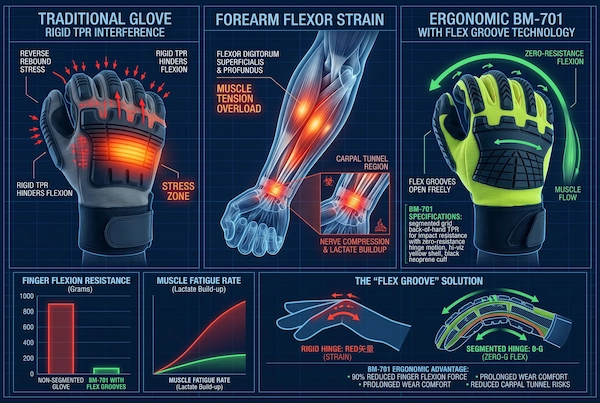
If heavy-duty protective gloves lack an ergonomic hinge design tailored to finger bone movement, the thick thermoplastic rubber (TPR) armor attached to the back of the hand creates significant reverse elastic mechanical resistance when the worker closes their hand:
Resistance to Finger Bone Flexion and Continuous Counter-Load:
When the human hand performs natural grasping or pinching motions, the distal, middle, and proximal phalanges must undergo smooth internal rotation and flexion. However, many traditional impact-resistant gloves, in pursuit of high impact absorption ratings, employ thick, one-piece TPR armor without hinged slots. This high-hardness polymer exhibits extremely strong elastic memory and rebound force at both room and low temperatures. Every time a worker grasps a workpiece, they must not only exert the grip force required to hold the tool’s own weight but also continuously generate additional force to counteract the stretching and deformation of the rubber on the back of the hand. The back-of-hand armor acts like a set of taut miniature springs, constantly and forcefully pulling the worker’s fingers outward and apart.
Rapid Metabolic Exhaustion of the Forearm Muscle Groups and Dulled Peripheral Nerves:
In order to firmly lock the fingers in a flexed position against the recoil of the back-of-hand armor, the superficial and deep flexor muscles of the forearm—which control hand movement—are forced into a prolonged state of isometric, overloaded contraction. This sustained high muscle tension directly compresses the microvessels within the forearm, rapidly disrupting local blood microcirculation and causing the muscle tissue to quickly enter a state of severe hypoxic metabolism. High concentrations of lactic acid accumulate rapidly within a matter of tens of minutes, causing an unbearable sensation of soreness, swelling, and burning in the workers’ forearms; more seriously, prolonged high-pressure compression and swollen tendons compress the median nerve in the carpal tunnel, causing the tactile and mechanoreceptors in the fingertips to rapidly become dull and numb. With the loss of proprioceptive feedback in the hands, workers’ ability to grip and control small parts declines sharply, making them extremely clumsy when handling fine tubing and fasteners.
The Unauthorized Glove Removal Trap: Micro-Decisions Leading to Amputation
It is precisely this unbearable localized physiological fatigue and the operational hindrance caused by the loss of tactile sensation that tempt workers to make fatal “micro-decisions” at the most dangerous mechanical pinch points:
The psychological trap of removing gloves to gain momentary relief from the loss of tactile sensation:
During tasks requiring extremely high precision—such as using a punch to align bolt holes on large steel box girders, aligning the fine-threaded union fittings at both ends of high-pressure oil lines, threading the end of a thin steel wire rope through a narrow rope splicing ring, or adjusting the position of a precision hydraulic valve spool —bulky, stiff gloves prevent workers from sensing, through their fingertips, the subtle vibrations of thread engagement and the clearance between threads. At this point, workers with extremely fatigued forearm muscles often succumb to a “let’s just take off the gloves for a few seconds, put them back on right after we’re done” mentality, tossing the gloves aside to pursue instant dexterity and muscle relaxation with their bare hands.
The deadly mechanism of finger amputation during this “protection vacuum” of tens of seconds:
Historical workplace injury statistics from the International Association of Drilling Contractors (IADC) and the Mine Safety and Health Administration (MSHA) clearly show that over 70% of finger bone crush injuries, comminuted fractures, and finger amputations do not occur during normal, steady work conditions involving the gripping and handling of heavy objects. Instead, they occur precisely within the brief window of just a few tens of seconds when workers remove their gloves without authorization to adjust alignment pins, insert their fingers into holes to probe, or manually align heavy components. Minor force-induced oscillations of heavy equipment booms, transient swings of lifting gear when gravity is released, or the recoil from residual back pressure in hydraulic lines can, within milliseconds, drag bare hands—deprived of any physical protection or visual warning—directly into the point of contact where two rigid components collide. Therefore, when companies implement a “hi-viz impact gloves safety program,” the primary engineering task is by no means simply to issue bans and penalize violations; rather, it is essential to fundamentally eliminate resistance loads on the back of the hand and wrist, ensuring that gloves provide a lightweight, snug, and comfortable fit, thereby eliminating the injury trap of unauthorized removal at the physiological source.
Mechanics of Photopic Vision: Fluorescent Contrast in Low-Illumination Blind Zones
In deep, recessed pits at open-pit mines at night, at workstations for installing tunnel segments in highway tunnels, and at bridge erection sites in the field on rainy days, ambient illuminance typically drops to extremely low levels of 1 to 10 lux. In these conditions, the work environment is filled with highly light-absorbing materials such as damp ore, asphalt mixtures, dark heavy oil residue, and high-concentration diesel exhaust fumes emitted by construction machinery. The dark gray, gray-black, or even deep red exteriors of conventional gloves tend to blend seamlessly with the construction background in low-light conditions, causing them to disappear entirely from the visual field of both equipment operators and their colleagues on site. To ensure that ground crew hand movements can be instantly detected in environments with extreme visual interference, the color scheme for impact-resistant gloves must be scientifically selected based on the physiology of human photoreception and spectral radiation mechanisms.
Spectral Conspicuity: Fluorescent Yellow-Green vs. Dark Mining Backgrounds
Visual contrast is by no means simply a matter of “bright colors,” but rather the physical result of a precise match between spectral reflection wavelengths and the peak sensitivity zones of the human eye’s photoreceptors:
Sensitivity Bands of Human Visual Transitions and Mesopic Vision:
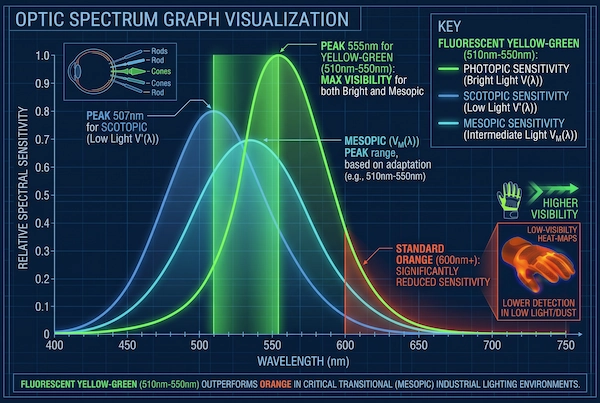
Under strong daylight conditions, the human eye relies on the cones in the fovea of the retina for photopic vision, with peak sensitivity at 555 nm; However, when ambient illuminance drops to the dim conditions typical of heavy industry night shifts, the eye’s visual mechanism switches to “mesopic vision,” in which the retina’s cones and rods work in concert, resulting in the Purkinje shift—a shift of the overall spectral photopic efficiency curve toward shorter wavelengths. Within this range, the retina exhibits extremely high quantum absorption efficiency and excitability for fluorescent yellow-green photons with wavelengths between 510 and 550 nm.
Fluorescent energy transitions penetrate mine particulate dust:
Conventional surface-dyed materials can only reflect visible light incident on their surfaces and quickly turn black and lose clarity when edge lighting from vehicle headlights is insufficient during nighttime operations; In contrast, the high-density fluorescent masterbatch used in the BM series possesses photoluminescent properties: it absorbs invisible near-ultraviolet (UV-A) and short-wavelength visible blue light from ambient light sources and, within milliseconds, converts this high-energy short-wavelength radiation into high-purity visible fluorescence at approximately 520 nm through intramolecular electronic energy level transitions. This self-luminous fluorescent effect endows the gloves with exceptionally high color purity and visual brightness contrast, enabling them to penetrate diesel soot particles and floating mineral dust suspended in the air, thereby outlining the hands’ contours with striking visual impact against the dark brown background of raw ore and oil-stained pipe walls.
Reaction Distances for Heavy Machinery and Dynamic Hand Tracking
On heavy-duty construction sites where multiple trades work side by side, enhancing the visual conspicuity of the operator’s hands ultimately aims to reduce neural reaction time within the cab, thereby securing the necessary braking time to prevent collisions and run-over accidents:
Operator visual recognition latency and gesture capture delay:
The windshields of heavy-duty rotary excavators, 100-metric-ton-class crawler cranes, and rotary drilling rigs are constantly covered with dust and condensation, and the operator’s cab is typically located 5 to 15 meters above the ground-level work area. Operators must monitor the load’s trajectory and boom swing angle while simultaneously tracking the hand signals of ground-based riggers—all within an extremely narrow field of view. Experimental eye-tracking data shows that when riggers wear traditional dark-colored or soiled gloves, the perception-reaction time for operators to identify the position of the ground crew’s hands and recognize “stop/slow down” hand signals in low-light conditions ranges from 1.8 to 2.4 seconds. This delay often results in the heavy load experiencing a slight sway and loss of stability before the crane operator belatedly applies the swing brake.
Safety buffer distance provided by a 0.8- to 1.2-second reduction in reaction time:
By fully covering the palms and backs of the fingers with high-contrast fluorescent yellow-green elements, hand movements create a highly visible dynamic target effect within the crane operator’s peripheral vision. The operator does not need to focus their gaze entirely on the hands; the cerebral cortex can immediately determine that the hands are within the lifting danger zone based on the high-frequency flickering of the fluorescent patches. The high-gloss fluorescent coating significantly reduces the operator’s visual perception and reaction time to within 0.8 to 1.2 seconds. Based on calculations using the counterweight of an excavator with a rotational linear velocity of 3 meters per second or a rapidly descending lifting hook, this approximately 1-second time savings can directly provide ground crew members at the edge of the pinch zone with a safe braking buffer distance of 2 to 3.6 meters, completely reversing the deadly scenario of uncontrolled equipment crushing and severing fingers.
For an in-depth exploration of how the flexible protective structure for the back of the hand balances highly visible fluorescent warning coatings with microscopic energy-absorbing damping performance, please refer to the materials mechanics literature: TPR exoskeleton engineering.
Anatomical Wrist Dynamics: Neoprene Cuff Engineering & Carpal Stability
In the design of heavy-duty industrial hand protection, the wrist is not only the joint connecting the hand to the forearm but also an anatomically sensitive area where the hand’s blood vessels, tendons, and median nerve converge. Traditional industrial gloves often employ two extreme designs at the wrist closure: either a stiff, extended safety cuff, whose hard edges frequently strike the ulnar styloid process when the wrist is flexed; or a cheap, unevenly tensioned standard latex elastic band, which, after just a few hours of work, leaves deep red, congested marks on the worker’s wrist, severely impeding blood return to the hand. To accommodate the high-frequency joint movements involved in rock drilling in mines and heavy-duty assembly in infrastructure projects, the wrist structure must strike a precise engineering balance between free flexion, balanced carpal tunnel pressure, and physical protection.
Elastic Restitution of Closed-Cell Neoprene Under Articulation
The SQG® BM-701 and BM-702 models have completely abandoned traditional cuff designs, introducing an engineering-grade closed-cell neoprene wrist cuff architecture across the entire product line to reconfigure the contact mechanics of the wrist during high-frequency dynamic flexion and extension:
Isotropic Elastic Restitution and Uniform Micro-Pressure Support:
The interior of closed-cell neoprene is filled with countless micrometer-scale sealed gas microcapsules, endowing the material with excellent elastic restitution and resistance to tensile deformation. When frontline rope workers or shield segment assemblers frequently perform complex, extreme-angle movements—such as wrist abduction, adduction, dorsiflexion, and palmar flexion—the neoprene adapts to the skin’s contours through multi-axial stretching and rebound. Its micro-elastic properties generate a constant and uniform ring of gentle pressure around the wrist, completely eliminating the localized high-pressure stress concentrations caused by ordinary elastic bands and preventing deep pressure marks and contact dermatitis.
Preservation of Wrist Joint Range of Motion and Unobstructed Venous Return:
Heavy lifting and hammering tasks require the wrist to maintain a high degree of freedom for instantaneous fine adjustments. The edges of the foamed neoprene are seamlessly ultrasonically welded; when the wrist is bent beyond 80 degrees, the cuff edges conform smoothly without rolling up or creating sharp corners that dig into the skin. Uniform, gentle compression provides moderate carpal stability while completely avoiding the superficial areas where the median nerve and radial artery run through the carpal tunnel. This ensures stable microcirculatory blood flow in the palm during prolonged, high-intensity work, effectively delaying soft tissue soreness and fatigue in the wrist and preventing a decline in exercise tolerance.
Thermal Insulation, Vibration Damping, and Debris Barriers
In addition to its mechanical adaptive properties, high-density, closed-cell neoprene serves as a natural physical insulation barrier:
Microporous damping attenuates high-frequency microvibrations generated by impact wrenches:
During the tightening of large mining truck wheel hub bolts and the initial and final tightening of high-strength bolts on steel bridges, pneumatic impact wrenches and hydraulic torque wrenches generate high-frequency, multi-axial mechanical shocks and microvibrations (HAVS). These high-frequency microvibrations are transmitted directly through the bones of the hand to the wrist and forearm, and are the primary cause of occupational “white finger syndrome” and synovitis of the wrist joint. The closed pores within foamed neoprene form a microscopic air-cushion damping and energy-absorption system that effectively absorbs and attenuates high-frequency shock waves transmitted in reverse from the tool handle to the wrist joint, significantly reducing the shear impact loads on the tendon groups.
Thermal insulation and complete sealing against slag debris:
Whether in the bitterly cold drafts of deep open-pit mines or in damp, chilly underground shield tunneling sections, neoprene’s low thermal conductivity creates a thermal barrier that prevents biting cold winds and moisture from reaching the wrist. This maintains the temperature of the synovial fluid within the carpal tunnel at an optimal physiological range, preventing tendons from stiffening and losing control due to cold. At the same time, the elastic neoprene cuff fits snugly against the skin, forming a 360-degree physical sealing lip around the wrist. This completely blocks the path for fine metal burrs from grinding operations, rock debris from drilling and blasting, and crushed ore and slag to seep into the palm through the cuff, preventing fine, hard foreign objects from abrasively damaging the worker’s wrist skin against the inner lining of the glove.
For heavy-duty crews that routinely perform high-altitude hoisting, winch rope traction, and steel cable towing operations—and require gloves that combine highly elastic, quick-release neoprene wrist cuffs with a full-palm, strong, and abrasion-resistant aramid framework—we recommend consulting the dedicated technical guide: Heavy Duty Rigging Gloves Aramid.
Core Model Comparison: BM-701 vs. BM-702 Structural Analysis
In the practice of safety protection for heavy-duty engineering, many project procurement departments often fall into the misconception that “as long as the gloves have a rubberized back and bright colors, they can be used for all high-risk workstations.” However, while both the SQG® BM-701 and SQG® BM-702 share the same visual design language—featuring a highly visible fluorescent ribbed palm and an impact-resistant exoskeleton—they exhibit distinct mechanical specializations and application boundaries in terms of the chemical composition of their skeletal fibers, the shear reinforcement mechanism at the web of the hand, the wrist locking structure, and the TPR-zoned damping on the backs of the fingers.
When these two models are subjected to engineering analysis, the technical differences in their underlying materials and structural dimensions directly determine their distinct protective performance when confronting “highly sharp mechanical cuts” versus “extreme heavy-load rigging torsional wear.”
Technical Specifications and Material Divergence Matrix
To provide EHS managers in mining, underground infrastructure, and heavy-duty lifting operations with precise, quantifiable data, the SQG Materials and Mechanics Laboratory conducted a comparative analysis of the core engineering parameters of the BM-701 and BM-702:
| Engineering & Safety Metrics | SQG® BM-701 (Cut & Impact Hi-Viz) | SQG® BM-702 (Rigging & Torsion Hi-Viz) |
| Palm Architecture & Color | Hi-Viz Yellow Fluorescent Corded Cotton | Hi-Viz Yellow Fluorescent Corded Cotton |
| Structural Shell / Liner | Cotton / HPPE / Glass Fiber Composite | Cotton / Heavy-Duty Polyester Blend |
| ANSI/ISEA 105 Cut Rating | ANSI Level A4 (Mechanical Cut Shield) | ANSI Level A2 (General Mechanical) |
| Thumb Crotch Reinforcement | Heavy-Stitched Abrasion-Resistant PU Patch | High-Tenacity Aramid Fabric Overlay |
| Wrist Closure System | Neoprene Cuff with Adjustable Hook-and-Loop Closure | Slip-on Heavy Neoprene Elastic Cuff |
| Dorsal Impact Armor | Segmented Flex-Groove Knuckle & Finger TPR | Dual-Density Broad Knuckle & Ribbed TPR |
| Primary Worksite Fit | Tunnels, Shield TBM, Steel Beam Rigging | Surface Mining, Draglines, Wireline Winches |
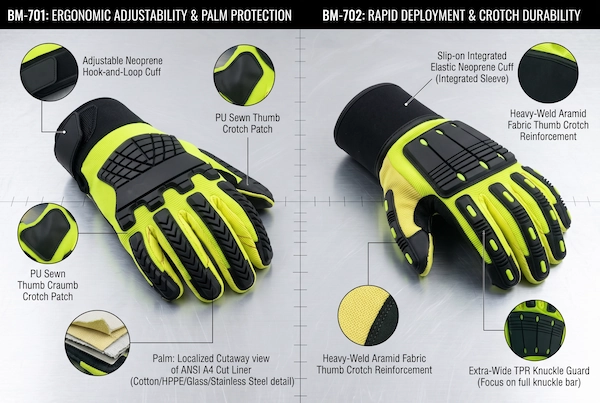
From the material engineering matrix above, we can clearly identify the fundamental differences in the mechanical structures of these two main pieces of equipment:
The differentiation in fiber pathways between the cut-resistant inner liner and the torsion-resistant blended-fiber skeleton:
The BM-701, designed to withstand the dense metal burrs and sharp rock fragments encountered during underground shield tunneling and steel box girder installation, employs a composite three-strand inner liner made of high-density cotton fibers blended with ultra-high-molecular-weight polyethylene (HPPE) and micron-level alkali-free glass fibers. Under microscopic stress, this ternary composite framework functions as follows: the outer layer of cotton fibers absorbs slurry; the core layer of glass fibers blunts the microscopic edges of cutting blades; and the long-chain HPPE molecules, with their extremely high tensile strength, block shear propagation, thereby establishing a robust ANSI Level A4 mechanical cut-resistant barrier. In contrast, the BM-702 focuses its R&D entirely on resistance to high-cycle torsion and tensile fatigue. It combines high-count combed cotton with heavy-duty industrial polyester staple fibers, achieving a long service life against repeated bending through extremely high weave density, specifically designed to withstand continuous abrasion from heavy-duty steel wire ropes and rough cables.
Thumb Crotch Reinforcement: Polyurethane Wear-Resistant Pads vs. Para-Aramid Thermal Shield:
The thumb crotch is the “eye of the friction storm” where shear wear is most severe when operating pipe valves or gripping steel cables. The BM-701 features a thick polyurethane (PU) wear-resistant pad sewn with double rows of high-tensile nylon thread, providing robust tear- and puncture-resistant cushioning while maintaining flexible movement between the fingers. In contrast, the BM-702—designed for extreme rigging and towing conditions—features a layer of high-toughness, heavy-duty aramid woven fabric directly welded over this area. This not only significantly enhances resistance to shear and tear but also forms a thermal insulation barrier during the transient high temperatures caused by high-speed cable reeling and unwinding, preventing the glove’s base material from melting through due to heat.
Dynamic Adaptability of the Wrist System and Back TPR Hinge:
For the wrist closure design, the BM-701 features a form-fitting neoprene wristband equipped with industrial-grade hook-and-loop fasteners, allowing workers to precisely adjust the tightness to their wrist circumference for a gap-free seal, preventing debris from entering narrow tunnels; The BM-702, on the other hand, employs a wide-brimmed, heavy-duty elastic neoprene slip-on cuff without hook-and-loop fasteners, ensuring that workers can quickly shed the gloves and sever the arm to save their lives within 1 second in the event of an extreme accidental entanglement hazard involving large winches or hoists in open-pit mining. Regarding the exoskeleton on the back of the hand, the BM-701 features reinforced deep-grooved phalangeal hinges to accommodate precise pin-insertion operations, while the BM-702 increases the coverage area over the main knuckle to provide a heavy-duty impact-absorbing barrier for securing large-diameter steel cables.
Workstation Mapping: Field Deployment in Infrastructure and Extraction
In the mining, smelting, and heavy industrial construction sectors, there is no single “one-size-fits-all” glove capable of providing comprehensive protection against all hazards. If procurement is mechanically implemented with a “one-size-fits-all” approach without considering specific environmental conditions, mechanical loads, and dynamic operating conditions, on-site protection is often significantly compromised: using ordinary abrasion-resistant gloves on a shield tunneling face littered with sharp rocks can easily result in the inner lining being slashed or punctured; using cotton-ribbed gloves to clean pipe valves with strong acidic waste liquid will cause the acid to instantly penetrate the fibers and burn the skin; and at heavy-duty winch workstations where gloves must be quickly removed in an emergency, tightly fastened Velcro wrist straps may even become a fatal entanglement hazard. Precise workplace safety depends on strictly mapping the mechanical hazard characteristics of each workstation to the material configuration of the gloves and dynamically switching between them.
Subterranean Tunneling and Shield TBM Maintenance: SQG® BM-701
Long, multi-line underground tunnels, urban rail transit immersed tube cut-and-cover construction, and large-scale hard-rock tunnel boring machine (TBM) advancement sections are typical examples of complex, high-risk environments in confined underground spaces. In such work zones, workers must not only endure cold, damp conditions and exposure to grout spray but are also constantly exposed to the immediate danger of cutting tools being replaced on the shield cutterhead, rock blockages being cleared from screw conveyors, and the hoisting and assembly of high-strength precast concrete segments:
Double Defense Against Narrow Segment Alignment and High-Grade Cut Resistance:
When curved segments weighing several metric tons are being fine-tuned and aligned by a hydraulic assembly machine, assembly workers must place both hands close to the segment edges to insert connecting bolts. The hardened cement burrs on the segment edges and the sharp gravel seeping from the assembly joints can easily tear through ordinary gloves the moment pressure is applied. The flagship SQG® BM-701 features a built-in triple-composite lining of cotton, HPPE, and alkali-free glass fiber, directly forming a robust ANSI Level A4 mechanical cut-resistant barrier that withstands scratches from sharp burrs;
High-visibility in low light and a sealed cuff that prevents gravel ingress:
Underground tunnels rely solely on low-intensity temporary explosion-proof floodlights for illumination, and the operator’s line of sight is often obstructed by the machine’s boom. The BM-701 features tightly woven, high-saturation fluorescent yellow-green cotton cords on the palm, combined with reflective contours on the back of the fingers, allowing the main operator to clearly track the ground crew’s finger movements and subtle gestures from over ten meters away; Paired with an adjustable, closed-cell neoprene wristband featuring heavy-duty hook-and-loop fasteners, workers can securely fasten the cuff around their wrists to completely prevent high-pressure cement slurry, grouted bentonite, and flying rock debris from entering the palm through the gaps in the tunnel segment joints. For tunnel electrical wiring or hydraulic micro-valve calibration tasks requiring even greater precision in fingertip manipulation, we recommend further consideration of the 18-gauge high-dexterity cut- and impact-resistant gloves.
Open-Pit Heavy Mining and Crane Rigging Banks: SQG® BM-702
In large-scale open-pit ferrous and non-ferrous metal mines, deep-cut open-pit coal mining and stripping workfaces, and high-tonnage floating crane lifting zones at ports, the machinery encountered by ground crew has evolved to include giant electric shovels, 100-metric-ton-class off-road wide-body mining dump trucks, and arrays of high-altitude crawler crane rigging:
Reinforcing the aramid-reinforced wire rope “jaw” to prevent wire breakage and cutting:
During the disassembly of steering knuckles on 100-metric-ton-class mining truck chassis, the replacement of high-strength steel wire ropes with diameters of 50 millimeters or more on electric shovel hoist drums, and the four-point balanced lifting of long-span box girders, riggers must frequently pull on steel cables and heavy-duty shackles. The outer surfaces of heavy-duty steel cables in use are covered with burrs from broken wires, which generate extreme mechanical cutting forces during the instant of tensioning and sliding. The flagship SQG® BM-702 features a heavy-duty, high-tensile aramid reinforcement layer directly overlaid via welding onto the high-wear shear zone at the thumb gusset, significantly enhancing resistance to mechanical tearing and transient high-temperature friction. This completely prevents the thumb gusset from being worn through during high-speed rope-handling maneuvers;
Quick-release elastic neoprene cuffs provide an escape route in case of extreme entanglement:
Open-pit mining electric shovels and winch drums generate immense rotational torque and traction inertia. When working near such high-speed rotating equipment, if the back of the hand or fingertips are accidentally caught by a rotating steel cable, the adjustable Velcro wrist closure will firmly lock the worker’s wrist inside the machinery, leading to horrific accidents involving the dragging and severing of limbs. The BM-702 features a wide, one-piece, quick-release elastic neoprene sleeve (Slip-on Cuff) that maintains a snug fit without any rigid mechanical fasteners. In the event of an emergency entanglement or sudden pull, the worker needs only to pull their hand forcefully in the opposite direction to quickly remove the glove within 1 second, enabling an escape even at the risk of losing a limb. The thick, corded cotton texture on the palm quickly absorbs and wicks away mining dust and grease from the surface of steel cables. For details on the corded palm’s liquid-wicking properties and the rigging anti-pinch design, please refer to: corded palm oil and gas gloves.
Transitioning to Acid Washing and Liquid-Tight Petrochemical Facilities
When construction operations shift away from mining and civil engineering projects to deep-fluid environments—such as degreasing heavy-duty asphalt paving equipment, dismantling and inspecting pipelines in mineral processing plants during high-concentration acid leaching, or removing and installing blind flanges on pipelines in alkylation units at chemical plants—the logic behind physical slip resistance undergoes a fundamental transformation:
Chemical Penetration Defects in All-Cotton Ribbed Coatings:
All-cotton high-gloss ribbed fabrics inherently feature a porous, breathable fiber structure designed specifically for dry conditions, light oil sludge, and dry abrasion of rigging. Once exposed to flowing inorganic strong acids, strong alkali cleaning solutions, or high-concentration aromatic hydrocarbon solvents, the liquid medium rapidly penetrates the cotton fiber layer via capillary adsorption, directly contacting and chemically burning the worker’s skin, causing the gloves to instantly lose their protective function;
Seamless Transition to a Pure PVC Liquid-Tight Chemical-Resistant and Impact-Resistant System:
In work environments where chemical corrosion and heavy-load impacts coexist, safety managers must decisively direct work teams to discontinue the use of cotton gloves and switch entirely to professional protective models featuring a fully liquid-tight barrier. We recommend the flagship SQG® P-902 model, made of pure polyvinyl chloride (PVC) through a multi-stage continuous impregnation process. This model’s outer shell offers outstanding resistance to strong inorganic acids and alkalis. Its outer layer features a microporous sand-textured surface that diverts chemical fluids to create a micro-negative pressure vacuum effect, while the heat-fused, integrated impact-resistant frame on the back of the hand establishes a dual defense baseline against chemical exposure and impact within the chemical liquid-proof impact glove system, enabling a closed-loop rotation of protection across all operational areas involving different chemical media.
Corporate HIPP Framework: Engineering a Zero-Pinch Safety Culture
At integrated mining workfaces, highway and railway bridge construction sites, and underground shield tunneling sites, simply distributing impact- and cut-resistant gloves to workers does not mean that a company has established an effective line of defense for hand safety. In-depth accident investigations by the International Association of Oil and Gas Producers (IOGP) and the U.S. Occupational Safety and Health Administration (OSHA) reveal that the root cause of the vast majority of hand crushing and finger amputation incidents is not insufficient impact resistance in glove materials, but rather the lack of rigorous, engineering-level management mechanisms on-site, which results in workers’ hands being continuously exposed to uncontrolled mechanical motion paths.
The core of establishing a “Zero-Pinch Safety Culture” lies in implementing a systematic, enterprise-wide “Hand Injury Prevention Program” (HIPP). This program must move beyond the traditional, rudimentary approach of “post-incident reporting and financial penalties” and instead utilize high-visibility protective gloves as visual sensors for proactive on-site defense. Through three phases—hazard mapping, dynamic mutual inspections, and ergonomic fitting—it builds a closed-loop network of physical and behavioral defenses at heavy industry sites.
Phase 1: Pinch-Point Hazard Mapping and Energy Isolation Audits
The first phase of implementing the HIPP program involves conducting detailed “Pinch-Point Hazard Mapping and Energy Isolation Audits” on all machinery and equipment along construction routes:
Engineered identification and red-zone marking of on-site pinch points:
The safety engineering team must collaborate with equipment maintenance crews to conduct on-site, in-depth inspections of all interfaces in dynamic mechanical systems where shearing, crushing, entanglement, or crushing hazards may occur. Key areas of focus include the points where hoist pulley blocks engage with steel wires, the gaps between pipe sliding guide supports and saddles, the operating openings of hydraulic pile-driving clamps, the areas surrounding the spring supports of large vibrating screens, and the alignment holes for bolts on large-diameter pipe valve flanges. At these high-risk physical interfaces, apply “Pinch Point Red Zone” warning markings using weather-resistant red fluorescent reflective contrast paint to clearly define the absolute physical boundaries where hand insertion is strictly prohibited;
Physical Isolation of Residual Energy and Lockout to Prevent Sudden Pinch Hazards:
For high-pressure equipment such as hydraulic drilling rigs and shield segment assemblers, strictly enforce hazardous energy control procedures (LOTO). Before workers reach in to align or fine-tune equipment, residual pressure in the hydraulic line accumulators must be released, and a mechanical physical lockout pin must be installed on the main control valve. By establishing a visual link between the red-zone markings on static equipment and the high-visibility color of workers’ gloves, as soon as a worker’s fluorescent gloves enter the red-marked area, on-site monitoring sensors and the shift safety officer can immediately trigger an alert, eliminating the risk of unintentional hand intrusion.
Phase 2: The “Line-of-Fire” Dynamic Peer-Checking Protocol
In heavy-duty lifting and coordinated machinery operations, individual protective measures taken in isolation are highly susceptible to failure due to blind spots. The core of HIPP Phase 2 is to utilize the high-saturation fluorescent yellow-green palm markings of the BM-701 and BM-702 to establish a team-level “Line-of-Fire” Dynamic Peer-Checking Protocol:
Definition of the “Line-of-Fire” Based on Visual Prominence:
When hoisting large-span precast steel beams, the buckets of rotary excavators, or components of moving 100-metric-ton mining trucks, the projected area of a falling load, the sector where the taut wire rope could snap back, and the inner wall within the radius of rotation all constitute lethal “lines of fire.” Since the entire palm and back of the fingers of the BM-701 and BM-702 are covered with highly visible fluorescent yellow-green cotton cord and reflective strips, the hand movements of ground crew members become the most conspicuous dynamic visual targets on the work surface;
Team Dynamic Communication and Visual Confirmation System for Hand Withdrawal:
Before issuing commands to raise the crane’s main hook, operate the winch, or apply pressure to the segment jacks, the heavy machinery operator and the hook-setting rigger must follow a standardized visual confirmation procedure: The rigger must face the operator, spread both palms outward, and expose a large area of fluorescent yellow-green palm surface to send the standard visual safety signal indicating that “hands have been safely withdrawn from the danger zone”; From inside the cab, the operator must visually confirm through the windshield that the highly visible hands of all on-site support workers are at least 1.5 meters away from the load’s drop point and the edges of the rotating area where crushing hazards exist before releasing the rotation lock and activating the hydraulic power. This crew-to-crew mutual inspection protocol, facilitated by high-visibility gloves, completely eliminates misoperations caused by the operator and rigger rushing to signal due to environmental noise and walkie-talkie frequency interference.
Phase 3: Ergonomic Compliance Tracking & Sizing Fit Mandate
No matter how sturdy a pair of gloves may be, their protective value is reduced to zero if workers remove them and toss them into a toolbox. The focus of HIPP Phase 3 is on eliminating the physiological incentives for workers to remove their equipment at the source by implementing a strict “Ergonomic Compliance Tracking & Sizing Fit Mandate” for gloves:
Sizing to eliminate excess material, wrinkles, and compensatory fatigue:
Statistics show that over 40% of frontline workers consistently wear work gloves that are either too large or too small. When gloves are too large, several millimeters of excess rubber remain at the fingertips, which not only makes them highly susceptible to being caught in high-speed gears but also forces workers to exert more than twice the gripping force to overcome the folds in the excess fabric when handling small parts; Conversely, gloves that are too small subject the palm and wrist to prolonged, high-pressure constriction, accelerating the decline in forearm blood circulation. When implementing safety programs, companies must provide standard hand-sizing charts to accurately measure workers’ palm circumferences and middle finger lengths on-site, strictly ensuring that each worker is issued gloves in their exact size;
Lifecycle Ergonomics: Washing Durability and Elastic Recovery Testing
In the actual operation and maintenance of heavy-duty transportation in mining, large-scale infrastructure projects, and shield tunneling projects, the procurement cost of high-visibility impact-resistant gloves is often not the primary cause of uncontrolled occupational safety and health budgets; rather, the “premature performance degradation” of gloves during multi-shift cyclic use is the key factor driving up the total cost of ownership (TCO). Many general contractors and equipment maintenance companies, when implementing hi-viz impact glove safety programs, often overlook the physical degradation patterns of gloves after prolonged exposure to heavy oil and mud and multiple rounds of rough washing and disinfection: After several improper machine washes, the originally bright and eye-catching fluorescent yellow-green palm surface rapidly fades to a dull, grayish mud-yellow, completely losing its low-light visibility and warning value; the closed-cell neoprene wrist cuffs, which originally fit snugly around the wrist, undergo irreversible, permanent deformation due to prolonged stretching, becoming loose and sagging; the hook-and-loop fastener’s hook and loop structures are severely worn down or detached, causing the wrist cuffs to frequently come undone during work. Establishing comprehensive, full-lifecycle ergonomic testing standards that cover both optical color retention and wrist cuff resilience is essential to prevent protective failure and unnecessary disposal.
Colorimetric Retention of Fluorescent Pigments Through Multi-Cycle Washing
The optical transmittance of fluorescent fabrics depends on the stimulated emission capacity of the dye chromophores and color masterbatches; however, under repeated exposure to heavy oil contamination in mines and strong alkaline cleaning agents, gloves are highly susceptible to chromophore quenching and optical degradation:
Heavy soiling and physicochemical damage to chromophores:
In open-pit mining stripping and tunnel segment assembly work areas, fine quartz dust, asphalt-based oils, and waste engine oil can rapidly penetrate the microporous structure of all-cotton twill fabric. If on-site cleaning involves inferior industrial detergents containing strongly oxidizing bleaches or free strong alkalis, or if the gloves are subjected to aggressive washing with extremely hot water at temperatures as high as 70 degrees Celsius or above, the conjugated double-bond chromogenic system of the polymeric fluorescent dyes will rapidly oxidize and break down; Residual oils and mineral particles will deposit and harden on the fiber surface, forming a dark gray film that blocks ultraviolet and short-wavelength visible light from penetrating the color masterbatch, completely extinguishing the high-excitation-state fluorescent radiation effect and causing a precipitous drop in the glove’s contrast in low-light blind spots.
Standardized Neutral Ergonomic Decontamination Process and Color Retention Protocol:
To ensure that BM series gloves maintain clear visual warning capabilities throughout their entire lifecycle, strict standard washing procedures must be followed at the worksite or in centralized decontamination centers. The washing water temperature must be strictly controlled below 40 degrees Celsius, and the use of chlorine-based bleach is strictly prohibited; It is recommended to use a neutral industrial surfactant degreasing emulsion with a pH between 6.5 and 8.0, combined with a gentle, low-speed drum wash cycle. This promotes fiber expansion and relies on emulsification to remove deep-seated dirt, thereby maximizing protection of the fluorescent color layer coating the cotton fibers and the outer HPPE layer. BM series gloves that have undergone the standard decontamination process, after 10 to 15 full wash cycles, are tested using a spectrophotometer and found to maintain their fluorescent yellow-green hue accuracy and relative brightness factor at over 80% of their initial high reference values, thereby continuously ensuring that equipment operators can visually detect objects from extremely long distances even in low-light or blind spots.
Preventing Neoprene Cuff Creep and Hook-and-Loop Degradation
For neoprene wrist cuffs and fastening structures designed to provide dynamic wrist support and block the entry of foreign objects, alternating mechanical stress and material aging are the two primary causes of structural relaxation:
Tensile Creep Relaxation in Closed-Cell Foamed Neoprene:
As workers repeatedly put on and take off gloves and flex their wrists during each shift, closed-cell neoprene undergoes tens of thousands of radial tensile cycles. Under prolonged alternating tensile stress, low-quality recycled neoprene or inferior foam materials experience slow, irreversible viscoelastic slippage in the microscopic walls of the closed cells, exhibiting pronounced mechanical creep (Creep Relaxation). Once the walls of the microcells undergo plastic deformation, the material’s elastic recovery modulus drops significantly. The cuff edges begin to curl, stretch, and lose their shape, failing to maintain close contact and gentle pressure against the worker’s wrist. This not only eliminates the material’s ability to dampen micro-vibrations affecting the tendons in the carpal tunnel but also creates dangerous gaps through which gravel and sand particles can seep in.
Velcro Shear Peel Damping and Mandatory Retirement Thresholds:
In the adjustable hook-and-loop closure system featured on the BM-701, micro-rigid injection-molded nylon hooks (Hook) repeatedly engage with the high-density velour fabric loops (Loop). In harsh environments where sand and dust particles infiltrate, the microscopic hooks are highly susceptible to being straightened or snapped off, while the loop fibers are prone to breaking and pilling. Corporate EHS teams must establish clear, quantifiable retirement criteria for wrist fastening systems:
Elastic elongation degradation threshold: When the natural elongation of a neoprene wrist cuff in a flat state exceeds 15% of its original factory dimensions, it indicates that the internal cellular structure has undergone plastic fatigue, and the elastic rebound support has completely failed;
Critical threshold for Velcro overlap peel resistance: If prolonged wear causes a severe decline in the shear bond strength of the Velcro overlap (opening with even slight external force, with a loss of shear strength exceeding 40% of the rated strength), there is a high risk of the cuff unexpectedly coming undone during mechanical operations and being caught in rotating workpieces. Once either of these two strict red lines is crossed, a mandatory decommissioning order must be issued, and the gloves must be replaced with brand-new ones to ensure that there are no blind spots in human-machine ergonomics and structural safety throughout the entire operational chain.
Technical FAQ: Ergonomics, Vision Mechanics, and Pinch Safety
At open-pit mining sites, in the excavation of long, multi-line tunnels, and at heavy-duty construction sites, equipment managers and EHS supervisors often face a variety of practical engineering questions from frontline staff and procurement teams when implementing a high-visibility impact gloves safety program for their companies: Should the high-visibility color be bright orange or yellow-green? Will fingers feel stiff when tightening bolts while wearing heavy TPR exoskeletons? How should one choose between Velcro wrist closures and one-piece elastic cuffs? Why does a 100% cotton ribbed palm actually provide better grip when handling heavy, mud-covered steel cables?
Combining the principles of optical physics, ergonomic testing, and field data from the SQG Material Protection Laboratory, we provide technical analyses addressing the four most representative core questions encountered on-site.
Why does fluorescent yellow-green provide superior visibility compared to bright orange in tunnels?
During tunnel excavation, culvert assembly, and unlit nighttime construction, fluorescent yellow-green generally offers a significantly greater visibility distance and detection speed than traditional fluorescent orange. This advantage is entirely based on the physiological mechanism of spectral luminous efficiency in human visual perception:
Peak Response of the Human Photopic Curve:
According to the International Commission on Illumination (CIE) standard spectral photopic efficiency function, the sensitivity peak of human retinal cones under photopic conditions precisely corresponds to a wavelength of 555 nm, while the sensitivity peak of rods under scotopic conditions shifts blueward to around 507 nm. The primary reflection and emission wavelengths of fluorescent yellow-green fall precisely within the highly sensitive range of 510 to 550 nm; in contrast, the wavelength of high-luminance orange typically lies above 600 nm, at the flat edge of the human photopic efficiency curve, and the intensity of electrical signals reaching the human optic nerve under the same irradiance is far lower than that of yellow-green.
High-Contrast Discrimination under Low-Illuminance Conditions and Sodium-Vapor Lighting:
Low-voltage sodium lamps, high-voltage sodium lamps, or temporary explosion-proof floodlights with low color temperature are commonly used for lighting in underground tunnels and cut-and-cover work zones. The spectral composition of the ambient background light in these environments is heavily skewed toward warm yellow-red tones. If bright orange gloves are worn, the hands will blend spectrally with the dim yellow lighting and reddish-brown bedrock, reducing them to indistinct shadows; In contrast, fluorescent yellow-green produces extremely strong chromatic contrast under artificial light sources rich in yellow components. Combined with the 520 nm visible light it spontaneously emits after absorbing near-ultraviolet light from the environment, it creates a striking dynamic contour contrast in the retinas of shield machine operators and muck truck drivers, instantly penetrating the barrier of dust.
Does an ergonomic TPR exoskeleton restrict finger dexterity during heavy bolting?
At workstations such as large flange bolt drilling, heavy-duty mining truck wheel hub tightening, or scaffolding coupler assembly, many workers are reluctant to wear impact-resistant gloves. The primary reason is concern that the impact-resistant rubber on the back of the hand is too stiff, making it difficult to bend the fingers and align them with the threads. However, scientifically designed TPR armor is by no means a rigid plate:
The mechanical drag-reduction mechanism of segmented finger joint hinges (Flex Grooves):
The thermoplastic rubber (TPR) armor on the back of the hand in the BM series impact-resistant gloves features a high-density, segmented geometric structure. Directly above the axes of motion at the proximal interphalangeal (PIP) and distal interphalangeal (DIP) joints, there are three-dimensional, inverted-triangular flex grooves with precisely controlled depths. When the finger bends naturally or is clenched to 90 degrees or even to its maximum angle, the grooves instantly close in space, preventing the rubber blocks from interfering with or compressing each other, thereby significantly reducing the internal shear stress caused by forced material elongation.
Zero-damping rebound eliminates fatigue in the finger’s antagonist tendons:
As determined by mechanical simulation grip force tests, when the fingers are flexed to grip a tool, the high-quality TPR exoskeleton equipped with segmented hinges generates less than one-third of the reverse elastic rebound resistance compared to ordinary one-piece molded rubber strips. When workers grip high-torque impact wrenches or manually insert bolts, the forearm muscle groups require almost no additional effort to “counteract the rubber on the back of the hand.” The fingers can freely maintain pinching force at the fingertips and precision in spatial adjustments. This not only eliminates the soreness and numbness in the forearm tendons caused by high-load work but also eliminates the potential risk of workers removing their gloves in violation of safety regulations to tighten bolts.
When should a worksite choose an elastic slip-on cuff over an adjustable hook-and-loop cuff?
The SQG® BM-701 is equipped with an adjustable neoprene cuff with hook-and-loop fasteners, while the BM-702 features a one-piece, fastener-free elastic neoprene slip-on cuff. This is by no means a matter of aesthetic preference, but rather a strict correspondence to different on-site mechanical operation risks:
Work conditions where an adjustable hook-and-loop cuff is recommended:
Suitable for workstations such as underground tunnel excavation, shield cutterhead maintenance, concrete structure grinding, and steel structure positioning at heights. These scenarios are typically characterized by an environment above and around the worker’s head that is filled with loose rocks, high-pressure grouting slurry, dust, and flying metal particles. By tightening the hook-and-loop fastener, workers can secure the glove cuff snugly above the wrist bones, creating a fully enclosed dust barrier that prevents loose rocks and debris from falling inside the cuff and causing wrist abrasions.
Work conditions where the use of a quick-release elastic cuff (Slip-on Cuff) is mandatory:
Suitable for workstations with a high concentration of high-speed rotating machinery, such as the main winch of an electric shovel in open-pit mining, the main rope guide of a hoist, the rotating drill pipe of a drilling rig, and the area around the drums of large conveyors. In such areas, there is an extremely low probability that gloves could be drawn into rotating components due to snagging on steel wire burrs, posing a “wrapping hazard.” If the glove is securely fastened to the wrist with Velcro, the worker’s arm could be violently yanked into the machinery’s engagement point in an instant, resulting in arm amputation or fatal entanglement. In contrast, the BM-702’s elastic cuff provides moderate wrist coverage without any mechanical fasteners. If a worker encounters a sudden pulling hazard, they can quickly pull their hand backward with force to slip it out of the glove within 1 second, limiting the injury to the glove itself.
How does a corded cotton palm maintain grip on mud-splattered rigging lines?
In mining hoisting operations, drilling rig operations, and field rigging towing applications, the surfaces of steel wire ropes are often coated with mud, crude oil, and heavy-water lubricants. Many people assume that smooth rubber or coated materials offer better slip resistance, but when dealing with rigging heavily saturated with oily mud, high-density corded cotton demonstrates unique physical advantages at the interface:
High-Speed Siphoning of Thick Slurry Through Capillary Channels: The surface of a densely woven, thick, multi-strand cotton rope is covered with countless microscopic natural fiber barbs and inter-fiber gaps, forming a highly absorbent three-dimensional capillary network. When a worker’s glove-covered palm presses firmly against a slurry-coated, slippery steel wire rope, the raised rope ridges on the palm first bear the high pressure of line contact, instantly crushing the thick slurry film on the rope’s surface; subsequently, through the capillary siphon effect, the cotton fibers rapidly absorb the squeezed-out liquid medium and divert it laterally into the depths of the rope grooves, preventing the liquid from stagnating at the contact interface and forming a fully hydrodynamic suspension film that causes slippage.
Micro-interlocking of high-density microscopic fiber interfaces: After the surface liquid is effectively diverted and absorbed by the rope-textured pattern, the dense bundles of pure cotton fibers come into high-pressure contact with the microscopic ridges and grooves of the steel wire rope’s outer strands. When deformed under pressure, the cotton fibers generate an extremely large surface contact area and microscopic shear resistance, rapidly converting sliding friction into semi-dry mechanical interlocking friction. Consequently, even during hoisting and towing operations where heavy mud or even mineral slurry splashes, the all-cotton rope-textured palm surface continues to provide workers with a stable, non-sticky, and controllable gripping force that prevents sudden slippage.
Enterprise HIPP Audit & Worksite Trial Program (CTA)
In heavy industry and mining excavation, high-altitude bridge closure operations for extra-large bridges, and the construction of deep, large-scale urban underground tunnels, systematic improvements to hand safety must never be limited to paper regulations or comparisons of laboratory sample parameters. The true risks of mechanical injury are always hidden in the blind spots of multi-machine coordination where dust obscures visibility deep in mine shafts late at night, in the high-frequency vibrations of pneumatic impact wrenches operating for hours on end, and in the brief moments—lasting just tens of seconds—when riggers tighten heavy steel cables to align with pin holes. Whether gloves can actually withstand cuts from sharp rock fragments, whether TPR armor will force workers to remove them without authorization during prolonged gripping, and whether highly visible fluorescent yellow-green colors can secure a life-saving braking buffer within a crane operator’s field of view—all of these must withstand rigorous testing in the real-world conditions of the worksite.
To help general contractors and construction project teams effectively translate the “Zero-Pinch” goal into actionable safety protocols, SQG deeply integrates its safety engineering team with actual workflow patterns, providing enterprises with end-to-end technical support—from hazard mapping to team-level trial wear.
Complimentary Job-Site Pinch-Point Hazard & Ergonomic Audits
For large-scale open-pit and underground mining general contractors, project teams erecting steel beams for cross-sea bridges and high-speed rail viaducts, as well as urban rail transit shield tunnel construction contractors, SQG’s senior safety engineers collaborate with on-site EHS teams to conduct customized “Complimentary Job-Site Pinch-Point Hazard & Ergonomic Audits”:
On-site mapping of machinery “line-of-fire” movement paths:
Engineering and technical personnel were deployed directly to the loading benches of open-pit mine electric shovels, the heavy-lift cable hoisting work areas of extra-large bridges, and the grouting and maintenance chambers of shield machine cutterheads to conduct on-site surveys of critical hazard interfaces, including rotating crane booms, guide pulleys on winch drums, alignment holes for large-diameter flange bolts, and high-pressure grouting pipe joints; Identifying blind spots and pinch points where hands are highly susceptible to accidental contact during minor instability oscillations of heavy components, assisting project teams in marking high-contrast red safety warning lines at critical physical junctions, and reconstructing visual safety movement paths for work crews;
Attribution Analysis of Continuous Forearm Muscle Load and Non-Compliant Removal of Protective Gear:
Using portable hand dynamometers and micro-motion pressure-sensing patches, we tracked the wrist flexion angles, peak grip forces, and fatigue trends of forearm muscle groups among on-site assembly fitters and rigging operators throughout an entire work shift; Precisely quantifying the “compensatory overload resistance” caused by stiff adhesive strips on the backs of glove fingers and loose-fitting gloves, identifying the physiological root causes that lead workers to take risks by removing their gloves during alignment and rope threading tasks, and developing a tailored, tiered equipment optimization plan for the worksite that balances protection against impacts and collisions with low-friction flexibility.
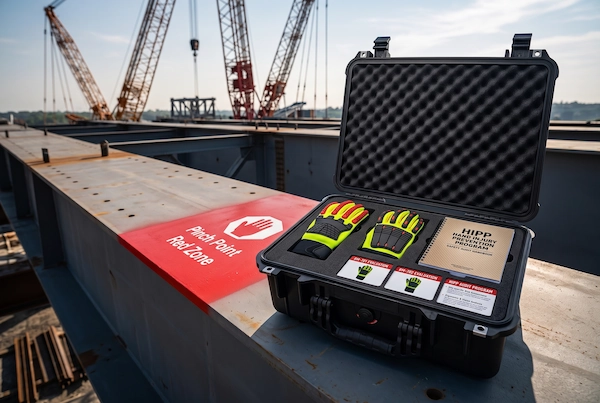
Request the SQG® Heavy-Duty Hi-Viz Evaluation Case
To support the equipment and supplies departments of mining groups, safety directors at large infrastructure projects run by central and state-owned enterprises, and maintenance managers for specialized engineering projects in conducting on-site comparative evaluations with frontline crews before centralized procurement bidding, SQG has officially opened a direct application channel for free, factory-direct shipments of the “SQG® Heavy-Duty Hi-Viz Evaluation Case.”
This pilot evaluation case precisely features two flagship models representative of the harsh operating conditions found in heavy-duty infrastructure and mining:
SQG® BM-701: The palm features a high-density cotton cord texture in high-saturation fluorescent yellow-green; the inner layer is a composite of cotton, HPPE, and high-strength alkali-free glass fiber, providing an ANSI Level A4 mechanical cut-resistant barrier; Equipped with an adjustable, closed-cell neoprene anti-fatigue sealed cuff featuring industrial-grade hook-and-loop fasteners, it is specifically designed for underground tunnel shield boring, debris removal involving highly sharp rock fragments, and the tightening of bolts in steel box girders. It strictly prevents the ingress of debris while offering both high dexterity and cut resistance;
SQG® BM-702: The palm features a high-density, tear-resistant, all-cotton cord-weave mud-shedding structure, while the high-stress “thumb gusset” area is reinforced with heavily layered, welded, abrasion-resistant woven aramid fabric; the wrist features a buckle-free, quick-release, one-piece heavy-duty elastic neoprene sleeve (Slip-on Cuff), specifically tailored for extreme open-air heavy-duty scenarios—such as maintenance of 100-metric-ton-class mining truck chassis, heavy-duty winch wire rope traction, and high-tonnage rigging hook operations—where there are risks of rotational entanglement and high-heat friction wear.
Companies can conduct on-the-job trials lasting 14 to 30 days with representative key lifting crews, shield tunnel segment assembly sections, or mining electric shovel maintenance work sites to conduct on-the-job trial wear sessions lasting 14 to 30 days. This allows for a comprehensive evaluation of the gloves’ performance in terms of forearm tendon fatigue resistance during continuous operation, the visibility and recognition distance of rigging hand signals in low-light conditions at night, and the longevity of fluorescent color retention after multiple neutral industrial machine washes.
If you need to schedule an on-site grip-point safety audit by a professional engineer for your project section, or to directly request factory-tested sample kits and engineering technical specifications for your frontline technical teams, please feel free to contact our Protective Engineering Team at any time: Request a Worksite Evaluation Kit & Direct Quote.


