Introduction: The Real Cost of Choosing the Wrong Glove Coating
On the front lines of industrial manufacturing and automated production, factory procurement managers and EHS (Environmental, Health, and Safety) supervisors face the same glaring and costly dilemma almost every day:
“We’re clearly purchasing high-quality nitrile gloves certified to international standards, so why do assembly line workers keep slipping when handling parts coated with cutting fluid? Why do workers constantly complain that the gloves feel stuffy and cause excessive sweating—and even take them off to make their jobs easier, leading to persistent hand abrasions and a high rate of workplace injuries?”
According to on-site protective equipment audit data from SQG® across hundreds of manufacturing facilities worldwide, more than 70% of premature glove wear and non-compliant use stem not from the quality of the gloves themselves, but from a mismatch between the glove coating and the physical and mechanical demands of the actual work environment.
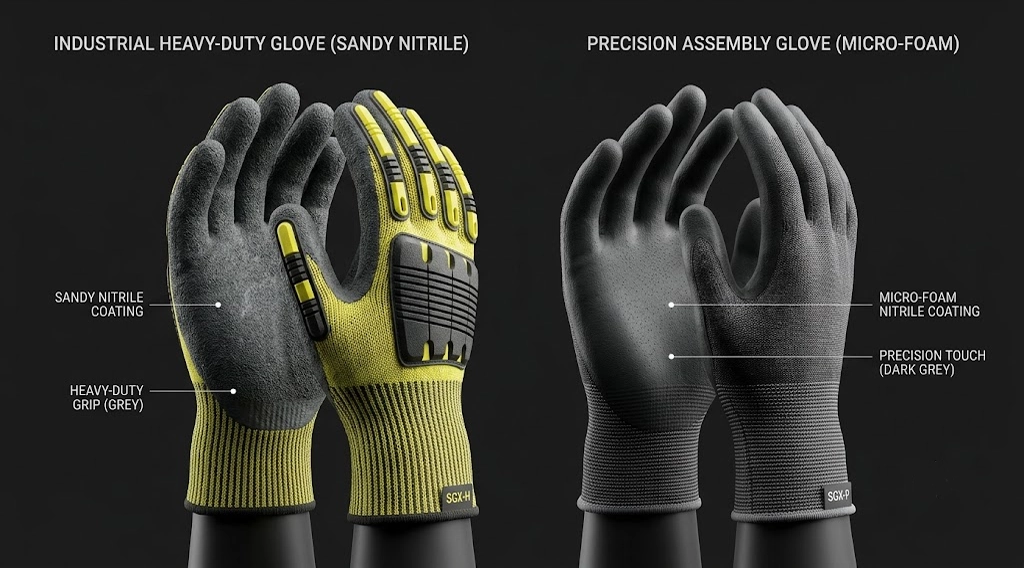
In the field of modern industrial protection, “nitrile” has long ceased to be a single, generic term for materials. Currently, the two most mainstream—and most easily confused—high-end coatings in industrial B2B procurement—Sandy Nitrile and Micro-Foam Nitrile—have fundamental differences in materials science and surface engineering.
Sandy Nitrile is specifically designed to break through oil films and provide a robust “Heavy-Oil Grip”;
Micro-Foam Nitrile, on the other hand, focuses on delivering “second-skin” Tactile Sensitivity and Open-Cell Breathability.
If the procurement department lacks an understanding of the microscopic physical mechanisms of these two coatings and blindly adopts a “one-size-fits-all” procurement strategy, the consequences will be obvious: dry-assembly workers will experience hand fatigue from wearing heavy, matte-finish gloves, while machinists working with oily materials will frequently slip while wearing foam gloves, ultimately leading to persistently high Total Cost of Ownership (TCO) for the factory.
Drawing on SQG®’s more than 20 years of experience in the R&D and manufacturing of industrial protective gloves as an OEM/ODM, this white paper will set aside empty marketing rhetoric and provide an in-depth analysis of the selection logic behind Sandy Nitrile vs. Micro-Foam Nitrile from four key dimensions: surface friction mechanics, oil-drainage channel design, breathability and heat dissipation mechanisms, and financial ROI for factory procurement. It will help your company achieve precise cost reduction and efficiency gains in workshop safety budgets while ensuring 100% safety and compliance.
Deconstructing the Science: How Sandy and Micro-Foam Coatings Are Made
To truly understand the differences in how these two gloves perform on the production line, we first need to zoom in to the microscopic level to see exactly what kind of material modifications they undergo on the glove dipping production line.
Although they appear to be the same layer of black nitrile latex, the surface engineering designs behind them are completely different:
What is Sandy Nitrile? (Macro-Drainage Engineering)
The core design objective of Sandy Nitrile is to address one of the most persistent challenges in industrial production—physical slippage caused by liquid oil films.
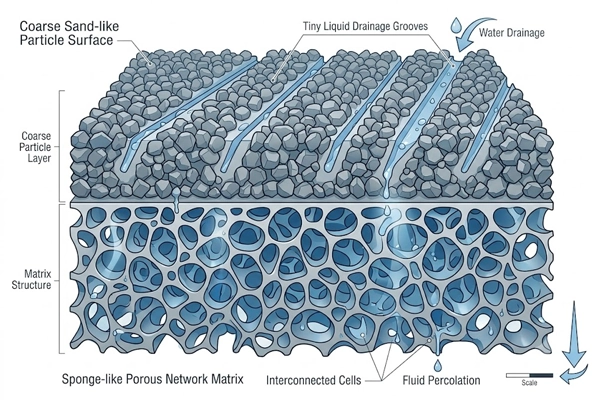
During the dipping production process, after the glove liner is immersed in liquid nitrile latex, the factory applies a special micro-particle crystallization technology to its surface. During the subsequent high-temperature drying and vulcanization processes, these micro-particles form a dense, uneven, and rough texture on the coating surface that is clearly visible to the naked eye, with a texture very similar to a sheet of fine sandpaper (Sandpaper Texture).
Physical Grip Mechanism: The sanded nitrile relies on “macroscopic fluid drainage” and “hard-particle interlocking.”
Performance in Actual Working Conditions: When workers use their hands to grasp metal parts saturated with cutting fluid, rust-preventative oil, or heavy oil, a smooth coating is completely enveloped by the oil film, causing a “hydroplaning effect.” In contrast, the deep grooves on the Sandy Nitrile surface—much like the drainage grooves on highway rain tires—rapidly squeeze the oil and grease into the surrounding grooves the moment the palm grips the part, allowing the raised, hard latex particles to penetrate the oil film and generate a direct, hard-on-hard physical interlock (Macro-Mechanical Interlock) with the metal surface.
What is Micro-Foam Nitrile? (Micro-Suction Engineering)
In stark contrast to the approach of adding external particles to matte nitrile, Micro-Foam Nitrile takes a highly precise route of “internal material foaming.”
Before the dipping process begins, the production line uses precision high-pressure foaming equipment to uniformly inject microscopic gas molecules into the liquid nitrile latex. After the gloves are cured, tens of thousands of sponge-like open-cell microporous networks (Open-Cell Micro-Porous Matrix) form within and on the surface of the coating.
Physical Grip Mechanism: Micro-foamed nitrile relies on “microscopic physical adsorption” and “excellent material flexibility.”
Performance in Actual Working Conditions: When these micron-sized pores come into contact with dry workpieces or those with a trace oil film, they adhere to the surface like countless micro-suction cups. At the same time, because the foamed coating is rich in air-filled micropores, its physical hardness is far lower than that of solid or matte nitrile. When force is applied, it can conform to the shape of the palm and undergo slight deformation, greatly increasing the actual effective contact area between the glove and the workpiece, thereby providing tactile sensitivity as precise as handling with bare hands.
Grip Performance in Action: Dry, Light Oil, and Heavy Oil Environments
On actual production lines in manufacturing plants, “grip performance” absolutely cannot be generalized. The physical and mechanical forces at play where the glove contacts the workpiece are completely different when holding a dry cardboard box versus gripping a stamped part that has just come off a machine tool and is covered in cutting fluid and metal shavings.
Using the wrong coating in the wrong production stage not only leads to frequent drops and damage to workpieces but also significantly increases hand fatigue among workers and the likelihood of workplace injuries.
Dry and Light Oil Operations: Micro-Foam Dominates
In processes such as automotive electronics assembly, dashboard wiring, precision machinery assembly, and warehousing and logistics—where conditions are dry or involve only a minimal anti-rust oil film (Light Oil Film)—Micro-Foam Nitrile demonstrates overwhelming advantages.
In dry or low-oil conditions, the core requirements for grip are “material conformability” and “tactile sensitivity”:
Physical and Mechanical Performance: The micro-foam coating is extremely soft and elastic. When workers use their fingers to pick up tiny M3 screws, electronic chips, or fine wires, the micro-foam coating instantly deforms under minimal pressure, conforming perfectly to the microscopic contours of the workpiece and significantly increasing the effective contact area.
Solving On-the-Job Pain Points: Traditional hard-coated gloves are too thick and rigid, preventing workers from feeling the shape of parts. To improve efficiency, workers often remove their gloves without authorization, creating significant safety hazards. In contrast, micro-foam gloves provide a “second-skin” feel akin to bare hands, allowing workers to perform high-precision assembly tasks without removing their gloves.
Sourcing Advice for Light-Duty Assembly: For lightweight assembly tasks requiring high flexibility, superior tactile sensitivity, and long-lasting breathability and comfort, we recommend evaluating our B-213 Foam Nitrile Glove, 13-gauge seamless polyester liner, palm-coated.
Heavy Oil and Wet Operations: Sandy Nitrile Takes the Crown
However, when the setting shifts to heavy-duty machining, metal stamping, castings cleanup, or heavy oil and wet environments where cutting fluids spill, the physical limitations of micro-foam gloves become glaringly apparent.
In heavy oil environments, a viscous oil film forms a barrier between the workpiece and the glove. The open micropores in micro-foam gloves quickly become “saturated” and clogged by thick oil residue. Once the micropores are filled with liquid, their original microscopic adhesive force vanishes completely, and the glove’s surface instantly becomes as slippery as if it were coated with lubricant.
This is precisely where Sandy Nitrile (textured nitrile) reigns supreme:
Physical and Mechanical Performance: The hard, grainy surface of the sanded coating (sandpaper-like texture) gives it powerful fluid-cutting capabilities. The moment the palm clenches, the hard, raised particles can directly penetrate the thick oil film barrier, rapidly squeezing and expelling cutting fluid and heavy oil into the surrounding micro-grooves.
Solving Real-World Workshop Challenges: When handling oil-stained steel plates, slippery aluminum ingots, or castings coated with cutting fluid, Sandy Nitrile’s dual mechanism of “oil-draining grooves + firm grip” delivers surprising physical grip strength, preventing heavy objects from accidentally slipping and causing toe injuries or mechanical pinching.
Sourcing Advice for Heavy Oil & Machining: When dealing with heavy oil contamination, cutting fluids, and heavy-duty metalworking applications that demand high grip resistance, our nano-textured technology provides an unparalleled anti-slip barrier. Learn more about our R-238 Nano-Sandy Nitrile glove, 18-gauge seamless nylon/spandex liner, palm-coated.
Tactile Feedback and Hand Fatigue: The Synergies Between Liners and Coatings
In industrial manufacturing and high-frequency assembly lines, “hand fatigue” is one of the most easily overlooked—yet most costly—hidden costs for factory management.
Many EHS departments focus solely on a glove’s cut resistance or abrasion resistance ratings, yet overlook a fundamental biomechanical fact: if gloves are too thick or too stiff, workers’ hand muscles must expend extra energy every time they clench their fists or grasp parts to overcome the resistance of the glove material itself.
During a typical 8-hour shift, workers may need to perform gripping motions thousands of times. This cumulative tendon strain not only leads to hand soreness and a sharp drop in assembly efficiency but also directly prompts workers to remove their gloves without authorization in pursuit of “comfort,” creating a significant safety hazard that could lead to workplace injuries.
The dexterity and comfort of gloves essentially depend on the synergistic mechanical design of the knitted liner and the nitrile coating:
Sandy Nitrile: Superior Protection with Structural Stiffness
To firmly lock the textured, sanded particles onto the surface during the dipping process and prevent them from falling off, the coating formulation for Sandy Nitrile typically requires a certain thickness and density.
Physical Properties and Feel: A thicker coating provides sanded gloves with superior puncture resistance and abrasion resistance, effectively protecting against metal burrs and sharp debris. However, the coating material itself inevitably possesses a certain degree of structural stiffness, resulting in a slightly stiffer feel compared to foam gloves.
Recommended Applications: A matte-finish coating is best paired with a medium-thickness seamless liner, such as 13-gauge or 15-gauge, for heavy-duty workstations that do not require frequent handling of extremely small parts but demand high levels of physical protection and oil-repellent grip.
Micro-Foam Nitrile: Ergonomic Flexibility and High-Gauge Harmony
In contrast, Micro-Foam Nitrile is a flagship product designed to deliver ergonomics and a second-skin fit.
Physical Properties and Feel: Because the foam coating is rich in open micropores, its material density is significantly lower than that of solid latex, allowing it to be precisely controlled to an extremely thin micrometer level. This lightweight, flexible coating integrates seamlessly with high-gauge liners—such as 15-gauge or 18-gauge ultra-fine nylon/spandex-covered yarn.
Recommended Application: The 18-gauge high-density liner provides the gloves with exceptional stretchability and tactile feedback similar to bare hands. When workers grip workpieces while wearing these gloves, the muscles in their palms barely feel any resistance from the material’s rebound, which significantly reduces cumulative hand fatigue caused by long shifts and ensures compliance with factory wear requirements at the source.
Breathability and Temperature Control: Solving the “Sweaty Hands” Problem
In frontline industrial work, aside from hand soreness, the number one reason workers remove their protective gloves in violation of safety regulations is always “heat and sweat buildup.”
In hot processing workshops without air conditioning, in high-temperature and high-humidity environments during summer, or on assembly lines requiring prolonged continuous work, the skin on the hands sweats profusely. If the glove coating fails to dissipate heat and moisture in a timely manner, the interior of the glove turns into a sealed “steam room.”
This not only significantly reduces work comfort but also triggers a series of chain reactions:
Skin maceration and blisters: When exposed to high humidity for extended periods, the skin on the hands becomes softened (skin maceration), making it highly susceptible to blisters caused by friction or contact dermatitis.
Compliance risks: In an effort to cool off, workers may frequently remove their gloves without authorization, exposing themselves directly to the risk of cuts, pinches, or splashes.
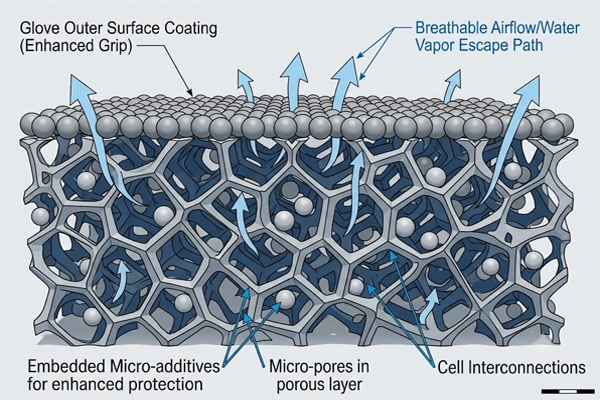
Micro-Foam Nitrile: The Open-Cell Thermal Release Mechanism
Micro-Foam Nitrile is hailed as the “breathable coating” in the industrial protective glove industry, and the secret lies in its unique open-cell microporous network (Open-Cell Matrix):
Convection of Heat and Moisture: At the microscopic level, the countless microbubbles within the micro-foam coating are interconnected. Heat and sweat vapor generated by the palm can naturally dissipate into the air through these tiny breathable channels, creating micro-scale gas convection.
Reduced Perceived Temperature: This continuous heat dissipation and breathability mechanism significantly reduces moisture buildup inside the gloves, keeping workers’ hands dry throughout an 8-hour shift. It eliminates at the source the non-compliance issue of removing gloves due to excessive hand perspiration, instantly improving the workshop’s compliance rate (glove-wearing compliance).
Sandy Nitrile: The Trade-Off for High-Density Protection
In contrast, Sandy Nitrile has a denser coating structure.
To trap coarse particulate matter on the surface and provide a robust barrier against liquid penetration, its latex density is significantly higher than that of foam coatings. Although it blocks the intrusion of the vast majority of external oils and liquids, it also sacrifices some airflow convection efficiency.
Selection and Purchasing Recommendations: If your factory production lines are located in high-temperature workshops, non-air-conditioned sections, or operate under high-temperature conditions during summer, and the work environment does not involve heavy oil immersion, prioritizing the purchase of highly breathable Micro-Foam gloves is the best solution to ensure worker comfort and safety compliance.
Here, we have provided an in-depth expansion and refinement of the section on H2 (5) Durability and EN 388 Abrasion Resistance.
EN 388 Durability and Abrasion Resistance: Debunking the Myth
In the field of industrial Protective Personal Equipment (PPE) procurement, there has long been a widespread misconception: “Sandblasted gloves have a rough surface and are certainly more abrasion-resistant than thin foam gloves; foam gloves are full of micro-pores and will tear within two days.”
If we were talking about the era of low-end, crude traditional foam impregnation processes from over a decade ago, this view would indeed have been accurate. However, thanks to advancements in modern polymer engineering, this outdated notion has long been thoroughly debunked.
The Science of Wear Resistance: Rigid Resistance vs. Elastic Energy Absorption
Whether a glove is durable when subjected to continuous friction does not depend on the roughness of its surface, but rather on the elasticity of the material’s molecular chains and its ability to absorb tear energy:
Sandy Nitrile (textured coating): Although the rough particles provide a strong oil-repellent grip, during dry, high-frequency friction (such as when handling cardboard boxes, stamped parts, or wooden boards), the raised particles create hard-on-hard shear resistance against the contact surface. Over time, the latex surrounding the particles is prone to microscopic flaking (particle shedding), causing the coating to gradually thin.
Micro-Foam Nitrile (Micro-Foam Coating): High-quality micro-foam coatings possess exceptional polyurethane/nitrile composite elasticity. When subjected to high-frequency dry friction against surfaces, they function much like the rubber tires on a luxury car: through the elastic micro-deformation of the coating’s microscopic pores, they instantly cushion and absorb the physical energy generated by friction, thereby significantly slowing the rate of wear on the material itself.
EN 388 Level 4 Abrasion Rating: The Benchmark of Quality
In testing conducted under Europe’s stringent EN 388 standard for mechanical safety protection, the “Martindale Abrasion Test”—which evaluates a glove’s abrasion resistance—involves subjecting the glove’s coating to high-pressure rotational friction using sandpaper.
Micro-Foam Nitrile gloves, enhanced by modern polymer formulations, consistently meet the highest EN 388 abrasion resistance standard—Level 4. This means the coating must withstand over 8,000 cycles of high-intensity abrasion without being worn through.
In high-frequency friction scenarios such as warehousing and logistics, electronics handling, automated assembly lines, and dry-condition assembly, the actual service life of high-quality micro-foam gloves not only matches that of sanded gloves but often provides factories with a longer safe wear cycle because they do not shed particles or harden.
Sourcing Advice for High-Abrasion Workstations: Looking to achieve an exceptionally long service life and low Cost-Per-Shift in dry, high-intensity, high-frequency friction environments? Learn more about our P-214 MAXGUARD, 18-gauge seamless nylon/spandex liner, nitrile foam palm coating.
Liquid Barriers vs. Chemical Safety: Knowing the Limits
When procuring industrial gloves, one of the most dangerous misconceptions that procurement personnel without a technical background are prone to fall into is: “As long as the label says ‘Nitrile,’ they assume they can wear them to soak in chemical solvents, clean machine tools, or handle strong acids and alkalis.”
This confusion can easily lead to serious chemical burns to the hands. It must be made clear that the vast majority of palm-coated industrial protective gloves on the market are designed primarily for mechanical and physical protection (such as abrasion resistance, cut resistance, and slip resistance) and must never be equated with fully coated professional chemical-resistant gloves!
Understanding the physical limitations of these two types of coatings when exposed to liquids is key to ensuring compliance and safety in the workplace:
Micro-Foam Nitrile: Permeability of the Open-Cell Matrix
The open-cell structure of Micro-Foam Nitrile (micro-foam coating) gives it remarkable breathability and flexibility. However, this also means it has physical limitations when it comes to acting as a liquid barrier:
Risk of Liquid Penetration: If workers wear Micro-Foam gloves while immersed for extended periods in organic solvents, thinners, paint, or large amounts of cutting fluid, liquid molecules will slowly seep through the microporous channels into the glove, coming into direct contact with the worker’s skin and potentially causing chemical dermatitis or toxic absorption.
Operating Conditions: The Micro-Foam coating is only suitable for dry, slightly oily, or assembly environments with only minimal liquid splashes.
Sandy Nitrile: The Uncoated Breathable Back Trap
Although the palm coating of Sandy Nitrile (satin-finish coating) is relatively dense and thick, providing a better barrier against liquid penetration than foamed coatings, it is also unable to handle immersion-type chemical operations:
Risk of Leakage on the Back of the Hand: The vast majority of sanded gloves use a palm-coated or two-thirds-coated process, leaving the knitted back (uncoated knitted back) fully breathable. Once the hand is immersed in a solvent tank or exposed to large-area chemical splashes, the liquid will instantly penetrate the knitted back and saturate the interior.
The Compliance Standard: EN ISO 374 vs. Mechanical Protection
For jobs that actually involve strong acids, strong alkalis, organic solvents, pesticide preparation, or prolonged immersion in liquids, factories must procure professional fully-coated or double-layer chemical-resistant gloves certified to EN ISO 374.
However, for outdoor agricultural work, landscaping spraying, or light outdoor construction tasks where conditions involve only light liquid splashes and require extremely high cut resistance, palm-coated foam gloves are the optimal compromise that balances comfort and protection.
Sourcing Advice for Agricultural & Light Liquid Scenarios: If your work environment requires both basic protection against light liquid splashes and a high level of mechanical cut resistance, explore our B3-210 Anti-cut Foam Nitrile Glove, 13-gauge seamless HPPE/Glass liner, palm-coated.
The B2B Sourcing Comparison Matrix
In the actual procurement process for Protective Personal Equipment (PPE) in manufacturing facilities, procurement departments and EHS safety managers often need to perform precise reconciliation and glove model matching across multiple workshop sections within an extremely limited timeframe.
To help your procurement team streamline the decision-making process and avoid budget wastage caused by model confusion, SQG®’s team of senior safety engineers has compiled this Sandy Nitrile vs. Micro-Foam Nitrile B2B Sourcing Matrix based on laboratory test data (such as EN 388 mechanical testing and coefficient of friction testing) and on-site feedback from hundreds of manufacturing facilities worldwide.
We recommend using this table directly as a reference for your facility’s internal Hand Protection Policy:
B2B Coating Performance & Sourcing Decision Matrix
| Performance Metric / Scenario | Sandy Nitrile-Coated Gloves | Micro-Foam Nitrile-Coated Gloves | Sourcing Decision Advice |
| Heavy Oil & Cutting Fluids | Exceptional (due to oil-draining grooves) | Average (Micro-pores tend to clog easily with prolonged exposure to heavy oil) | For heavy-duty machining, stamping, and handling oil-contaminated steel plates, Sandy is highly recommended. |
| Grip in Dry & Light Oil Conditions | Good | Excellent (Relies on microscopic adsorption) | For dry assembly, logistics packaging, and general light industrial applications, Micro-Foam is recommended. |
| Tactile Sensitivity / Dexterity | Good | Top-tier (Feels like bare hands, with a snug fit) | For precision electronics and small screw assembly, Micro-Foam is recommended. |
| Breathability & Heat Control | Fair | Exceptional (Open-cell micro-pores allow for breathability) | For high-temperature workshops and long shifts, Micro-Foam is the preferred choice. |
| EN 388 Abrasion Rating | Typically meets Level 3–4 | High-quality foam can reach Level 4 (the highest rating) | Choose high-quality products from major manufacturers; both options offer excellent wear resistance and service life. |
| Hand Fatigue Reduction | Fair | Excellent (lightweight and soft, reduces hand fatigue) | To reduce hand fatigue among workers and increase wear rates, choose Micro-Foam. |
| Primary Industrial Use | Metal stamping, recycling and dismantling, heavy-oil machining | Automotive assembly, warehousing and logistics, electronics assembly, cleanrooms | Tailor your procurement precisely to the physical conditions of each specific workstation in the workshop. |
Key Procurement Insights from the Matrix
A comparison of the matrix reveals that no single type of coating can fully cover all workstations in a factory:
Heavy oil/liquid-intensive workstations (typically accounting for 15%–20%): The key challenge lies in slip resistance and grip. Sandy Nitrile must be procured, as its coarse particles break through oil films to ensure zero workplace accidents.
Dry-condition/precision assembly/high-frequency handling workstations (typically accounting for 80%–85%): The key trade-off lies between fatigue levels, breathability, and flexibility. Micro-Foam Nitrile must be procured; its open-cell microporous structure for heat dissipation and high-thread-count lining ensure workers are willing to wear them all day.
Total Cost of Ownership (TCO): How Segmented Sourcing Saves Money
In B2B industrial PPE procurement, finance departments and procurement managers often fall into a dangerous blind spot: focusing solely on the “unit price for single- and double-gloves” listed on invoices, while overlooking the “Total Cost of Ownership (TCO)” at year-end settlement.
In real-world factory operations, the gloves with the lowest purchase price often turn out to be the most expensive when the year-end accounts are settled.
Seasoned B2B procurement decision-makers evaluate the cost-effectiveness of gloves based on a single core metric—Cost-Per-Shift:
True cost per shift = Purchase price per pair ÷ Actual number of shift days the gloves can be worn safely
Here’s a very straightforward example:
If a factory purchases low-end gloves at ¥5 per pair, but due to poor abrasion resistance and susceptibility to tearing, workers must discard them and replace them after just one day of use, the actual cost per shift is ¥5 per day;
If the factory purchases a pair of high-quality micro-foam or matte nitrile gloves at ¥10 per pair, which have passed the EN 388 Level 4 high-strength abrasion resistance test, workers can safely wear them for 5 consecutive shifts, so the actual cost per shift is only ¥2 per day!
At face value, the latter option appears twice as expensive, but on the annual financial statements, it directly saves the factory 60% on glove procurement expenses.
The “One-Glove-Fits-All” Trap
To simplify supplier management and SKU inventory counts, the procurement departments of many factories have adopted a “one-size-fits-all” procurement model—purchasing and distributing a single type of heavy-duty Sandy Nitrile (textured nitrile) glove for the entire factory.
While this approach may seem convenient, it actually represents a massive waste of the factory’s procurement budget:
Functional Overkill: In the vast majority of manufacturing facilities, workstations involving heavy oil contamination and cutting fluids (such as machining and heavy-duty stamping) typically account for only 15%–20% of the entire workforce; the remaining 80%–85% of workers are engaged in dry assembly, electronic component placement, quality inspection, packaging, and logistics handling.
Negative Impact on Wearer Comfort: Issuing thick, heavy-duty, oil-resistant gloves to workers in dry, precision assembly roles is akin to making long-distance runners work in heavy mountaineering boots. Not only do workers fail to experience the oil-repellent benefits of the coarse texture, but they also find the gloves thick, stiff, and stiflingly hot, causing them to sweat. They may even discard perfectly good gloves prematurely due to hand fatigue, resulting in significant secondary waste.
The Smart Sourcing Strategy
To truly achieve a win-win scenario that balances workshop safety with financial cost savings, the most scientific approach is to implement a “Segmented Sourcing” strategy:
Based on the actual physical environment of each production section, precisely allocate the procurement budget as follows:
Allocate 15%–20% of the procurement budget to the precise procurement of high-end Sandy Nitrile gloves, specifically for heavy-oil-contaminated workstations such as heavy-duty machining, stamping part handling, scrap steel recycling, and areas with coolant spills, ensuring slip resistance, a secure grip, and zero accidents.
Allocate 80%–85% of the procurement budget to purchase lightweight, form-fitting, and highly breathable Micro-Foam Nitrile gloves for dry assembly, automated production lines, packaging and logistics, and routine equipment maintenance tasks, thereby minimizing hand fatigue and perspiration.
This strategy of precisely matching glove coatings to specific workstations not only significantly extends the average service life of gloves across the entire factory but also greatly improves wearer satisfaction among shop floor workers. According to SQG®’s customer field data, implementing this refined, segmented procurement strategy typically results in a direct reduction of 15% to 30% in a factory’s annual total glove procurement budget.
Expert Sourcing Checklist for Plant Audits
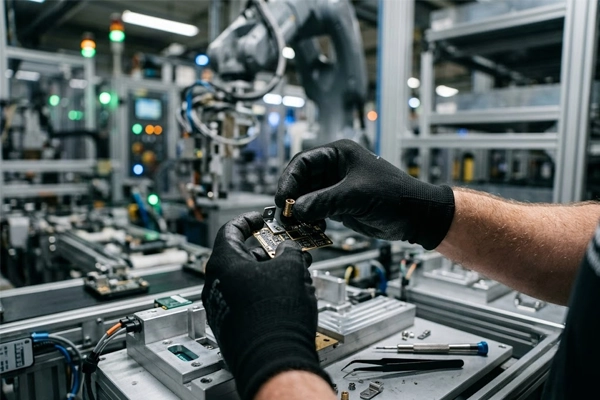
Before placing your next large-volume industrial PPE purchase order or conducting your annual supplier solicitation, SQG® strongly recommends that your EHS safety manager and procurement team go out to the shop floor to conduct a simple 3-Step Industrial Workstation Audit.
Using this simple and intuitive on-site checklist, you can quickly identify which workstations have insufficient or excessive glove protection, allowing you to precisely match them to the Sandy Nitrile and Micro-Foam Nitrile coating matrix:
Step 1: Liquid & Fluid Assessment (Assessing the Liquid Environment at the Workstation)
On-site Observation: Carefully observe the surface condition when workers’ palms come into contact with workpieces. Are the workpieces completely dry? Do they have a trace of rust-preventive oil? Or are workers’ hands dripping with oil and cutting fluid?
Selection Guidelines:
Dry / Slight Oil Film Conditions: Prioritize Micro-Foam Nitrile gloves, which utilize microscopic adhesion to ensure slip resistance and flexibility.
Heavy Oil Spills / Cutting Fluid Saturation Conditions: Sandy Nitrile gloves are mandatory; their textured grooves instantly disperse oil films to provide superior grip and slip resistance.
Step 2: Part Geometry & Precision Audit (Assess Workpiece Dimensions and Handling Precision)
On-site Observation: Do workers routinely handle large-area stamped steel sheets, heavy castings, and machine housings, or extremely small M2/M3 screws, electronic chips, and fine wire harnesses?
Selection Guidelines:
Large Workpieces / Heavy-Duty Handling: Choose Sandy Nitrile (13-gauge or 15-gauge lining), which provides higher puncture resistance and tensile strength.
Small Precision Assembly / Frequent Button Pressing: Micro-Foam Nitrile (18-gauge ultra-thin lining) is essential, providing workers with tactile feedback similar to bare hands and preventing them from dropping small parts.
Step 3: Worker Compliance Signal Check (Check for Signs of Compliance and Non-Compliance on the Shop Floor)
On-site Observation: During shop floor inspections, do you frequently find gloves removed and discarded next to workbenches? When asking workers, do they commonly complain that “it’s too hot to wear them, and sweaty hands are uncomfortable” or “my hands get tired, and I can’t grip parts”?
Glove Selection Checklist:
These are warning signs of non-compliance caused by poor breathability or excessive stiffness in the glove coating. Once such issues arise, immediately upgrade the workstation by replacing gloves with Micro-Foam Nitrile gloves featuring an open, microporous breathable structure and high elongation. The compliance rate among shop floor workers typically improves significantly within one week.
Need a Custom Plant Protection Audit?
Unsure which nitrile coating matrix best suits your existing production line operations? Or do you hope to further reduce your annual PPE procurement budget through refined, segmented purchasing?
As an industrial protective glove manufacturer with over 20 years of experience, SQG®’s team of professional safety engineers offers free on-site/online Hand Protection Audits and free sample testing services to industrial clients worldwide.
Based on the specific types of cutting fluids, mechanical friction levels, and workpiece dimensions in your workshop, we can tailor a customized product selection recommendation and trial kit just for you.
Knowledge Base: Frequently Asked Questions (FAQs)
To address the questions frequently encountered by B2B procurement teams, EHS safety managers, and shop floor workers during product selection and use, SQG® engineers have compiled the following answers to the most common technical questions:
Is “Foam Nitrile” the same as “Micro-Foam Nitrile”?
Answer: While the underlying physical principles are similar (both involve injecting air into nitrile latex to create foam), there are fundamental differences in the microscopic fine structure and durability achieved through engineered foaming.
Standard Foam Nitrile: Most products use traditional, coarse foaming processes, resulting in large, unevenly distributed air bubbles. Under frequent friction or contact with light oils, this larger pore structure is prone to tearing or collapsing, leading to a short abrasion resistance lifespan and causing the palm coating to peel off after just a few days of use.
Micro-Foam Nitrile: Utilizes modern high-pressure micro-foaming technology to create extremely small, highly dense, and uniformly distributed internal pores. This microstructure allows the gloves to maintain an ultra-thin profile and a premium bare-hand feel while still meeting the highest abrasion resistance standard (Level 4) under EN 388, with overall durability far exceeding that of standard foamed gloves.
Can Sandy nitrile gloves be washed and reused in industrial laundries?
Answer: Absolutely, provided that a high-quality combination of coating and lining is used.
High-quality textured gloves (such as our R-238), which feature a durable nylon, spandex, or high-strength HPPE cut-resistant liner, can fully withstand multiple standard industrial washing and drying cycles.
During the washing process, the micro-particles in high-quality textured nitrile are fused directly with the nitrile latex through high-pressure curing, so they will not shed or become flattened due to washing. After washing removes heavy oil stains and cutting fluids from the surface, the oil-repellent grip provided by the physical grooves in the particles is fully restored, helping factories achieve reuse and further reduce PPE procurement costs.
Does the coating type affect the cut resistance level of the glove?
Answer: No. A glove’s cut resistance rating is determined entirely by the material of its inner liner, not by the outer nitrile coating.
Source of Cut Resistance: The cut resistance rating (such as ANSI Cut A2 to A9, or EN 388 Cut B to F) depends on whether high-performance cut-resistant yarns—such as HPPE (high-strength polyethylene), glass fiber, stainless steel wire, or proprietary composite yarns such as TekArmor®.
The Role of Coatings: Coatings (whether Sandy Nitrile or Micro-Foam Nitrile) primarily provide slip resistance, resistance to liquid penetration, and abrasion resistance. Therefore, the same ANSI Cut A4-rated cut-resistant liner can be impregnated with a Sandy Nitrile coating for use in heavy-oil environments or with a Micro-Foam Nitrile coating for dry, precision assembly applications.
Technical Glossary
To help your procurement team quickly compare information when reviewing product specification sheets and safety compliance documents, here is a brief explanation of the most commonly used technical terms in the field of industrial protective gloves:
Coefficient of Friction (COF): A metric that measures the physical frictional resistance between the glove’s coated surface and a workpiece. The higher the COF value, the stronger the glove’s slip resistance and grip when handling wet, slippery, or oily workpieces.
Open-Cell Structure: A specialized foamed mesh structure in which internal microbubbles are interconnected. It acts like a breathable membrane, allowing heat and sweat vapor generated by the hand to pass through and dissipate freely, serving as the core technology for achieving ultimate breathability in micro-foamed gloves.
18-Gauge Liner: Refers to a high-density, fine-knit process featuring 18 needles per inch of knitted fabric. Compared to traditional 13-gauge liners, the 18-gauge liner is exceptionally lightweight and soft, offering superior softness and tactile sensitivity. It is commonly used in combination with micro-foam coatings to create gloves that feel like bare hands.
Cost-Per-Shift: A financial evaluation metric that measures the true cost-effectiveness of PPE products. It is calculated as: the unit purchase price of the gloves ÷ the number of shift days the gloves can be worn safely. This metric helps factories avoid the budget trap of “buying low-quality gloves based solely on unit price.”