

At construction sites for municipal pipeline networks, deep excavation projects, or high-intensity concrete pouring operations, frontline workers often face the most daunting physical conditions: ubiquitous mud and water, slippery pipes and equipment, and the resulting complete loss of grip.
EHS managers and procurement personnel at many multinational corporations frequently encounter a thorny problem: conventional palm-coated rubber gloves often fail within minutes in these highly humid, heavily soiled environments. The reason is straightforward: the breathable mesh on the back of these gloves acts like a sponge, voraciously absorbing external moisture and mud. Not only does this instantly leave workers’ hands cold and damp, but more critically, the pH of wet, uncured concrete typically exceeds 12. Once highly alkaline cement slurry seeps through the gaps on the back of the hand and comes into direct contact with the skin, it can easily cause extensive contact dermatitis or even severe chemical burns.
Faced with this complex industrial hazard, conventional protective designs are powerless. This article will set aside complex academic jargon to break down the underlying manufacturing logic of waterproof dual dip latex coated gloves for you.
We will demonstrate in detail how a true industrial-grade waterproof and oil-resistant structure is crafted: it must first feature a smooth latex base coat with 360-degree full immersion to completely seal even the tiniest gaps in the knit fabric, followed by the precision lamination of a second layer of fine-grit (Sandy) anti-slip palm coating. This dual-layer architecture creates a physical barrier that is 100% impervious to high-pressure water penetration, while still maintaining exceptionally strong grip even in muddy conditions.
Whether you’re bidding on a project for an offshore drilling rig or seeking solutions for mud-filled excavation pits, this comprehensive purchasing guide will not only help you avoid common pitfalls in product selection but will also set a new standard for safety and compliance when it comes to latex-coated work gloves in extremely harsh working conditions.
The Critical Hazards of Wet and Caustic Environments
When evaluating industrial hand protection, cut resistance or abrasion resistance in dry environments are often easy to quantify. However, when the work environment shifts to extreme conditions filled with mud, standing water, and chemical fluids, the nature of the protection changes fundamentally. In such situations, workers face not just a single mechanical hazard, but a lethal combination of water pressure penetration and hidden chemical corrosion. For EHS procurement teams, a deep understanding of the physical and chemical threats in these highly humid and corrosive environments is essential for selecting the appropriate personal protective equipment.
Alkaline Cement Burns During Concrete Pouring
A major safety hazard, often overlooked by contractors, lurks during the concrete pouring phase of construction. Unset, wet concrete contains large amounts of free calcium hydroxide (Ca(OH)₂), which typically raises the slurry’s pH to as high as 12 to 13, making it a highly alkaline fluid.
When frontline workers wear ordinary semi-coated (rubber-coated palms) gloves to handle rebar covered in slurry or clean formwork with their bare hands, disaster often strikes unnoticed. This highly alkaline slurry can easily penetrate the breathable knitted gaps on the back of the gloves—where there is no coating protection—and seep directly inside.
What is most alarming is that this hidden alkaline penetration causes almost no noticeable stinging sensation in the early stages. Workers often continue with high-intensity tasks, but in reality, the strong alkaline fluid is continuously fermenting in a damp, confined environment inside the gloves, rapidly destroying the skin’s weakly acidic lipid layer within just a few hours. By the time workers remove their gloves at the end of their shift, they have often already developed severe contact dermatitis or even irreversible third-degree chemical burns (commonly referred to in the industry as “cement burns”). Therefore, in concrete work, the knitted back of the gloves must be completely sealed.
Offshore and Deep Pit Hydrostatic Pressure
In addition to severe alkali corrosion, environments with heavy water accumulation present another demanding engineering challenge: water pressure. Whether working on offshore drilling platforms, dredging harbors, or excavating deep foundation pits for urban underground pipeline networks, workers’ hands are often not merely exposed to a few splashes of water; instead, they must fully submerge their hands—and even their forearms—in a mixture of mud and water to perform their tasks.
In this fully submerged state, the physical boundary conditions acting on the glove’s surface change, requiring it to directly withstand the hydrostatic pressure of the fluid. This means that any conventional water-repellent treatment will fail instantly.
Under continuous water pressure, even microscopic pinholes in the glove’s coating, invisible to the naked eye—or any exposed threads on the back of the hand that haven’t been sealed with latex—will allow water molecules to penetrate rapidly through the gaps in the fibers via capillary action. This penetration occurs so quickly that the inside of the glove becomes completely saturated in an instant. In the cold of the open sea or underground excavation pits, internal saturation not only causes workers to completely lose their sense of touch but also rapidly draws away body heat, leading to stiff joints. Therefore, to truly achieve “waterproof” protection in such environments, the glove’s coating structure must possess the absolute ability to resist penetration by high-pressure fluids.
Engineering the Dual-Dip Architecture
Faced with high-pressure muddy water in deep excavations and strongly alkaline cement slurry at construction sites, the traditional single-layer palm-dip coating process has completely lost its protective effectiveness. To simultaneously achieve the two seemingly contradictory physical requirements of “absolute waterproofing” and “maximum grip” under such extremely damp and dirty conditions, the glove manufacturing process must undergo a fundamental upgrade. This is the Dual-Dip Architecture, which is currently highly regarded in the field of high-end industrial protection.
The First Layer: 360-Degree Smooth Latex Base
To achieve absolute water repellency and impermeability, gloves must first be outfitted with a true “diving suit.” Therefore, the first step in the dual-dip process is an extremely rigorous, fully coated base-coating procedure.
On modern production lines, complete glove liners—precisely cut and knitted by machines—are fully immersed 360 degrees into a tank of high-purity liquid natural latex. As the liner is slowly pulled out and fed into a high-temperature oven for vulcanization and shaping, the liquid latex undergoes a cross-linking reaction at high temperatures, ultimately forming an extremely dense, physically pore-free, smooth latex film (Smooth Latex Base) across the entire exterior of the glove.
This 360-degree, fully covering smooth base layer is the heart of the entire waterproof structure. It acts like a physical shield with no blind spots, completely sealing off all microscopic pores in the knitted yarn. Whether facing splashes of corrosive chemicals or requiring hands to be immersed for extended periods in a mixture of cold mud and water, this core protective layer blocks 100% of harmful external fluids from penetrating the glove, ensuring workers’ hands remain absolutely dry and safe at all times.
The Second Layer: Sandy Latex Palm Coating
However, rigorous industrial design must never focus on a single dimension alone. Although the smooth latex base layer of the first layer is completely watertight, it has a fatal weakness from a physical standpoint: once its smooth surface becomes contaminated with muddy water or oil, it becomes extremely slippery. If workers wearing gloves with only this single layer of coating were to grasp heavy steel pipes, slips and falls would be highly likely—a situation clearly incompatible with the practical demands of heavy industrial settings.
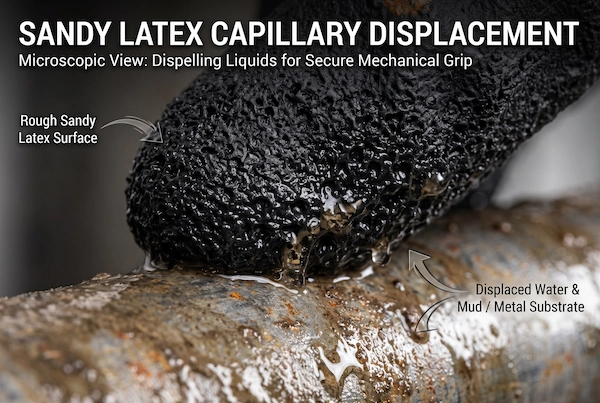
To thoroughly resolve this engineering dilemma, a second, precision palm-coating process was essential. We precisely applied a second layer of specially foamed “Sandy Latex” to the palm and fingers—the key areas where grip force is generated.
The surface of this fine-grit coating is covered with a rough, microporous texture visible to the naked eye. When workers wear these gloves to firmly grip metal pipes covered with mud or a film of water, these rough microporous structures generate a powerful “capillary displacement effect”—they instantly pierce and drain the water film on the contact surface, clamping down on the metal surface as firmly as thousands of microscopic suction cups. This ingenious “smooth, water-repellent backing + fine-sand anti-slip palm” composite design ensures absolute water repellency while perfectly restoring mechanical traction in extremely slippery conditions, making the handling of heavy loads in harsh environments both safe and efficient.
Hydrostatic Pressure and Permeability Metrics
In rigorous industrial B2B procurement, “waterproofing” must never be merely a verbal promise in a supplier’s marketing brochure; it must be backed by solid, reliable laboratory physical data. To precisely define the protective limits of double-layer, fully-coated gloves under extremely humid working conditions, procurement decision-makers must understand two key materials engineering test metrics.
Water Vapor Transmission Rate (WVTR) vs. Absolute Waterproofing
When selecting PPE work gloves, many EHS managers often expect products to provide 100% protection against muddy water while also maintaining the extreme breathability and dryness of high-end outdoor sportswear. However, in the real world of physics, this often represents an engineering trade-off.
In materials science, the core metric for evaluating breathability is known as the Water Vapor Transmission Rate (WVTR). Objectively speaking, because the double-layer dipping process creates a dense, pore-free latex barrier on the glove’s exterior, its WVTR performance will inevitably be significantly lower than that of traditional semi-coated, breathable gloves. This means that when workers are engaged in high-intensity physical labor, the moisture from their hands cannot dissipate quickly.
However, when facing the threat of burns from highly alkaline cement slurry with extremely high pH levels, or frostbite from the icy, muddy water in deep excavations, preventing the intrusion of lethal external fluids takes absolute priority over the release of internal sweat vapor. The original design intent of the double-layer dipping structure is very clear: to sacrifice some breathability (WVTR) in exchange for “absolute protection” against hazardous chemical slurries and high-pressure standing water. In the face of irreversible occupational injuries, this trade-off in physical performance is not only necessary but also an extremely rational safety decision.
Hydrostatic Head Testing for PPE
Since breathability has been sacrificed in the pursuit of absolute waterproofing and leak resistance, we must use the most rigorous methods to verify the pressure resistance limit of this waterproof coating. In professional industrial protection laboratories, the core standard for evaluating the true performance of fully coated gloves is the Hydrostatic Head Test.
The logic behind this test is straightforward: precision instruments continuously apply water pressure to the glove’s surface until the first tiny drop of water is observed seeping through the coating. A double-layer latex base coating that truly meets heavy-duty industrial protection standards must be able to withstand extreme pressures far exceeding typical working conditions—high-quality base coatings are typically required to withstand hydrostatic pressures exceeding 10,000 mmH₂O without any physical rupture or leakage.
Translating this rigorous laboratory data into real-world scenarios for frontline workers means that when municipal pipeline workers reach directly into murky standing water dozens of centimeters deep to clear debris after a downpour, or when offshore oil workers handle heavy anchor chains completely submerged in seawater, the intense external water pressure simply cannot breach the gloves’ physical defenses. Even when workers’ hands are submerged in high-pressure muddy water for extended periods, the interior of the gloves remains 100% absolutely dry.
Technical Specifications Table (Hydrostatic & Grip Matrix)
To help EHS teams and procurement managers make the most scientifically sound material selections from complex supply chain catalogs—and to prevent workplace injuries caused by unclear material performance limits—we have translated the real-world performance of different glove coating architectures when exposed to high-pressure slurry in deep excavations and strongly alkaline cement into the following highly intuitive engineering parameter comparison matrix.
Through this summary of test data, you can clearly see the significant leap in protective capability resulting from underlying process upgrades:
| Coating Architecture | Hydrostatic Resistance | Wet & Mud Grip Level | Concrete Alkali Defense | Primary Applications |
| Single-Dip Palm Coated | Zero (Back of hand exposed) | High | Poor (Liquid penetrates back) | Dry handling, assembly |
| Smooth Latex Fully Coated | Excellent (100% Sealed) | Poor (Slippery when wet) | Excellent | General cleaning, light lifting |
| Dual-Dip: Smooth + Sandy | Excellent (100% Sealed) | Extreme (Sandy suction) | Excellent (Total Barrier) | Concrete pouring, offshore work, trenching |
From the core benchmarking matrix above, procurement decision-makers can draw an extremely clear conclusion: in relatively dry logistics handling or assembly line operations, conventional single-dip gloves offer exceptional value for money; however, if they are mistakenly used in high-humidity, dirty environments, the critical flaw of water permeability on the back of the hand will allow mud and strong alkaline liquids to penetrate unimpeded, rendering the gloves completely ineffective.
On the other hand, while fully coated smooth latex gloves perfectly address the issues of 100% waterproofing and resistance to strong alkalis, their surfaces become excessively slippery when wet, limiting their use to non-load-bearing, light cleaning tasks.
Therefore, only work gloves featuring the Dual-Dip: Smooth + Sandy (smooth base layer + fine sand palm, double-layered composite) construction truly address all physical shortcomings in complex and harsh environments. Not only do they create an absolute barrier against high-pressure muddy water and the strong alkalis in cement, but the microporous fine sand also endows the gloves with extreme suction-cup-like grip in heavily muddy conditions, making them the only qualified and highly ergonomic ultimate safety solution for offshore heavy-duty drilling, urban underground pipeline excavation, and large-scale concrete pouring projects.
High-Visibility and Thermal Integration: The WP-175
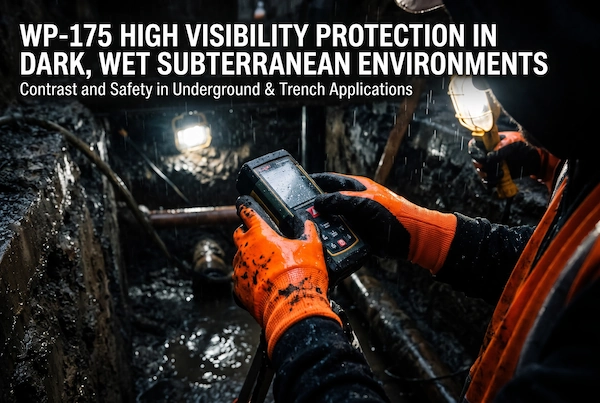
In real-world construction sites, harsh environmental conditions often occur simultaneously. When muddy water from deep excavations, splashing water from offshore platforms, and extreme winter temperatures strike at the same time, workers face a double physical blow from the deadly “wet-cold effect.” To address these brutal working conditions—where extreme cold intertwines with icy, muddy water—the WP-175 model showcases top-tier composite material manufacturing capabilities.
Dual-Layer Liner for Sub-Zero Work
When working outdoors in winter—wading through water and mud—if gloves have only a simple waterproof layer, the cold from the icy, muddy water will quickly penetrate the rubber and conduct to the skin, instantly draining the hands of their core body heat. To address this, the WP-175 features an exceptionally precise design for its internal thermal insulation structure: it uses a 15-gauge seamless polyester shell as a durable, highly elastic foundation, with an extremely thick 7-gauge seamless acrylic terry liner tightly nested inside.
This robust dual-layer liner architecture not only locks in the heat emitted by the hands through the dense acrylic terry loops, providing exceptional cold resistance (Acrylic Terry liner for cold resistance); more importantly, the high-gauge polyester shell minimizes the bulkiness associated with the insulating layer. This allows workers to maintain a high degree of dexterity even when wading through water in extremely cold conditions, enabling them to easily perform precise gripping and equipment lashing tasks on icy scaffolding in winter.
Orange Smooth Base + Black Sandy Palm
In extremely dimly lit underground mud pits, port dredging sites, or winter work environments blanketed in heavy snow, high-visibility (Hi-Vis) design is critical to the safety of workers operating heavy machinery. In terms of appearance and waterproof coating design, the WP-175 innovatively features an extremely eye-catching, fully coated smooth orange latex as a 360-degree impermeable base layer. This bright orange waterproof barrier not only blocks high-pressure water penetration and provides excellent water resistance but also offers frontline workers exceptional visual safety recognition in dim, muddy environments.
In the palm and finger areas—where grip is most critical—we have applied a secondary layer of black, fine-grained latex coating (Sandy Latex, palm coated). This high-contrast color scheme not only offers an industrial, stain-resistant aesthetic, but the microporous, fine-grained structure on the palm is specifically designed to provide excellent grip in both dry and extremely wet, muddy conditions. Thanks to this robust thermal insulation and dual-layer anti-slip coating system, the WP-175 has successfully met the high standards of CAT. II safety certification, establishing itself as the benchmark product for winter wading and muddy construction projects.
Secure Fit for Heavy Mud: The R-175 Velcro Design
In many extreme, heavy-mud work environments, relying solely on a waterproof coating on the glove’s surface is often insufficient. Many frontline workers frequently complain to EHS managers that their hands still get wet and dirty even when wearing fully rubber-coated waterproof gloves. This is usually not due to a cracked coating, but rather stems from an easily overlooked engineering blind spot: open glove cuffs. To completely seal this final line of defense, the R-175 model offers an extremely robust structural upgrade.

Preventing Debris Ingress with Velcro Cuffs
When workers are operating in deep excavations within urban underground pipeline networks or on muddy construction sites after days of heavy rain, they inevitably have to frequently reach into sludge and standing water. During this process, murky mud, sewage, and sharp gravel often seep directly into the gloves through their open knitted cuffs. Once this ingress occurs, even the most robust external waterproof coating is instantly rendered ineffective, resulting in severe contamination of the hands.
To thoroughly address this on-site challenge, the R-175 innovatively incorporates high-strength Velcro straps at the wrist of the fully rubber-coated gloves (Velcro straps adjust easily for a comfortable fit). Thanks to this mechanical locking mechanism, workers can freely and quickly adjust the tightness according to the circumference of their wrists. This design completely seals the gap between the glove cuff and the arm, forming a perfect physical barrier that effectively prevents any mud, gravel, or wastewater from accidentally flowing into the glove from above.
15G Seamless Polyester Comfort
In EHS procurement, it is often difficult to balance heavy-duty protection with wearing comfort. While a double latex coating provides exceptional water and liquid resistance, it also objectively increases the overall thickness and bulk of the glove; if the liner is too thick, it can easily cause fatigue in workers’ fingers when bending and extending them.
To precisely counteract the bulkiness caused by this coating, the R-175 features a highly elastic, high-density 15-gauge seamless polyester liner as its inner structure. This lightweight, high-gauge yarn, combined with an extremely soft natural rubber coating (which ensures elasticity and comfort), not only ensures 360-degree all-around protection against dirt and mud (full coating keeps hands clean from all directions) but also significantly preserves the hand’s natural muscle flexibility and wearing comfort. This allows workers to maintain excellent flexibility even during prolonged mud cleanup or when handling slippery tools, completely eliminating the “stiffness” commonly associated with traditional, heavy-duty waterproof gloves.
Protection Against Cold and Wet Weather: The WP-176
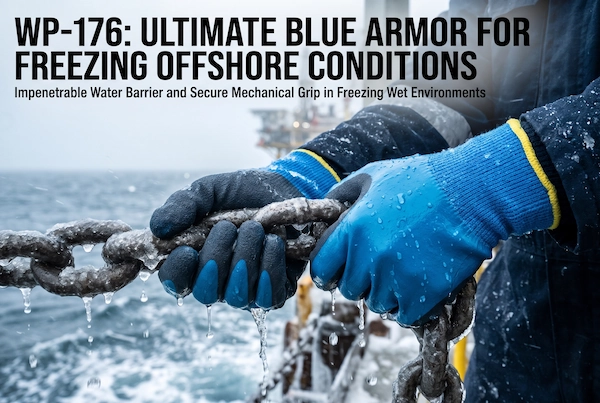
In real-world, extremely cold outdoor work environments, dry cold and wet cold pose safety threats of entirely different magnitudes. When a mixture of ice and water strikes alongside sub-zero temperatures, if moisture penetrates the insulating layer, it will draw heat from the hands 20 times faster than air, instantly causing excruciating frostbite. For these most extreme conditions involving liquid ice and water, the WP-176 offers a heavy-duty, armor-level solution for cold-weather wading.
Blue Fully Coated Smooth Base
In polar marine engineering, winter port dredging, or infrastructure pile driving during severe cold spells, gloves must possess absolute physical water-repellency. To this end, the WP-176 provides an indestructible layer of bright blue armor.
Its first line of defense is a bright blue, cold-resistant smooth latex. Through an extremely thorough 360-degree, fully coated process, this base layer completely seals off the penetration of icy water and cold winds into the knitted yarn, achieving 100% absolute liquid and water resistance. Merely being waterproof is not enough. To cope with frozen and extremely slippery tool surfaces, WP-176 features a precisely applied layer of dark, fine-grained sand-textured latex (Sandy Latex, palm coated) on the palm area. This rough, microporous palm surface acts like countless miniature snow chains, gripping firmly onto crane cables or metal pipes coated in a mixture of ice and water, ensuring workers maintain excellent grip in both dry and wet environments, even under the harshest conditions.
13G Acrylic Terry for Extreme Environments
As a high-end model designed for extreme cold and wading, the WP-176 features engineered upgrades to its internal thermal lining. It incorporates a 13-gauge seamless acrylic terry liner.
Compared to traditional 7-gauge thick-yarn thermal liners, the weave density of 13-gauge yarn is significantly higher. This high-density structure not only effectively traps heat emitted by the hands in extreme cold, providing robust physical resistance to freezing (Acrylic Terry liner for cold resistance), but, more importantly, the higher gauge creates a more compact and snug fit inside the glove. This ingenious compression design not only counteracts the bulkiness caused by the double-layered, heavy-duty coating but also significantly enhances the mechanical tactile sensitivity (Dexterity) of the fingertips when workers perform high-difficulty tasks—such as feeling around and working blindly—in deep, icy water, while retaining basic breathability and moisture-wicking capabilities (Breathable). It serves as the ultimate safety barrier for frontline workers engaged in heavy physical labor in water.
Maintenance and Washability of Dual-Dip Gloves
For procurement teams at multinational construction companies and large-scale engineering projects, the lifecycle of PPE (personal protective equipment) directly determines the safety operating costs of the entire project. Traditional work gloves, after being subjected to heavy mud and alkaline cement, often end up as nothing more than expensive disposable items. In contrast, waterproof dual-dip latex-coated gloves, thanks to their unique dual-layer coating structure, offer exceptional washability and long-term durability.
Cleaning Cement and Oil Residue
A key advantage of double-dip coated gloves in terms of maintenance is their highly cleanable surface. With traditional knitted-back gloves, once contaminated with slurry or heavy oil, the dirt becomes deeply embedded within the knitted fibers, making it virtually impossible to wash out; once dried, the gloves become as hard as stone.
In contrast, after using double-layer, fully coated gloves for high-intensity concrete pouring or deep excavation work, workers need only rinse the exterior of the gloves with clean water before the cement or slurry has fully set and hardened. Since the first layer of the glove is a 360-degree smooth, dense latex base coat, this completely non-porous surface not only repels water but also prevents the deep absorption of sticky slurry and chemical oil stains. With just a simple rinse, dirt is quickly washed away from the glove surface, restoring it to a clean state. This exceptional ease of cleaning significantly extends the gloves’ actual service life under harsh working conditions, saving companies a considerable amount on consumables.
Inspecting the Latex Barrier for Integrity
Although the double-layer latex structure is extremely strong and durable, the EHS manager must emphasize one ironclad rule to front-line workers during safety training: the gloves’ 100% waterproof and alkali-resistant protection depends entirely on the physical integrity of the outer latex layer.
Therefore, a daily “coating integrity inspection” system must be strictly enforced on construction sites. In particular, after workers have handled scaffolding with sharp burrs, barbed rebar, or cleared away sharp metal debris, the smooth base layer on the backs of the hands and between the fingers must be carefully inspected for deep punctures or tears.
In environments with high hydrostatic pressure, such as deep excavations, or in strongly alkaline cement containing free calcium hydroxide, even a pinhole-sized perforation can cause the glove’s impermeable barrier to collapse instantly, allowing hazardous external fluids to rush into the inner liner through the hole. Therefore, as soon as any damage to the base layer is detected, out of an absolute commitment to safety, the gloves must be immediately discarded and replaced with new ones. Under no circumstances should damaged gloves be used in work conditions involving contact with water or chemical fluids.
Frequently Asked Questions (FAQ)
Why not use standard PVC gloves for concrete pouring?
Many purchasing managers ask: Since ordinary PVC gloves are also waterproof, why not prioritize the more economical PVC option for heavy-duty concrete pouring or municipal construction? This is because construction sites are filled with rough, barbed rebar, stones with sharp edges, and heavy precast concrete pipes. When faced with this high-intensity physical cutting and abrasion, natural latex demonstrates physical advantages far surpassing those of ordinary PVC in terms of tear resistance, high elasticity and flexibility, and puncture resistance. Choosing double-layer latex-composite gloves not only effectively protects against cuts from rebar burrs but also provides a longer service life and a more comfortable grip for high-intensity, physically demanding work, significantly reducing hand fatigue for workers and the procurement costs associated with frequent replacements.
Does the double-coating process significantly reduce finger dexterity?
Not at all. Many people worry that adding two layers of rubber will make the gloves as stiff as cardboard, but the advanced double-coating process has completely resolved this issue. By precisely controlling the fluid viscosity and immersion time in the high-purity latex tanks on the production line, the factory is able to apply a waterproof and leak-proof coating that is extremely thin yet highly durable. When this precision double-layer coating is combined with a 15-gauge, highly elastic, high-density, lightweight liner (such as the R-175 model), the gloves ensure 100% absolute waterproofing while still allowing frontline workers to perform high-precision fingertip tasks—such as tightening tiny nuts, securing scaffolding, or tying extremely fine wire—with ease and flexibility.
How exactly does the Sandy Latex texture displace water and oil?
From a microscopic materials science perspective, Sandy Latex (fine sand latex) exhibits a structure of countless ruptured microbubbles under an electron microscope. When a worker applies pressure with their palm to a wet, slippery, or even heavily oil-and-mud-covered metal surface, these dense microscopic pores rapidly generate powerful “capillary siphoning” and “micro-suction cup” effects. Within milliseconds, they instantly displace moisture and oil films from the contact surface and draw them into the pores, allowing the tough rubber framework to come into direct contact with the surface of the target object. This purely physical water-displacement mechanism enables the gloves to instantly regain the high levels of friction and traction they possess in dry conditions, even under extremely muddy and slippery conditions.
Can these waterproof dual-dip latex-coated gloves be completely submerged in water?
Absolutely. This is precisely the core value of the dual-dip construction. During the manufacturing process, the first layer—Smooth Latex—is molded in a single step by completely submerging the entire hand area, including the back of the hand and between the fingers, 360 degrees into a latex tank, resulting in a surface with no physical seams. During actual deep excavation or offshore wading operations, as long as the external water level or slurry level does not exceed the knitted cuff edge of the gloves (or, as with the R-175 model, the cuff is completely sealed with the wrist Velcro), all parts covered by the rubber coating can withstand extremely high hydrostatic pressure in deep water, ensuring they remain completely watertight even during prolonged immersion and providing workers’ hands with the most robust barrier against moisture.


