Introduction
In heavy industrial settings—where achieving rigorous en 388 latex coated gloves compliance is critical for worker safety—hands are constantly on the front lines during outdoor construction, scaffolding erection, precast concrete hoisting, and heavy-duty port logistics. Flying stone debris, jagged ends of rusted steel pipes, microscopic protrusions on rough masonry, and repeated scraping from barbed wire have led to persistently high rates of abrasions, lacerations, and deep puncture wounds among frontline workers. These frequent acute injuries not only result in significant lost-time injuries but also create massive liability loopholes in the overall operating costs of construction contractors and logistics companies.
Faced with harsh working conditions, many procurement departments—driven by cost-reduction targets—habitually fall into the “material substitution trap” of low-end PPE consumables. Mass-purchased, cheap plastic-coated cotton yarn gloves or thin, substandard recycled rubber gloves offer virtually no effective protection against high-stress friction and sharp edges. Ordinary coarse-weave fabrics are instantly severed and frayed upon contact with metal burrs, and the plastic particles on the surface are quickly worn down and shed; once the point of stress is subjected to pulling, the entire glove instantly disintegrates and tears along the fiber lattice, leaving the worker’s palm directly exposed to mechanical impact without any cushioning—causing what was originally a minor surface scrape to rapidly deteriorate into deep lacerations and abrasions.
To fundamentally mitigate the destructive risks posed by heavy-duty abrasion, the engineering safety system must return to the fundamentals of materials engineering. The high-elasticity polymer coating developed by Source Super Factory—based on natural cis-1,4-polyisoprene molecular chains—demonstrates physical toughness unmatched by synthetic resins in terms of tear resistance and impact energy absorption, thanks to its unique tension-induced crystallization mechanism and robust three-dimensional cross-linked structure. Establishing a rigorous baseline for mechanical protection compliance with EN 388 latex-coated glove standards—specifically through laboratory-calibrated, controlled physical destruction testing—sets a quantifiable engineering safety benchmark for personal protective equipment procurement under extremely complex working conditions. When comprehensively optimizing the selection of engineering hand protection for heavy-duty construction and extreme material-handling operations, corporate safety and technical teams should thoroughly evaluate the synergistic mechanisms among the coating’s physical thickness, the inner liner’s weight per square meter, and puncture resistance metrics. For systematic technical analyses regarding the dipping process matrix, microscopic surface texture engineering, and model specifications across all scenarios, please refer to the official Latex Coated Work Gloves product knowledge hub.
Demystifying the EN 388:2016+A1:2018 Testing Protocol
In heavy industry safety management and the centralized procurement of industrial supplies, the European standard EN 388:2016+A1:2018 serves as the core technical benchmark for measuring the resistance of protective gloves to physical damage. Any glove product entering an industrial setting features a rating code printed beneath the mechanical shield symbol on the back. For engineering procurement teams, the key to moving beyond the empirical misconception that “thick gloves equal safety” lies in understanding the laboratory-controlled destructive testing mechanisms behind these numbers and translating the test data into protection criteria that align with actual construction environments.
The Four Mechanical Performance Indices
The first four digits under the EN 388 mechanical hazard shield logo strictly correspond to four fundamental mechanical performance indices: Abrasion Resistance, Cut and Tear Resistance, and Puncture Resistance:
Abrasion Resistance (Rated 1–4): Determined by the number of mechanical friction cycles required for the sample’s coating to be completely worn through, exposing the inner liner’s base yarn. In heavy-duty scenarios involving continuous pushing, pulling, and dragging across rough brick surfaces or rusty scaffolding pipes, the abrasion rating determines the glove’s service life under abrasive conditions;
Coup Cut (Rated 1 to 5): This test involves cutting a test specimen with a reciprocating rotating circular blade under a constant load, and calculating the Coup Index—the ratio of the number of cutting cycles required to cut the specimen compared to a standard cotton reference specimen. In natural latex glove systems, where blunt impacts, squeezing, and scraping are the primary hazards, this value typically serves as a standard reference; High-risk sharp edges are further evaluated according to ISO 13997 (i.e., the TDM-100 straight-edge test, rated by the fifth letter from the end, ranging from A to F);
Tear resistance (Tear, rated 1 to 4): A rectangular specimen with a pre-cut notch is placed in a tensile testing machine fixture, and the peak vertical force required to completely tear the notch is measured. This is a critical performance indicator for heavy-duty construction gloves; high-quality natural latex gloves must meet the highest Level 4 threshold of greater than 75 Newtons to ensure that the gloves do not suffer instantaneous, catastrophic tear-through when subjected to scraping and stretching by sharp metal edges or wood edges;
Puncture Resistance (Levels 1–4): A steel probe with a rounded tip and specified dimensions is pressed down onto the test specimen at a constant speed, and the maximum force in Newtons required to penetrate the palm composite layer is recorded. In tasks such as grading gravel subbases or twisting wire ties, this metric directly reflects the physical cushioning capacity of the glove coating to resist penetration by sharp, hard objects;
Mechanical property comparison between 10-gauge thick rubber and 13-gauge lightweight liner:
10-gauge heavy-duty roving structure (e.g., the B-111 benchmark model): Features a seamless knitted polyester base lining with a significantly higher grammage per unit area, enabling it to fully absorb deeply impregnated natural rubber and form a rugged, crinkled rubber shield with a physical thickness exceeding 1.2 millimeters; Its mechanical performance profile features high tear resistance (consistently exceeding 75 Newtons), high puncture resistance, and strong energy absorption, making it ideal for harsh working conditions such as open-pit mining, construction tie-down, and heavy-load formwork handling;
13-gauge lightweight fine-yarn construction: Designed to achieve higher gauge density and a snug fit around the fingertips, the rubber layer is relatively thin. While this involves some engineering compromises in tear and puncture resistance, it primarily ensures the flexibility required for finger joint flexion and extension during precision assembly operations.
Laboratory Methodologies: Martindale vs. Tensile Crosshead Testing
The credibility of rating figures depends on strict, standardized instrument operating limits and sensor calibration protocols within the laboratory:
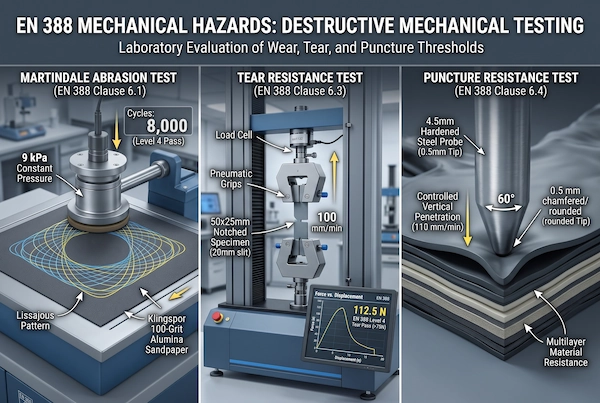
Constant-pressure cutting conditions for the Martindale abrasion tester:
Calibrated abrasive media and constant surface pressure: Testing is conducted in a laboratory maintained at constant temperature and humidity (23 degrees Celsius, 50% relative humidity); the test must use legally certified, calibrated Klingspor PL31B No. 100 special alumina sandpaper as the abrasive pair;
Lissajous-Pattern Omnidirectional Friction Trajectories: A precisely calibrated vertical contact pressure of 9 kilopascals (kPa) is applied by the specimen chuck, causing the specimen to perform reciprocating, omnidirectional friction motion on the sandpaper surface in the form of intricate, interwoven Lissajous curves;
Final Electrical Insulation Assessment and Visual Verification: After every 100 to 500 cycles, the machine must be stopped to remove sanding debris, and the palm-side coating must be inspected using a high-magnification optical microscope; when the rubber layer is completely worn away in a localized area, revealing at least two independently broken backing yarns, the system automatically locks the cycle counter—subjective estimation is strictly prohibited;
Sensor Accuracy and Tensile Control of the Universal Testing Machine (Tensile Crosshead Tester):
Calibration of high-response load cell sensors: When conducting tear resistance and puncture resistance tests, the crosshead travel speed of the testing machine must be strictly locked at a constant rate of 100 millimeters per minute (100 mm/min); The load sensor must have Class 1 metrological accuracy, and the sampling frequency must reach several hundred times per second to capture the millisecond-level peak forces in the latex molecular network at the moment of tensile tearing;
Mechanical orthogonal control of specimen cutting in the warp and weft directions: Tear resistance test specimens are rectangular, measuring 50 millimeters by 25 millimeters, with a 20-millimeter initial guide cut made longitudinally at the center;
Engineering specifications for sampling direction: Knitted liners exhibit significant anisotropy, with the elongation in the warp direction (perpendicular to the knitted loops) differing by several times from that in the weft direction (transverse to the knitted loops). Standard laboratory testing requires the separate cutting of two warp-direction specimens and two weft-direction specimens; the final rating is strictly determined by the lowest individual measured value among the four test specimens, thereby eliminating the possibility of some small workshops engaging in fraudulent practices by selectively submitting specimens from their preferred directions for testing to inflate their scores.
Macromolecular Resilience: Why Natural Rubber Outperforms Synthetic PU and Nitrile in Tear Resistance
In the field of industrial glove manufacturing, the microscopic molecular chain topology of the coating polymers directly determines the physical limits of protective equipment under heavy friction and rough tearing. Although synthetic rubbers such as polyurethane (PU) and nitrile rubber (NBR) have made significant strides in oil resistance and microporous breathability, they have consistently failed to challenge the physical dominance of high-quality natural rubber latex in the mechanical realm of resisting vertical tearing and blunt impact damage. This performance gap does not stem from simply stacking and thickening coatings, but is deeply rooted in natural rubber’s unique molecular self-reinforcement mechanism and the interfacial anchoring effect with the backing fibers.
The Cis-1,4-Polyisoprene Network: Strain-Induced Crystallization
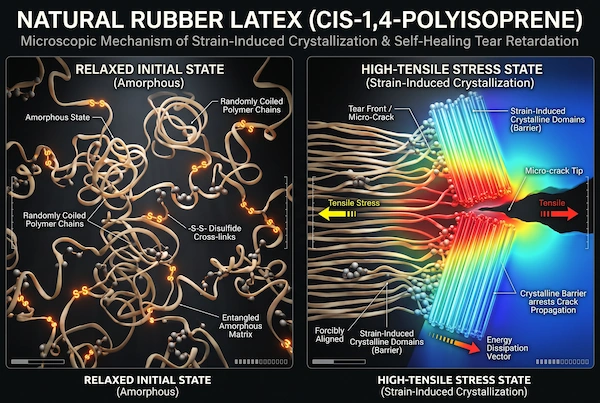
Natural rubber is produced by coagulating and refining the latex secreted by the Brazilian three-leaf rubber tree; its core chemical composition is an extremely high-purity polymer of cis-1,4-polyisoprene. These linear polymer chains exhibit a highly regular cis spatial configuration; the long chains are tightly entangled with one another, appearing as amorphous, randomly coiled clusters under normal relaxed conditions. The molecular chains are interwoven via covalent sulfur bonds introduced during the vulcanization process, forming an extremely elastic three-dimensional network:
Microscopic self-healing inhibition via strain-induced crystallization: When the palm of the glove is locally scratched or pulled by a sharp object, the stress at the point of application is instantly concentrated and amplified hundreds of times; In ordinary amorphous polymers, micro-scratches rapidly propagate along defects under this shear stress, leading to instability; however, when the natural cis structure undergoes axial tensile strain exceeding a critical threshold, the molecular chains are forcibly aligned parallel to the direction of tension and spontaneously aggregate within a few milliseconds to form high-density, highly ordered microscopic crystallites;
The physical mechanism of crack-tip blunting: The melting point of the newly formed microcrystals is far higher than room temperature, and their local elastic modulus and shear strength increase by a factor of several dozen; this high-hardness phase region precisely envelops the area immediately ahead of the crack tip, acting like a microscopic blast-proof barrier that forcibly blunts the stress concentration at the crack tip; If an external force attempts to further tear open the crack, it must expend several times the mechanical energy to forcibly break or even melt these microcrystals; once the external force is removed, the crystalline region rapidly remelts and restores its original flexible lattice, endowing the gloves with the toughness to “resist tearing without breaking and withstand pulling without tearing” when subjected to the tugging forces of rough wood or rusty, barbed iron.
Achieving Level 4 Tear Thresholds (>75 N) with 10-Gauge Heavy Liners
The key to translating the tensile crystallization advantages of microscopic materials into the rigid protective performance of macroscopic glove products lies in the composite engineering design of the interface between the coating and the liner. Taking the B-111 work safety glove—a benchmark product in the heavy industry sector—as an example, this model consistently exceeds the highest Level 4 tear resistance rating (>75 Newtons) under EN 388 through the deep interlocking of the heavy-duty knitted liner and latex:
Mechanical Interlocking of 10-gauge High-Grammage Yarn and Latex: The B-111 eschews the high-count, ultra-fine denier yarns commonly used in lightweight gloves, opting instead for 10-gauge continuous polyester multifilament yarn with a large cross-section and high thread density, woven into a loose looped knit; When impregnated with natural latex emulsion after preheating, the latex does not simply float on the surface but, aided by negative pressure permeation, completely saturates and envelops the three-dimensional pores within the 10-gauge yarn loops and the deepest crevices of the fibers; After vulcanization and cross-linking, the robust polyester loops act like the ribbed rebar in reinforced concrete, fusing with the outer high-resilience latex layer to form an indestructible, monolithic structure, eliminating the risk of “delamination” between the rubber layer and the fabric backing under high stress;
Actual comparison matrix under a 75-Newton peak tear strength test: In a constant-speed (100 mm/min) failure test conducted on a universal testing machine in the mechanical laboratory, the three mainstream coatings exhibited completely different stress-strain curves:
Thin-layer polyurethane (18-gauge microporous PU): Since the elongation at break of water-based or solvent-based PU molecular chains is typically less than 350%, and their cross-linking density tends to be brittle, when the load applied by the tensile tester reaches only the 18 to 22 Newton range, the pre-cut guide slot immediately loses control, and a straight, brittle fracture instantly tears through the cross-section, resulting in a final rating that often barely reaches Level 1;
Foamed Nitrile (15-gauge synthetic NBR): Although nitrile offers excellent abrasion resistance, its trans-butadiene molecular chains cannot produce an induced crystallization effect when subjected to tensile stress at room temperature; When the tensile force rises to 45–55 Newtons (between Level 2 and Level 3), irreversible plastic yielding and void coalescence occur at the crack tip, causing the coating to split open entirely along the yarn grain;
gauge Heavy-Duty Crinkled Natural Latex (B-111): Thanks to the strong bond between the tensile-induced crystalline self-locking network and the 10-gauge coarse-denier polyester, the specimen undergoes severe deformation on both sides of the crack—extending by over 700%—when subjected to sustained tensile force, dispersing the stress over a large area throughout the entire specimen; Only when the peak tensile force exceeded 110 to 130 Newtons (far surpassing the 75-Newton lower limit of the Level 4 regulatory standard) did the specimen undergo a gradual, blunt tear, thereby establishing a secure barrier that is difficult to tear through for workers engaged in high-risk, heavy-duty operations.
Puncture Dynamics: Stress-Yield Curves of Rounded Probe Penetration
In the procurement of industrial personal protective equipment and on-site safety management, “puncture resistance” is a technical concept that is highly prone to cognitive biases. Many on-site safety officers and procurement managers often equate the puncture resistance ratings on glove labels with medical-grade protection against needle sticks or needle tip cuts, leading to incorrect protective equipment selection for tasks such as hazardous waste sorting, medical waste removal, or work involving extremely fine metal wire weaving. To establish rigorous safety technical boundaries, engineering teams must look beyond the mechanical probe models used in laboratory puncture tests and rationally evaluate the physical defense mechanisms of natural latex polymers against coarse particles and blunt sharp objects.
EN 388 Blunt Probe vs. Medical Hypodermic Needles: Engineering Boundaries
Puncture resistance testing under the EN 388 standard framework and the ASTM F2878 test for punctures by fine medical hypodermic needles differ fundamentally in terms of force, contact area, geometric cross-sectional shape, and the physical mechanisms of penetration:
EN 388 industrial standard probe specifications: The penetration component used in testing is not a sharp bayonet or a hypodermic needle with a beveled cutting edge, but rather a cylindrical probe made of hardened and tempered tool steel with a diameter of 4.5 millimeters. The very tip of the probe is ground into a frustum with a 60-degree cone angle, and the central contact point of the probe is rigorously chamfered to form a micro-flat, blunt tip with a radius of 0.5 millimeters. When the specimen is pressed downward at a constant speed of 100 millimeters per minute, the test essentially simulates the sharp edges of crushed stone with obtuse angles found on construction sites, the blunt ends of bent or broken nails on formwork, the broken ends of coarse wire, or rough burrs protruding from the edges of machined castings;
Physical differences from medical injection needles (ASTM F2878): Medical needles typically consist of ultra-thin, hollow, ultra-fine metal tubes ranging from 21G to 28G, with tips featuring an extremely sharp, three-sided bevel-ground edge, and a contact curvature radius at the tip approaching the micrometer level. This sharp geometric structure exerts microscopic cutting shear stress on fabrics and rubber layers, enabling it to effortlessly part the gaps between polymer molecular chains—much like a scalpel—and directly penetrate the gaps between yarns, while causing virtually no overall tensile deformation of the polymer matrix;
This clearly defines the technical defense boundaries of heavy-duty industrial safety gloves: natural latex industrial gloves certified to EN 388 Level 2 to Level 3 for puncture resistance are designed primarily to withstand “blunt puncture impacts” encountered during rough industrial operations.
High-Elastic Deformation and Blunt Object Deflection
When a thick-layer natural wrinkled latex specimen was subjected to downward penetration on a universal testing machine, the stress-yield curve recorded by the sensor exhibited high-elastic rheological energy absorption and spatial vector deflection behavior characteristic of natural polymers:
Microscopic elastic deformation and strain-induced energy dissipation: When a 4.5-millimeter round-tipped steel probe made contact with the wrinkled latex layer on the surface of B-111, no immediate failure occurred at the point of contact; the extremely high elongation at break and molecular flexibility of natural cis-polyisoprene caused the rubber coating to undergo violent three-dimensional indentation and extension the instant the probe was pressed downward; As the probe continues to advance downward by 2 to 4 millimeters, the originally curled cross-linked molecular chains surrounding the indented area are significantly stretched, efficiently converting the vertical destructive kinetic energy applied downward by the probe into elastic deformation potential energy covering a large palm-like surface area;
Stress concentration mitigation and adaptive expansion of the contact area: Ordinary brittle synthetic coatings undergo microscopic shear tearing when compressed to their yield point, resulting in a sharp decline in penetration force; in contrast, a high-quality natural rubber network forms a taut “microscopic high-tension membrane” around the probing tip. This highly elastic membrane forces the localized point-contact stress at the probe tip to disperse uniformly across the microporous structure at the edges of the contact surface and the 10-needle-thick polyester backing, significantly delaying the failure point caused by stress concentration;
Physical Sliding Deflection Mechanism of Force Vectors (Deflection Mechanics): When handling barbed steel pipes, crushed stone, or broken bricks at heavy construction sites, external forces are often applied to the glove’s palm in the form of compound impacts at an oblique angle; the B-111 palm features a coating of densely packed deep-grooved wrinkles with highly irregular microscopic protrusions and depressions; When a rough protrusion with a certain obtuse angle strikes the glove surface, the ultra-high frictional damping of natural rubber and the highly elastic protrusions force the impactor to undergo microscopic lateral slippage, instantly decomposing the downward penetrating force—which is vertically directed toward the skin—into lateral shear friction along the glove surface; This deflection of the force vector caused by the polymer deformation significantly reduces the incidence of deep lacerations and punctures on workers’ palms resulting from localized, concentrated impacts during actual work conditions.
The Machinery Entanglement Paradox: Balancing Tear Strength with Rotating Spindle Safety
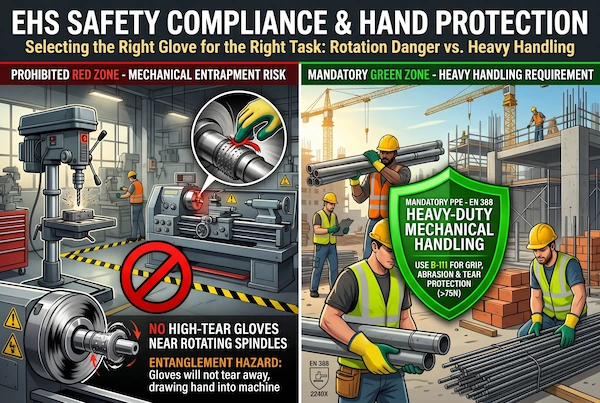
In industrial machinery safety engineering, higher safety performance metrics do not necessarily guarantee absolute safety in all scenarios. Any enhancement in a single physical dimension, when detached from specific process conditions, may become a fatal hazard capable of causing serious mechanical injury accidents. The high tear resistance of natural crinkled latex gloves (EN 388 Level 4, with measured tensile strength exceeding 75 to 110 newtons) serves as an indispensable line of defense against dragging by rough materials and heavy-load abrasion; however, if they are mistakenly worn in the work area of rotating power equipment, the “tear-resistant” physical toughness originally intended to protect the skin can instantly transform into a physical noose that entangles the worker’s limbs in the power mechanism.
When High Tear Resistance Becomes a Hazard: OSHA and ISO Industrial Guidelines
Both the Occupational Safety and Health Administration (OSHA 1910.212 General Requirements for Mechanical Guards) and the European standard EN ISO 12100 (Basic Concepts and Risk Assessment for Mechanical Safety) explicitly stipulate that operators are strictly prohibited from wearing high-tear-resistance work gloves in any work area exposed to rotating spindles, lead screws, drill chucks, pulleys, and open gears. Behind this strict safety prohibition lies a rigorous understanding of the dynamics of mechanical trauma and the irreversible mechanisms of power source runaway:
The mechanism of engagement between rotating spindles and polymer fibers: During cutting operations on bench drills, vertical milling machines, or horizontal lathes, the spindle and cutting tool rotate at high speeds of several thousand revolutions per minute (RPM), generating output torque sufficient to produce sustained rotational force ranging from hundreds to thousands of newtons. When an operator reaches in to fine-tune a workpiece or clear chips, if the fingertips come into contact with a high-speed twist drill bit or burrs, the highly elastic latex coating instantly grips the metal surface; the extremely high coefficient of kinetic friction between the surfaces, combined with the 10-gauge seamless polyester liner, creates a self-locking coil effect that instantly wraps the glove completely around the cutting tool or rotating shaft;
The stark contrast between low-elongation-at-break materials and high-tear-resistant latex: For ordinary thin gloves with only Level 1 tear resistance (such as thin PU), when subjected to a localized shear force exceeding 20 newtons, the fiber lattice spontaneously breaks along the tear, and although the glove is damaged, the worker’s fingers can slip out to avoid secondary injury; However, heavy-duty latex gloves with Level 4 tear resistance (with an elongation at break of over 700% and a tensile strength exceeding 75 Newtons) not only fail to break on their own when caught in machinery but instead continue to tighten and pull inward as the shaft rotates;
Mechanism of entanglement and amputation injuries: The entire entanglement process often occurs within tens of milliseconds—far faster than the physiological limit (approximately 200 milliseconds) required for the human brain to establish pain feedback and execute a hand-withdrawal reflex. The high-strength polyester liner and highly elastic raw rubber layer act like high-tensile steel wire ropes, forcibly pulling the worker’s palm—or even the entire forearm—toward the rotating cutting zone, resulting in severe comminuted fractures, deep tendon tears, or even forced amputation. Therefore, during workshop safety inspections, the use of high-tear-resistance gloves in areas involving mechanical cutting, power grinding, and open-shaft rollers constitutes a serious safety violation.
Safe Workstation Profiling: Where B-111 Heavy Crinkle Gloves Excel
To eliminate safety risks caused by the mixed or improper use of PPE, the general contractor and the manufacturer’s EHS (Environment, Health, and Safety) departments must establish a mandatory physical access and restricted-entry zoning plan for PPE based on the identification of process hazards:
Work Areas Where B-111 Heavy Crinkle Gloves Offer an Absolute Advantage (Mandatory PPE Workstations):
Erection of high-altitude scaffolding and fastening of couplers: Burrs from cut steel pipe ends, flash on coupler bolts, and corroded pipe walls exert continuous shearing and dragging forces on the palm. The B-111 provides high tear resistance through its 10-gauge thick lining and deeply crinkled latex layer, preventing the glove from being instantly torn by sharp pipe edges;
Lifting Heavy Stone and Precast Concrete Components: Rough stone slabs and porous precast concrete blocks are covered with sharp, irregular protrusions. Natural latex’s extremely high tear resistance, extensibility, and energy-absorbing deformation mechanism effectively prevent rapid coating peeling and cracking caused by rough contact surfaces;
Steel Storage, Pipe Loading/Unloading, and Formwork Handling: Sharp scale formed by long-term outdoor storage of steel, burrs on the edges of wooden construction formwork, and blunt nail heads all fall within the B-111’s optimal range for blunt puncture resistance and high-load tear protection;
Workshop Physical Markings and Closed-Loop PPE Access Management:
Red Zone (Prohibited Zone – Absolute Mechanical Restricted Area): Within a 1.5-meter radius of equipment such as lathes, milling machines, radial drill presses, and calendering open mills, the floor must be marked with alternating yellow and black safety warning lines, and a mandatory sign reading “No Gloves Allowed Around Moving Spindles” must be displayed; If gloves must be worn in this area to prevent cuts, only specialized quick-release gloves strictly limited to Level 1 (low tear resistance) may be used; Level 4 heavy-duty gloves are strictly prohibited;
Green Zone (Designated Zone – Mandatory Protection Area): In material storage yards, heavy-duty assembly areas, manual handling aisles, and open-air construction work areas, clear signage reading “Wear Heavy-Duty Mechanical Gloves” must be posted on the ground; All personnel must be issued the standard B-111 model certified to EN 388 Level 4 to ensure comprehensive physical protection during high-intensity gripping, heavy-load dragging, and exposure to harsh abrasion.
Crinkle Texture Engineering: Micro-Trench Tribology in Dry and Wet Handling
In civil engineering, precast outdoor components, and heavy-duty warehouse material handling operations, the effectiveness of gloves as protective gear depends not only on the tensile strength of the rubber layer itself but also on the control of friction mechanics at the contact interface. When the glove’s contact surface is saturated with rainwater, concrete slurry, geological mud, or damp silt, a continuous lubricating water film rapidly forms at the contact interface, causing a precipitous drop in the coefficient of friction and leading to high-risk slippage and secondary impact injuries. The distinctive deep-grooved crinkle texture of natural latex gloves is not formed by mechanical stamping with molds, but rather relies on precise control of chemical interfacial fluid dynamics and microscopic tribology to establish a stable physical grip defense against extremely slippery and rough working conditions.
Acid-Coagulated Volcanic Fissures: Eliminating Fluid Film Hydroplaning
The heavy-duty crinkled latex surface, with its volcanic crater-like undulations and deep fissures, originates from a strictly controlled “chemical weak-acid demulsification gradient coagulation process” on industrial production lines:
Surface Tension Imbalance and Anisotropic Contraction Mechanism: When a glove mold lined with a 10-gauge heavyweight backing is uniformly dipped and lifted from a tank of fresh natural latex, the raw rubber film on the glove’s surface remains in a semi-fluid, polymer colloidal dispersion state; The automated production line then rapidly conveys it into a solidification reaction zone containing atomized weak organic acids (such as aqueous solutions of acetic acid or formic acid at controlled concentrations); The weakly acidic environment instantly neutralizes the negative charges on the surface of the raw rubber particles, causing the outer layer of latex to undergo rapid demulsification, cross-linking, and gelation within seconds, forming a thin, tough, and dense outer skin; however, the underlying deep layer of rubber liquid remains in an uncured, wet, and soft fluid state; Within an extremely short period, a significant difference in cross-linking and shrinkage rates between the inner and outer layers, coupled with phase separation stress, causes the surface rubber film to spontaneously fold, wrinkle, and crack in a regular pattern under the tension of shrinkage stress. It ultimately vulcanizes into a volcanic rock-like, irregular network of microscopic grooves with depths ranging from 0.3 to 0.6 millimeters;
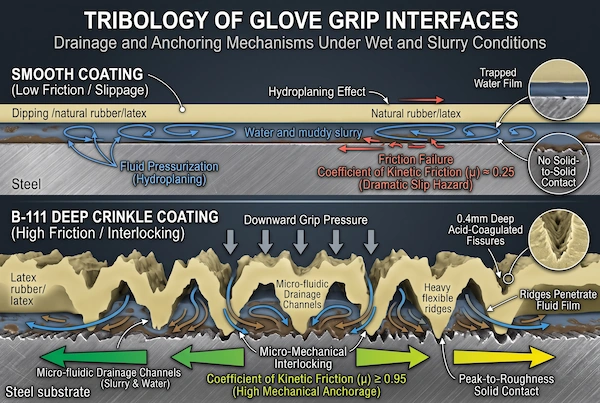
Fluid-Dynamic Drainage Channels (Micro-Trench Drainage): When a worker’s palm presses firmly against a scaffolding steel pipe or a damp stone surface covered with a water film, the smooth coating floats directly on top of the liquid film, producing a phenomenon similar to “fluid film hydroplaning” that occurs when a car tire travels at high speed on a water-logged road; At this moment, the dense network of wrinkled grooves on the palm of the B-111 acts as a matrix of microscopic drainage channels; Under the pressure of a closed grip, the continuous liquid at the interface is instantly forced into adjacent low-pressure microscopic grooves and drained away. The retained water film between the glove’s raised ridges and the workpiece’s actual contact surface is completely shattered, allowing the dry natural polymer rubber at the contact points to achieve direct, tight solid-to-solid contact with the workpiece’s microscopically rough surface within milliseconds.
Dry-Grip Friction vs. Wet Cement Mud Traction
Under different contact media and interface contamination conditions, the three mainstream dipping processes—Smooth, Sandy, and Crinkle—exhibit distinctly different tribological performance thresholds:
Measured Comparison of Dynamic Friction Coefficients for Different Coating Types:
Smooth Natural Latex (Smooth Dip): On an absolutely dry, clean steel plate surface, the smooth coating surface exhibits a high dry dynamic friction coefficient of 1.2 to 1.4 due to its large actual microscopic physical contact area; However, once the contact surface is completely covered by a water film or slurry—trapping the liquid between the smooth rubber surface and the workpiece and preventing it from flowing away—the dynamic friction coefficient plummets to an extremely low and dangerous slip range of 0.25 to 0.35;
Fine-grained, microporous latex (Sandy Latex, such as the B-115 model): Formed via a salt-absorption and salt-precipitation process, this micron-scale porous, rough surface delivers balanced performance under low-viscosity clean water or slightly oily conditions (with a wet dynamic coefficient of friction maintained between 0.70 and 0.85). However, the depth of its fine micropores is extremely limited (typically less than 50 micrometers), making it highly susceptible to physical clogging when exposed to high-viscosity fluids;
Deep-Crinkled Natural Latex (Crinkle Latex, such as Model B-111): Three-dimensional ridges and grooves reaching depths of several hundred micrometers provide exceptional resistance to contamination; in dry conditions, the micro-elastic deformation of the crinkle ridges ensures a stable dry dynamic coefficient of friction (0.95 to 1.10); even under wet and slippery conditions—such as when fully submerged in water or covered in slurry—the coefficient of kinetic friction remains stable within the high anti-slip range of 0.85 to 0.95 or higher, demonstrating exceptional all-weather durability;
Mechanical anchoring effects in high-viscosity cement mortar and masonry dust conditions: During masonry construction, precast beam grinding, and deep excavation work in muddy water, the surface of workpieces is often coated with large amounts of slippery, viscous cement colloids, fly ash, and stone powder particles; The micro-pores in ordinary fine-sand gloves are completely clogged and flattened by thick slurry within minutes, degrading into a slippery, smooth surface; whereas heavy-duty, deeply creased latex gloves, due to their extremely deep three-dimensional grooves, can directly absorb and channel excess slurry into the recesses at the bottom of the grooves when localized high pressure is applied during gripping; The exposed, thick rubber ridges undergo elastic deformation under gripping shear forces, firmly “biting into” and interlocking with the microscopic pits on red bricks or the spiral threads of mud-coated rebar; This macroscopic “micro-mechanical interlocking effect”—which goes beyond pure intermolecular adsorption—fundamentally ensures that frontline workers can maintain a high-shear grip while handling cement components, damp sand and gravel, and slippery molds for extended periods without having to tense their fingers excessively. This significantly delays hand muscle fatigue and eliminates accidents caused by sudden drops in grip strength that could result in objects slipping and causing injuries.
Comparative Laboratory Metrology: Physical Testing Benchmarks
In the standardization process for industrial occupational safety and protection, empirical, subjective assessments based on tactile sensation must give way to rigorous, repeatable, and quantitative physical testing. To provide engineering safety teams, EHS risk assessment experts, and industrial procurement directors with a clear basis for comparative analysis, various glove coatings must undergo destructive mechanical analysis under fully standardized, controlled laboratory loads. By measuring abrasion cycle benchmarks, ultimate elongation at break, peak tear strength, and critical puncture load, the inherent physical limits of various polymer materials in terms of micro- and macro-level engineering performance are clearly demonstrated.
Mechanical Metrology Matrix Across Polymer Glove Coatings
Under standard, controlled, constant temperature and humidity conditions (23 degrees Celsius, 50% relative humidity), comprehensive destructive mechanical metrology testing in accordance with EN 388 was conducted on four of the most representative combinations of coated polymers and knitted linings using a strictly calibrated Martindale abrasion tester and a universal materials testing machine. The key benchmark data obtained are shown in the table below:
| Coating Polymer & Liner Specifications | EN 388 Abrasion Cycles (Level) | Tear Resistance Force (N / Level) | Puncture Resistance (N / Level) | Tensile Elongation at Break (%) | Primary Engineering Applications |
| Heavy Crinkle Natural Latex (B-111 10G) | 2,000+ Cycles (Level 2) | > 75 N (Level 4) | 60 N – 100 N (Level 2) | 700% – 850% | Heavy Construction, Scaffolding, Masonry |
| Waterborne Precision PU (18G) | 500+ Cycles (Level 1) | < 25 N (Level 1) | < 20 N (Level 1) | 280% – 350% | SMT Cleanrooms, Precision Electronics |
| Micro-Foam Nitrile (15G) | 8,000+ Cycles (Level 4) | 40 N – 60 N (Level 2/3) | 30 N – 50 N (Level 1) | 350% – 450% | Automotive Assembly, Handling of Oily Tools |
| TekArmor® Cut-Resistant Latex (K5-111) | 2,000+ Cycles (Level 2) | > 75 N (Level 4) | 100 N+ (Level 3) | 650% – 750% | Metal Stamping, Glass Curtain Wall Construction |
The mechanical comparison matrix above clearly illustrates the actual trends in the engineering properties of different polymers:
Micro-Foam Nitrile demonstrates exceptional resistance to mechanical abrasion in high-RPM sandpaper friction tests, withstanding more than 8,000 consecutive grinding cycles (consistently maintaining a Level 4 abrasion resistance rating); however, its performance in sustained vertical tensile tear tests is relatively mediocre, as stress cracks tend to propagate along the shear lattice;
Waterborne Precision Polyurethane (Waterborne PU), on the other hand, sacrifices structural strength to achieve excellent breathability and fingertip sensitivity. With an elongation at break of less than 350%, it offers virtually no effective resistance against penetration by sharp, hard objects and is suitable only for cleanroom operations in electronics or micro-assembly where no heavy mechanical stress is present;
Heavy-duty crinkled natural latex gloves, such as the B-111, rely on an elongation at break of 700% to 850% and the unique tensile-induced crystallization capability of cis-polyisoprene to consistently exceed 75 Newtons in tear resistance testing (steadily achieving the highest Level 4 rating). They also consistently maintain a safe resistance range of 60 to 100 Newtons against blunt, round-tipped punctures, precisely meeting the practical demands of heavy-duty construction and the handling of rough stone materials.
Synergy with Cut-Resistant Technologies
In traditional occupational safety engineering, natural latex gloves are often simply classified as ordinary “low-cut-resistant, purely abrasion-resistant” entry-level handling gloves. This is because conventional polyester or cotton liner fabrics lack sufficient microscopic shear resistance against sharp metal edges. However, when materials science combines high-performance synthetic engineering fibers with naturally highly elastic latex, the two materials generate a powerful synergistic protective effect:
The polymeric synergy between the TekArmor® composite cut-resistant engineering liner and latex (such as the K5-111 model): The K5-111 model replaces traditional standard polyester yarn with a TekArmor® 18-gauge ultra-high-density cut-resistant skeleton, precisely coated and blended from ultra-high-molecular-weight polyethylene (UHMWPE), high-modulus specialty aramid staple fibers, and microfine reinforcing filaments; This engineered fiber skeleton possesses extremely high tensile strength and transverse shear resistance, enabling the entire glove to consistently withstand high blade loads during the ISO 13997 (TDM-100) straight-edge cut test, achieving automotive and industrial protection levels equivalent to ANSI A5 and EN 388 Cut Class E;
Natural crinkled latex provides high-damping energy absorption against hard, sharp edges: During the installation of large curtain wall glass panels, the handling of metal stamping sheets, and thick sheet metal forming operations, workers face not only the risk of sharp cuts from material edges but also endure immense localized line-contact loads from the material’s weight and the risk of accidental slippage; Although high-rigidity cut-resistant yarn can prevent the blade from cutting through, if paired with a standard hard, thin outer coating, it is highly prone to slipping out of the hand when in contact with smooth, heavy glass or oily steel plates; the kinetic energy from an uncontrolled fall can then cut through the protective layer of the glove. In contrast, the high-thickness, deeply crinkled natural latex composite impregnated on the palm surface possesses extremely high damping and energy-absorption properties, as well as excellent elastic deformation recovery capabilities; When the palm is compressed by the edge of a heavy workpiece, the latex layer rapidly disperses localized concentrated shear stress through three-dimensional deformation and significantly absorbs the impact energy from the workpiece, while the tough, ridged texture simultaneously provides extremely high static friction grip to prevent slippage;
Cross-disciplinary technical integration: For an in-depth understanding of high-strength, cut-resistant engineered yarn structures, microscopic blocking mechanisms, and ANSI/EN blade cut resistance test ratings, please refer to the official compliance analysis in the “Cut-Resistant Work Gloves” special feature. This composite technology—which combines a high-grade cut-resistant framework with thick, high-rebound latex—is the core solution for modern heavy equipment manufacturing to overcome the conflicting challenge of “requiring both high cut resistance and slip resistance to prevent the workpiece from slipping out of the hand.”
Factory-Floor Quality Control: Vulcanization Curing Kinetics and Batch Integrity
In the mass production of industrial safety gloves, laboratory prototyping and testing to meet the EN 388 standard is merely the first step toward compliance. Ensuring that every batch of gloves leaving the factory—produced on continuous production lines running at a rate of tens of thousands—possesses mechanical toughness that is consistent down to the last detail depends on the factory’s mastery of polymer chemistry, vulcanization kinetics,s and a rigorous process quality control system. The process by which natural rubber transforms from a viscous fluid into a highly resilient three-dimensional elastomer is extremely dependent on the precise closed-loop control of thermal parameters. For multinational bulk procurement, gaining insight into the factory’s production and quality inspection practices is the core defense against batch-level quality defects.
Crosslink Density Optimization in Continuous Tunnel Ovens
The molecular chains of natural cis-1,4-polyisoprene must undergo chemical reactions under specific thermal conditions with vulcanizing agents (highly reactive sulfur), accelerators, and activators (nanoscale zinc oxide and stearic acid) to form single-sulfur, double-sulfur, and multi-sulfur cross-linking bridges, thereby constructing a stable three-dimensional rubber network structure. The SQG automated continuous multi-temperature zone drying tunnel is based on a temperature control model established using rigorous vulcanization kinetic equations:
Temperature gradient dynamics in the continuous tunnel-type drying tunnel: The pre-formed glove mold chains move smoothly at a controlled linear speed through the automated hot-air circulation drying tunnel, which spans over 100 meters in length. The interior of the drying tunnel is divided into multiple independent temperature-controlled zones: the entry zone is maintained at 70 to 90 degrees Celsius to allow the raw rubber film to undergo initial dehydration and preheating, thereby preventing rapid boiling of water vapor that could create microscopic pores; the temperature in the main reaction zone is precisely maintained within the range of 110 to 125 degrees Celsius, with the dwell time for the molds in this constant-temperature section strictly controlled between 35 and 45 minutes; A microcomputer-based PID closed-loop control system, in conjunction with an infrared thermal imager, monitors the surface temperature of the glove mold in real time, ensuring that the measured temperature difference across the palm, fingertips, and finger creases of the entire glove is less than ±1.5 degrees Celsius, thereby promoting the synchronized formation of the cross-linked network under uniform heating;
Mechanisms by which an imbalanced curing state compromises the mechanical properties of finished gloves:
Hazards of Under-Curing: If insufficient heat in the curing tunnel or excessive conveyor belt speed results in inadequate dwell time, an adequate covalent cross-linking network has not yet formed between latex molecules, leaving a disproportionately high proportion of free molecular chains. Macroscopically, this manifests as a soft overall feel of the coating, low tensile strength, and—although the elongation at break is high—extremely high residual permanent deformation. More critically, the rubber surface becomes extremely sticky, making it highly prone to self-adhesion and scrapping in the high-temperature environment of shipping containers; furthermore, abrasion resistance and tear resistance metrics plummet dramatically;
Strict AQL 0.65 Batch Release Protocols for Enterprise Procurement
To ensure consistent quality in enterprise-level bulk procurement, the Super Factory has established a set of factory-release quality control protocols based on standard procurement batches (standard OEM/ODM minimum order quantity (MOQ) of 12,000 pairs) as the unit of measurement:
It enforces a stringent AQL 0.65 Acceptance Quality Limit:
For each batch of 12,000 pairs of finished products (which can be packed into 1,000 standard industrial cartons), the quality inspection department strictly follows the normal inspection sampling plan specified in ISO 2859-1 (GB/T 2828.1);
For critical and severe defects—such as coating delamination, cracks, holes, and significant dimensional deviations—an AQL threshold of 0.65 is applied, which is several times higher than conventional consumer standards. If the number of nonconforming items in a randomly selected sample reaches the rejection number, the entire production batch of 12,000 pairs is immediately subject to full-lot quarantine and isolation, along with a root-cause investigation procedure, to prevent non-conforming products from leaving the production line;
Physical Laboratory Mechanical Testing and Water/Air Tightness Testing:
Batch Yield Testing Using a Universal Testing Machine: Quality control engineers, working in a temperature-controlled room, randomly select 5 pairs of gloves from each production shift, cut them into standard-length test specimens, and use calibrated sensors to test the coating’s tensile strength and tear propagation resistance at a tensile speed of 100 millimeters per minute; The measured average tear resistance must be consistently maintained at 90 Newtons or higher (far exceeding the 75-Newton threshold for EN 388 Level 4), ensuring that the coefficient of variation in batch mechanical strength is controlled within extremely tight tolerances;
100% pneumatic inflation and palm leak-proof hydrostatic retest: A specified proportion of gloves is selected and placed into pneumatic sealing chucks; the inner cavity is filled with air at a specified low pressure, and the gloves are immersed and rotated in a water tank. The integrity of the microporous waterproofing of the fully-immersed palm rubber is comprehensively verified by observing the release of microbubbles, ensuring excellent resistance to seepage under wet slurry conditions;
Full-batch traceability with Certificate of Analysis (COA): Each batch of 12,000 pairs of standard products that pass inspection and are shipped is affixed with a unique batch-specific laser barcode on the exterior of the carton and accompanied by a “Certificate of Analysis (COA)” stamped and issued by the SQG Physical Testing Laboratory; The records comprehensively document the dry rubber content (DRC) of the raw latex in that batch, the measured temperature profiles of the curing oven zones, the tensile elongation at break, the AQL sampling data record sheet, and the corresponding measured tear resistance loads in both the warp and weft directions, establishing an enterprise-level compliance archive for heavy industry EPC clients that allows for traceability at any time.

Enterprise Sourcing & Total Cost of Ownership (TCO) in Heavy Construction
In supply chain management for large-scale infrastructure projects, open-pit mines, and port logistics, there has long been a common misconception regarding the final accounting of protective consumables procurement: using the purchase price listed on a single or double invoice as the sole criterion for evaluating procurement performance. However, the extremely high attrition rate of low-end protective gloves under harsh working conditions not only multiplies the actual total consumption but also causes a continuous drain on funds through hidden costs such as warehouse turnover, on-site distribution labor, compensation for work-related injuries, and industrial waste removal. Shifting the procurement evaluation system from “initial unit price” to “Total Cost of Ownership (TCO)”—which encompasses the entire lifecycle—and sourcing directly in bulk via full container loads from super factories at the source is the core strategy for modern engineering contracting firms to reduce costs and improve efficiency.
Workstation Durability Cycle: 10-Gauge Crinkle vs. Cotton Dotted Gloves
Using a standard open-air civil engineering project site with 500 frontline workers (covering rebar tying, scaffolding erection, concrete pouring, and material handling sections) as a calculation sample, we compare the consumption patterns of traditional, low-cost plastic-dotted cotton yarn gloves and B-111 heavyweight 10-gauge crinkle natural latex gloves at actual workstations:
The Gap Between Single-Shift Consumption Rates and Service Life:
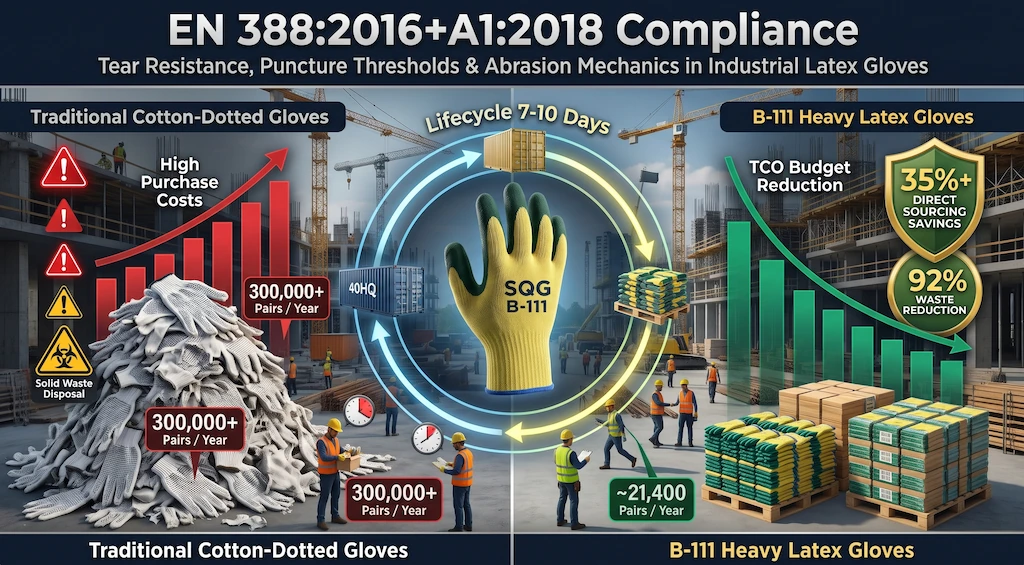
Standard plastic-dotted cotton-yarn gloves: When in contact with rough-threaded rebar, rusted scaffolding pipes, and masonry components, the cotton fibers are highly prone to fraying and breaking, and the plastic dots quickly peel off; On-site measurements show that a heavy-duty assembly worker averages 2 pairs of gloves per shift (8 hours), and this number can rise to as high as 3 pairs in rainy, snowy, or muddy conditions; for a 500-person project team operating 300 construction days per year, the annualized total consumption of plastic-dotted gloves reaches a staggering 300,000 pairs;
B-111 Heavy-Duty Crinkled Latex Gloves: Thanks to the tear-resistant mesh toughness of EN 388 Level 4 and the high-thickness, abrasion-resistant layer formed by deep acid-cured crinkles, a single pair of gloves consistently achieves an average continuous service life of 7 to 10 workdays under conditions of heavy mechanical friction and gripping; Even when calculated based on a relatively conservative 7-day replacement cycle, the total annual glove consumption for the entire project department is only approximately 21,400 pairs, representing a sharp reduction of over 92% in total physical consumption;
Comprehensive Analysis of Explicit Procurement and Implicit Operational Costs:
A qualitative shift in procurement costs and logistics/warehousing pressures: Although the initial unit price of high-grammage crinkled latex gloves is higher than that of inferior dotted-pattern gloves, the total annual expenditure on direct consumables has decreased rather than increased due to a more than tenfold reduction in usage volume, resulting in direct savings of 25% to over 35% in the procurement budget;
Reduction in Warehouse Management and On-Site Distribution Labor Hours: Managing 300,000 pairs of cotton-yarn gloves required several large shipping containers to occupy limited construction site space for extended periods, and warehouse staff had to frequently open boxes daily to take inventory and record distributions. After reducing annual demand to 21,400 pairs, on-site staff only need to retrieve small batches of materials monthly, freeing up a significant amount of warehouse staff and storage space;
Bulk Sourcing Logistics: 40HQ Container Density and MOQ Scalability
For overseas engineering contractors and regional workwear distributors with massive annual procurement volumes, establishing direct connections with source factories and consolidating shipments in full container loads is a key strategy for eliminating channel markups and reducing overall delivery costs:
Production Scale Advantages of a 12,000-pair Industrial Minimum Order Quantity (MOQ):
SQG’s Super Factory has established a minimum order quantity of 12,000 pairs (equivalent to 1,000 standard outer cartons), which enables the automated continuous dipping production line to maintain a consistent and stable chemical and thermal equilibrium;
This bulk production scheduling fully spreads out the fixed marginal costs per batch—including acid-curing tank setup, energy consumption for preheating and temperature ramp-up in the tunnel-type drying oven, and automated mold cleaning—allowing bulk buyers to directly benefit from the lowest possible factory-direct prices and avoid the high markups resulting from small-batch trial production;
40HQ High-Cube Full Container Load (FCL) Ocean Freight and Loading Topology Optimization:
High-density, orderly palletization: For long-haul international ocean freight routes, the factory’s engineering packaging team performs geometric topology optimization of the B-111 outer carton dimensions (standard 120 pairs per carton, five-layer reinforced moisture-proof corrugated cardboard boxes) for container loading;
Optimal Cost Allocation for Single- and Double-Container Ocean Freight: A standard 40-foot high-cube container (40HQ Container), when loaded with a rational high-density pallet arrangement or neatly stacked by hand, can accommodate 60,000 to 72,000 pairs of heavy-duty crinkle latex gloves; By shipping full containers directly to major overseas ports, the costs allocated to each pair of gloves—including ocean freight booking, terminal handling charges (THC), and inland transit fees—are minimized to the greatest extent possible, significantly increasing importers’ gross profit margins in local wholesale and retail markets;
Direct sourcing from the source factory eliminates the risk of counterfeit or substandard products and ensures compliance:
In multi-tiered trading chains, some intermediaries—seeking to earn high markups—often adulterate goods with low-quality calcium powder fillers, shorten curing time in drying tunnels to save electricity, or even use recycled vulcanized rubber waste in the re-compounding process. This results in gloves that are highly prone to delamination and water leakage when used on construction sites, and can cause severe skin redness, swelling, and allergic reactions;
By bypassing middlemen and placing full-container orders directly with source manufacturers that possess full-process production certification, buyers can not only obtain complete customs certificates of origin (such as those under the China-ASEAN or China-Latin America Free Trade Agreements to reduce or eliminate tariffs) but also receive a physical testing Certificate of Analysis (COA) report for the entire batch with each container shipment. This ensures that every box of gloves delivered to the construction site meets consistent EN 388 Level 4 mechanical and physical performance standards, achieving a comprehensive closed-loop supply chain in terms of cost, quality, and safety.
Frequently Asked Questions (FAQ)
What does EN 388 Level 4 tear resistance mean for daily construction work?
In the physical destruction test specified by the EN 388:2016+A1:2018 standard, Level 4 represents the highest rating for tear resistance. This rating indicates that, under constant speed on a universal testing machine, a vertical, sustained mechanical tensile force greater than 75 newtons (with actual measurements often exceeding 90 to 110 newtons) is required to completely tear apart a standard test specimen with a pre-cut notch. During routine construction work, when workers drag rough formwork, handle lumber with sharp splinters, load and unload rusted scaffolding pipes, or flip precast concrete components, the glove surface will inevitably be subjected to localized hard snagging and lateral tearing. With ordinary thin-layer gloves, once a tiny tear appears at the point of stress, external tensile force instantly causes the glove to tear linearly along the fiber grain, resulting in direct exposure and injury to the skin of the palm. In contrast, Level 4 natural crinkled latex gloves, thanks to the crystalline self-locking effect of cis-polyisoprene molecular chains under tension, can forcibly disperse concentrated tearing forces throughout the glove’s mesh-like structure. This ensures that the glove maintains its physical integrity even under heavy scraping and tearing loads, preventing the wound from enlarging and causing severe skin lacerations.
Does the thick, crinkled latex coating on the B-111 resist wood splinters and metal burrs?
The B-111 utilizes a composite process combining a 10-gauge, high-grammage seamless polyester liner with high-solids natural latex; the physical thickness of its deeply crinkled vulcanized rubber layer on the palm exceeds 1.2 millimeters. This high-thickness structure, combined with the exceptional rebound and energy-absorption properties of natural polymers, creates a robust, blunt-impact buffer layer for workers handling construction wood splinters, broken wire ends, and metal casting burrs:
Effective Protection Range: When faced with rough splinters on the surface of construction lumber, the bent, blunt ends of binding wire, flash from scaffolding fastening bolts, and hard corners of broken stones, the gloves rely on the micro-elastic three-dimensional deformation of the thick rubber to effectively absorb the kinetic energy of the hard object’s penetration and force the penetrating object to undergo microscopic lateral slippage and deflection, eliminating the risk of “puncture upon contact” associated with ordinary thin fabric gloves;
Physical Protection Limits: Engineering teams must clearly understand that the B-111 is a heavy-duty industrial glove certified to EN 388 Mechanical Level 2 puncture resistance (withstanding downward pressure from a 60- to 100-newton round-head steel needle). Its puncture-resistant mechanism is designed to withstand blunt industrial punctures; However, in the case of medical syringe needles with extremely small and sharp geometric edges (falling under the ASTM F2878 fine-needle category) or cuts from extremely thin and sharp shards of glass, such fine needle tips may still penetrate the gaps between rubber molecules. In specialized work environments involving the sorting of high-risk medical waste or the cleanup of extremely fine syringe needles, it is mandatory to use specialized gloves with built-in high-hardness metal wire mesh panels designed to prevent fine needle punctures. Working beyond the specified scope is strictly prohibited.
Why are Level 4 tear-resistant gloves strictly prohibited near rotating shafts?
Many procurement personnel and shop floor supervisors often have a misconception that gloves are “safer the sturdier they are and the more tear-resistant they are,” but this logic can be absolutely fatal when working near rotating machinery. According to OSHA 1910.212 and ISO 12100 safety standards, protective gloves with Level 4 tear resistance are strictly prohibited when working near bench drills, lathes, vertical milling machines, rotating drive shafts, and pulleys:
Mechanical entanglement and self-locking mechanisms: High-speed spindles and drill bits generate uncontrolled torque in the range of thousands of newtons. If a worker’s glove fingertip accidentally comes into contact with burrs or metal shavings on a rotating spindle, the extremely high surface friction of natural latex will instantly grip the metal surface, causing the 10-gauge polyester liner to become tightly wound around the rotating shaft;
A physical noose with no escape: If a worker were wearing ordinary, fragile, thin gloves with a tear resistance rating of only Level 1, the gloves would tear and break on their own when subjected to a tensile force of 15 to 20 newtons, allowing the worker to pull their hand free and escape; However, the B-111—which meets Level 4 standards—has an elongation at break of over 700% and sustained tear resistance exceeding 75 newtons. When drawn into the spindle, not only does it fail to tear, but it actually contracts and tightens rapidly inward as the power source continues to pull it in;
Instantly Disabling Consequences: Since the entire entanglement and tightening process takes only tens of milliseconds—far exceeding the limit of the human nervous system’s reflexive hand-withdrawal response—the gloves will act like a steel cable, forcibly dragging the worker’s fingers, palm, and even the entire forearm into the high-speed cutting and rotating zone, directly causing fractures, finger amputations, or even lacerations and avulsions of limbs. Therefore, clear warning lines must be established around all rotating equipment, and strict safety regulations prohibiting the use of high-tear-resistance gloves must be rigorously enforced.
How does SQG prevent batch-to-batch variations in latex thickness during automated dipping?
In large-scale industrial manufacturing with an annual output of tens of millions of pairs, uneven coating thickness across different batches of gloves can directly result in some batches failing to meet tear resistance standards, or cause the gloves to become stiff and hard due to localized excess latex thickness. Through three closed-loop automated processes, SQG’s automated super factory strictly controls the thickness tolerance of the palm rubber layer for standard purchase orders (MOQ of 12,000 pairs) within an extremely narrow range of ±0.05 millimeters:
Constant temperature and humidity circulation in the dipping tanks with dynamic viscosity balance: Natural rubber is highly sensitive to temperature and shear force. The factory’s dipping tanks are equipped with a fully enclosed jacketed constant-temperature water circulation system and variable-frequency low-shear screw agitators, which maintain the latex bath temperature consistently between 22 and 25 degrees Celsius. An online rotational viscometer and conductivity sensor automatically monitor the system every 10 minutes, while servo-controlled replenishment valves supply deionized water and fresh stabilizers in real time, ensuring that the dry rubber content (DRC) and rheological viscosity of the latex entering the dipping section always remain within the optimal process parameters;
High-precision servo motors control the mold’s entry and exit trajectory: The movement of the glove mold as it enters and exits the dipping tank is entirely driven by high-precision multi-axis servo slides; The control system uses a preset acceleration algorithm to ensure the glove mold sinks gently into the liquid surface to avoid entrapping air microbubbles, while executing millimeter-level gradual deceleration, lifting, and orientation reversal as it is raised out of the liquid, promoting the smooth return of excess latex and eliminating the accumulation of latex at the fingertips that could cause lumps;
Uniform Film Formation in a 100-Meter Multi-Temperature Zone Tunnel Drying Oven: After being lifted and molded, the glove mold chain immediately passes smoothly through a long drying oven equipped with PID closed-loop temperature control; Through hot-air convection circulation and pressure differential control within the drying tunnel, the wind speed and temperature deviation across the upper, middle, and lower airflow surfaces are maintained within 1 degree Celsius. This ensures that moisture in the latex evaporates and solidifies uniformly from the inside out within a stable thermal field, completely eliminating localized pinholes and uneven thickness caused by uneven heating, and ensuring that every shipment of bulk goods delivered from the factory possesses a completely consistent physical protective barrier.
Request Enterprise Bulk Sourcing & Master Sample Kit
In the fields of heavy industrial production, civil engineering, and large-scale logistics, the selection of hand protection solutions not only affects compliance with workplace safety regulations in factories and on construction sites but also directly impacts the annual operating costs of construction contractors and bulk material purchasers. By penetrating the microscopic polymer network of natural rubber, rigorously implementing automated, continuous tunnel-type curing kinetics control, and establishing stringent factory inspection protocols, original equipment manufacturers can build a robust and reliable physical protective barrier for extreme heavy-duty industrial scenarios.
Industrial Sourcing Value & Direct Manufacturing Assurance
As a source “super factory” dedicated to the R&D and large-scale mass production of industrial-grade safety gloves, SQG has always grounded its R&D in materials engineering and rheology:
Intrinsic Advantages of Natural Polymers and Structural Reinforcement: Leveraging the unique tensile-induced crystallization properties of natural cis-1,4-polyisoprene, combined with a 10-gauge, high-density, seamless polyester knit skeleton, the gloves demonstrate stable tear resistance exceeding 75 newtons (up to Level 4) and excellent blunt puncture resistance when subjected to rough, heavy-duty friction and when subjected to rough, heavy-load friction or being pulled against wooden splinters and steel structures, the gloves demonstrate tear resistance consistently exceeding 75 Newtons (up to Level 4) and excellent cushioning against blunt puncture;
Friction Energy Control via Chemically Demulsified Deep-Grooved Textures: Deep, volcanic-rock-like micro-grooves created through a weak-acid, controlled demulsification process instantly disperse water films and slurry from the contact interface, preventing fluid-induced slippage during heavy-duty gripping. This provides lasting and stable micro-mechanical anchoring grip during construction masonry work, deep slurry foundation pits, and the handling of rough components;
Full Lifecycle TCO Cost Reduction and Efficiency Enhancement: The service life has been significantly extended from the single-shift wear-out of low-quality point-plastic cotton yarn gloves to 7 to 10 workdays. This dramatic reduction in consumption not only directly cuts the annual total procurement bill for consumables by more than 25%, but also fundamentally reduces the hidden burdens associated with on-site warehouse space, distribution and material issuance labor hours, and the removal of industrial solid waste, helping general contractors strike a balance between cost reduction, efficiency improvement, and workplace safety.
Enterprise Master Sample Kit & Direct Bulk Procurement Channels
For multinational engineering, procurement, and construction (EPC) contractors, open-pit mining operation groups, large-scale port logistics hubs, and overseas regional-level primary distributors of personal protective equipment (PPE) with annual procurement volumes exceeding 10,000 pairs, SQG has now officially opened the application channel for direct delivery of the “Enterprise-Level Full-Lot Project Master Sample Kit”:
In-Depth Evaluation of the Enterprise Sample Kit: The kit includes mechanical test reports (Certificates of Analysis, COA) issued by the factory’s physical laboratory for the corresponding production batch numbers, actual tear resistance force-displacement curve charts for both warp and weft directions, and technical white papers compliant with CE CAT. II and EN 388:2016+A1:2018 standards, as well as physical trial samples covering mainstream sizes (Size 8/M to 11/XXL);
Exclusive Customized Bulk Procurement Services: The factory’s direct procurement channel fully supports scaled, tiered factory pricing based on a standard minimum order quantity (MOQ) of 12,000 pairs; for bulk consolidated shipments and full container load (FCL) direct ocean freight orders in 40HQ containers, our engineering packaging team provides moisture-proof, five-layer reinforced corrugated outer boxes with optimized loading topologies, high-density, organized palletizing solutions, as well as Certificates of Origin compliant with the target customs clearance port (e.g., tariff preference documents under the China-Latin America, China-Africa, or ASEAN Free Trade Agreements) and custom heat-transfer or woven label services for private labeling;
Product Specifications Page and Immediate Technical Consultation: If you need to review the complete engineering parameter matrix and factory-issued mechanical testing certification documents for heavy-duty, abrasion-resistant, puncture-resistant crinkle latex gloves, or request evaluation samples for your company’s ongoing heavy industry projects, please click directly to access the official B-111 Heavy-Duty Crinkle Latex Glove product specifications landing page to contact our team of senior hand protection engineers directly.