Introduction: The Costly Fallacy of Binary Impact Ratings in Heavy Industry
Navigating ANSI/ISEA 138 vs EN 388 compliance is vital in demanding heavy industrial environments such as onshore oil rigs, offshore platforms, open-pit mining operations, and structural steel erection, where hands remain on the front lines of high-kinetic-energy motion. Industry occupational health and safety (EHS) statistics show that, among recorded injury incidents in heavy industry, more than 70% of hand injuries result directly from sudden mechanical malfunctions at pinch points. Finger bone comminution caused by violently swinging drill pipes, metacarpal fractures resulting from the dislodgement of heavy lifting slings, and blunt trauma from the recoil of high-torque hydraulic clamps often occur in a matter of milliseconds and directly result in permanent hand disabilities for workers.
Faced with such deadly mechanical and physical hazards, the industrial procurement teams at many manufacturing and mining companies have long been trapped in an extremely dangerous “cognitive simplification trap”—reducing hand protection to a black-and-white, binary concept. When conducting annual personal protective equipment (PPE) tenders, some companies purchase low-cost, basic protective gloves based solely on suppliers’ verbal claims of “impact resistance” or the vague appearance of rubber protective strips on product packaging. This blind selection process, divorced from actual mechanical energy testing, quickly evolves into a costly hidden liability on the production floor: when low-end protective gloves are struck by heavy objects, the outer layer of cheap thermoplastic often immediately shears or ruptures under stress. Not only do they fail to absorb the impact wave, but the shattered hard fragments actually exacerbate secondary lacerations to finger bones and soft tissues. The result is a sharp spike in workers’ compensation medical claims, hefty administrative fines from regulatory agencies for compliance violations, and production line downtime losses caused by staff shortages at critical workstations.
The key to eliminating these high compliance costs lies in procurement and safety engineering departments establishing a quantitative mechanical assessment framework based on international standards. Whether a glove truly possesses industrial-grade impact protection has never been a subjective, qualitative description; rather, it depends on the material’s ability to suppress “Peak Transmitted Force” under specific impact momentum. A thorough analysis of the underlying test mechanisms behind the North American ANSI/ISEA 138 specialized impact resistance rating system and the European EN 388 mechanical hazard certification—clarifying the fundamental differences between the two in terms of impact energy input, anatomical zone sensor arrays, and rating granularity—serves as the scientific foundation for companies to build a zero-tolerance safety defense and optimize safety investments across the entire product lifecycle.
For a systematic overview of our full range of engineering-grade protective gloves—all certified through rigorous international mechanical impact testing and custom-engineered for extreme drilling, mining, and heavy industry applications—please visit our core product hub: Impact Resistant Work Gloves.
Fundamental Divergence: Continuous Metric vs. Binary Pass-Fail
In technical procurement agreements for PPE in multinational heavy manufacturing and energy engineering, standard certification codes serve as the legal basis for determining product compliance. When reviewing product specifications, many corporate procurement professionals often assume that as long as gloves carry “impact protection certification,” the level of protection they provide is equivalent. However, there is a generational difference in the engineering design philosophy behind impact resistance testing between Europe and North America: the European standard EN 388 adheres to a traditional pass/fail threshold mechanism, while the North American standard ANSI/ISEA 138 employs a continuous, quantitative performance grading matrix. This fundamental difference in underlying mechanisms directly determines whether a glove can dissipate kinetic energy when subjected to extreme impacts in the field, or whether it merely “barely meets the standard.”
The Limitations of EN 388:2016 Impact Testing (The “P” Marking)
When the European Union made major revisions to the EN 388 comprehensive standard for mechanical hazards in 2016, it formally incorporated impact protection into the test annex (Clause 6.9). However, this test method was not developed independently for industrial conditions; rather, it was directly adapted from the EN 13594:2015 test specification for motorcycle riding gloves:
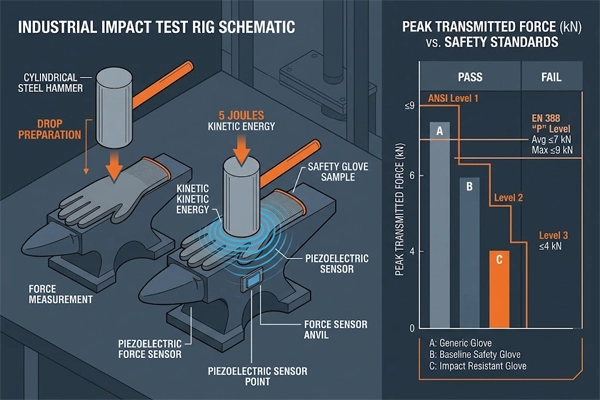
5-joule drop-weight impact mechanism: The test rig uses a flat-bottomed cylindrical steel drop weight (typically weighing 2.5 kilograms) that is dropped from a fixed height onto a glove sample placed on a hemispherical anvil, generating a standardized 5 joules (J) of impact kinetic energy. A piezoelectric force sensor beneath the anvil records the residual peak transmitted force (Peak Transmitted Force) at the moment the impact penetrates the glove material.
Limitations of the Binary Pass/Fail System: The compliance determination under EN 388 is extremely broad—as long as the average transmitted force of the tested glove does not exceed 7 kilonewtons (kN) across four drop-test trials, and the maximum peak force of any single impact does not exceed 9 kilonewtons (kN), the glove is eligible to be marked with the letter “P” (Pass) in the sixth position of the EN 388 pictogram code (e.g., 4X43DP); if the standards are not met or the test is not declared, it is directly marked with an “X” or left blank.
Masking True Engineering Differences in Energy Absorption: This single-pass system creates serious blind spots in B2B procurement decisions. A lightweight glove with a measured residual force as high as 6.8 kilonewtons (just slightly below the 7-kilonewton threshold) and a high-performance engineered glove that uses an advanced energy-absorbing structure to limit the transmitted force to 3.5 kilonewtons both display only a simple “P” on their EU certification labels. For high-risk work sites where workers face impacts from heavy drill pipes or flying rocks, this lack of granularity in certification information prevents purchasers from distinguishing between gloves’ maximum energy-absorption reserves, making it extremely easy to make the wrong selection.
The Graded Performance Architecture of ANSI/ISEA 138
To thoroughly address the shortcoming of the European grading system—namely, its inability to provide detailed protection levels in industrial settings—the International Safety Equipment Association (ISEA), in collaboration with leading global materials scientists and occupational physicians, officially released ANSI/ISEA 138, a specialized standard for impact protection in industrial gloves, in 2019. This standard establishes a discrete performance scale (Graded Performance Levels) centered on residual impact force:
Unified 5-joule kinetic energy benchmark: ANSI/ISEA 138 also employs a standard impact kinetic energy of 5 joules applied by a 2.5-kilogram falling hammer, ensuring comparability with internationally accepted standards in terms of the energy input for basic physical testing. However, the key distinction lies in its rejection of a vague “pass/fail” determination; instead, it precisely classifies protection into three discrete levels based on the residual peak force captured by sensors:
Level 1 (Basic Impact Protection): Average peak transmitted force is less than or equal to 9 kilonewtons (kN). This level primarily absorbs kinetic energy from minor physical impacts and is suitable for equipment inspections, light logistics handling, or auxiliary workstations in confined spaces where hands are prone to lateral scrapes.
Level 2 (Heavy Industry Standard): Average peak transmitted force is less than or equal to 6.5 kilonewtons (kN). This is currently the benchmark threshold for multinational mining operations, steel structure assembly, and heavy-duty automotive stamping shops. Meeting this level means the glove’s thermoplastic rubber framework can dissipate most of the kinetic energy from direct impacts, reducing the destructive force transmitted to the human skeleton to within a tolerable threshold.
Level 3 (Extreme Heavy-Duty Impact Protection): Average peak transmitted force is less than or equal to 4 kilonewtons (kN). This is the highest level under this standard, requiring that after withstanding a 5-joule impact, only an extremely minimal amount of kinetic energy is allowed to penetrate the back of the hand. It serves as the mandatory protective standard for environments with extremely high injury risks, such as oil and gas rig floors, deep-well hydraulic fracturing, heavy-duty pile driving, and the hoisting of large-diameter, thick-walled pipelines.
When implementing the ANSI/ISEA 138 impact glove standard, ANSI/ISEA 138 provides corporate EHS teams and procurement decision-makers with a clear, quantifiable framework: By mathematically mapping on-site Job Hazard Analyses (JHA) to the peak force thresholds for Levels 1 through 3, companies can precisely procure protective equipment of the corresponding level, completely eliminating the outdated practice of relying solely on subjective experience to make blind selections when faced with “P”-marked gloves.
Anatomical Multi-Zone Testing: Knuckles vs. Fingers and Thumb
In addition to discrepancies in the mechanisms for measuring impact force, the two major standards also exhibit a fundamental gap in the comprehensiveness of coverage for the “anatomical areas under test.” The human hand consists of a highly intricate combination of metacarpal bones, proximal phalanges, middle phalanges, and distal phalanges, with soft tissue thickness and mechanical load-bearing limits varying significantly across different regions. If the test points specified by protective equipment standards do not align with the anatomical high-risk areas where workplace injuries actually occur, the compliance reports issued by laboratories will create a “false sense of security” regarding on-site protection.
Testing Beyond the Metacarpals: Why Finger Protection Fails Under EN 388
The European EN 388 standard contains a serious flaw in the design of its impact test locations that has long been overlooked by industrial procurement: its testing scope is limited solely to the metacarpophalangeal joint (knuckles/metacarpals) area on the back of the hand, with absolutely no impact drop-weight testing conducted on the fingers or thumb.
Testing Blind Spots Disconnected from On-Site Reality: According to long-term workplace injury monitoring data from the International Association of Drilling Contractors (IADC) and the Occupational Safety and Health Administration (OSHA), among all mechanical hand injuries occurring in heavy industrial settings, more than 70% of crush injuries, pinching incidents, and fractures occur at the fingertips and phalangeal joints (distal and middle phalanges), rather than on the broad, thick metacarpal bones of the back of the hand. When workers use heavy-duty wrenches to tighten bolts, brace swaying casings on a drilling rig, or adjust dies in the gaps of stamping machinery, their fingers are positioned deepest within narrow pinch points, where they face the highest risks of instantaneous shearing and opposing compression forces.
Substandard Design Resulting from Structural Loopholes: Since the “P” mark certification under EN 388 evaluates energy absorption data only for the few square centimeters at the knuckles, many low-cost glove manufacturers have exploited loopholes in the standard—they simply sew a thick rubber patch onto the knuckles on the back of the glove to easily pass the 5-joule test and obtain the “P” mark, while the finger areas are covered with decorative rubber strips as thin as a cicada’s wing, or left completely unprotected against impact, in exchange for extremely low manufacturing costs. When frontline workers wear these so-called “compliant impact-resistant gloves” on the job, if their fingers are violently pinched by the edges of heavy valves or drilling tools, the finger sections of the gloves are completely unable to dissipate the kinetic energy, making them highly susceptible to severe comminuted fractures.
The “Lowest Performing Score Governs” Rule in ANSI/ISEA 138
To address this critical blind spot in European standards, the ANSI/ISEA 138 impact glove standard mandated full-anatomy testing as a mandatory requirement from its inception, thereby completely eliminating structural protection vulnerabilities:
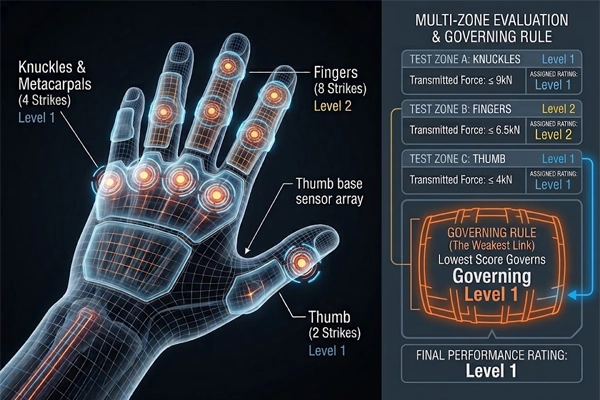
Independent Test Matrix Covering All Anatomical Zones: ANSI/ISEA 138 explicitly divides the back of the hand into three distinct anatomical test zones:
Metacarpophalangeal Joint Zone (Knuckles): Tests involve precise hammer strikes to the prominent joints on the back of the hand, with at least four independent impact peak readings recorded;
Fingers: Covers the phalangeal protection zones of the index, middle, ring, and little fingers; test impact points are evenly distributed across the phalangeal protection blocks, with at least 8 independent impact data points recorded;
Thumb Area (Thumb): Given the unique anatomical structure of the opposable thumb—which is highly susceptible to being caught in rotating parts and pinch points—a separate drop-weight impact position is designated, with at least 2 independent impact data points recorded. The full certification process requires the collection of up to a dozen high-precision impact data points across different samples to ensure that the energy-absorption capacity of every exoskeletal component on the back of the hand is digitally recorded.
Lowest Performing Score Governs Principle: To prevent manufacturers from “optimizing specific areas while compromising overall performance,” ANSI/ISEA 138 has established the most stringent “law of the shortest plank” in the field of protective equipment certification—the comprehensive rating ultimately marked on the standard label for the entire glove must be directly tied to the lowest score among all tested areas. For example: If the knuckles on the back of a glove, equipped with a composite cushioning air chamber, measure a transmitted force of 3.8 kN—reaching Level 3, which represents the highest level of impact protection—but the armor thickness in the finger area has been reduced to allow workers to grip tools more easily, resulting in a measured transmitted force of 6.2 kN (which falls within the Level 2 threshold); furthermore, due to uneven force distribution along the edges of the thumb guard, the measured force transmission there reached 7.8 kN (dropping into the Level 1 range). According to the “weakest link” principle, the official final certification label for this glove must be mandatorily classified as Level 1.
This rating philosophy—which “defines overall protection based on the weakest point”—compels glove manufacturers to conduct in-depth engineering optimizations in mold development, thermoplastic rubber (TPR) material density distribution, and joint hinge geometry, to thoroughly ensure that every pair of gloves worn by workers provides robust and balanced physical defense depth from the fingertips and knuckles to the major joints on the back of the hand.
Head-to-Head Comparison: ANSI/ISEA 138 vs. EN 388 Engineering Metrics
Translating the testing logic of European and North American standards into actionable engineering metrics is a critical preliminary step for corporate supply chains when developing technical specifications for equipment tenders. Relying solely on product brochures or qualitative compliance claims provided by suppliers makes it highly likely that compliance will be rejected during safety reviews by overseas engineering, procurement, and construction (EPC) contractors, multinational oil and gas joint ventures, and original equipment manufacturers (OEMs).
Comprehensive Compliance & Physics Parameter Matrix
To eliminate ambiguities in standard terminology, the following section provides a comprehensive parameter alignment between EN 388:2016 (Clause 6.9) and ANSI/ISEA 138-2019 using standardized engineering test parameters:
| Comparison Dimension | EN 388:2016 + A1:2018 (Clause 6.9) | ANSI/ISEA 138-2019 |
| Origin Standard | Adapted from EN 13594:2015 (Specification for Motorcycle Gloves) | A specialized standard developed specifically for hazards associated with industrial machinery |
| Impact Energy (Joules) | 5 joules (2.5 kg drop weight falling vertically from a specified height) | 5 joules (equivalent to the initial impact kinetic energy applied by a 2.5 kg flat-bottomed drop weight) |
| Test Strike Anvil Geometry | Hemispherical steel anvil (simulating the protrusions subjected to pressure on the joints during riding) | Flat-bottomed cylindrical anvil combined with an anatomically inspired base sensor |
| Tested Anatomical Zones | Limited to a single zone: metacarpal joints (knuckles) | Mandatory coverage of three distinct anatomical regions: joints, finger bones, and the thumb |
| Number of Impact Strikes | At least 4 independent impacts must be performed on the joint areas on the back of the hand | Covers all test points for fingers (8 times), thumb (2 times), and joints (4 times) |
| Classification System (Rating) | Binary pass/fail system: “P” (Pass) indicates compliance; “X” or a blank space indicates failure | Continuous, discrete three-level rating: Level 1, Level 2, Level 3 |
| Transmitted Force Thresholds | Average transmitted force of 7 kN or less, with a maximum transmitted force per impact not exceeding 9 kN | Level 1: 9 kN or less; Level 2: 6.5 kN or less; Level 3: 4 kN or less |
| Governing Rule for Final Grade | Only the average performance of the joint area is evaluated; if the standard is met, the entire glove is awarded a “P” mark | Strict adherence to the “Lowest Performing Score Governs” principle |
| Audit & Marking Requirements | Indicated immediately after the abrasion, cut, tear, and puncture resistance codes (e.g., 4X43DP) | Uses distinct shield-shaped icons to clearly label the outer-frame level (1, 2, or 3) and the corresponding subregion |
As can be seen from the measured physical data in this parameter matrix, there are three significant differences between the two systems in terms of industrial implementation:
Differences in the stringency of energy-absorption requirements: The “passing threshold” for EN 388 (below 7 kN) is actually only slightly higher than the minimum entry-level standard for ANSI/ISEA 138 (Level 1: below 9 kN), and falls far short of the extreme impact protection performance required by ANSI Level 3 (below 4 kN). If a company’s procurement involves work scenarios with extremely high mechanical energy, such as high-pressure pipeline pressure testing, well servicing operations (tripping in and out), or open-pit blasting, requiring only the “EN 388 P-marked” standard will leave workers’ fingers and metacarpal bones directly exposed to destructive impacts of up to 7 kN—far short of the intrinsic safety requirements for heavy industry.
Preventing anatomical protection blind spots: EN 388’s “zero actual testing requirements” for fingers and thumbs mean that a large number of CE-certified “P-rated” gloves on the market lack effective energy-absorbing structures in the finger areas. In implementing the ANSI ISEA 138 impact glove standard, the ANSI system’s more than ten full-area drop-weight impacts, combined with the “shortest board” principle, eliminate the risk of crush injuries caused by substandard finger protection pads at the physical source.
Transparency of Compliance Markings: In cross-border EHS regulation, ANSI’s independent shield-shaped rating symbol allows safety officers to quickly verify, with the naked eye and from several meters away from the production line, whether the gloves worn by workers meet the Job Hazard Analysis (JHA) requirements for that workstation by checking the markings on the back of the gloves; In contrast, EN 388 labeling is often hidden at the end of a lengthy alphanumeric code on the inner wrist, making visual error-proofing on-site extremely costly.
Material Physics of Impact Attenuation: TPR Exoskeletons vs. Foams
In the structural engineering of impact-resistant gloves, the choice of material for the back-of-hand exoskeleton directly determines the efficiency of impulse absorption and the physical service life. To control manufacturing costs, some low-cost industrial gloves often use EVA foam, microporous PU foam, or inexpensive polyethylene sheets as back-of-hand fillers. When subjected to an initial impact from a heavy object, the closed-cell air chambers within these foamed polymers instantly rupture and compress, resulting in irreversible plastic deformation; upon a second impact, the already hardened foam layer loses nearly all of its energy-absorbing and cushioning capabilities. In contrast, injection-molded thermoplastic rubber (TPR) exoskeletons, with their excellent viscoelasticity and high-frequency deformation recovery, represent the mainstream engineering solution for meeting industrial-grade impact protection standards.
Thermoplastic Rubber (TPR) Chemistry and Shore A Hardness Tuning
Thermoplastic rubber (TPR) is a block copolymer that combines the high elasticity of rubber with the thermoplastic flow properties of plastic. Upon impact from a heavy hammer or violent compression by a metal component, the TPR molecular chains disperse the concentrated impact kinetic energy through instantaneous viscoelastic stretching and convert mechanical energy into minute amounts of thermal energy through intramolecular friction, which is then dissipated into the surrounding area. This significantly reduces the destructive shear force transmitted vertically downward to the bones of the back of the hand:
Precise Calibration of Shore A Hardness: When developing protective gloves that comply with the ANSI ISEA 138 impact glove standard, the hardness of the TPR formulation must typically be strictly calibrated within the engineering window of Shore A 40 to Shore A 60:
Excessively high hardness (greater than Shore A 65): The TPR material exhibits excessive rigidity. Although it can resist penetration by sharp, hard objects during static testing at room temperature, when subjected to high-energy blunt impacts, the overly rigid armor is prone to localized stress concentration, leading to brittle fracture of the material and even the direct, rigid transmission of the impact force to the subcutaneous soft tissues.
Excessively low hardness (less than Shore A 35): The rubber compound is too soft and collapses easily; when subjected to a falling hammer impact of 5 joules or more, it will instantly bottom out, losing its required dynamic cushioning thickness and allowing the impact force to penetrate unimpeded to the finger bones.
Formulation Modification for Low-Temperature Resistance and Anti-Brittleness: For workers operating in Canadian oil sands mines, North Sea offshore drilling platforms, or high-latitude mining environments during winter, ambient temperatures often drop below minus 20 degrees Celsius. Ordinary, low-cost industrial plastics are highly prone to exceeding their glass transition temperature (Tg) at low temperatures, becoming brittle and fragile, and shattering upon even minor impact. High-grade industrial-grade TPR significantly lowers the embrittlement temperature to below –40 degrees Celsius by incorporating cold-resistant plasticizing additives and long-chain polymers into the styrene-butadiene block matrix, ensuring that the impact-resistant exoskeleton retains its flexible, energy-absorbing properties even in severe outdoor cold conditions.
For an in-depth understanding of the microscopic damping and energy-absorption mechanisms of thermoplastic elastomers, the design of cavity-based energy-absorbing structures, and anti-aging and fatigue test data, please refer to our technical article on materials engineering: TPR Exoskeleton Engineering: Dissipating Crush, Pinch, and Impact Energy.
Segmented Flex Grooves and Ergonomic Grip Fatigue Mitigation
If impact-resistant gloves simply stack layers of protective material while neglecting ergonomic design, they will inevitably feel stiff and rigid. This can lead to high-risk safety violations, such as production line workers removing their gloves without authorization due to operational inconvenience. Ergonomic studies show that when workers wearing rigid-armor gloves continuously grip heavy wrenches, vibrating air hammers, or pipe wrenches, the extensor tendons on the back of the hand must exert additional force to overcome the glove’s resistance to bending—a key factor contributing to carpal tunnel syndrome and premature loss of finger grip strength.
Bionic Hinged Segmented Flex Grooves: To completely resolve the physical conflict between protective thickness and hand flexion/extension flexibility, the engineering team designed through-type bionic hinged grooves corresponding to the proximal and distal interphalangeal joints in hand anatomy.
Eliminating Elastic Rebound Torque: When the worker’s hand is in a naturally extended position, the independently arranged TPR protective blocks lie closely adjacent to one another, forming a continuous protective shield covering the entire back of the hand; when the worker’s fingers perform a gripping action, the exoskeleton naturally folds and unfolds along the deep hinge grooves, not only avoiding any compression of the glove’s inner lining fabric but also geometrically eliminating the reverse rebound stress generated when the protective material bends.
Reduced tendon fatigue and risk of accidental slippage: This biomimetic, segmented ergonomic design reduces the wearer’s static bending resistance by more than 45%, enabling smooth execution of tasks such as erecting scaffolding at heights, connecting pipe strings in deep wells, and operating heavy-duty valves. While strictly adhering to ANSI impact protection standards, it ensures grip stability during prolonged, high-load operations.
Cross-Hazard Integration: High-Dexterity Cut Resistance Meets Impact
In modern industrial manufacturing and heavy-duty electromechanical assembly settings, the causes of workplace injuries rarely occur in isolation. While operators face the risks of being caught or crushed by moving mechanical parts and struck by falling heavy objects, their hands are often simultaneously exposed to cutting hazards from sharp metal burrs, stamped sheet metal edges, or exposed cutting tools. Traditional on-site PPE provision often presents a dilemma: conventional cut-resistant gloves lack an impact-absorbing exoskeleton, which can result in fractures if a hand becomes trapped; conversely, traditional heavy-duty impact-resistant gloves are so bulky and heavy that workers are unable to perform tasks such as tightening small bolts or connecting and disconnecting wiring harnesses. The deep integration of high-gauge cut-resistant weaving technology with miniaturized impact-absorption engineering has become the core direction for the evolution of protective equipment in modern high-end manufacturing.
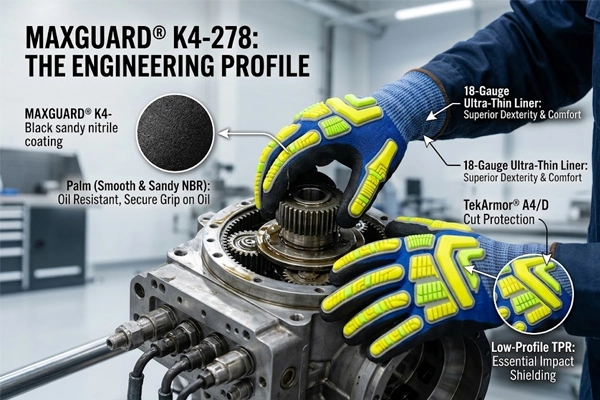
18-Gauge Precision Handling with TekArmor®: Deploying Model K4-278
To address the long-standing industry pain point that “impact-resistant gloves must be bulky and stiff,” the SQG R&D team launched the MAXGUARD® K4-278, designed specifically for high-dexterity assembly tasks, achieving a physical synergy between an ultra-thin feel and industrial-grade impact protection:
18-gauge ultra-high-density TekArmor® cut-resistant lining base: The K4-278 abandons traditional 10-gauge or 13-gauge coarse-knit loops, upgrading comprehensively to an 18-gauge ultra-fine, high-density seamless knitting process. The lining utilizes our proprietary TekArmor® high-performance composite fiber, precisely coated with ultra-high-molecular-weight polyethylene (HPPE) and high-tensile microfibers, delivering robust ANSI A4 and EN ISO Class D mechanical cut resistance despite the fabric’s ultra-thin profile. The ergonomic cut, tailored to the hand’s shape, eliminates excess fabric at the fingertips, providing operators with tactile feedback and sensitivity for handling fine parts that feels almost like a second skin.
Dual-layer nitrile coating with oil-resistant microporous grip (Smooth + Sandy NBR): Designed for applications such as engine block assembly, transmission maintenance, and handling oil-coated stamped parts, the K4-278 employs a two-stage specialized nitrile dipping process. The base layer consists of a fully coated smooth nitrile (Smooth Fully Coated), forming a dense barrier that prevents mineral oils, assembly cutting fluids, and hydrocarbon solvents from penetrating inward; the outer palm is coated with high-friction microporous sandy nitrile (Sandy Palm Coated), displacing surface liquid lubrication films to deliver reliable vacuum-like grip in oily conditions.
Low-profile ergonomic TPR exoskeleton: Injection-molded with segmented flex channels compliant with the ANSI/ISEA 138 standard, the back-of-hand armor absorbs sudden crushing force at pinch points without adding cumbersome bulk.
For an in-depth analysis of ultra-thin knitting structures, tactile dexterity ratings, and fatigue-reduction metrics in complex assembly workflows, explore our dedicated technical article: 18-Gauge High-Dexterity Cut & Impact Gloves: Eliminating Hand Fatigue in Precision Heavy Assembly.
Extreme Cut Hazards Under Crushing Loads: Deploying Model K7-682
In extreme work environments—such as heavy-duty automotive body stamping, shearing and blanking of large, thick steel plates, wind turbine flange machining, and metal recycling and dismantling—workers face devastating forces resulting from the combined impact of metric-ton-class stamping equipment and razor-sharp burrs. Standard cut-resistant gloves are extremely susceptible to being instantly severed or punctured when subjected to such heavy, combined external forces. The MAXGUARD® K7-682 was specifically developed as an engineering-grade defense against these extreme heavy-industry conditions:
TekArmor® A7 / EN ISO Level F Extreme Cut-Resistance Barrier: The K7-682 features a high-strength, patented TekArmor® composite weave architecture. Through high-density weaving, it tightly interlocks specialized tungsten alloy wires, an industrial-grade glass fiber core, and ultra-high-molecular-weight polyethylene, elevating its mechanical cut resistance rating directly to ANSI A7 and EN ISO Level F. Even when scraped by the edges of high-speed shearing parts or struck by falling, sharp steel plate splinters, the microscopic fiber matrix rapidly blunts sharp edges through its high modulus tensile strength, preventing tendon lacerations.
Low-profile, fatigue-resistant TPR shielding and PolyMAX® heavy-duty coating: To balance high-strength protection with long-term comfort during extended shifts, the K7-682’s thermoplastic rubber back armor features a biomimetic, low-profile design with deep vented cushioning grooves at the knuckles—areas prone to impact and compression—effectively reducing peak impact forces during heavy-duty operations. The palm is coated with a proprietary, highly abrasion-resistant PolyMAX® polymer coating. Its superior microscopic molecular network provides the glove with an abrasion resistance lifespan of up to thousands of cycles on rough cast iron parts and heavy, rusted structural steel surfaces, completely eliminating rework and frequent glove scrapping caused by premature coating tearing and peeling.
Heavy Oil Mud and Hydrocarbon Environments: The Corded Palm Solution
On offshore drilling platforms, during onshore workover operations, and at shale oil and gas fracturing sites, the working environments to which hands are exposed are extremely unique. Drilling rig workers must come into direct contact daily with high-density bentonite-based water-based mud, oil-based drilling mud (OBM), heavy lubricating grease, and heavy oil mixtures. Under these extreme conditions—which are exceptionally slippery and involve violent oscillations from heavy drilling equipment—conventional rubber-coated protective gloves often suffer from severe grip failure, leading to uncontrolled pipe string slippage and even serious safety incidents such as hand entrapment and crushing. Developing a specialized mechanical anti-slip and structural reinforcement system tailored to the unique interfacial fluid dynamics of oil and gas drilling and production is key to ensuring intrinsic safety in heavily contaminated work environments.
Capillary Suction Dynamics: Why Model BM-701 Replaces Coated Gloves
Many on-site safety officers habitually select gloves with continuous polymer coatings, such as nitrile or latex, but these gloves rapidly experience physical grip failure when exposed to heavy oil mud:
“Hydroplaning” of Continuous Coated Layers: Whether smooth or conventional microporous foamed nitrile coatings, their surfaces are essentially dense, sealed polymer films. When exposed to high-viscosity oil-based drilling mud or crude oil emulsions, the liquid forms a continuous lubricating oil-water mixture barrier between the glove’s rubber surface and the smooth steel drill pipe. Due to the lack of microscopic drainage channels on the rubber surface, workers cannot displace this liquid film when gripping firmly; instead, high-speed dynamic water pressure builds up, causing the palm to slip relative to the workpiece (similar to a tire losing traction on a waterlogged road), resulting in a dramatic, cliff-like drop in the grip friction coefficient.
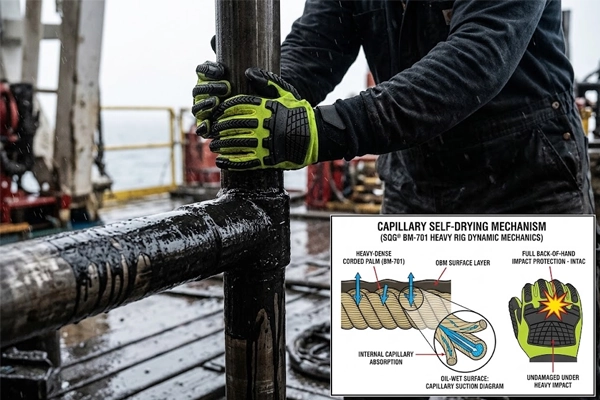
BM-701 Fluorescent Corded Palm’s Microscopic Capillary Self-Drying Mechanism (Capillary Suction Dynamics): To address this issue at its physical root, the SQG® BM-701 completely abandons the traditional continuous, sealed rubber surface in favor of a special high-density, heavy-duty cotton corded weave palm (Hi-viz Corded Palm). The corded structure consists of thousands of multi-ply twisted cotton fibers with high oil- and water-affinity, arranged in a three-dimensional, raised-rib pattern:
Instantaneous microchannel drainage: When a worker grips a mud-covered drill string, the raised corded ribs mechanically break through the thick surface oil film, establishing direct, physically rough contact with the steel pipe;
Capillary Pores for Self-Drying: The vast number of micron-scale capillary pores interwoven between fiber bundles rapidly draw drilling fluid and crude oil from the contact interface into the fabric’s deeper layers under pressure differential, temporarily trapping them. This instantly achieves a “transient drying effect (Self-Drying Effect)” at the grip interface, restoring effective friction to dry-condition levels and completely eliminating the fatal risk of slippage in heavy-mud drilling conditions.
ANSI-Grade Full-Back Impact-Resistant Skeleton Synergy: While the high-density rope weave ensures a secure grip, the BM-701 features full-coverage, one-piece heavy-duty thermoplastic rubber (TPR) shields on the back and joints. These strictly meet the Level 2 absorption threshold of the ANSI ISEA 138 Impact Glove Standard, providing protection against powerful swinging impacts during heavy piling and casing hoisting operations.
For an in-depth exploration of the fluid lubrication mechanisms of heavy drilling mud and hydrocarbons on oil and gas rig floors, wear resistance testing of corded weaves, and anti-slip operating procedures for drilling tools, please refer to our oil and gas safety technical white paper: Oil & Gas Rig Hand Safety: Why Corded Palms Outperform Coatings in Heavy Drilling Mud.
Structural Reinforcements: Neoprene Cuffs and PU Thumb Crotches
In addition to extremely slippery fluid media, operations at oilfield drilling rigs, mining hoisting sites, and heavy-duty manifold assembly sites involve extremely high mechanical shear and tensile forces. Workers frequently grip large-diameter steel wire rope slings, slips, and heavy-duty swivel couplers; the weak seams in conventional gloves often tear and disintegrate within days under such immense tension. The BM-701 features industrial-grade structural reinforcement across its load-bearing framework:
High-Toughness Neoprene Elastic Wrist Cuff: The glove cuff eliminates traditional thin knitted ribbing or rigid plastic edging, instead utilizing foamed neoprene, which offers excellent resilience and impact-absorbing properties. The highly elastic neoprene snugly fits the wrist, effectively preventing heavy mud splashes, drill cuttings, and high-pressure water mist from entering the glove through the cuff; simultaneously, neoprene’s excellent cushioning and damping properties absorb lateral shear forces during mechanical side impacts to the wrist, while the wide Velcro closure ensures the glove remains securely in place even during vigorous limb movements.
PU Patch for Tear Resistance in the Thumb Crotch (PU Sewn on Thumb Crotch): During heavy-duty pipe handling and rigging operations, the thumb crotch area—the space between the thumb and index finger—is subjected to frequent friction and bidirectional tensile shear forces, making it the glove’s most vulnerable “weak point” where seams are prone to bursting and fibers to fraying. The BM-701 incorporates a high-abrasion-resistant polyurethane (PU) leather reinforcement patch in this critical shear zone and is reinforced with double-stitched, high-tensile, flame-retardant nylon thread. This double-layer structure not only extends the abrasion resistance cycle life of the web area by more than three times but also forms a stress-distribution bridge under high tensile forces, completely eliminating the problem of premature failure of the web area that would otherwise render the entire pair of high-level impact-resistant gloves unusable, thereby ensuring long-lasting durability for heavy-duty loading and unloading operations.
Total Cost of Ownership (TCO): Compliance Audits vs. Medical Claims
When making financial decisions regarding bulk purchases of heavy-duty industrial gloves, the procurement departments of many companies often fall into a cost-accounting rut dominated by the “unit price fallacy”: they view generic, low-cost gloves priced at $3 to $5 each as a model of cost control, while regarding impact- and cut-resistant gloves with engineered energy-absorbing structures—priced at $12 to $18 each—as unnecessary sunk costs. This accounting model, which measures expenses solely at the invoice level, completely breaks down when a serious workplace injury occurs. The metric that truly determines a company’s bottom line for occupational safety and health expenses is the Total Cost of Ownership (TCO), which encompasses direct medical expenses, statutory workers’ compensation, litigation reserves, and production line downtime losses.
Financial Loss Breakdown: Non-Compliant PPE vs. Engineered Protection
According to financial loss models for workplace injuries developed by the National Safety Council (NSC) and the Occupational Safety and Health Administration (OSHA), a single moderate recordable finger fracture (Recordable Hand Fracture) occurring at a heavy manufacturing or energy drilling and production site incurs devastating explicit and implicit financial costs:
Comprehensive Financial Loss Model for a Single Comminuted Crush Injury/Fracture:
Direct medical and surgical costs: Emergency orthopedic debridement, surgical internal fixation with steel pins, hospitalization, and anesthesia expenses, with baseline costs typically ranging from $18,000 to $25,000;
Statutory workers’ compensation benefits: Paid leave and physical therapy benefits for a recovery period of 8 to 16 weeks, with direct expenses totaling approximately $15,000 to $22,000;
Indirect legal and regulatory penalty costs: If it is verified on-site that gloves lacking finger impact resistance testing (e.g., those with only a single vague rating or substandard products) were in use, administrative fines issued by regulatory agencies for pinch point violations typically range from $14,000 to $40,000;
Hidden losses from production line downtime and employee retraining: Investigations into shift-level accidents and a surge in assembly defect rates caused by the absence of skilled workers result in indirect losses averaging over $12,000.
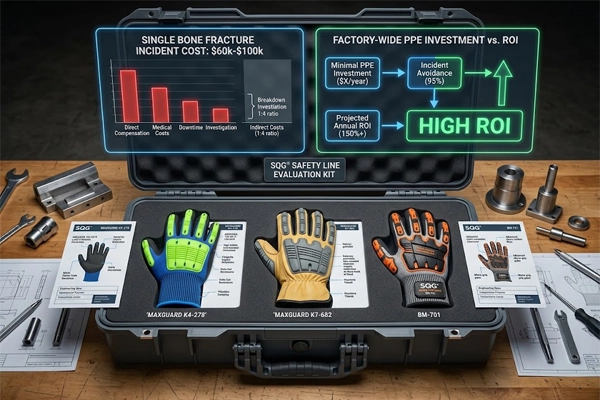
Combined direct and indirect economic losses: The average total financial cost of a single severe pinch injury incident ranges from $60,000 to $100,000—and this does not even account for the punitive increases in the employer’s commercial liability insurance rates over the following years.
Return on Investment (ROI) for Engineering-Grade Impact-Resistant Gloves: Take, for example, a heavy machinery machining or drilling workshop with 200 front-line employees. The total annual budget for purchasing engineering-grade impact-resistant gloves certified to the stringent ANSI/ISEA 138 impact glove standard (such as the K4-278 or BM-701) is approximately $20,000 to $35,000. Preventing even a single severe pinch or crush incident on-site eliminates tens of thousands of dollars in medical compensation, regulatory penalties, and lost-time claims—effectively offsetting the PPE budget for an entire facility over multiple operational cycles.
Preventing Glove Tampering and Unauthorized Removal During Shifts
In addition to establishing quantifiable safeguards in financial records, another key way that engineering-grade impact-resistant gloves reduce TCO is by fundamentally addressing the long-standing problem of “under-the-radar non-compliance” on the shop floor.
Worker Resistance Caused by Traditional, Bulky Impact-Resistant Gloves: Many older models of impact-resistant gloves, despite being packed with thick protective materials, lack ergonomic considerations—they have no hinge grooves at the finger joints, and their linings are made of stiff, coarse yarn with a low thread count. When workers wear these gloves on the job, their grip strength decreases by more than 30%, and they virtually lose all finger dexterity. During processes such as tightening small bolts, calibrating manifold sensors, or performing precision assembly, workers often remove their gloves without authorization to work barehanded—or even cut off the fingertips with a utility knife (glove tampering)—simply to “work more comfortably” or “make things easier.” This type of unauthorized violation, which is extremely common on-site, renders the protective equipment purchased at great expense by the company virtually useless; often, within minutes of a worker removing their gloves, severe entanglement, crushing, or pinching accidents occur that cannot be reversed.
100% on-site compliance driven by high-ergonomic design: Gloves such as the MAXGUARD® K4-278, which combine an 18-gauge ultra-high-density cut-resistant lining with a biomimetic low-profile TPR skeleton, maximize the retention of workers’ natural fingertip sensitivity and gripping flexibility. The multi-segment hinged grooves on the back of the hand fully conform to the natural curvature of the fingers during gripping, eliminating rebound resistance during sustained gripping. Workers do not need to remove or damage their gloves at any point during the entire workflow, whether performing precision electromechanical adjustments or high-torque, heavy-duty assembly. By eliminating the psychological incentive to remove gloves in violation of safety protocols, on-site safety compliance rates are raised to nearly 100%, thereby nipping at the source the root causes of major workers’ compensation claims resulting from human violations.
Frequently Asked Questions (FAQs)
During on-site safety audits and supply chain bidding processes for heavy industry manufacturing, mining, and multinational oilfield service projects, there are often significant technical misunderstandings regarding mechanical impact testing standards. The following provides expert answers—based on physical test data and engineering practice—to the four core compliance and technical questions most frequently asked by frontline EHS managers and bulk procurement teams.
Can a glove be labeled ANSI Level 3 if only the knuckles pass the threshold?
The answer is absolutely not.
This is precisely the most fundamental engineering distinction between the ANSI/ISEA 138 impact glove standard and European standards. Under the ANSI/ISEA 138 specification, gloves must not only withstand a 5-joule impact test at the knuckles but must also undergo independent, multi-point drop-weight impacts at the phalangeal joints of the remaining four fingers and the thumb.
The standard strictly enforces the “Lowest Performing Score Governs” principle. Suppose a glove has a thick energy-absorbing shield injection-molded onto the main joint on the back of the hand, resulting in a measured residual peak transmitted force of 3.6 kN (meeting the Level 3 threshold of less than 4 kN for maximum impact protection). However, to enhance grip flexibility, the rubber layer on the fingers has been locally thinned, causing the measured transmitted force at the finger locations to rise to 6. 1 kN (which falls within the Level 2 range, i.e., 4 to 6.5 kN), and the thumb even measures 7.5 kN (falling into the Level 1 range, i.e., 6.5 to 9 kN), then the entire pair of gloves must be officially designated as the lowest Level 1 in both the official test report and on the product label. As long as any single finger area fails to meet the standard, the entire pair of gloves absolutely cannot be labeled as ANSI Level 3. This rule systematically eliminates any possibility of suppliers cheating by exaggerating protection levels on labels through localized thickening.
Why do European EN 388 certificates lack Level 1/2/3 impact subclassifications?
The reason EN 388 certificates issued by the European Committee for Standardization (CEN) do not include Level 1, Level 2, or Level 3 subclassifications is that the two standardization systems differ in their regulatory philosophies and testing methodologies:
Historical Limitations of European Standards: When Europe revised the comprehensive EN 388 standard for mechanical hazards in 2016, it did not develop a separate, detailed mechanical model specifically for industrial falling object impacts; instead, it directly incorporated the testing procedure for motorcycle gloves (EN 13594:2015, Clause 6.9). Within the traditional framework of motorcycle safety regulations, the testing logic focuses solely on whether riding protective gear meets basic safety thresholds under a single, fixed sliding impact force. Consequently, EN 388 retained a binary pass/fail system: if the average residual force from four impact tests does not exceed 7 kN and no single test exceeds 9 kN, the product is marked with a “P”; if these criteria are not met, it is marked with an “X” or left blank. The regulatory framework contains no provisions for establishing a tiered classification system.
Evolution of North American Standards: In contrast, when the International Safety Equipment Association (ISEA) released ANSI/ISEA 138 in 2019, it was entirely grounded in the challenges of diverse on-site conditions in heavy mining, deep-well drilling, and heavy industrial assembly. Heavy industry requires not only knowing whether a glove “meets the standard,” but also distinguishing the precise level of physical protection against minor impacts (9 kN threshold), heavy mechanical assembly (6.5 kN threshold), and heavy falling objects in oilfields (4 kN threshold). Since the European standard has not yet initiated a comprehensive revision of this provision, it currently remains limited to providing single-dimensional “P” mark certification.
How does ambient temperature affect TPR impact performance in extreme cold?
Ambient temperature has a disruptive effect on the mechanical energy absorption properties of ordinary rubber and thermoplastic polymers. The core of this physical phenomenon depends on the material’s glass transition temperature (Tg):
“Cold-brittle hardening” failure of conventional rubber and plastics at sub-zero temperatures: Conventional, low-cost impact-resistant gloves typically use non-engineered, general-purpose TPR or PVC composite plastics, whose glass transition temperature generally ranges from -5°C to 5°C. When the work environment becomes extremely cold (such as in high-latitude winter mining areas, polar open-air lifting operations, or field drilling at temperatures below -20°C), the movement of polymer macromolecular chains within the plastic is completely frozen and locked in place. At this point, the back-protection framework—which normally possesses rebound and energy-absorption properties—instantly undergoes “physical hardening,” transforming into a brittle state similar to hard glass. When a heavy object strikes, the brittle plastic not only fails to deform and dissipate kinetic energy but instead shatters into fragments; the sharp shards formed by the fracture can even pierce the inner lining, causing secondary lacerations.
How should procurement balance cut resistance (ANSI A4 vs. A7) with impact resistance?
When developing a glove procurement plan for a factory, blindly pursuing “the highest ratings across the board” (such as directly issuing gloves with the highest impact resistance combined with the highest cut resistance to the entire factory) often results in excessively high procurement costs per pair and can easily cause hand fatigue among precision assembly workers due to the gloves being too thick and heavy. A scientifically sound selection model should precisely match the shear risk posed by sharp edges on workpieces with the impact energy from the weight of falling components:
Solution A: Select K4-278 (18-gauge knit / ANSI A4 cut resistance + ANSI Level 1/2 impact resistance)
Work Environment Characteristics: Workpieces feature stamped burrs, unpolished metal edges, or exposed thin metal sheets, accompanied by mechanical pinching in confined spaces, impacts from slipping wrenches, or light-to-moderate scraping from heavy objects.
Selection Rationale: In these situations, hand movements primarily involve high-frequency, prolonged, and precise operations. The K4-278 features an 18-gauge ultra-high-density TekArmor ultra-thin base that provides a high standard of ANSI A4 mechanical cut resistance safety margin. its low-profile, lightweight TPR back guard effectively absorbs impact forces at most assembly clamping points while providing workers with excellent fingertip tactile feedback to prevent premature hand fatigue. It is suitable for engine piping assembly, precision metal stamping, and high-altitude electrical wiring work.
Recommended Solution B: Select K7-682 (Heavy-Duty Braided / ANSI A7 Extreme Cut Resistance + ANSI Level 2/3 Impact Resistance)
Work Environment Characteristics: Handling large areas of heavy-duty, untrimmed steel plates thicker than 3 mm; dismantling and crushing scrap metal; heavy-duty punching and shearing operations; or operating heavy-duty machinery with high-speed rotating parts that produce jagged, tearing edges.
Selection Criteria: The primary hazard sources on-site involve the combined effects of high-tonnage falling loads and extremely sharp fracture edges. In such cases, it is essential to use the TekArmor A7-level extreme cut-resistant barrier, reinforced with a composite of high-density tungsten wire and glass fiber. Combined with a heavy-duty TPR exoskeleton featuring deep energy-absorbing air chambers and a wear-resistant PolyMAX coating, it provides a robust barrier approaching the level of physical armor, specifically designed for heavy-duty foundries, sheet metal shearing centers, and high-risk workstations with a high risk of disabling injuries.
Factory-Direct Sourcing & Impact Audit Protocol (CTA)
In heavy industry manufacturing, oil and gas exploration, and mining operations, procurement decisions regarding hand protection equipment directly impact the safety of on-site workers and a company’s compliance costs. Blindly selecting generic gloves that have not been validated for specific working conditions often results in costly production hazards during sudden mechanical impacts or entrapment incidents. Leveraging comprehensive in-house manufacturing capabilities, expertise in proprietary mold development, and a multi-faceted physical and mechanical validation system at its CNAS-accredited laboratory, SQG provides global industrial enterprises with one-stop protective solutions—ranging from on-site hazard assessments and customized mechanical performance matching to factory-direct sourcing.
Request an Engineered Impact Compliance Audit & Line Evaluation Kit
For oilfield drilling crews, multinational engineering contractors, large mining consortia, and heavy machinery manufacturers with high annual procurement volumes and facing demanding operational challenges, we are officially launching a dedicated industrial site safety assessment program:
Operational Impact and Pinch Hazard Assessment (Pinch & Impact Risk Audit): A company’s EHS safety engineering team or supply chain manager can submit key engineering parameters of the on-site working environment—including contact media (heavy oil sludge, hydrocarbon solvents, or dry metal chips), sharpness indices of workpiece edges, estimated kinetic energy of falling and rebounding components, and process points where pinch points occur frequently. Based on the ANSI ISEA 138 Impact Glove Standard and EN 388 specifications, the SQG Safety Protection Engineering Team will provide companies with a customized selection report that includes recommendations for anatomical protection zone classification and calculations for coating impermeability and abrasion resistance.
Request for Industrial-Scale Line Evaluation Kits: To assist procurement departments in advancing on-site, in-production wear testing and wear-cycle validation, we provide trial evaluation kits containing core engineering gloves to companies that have passed our qualification review:
MAXGUARD® K4-278 (18-gauge ultra-high-density TekArmor® A4/D cut-resistant base + double-layer oil-resistant nitrile + biomimetic low-profile lightweight TPR armor)
MAXGUARD® K7-682 (TekArmor® A7/F extreme tear-resistant cut-resistant liner + PolyMAX® heavy-duty coating + honeycomb cushioning exoskeleton)
BM-701 (fluorescent high-density cotton-yarn ribbed palm + heavy-duty mud-resistant capillary oil absorption and slip resistance + full-coverage ANSI Level 2 heavy-duty impact-resistant back protection)
Connect directly with our factory-direct technical experts today to obtain customized compliance technical documentation or schedule hands-on sample testing: Request Factory-Direct Bulk Quotation & Impact Audit.
Access the Complete Heavy-Duty Impact Hand Protection Portfolio
In addition to the representative models listed above, SQG’s impact-resistant hand safety product line encompasses a multidimensional engineering matrix designed for complex industrial environments: From ultra-high-thread-count cut- and impact-resistant gloves designed for precision assembly, to heavy-duty corded-palm anti-slip series for deep-well mud drilling and extraction, to fully rubber-coated, long-sleeved, liquid-tight, impact-resistant styles specifically engineered for petrochemical refining, tanker truck hazardous chemical loading/unloading, and fracturing slurry operations—all are deeply aligned with frontline operational requirements and international regulatory testing standards.
To view the engineering specifications, material mechanical testing curves, and bulk purchase specifications for direct factory supply across our entire product line, please visit our catalog page: Explore Full Range of Impact Resistant Work Gloves.