

Introduction: The Industrial Challenge of Oils, Coolants, and Solvents
Understanding the chemical resistance of nitrile coatings is essential for protecting hands against industrial oils, coolants, and solvents in CNC machining shops, stamping lines, and assembly stations. Cutting fluids, hydraulic oils, quenching oils, and degreasers are indispensable fluids for maintaining high-efficiency production. However, these industrial fluids also pose a long-term threat to hand health and workplace safety.
The Hidden Hazard in Machine Shops & Assembly Lines
During daily shop operations, workers’ hands are frequently exposed to water-soluble cutting fluids and mineral-based machine oils, which not only impair grip and cause parts to slip and fall but, more critically, lead to long-term chemical penetration and erosion.
Water-soluble cutting fluids commonly contain polar surfactants, extreme-pressure (EP) additives, organic amines, and biocides. These chemical components can easily penetrate the stratum corneum barrier of ordinary protective gloves, stripping the skin of its natural oils and causing severe occupational contact dermatitis, chemical burns, or skin allergies. Because gloves become sticky or saturated with oil, workers frequently remove them and work without proper protection, resulting in persistently high rates of hand scrapes and cuts.
Mechanical Protection vs. Chemical Barrier
The root cause of this safety dilemma lies in the fact that many factory procurement teams and safety managers confuse the material distinctions between “mechanical protection” and “chemical barrier.”
A pair of ordinary gloves may pass basic abrasion and cut resistance tests, but when exposed to highly penetrating petroleum-based solvents or cutting fluids, their coating materials (such as traditional polyurethane (PU) or ordinary natural latex) can undergo polymer chain degradation, swelling, stickiness, or even peeling within just a few tens of minutes. Only by understanding the barrier mechanisms of protective materials against different chemical media can one strike the precise balance between physical grip and chemical protection.
Scope of This Technical Guide
This technical guide provides an in-depth analysis of the chemical resistance and oil-repellent properties of nitrile rubber (Nitrile) coatings, covering aspects such as the molecular barrier mechanisms of polymer chemistry, the resistance profiles of common cutting fluids and solvents, the certification compliance thresholds of EN 388 and EN ISO 374, and the selection and matching of gloves for specific work processes.
Whether you’re looking for a robust barrier against heavy oil spills or need protective gear that balances oil resistance with extremely high-sensitivity grip, you can refer to our Nitrile-Coated Industrial Safety Gloves product series to help establish a standardized, cost-effective line of hand protection for your workshop.
Polymer Chemistry: Why Nitrile Resists Oils and Hydrocarbons
To truly understand the exceptional oil resistance exhibited by nitrile gloves in machining and equipment maintenance applications, we cannot rely solely on superficial mechanical test data; we must delve into their polymer microstructure. As a synthetic rubber, nitrile butadiene rubber (NBR) derives its physical limits for chemical protection from the unique arrangement of its molecular chains.
Acrylonitrile Content and Chemical Impermeability
Nitrile butadiene rubber is a copolymer formed through emulsion polymerization of two monomers: acrylonitrile (ACN) and butadiene. In this combination, ACN plays the “core defensive role” in determining the glove’s chemical resistance.
From a polymer chemistry perspective, the acrylonitrile monomer contains a highly polar nitrile group (-CN). Based on the “like dissolves like” principle in polymer physics, polar molecules are immiscible with nonpolar molecules. Unfortunately, the most common contaminants found in industrial settings—such as hydrocarbon oil stains, mineral oils, quenching oils, and petroleum-based solvents—are all nonpolar or weakly polar liquids. Consequently, the copolymer molecular chains formed from the highly polar acrylonitrile monomer create a “chemical barrier” that nonpolar oil molecules find difficult to penetrate.
The ACN content in a glove formulation directly determines its chemical barrier performance: the higher the ACN content (typically between 18% and 50%), the greater the nitrile coating’s resistance to permeation by engine oil and weak solvents.
Cross-Linking Density and Swelling Resistance
In addition to the chemical polarity of the monomers themselves, the vulcanization (cross-linking) process that nitrile rubber coatings undergo during the dip-molding process is key to imparting their elasticity and swelling resistance.
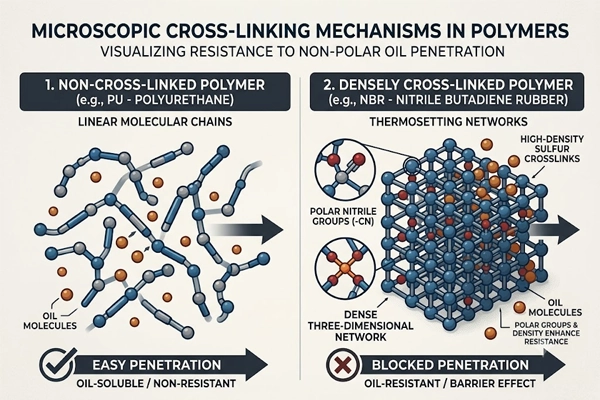
Without cross-linking, NBR resembles a pile of loose molecular ropes; although oil molecules do not react chemically with them, they can slowly seep through the gaps between the ropes. During vulcanization, the cross-linking agent (typically sulfur) builds chemical “scaffolds” between the originally linear nitrile molecular chains, forming a dense three-dimensional network structure.
The higher the cross-linking density, the denser this network barrier becomes. When industrial solvents or hydrocarbon-based oils attempt to penetrate the glove, the dense three-dimensional network restricts the movement and stretching of the nitrile molecular chains within the liquid, thereby significantly enhancing the glove’s resistance to swelling and preventing the coating from becoming sticky, softening, or losing its grip due to oil absorption.
In contrast, as we analyzed in detail in the Nitrile Coated vs. Polyurethane (PU) Gloves Whitepaper, ordinary thermoplastic PU resins lack a high-density chemically cross-linked network; their molecular chains are highly susceptible to swelling, degradation, and failure when exposed to cutting fluids and grease. This is the scientific reason why PU gloves continue to be consumed at such high rates in oil-contaminated work environments.
Nitrile Performance Spectrum: Guide to Oils, Coolants, and Solvents
In the complex fluid environments of industrial production, no single polymer material can provide 100% “universal resistance.” Procurement and EHS departments need a clear understanding of the chemical resistance spectrum (Performance Spectrum) of nitrile coatings when exposed to various industrial media, so they can accurately distinguish between the “safe zone” and the “warning zone” of protection.
Hydrocarbon Oils and Petroleum Distillates (Safe Zone)
Hydrocarbons and petroleum distillates fall within the absolute “Safe Zone” for nitrile rubber.
Industrial lubricants, heavy-duty engine oils, quenching oils, hydraulic fluids, and petroleum-based rust-preventive oils all consist of nonpolar aliphatic hydrocarbons. As mentioned earlier, the highly polar acrylonitrile molecular chains in nitrile rubber perfectly block the penetration of these oils and greases, preventing degradation or molecular shedding.
Workplace Applications: For routine light-oil-contaminated workstations—such as lubricating automotive engine parts, assembling mechanical bearings, and applying rust protection to general components—we recommend lightweight, eco-friendly dip-coated gloves, such as the B-210R Smooth Nitrile Glove, 13G seamless RPET liner. Featuring a seamless knitted recycled polyester (RPET) liner paired with a smooth nitrile dip-coated palm, these gloves not only form a dense, oil-resistant barrier but also strike a balance between low-carbon sustainability and high flexibility.
Water-Soluble Coolants and Synthetic Cutting Fluids
Water-soluble coolants and synthetic cutting fluids fall under the “High-Frequency Protection Zone.”
In CNC deep-hole drilling, milling, and grinding operations, water-soluble emulsified coolants and fully synthetic cutting fluids are widely used in workshops. In addition to water and base oil, these fluids contain extreme-pressure anti-wear additives, polar surfactants, and biocidal additives, making them highly penetrating.
Physical barrier logic: The surfactants in synthetic cutting fluids attempt to reduce the liquid’s surface tension, allowing them to penetrate extremely thin or unevenly porous coatings. For machining operations involving cutting fluid splashes or spills, it is essential to use high-density, defect-free nitrile coatings, which block the liquid from siphoning through the fabric lining into the palm via a tightly packed array of rubber molecules.
Organic Solvents: Aliphatics vs. Aromatics & Ketones (Danger Zone)
In the field of organic solvents, it is essential to strictly distinguish the dividing line between “aliphatics” and “aromatics/ketones.”
Not all chemical liquids can be protected against using standard nitrile-coated gloves; EHS managers must instruct the workshop to strictly define the following safety boundaries:
Safe/Short-Term Protection (Aliphatic Solvents): Nitrile coatings offer good resistance to permeation and swelling when exposed to aliphatic solvents (such as kerosene, n-hexane, naphtha, white gasoline, and conventional rust-preventive oils used for cleaning), and can be safely used for degreasing parts and wiping down equipment surfaces.
Dangerous/Prohibited (Aromatics, Ketones & Esters – Danger Zone): Nitrile rubber is extremely susceptible to highly polar and highly polar-affinity organic solvents, including acetone, methyl ethyl ketone (MEK), xylene, toluene, and thinners. The small molecules in these solvents rapidly leach out the plasticizers from the nitrile rubber, causing the coating to swell dramatically, become sticky and soft, or even dissolve within a very short time. The use of ordinary machine-dipped nitrile gloves is strictly prohibited during cleaning operations involving these types of solvents.
Nitrile vs. Other Polymer Coatings: Chemical Resistance Comparison
In industrial PPE procurement and workplace safety management, given the wide variety of materials used in dipped gloves, an intuitive side-by-side comparison of material resistance is an effective tool for EHS departments to quickly establish standard SOPs.
H3: Comprehensive Material Resistance Benchmark
The following is a comparison matrix of the resistance of four mainstream coated polymer materials—synthetic nitrile (NBR), polyurethane (PU), natural latex, and neoprene—to common industrial chemical media:
| Chemicals / Medium Class | Synthetic Nitrile (NBR) | Polyurethane (PU) | Natural Latex | Neoprene | Sourcing / EHS Selection Advice |
| Mineral and Motor Oils | Exceptional | Poor (Degrades) | Poor (Swells) | Good | For heavy oil contamination and mechanical assembly operations, smooth or foamed nitrile gloves are the preferred choice. |
| Water-Soluble Cutting Oils | Excellent | Moderate | Poor | Excellent | For scenarios involving cutting fluid spills and splashes, 360-degree fully-dipped nitrile gloves are recommended. |
| Aliphatic Solvents | Good | Moderate | Poor | Good | For equipment maintenance and degreasing of parts, gloves capable of withstanding kerosene for short periods are suitable. |
| Ketones (Acetone, MEK) | Poor (Avoid) | Poor | Good | Fair | The use of standard nitrile or PU-coated gloves is strictly prohibited in acetone/thinner cleaning operations. |
| Concentrated Acids/Alkalis | Moderate | Poor | Fair | Excellent | For immersion in strong acids or alkalis, specialized chemical-resistant gloves certified to EN ISO 374 must be used. |
Key Insights from the Material Benchmark
From the comparative data presented above, we can draw the following three key conclusions that influence factory procurement decisions:
The Absolute Dominance of Resistance to Fats and Mineral Oils: Synthetic nitrile (NBR) demonstrates an overwhelming advantage against mineral engine oil, hydraulic oil, and synthetic cutting fluids, whereas natural latex and PU resins are highly susceptible to softening, swelling, and even molecular chain degradation in such environments.
Compliance Red Lines for Strong Solvents and Strong Acids/Bases: No conventional mechanical protection-impregnated glove (EN 388) can provide comprehensive protection against ketone solvents (such as acetone) or high-concentration strong acids and bases. When exposed to such harsh chemicals, it is essential to upgrade to thick-walled, professional chemical-resistant gloves certified to EN ISO 374.
Innovative Selection of Composite Protection: For precision assembly workstations that require both the robust oil resistance of nitrile and the extremely sensitive, bare-hand feel of PU resin, modern composite impregnation processes offer the perfect solution. Recommended configuration EZ-324 PU+NBR glove, 18-gauge seamless nylon liner. Featuring an ultra-thin, 18-gauge high-elasticity knitted liner combined with PU and nitrile composite coating technology, this glove not only provides oil resistance in low-oil environments but also delivers exceptional fingertip flexibility and comfort.
Coating Styles and Liquid Barrier Protection
Once nitrile rubber has been selected as the protective base material, the glove’s dipping styles and surface textures directly determine its “fluid defense area” and “oil-stain grip efficiency” in industrial settings. If the wrong style is chosen, liquids will still penetrate the interior along the exposed fabric back of the hand, even if the material is oil-resistant.
Palm-Coated: Breathability with Light Oil Defense
Palm-Coated Style: The preferred choice for workstations involving light oil contamination and requiring high breathability.
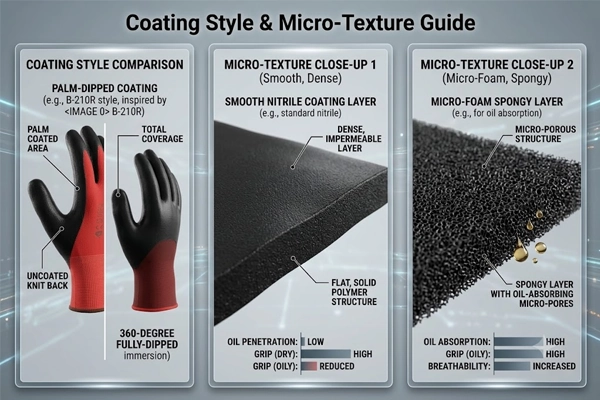
Palm-coated gloves feature a nitrile rubber coating only on the palm and fingertips, while the back of the hand remains exposed as a seamless knitted fabric.
Physical Advantages: The exposed fibers on the back of the hand maximize the dissipation of hand perspiration, effectively preventing the stuffy feeling associated with prolonged wear during long shifts; simultaneously, the nitrile coating on the palm blocks trace amounts of rust-preventive oil or grease on the surfaces of metal parts.
Suitable Applications: Handling dry or slightly oily parts, light assembly, warehousing and logistics, and dry machining workstations. However, in environments with liquid splashes or significant spills of cutting fluid, the palm-coated style cannot prevent liquids from seeping in through the back of the hand.
3/4 and Fully Coated: Protection Against Fluid Submersion
3/4 Immersion and 360-Degree Full Immersion (Fully Coated): A robust barrier against fluid spills and leaks.
When working environments involve cutting fluid splashes, cleaning oil buildup in pipes, or soaking parts, protection must be upgraded from palm-only immersion to a fully coated design with greater coverage.
The Logic Behind Full Leak Protection: 360-degree fully coated gloves feature a continuous, dense layer of nitrile rubber coating the palm, between the fingers, and across the entire back of the hand, completely blocking the physical pathway for “siphoning leaks” through the fabric on the back of the hand.
Recommended Configuration: For workstations requiring frequent contact with deep-well cutting fluids, metal parts washing tanks, or liquid immersion, we recommend the B-288 Smooth Nitrile Glove, fully coated. Featuring a 13-gauge seamless polyester liner paired with a fully coated smooth nitrile coating, it establishes a 360-degree liquid barrier with no blind spots, ensuring hands remain dry and comfortable throughout the entire work process.
Micro-Foam vs. Smooth Coating Texture for Grip in Oily Conditions
In addition to the coated surface area, the microscopic physical texture (micro-structure) of the coating directly determines grip performance in oily environments:
Smooth Nitrile: Forms a completely continuous, dense barrier without micro-pores, delivering ultimate water, oil, and leak resistance, and is extremely easy to rinse and clean. However, on heavily oil-contaminated surfaces, the smooth coating tends to form a slippery liquid film with the oil, requiring workers to apply greater gripping force.
Micro-Foam Nitrile: Utilizing a special physical foaming process, this creates countless interconnected “sponge-like open-cell micropores” on the coating surface. Upon contact with oily parts, these micropores instantly absorb and expel the surface oil film through capillary action, allowing the rubber base of the glove to come into direct contact with the part’s surface. This provides exceptionally strong “oil-absorbing, anti-slip grip,” significantly reducing hand muscle fatigue.
The Line Between: Mechanical Coated Gloves (EN 388) vs. Chemical Gloves (EN ISO 374)
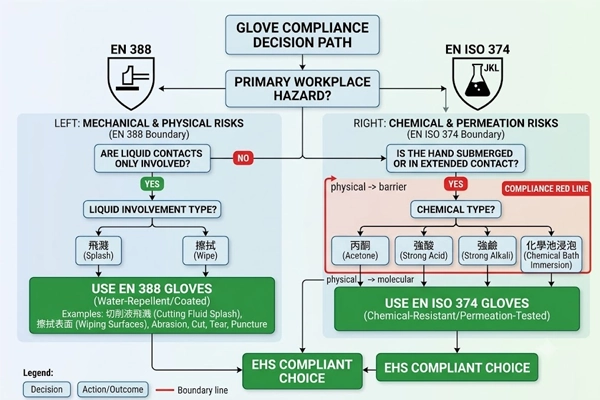
In factory safety audits and EHS incident investigations, “using mechanical protective gloves as chemical-resistant gloves” is a common compliance risk that leads to chemical burns and occupational dermatitis. Clearly defining the underlying logic and scope of application for the two major certification standards—EN 388 (mechanical protection) and EN ISO 374 (protection against chemicals and microorganisms)—is the first line of defense in ensuring 100% production safety compliance at the factory.
Understanding EN 388 Fluid Splash Barrier Limits
The core focus of the EN 388 standard is “physical mechanical damage,” rather than true “barrier protection against chemical molecular penetration.”
EN 388-certified dipped gloves (including various smooth or foamed nitrile gloves) are designed to provide physical protection against abrasion, cuts, tears, and punctures.
Physical Limits of Splash Protection: At the microscopic level, the coating acts solely as a “physical liquid barrier,” protecting against brief splashes of cutting fluids, motor oil, and water-based liquids (splash protection).
Inability to resist molecular-level penetration: The EN 388 test does not take into account the molecular-level permeation rate or degradation of the coating caused by chemicals. If such gloves are immersed in chemical fluids for an extended period, chemical molecules will still gradually penetrate the fabric lining, causing skin damage.
EN ISO 374 Permeation and Degradation Standards
EN ISO 374 is the only authoritative standard for evaluating whether protective gloves possess true “chemical resistance.”
When work environments involve immersion in or frequent contact with concentrated acids, strong alkalis, organic solvents, or hazardous chemicals, gloves must be certified to EN ISO 374 and meet the following three core physical and chemical criteria:
Permeation Test (Permeation Rate – EN 16523-1): Measures the breakthrough time required for chemical molecules to penetrate the glove material at the microscopic level. Protection levels are classified based on breakthrough time (e.g., Class 1 > 10 minutes, up to Class 6 > 480 minutes).
Degradation Test (EN ISO 374-4): Assesses the percentage change in the glove’s physical properties (such as hardening, softening, swelling, or brittleness) after exposure to the test chemical.
Penetration Test (EN ISO 374-2): Ensures that the gloves are free of microporous defects through airtightness and watertightness tests, thereby preventing physical leakage of chemical liquids.
Risk Assessment Protocol for Factory EHS Officers
To prevent incorrect PPE selection in the workshop, it is recommended that EHS officers follow the three-step risk assessment protocol (Risk Assessment Protocol) below when developing internal PPE standard operating procedures (SOPs):
Step 1: Identify the Properties of the Medium (Medium Identification). Review the MSDS (Material Safety Data Sheet). If the medium consists of mineral oil, cutting fluid, coolant, or mild hydrocarbon-based rust-preventive oil, EN 388-rated nitrile-coated gloves may be safely selected.
Step 2: Assess Exposure Mode. For “surface wiping and minor splashes,” EN 388 nitrile gloves are sufficient; however, if “hands must be directly immersed in chemical wash tanks, strong acid or alkali tanks, or strong solvent drums,” it is mandatory to switch to thick-walled chemical-resistant gloves certified to EN ISO 374.
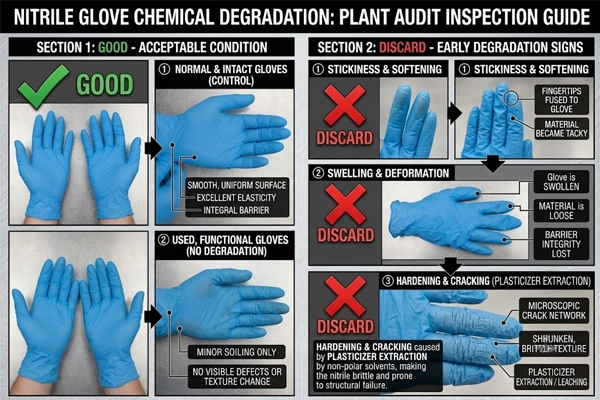
Step 3: Lifespan Monitoring:g Even for EN 388-compliant nitrile gloves designed to resist splashes, they must be immediately discarded if any signs of physical degradation—such as a sticky, hardened, or swollen coating—appear. It is strictly prohibited to continue using them beyond their service life.
Workstation Allocation Guide: Matching Nitrile Gloves to Industrial Tasks
In large manufacturing plants, a one-size-fits-all approach to glove procurement is often the root cause of wasted PPE budgets or frequent workplace accidents. Precisely matching gloves to the types of fluids, physical wear and tear, and hand dexterity requirements of different workstations is key to achieving refined cost reduction and accident-free safety management in the factory.
CNC Machining & Metal Cutting Operations
Workstation Environment Characteristics: High-speed cutting spatter, large amounts of spilled water-soluble cutting fluid, metal burrs, and sharp chips.
At CNC turning, deep-hole drilling, and milling workstations, workers must not only contend with the corrosive effects of cutting oils and emulsions but also frequently load and unload metal workpieces with sharp edges. Conventional gloves are either oil-resistant but not cut-resistant, or cut-resistant but not oil-resistant.
Optimal Selection: We recommend deploying three-in-one protective gear that offers “cut resistance + oil resistance + ultra-high sensitivity”—such as the EZP5-318 18G HPPE/Steel/Nylon/Spandex, EZGRIP® palm coating. It utilizes 18-gauge ultra-fine seamless stitching technology and incorporates a blend of HPPE, steel wire, and spandex anti-cut fibers to meet high-level cut-resistant standards. The palm features a patented EZGRIP® nitrile coating that not only blocks cutting fluid but also provides a powerful grip on oily surfaces, while perfectly preserving fingertip sensitivity for assembling micro-components.
Automotive Engine Assembly & Gearbox Maintenance
Workstation Environment Characteristics: Heavy exposure to engine oil and transmission fluid, high-viscosity grease, bolt torque operations, and work in confined spaces.
Automotive engine assembly lines, transmission assembly lines, and heavy equipment maintenance workstations are typical environments characterized by heavy oil contamination and high-torque operations. Gloves must withstand prolonged immersion in high-concentration mineral oils and heavy-duty greases without becoming soft or sticky, which could compromise assembly efficiency.
Optimal Selection: For these workstations, prioritize thick, smooth or foamed nitrile gloves. Their high acrylonitrile content ensures the gloves will not swell or peel even after continuous use for several shifts in heavy-oil environments; the thicker rubber-plastic material also absorbs some of the localized impact forces from tool strikes and bolt tightening, protecting the muscles of the palm.
Sheet Metal Cleaning & Degreasing Stations
Workstation Environment Characteristics: Solvent-based wiping and degreasing, risk of cuts from thin sheet metal, and frequent friction-intensive tasks.
At workstations for cleaning stamped sheet metal parts, degreasing sheet metal components, and surface preparation before painting, workers must frequently wipe metal parts with rags saturated with rust-preventive oil, kerosene, or degreasers.
Optimal Product Selection: For these types of work environments involving small amounts of solvents and extremely sharp metal edges, it is essential to select gloves with a highly abrasion-resistant, cut-resistant liner paired with a 3/4 or fully impregnated nitrile coating. The fully coated lining prevents cleaning agents from seeping into the palm via capillary action, while the abrasion-resistant nitrile base easily withstands frequent scraping against the edges of sheet metal parts, extending the overall service life of the gloves.
Plant Audit Checklist: Extending Glove Lifespan in Oily Environments
In the day-to-day operations of industrial workshops, even when high-quality nitrile protective gloves are selected, the lack of scientific SOPs for use and maintenance—as well as a mechanism for early disposal—can still lead to persistently high PPE consumption or frequent safety hazards. By establishing a Plant Audit Checklist, EHS managers and shift supervisors can effectively monitor glove condition and maximize the safe service life of gloves in oily working conditions.
Chemical Exposure Time Tracking
Establish a mechanism to track cumulative exposure time to chemicals and oils.
Although nitrile rubber offers excellent physical resistance to hydrocarbons and cutting oils, microscopic molecular permeation and physical fatigue in polymer materials caused by prolonged immersion are irreversible.
Tiered exposure time management: For assembly stations with light oil contamination, gloves can be reused for 2–3 shifts; for stations with deep-hole cutting fluid spills or frequent contact with solvents, it is recommended to establish a cumulative exposure limit per shift (e.g., continuous contact with liquids should not exceed 8 hours).
Rotation Principle: At workstations involving high-intensity immersion, such as solvent degreasing, it is recommended to use two pairs of gloves in rotation. Allow the removed gloves to air dry in a well-ventilated area to facilitate the complete evaporation of trace solvents absorbed into the material and restore the physical elasticity of the polymer chains.
Identifying Signs of Chemical Degradation
Train front-line workers and team leaders to accurately identify early signs of chemical degradation in coatings.
The absence of physical holes on the glove surface does not necessarily mean that its chemical protective barrier remains effective. If any of the following four signs of degradation appear, the gloves must be mandatorily discarded and replaced immediately:
Softening & Tackiness: The coating surface loses its original dry or foamy elasticity and begins to feel sticky to the touch, indicating that the polymer chains have been partially broken down by solvents or corrosive additives.
Swelling & Expansion: Noticeable localized swelling, bulging, or wrinkling appears on the palm or fingertips; the glove becomes larger and no longer fits the hand properly.
Hardening & Embrittlement: Strong solvents have leached out the plasticizers from the rubber formulation, causing the coating to lose its flexibility and develop microscopic cracks or flaking when bent.
Delamination: The bond between the nitrile coating and the seamless knitted liner (such as nylon or RPET) is lost, causing the coating to peel off in patches.
Storage & Cleaning Protocols for Reusable Nitrile Gloves
Standardized cleaning and storage protocols for reusable nitrile gloves.
Properly washing gloves contaminated with cutting fluids and machine oil not only restores their oil-repellent grip but also prevents residual oil from causing long-term corrosion of the coating.
Workshop Cleaning SOP: At the end of each shift, wash gloves using lukewarm water below 40°C with a neutral industrial detergent (avoid using strong acids, strong alkalis, or high-bleach-content cleaners). Gently scrub the surface to remove oil residue, then air-dry naturally. The use of high-temperature dryers is strictly prohibited to prevent thermal aging of the rubber and plastic coatings.
Warehouse Storage Guidelines: Unopened stock of nitrile gloves should be stored in a cool, dry, and well-ventilated warehouse (recommended temperature: 10°C–25°C; relative humidity: less than 60%). Direct sunlight (ultraviolet rays) and high-voltage electrical equipment (ozone) must be strictly avoided, as ultraviolet rays and ozone accelerate the oxidative breakdown of nitrile polymer chains, causing the coating on gloves not yet shipped to harden and become brittle prematurely.
Knowledge Base: Frequently Asked Questions (FAQs)
This section compiles key answers to the practical questions most frequently raised by factory procurement managers and EHS safety supervisors regarding workshop management and product selection, providing quick guidance for day-to-day decision-making.
Can nitrile-coated gloves be washed and reused after exposure to oil?
Yes, but strict cleaning SOPs must be followed, and attention must be paid to cumulative usage time.
Gloves contaminated with mineral oil, hydraulic oil, or cutting fluid can be surface-cleaned in lukewarm water (below 40°C) using a neutral industrial detergent, then air-dried in a well-ventilated area. Washing effectively removes surface oil buildup and metal particles, restoring the original oil-absorbing, slip-resistant grip of the Micro-Foam nitrile.
Please note that frequent washing and prolonged exposure to oil can cause the fabric lining and rubber coating to gradually deteriorate. If you notice that the glove coating has hardened, cracked, or that the cut-resistant fibers are damaged, the gloves should be discarded immediately and replaced, even if they have been thoroughly cleaned.
Why do nitrile gloves become stiff or crack after prolonged exposure to certain solvents?
This is a phenomenon of polymer hardening caused by strong solvents extracting plasticizers from the rubber.
Nitrile rubber formulations contain a certain proportion of plasticizers and softeners to maintain the coating’s flexibility and tactile feel. When gloves are exposed for extended periods to ketones (such as acetone or MEK), aromatic hydrocarbons (such as xylene or thinner), or high-concentration strong solvents, these solvent molecules rapidly penetrate the rubber matrix, dissolving the plasticizers and “leaching” them away.
Without the protection of plasticizers, the polymer chain network becomes dense and rigid, causing the coating to harden and lose elasticity. When the palm is bent and subjected to stress, this makes the coating highly prone to micro-cracking or even fracturing and peeling. When encountering cleaning conditions involving such solvents, you must stop using ordinary mechanical protection gloves and switch to specialized, thick-walled chemical-resistant gloves.
Is micro-foam nitrile completely waterproof and chemical-resistant?
Not entirely. The core design of micro-foam nitrile focuses on slip resistance and breathability, rather than absolute protection against liquid immersion.
The micro-foaming process creates sponge-like open-cell micropores on the surface and inside the glove’s coating. These micropores act like capillaries to absorb and disperse oil films, providing exceptional grip in dry conditions and on lightly oiled surfaces, while allowing hand perspiration to evaporate.
However, during prolonged immersion or when faced with large amounts of spilled liquid, the liquid will slowly seep into the inner lining through the interconnected microporous structure. If work conditions require immersing hands in cutting fluid pools or washing tanks, or if there is significant liquid splashing, you should prioritize the Smooth Fully Coated Nitrile option, which uses a dense, non-porous rubber layer to establish a 360-degree absolute watertight and oil-resistant barrier.
Call to Action (CTA)
In complex industrial workshop environments, selecting the right protective gloves is key to reducing total cost of ownership (TCO), improving workstation productivity, and ensuring 100% EHS compliance.
If you’re looking for a factory hand protection solution that combines high abrasion resistance, superior oil-resistant grip, and excellent value for money, feel free to explore our full product line. Explorethe Full Range of Certified Nitrile-Coated Industrial Safety Gloves.
For factory clients with bulk purchasing needs or those requiring on-site factory audits, we offer professional workstation risk assessments and free sample testing support. Please contact our technical team directly [Contact SQG® for Free Sample Kits] to receive a customized protection solution and a free sample kit.


