

In an era marked by the accelerated transition of supply chains toward low-carbon and net-zero operations, sustainable PPE selection has become a critical strategic priority, and the underlying logic of industrial procurement is undergoing a fundamental transformation. In the past, procurement departments at automotive manufacturers, high-end semiconductor firms, and multinational electronics corporations often focused solely on cost comparisons and basic physical safety, treating personal protective equipment (PPE)—such as work gloves—as low-value, high-turnover consumables.
However, in 2026, as the EU’s Corporate Sustainability Due Diligence Directive (CSDDD) is fully transposed into the national laws of member states and the audit standards of Germany’s Supply Chain Due Diligence Act (LkSG) continue to tighten, this traditional mindset is facing a devastating challenge. For safety officers and procurement directors currently evaluating bio-based polyurethane vs petroleum-based coatings, the critical factor in decision-making no longer hinges solely on floor-level protective performance and unit purchase prices; it has risen directly to the level of legal compliance. A pair of traditional petrochemical gloves without authoritative certification is quietly transforming from an operational expense into a severe compliance liability lurking at the bottom of the supply chain.
At the heart of this compliance storm lies the global green regulatory framework’s complete ban on “risk shifting.” Traditional procurement departments have long relied on suppliers signing a “Code of Conduct” or a standardized compliance disclaimer to satisfy audits. Under the new legal framework, the illusion of this “paper-based compliance” has been completely shattered.
The latest 2026 audit standards reject any written or verbal commitments lacking support from traceable data; they strictly require companies to provide fully transparent, verifiable visibility across the entire “chain of activities”—from raw material extraction, processing, and manufacturing through to end-of-life disposal. If frequently used PPE is found to contain untraceable fossil-based raw materials that cause high pollution or result in indirect carbon emissions exceeding regulatory limits, companies will face the direct risk of civil litigation in the EU and massive fines of up to 5% of their global annual net turnover.
Faced with such a stringent supply chain environment, how can companies establish a robust compliance defense mechanism? This white paper provides an in-depth analysis from two key dimensions—multinational compliance audits and on-site physical performance—to explore:
The Compliance Trap: Why is traditional petroleum-based PU coating—which relies entirely on crude oil extracted from the ground—becoming a source of hefty fine risks hanging over multinational corporations under the EU Supply Chain Act?
Performance Beyond Petroleum: How do bio-based polyurethane gloves utilize the microscopic three-dimensional (3D) covalent cross-linking network formed by natural castor oil monomers to shatter the outdated prejudice that “environmental friendliness means sacrificing performance,” and actually outperform petrochemical coatings in EN 388 abrasion resistance cycles and oil-based liquid film drainage?
Scope 3 Financialization: How can companies, by incorporating third-party LCA (Life Cycle Assessment) data, transform high-volume protective gloves into auditable, transferable green carbon assets in their corporate carbon ledgers?
Under the strict constraints of low-carbon compliance, proactively eliminating high-carbon supply chain risks has become imperative. Choosing [bio-based polyurethane protective gloves] verified by internationally recognized standards is no longer merely an environmentally friendly corporate initiative; it has become a core strategic moat for modern manufacturing giants to mitigate supply chain risks and seamlessly pass European third-party audits.
The Compliance Guillotine: CSDDD and LkSG Mandates in 2026
Upstream Due Diligence Is No Longer Optional
In 2026, the full implementation of the EU Corporate Sustainability Due Diligence Directive (CSDDD) and its alignment with national legislation will put an end to multinational corporations’ “selective blindness” regarding supply chain compliance. For global manufacturing and procurement chains, the most potent weapon of this legislation lies in the “piercing due diligence” mechanism it establishes. Under this new audit paradigm, the scope of scrutiny faced by compliance officers is no longer limited to Tier 1 suppliers with whom procurement contracts are directly signed, but extends directly to Tier 2, Tier 3, and even further upstream to raw material and chemical processing plants (Tier n).
This shift has thrust “Chain of Activities” audits into the spotlight. Take protective gloves—a high-volume consumable in industrial manufacturing—as an example. When conducting on-site or written audits, compliance auditors at European headquarters will not stop at the packaging of the finished gloves. The audit checklist will trace the supply chain upstream, all the way back to the synthesis process of coating raw materials (such as whether fossil-based polymers or plant-derived polyols are used), whether controlled solvents were used during synthesis, and the recycling and traceability records of the knitted lining fibers.
For compliance officers at multinational corporations, specific audit crises have evolved into a data battle. When faced with this round of in-depth audits, traditional annual supplier self-assessment forms are virtually worthless in the eyes of European third-party audit agencies. If a company’s upstream manufacturing operations—such as the sites where petrochemical coating raw materials are extracted or the fiber textile mills—cannot provide complete, continuously traceable digital carbon footprint certificates and environmental compliance records, compliance officers will be unable to complete the company’s annual due diligence report. This will not only cause the procurement process to stall at the “supplier onboarding” stage but will also trigger a red flag during the company’s quarterly compliance review.
The Financial Penalty of Non-Compliance
Faced with such rigorous look-through audits, some multinational procurement departments still cling to outdated notions of risk avoidance, attempting to “block” legal risks from reaching them by inserting disclaimer clauses into procurement contracts or forcing suppliers to unilaterally sign compliance warranties. However, the implementation of the CSDDD has completely shattered this traditional mindset of liability avoidance. The legislation explicitly stipulates that companies cannot use private contracts to shift, waive, or dilute their statutory due diligence obligations. Once environmental violations or labor scandals are exposed at the bottom of the supply chain, no written indemnity agreement can serve as a “get-out-of-jail-free card” in legal proceedings.
The cost of non-compliance has become exorbitant in 2026. According to the latest implementing regulations, any company that fails to establish an effective, penetrative due diligence system—or that allows non-compliant products to enter its “chain of operations”—will face direct civil liability lawsuits. What poses the most severe existential threat to multinational boardrooms is the iron-fisted penalty mechanism: civil fines of up to 5% of the company’s global annual net turnover. For a multinational manufacturer with annual revenue in the billions, this amounts to a devastating financial catastrophe.
In addition to these direct financial penalties, the compliance red lines of the European market access system are equally non-negotiable. Once a company’s supply chain audit is deemed “non-compliant,” non-compliant personal protective equipment (PPE)—and even the end-use industrial products manufactured using such equipment—will face the risk of detention, seizure, or even immediate forced removal from shelves at European customs ports. Such a ban affecting the entire supply chain would not only instantly sever a multinational corporation’s main source of revenue in Europe but also trigger a domino effect of rating downgrades in global ESG ratings (such as EcoVadis and MSCI), completely plunging the company’s commercial credibility into the abyss. Therefore, phasing out opaque, high-carbon traditional supply chains and selecting PPE suppliers with closed-loop compliance assets has become a critical financial risk-mitigation decision for multinational corporations.
Breaking the Risk-Shifting Illusion: Why Code of Conduct Sign-offs Fail
H3: The Death of Paper-Based Compliance
In traditional supply chain risk management, the procurement departments of many multinational corporations are accustomed to treating compliance as an administrative process where “a signature is all it takes to pass.” Whenever faced with environmental, low-carbon, or labor standards audits, the most common practice is to send suppliers a standard “Code of Conduct” or a formatted disclaimer, requiring them to affix their seal and sign it, thereby serving as a legal shield for the company to absolve itself of upstream environmental liability. While this approach may have sufficed for general internal reviews in the past, by 2026, this old paradigm of “paper compliance” has become completely obsolete.
As the EU tightens its regulations on supply chain compliance audits, European auditors and third-party audit authorities explicitly classify such paper documents—lacking substantive evidence—as high-risk manifestations of “systematic greenwashing” during on-site and systematic, in-depth verifications. Auditors no longer inquire about what suppliers “have promised”; instead, they directly examine what has actually been “achieved.” In the absence of continuous, traceable, and quantifiable real-world data, mere “Codes of Conduct” on paper will be outright rejected by auditors. For multinational corporations, failure to provide real-time, verifiable data chains on material flows and carbon emissions during on-site audits will result in an immediate red-card warning for their supply chain ratings.
Hard Proof Over Contractual Clauses
Faced with a fundamental shift in regulatory logic, companies must clearly recognize that legal disclaimers can no longer substitute for hard proof. Amid this new wave of audits, companies must shift from passively signing agreements to actively scrutinizing them and directly requesting legally binding “hard proof” of environmental compliance from suppliers, endorsed by authoritative international third-party organizations. This comprehensive, data-driven audit is particularly critical when dealing with industrial-grade personal protective equipment (PPE), which is consumed frequently, circulates rapidly, and is highly prone to being overlooked during audits.
Since the production of industrial protective gloves consumes large amounts of fossil raw materials and chemical solvents (such as DMFa in traditional petrochemical PU coatings) and because they are fast-moving consumables that require frequent replacement, the cumulative total of “hidden” carbon emissions and chemical pollution is extremely substantial. If procurement departments continue to rely solely on a clause in the contract stating that “the supplier commits to complying with environmental standards,” without being able to produce ASTM D6866 bio-carbon content test reports, full life-cycle LCA product carbon footprint certifications, or GRS recycled content traceability certificates issued by authoritative bodies (such as TÜV Rheinland or SGS), these clauses will instantly lose their defensive value in court and at customs. Only by holding tamper-proof, third-party verified evidence can multinational manufacturers establish a true strategic compliance moat and achieve genuine risk mitigation amid the turbulent waves of global regulation.
De-risking Raw Materials: From Crude Oil Tracking to Plant-Derived Sources
H3: Chemical Traceability from the Ground Up
Under the strict scrutiny of the CSDDD, the “purity of origin” of raw materials has become the first key benchmark for measuring supply chain compliance. Traditional coatings for personal protective gloves rely heavily on the extraction of crude oil from underground reserves. However, the lengthy chain—from drilling and transnational maritime transport to multi-stage distillation and the final synthesis of petroleum-based polyurethane (Petroleum-Based PU)—is virtually an impenetrable “black box” in terms of chemical traceability.
When faced with auditors, the procurement departments of major multinational manufacturers are simply unable to provide empirical data on whether the crude oil extraction sites are associated with environmental destruction, geopolitical conflicts, or uncontrollable high carbon emissions. Under the 2026 compliance framework, this data gap is directly classified as a high-risk supply chain.
In stark contrast, plant-based monomers demonstrate a decisive compliance advantage in terms of carbon footprint transparency at the source. An assessment of bio-based polyurethane vs petroleum-based coatings reveals a fundamental difference in the origin of their carbon chains: the key precursor required for bio-based coatings—bio-based polyols—derives its carbon atoms directly from above-ground, renewable plants. Since land transfers, cultivation records, and fertilizer usage during the agricultural cultivation phase are all verifiable, companies can leverage satellite positioning and modern digital agricultural ledgers to establish a 100% transparent, auditable, closed-loop data system—from the farm to the surface of the gloves—starting at the very source of the chemicals. This airtight supply chain transparency directly helps multinational corporations avoid compliance red flags caused by “unclear traceability” among upstream suppliers.
Carbon Sequestration at the Source
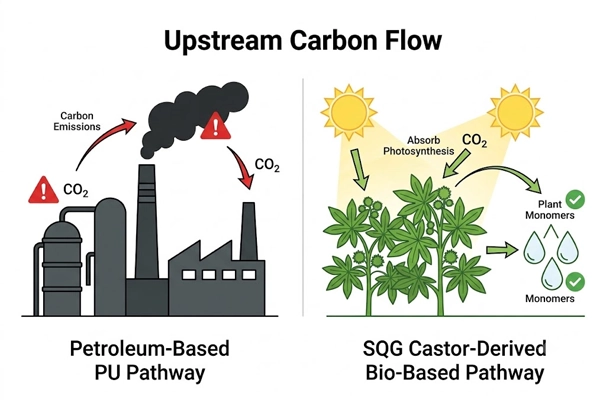
To truly understand how bio-based materials relieve compliance pressure for procurement teams, we must examine the fundamental physical and chemical mechanisms of nature. Take the natural, non-edible castor crops widely utilized by SQG as a prime example. During their growth cycle, these plants leverage highly efficient photosynthesis to continuously capture carbon dioxide (CO2) and water (H2O) from the atmosphere, converting them into energy-rich castor oil monomers. This natural carbon sequestration biochemistry acts as an inherent, intervention-free carbon sink mechanism.
Unlike fossil resources—which have been buried deep underground for hundreds of millions of years and release net CO2 into the atmosphere upon extraction—plant-derived raw materials lock away massive carbon emissions at the very inception of their life cycle. This natural low-carbon or net-negative attribute can be quantified with absolute precision through ASTM D6866 radiocarbon dating, which provides an unforgeable percentage of bio-based carbon content. For ESG auditors and customs compliance teams at global manufacturers, this testing report, combined with traceable agricultural origin certificates, forms a legitimate, compliant upstream green passport. Backed by solid scientific and physical data, it proves that the procured gloves do not rely on exploiting underground fossil fuels but are manufactured through a surface-level natural cycle, smoothing the compliance onboarding pathway through the web of global green barriers.
Scope 3 Accounting: Translating Glove Service Life into Corporate Carbon Assets
Carbon Footprint Data Integration
In the greenhouse gas (GHG) accounting systems of multinational corporations, Scope 3 indirect emissions have long been the most challenging “data black hole” to address. With the advancement of the CSDDD and new carbon audit standards, major manufacturers and buyers can no longer rely on estimates or ignore the high-turnover consumables in their supply chains. As personal protective equipment (PPE), the annual consumption of industrial gloves in large factories can easily range from tens of thousands to hundreds of thousands of pairs. Using traditional fossil-based coated gloves means that companies indirectly include massive amounts of fossil carbon emissions from underground reserves directly into their own Scope 3 accounts.
To help buyers address this data compliance challenge, SQG provides comprehensive Life Cycle Assessment (LCA) accounting data. Thanks to the inherently low-carbon nature of castor oil monomers and a green synthesis process, SQG’s bio-based PU coating achieves up to a 60% reduction in carbon emissions across its entire life cycle (LCA Carbon Reduction) during production. This carbon reduction figure is not merely a verbal commitment but is backed by rigorous environmental data—verified through actual testing and scientific calculations by authoritative third-party organizations in accordance with ISO 14040 and ISO 14044 standards.
EHS managers and ESG teams at multinational buyers can access the LCA carbon emission factor report provided by SQG with each product shipment. This report can be directly and seamlessly imported into the buyer’s internal greenhouse gas accounting software (such as SAP or various digital carbon management platforms). Using these precise, third-party-verified emission factors, companies can easily reconcile their carbon ledgers for Scope 3 Category 1 (purchased goods and services) and Category 5 (operational waste), transforming the procurement of protective gloves directly into auditable, transferable green compliance carbon assets.
TCO Multiplication Beats Carbon Penalties

In the process of implementing sustainability compliance, traditional procurement thinking often assumes that “environmental friendliness inevitably comes with a high premium” or that “eco-friendly materials require compromises in physical performance.” However, SQG bio-based polyurethane gloves have completely shattered this prejudice of “green compromise” through cutting-edge material physics design.
Under European standards for measuring glove abrasion resistance, SQG bio-based PU gloves—such as the B-312-BIO-WL, which features a dust-free abrasion-resistant coating—have achieved the top-tier EN 388 Level 4 abrasion resistance rating. The scientific mechanism behind this lies in the fact that bio-based polyols, thanks to the flexibility of their naturally long carbon chains and precise molecular structure design, form a microscopic three-dimensional covalent cross-linked network during the thermal curing process that is denser and more elastic than that of traditional petrochemical PU.
This molecular structural advantage at the microscopic level directly translates into exceptionally robust macroscopic abrasion resistance, extending the service life and wear cycle of both single- and double-layer gloves by 1 to 2 times. For factories, this doubling of service life brings dual benefits:
Financial TCO Reduction: The reduced frequency of glove replacement leads to a significant decrease in the comprehensive cost per shift (Cost-Per-Shift), resulting in a marked optimization of the Total Cost of Ownership (TCO) through actual physical performance;
Source Carbon Reductions: Doubling the glove lifespan means the factory’s procurement volume is directly halved, thereby reducing by half the carbon emissions from packaging, ocean freight, and solid waste incineration at the end of the life cycle.
This reduction in carbon emissions achieved through “extended physical lifespan” not only helps companies completely avoid hefty “carbon emission penalty fines,” but also transforms every penny spent on safety protection into a highly effective lever for driving the company’s green transition and ensuring regulatory compliance.
The Chemical Safety Audit: DMFa-Free Restrictions and REACH Red Lines
Easing the Burden of Toxicological Audits
Under the REACH regulatory framework established by the European Chemicals Agency (ECHA), controls on toxic and hazardous substances are tightening exponentially year by year. During the manufacturing process of traditional petroleum-based PU-coated gloves, the heavy reliance on the organic solvent dimethylformamide (DMF) to dissolve polyurethane resins has made residues of this substance a major concern in toxicological audits. DMFa has been included on ECHA’s list of Substances of Very High Concern (SVHC) due to its established reproductive toxicity. Under the latest REACH restriction provisions, extremely stringent limits have been imposed on the residual concentration of DMFa in polyurethane products (requiring concentrations to be below 0.001% or, in certain high-standard audits, approaching the detection limit).
This strict regulatory red line has made toxicological audits in multinational supply chains more burdensome than ever before. Under traditional audit procedures, multinational buyers and compliance officers must sift through mountains of Material Safety Data Sheets (MSDS) and undergo rigorous mass spectrometry testing by customs authorities and third-party audit agencies upon the arrival of each shipment. If a glove sample is found to exceed the DMFa limit, the entire shipment of personal protective equipment (PPE) faces immediate rejection at the port, mandatory destruction, and a public reprimand for the company. Against this backdrop, implementing “detoxification” audits in the supply chain is no longer merely a matter of corporate social responsibility; it has become a critical necessity for ensuring the continuity of the logistics supply chain.
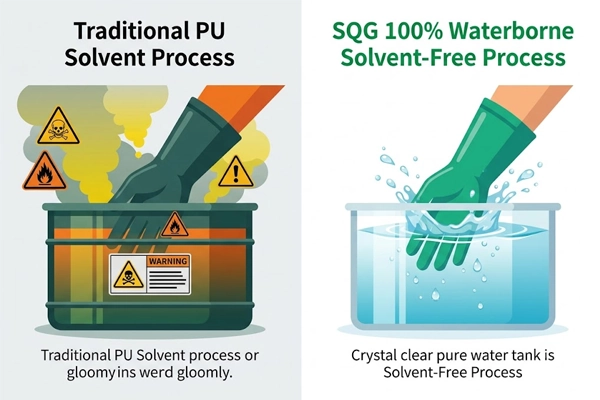
Skin Contact Safety as an EHS Priority
Within a company’s Environmental, Health, and Safety (EHS) management system, the occupational health of frontline workers is always the top priority in risk control. Industrial safety gloves are protective equipment that frontline workers wear in close contact with their skin for up to 8 to 12 hours each day. When trace amounts of volatile solvents, such as DDM for plasticizers, remain in glove coatings, these harmful toxins can rapidly penetrate the body through skin contact in the warm, humid microenvironment created by sweaty hands and open pores. This not only makes workers highly susceptible to serious occupational skin diseases such as contact dermatitis and eczema, but also silently accumulates long-term systemic toxicological health risks for employees.
For multinational manufacturers and large industrial conglomerates, employee health damage caused by harmful chemical residues is a powder keg that can trigger civil lawsuits for occupational diseases and transnational health claims. Once frontline employees file collective health claims, companies will face staggering legal fees, compensation payments, and a sharp rise in employer liability insurance premiums.
SQG protective gloves, which utilize a 100% water-based, solvent-free, and bio-based manufacturing process, fundamentally eliminate this occupational health risk. By completely replacing DMFa with water throughout the entire production process, from polyurethane resin synthesis to glove impregnation, the finished gloves achieve truly 100% zero DMFa residue. This solvent-free formulation enables the product to easily pass OEKO-TEX Standard 100—the world’s most stringent certification for textile toxicology and skin contact safety. By reducing chemical toxicity to zero at the source, EHS managers establish an absolutely safe skin protection barrier for frontline employees and eliminate potential triggers for labor health litigation.
Closed-Loop Traceability: The Role of GRS and TC Evidence Chains
Combating the Epidemic of Fake Recycled Fibers
Against the backdrop of the global surge in sustainable procurement, using recycled fibers such as recycled polyester (RPET) to manufacture knitted linings for gloves has become standard practice for major multinational corporations seeking to demonstrate their circular economy performance and reduce their supply chain carbon footprint. However, a covert “epidemic of fake recycled materials” is quietly spreading throughout the industrial personal protective equipment (PPE) sector. Since the price of recycled polyester chips exceeds that of standard virgin polyester during certain market periods, some opportunistic low-end glove manufacturers have begun resorting to the trick of “conceptual padding”—they simply label their products as “Recycled” or blend an extremely small proportion of recycled fibers with large quantities of standard petrochemical-based polyester, then claim their gloves are “green” and eco-friendly circular products.
This opaque industry practice triggered an unprecedented “greenwashing” penalty crisis in 2026. With Europe’s full implementation of extremely stringent Anti-Greenwashing Directives, customs regulators and third-party ESG audit agencies will never approve products based solely on a “circular recycling” symbol on the outer packaging or a supplier’s self-proclaimed “eco-friendly” label during inspections.
If, during an on-site audit, a company is found to have procured so-called recycled polyester gloves that contain fraudulent raw materials, not only will the gloves themselves be classified as “false advertising” and seized by customs, but the entire shipment of finished products assembled using this PPE material will also be held up at customs. This disruption of an entire cross-border logistics chain caused by a single pair of gloves represents a compliance challenge that modern lean supply chains simply cannot afford.
The Non-Negotiable Transaction Certificate (TC)
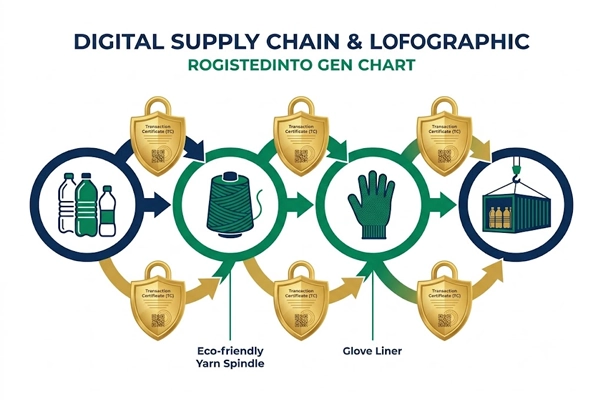
To build resilience against this crackdown on greenwashing, procurement decision-makers must understand the underlying trust framework within international certification systems. Many B2B buyers often make a critical error in judgment when conducting compliance due diligence on suppliers: they mistakenly believe that a supplier’s presentation of a “GRS (Global Recycled Standard) Scope Certificate (SC Certificate)” proves that every batch of gloves they receive is a genuine and trustworthy recycled product.
In fact, the SC certificate is merely equivalent to a “qualification license”; it only proves that the factory theoretically possesses the equipment and qualifications to process and produce recycled products, but it does not prove that the specific batch of gloves you received was actually manufactured using recycled plastic bottles.
When facing extremely rigorous legal audits in Europe, the only seamless, court-admissible evidence is the Transaction Certificate (TC).
A TC certificate is a “digital ID” tailored to each specific transaction and each specific batch of materials. It is issued directly by an internationally designated third-party certification body (such as Control Union) and precisely records the actual weight of the recycled material, along with the corresponding invoice and shipping document numbers, for every stage of the process—from the initial collection of discarded plastic bottles through pelletization, spinning, and knitting to the final finished gloves.
Only when each batch of delivered gloves is accompanied by a TC certificate corresponding to that batch—and verifiable on the official GRS system—can an unbreakable, tamper-proof closed-loop chain of custody be provided during customs spot checks and audits by European Supply Chain Act inspectors. SQG’s BLADEGUARD and other glove series ensure that every shipment is accompanied by a legitimate TC certificate. This fully insulates buyer enterprises from greenwashing liabilities and safeguards every safe customs clearance in the global supply chain through absolutely honest and verifiable technical assets.
B2B Compliance Matrix: Standard Certifications vs. Regulatory Targets
Bridging the Gap Between Legal Mandates and Technical Verification
For procurement managers and compliance officers at large multinational corporations, the biggest challenge in addressing Europe’s green regulatory barriers often lies in the “significant disconnect between abstract legal provisions and technical specifications.” The legal department may submit a CSDDD due diligence guide or the latest REACH amendment—potentially hundreds of pages long and filled with legal jargon—while the procurement and EHS teams are left with hundreds or even thousands of complex technical data sheets (TDSs) for glove materials. The key to ensuring supply chain security lies in accurately translating broad legal compliance requirements into concrete technical assets that the procurement side can implement and verify.
To break down these information barriers, companies need a standardized compliance reconciliation matrix. This matrix maps the three core European environmental and chemical regulatory frameworks to specific risk points in the manufacturing, chemical control, and raw material traceability of PPE gloves, and provides internationally recognized, authoritative third-party testing standards that can serve as part of a legal chain of evidence.
B2B Compliance Matrix
| European Regulatory Mandates | Key Risk Areas in PPE | Verified Compliance Solution | Authorized Testing Standard |
| CSDDD Upstream Decarbonization | High reliance on fossil fuels and a high baseline carbon footprint. | Bio-based polyols with up to 60% CO2e savings. | ASTM D6866 / ISO 14044 LCA |
| EU REACH & DMFa Bans | Residual-free volatile solvents and industrial toxic hazards. | 100% DMFa-free and plasticizer-free formulation. | OEKO-TEX Standard 100 |
| Anti-Greenwashing Circularity | Unverified blends of virgin polyester marketed as “green.” | 100% traceable, closed-loop recycled RPET liners. | GRS Certified with TC Evidence |
Deciphering the Compliance Checklist: Why Testing Standards Matter
A close examination of this compliance matrix reveals that the implementation of every core European regulation is accompanied by a set of non-negotiable “gold standard” testing requirements:
CSDDD Carbon Reduction Audits and ASTM D6866: When calculating upstream Scope 3 carbon emissions, auditors will not accept any verbal “low-carbon claims.” Companies must provide a radiocarbon analysis report based on the ASTM D6866 standard. This standard uses physical methods to determine the ratio of natural biogenic carbon to fossil carbon in glove coatings; only when combined with Life Cycle Assessment (LCA) data based on ISO 14044 can these emissions be formally recognized as “carbon reduction assets” on financial statements.
REACH Toxicity Control and OEKO-TEX Standard 100: Residual dimethylformamide (DMF) in traditional petrochemical PU gloves is a major cause of occupational skin diseases and export rejections. OEKO-TEX Standard 100 certification is not only a safety label but also a chemical protective umbrella that helps products comply with REACH restrictions. By simulating extreme contact with human skin in a hot and humid environment, it conducts rigorous screening for over 300 known harmful substances—including DMFa, heavy metals, and plasticizers—thereby relieving buyers of the burdensome task of self-declaring toxicological compliance.
Anti-Greenwashing Legislation and GRS Trade Certificates (TC): As Europe intensifies its crackdown on “fake recycled materials,” a factory’s primary GRS certification alone is no longer sufficient to prove compliance. Purchasers must ensure that every incoming shipment is accompanied by a Transaction Certificate (TC) issued by a designated certification body (such as Control Union). This is the only legally valid chain of evidence proving that recycled polyester (RPET) knit linings follow a 100% closed-loop supply chain, thereby eliminating allegations of “greenwashing.”
Compliance Note: In modern B2B supply chain audits, having this “Standard Certification vs. Legal Objectives” reconciliation matrix ready can shorten a company’s supplier onboarding and compliance audit cycle by more than 70%. It streamlines what was once a tedious process—involving months of back-and-forth and repeated submission of material flow documentation—into a one-time, standardized submission of a “Compliance Dossier.”
Turning Compliance into Strategy: SQG’s Turnkey Auditing Dossier
Streamlining the Vendor Qualification Process
In the day-to-day operations of multinational supply chains, the biggest challenge facing procurement departments is often not finding protective gloves that meet standards, but rather spending weeks—or even months—collecting and verifying suppliers’ scattered and non-standardized compliance documents. For companies urgently seeking to pass European CSDDD or LkSG audits, the lengthy “vendor qualification” process acts as an invisible barrier hindering on-time production line deliveries.
To thoroughly address this pain point, SQG has transformed the traditional, inefficient model in the PPE industry—one characterized by “passive cooperation” and the “drip-feed” provision of reports. By transforming complex legal compliance metrics into highly standardized technical assets, SQG has customized a “Turnkey Compliance Dossier” for multinational buyers and corporate compliance officers.
This digital dossier, which is either shipped with the goods or delivered immediately during the qualification phase, contains all primary environmental and chemical test certificates issued by world-class authoritative laboratories such as SGS and TÜV. The dossier not only comprehensively covers physical test reports for bio-based content in accordance with ASTM D6866 but also bundles OEKO-TEX Standard 100 certification proving 100% zero DMFa residue, as well as GRS certification and batch TC evidence chains spanning the entire life cycle of raw material recycling.
Compliance officers no longer need to verify each item against the lengthy CSDDD provisions. By simply uploading the standard compliance dossier provided by SQG with a single click to the company’s internal ERP audit system or an external third-party ESG assessment platform (such as EcoVadis), they can complete supplier qualification reviews—which previously took months of back-and-forth—in just a few hours.
Zero-Friction Onboarding for European Audits
When companies switch their PPE procurement decisions from traditional petrochemical gloves to SQG’s signature MAXGUARD Precision and Heavy-Duty Protection Series (such as the B-329-BIO, which features a 15-gauge RPET/spandex lining paired with a bio-based PU coating) or the BLADEGUARD Extreme Blade Cut-Resistance Series (such as cut-resistant gloves incorporating the patented TekArmor® glass-free, hypoallergenic cut-resistant fiber), the direct benefits will quickly materialize in the annual ESG audit reports of multinational manufacturing facilities.
In traditional audits of multinational manufacturing facilities, the procurement of personal protective equipment (PPE) is often a defensive risk area. Auditors must repeatedly verify whether high-volume-consumption gloves generate excessive solid waste during end-of-life disposal and whether their chemical residues pose a risk of occupational disease claims related to frontline workers’ skin health. However, when the procurement department specifies SQG’s flagship product line, these tedious and high-risk compliance gaps are immediately transformed into positive highlights in the audit report:
MAXGUARD Precision Series: With a bio-based coating formulation of up to 40% and an ultra-lightweight recycled polyester lining, every 10,000 pairs used in precision electronics or semiconductor assembly workshops directly corresponds to precisely quantifiable reductions in upstream Scope 3 carbon emissions;
BLADEGUARD Cut-Resistant Series: Not only does it achieve the highest level of mechanical and physical protection in heavy-duty industrial, automotive stamping, and glass manufacturing settings, but its accompanying GRS Transaction Certificate (TC) also serves as irrefutable, “zero greenwashing” evidence that leaves customs authorities and European regulators with no room for criticism.
By seamlessly integrating basic physical safety protection (EN 388 mechanical risk protection) with top-tier legal compliance (CSDDD/REACH), SQG helps multinational manufacturers put an end to last-minute fixes before audits. Choosing SQG is like obtaining a passport to exemption for multinational supply chains, transforming protective gloves—which would otherwise be merely an operational cost—into a strategic asset that helps companies pass the rigorous European market entry test and earn top ESG ratings.
FAQs: European Mandates and Sustainable Hand Protection
Q1: Can a company be fined under the CSDDD for purchasing unverified, non-eco-friendly PPE?
Answer: Yes. Although occupational safety supplies such as protective gloves and safety shoes are typically classified as “indirect procurement” or non-production materials (MRO) in corporate procurement systems, the legal definitions under the EU Corporate Sustainability Due Diligence Directive (CSDDD) and Germany’s Supply Chain Due Diligence Act (LkSG) stipulate that the scope of due diligence extends across a company’s entire “chain of activities.”
This means that as long as these materials are consumed frequently in a company’s production and operations, logistics, or service provision, they must be included in a comprehensive environmental audit. If a company consistently procures and uses traditional fossil-based PPE that lacks traceability regarding environmental compliance, lacks life cycle assessment (LCA) data, or is even suspected of causing pollution in the upstream supply chain, and this is verified by a third-party audit firm or regulatory authority, the company will be deemed to have failed to fulfill its supply chain due diligence obligations. This will not only trigger a systemic compliance red flag in the supply chain, leading to delays in customs clearance, but may also expose the company to the risk of legal fines of up to 5% of its global annual net revenue.
Q2: How does a GRS Transaction Certificate (TC) protect a procurement manager from greenwashing penalties?
Answer: Under the EU’s increasingly stringent anti-greenwashing legal framework, only a Transaction Certificate (TC) can serve as an impenetrable legal compliance shield for procurement managers.
A standard GRS Scope Certificate (SC) is merely a processing authorization that only certifies the facility’s technical capability to process recycled fibers. However, an SC cannot verify that the gloves you purchased—specifically those in a particular container—were actually manufactured using polyester derived from recycled plastic bottles.
The Global Recycled Standard (GRS) Chain of Custody adheres to extremely stringent closed-loop regulations: every transfer of ownership—from the initial collector and fiber processing plant to the final finished product—must be accompanied by a TC certificate issued directly by an authorized third-party certification body (such as Control Union). This is a verifiable document with court-admissible credibility issued for a specific transaction, which precisely reconciles the recycled material’s batch number, actual weight, and logistics tracking numbers for upstream and downstream transfers. When facing strict environmental compliance audits or customs spot checks, only by presenting authentic TC certificates that correspond one-to-one with specific incoming batches can a company prove its innocence and eliminate any risk of penalties for false advertising or greenwashing related to conceptual sustainability or fake recycled materials.
Q3: Why is DMFa-free status critical for compliance with EU REACH regulations in 2026?
Answer: Dimethylformamide (DMF) is an indispensable, highly polar solvent in the production of traditional petroleum-based polyurethane gloves; however, it is also one of the Substances of Very High Concern (SVHCs) subject to the strictest monitoring under the REACH regulations established by the European Chemicals Agency (ECHA).
Due to DMF’s well-documented reproductive toxicity and skin contact hazards, the latest restrictions under the REACH regulation set an extremely low threshold for its residual concentration in finished polyurethane resin products (requiring levels below 10 ppm / 0.001%). Traditional petrochemical-based PU-coated gloves are highly prone to exceeding solvent residue limits during post-processing steps such as washing and centrifugation.
This not only results in entire batches being directly detained, impounded, or returned at European ports but also exposes frontline workers to prolonged skin contact and absorption of harmful toxins through sweat during extended wear, leading to severe occupational skin diseases and potentially massive labor health compensation claims.
SQG’s bio-based polyurethane-coated gloves utilize an advanced waterborne and solvent-free synthetic process, employing water exclusively as the medium throughout the entire production chain—from raw material polymerization to impregnation, thereby eliminating the use of DMF at the source. This enables the products to easily pass OEKO-TEX Standard 100—the world’s most stringent chemical safety test for skin contact—helping major multinational manufacturers completely avoid the regulatory pitfalls of REACH toxicological audits and ensuring the absolute skin health of frontline workers.


