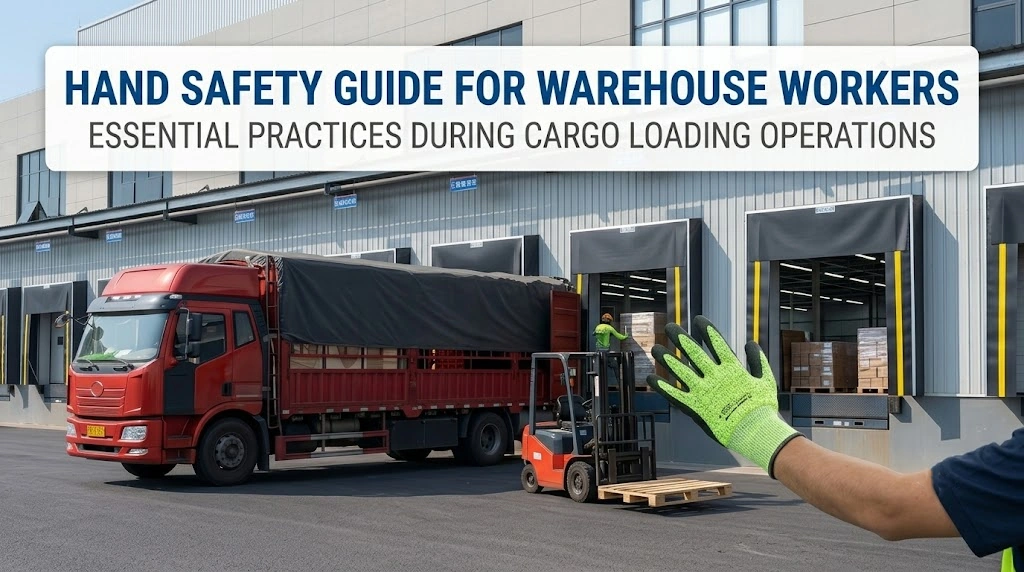
In modern warehouse and logistics hubs, where the pursuit of maximum delivery speed is paramount, the constant movement of forklifts and the handling of wooden pallets make loading docks a typically high-risk environment. Industry data shows that hand injuries have consistently been the most prevalent and challenging safety issue in the global warehousing industry. For B2B companies, even a seemingly minor hand laceration or crush injury not only results in direct medical compensation costs but also triggers staff absences and operational disruptions, leading to a significant increase in supply chain operating costs.
Creating a zero-accident loading dock requires a “combination of hardware and software.” Companies must not only maintain efficient loading dock equipment to ensure facility safety but also provide employees with high-quality personal protective equipment (PPE). Based on real-world cargo loading operations, this guide offers a systematic warehouse hand safety solution and advises B2B buyers on how to scientifically select the most suitable industrial-grade safety gloves and work gloves.
The Reality of Hand Injuries in Modern Warehouses
The Hidden Costs of Crush Injuries and Lacerations
According to numerous global occupational safety and health survey reports, hand injuries have long ranked among the top three non-fatal workplace injuries in the cross-border logistics and warehousing industry. Among these, hand lacerations, finger crush injuries, and fractures caused by impacts from heavy objects account for more than 40% of frontline accidents in warehouses. This high incidence rate directly reflects the critical need for specialized protective equipment in high-intensity manual handling operations.
Many B2B procurement companies tend to overlook the “hidden economic losses” behind accidents when assessing occupational safety and health costs. Data shows that for a typical hand injury, the indirect operational losses often amount to 4 to 10 times the direct medical costs:
Lost productivity and delay costs: Accidents cause on-site operations to halt, directly leading to loading and unloading delays and incurring high demurrage costs.
Replacement and training costs: Temporary workers recruited on short notice, due to their lack of familiarity with processes, not only cause an overall decline in warehouse productivity but also increase the risk of secondary workplace injuries.
Compliance and legal risks: Failure to provide personal protective equipment (PPE) that meets regulatory standards exposes companies to labor lawsuits and substantial compliance fines.
For supply chain managers, neglecting hand protection for frontline workers essentially erodes the operational efficiency of the entire warehouse. To gain a deeper understanding of the evolution of protection levels under extreme laceration and impact hazards, please refer to our previous technical report: Beyond ANSI A5: Scaling Hand Protection for Extreme Laceration and Impact Hazards. This will help companies establish safety measures for high-risk positions in a more scientific manner.
Key Hand Hazards During Cargo Loading and Handling
Splinters and Cuts from Wooden Pallets
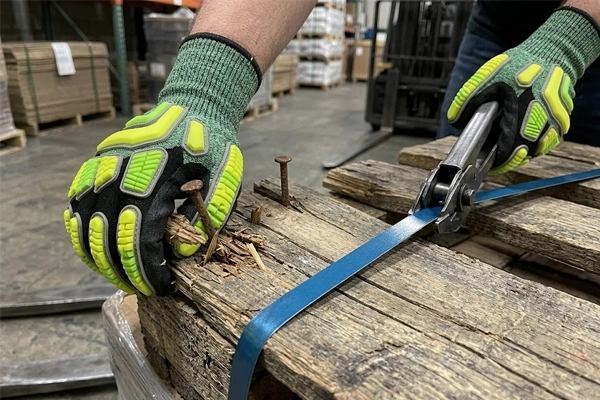
In warehouse transshipment operations where every second counts, wooden pallets—as the most basic logistics carriers—are also hidden hazards that frequently cause lacerations to the hands. During daily manual handling, rapid stacking, or dismantling of old pallets, the palms and fingers of frontline workers come into contact with rough wooden surfaces thousands of times a day.
Due to prolonged use, many wooden pallets suffer from physical defects such as aging and cracking. During manual handling, sharp splinters and jagged wood shavings can easily pierce the skin in an instant, causing deep puncture wounds or infections. Even more dangerous are the rusted, loose nails often exposed on damaged pallets, or the broken hard metal strapping used to secure container cargo. These sharp edges can easily tear deep gashes—sometimes down to the bone—the moment a worker exerts force to push or pull. This not only directly interrupts work during a shift but is also a common trigger for workers’ compensation claims.
Crush Hazards from Cargo Shifting and Forklifts
Compared to minor scratches caused by pallets, structural crushing and blunt force trauma at loading bays pose a life-threatening risk to the safety of workers’ fingers. During typical cargo loading and unloading operations, hands can easily become trapped in complex mechanical pinch points at any moment.
These risks typically manifest in the following high-risk scenarios:
Unexpected Shifting of Heavy Cargo: When handling or unpacking palletized cargo from large trucks or containers, the load is highly prone to sudden tilting or sliding due to an unstable center of gravity, trapping workers’ hands between the cargo and the interior walls of the cargo hold.
Truck docking and container door operations: During truck docking with container trucks or when closing heavy container doors in strong winds, improper handling can result in fingers being instantly severed by the inertia of machinery weighing several metric tons.
Forklift Blind Spot Hazards: In warehouse blind spots or at aisle intersections, high-speed forklifts and manual pallet jacks often crush nearby workers’ hands against shelving or adjacent cargo when picking up pallets, due to obstructed visibility.
Ordinary canvas or latex gloves are simply incapable of withstanding this high-energy physical impact. This makes heavy-duty cut-resistant gloves—featuring an impact-resistant thermoplastic rubber (TPR) framework and certified for high-level mechanical protection—an absolute necessity for safeguarding the fingers of dock workers and reducing the incidence of crush fractures.
Macro-Level Safety at the Loading Bay
Balancing Facility Infrastructure with PPE
In warehouse operations management, many supply chain managers tend to treat “personal protective equipment” and “facility safety” as two separate categories, which is often the root cause of systemic safety vulnerabilities. In fact, a modern loading bay that truly achieves “zero accidents” must be the result of deep synergy between macro-level mechanical hardware and micro-level personal protective equipment (PPE). If the physical environment of the workplace itself is flawed, even workers wearing the highest-grade protective gear cannot fully guard against catastrophic workplace injuries caused by the environment; conversely, without personal protective equipment, even the most advanced automated workshop cannot prevent random cuts during manual handling.
From a facilities management perspective, this dual-defense mechanism is particularly critical in the transition zones where cargo loading and unloading intersect with heavy-load transportation. While warehouse workers must wear appropriate safety gloves to shield against manual hazards, the maintenance of macro-level hardware is equally vital. Ensuring optimized workplace safety requires facilities to invest in and maintain high-efficiency loading dock equipment—such as heavy-duty dock levelers and vehicle restraints—to prevent loading bay drift and forklift cross-traffic accidents. Such hardware investments can fundamentally eliminate the risks of high-energy falls and collisions, establishing a controllable physical safety boundary for frontline workers.
Only by seamlessly integrating this macro-level, heavy-duty equipment protection with micro-level PPE standards—such as cut-resistant gloves and safety shoes—can a company’s overall level of compliance (Sustainable Compliance) be truly realized. Hardware mitigates major risks, while software protects against minor cuts; this dual-layer safety network is not only the cornerstone of efficient supply chain operations but also the core metric that multinational B2B procurement companies value most during on-site supplier audits.
Key Metrics for Selecting Industrial Gloves
Cut Resistance Ratings: ANSI vs. EN 388
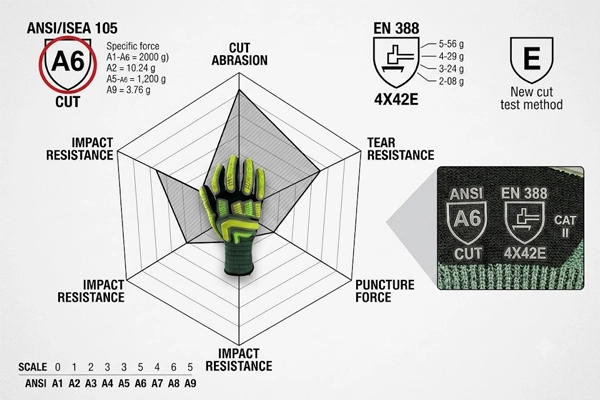
When conducting large-volume B2B procurement of industrial-grade safety gloves, buyers cannot rely solely on “thickness” or “feel” to assess protective performance; instead, they must rely on quantifiable international technical standards. Currently, the two main global certification systems for cut resistance are the ANSI/ISEA 105 standard in North America and the EN 388 standard in Europe. These two standards differ fundamentally in their testing methods and rating logic; understanding how they correspond is the first step for companies to mitigate compliance risks.
The U.S. ANSI standard uses the ASTM F2992-15 test method, which classifies cut resistance into nine levels ranging from A1 to A9. It calculates the absolute pressure withstood by the glove surface when pierced by a blade by measuring the weight in grams. In contrast, the European EN 388:2016 standard introduces a dual-testing system: the traditional Coup Test (a cyclic cutting test that accounts for blade wear, classified into levels 1–5) and the more rigorous TDM-100 Test (the ISO 13997 testing method, which uses newtons as the unit of measurement and is classified into six grades from A to F).
To help B2B procurement managers make informed decisions when reviewing specifications across international supply chains, we can scientifically compare the actual cut resistance performance of these two standards and categorize them as follows:
Low-risk environments (handling of lightweight items with non-sharp edges): Suitable for handling standard cardboard packaging and light-duty plastic assembly. Corresponds to ANSI Levels A1–A2 or EN 388 TDM Levels A–B (withstanding pressures of less than 500–999 grams / 2–5 Newtons).
Moderate-risk environments (routine warehousing, handling of wooden pallets and large cartons): This is the most common work scenario in logistics centers, where workers face a risk of random lacerations to their hands when handling slightly worn wooden pallets or metal strapping. The optimal procurement standard for this scenario is ANSI Levels A3–A4, corresponding to EN 388 TDM Levels C–D (withstand forces of 1,000–2,199 grams / 10–15 newtons).
Heavy-Duty to Extreme Hazard Environments (Heavy-Load Machining, Sharp Metal Sheets, Broken Glass Cleanup): These high-risk operations require gloves with top-tier cut resistance; ANSI Levels A5–A9 must be procured, corresponding to EN 388 TDM Levels E–F (withstand pressure of 2,200–6,000+ grams / 22–30+ newtons).
For warehouse and facility managers, understanding these external ratings is merely the surface level of selection criteria. To understand at the source how high-strength cut-resistant barriers are constructed at the microscopic level, we recommend a thorough reading of our core technology blog: Physics of Cut-Resistant Glove Materials: Core Yarn Science. This will help your procurement team evaluate every PPE procurement budget more scientifically and rationally, starting from the fundamentals of materials engineering—such as core-spun yarns and high-performance polyethylene (HPPE).
The Importance of Glove Coatings & Grip
Micro-Sandy vs. Polyurethane (PU) Coatings
In manual handling operations involving heavy materials, the grip performance of work gloves not only determines loading and unloading efficiency but also serves as a critical line of defense against acute workplace injuries. When workers handle large cargo, metal components, or pallets wrapped in plastic film, if the palm coating of the gloves lacks sufficient friction, the cargo is highly prone to slipping out of their hands instantly while being lifted off the ground or raised overhead. Such sudden slips and drops are often the direct cause of cargo falling and striking the feet, or of reflexive muscle contractions that strain the ligaments in the arms and lower back. Therefore, scientifically matching the outer coating material of gloves to the different physical environments in warehousing centers—whether dry, oily, or damp—is a technical detail that B2B procurement teams must carefully manage.
Currently, in the field of industrial safety protection, the mainstream palm coating processes are primarily divided into the following three types, each corresponding to different loading and unloading areas:
Sandy (Foamed Micro-Grit) Coating: This is the “all-terrain” gold standard for high-intensity warehousing and loading docks. Through a special foaming technique, countless tiny suction-cup-like protrusions are formed on the surface of nitrile or latex. When this micro-sand surface comes into contact with cargo surfaces lightly coated with oil, rust inhibitors, or rainwater, it instantly breaks down and adsorbs the liquid film, providing exceptionally strong anti-slip grip in both dry and wet conditions, thereby fundamentally preventing accidents caused by falling objects due to a lack of friction.
PU (Polyurethane) Coating: Known for being lightweight, highly sensitive, and exceptionally breathable. PU-coated gloves perform exceptionally well in completely dry warehouse environments, providing operators with flexibility close to that of bare hands. They are ideal for multifaceted roles that require barcode scanner operation, precise labeling, and the handling of lightweight items.
Nano-oil-based coating (Micro-Finish / Smooth Coating): With a smooth, dense surface and excellent resistance to liquid penetration, this coating effectively prevents external oils or moisture from seeping extensively into the inner lining fabric; however, its coefficient of friction is slightly lower than that of the foamed micro-grit coating in purely heavy-duty, oily, and slippery handling environments.
For facility managers prioritizing supply chain asset safety and employee occupational health, technological innovations in coatings are no longer limited to improving the coefficient of friction but have expanded into the realm of sustainable raw materials. If your company is conducting a green compliance audit of its supply chain or wishes to further understand the technological evolution and abrasion resistance performance of new polymer coatings, we recommend consulting our in-depth technical analysis report: What is Bio-Based PU Coating? Performance Analysis in Industrial Gloves. From a materials science perspective, this article comprehensively analyzes how eco-friendly coatings can reduce the carbon footprint while maintaining—or even exceeding—the mechanical service life of traditional petrochemical materials, providing robust data support for companies’ sustainable PPE procurement.
Top Work Gloves Recommended for Cargo Handlers
To address the unpredictable and high-intensity work environments in warehousing and transshipment, B2B procurement teams need to implement “Targeted Protection” based on the specific risk exposure of each job role. Based on the analysis of shear, crush, and slip risks discussed earlier, we have selected three core work glove models that have undergone rigorous testing in industrial settings. All three gloves represent the highest standards of craftsmanship currently available in the occupational safety and health field and fully meet the precise requirements of various frontline operations.
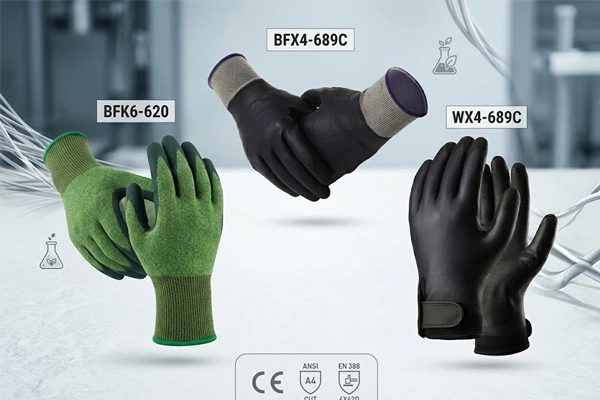
Product 1: BFK6-620 — Bio-based PolyMax Glove (18-Gauge Seamless Liner)
For warehouse workers who must wear gloves for extended periods while stacking large items, manually unpacking boxes, and frequently handling wooden pallets, traditional, bulky work gloves can easily cause hand fatigue—and may even lead workers to violate safety protocols by working bare-handed due to discomfort from the heat. The BFK6-620 is an iconic product designed specifically to address this pain point.
Ultra-Lightweight, Seamless Liner: This model innovatively employs 18-gauge ultra-thin seamless knitting technology, with the liner incorporating cutting-edge bio-based, eco-friendly fibers. It effectively relieves pressure on the hands while maintaining exceptional breathability and sensitivity comparable to bare hands.
Nano-Sandy High-Grip Technology: The palm of the glove features an advanced nano-sandy (nano-foamed micro-sand) nitrile coating. This unique microporous suction-cup structure provides an exceptionally high coefficient of friction when handling goods contaminated with rainwater, trace amounts of rust-preventive oil, or plastic stretch wrap, ensuring outstanding cut resistance and secure grip.
Product 2: BFX4-689C — Bio-based X-Plus Glove (21-Gauge Fully Coated)
During heavy-duty material handling, thorough container cleaning, and high-risk operations involving broken,n sharp metal strapping, workers’ hands are not only at serious risk of cuts but are also frequently exposed to complex environments characterized by dust, moisture, and even trace chemical leaks. The BFX4-689C is specifically designed for these extreme, heavy-duty loading and unloading scenarios.
Ultra-Tough Lining: The glove’s core protective layer is woven from an ultra-thin yet highly durable 21-gauge HPPE and metal fiber composite yarn, successfully shattering the traditional industry myth that “high protection must be bulky.”
Fully Coated 360-Degree Physical Barrier: This model features a fully coated design, creating a robust mechanical protection shield for the entire hand—including the back of the hand and sensitive wrist areas. The fully enveloping outer coating completely blocks the penetration of external moisture, grease, and dust, ensuring the inside of the hand remains dry and comfortable at all times—making it the ultimate protective solution for workers engaged in heavy-duty material handling.
Product 3: WX4-689C — X-PLUS™ Winter Work Glove
Cold-chain logistics, winter outdoor container unloading at ports, and loading/unloading operations in unheated cold regions are high-risk areas for frontline workers. Low temperatures not only cause finger muscles to stiffen and slow reaction times but also significantly weaken hand grip strength, exponentially increasing the risk of workplace injuries. The WX4-689C is our flagship heavy-duty cold-weather glove, specifically developed to withstand these extreme climatic challenges.
Double-Layer Seamless Insulated Lining: The glove’s interior features an innovative design with a 21-gauge outer layer and a 10-gauge inner layer of seamless acrylic terry fabric to trap heat. This design blocks the intrusion of external cold while efficiently retaining body heat through an air layer, providing exceptional cold resistance.
Impact Resistance and High Flexibility: Addressing the frequent risk of heavy-object impacts common in cold northern regions or cold storage loading docks, the gloves incorporate high-performance impact-resistant pads on the back of the hand. This robust impact protection, combined with excellent low-temperature elasticity, ensures that frontline workers can still flexibly operate barcode scanners and handle heavy loads in environments with temperatures dozens of degrees below zero, effectively preventing frostbite and secondary mechanical injuries.
The Shift to Sustainable PPE & Bio-Based Liners
Why Lightweight 18-Gauge & 21-Gauge Gloves Matter
As global supply chains transition toward low-carbon operations, major multinational corporations are no longer evaluating suppliers solely on production capacity and price; they now regard ESG (Environmental, Social, and Governance) performance as a core criterion for supplier qualification. Against this backdrop, a green procurement revolution is sweeping through the industrial safety sector, and the urgent demand for environmentally friendly and sustainable personal protective equipment (PPE) has given rise to a new standard: Sustainable Compliance. Traditional petrochemical-based PPE gloves, due to their high carbon footprint and non-biodegradable nature, are gradually being replaced by a new generation of products incorporating bio-based fibers. This material innovation allows B2B buyers to fulfill their corporate environmental responsibilities without compromising on protective performance.
In addition to this leap in environmental performance, polymer material technology has also directly driven a lightweight revolution in glove knitting processes. In traditional warehousing and logistics operations, frontline workers often resist wearing cut-resistant gloves because conventional 10-gauge or 13-gauge gloves—designed to achieve high protection levels—are typically exceptionally thick, heavy, and inflexible. When workers wear these bulky gloves for extended periods during manual handling, not only do they have to overcome significant material resistance when gripping and flexing their fingers—which can easily lead to muscle strain and chronic fatigue—but the reduced tactile sensitivity also significantly lowers their efficiency in stacking pallets and operating precision equipment.
Upgrading to lightweight, high-gauge (18-gauge and 21-gauge) ultra-thin safety gloves is the technical solution to this industry pain point:
Extreme lightweight design reduces hand fatigue: 18-gauge and 21-gauge represent an extremely high-density seamless knitting process, resulting in a glove lining as thin as a second skin. While providing the same level of cut resistance, this significantly reduces the weight of the material, allowing workers to use their hand muscles more naturally when gripping and lifting goods, and significantly lowering the rate of hand strain during high-intensity shifts.
Significantly improves compliance rates among frontline employees: The ultra-thin gloves offer excellent breathability and fine tactile feedback, comparable to bare hands. Workers no longer need to frequently remove their gloves to answer phone calls, operate barcode scanners, or handle small parts, which fundamentally eliminates random workplace accidents caused by temporary non-compliance—such as exposure to cuts or punctures—when gloves are removed.
For B2B procurement decision-makers, upgrading to lightweight, high-gauge protective gloves is a highly cost-effective safety investment. Not only does it enable companies to easily achieve compliance in ESG audits, but it also genuinely reduces accident rates on the shop floor by improving employee comfort. If your team is evaluating how to balance “thinness” and “cut resistance” in gloves, we invite you to read our practical selection guide: Thin Cut-Resistant Gloves: 18-Gauge & 21-Gauge Safety Guide, to gain a deeper understanding of the latest high-gauge protective technology.
Glove Selection Matrix: Quick Comparison
In the B2B industrial procurement process, faced with diverse work processes and complex on-site risks, supply chain managers and facility managers at multinational corporations need a selection tool that enables rapid decision-making. To help procurement teams quickly evaluate key technical metrics and precisely match different models of work gloves to specific warehouse loading and unloading scenarios, we have developed the following structured industrial selection comparison matrix.
This matrix is strictly categorized based on physical protective performance, fiber count, and coating processes, and is designed to help companies optimize their PPE procurement budgets and achieve the precise implementation of safety compliance (Sustainable Compliance):
B2B Product Comparison Table (Markdown Table)
| Glove Model | Core Fiber & Liner | Coating Feature | Primary Hazard Protection | Ideal Loading Applications |
| BFK6-620 | Bio-based Fiber / 18-Gauge | Palm-Coated (Nano-Sandy) | Cut-Resistant, High Grip | Moving Dry and Lightly Oily Pallets |
| BFX4-689C | HPPE & Metal Fiber / 21-Gauge | Fully Coated | Mechanical & Laceration Protection | Heavy-Duty Material Handling |
| WX4-689C | TekArmor® & Acrylic Terry | Fully Coated | Cold-Resistant, Impact-Resistant | Cold Storage Loading Operations |
| X4-388C | TekArmor® Yarn / 21-Gauge | Fully Coated PU | Touchscreen-Compatible, Abrasion-Resistant | Precision Parts and Scanner Operations |
As shown in the matrix above, no single glove can fully address all warehouse risks. For example, for common hazards at loading docks—such as exposure to rain or cuts from metal straps on pallets—the BFK6-620, with its high grip strength, is the top choice for both dry and wet environments; whereas for operations in extreme cold, such as cold-chain logistics or winter container handling, it is essential to upgrade to the WX4-689C, which features cold resistance and an impact-resistant reinforcement. We recommend that B2B procurement teams conduct tiered, combined procurement based on the results of job risk assessments, thereby ensuring the absolute safety of employees while maximizing the overall service life of the gloves.
B2B Procurement & Implementation Action Plan
How to Implement a Workplace PPE Assessment
In today’s highly competitive modern supply chain environment, hand protection is no longer merely a financial expense but a strategic investment that directly impacts a company’s core operational efficiency. By equipping frontline workers at loading docks and distribution centers with scientifically designed, high-standard safety gloves, B2B companies can not only build a solid defense against workplace injury risks but also effectively curb a series of operational chain reactions—such as work stoppages, soaring demurrage fees, and skyrocketing costs for temporary labor. Maintaining stable and efficient delivery schedules on a macro level is the hidden weapon for every successful logistics company to reduce costs and improve efficiency.
To help multinational buyers and supply chain facility managers truly implement safety compliance (Sustainable Compliance), we recommend that companies follow the standardized B2B procurement process below to scientifically advance the bulk upgrade and selection of industrial gloves:
Submit a Sample Request: Companies can identify preliminary models based on their current loading/unloading environments and specific job-related risks (e.g., cut resistance, fully coated leak-proofing, or winter cold and impact protection), and submit a targeted sample request to a sales engineer through our official channels.
Initiate On-site Trial: Upon receiving the samples, arrange for key workers in high-risk positions to conduct a 1–2-week on-site trial involving real-world manual handling tasks. Focus on collecting feedback from frontline employees regarding the fatigue resistance and sensitivity of 18-gauge/21-gauge ultra-thin gloves, as well as the actual anti-slip performance and wear resistance of the palm coating when handling wet or slippery goods.
Finalize a Long-Term Bulk Procurement Plan: Based on the actual wear-and-tear cycle and compliance data from the test feedback, we will finalize a detailed long-term supply contract. By establishing a standardized, tiered procurement catalog, we will maximize the optimization of your annual PPE budget while ensuring employee safety.
Build a secure warehouse defense starting today. If your company is preparing for the next season’s supplier safety compliance audit or if you need a customized protection solution for specific loading and unloading processes, please don’t hesitate to reach out. Feel free to visit our official Contact Us page at any time to submit your specific protection needs or send an inquiry email directly to our sales team. Our professional engineers will provide you with a customized, comprehensive set of industrial work glove samples and a bulk purchase quote within 24 hours, helping your supply chain run smoothly and sustainably.
FAQ Section
In the procurement and warehouse compliance management of B2B occupational safety products, buyers often encounter specific questions regarding the service life of gloves, their functional suitability, and ongoing maintenance. To help facility managers and supply chain teams quickly address these key pain points, we have compiled the following expert answers tailored to the practical working environment of loading docks. This information not only optimizes your procurement decisions but also serves as industry-specific insights that meet Google SERP’s structured data crawling requirements (FAQ Schema).
Q1: How often should warehouse cargo loaders replace their safety gloves?
A: The replacement cycle for industrial work gloves depends directly on the intensity of frontline workers’ tasks and the frequency of interaction with specific materials. At loading docks, heavy-duty handling of wooden pallets, stretching metal strapping, and frequent opening and closing of container doors all cause severe mechanical wear to the palm coating and fingertip fabric of the gloves. In such high-intensity work environments, to ensure gloves remain in optimal condition for mechanical protection, we recommend mandatory replacement every 2 to 4 weeks. If on-site inspections reveal extensive peeling of the coating, wear through the engineering fibers exposing the fingers, or severe tearing of the lining, the gloves must be replaced immediately. Never expose workers to potential risks of cuts or crush injuries due to overuse.
Q2: Are touchscreen-compatible gloves necessary for warehouse loading docks?
A: With the trend toward modern smart logistics and digital warehousing, gloves equipped with touchscreen functionality have long been an essential requirement. Today, workers at loading docks frequently need to operate RF scanners, warehouse tablets, or electronic signature terminals when taking inventory. If their gloves do not support touchscreen functionality, workers must frequently remove their gloves to enter data. This not only significantly slows down loading and unloading efficiency but, more critically, leaves their hands completely unprotected while they are in the high-risk cargo handling area. Selecting models such as the X4-388C or X4-389C—which combine high cut resistance with touchscreen sensitivity—is the optimal solution for ensuring safety and production efficiency in digital warehousing.
Q3: Can these cut-resistant work gloves be washed and reused?
A: Industrial cut-resistant gloves that meet high-quality technical standards are fully compatible with professional cleaning and reuse, which is a key manifestation of a company’s commitment to Sustainable Compliance. The high-end safety gloves we have developed feature advanced engineered fiber linings (such as the highly durable, patented TekArmor® yarn). After industrial-grade washing and degreasing with neutral detergents, the microscopic crystal structure of this material remains intact, allowing the gloves to reliably maintain their original cut resistance rating and abrasion resistance. Through scientific washing and reuse, companies can not only significantly extend the procurement lifecycle of individual PPE products but also achieve cost savings of up to 30% or more on their annual occupational safety and health budget.