

Introduction: The Rising Standard of Chemical Safety in Modern Manufacturing PPE
When updating your inventory with OEKO-TEX 100 Safety Gloves, modern manufacturing facilities must recognize that the criteria for selecting occupational safety supplies have changed. In the past, centralized procurement teams would issue requests for proposals and focus almost exclusively on mechanical performance. The standard checks involved verifying the cut resistance level according to EN 388 and how many weeks the gloves could withstand abrasion; as long as they were durable and inexpensive, orders were placed immediately. However, this crude, bulk procurement approach—which focuses solely on physical parameters—is becoming a major loophole in the compliance audits of major manufacturers.
To extend their service life, ordinary industrial gloves often contain large amounts of chemical additives that remain in the textile lining during the weaving process and in the resin impregnation and curing stages. When workers wear these gloves continuously for 12 hours on the shop floor, heavy sweating causes hidden harmful volatile substances and heavy metals within the gloves to seep through the pores. If a factory fails to prioritize toxicological compliance and skin-friendly protective gear when purchasing gloves, workers on the shop floor will soon experience widespread redness, itching, and even contact dermatitis. This not only leads to the loss of skilled frontline workers and reduced productivity but also exposes the EHS department to workers’ compensation claims and occupational health compliance lawsuits.
In the face of increasingly stringent Occupational Health and Safety Audits, simply presenting a basic national-level compliance report is no longer sufficient to ensure procurement compliance and safety. Major manufacturers require non-toxic self-certification at the source and at the microscopic level. This is why OEKO-TEX Standard 100 Certification is becoming the standard for procurement by major manufacturers. In today’s PPE bidding compliance tenders, it is not merely a dispensable environmental gimmick, but a mandatory threshold for screening top-tier protective equipment suppliers.
Why the OEKO-TEX Standard 100 Is a Mandatory Requirement in Corporate PPE Bidding
The Hidden Risk of Contact Dermatitis on the Shop Floor
If the centralized procurement teams at large manufacturers focus solely on cut resistance and abrasion resistance parameters during the bidding process, it indicates they have never actually visited the front-line production floor. On modern lean assembly lines or in long-shift component transfer areas, workers’ hands are constantly subjected to intense physical friction. Even more dangerous is trapped sweat. Once a sealed, high-heat environment forms inside the gloves and sweat accumulates in large quantities, the outermost layer of the skin—the stratum corneum—becomes repeatedly and excessively saturated. Within just a few hours, the hands’ natural skin barrier becomes completely compromised and fragile.
At this point, if harmful chemical residues from upstream processing—left behind in hard-to-reach areas of the glove’s knitted lining—remain unwashed, sweat acts as an extremely efficient “extraction solvent,” forcing toxins from the coating and the micro-pores of the fibers directly into the skin through fully dilated pores. Within as little as two or three days, widespread outbreaks of contact dermatitis will occur on the shop floor. As soon as employees start their shifts, their hands become red, swollen, and peeling, accompanied by a stinging itch that compels them to scratch. Under these conditions, when workers operate HMI touchscreens or handle precision components, their movements inevitably become awkward, and their hand speed slows down, resulting in a direct and significant drop in the workshop’s overall productivity. What causes the plant manager even more headaches is the turnover rate among skilled workers. Forced to wear gloves day after day until their skin becomes raw, workers would rather forgo their commissions than continue working. All the company’s initial investments in lean training and production scheduling are secretly undermined by the chemical residues left behind by just a few pairs of substandard gloves.
Upstream Toxic Liabilities: Dimethylformamide DMFa) and Heavy Metals
When reviewing supplier proposals, the centralized procurement teams at many large multinational manufacturers are often completely unaware of the “hidden toxic liabilities” lurking in upstream weaving and impregnation processes. The most typical chemical compliance pitfall is the frequent occurrence of DMFa (dimethylformamide) solvent residues exceeding permissible limits in traditional polyurethane (PU) coated gloves. Traditional petrochemical-based PU requires large amounts of DMFa as a solvent during molding and curing. If factories cut corners in their post-production cleaning processes to save water and electricity, these highly sensitizing and hepatotoxic solvents become firmly trapped within the microporous structure of the coating.
In addition to solvents, to make the glove lining stain-resistant or achieve a specific appearance, low-quality yarns and dyes often contain excessive levels of heavy metals (such as hexavalent chromium and lead) as well as azo dyes that readily break down into carcinogens when exposed to sweat. These harmful substances have extremely low molecular weights and are hidden within the glove’s microscopic porous structure; they cannot be removed by ordinary physical tapping or surface cleaning. When they enter the global supply chain in bulk through centralized procurement, they become blind spots that major manufacturers simply cannot detect on their own. When multinational brands conduct unannounced third-party spot checks or buyers cross-reference against technical white papers, these hidden toxic components instantly come to light, directly landing suppliers on the blacklist.
Legal and Financial Consequences: Workplace Injury Claims and OSHA/EHS Pitfalls
Once gloves containing chemical residues exceeding permissible limits are widely distributed on production lines, the company’s legal and financial departments will quickly face a series of severe setbacks. In Europe, the United States, and major industrial markets worldwide, acute skin allergies or chronic occupational health risks caused by PPE consumables can directly trigger serious workplace injury claims litigation. If labor unions intervene to protest, this could even lead to collective strikes and a protracted media and public opinion battle, saddling the company with a heavy social credibility liability.
From a corporate management perspective, this is also an inescapable trap in OSHA and EHS environmental and health audits. When environmental and labor enforcement agencies conduct unannounced compliance audits on-site, if random inspections reveal that PPE consumables contain harmful volatile organic compounds (VOCs) exceeding international threshold limits, companies face far more than just an order to suspend operations for rectification; they also face massive compliance fines that can easily run into hundreds of thousands of U.S. dollars. For manufacturing giants that are already publicly listed or pursuing global expansion, the potential financial losses resulting from a collapse in their overall ESG performance rating or an indefinite suspension of their supply chain—all triggered by a few pairs of cheap gloves—are costs that no procurement director can afford to bear.
Demystifying the Testing Rigor: What Makes a Glove Truly Skin-Friendly?
[H3] 3.1 Decoding Product Class II Limits for Direct Skin Contact
When reviewing occupational safety and health bidding documents, many central procurement teams assume that gloves are compliant simply because they have obtained OEKO-TEX Standard 100 certification, but they do not understand that the acceptance thresholds behind the different certification levels vary dramatically. This certification system strictly categorizes testing standards into four product classes based on the product’s actual usage scenarios and the degree of skin contact. Among these, Class I applies to textiles for infants and children under 3 years of age, whereas industrial protective gloves—which must be worn continuously for 12 hours in a workshop—must unconditionally pass the extremely stringent safety thresholds of Product Class II (direct skin contact).
Achieving Class II certification means that the gloves’ microscopic toxicological indicators must meet standards that are several or even dozens of times stricter than ordinary industrial access standards. It not only evaluates the glove’s inner knitted lining but also requires that the chemical stability of the outer synthetic coating fully meet standards under conditions of prolonged, high-frequency friction and heavy hand perspiration. Only by meeting the strict requirements of Class II can protective equipment be recognized by compliance officers as truly zero-risk to the skin during long shifts on the shop floor.
The Zero-Tolerance List: Banned Azo Dyes, Formaldehyde, and Phthalates
The reason the OEKO-TEX Standard 100 has become a mandatory requirement in tenders issued by major multinational manufacturers is that its testing checklist includes a long list of highly toxic and sensitizing chemicals subject to “zero tolerance.” During laboratory testing, gloves undergo intensive, comprehensive testing for hundreds of regulated hazardous substances.
First are banned azo dyes, which are low-quality dyeing additives that, upon contact with the human body, are easily absorbed by the skin and break down into carcinogenic aromatic amines; Next is free formaldehyde, the primary culprit behind extensive skin ulcers and contact dermatitis among factory workers; followed by phthalate plasticizers, additives used to forcibly increase the flexibility of low-quality resins, which exhibit extreme reproductive toxicity. Class II certification establishes a strict threshold right at the molecular level of textiles and coatings; if any single component crosses the line even slightly, the entire batch of products is immediately rejected.
Dynamic Testing: Simulating Human Sweat Extraction in Laboratory Protocols
What truly sets this certification apart from standard laboratory reports is its strong emphasis on “simulating real-world conditions” in technical validation. When testing gloves for non-toxicity, laboratories do not simply cut them into pieces and perform a basic surface scratch test; instead, they employ rigorous dynamic human sweat extraction tests (Sweat Extraction Protocols).
Technicians formulate highly realistic acidic and alkaline artificial sweat solutions based on actual frontline workshop conditions. The gloves are then fully immersed in the sweat solution and subjected to prolonged dynamic, high-frequency oscillation and gripping motions under specific simulated body temperature conditions. The objective of the experiment is very straightforward: to simulate extreme, high-risk conditions where workers sweat profusely on the shop floor, and their skin pores are fully open, and to determine exactly how many micrograms of hidden chemical residues can be “scraped” out of the glove’s inner lining, structural framework, and coating pores by the sweat. Only protective gloves whose eluate data remain firmly below the detection limit even after repeated extraction and leaching by sweat are worthy of being labeled as “skin-friendly protective gear.”
Cross-Checking Compliance: Alignment with the EU REACH Regulation
Understanding the REACH SVHC (Substances of Very High Concern) Ledger
For compliance teams at major multinational manufacturers, the EU’s REACH Regulation is an absolute legal red line that cannot be bypassed when conducting global supply chain reconciliations. In particular, the SVHC (Substances of Very High Concern) list is a key focus area that major brands rigorously scrutinize during audits. For any batch of industrial protective gloves, if SVHC content is found to exceed the strict threshold of 0.1% during import/export customs clearance or final product inspection, the entire shipment will be directly seized and destroyed by customs, and the multinational purchasing entity may even face devastating legal liability.
Truly compliant, eco-friendly, and safe gloves must be 100% free of SVHCs right from the source of the raw material supply chain. This requires glove manufacturers to establish rigorous chemical traceability mechanisms throughout the entire process—from the initial textile slitting and selection of additives to the final stages of molding and coloring. For centralized procurement teams, ensuring that gloves come with self-certification of chemical compliance—proving they are completely free of SVHCs—is not only about meeting the strict random inspections by European and U.S. customs authorities but also about ensuring that the company’s global procurement and cross-border logistics proceed without a hitch, eliminating the regulatory pitfalls in international trade.
How OEKO-TEX 100 Goes Beyond Basic REACH Thresholds
In practice, however, many centralized procurement directors often fall into the misconception that as long as gloves pass REACH certification, they can rest easy. In fact, simply meeting the basic REACH requirements is far from sufficient when it comes to the occupational health and safety standards of major multinational manufacturers. The REACH regulation is essentially a macro-level “Registration, Evaluation, and Authorization of Chemicals” compliance framework; its assessment logic primarily focuses on whether a chemical “exceeds the limit.” In contrast, the OEKO-TEX Standard 100 is a dynamic, micro-level toxicological screening standard specifically tailored for textile products and high-frequency skin contact scenarios.
The level of testing precision between the two is in completely different leagues. To illustrate, certain harmful heavy metals or solvent residues might just fall within the permissible limits under REACH’s macro framework, but as soon as they are subjected to the simulated artificial sweat extraction and high-frequency agitation tests of OEKO-TEX Standard 100 Class II, they are immediately exposed. OEKO-TEX 100 sets far more precise and stringent thresholds for allergens, trace heavy metal release, and textile residues than REACH does. Therefore, meeting both of these standards in a bid proposal is by no means a mere accumulation of optional certifications; rather, it achieves the highest level of self-certification for compliance assets in major manufacturers’ procurement processes through a dual cross-verification of “macro-level market access + micro-level toxicology.”
Purification Engineering: How SQG® Achieves 100% Non-Toxic Microstructures
Closed-Loop Multi-Stage Ultrasonic Cleaning Processes
Whether protective gloves can truly obtain OEKO-TEX 100 Class II certification ultimately comes down to the factory’s post-production cleaning and purification processes. Traditional industrial glove washing lines typically involve simply tossing finished products into large tanks for a basic surface rinse; this crude cleaning method is completely ineffective at removing chemical residues deeply embedded within the resin coating. To fundamentally solve this problem, the SQG® production line has exclusively adopted Closed-Loop Multi-Stage Ultrasonic Laundering technology.
Inside the washing tank, high-power ultrasonic transducers oscillate at high frequencies, generating tens of thousands of microscopic “cavitation bubbles.” These tiny bubbles violently collapse and instantly burst within the glove’s fabric fibers and the microporous resin structure, releasing extremely powerful micro-jets. These microscopic physical shock waves act like countless nanoscale brushes, forcibly stripping and scraping away free DMFa solvent molecules and surfactant residues firmly adsorbed deep within the polyurethane porous framework, and thoroughly carrying them away with the circulating water flow. This thorough physical cleaning process is the fundamental basis for SQG® products’ ability to strictly adhere to microscopic toxicological thresholds.
High-Temperature Thermal Decontamination and Vaporization
After the ultrasonic deep cleaning is complete, the finished products proceed directly to the core stage of the post-processing line—the multi-stage high-temperature thermal desorption and vaporization process. This is because even after intensive water washing, trace amounts of volatile organic compounds (VOCs) remain bound within the material’s molecular structure, and precise temperature-controlled thermodynamics are required to extract them.
Within a custom-built drying tunnel, we implement strict, stepwise temperature control. By continuously introducing high-flow hot air, the gloves undergo deep baking. During this process, trace residues of chemical solvents and low-molecular-weight volatiles reach their boiling points, forcing the chemical volatiles within the fibers and coatings to undergo rigid vaporization and desorption. With the suction of the forced exhaust system, these vaporized harmful components are centrally collected and sent to the factory’s closed-loop environmental treatment system, while the residual VOC levels inside the gloves are directly reduced to levels below those detected by professional testing lines, achieving true dust-free, odor-free, and non-toxic products.
On-Site Gas Chromatography (GC-MS) Testing for Real-Time Batch Verification
Data doesn’t lie; the final step in process implementation relies on rigorous quality control by the manufacturer’s in-house laboratory. At SQG® factories, before any batch of gloves is packaged and stored, it is absolutely impermissible to rely solely on visual inspection or smell by quality control personnel; the batch must unconditionally pass the manufacturer’s in-house laboratory’s independent spot-check verification.
We have installed a dedicated gas chromatography–mass spectrometry (GC-MS) system. Testing technicians randomly select finished batches for cross-section sampling and use a precision chemical thermal desorption device to introduce the samples into the GC-MS instrument for microscopic compositional analysis. The mass spectrometer acts like a “facial recognition system” for chemical substances, capable of thoroughly identifying even the slightest traces of harmful additives, free solvents, and toxic heavy metals—at levels as low as parts per million (PPM) or even parts per billion (PPB)—on the spectral graph. Only when the curve data generated by GC-MS analysis shows a completely clean “Not Detected” (ND) result is the product batch deemed eligible to be labeled as compliant and released from the factory. This provides major manufacturers’ procurement and EHS departments with 100% confidence to purchase with complete peace of mind, backed by a rigorous, official laboratory report in black and white.
Certified Dermatologically Safe PPE Matrix
During tender audits at multinational manufacturing groups, procurement and EHS departments at major manufacturers often need to translate complex chemical toxicology reports into intuitive, quantifiable procurement data. The table below eliminates any redundant industry-specific qualifying statements and facilitates data reconciliation directly through hard-core materials science parameters, providing global supply chain compliance officers with a transparent reference for on-site audits.
| Model Fleet | Liner Specifications | Coating Technology & Specifications | Certification Status | DMFa Content | Shop Floor Ergonomics |
| B-312-BIO -BL / -G | 13-Gauge Seamless RPET Recycled Liner | Bio-Based PU Polyurethane Coating | Certified Class II Product | ND (< 5 PPM) | High tactile sensitivity for precision assembly; no solvent release when exposed to sweat |
| P-322-BIO | 18-Gauge Ultra-Fine RPET Filament | Soft Bio-Based PU Dip | Certified Class II Product | ND (< 5 PPM) | Bare-hand sensitivity; ultra-fine gauge eliminates mechanical skin friction |
| B3-340-BIO | 13-Gauge HPPE/RPET/Glass Fiber | Bio-Based Soft PU Matrix | Certified Class II Product | ND (< 5 PPM) | Balances rigorous physical cut protection with 12-hour allergy-free shifts |
| B6-310R-BIO | 13-Gauge HPPE/RPET/Steel Fiber | Bio-Based Soft PU High-Density | Certified Class II Product | ND (< 5 PPM) | Designed for heavy machinery handling; no fraying under shear stress; 100% REACH compliant |
Visual Evidence: Inside the SQG® Certified Testing Laboratory
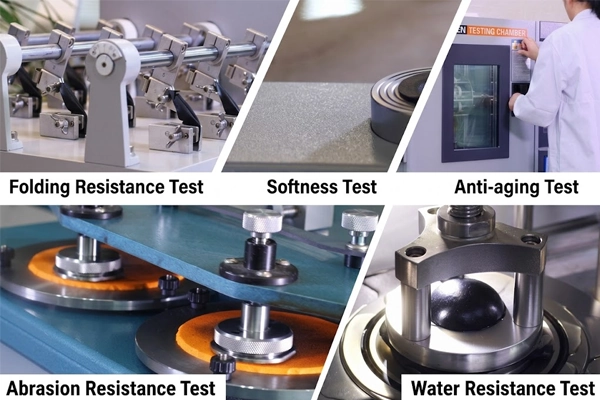
In B2B centralized procurement of occupational safety and health consumables, written test reports are certainly important, but what truly puts the minds of compliance officers and supply chain directors at major manufacturers at ease is the rigorous testing conducted in the manufacturer’s own in-house laboratory. SQG® refuses to use any generic, empty conceptual images downloaded from stock photo libraries; instead, we openly and unreservedly showcase our own professionally certified, state-of-the-art laboratory (Our Test / Innovation Testing) to global buyers.
We understand that for gloves, meeting the basic chemical and physical thresholds of European (EU) and American (ANSI) standards is merely the starting point for entering the supply chains of major manufacturers. To prove our integrity, our technical team at the Quality Inspection Technology Center conducts comprehensive, round-the-clock saturation testing and verification throughout the entire product lifecycle. In addition to routine microscopic chemical chromatography analysis, our in-house laboratory is equipped with a series of highly targeted destructive and real-world simulation test matrices to eliminate latent quality issues caused by manufacturing defects at the source.
As part of our daily quality inspection routine, gloves must pass rigorous testing through multiple stages of extreme physical and environmental simulations:
Bending Test: Simulates the high-frequency gripping motions—thousands upon thousands of times—performed by workers on an assembly line to test the interlocking stability of the resin coating under continuous mechanical deformation, thereby preventing the accelerated leaching of internal residues caused by substrate cracking.
Water Permeability Test: A high-pressure water jet directly impacts the palm coating to precisely map the density of the coating’s porous microstructure, verifying the product’s resistance to oil and wastewater penetration while maintaining the material’s stable, textured finish.
Softness Test: Who says comfort can’t be measured? Our technical team uses precision sensors to quantitatively measure the flexural stiffness of the inner lining framework and the coating. The softer the glove and the lower the friction, the more effectively it can physically prevent mechanical friction from damaging fragile skin.
Ageing Test: “It’s fine now, but what about a year from now?” We use an aging test chamber to simulate the chemical stability of gloves under extreme storage conditions or in workshops with prolonged high heat. This ensures that even after prolonged degradation, the polyurethane molecular chains in the material will never undergo reverse cracking, fundamentally securing long-term compliance with toxicological safety standards.
All experimental testing is subject to real-time on-site verification by lab technicians in white coats at the SQG® laboratory. Only this rigorous, integrated approach—combining microscopic chemical non-toxicity with macroscopic physical durability—can provide multinational giants with the most intuitive, traceable, and risk-free assurance.
Translating Clean PPE into Group-Level ESG Compliance Assets
Fulfilling Social Responsibility (S) in the ESG Ledger
For multinational manufacturing giants or publicly traded companies preparing to expand overseas, if the centralized procurement team treats the purchase of gloves as merely a financial expense, it completely underestimates the capital value of supply chain management. Modern enterprises must not only reconcile financial statements but also align with ESG (Environmental, Social, and Governance) performance metrics. Introducing large quantities of eco-friendly, skin-friendly work gloves into the production floor is the easiest “compliance achievement” for a procurement director to implement within the group.
Procurement teams can directly convert the total value of bulk purchases of OEKO-TEX Standard 100-certified gloves and the number of workers they cover into the most eye-catching, quantifiable, and auditable data in the “Social Responsibility” section of the group’s ESG report. Under the “Occupational Health & Safety” and “Employee Welfare and Workplace Human Rights” metrics, the company’s concrete investments in preventing chemical residue contamination and eliminating the risk of workplace dermatitis at the source are documented in black and white. This strategic approach—elevating the procurement of basic consumables to the status of a Group-level ESG asset—enables audit firms to directly award high ratings, thereby transforming procurement expenditures into compliance-related advantages for the company in the capital markets.
Streamlining Brand Audits for Global Consumer Supply Chains
As multinational contract manufacturers that work directly with top European and American retail brands or international consumer goods giants, supply chain compliance audits are mandatory assessments that are grueling almost every quarter. Many factories often lose points during unannounced audits simply because they cannot produce formal self-certification proving that the work gloves in their production areas are chemical-free. At best, they face a deadline for rectification; at worst, they are immediately disqualified as suppliers.
In such situations, a genuine OEKO-TEX Standard 100 certificate issued by the original manufacturer—one that is verifiable online—serves as the strongest endorsement for contract manufacturers to stand tall. When compliance officers from international brands show up with a long list of banned chemicals and are ready to fight tooth and nail, a non-toxic certificate directly linked to product models and verified through an official certification system is worth more than ten thousand verbal assurances. It proves that your factory has demonstrated a high level of compliance awareness from the very top of the procurement chain, ensuring a smooth passage through the entire supply chain chemical audit and transforming compliance pitfalls into strategic assets that secure major international orders.
De-risking Cross-Border Logistics: Eliminating Customs Chemical Seizures
Beyond addressing audits, fully compliant products can also directly save you massive hidden logistics costs in cross-border trade. Today’s global cross-border logistics and customs clearance procedures are no longer based solely on declared value. Customs authorities in major destination countries such as Europe and the United States conduct extremely rigorous spot checks on imported textiles and chemically impregnated products, and they take a strict “zero-tolerance” approach to violations involving prohibited chemicals exceeding permissible limits.
If gloves contain excessive levels of highly toxic solvents or controlled substances left over from upstream processing, and are flagged during a random inspection by the destination country’s customs authorities during cross-border clearance, the entire shipment faces devastating consequences—including indefinite seizure, mandatory return, or even on-site destruction. This would not only expose large manufacturers’ centralized procurement teams to catastrophic disruptions—such as direct supply cuts leading to production halts—but would also result in the company being blacklisted by customs authorities. Products verified through SQG®’s dual compliance process, however, possess impeccable chemical compliance during customs clearance, eliminating the risk of seizures and fines due to excessive chemical levels, and ensuring that the logistics lifeline of the global supply chain remains unimpeded.
Cross-Linking the Fleet: Procuring Certified Models from the SQG® Portfolio
The MAXGUARD Precision Series (Ultra-Tactile & Allergy-Free Foundation)
For light industrial precision assembly lines that demand extremely high tactile sensitivity and require protection against dermatitis caused by frequent hand friction, the following OEKO-TEX-certified “Pure Fleet” is the optimal choice:
In work environments where tactile sensitivity is pushed to the absolute limit—such as 3C electronics, automotive dashboard assembly, or semiconductor back-end packaging—protective gloves must not only be absolutely pure but also address physical friction injuries caused by material hardening. For these light industrial assembly lines, where workers are prone to sweaty hands and require protection against skin redness and itching, the MAXGUARD series achieves a non-toxic solution directly through its base fabric thread count and coating texture.
B-312-BIO-BL (Classic Black Tech Armor): A 13-gauge recycled RPET eco-friendly base fabric paired with a skin-friendly bio-based PU coating, featuring a classic black-dipped palm, designed specifically for digital precision workshops. While providing a strong, slip-resistant grip, it eliminates the residual sensitizing solvents found in traditional synthetic resins that often exceed permissible limits.
B-312-BIO-G / B-312-BIO-GBL: Offering two exclusive coating color options—gray (G) and high-contrast forest green (GBL)—for visual management in modern factories, these gloves not only feel supple and natural but also perfectly support visual safety compliance audits during corporate EHS inspections.
P-322-BIO: A revolutionary, top-tier, ultra-fine-denier 18-gauge recycled eco-friendly skeleton. This glove is tailor-made for workshops with exceptionally stringent requirements for dust protection and bare-hand sensitivity. The ultra-fine-denier fabric is exceptionally soft, eliminating the physical abrasion caused by coarse fibers on the skin’s fragile barrier. Combined with a highly breathable, soft bio-based PU palm coating, it delivers long-lasting, bare-hand-level breathability even during hot, long shifts, putting an end to skin itching caused by trapped sweat.
The BLADEGUARD Series (High-Performance Non-Toxic Laceration Protection)
Designed for complex, high-risk, heavy-industry environments involving long shifts—such as those involving friction from metal burrs and mechanical cutting—this series achieves the perfect balance between physical protection and toxicological compliance:
In environments such as metal stamping, hardware machining, or heavy-duty logistics operations, frontline workers’ hands are often at risk of severe mechanical lacerations. Traditional cut-resistant gloves, in pursuit of tensile strength, often incorporate large amounts of inexpensive chemical additives during the yarn synthesis and curing stages, resulting in gloves that are stiff, malodorous, and contain excessive levels of toxins. The BLADEGUARD series, however, achieves the ultimate integration of physical cut resistance and chemical non-toxicity.
B3-340-BIO: 13-gauge HPPE/RPET/glass fiber composite cut-resistant gloves. While providing robust resistance to tensile and shear forces, an ultrasonic deep-cleaning process removes all chemical residues hidden in the coating’s microporous structure, ensuring workers face no risk of chemical toxin penetration even after 12 hours of continuous wear during high-intensity cut-resistant operations.
B4-310-BIO: A 13-gauge heavy-duty, tear-resistant framework featuring an ultra-high-density, soft bio-based PU dip-coated palm. While maintaining zero microscopic residue, it significantly extends service life under rigid friction, perfectly transforming corporate procurement of consumables—which would otherwise be written off as expenses—into tangible ESG green compliance assets.
B6-310R-BIO: An extreme heavy-duty cut-resistant “monster” reinforced with steel fibers. Even when facing steel sheet stamping with sharp burrs or severe mechanical friction, its interlocking microstructure ensures the gloves will not fray or shed fibers. More importantly, even under extreme conditions—such as high-frequency friction between steel fibers and resin, and intense heat on the hands—its chemical indicators still fully comply with both REACH SVHC and OEKO-TEX 100 standards, proving its safety with hard data.
People Also Ask: Frequently Asked Questions on Skin-Friendly PPE
Q1: Can a work glove be EU REACH compliant but still fail to meet the OEKO-TEX Standard 100?
It is entirely possible, and this is very common in the global procurement of personal protective equipment (PPE). The EU’s REACH regulation is a broad-based market access regulation for chemicals. Its assessment logic primarily focuses on whether a product contains any substances listed on the SVHC (Substances of Very High Concern) list in concentrations exceeding the 0.1% threshold. In other words, it only checks whether the legal red line has been crossed; it is a static, qualitative compliance screening.
In contrast, OEKO-TEX Standard 100 Class II is a toxicological screening standard specifically tailored for textiles that come into frequent contact with the skin. Its testing criteria are far more rigorous. For example, trace amounts of heavy metal release, free formaldehyde, or residual sensitizing solvents that have not been fully washed out might pass under the broad thresholds of the REACH regulation. However, when subjected to the OEKO-TEX 100 dynamic artificial sweat extraction test—which simulates workshop conditions with repeated rubbing and agitation—these hidden toxins are immediately exposed and result in a failure. Therefore, to ensure that factory workers can eliminate contact dermatitis, large manufacturers’ centralized procurement specifications must strictly enforce both of these standards and conduct dual cross-checks.
Q2: How do centralized procurement teams verify the authenticity of an OEKO-TEX certificate?
When auditing bids, the centralized procurement teams of large multinational manufacturers must never rely solely on PDF screenshots of certificates provided by suppliers, as the industry is rife with tactics such as certificate forgery, misrepresentation of model numbers, or the use of expired certificates to pass inspections. The method for verifying the authenticity of the original manufacturer’s certificate is very straightforward and rigorous.
Procurement compliance officers can log in directly to the Label Check system on the official OEKO-TEX® website. On the verification page, they enter the unique certificate number (Certificate Number) provided by the supplier. The system instantly displays the certificate’s real-time status, including whether it is valid, whether the company name associated with the certificate matches the bidding entity, and—most importantly—the product models and material scope covered by the certificate. If the model numbers specified in the supplier’s bid (e.g., B-312-BIO or P-322-BIO) are not explicitly listed within the “Scope” displayed by the official system, this constitutes a classic case of “product not matching the description,” and must be rejected outright during the audit.
Q3: Does a bio-based PU coating naturally lower the risk of chemical allergies compared to fossil-based PU?
The answer is yes. This is not merely an environmental marketing concept, but rather a purely microscopic material science mechanism inherent to the resin. To maintain high elasticity and curing stability during synthesis in chemical plants, traditional petrochemical-based PU (polyurethane) coatings rely heavily on petrochemical byproducts and strong solvents in their upstream synthesis processes. This often results in high levels of highly sensitizing chemical intermediates remaining in the finished gloves.
In contrast, the Bio-Based PU Polyurethane Coating technology used by SQG® replaces traditional petrochemical-derived raw materials with renewable plant-based polyols right at the source of resin synthesis. This transformation in source materials means that the molecular structure is naturally free of the specific sensitizing factors associated with petrochemical byproducts. Furthermore, plant-based resins inherently offer superior microporous breathability, significantly reducing sweat buildup on workers’ hands during long shifts and preventing the skin barrier from softening and becoming compromised by sweat. By eliminating allergenic chemical residues at the source and physically reducing sweat buildup, bio-based gloves effortlessly pass the rigorous OEKO-TEX 100 testing—this is the core reason behind their success.
(For a comprehensive technical breakdown of how bio-based resins reduce carbon emissions and their microscopic material structure, please refer to our dedicated technical white paper: Explore Bio-Based Coating Technology in Carbon Emission Mitigation]to learn how plant-based materials can help companies account for their Scope 3 carbon footprint assets.)
Conclusion: Specifying Certified Non-Toxic Protection for Zero-Risk Procurement
In summary, within the bidding and procurement logic of modern industrial enterprises, central procurement teams and EHS departments must break free from past rigid thinking and biases: the “physical protection” provided by personal protective gloves and “microscopic toxicological compliance” are by no means mutually exclusive. Through a comprehensive, closed-loop process involving multiple stages of continuous ultrasonic deep cleaning and high-temperature thermal desorption, combined with precise GC-MS (gas chromatography–mass spectrometry) analysis conducted in our in-house laboratory, SQG® has proven its safety at the very source of the materials. —protective consumables can fully meet the stringent physical cut resistance and abrasion resistance requirements of EN 388 while simultaneously reducing hidden toxic liabilities—such as DMFa, heavy metals, and sensitizing azo dyes—to levels well below detectable thresholds.
For centralized procurement directors facing the pressure of multinational brand supply chain compliance audits and group ESG quantitative metrics, choosing skin-friendly gloves certified under OEKO-TEX Standard 100 Product Class II is not only about protecting frontline workers’ skin barriers from contact dermatitis but also a strategic, long-term investment that clears away the hidden pitfalls in cross-border logistics and multinational audits. Uncompromising safety and visible compliance—these are the true zero-risk procurement assets that stand up to data verification.
Zero-Risk Group Procurement Compliance Channel:
If you are drafting a PPE procurement bid for the new quarter or urgently need to provide non-toxic self-certification for a chemical audit of a multinational brand buyer’s supply chain, click “Explore Sustainable Compliance Category Portfolio” now to access our comprehensive sustainable and green compliance category matrix.
You can contact our senior technical application engineers directly online to request, free of charge, official OEKO-TEX certificates with factory-level batch traceability, REACH SVHC non-toxicity white papers, and a Complimentary Sample Pack—customized for long-term shift testing at major manufacturing facilities. Ensure your supply chain compliance audits run smoothly from the very first pair of sample gloves.


