

Introduction: The Invisible Hazard in Heavy Chemical Operations
The Legal and Health Risks of Sub-Microscopic Chemical Exposure
At chemical storage and transportation sites—such as those involved in large-scale petrochemical refining, semiconductor wafer etching, industrial heavy oil decontamination, and transoceanic energy projects—chemical agents exhibit covert, molecular-level penetration that erodes workers’ hands. Unlike injuries visible to the naked eye—such as those caused by heavy objects or sharp edges, which involve severe mechanical damage—the migration of hazardous chemical molecules often occurs covertly under the false impression that “gloves are intact.”
When frontline workers are exposed for extended periods to high concentrations of volatile organic compounds (VOCs), aromatic hydrocarbon solvents (such as toluene and xylene), hydrogen sulfide-containing fluids, and highly corrosive acids and bases—such as concentrated sulfuric acid and sodium hydroxide—harmful molecules can directly migrate through the microscopic free volume between polymer chains. When toxic substances migrate through the inner liner and come into contact with the skin, the initial peeling of the stratum corneum and chemical erythema are easily mistaken by workers for “contact dermatitis” caused by ordinary heat, humidity, and sweating. However, as exposure time accumulates, fat-soluble toxic solvents are absorbed in large quantities by the capillary network beneath the dermis, entering the body’s systemic circulation and inducing bone marrow suppression, peripheral neuropathy, and irreversible liver and kidney parenchymal lesions.
In the field of industrial safety and engineering law, a long-standing industry challenge for EHS departments and team leaders is that relying solely on visual inspection—such as “no visible cracks” or “no water leakage”—is fundamentally insufficient to determine whether protective equipment has completely failed. When polymer materials are subjected to continuous exposure to chemical agents, their microscopic cross-linked networks may have long since been completely breached by the solvent, entering a state of saturated desorption. At this point, a sealed microenvironment containing a high concentration of toxic liquid has formed inside the glove. Without a molecular breakthrough time—determined by an authoritative laboratory in accordance with international standards—as a mandatory replacement benchmark, frontline workers who repeatedly wear the gloves without knowing the true condition are effectively immersing their hands directly in toxic chemical solutions.
The Procurement Paradox: Waterproof Does Not Mean Chemical-Safe
In the Group’s bulk bidding and procurement of industrial products for foreign trade, many materials departments often fall into a cognitive trap deliberately created by low-end suppliers: they confuse “physical water and oil resistance” for routine maintenance and upkeep with “chemical resistance” required for high-risk industrial applications.
To secure low-price bids, many small-scale workshops label single-layer, thin-coated latex gloves—intended for general agricultural, forestry, and civilian use—or low-crosslinked PVC work gloves as “Oil Proof” or “Waterproof” and directly supply them to heavy industrial and chemical sites. These unmodified, general-purpose polymers do indeed remain impermeable when exposed to pure water or slow-moving cold water; however, upon contact with strongly polar inorganic acids, high-shear crude oil from drilling operations, or ketone-based cleaning agents, the low-molecular-weight plasticizers within the coating are rapidly leached out within minutes. This is accompanied by irreversible molecular chain swelling and softening of the polymer, the collapse of microscopic pores, and even complete molecular permeation within less than 15 minutes of contact with highly toxic media—completely breaching the company’s safety defenses.
To avoid workers’ compensation claims and hefty fines for work stoppages and corrective actions resulting from such false advertising, global EPC groups and multinational procurement teams must establish an ironclad rule in their bidding documents and technical specifications: any hand protection equipment entering chemical-handling work areas must be certified under an international compliance system centered on the EN ISO 374 chemical glove standards. From the “deal-breaker” requirements for hydrostatic pressure and gas-tightness (EN ISO 374-2), to standardized penetration breakthrough time testing for specific chemical agents (EN 16523-1), to monitoring the rate of physical puncture resistance degradation after wetting (EN ISO 374-4), only by relying on rigorous mechanical testing and data curves can a true molecular-level protective barrier be established in deepwater drilling, acid washing tanks, and hazardous material transfer stations.
To address the molecular characteristics of different chemicals (based on their CAS numbers) and the combined mechanical hazards of extreme operating conditions, a systematic evaluation covers multidimensional protective assets, including double-layer nitrile full-immersion gloves, high-purity heavy-duty PVC, and chemical-resistant composite impact-resistant exoskeletons. We recommend consulting the core category outline: Chemical & Liquid Resistant Work Gloves.
Legal and Regulatory Implications: OSHA Penalties and Chemical MSDS Audits
MSDS/SDS Chemical Compatibility Requirements
In modern heavy chemical refineries, semiconductor manufacturing facilities, and multinational energy EPC projects, the top compliance priority for EHS (Environment, Health, and Safety) engineering departments is to strictly follow the personal protective equipment (PPE) guidelines specified in Section 8 (Exposure Controls / Personal Protection) of the Safety Data Sheet (SDS, formerly known as MSDS) Section 8 (Exposure Controls / Personal Protection).
Many procurement teams often fall into the trap of assuming that gloves with basic abrasion-resistant or waterproof properties are sufficient for all plant operations. However, the data in Section 8 of the SDS is not a general recommendation but a legal basis for compliance derived from rigorous laboratory chemical compatibility testing. For example, when the SDS for a petrochemical tank cleaning operation explicitly states that operators must wear nitrile or butyl rubber gloves with specific molecular barrier capabilities when exposed to certain aromatic hydrocarbons or organic solvents, on-site safety supervisors have the legal authority to immediately reject any non-compliant, generic gloves.
The selection of polymer materials allows for no room for error:
Selective molecular polar repulsion: Polar and nonpolar solvents erode polymer network structures through entirely different pathways. If ordinary latex gloves—intended for general water-based acid and alkali cleaning—are used directly in workstations involving contact with organic solvents such as esters or ketones, the glove material will swell, soften, and undergo structural depolymerization within minutes;
Strict constraints on exposure thresholds: The personal protective equipment standards listed in the Safety Data Sheet (SDS) directly correspond to Occupational Exposure Limits (OELs). Any deviation from these standards or blind procurement of low-end substitutes will directly result in chemical molecules silently breaching the protective barrier and entering the worker’s body.
The Hidden Liability of Counterfeit or Mismatched Hand Protection
In supply chain audits of multinational engineering contractors and large manufacturing enterprises, the use of non-compliant, counterfeit, or severely mismatched hand protection equipment often creates extremely serious legal risks and financial liabilities. If frontline workers in chemical-handling positions suffer severe chemical burns to the skin, necrosis of the fingertips, or systemic poisoning due to chemical penetration of their gloves, the consequences for the company will extend far beyond mere reimbursement for workers’ compensation medical expenses.
Under the regulatory framework of the U.S. Occupational Safety and Health Administration (OSHA)—such as 29 CFR 1910.138, the Hand Protection Standard—and the European Union’s stringent occupational safety directives, if an accident investigation reveals that a company has the following compliance violations, it will trigger devastating regulatory penalties:
Heavy Regulatory Shutdown Penalties: If safety and health enforcement agencies discover at the accident site that a company has failed to provide chemical-resistant gloves meeting statutory penetration standards as required by the Safety Data Sheet (SDS), or has procured counterfeit gloves lacking certification from a recognized notified body or bearing forged compliance certificates, the company will face immediate and severe shutdown penalties and exorbitant fines for noncompliance;
Exorbitant Workers’ Compensation Claims and Civil Liability Lawsuits: In subsequent legal proceedings, the legal representatives of injured workers often name the source of the supply chain, the procurement decision-makers, and those responsible for on-site EHS management negligence as co-defendants. Without rigorous compliance audit records and proof of material compatibility from the original manufacturer, the company will be powerless to defend itself against exorbitant civil damages, punitive damages, and the long-term collapse of its corporate reputation.
Therefore, conducting compliance reviews early in the process to thoroughly eliminate counterfeit and substandard protective equipment at the source, and adopting compliant chemical-resistant gloves with end-to-end data traceability, is an unshakable legal and operational baseline for ensuring the stable operation of multinational projects.
Failure Mechanisms: Definitions of Penetration, Permeation, and Degradation
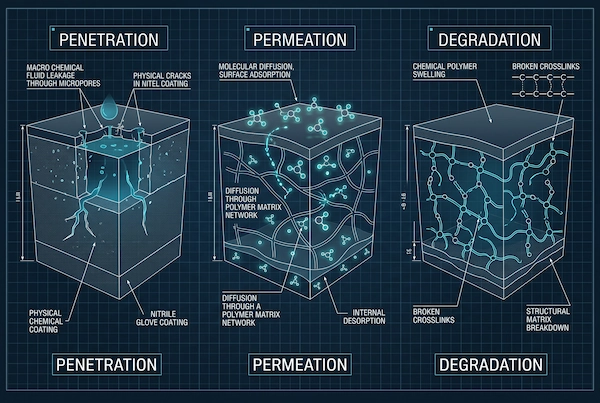
When evaluating the protective barrier of industrial chemical-resistant gloves, safety engineering teams must strictly distinguish between three physically and chemically distinct failure modes. The frequent occurrence of chemical burn incidents on the front lines of many companies is essentially due to confusion regarding the distinction between macroscopic liquid leakage and microscopic molecular diffusion.
Macroscopic Penetration: Porosity and Pinhole Leakage
Penetration is a macroscopic, physical form of liquid leakage failure. It refers to the physical flow of chemical liquids at the non-molecular level through visible holes, microscopic pores, sewing pinholes, coating bubbles, or injection molding cracks in the protective glove material.
In accordance with the internationally recognized EN ISO 374-2 standard, gloves must undergo rigorous macroscopic leak testing during both factory production and incoming inspection:
Water Leak Test: The glove is suspended vertically and filled with a specified volume of test water at room temperature; it is then left to stand for several minutes under standard hydrostatic pressure for observation. Inspectors closely monitor the glove’s outer surface for water droplets or wet spots;
Air Leak Test: Using a specialized airtight fixture, the glove’s cuff is sealed and pressurized with air. The pressurized glove is then fully submerged in a clean water tank, and the glove is observed for continuous bubbles escaping from the fingertips, palm, and sides;
“One-Flaw-Disqualification Mechanism”: In Acceptable Quality Level (AQL) acceptance sampling, if even a single bubble or a tiny water droplet is detected during the hydrostatic or air leak test, that glove is immediately deemed defective. Gloves with penetration defects are classified as substandard and are strictly prohibited from entering any chemical-handling work areas; furthermore, they are ineligible for subsequent advanced impermeability and chemical resistance testing.
Molecular Permeation: Three-Step Chemical Sorption and Diffusion
Even if a pair of gloves fully passes the macroscopic airtightness hydrostatic pressure test specified in EN ISO 374-2, and even if their surface is smooth and flawless with no microscopic pinholes, hazardous chemicals can still breach the barrier through molecular-level permeation. Permeation is a physicochemical mass transfer process at the microscopic level, typically manifesting as an irreversible three-step diffusion sequence:
Outer-layer Sorption: Liquid or volatile chemical molecules come into direct contact with the polymer coating on the glove’s outer surface and, based on the principle of like dissolves like or surface chemical affinity, are rapidly absorbed and dissolved by the outer layer of the polymer elastomer;
Diffusion through Intermolecular Gaps: Driven by a significant concentration gradient between the glove’s outer and inner walls, chemical molecules begin to undergo Brownian motion and shuttle migration through the microscopic free volume between polymer chains, gradually permeating and diffusing from the outside to the inside;
Desorption at the Inner Surface: After a certain period of continuous migration, the chemical molecules eventually reach the glove’s inner fabric layer, where they detach from the polymer network and volatilize or precipitate into the glove’s interior space, coming into direct contact with the worker’s skin in the enclosed environment.
The time interval from the moment the chemical comes into contact with the glove’s outer layer until a specific critical penetration rate is detected on the inner surface is defined as the glove’s “Normalized Breakthrough Time.”
Physical Degradation: Swelling, Embrittlement, and Mechanical Decay
Another major critical hazard associated with permeation is material degradation. Degradation refers to the harmful changes in the inherent physical and mechanical properties of glove materials that occur when they come into contact with chemicals.
When chemical media penetrate the polymer matrix, the material’s microscopic cross-linked network suffers severe damage:
Excessive Swelling: Solvent molecules force their way between polymer chains, widening the intermolecular spacing. This causes the originally dense and rigid rubber layer to rapidly absorb liquid, swell, soften, and become sticky, resulting in increased thickness and decreased density;
Plasticizer Leaching and Embrittlement: Upon contact with mineral oil, diesel, or organic acids, the liquid plasticizers in the rubber compound formulation are easily extracted, causing the polymer chains to lose their flexibility. The rubber surface hardens and rapidly develops a network of dry cracks;
Mechanical Decay: In evaluations conducted according to the EN ISO 374-4 standard, the most direct consequence of degradation is a precipitous drop in tear resistance, abrasion resistance, and, crucially, puncture resistance. Gloves that have undergone severe swelling or embrittlement—even if their theoretical barrier life has not yet expired—will tear instantly under extremely low mechanical shear forces when handling barbed pipes or tightening sharp flange bolts, causing the chemical barrier to collapse completely under physical friction.
Deconstructing EN ISO 374-1: Type A, B, and C Classifications
EN ISO 374-1:2016+A1:2018, part of the European protective glove standards system, has completely done away with the earlier vague practice of defining the scope of protection based solely on general descriptions. The new regulation requires that all industrial chemical protective gloves entering the EU market or participating in global standard-adoption programs must undergo quantitative testing against a standardized list of chemical reagents and be classified into three compliance levels: Type A, Type B, and Type C.
The 18-Test Chemical Reagent Matrix (Letter Codes A to T)
To cover the extremely complex systems of corrosive media found in modern heavy chemical, semiconductor, and biopharmaceutical industries, EN ISO 374-1 established an official test matrix comprising 18 representative challenge chemicals. Each reagent corresponds to a standard uppercase letter code (Code Letter), covering core categories ranging from highly volatile solvents to strongly oxidizing acids and bases:
Code A (Methanol): A primary alcohol compound and a highly mobile, polar solvent commonly used in fine chemical synthesis and industrial extraction;
Code B (Acetone): A polar ketone solvent that causes severe swelling and delamination of standard neoprene or natural rubber;
Code C (Acetonitrile): An organic nitrile solvent commonly used in pharmaceutical crystallization and chromatographic analysis processes;
Code D (Dichloromethane): A halogenated hydrocarbon commonly used in industry as a paint stripper and highly effective cleaning agent, with extremely high penetration rates for the vast majority of polymers;
Code E (Carbon disulfide): A sulfur-containing organic solvent with high fat solubility and extremely low surface tension;
Code F (Toluene): An aromatic hydrocarbon solvent and a major component of heavy petroleum oils and industrial diluents;
Code G (Diethylamine): An organic aliphatic amine that is strongly alkaline and corrosive;
Code H (Tetrahydrofuran): A heterocyclic organic ether with extremely strong solubility in resins;
Code I (Ethyl acetate): A highly volatile ester solvent and a core medium in printing ink and paint production facilities;
Code J (n-Heptane): A nonpolar, saturated aliphatic hydrocarbon and a benchmark test medium for industrial cleaning and light fuel oils;
Code K (Sodium hydroxide 40%): A strong inorganic base used for pipeline degreasing, acid-base neutralization, and alkali etching in papermaking;
Code L (Sulfuric acid 96%): An extremely strong, highly oxidizing inorganic acid; its high-heat dehydration properties cause severe damage to glove substrates;
Code M (Nitric acid 65%, 65% nitric acid): A strongly oxidizing acid and the primary corrosive agent in metal pickling and passivation processes;
Code N (Acetic acid 99%, 99% glacial acetic acid): A highly concentrated organic carboxylic acid with rapid penetration and high corrosivity;
Certification Thresholds for Types A, B, and C
Based on the gloves’ actual permeation performance against the 18 standard chemicals listed above, the certification system has established three clearly defined certification thresholds:
Type A Certification (Full Chemical Protection, Very High Protection Level):
The gloves must be tested against at least 6 of the 18 standard chemicals, and the measured permeation resistance level for each of these 6 chemicals must reach Level 2 or higher (i.e., the standard breakthrough time for each chemical must be no less than 30 minutes). The 6-letter codes corresponding to the passed tests must be listed in order below the chemical protection pictogram on the CE mark of qualified products. This rating is suitable for large-scale integrated petrochemical facilities involving cross-medium operations, hazardous chemical loading/unloading and transshipment hubs, and deep-sea oil drilling mud operations;
Type B Certification (Moderate Directional Chemical Protection Rating):
The gloves must achieve a Level 2 or higher for at least 3 challenge chemicals from the standard list (with a breakthrough time of no less than 30 minutes for each), and the corresponding 3-letter codes must be printed below the pictogram. This level is intended for single-medium assembly line operations, such as dedicated electroplating and pickling tanks, paint mixing stations using specific solvents, or degreasing and cleaning stations for machining;
Type C Certification (Low Splash Protection Level):
Gloves need only achieve Level 1 protection against at least one of the 18 chemicals on the list (with a breakthrough time of no less than 10 minutes), and only a single-letter code is indicated below the pictogram. Type C gloves must never be used for immersion or prolonged contact operations; they are limited to serving as an emergency barrier against occasional, minimal liquid splashes.
Permeation Breakthrough Time (BTT) Performance Tiers
Based on the standard breakthrough time (BTT) measured by the laboratory under constant temperature conditions of 23 degrees Celsius, EN ISO 374-1 classifies glove permeation resistance into six performance tiers:
| Permeation Performance Level | Measured Breakthrough Time (Minutes) | Protection Capability & Workstation Operational Assessment |
| Level 1 | 10 to 30 min | Critical Splash Protection: Applicable only to accidental spills or splashes of trace amounts of chemicals; if exposed to liquid, the garment must be removed and replaced immediately within 10 minutes. |
| Level 2 | 30 to 60 min | Short-Term Controlled Exposure: Suitable for brief handling of small containers, sampling and analysis, or quick-assembly and quick-disassembly maintenance tasks. |
| Level 3 | 60 to 120 min | Moderate-Duration Exposure: Covers continuous work processes such as routine workshop fluid loading, equipment scrubbing, and single-batch material preparation. |
| Level 4 | 120 to 240 min | Full-Shift Continuous Protection: Provides stable protection against chemical exposure for more than half a standard shift; suitable for maintenance inside and outside storage tanks and fluid discharge from long pipelines. |
| Level 5 | 240 to 480 min | High-Intensity, Heavy-Duty Immersion: Supports continuous contact with heavy-duty chemical media throughout an entire production shift, providing ample safety margin for immersion operations. |
| Level 6 | > 480 min | Extreme-Duration Molecular Barrier: With a breakthrough time exceeding 8 hours, it offers seamless protection across shifts and is suitable for high-risk crude oil slurry circulation and extreme deep-well heavy-liquid operations. |
Comparison of Transatlantic Testing Protocols: EN 16523-1 vs. ASTM F739
In transnational petrochemical projects, deepwater oil and gas exploration, and large-scale international EPC project tenders, technical procurement teams often find themselves reviewing two chemical resistance test reports for gloves from different authoritative laboratories: one based on the European standard EN 16523-1 (which replaced the original EN 374-3), and the other based on the North American standard ASTM F739. Many procurement professionals without a technical background are prone to a serious misconception: they simply judge the quality of gloves by comparing the “breakthrough time” in minutes listed on the reports.
In fact, there are significant underlying differences in the logic behind chemical permeation testing standards on both sides of the Atlantic. Without understanding the distinctions between the two standards regarding mechanical threshold criteria and laboratory sampling mechanisms, blindly substituting glove models could very well expose frontline workers to high-risk situations with inadequate safety protection.
Discrepancies in Normalized Permeation Rate (NPR) Calculations
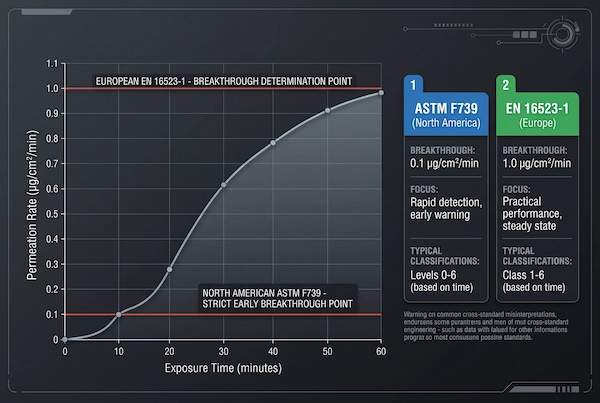
The most fundamental technical discrepancy between the two standards lies in their completely different quantitative thresholds for determining the endpoint of the “Normalized Permeation Rate” (NPR).
The threshold for the European standard EN 16523-1:
The European standard sets the threshold for the permeation rate at which a chemical penetrates the glove specimen and enters the test chamber at 1.0 micrograms per square centimeter per minute (1.0 ug/cm²/min). Only when the sensor detects that the flow rate of chemical molecules passing through a unit area of the glove reaches or exceeds this fixed value will the timer stop, and the elapsed time at that moment is recorded as the glove’s “Normalized Breakthrough Time”;
The threshold for the North American standard ASTM F739:
The North American testing system adopts a more stringent and conservative toxicological protection assumption. ASTM F739 strictly sets the threshold for normalized permeation rate at 0.1 micrograms per square centimeter per minute (0.1 µg/cm²/min). This definition means that as soon as the inward permeation rate of chemical molecules reaches one-tenth of the European standard’s threshold, the system deems the protective barrier to have been officially “breached” and records the endpoint.
In quantitative terms, the sensitivity threshold of ASTM F739 is exactly 10 times stricter than that of EN 16523-1. This means that when gloves are tested according to the North American standard, the timer stops very early during the initial permeation phase involving extremely small amounts of molecules; whereas when tested according to the European standard, the timer continues to run until the permeation rate increases to ten times the concentration before the test is considered complete.
Closed-Loop Testing Cell Architecture and Sensor Dynamics
In addition to the significant differences in how the permeation rate endpoint is determined, the two sets of standards also exhibit highly precise engineering constraints regarding the physical hardware configuration of the laboratory and the dynamic sampling logic of the analytical sensors.
A standard chemical permeation test apparatus consists of a precision-machined two-chamber permeation cell. A sample of the polymer coating from the test glove is clamped flat in the center, forming an absolutely isolated, sealed barrier, while the left and right chambers perform distinct fluid functions:
Donor Chamber: The liquid or gaseous test chemical (e.g., pure toluene, 96% sulfuric acid, or n-heptane) is directly injected into this chamber, which maintains a constant hydrostatic pressure and is controlled by a standard thermostatic water bath at 23 degrees Celsius (±1 degree);
Receptor Chamber and Collection Medium: The receptor chamber is responsible for continuously collecting microscopic molecules desorbed from the inner surface of the glove material. For highly volatile organic solvents or gases, the receptor chamber is purged in a closed-loop system using high-purity, dry nitrogen (or clean air that has been degreased and dehumidified) at a constant flow rate; for less volatile, nonpolar acidic or basic liquids, the receptor chamber is filled with high-resistance, ultrapure deionized water as the carrier medium;
High-frequency closed-loop sampling by the online analyzer: The collection medium is circulated at a constant flow rate with micron-level precision into the downstream detection instruments. Gas chromatographs (GC), flame ionization detectors (FID), ultraviolet-visible spectrophotometers (UV-Vis), or precision online microconductivity meters continuously record concentration changes of chemical substances at a high sampling frequency—multiple times per minute—and plot a complete dynamic permeation curve in real time, ranging from “not detected” to “steady climb” to “steady-state equilibrium.”
Transatlantic Procurement Pitfalls: Accurately Converting Test Reports
By understanding the underlying discrepancies in the testing mechanisms described above, transnational supply chains can avoid several serious “conversion pitfalls” when comparing technical documentation and conducting procurement tenders:
Why is the breakthrough time for the same gloves always significantly shorter in ASTM reports than in EN reports?
Even with identical coating thickness, production batch, and polymer formulation, the breakthrough time measured for the same polymer glove in an ASTM F739 test will inevitably be significantly shorter than the data obtained under the EN 16523-1 test. For example, when a heavy-duty nitrile glove is tested against a specific aromatic hydrocarbon solvent, an ASTM F739 report may show a breakthrough time of 45 minutes, while an EN 16523-1 report may easily measure a time exceeding 90 minutes (corresponding to Level 3). This in no way implies that the glove’s physical chemical resistance is reduced in North America; it is purely because the ASTM evaluation endpoint is set at an extremely low concentration stage earlier in the permeation ramp curve;
It is strictly prohibited to perform proportional division conversions in bid specifications.
Some inexperienced procurement officers, when compiling cross-regional comparison tables, mistakenly attempt to use linear conversion formulas—such as directly multiplying “European standard minutes by a fixed coefficient”—to estimate performance under North American standards. However, molecular diffusion pathways within polymeric materials are highly nonlinear. The time required for the penetration rate to rise from 0.1 µg/cm²/min to 1.0 µg/cm²/min depends entirely on the swelling kinetics curve of the polymer under chemical attack; there is absolutely no fixed proportional multiplier between the two;
Establish a Penetration Test Report Review Mechanism
When reviewing international test certificates submitted by suppliers, companies must never rely solely on the simple “minutes” figure or “Level” rating on the conclusion page. Procurement technicians must require suppliers to provide the full text of the original test reports issued by authoritative notified laboratories such as SATRA, Intertek, or UL, and directly verify the “Permeation Curve” and “Temperature Fluctuation Control Log” within the reports. Verifying whether the test was integrated using a normalized endpoint of 0.1 or 1.0 is essential for making objective, rigorous, and safety-compliant selection decisions that meet mandatory local regulatory requirements in complex transatlantic standard-based tenders.
The Degradation Dilemma (EN ISO 374-4): Overcoming Molecular Swelling
In the analysis of protective failure in industrial chemical exposure scenarios, a common and highly deceptive phenomenon is this: a particular model of chemical-resistant glove may clearly demonstrate a molecular breakthrough time of several hours in static laboratory reports, yet when worn by workers on-site, the palm area shows extensive abrasion or tearing of the rubber layer in less than half an hour, leading to chemical burn incidents.
The root cause of this vast disconnect between theoretical and field performance lies in the fact that many procurement technical specifications have long overlooked the latent damage caused by material degradation to physical and mechanical strength. In complex heavy-industry workshops, purely static molecular permeation protection is merely the baseline; whether the glove matrix can maintain material integrity under the combined effects of chemical wetting and mechanical loads is the critical line of defense that determines life or death.
Quantifying Puncture Resistance Loss After 60-Minute Exposure
To eliminate the blind spot where companies “focus solely on impermeability while ignoring mechanical degradation,” the European standard EN ISO 374-4 established a mandatory test method for chemical degradation resistance. The core logic of this procedure is to quantitatively evaluate a material’s molecular resilience by precisely measuring the extent of mechanical puncture resistance degradation in the glove material before and after immersion in chemical reagents.
The standard test procedure is extremely rigorous:
Blank Reference Force Calibration: Standard circular specimens are cut from the palm or back of gloves from the same batch that have not been exposed to any chemicals. These are placed on a high-precision mechanical tensile and compressive testing machine, where a hard alloy probe of a fixed specification is pressed downward at a constant speed. The peak force required to puncture the specimen is recorded (labeled as the initial puncture force, P0);
60-Minute Continuous Immersion at a Constant Temperature: Another set of identically cut parallel specimens is fully immersed in the test chemical agent and kept continuously immersed for 60 minutes under a standard constant temperature of 23 degrees Celsius to ensure sufficient adsorption and swelling of the chemical molecules within the polymer network;
Determination of residual penetration force after exposure: Remove the specimen from the chemical solution and gently blot the surface to remove any excess liquid. Immediately reinstall it into the testing machine fixture within the specified time and perform the same constant-speed penetration failure test again. Record the peak penetration force required for failure at this point (labeled as post-exposure penetration force P_exposed);
Calculation of Degradation Percentage: Quantify the percentage using the standard degradation rate assessment formula: Degradation Percentage (DR) = (P₀ – P_(exposed)) / P₀ * 100%
The degradation percentage (DR) obtained from the test directly reflects the microscopic damage state of the polymer network structure following chemical corrosion:
Positive degradation (DR greater than 0): Indicates that typical swelling and softening occurred after the glove came into contact with the chemical, resulting in a significant reduction in puncture resistance. For example, a measured degradation rate of 45% indicates that, after only one hour of contact with the chemical, the glove’s original mechanical puncture barrier was reduced by nearly half, making it extremely susceptible to puncture by fine metal particles or rough burrs;
Tribological Failure Under Combined Chemical and Shear Stress
In petrochemical refining facilities, offshore oil production pipelines, and heavy acid washing processes, it is virtually impossible for workers to remain in a “stationary, soaking state.” On-site workers must perform high-intensity tasks such as tightening high-pressure flange bolts, dragging oil-coated steel cables, handling rusty metal drums, and operating heavy, rigid industrial valves. This “chemical-mechanical composite environment,” characterized by the combined effects of chemical solvent erosion and dynamic mechanical shear friction, is the root cause of rapid degradation of the glove’s palm surface.
When polymer coatings (such as traditional single-layer pure PVC or low-density nitrile) undergo positive degradation and excessive swelling, solvent molecules break the van der Waals bonds between polymer chains. At this point, the glove coating becomes spongy, sticky, and soft on a macroscopic level, and its surface shear yield strength plummets dramatically. In this softened state, as soon as a worker grips the rough metal valve wheel—which bears machining marks—the microscopic protrusions on the metal surface act like tiny planer blades, easily cutting into the swollen polymer surface.
Under continuous torsional shear and high axial compressive stress, the already swollen polymer coating not only experiences frictional shear resistance several times higher than under normal conditions but also suffers severe delamination and abrasive wear due to the failure of molecular chain anchoring. A coating that was originally capable of withstanding 8 hours of static impermeability is often worn through and peeled off within 20 to 30 minutes of operation, and the exposed, fragile fabric lining is then rapidly permeated by the chemical medium.
To fundamentally address the mechanical shear failure caused by chemical swelling, it is essential to enhance the molecular cross-linking density of the polymer matrix in the material formulation to suppress excessive liquid absorption, while simultaneously incorporating microscopic adsorption grooves and shear-resistant three-dimensional textures into the palm’s geometric structure to specifically disperse viscous fluids and reduce interfacial resistance.
For a detailed mechanical analysis of how microporous fine-sand adsorption and three-dimensional granular textures on the palm surface balance hydrodynamic drainage, provide a stable critical static coefficient of friction, and protect the underlying rubber film from severe shear tearing under conditions of heavy crude oil, diesel, and viscous oil-based slurry erosion, please refer to the special issue on interfacial tribology engineering: Sandy Finish vs. PVC Dot Grip Gloves: Palm Friction Mechanics in Viscous Fluids.
Technical Portfolio Alignment: Deploying the SQG Chemical Barrier Matrix
In centralized procurement specifications for multinational engineering contractors, heavy chemical refineries, and the automotive industry, a single material formulation can never universally cover all high-risk chemical exposure scenarios. When exposed to aliphatic alkanes, aromatic hydrocarbons, organic solvents, and high-concentration, strongly oxidizing inorganic acids and bases, different polymer resins exhibit distinct differences in molecular polarity repulsion and resistance to swelling.
Based on deep molecular modification, multi-layer automated continuous impregnation, and an integrated injection-molding process that combines chemical resistance with impact resistance, SQG has developed three flagship chemical-resistant protective models tailored for various severe operating conditions. These three core SKUs form a multi-layered defense system ranging from highly agile dual-layer leak prevention and fully submerged operations involving strong acids and alkalis to deep-water drilling applications requiring impact and erosion resistance.
Engineering Specifications Across SQG’s Flagship Chemical-Resistant Glove Models
To provide corporate materials departments and on-site EHS engineers with a clear, cross-product reference for technical selection, the following table compares the actual test parameters of three flagship models in terms of polymer systems, lining weave density, chemical resistance ratings, and palm engineering design:
| Key Engineering and Technical Specifications | SQG® P-901 | SQG® P-902 | SQG® P-286R |
| Polymer Shell Base Material | Proprietary PVC/Nitrile Polymer Blend Modified Resin | High-purity, dense, plasticized pure PVC homopolymer resin | Dual-layer engineered coating: dense, smooth nitrile base layer + microporous foamed nitrile top layer |
| Lining Structure and Weave Count | 13-gauge Ergonomic Seamless Nylon-Woven Liner | 13-gauge high-strength seamless nylon-blend ultra-fine glass fiber liner | 15-gauge lightweight, ultra-soft, seamless, high-density polyester knit liner |
| EN ISO 374-1 Certification Levels | Type A / Type B (Long-lasting resistance to hydrocarbon and oil-based fluids) | Type A (Full immersion protection against high-concentration strong inorganic acids and alkalis) | Type B (continuous oil resistance and protection against trace chemical splashes) |
| Key Protective Chemical Media | Aliphatic hydrocarbons, crude oil components, diesel, oil-based drilling mud | 96% concentrated sulfuric acid, 40% sodium hydroxide, strong inorganic acids and bases | Lubricants, cutting fluids, hydraulic fluids, kerosene, water-based coolants |
| Microscopic Grip Design on the Palm | Raised polymer extruded and injection-molded PVC anti-slip granules | Fine-sand microporous roughened anti-slip treatment (Sandy Finish) | Open-cell microporous foam with breathable, oil-absorbing texture (Foam Nitrile) |
| Mechanical Impact Resistance and Cut Resistance Features | Highly elastic and tough TPR impact-resistant exoskeleton providing full coverage of the back of the hand and finger bones | Segmented high-cushioning TPR impact-resistant armor on the back of the hand and knuckles | Designed for ultra-high hand dexterity; no heavy-duty TPR reinforcement |
| Cuff Engineering Design | Extended, heavy-duty rigid safety cuff (Safety Cuff) | Extended heavy-duty rigid safety cuff (Safety Cuff) | Highly elastic, snug-fitting ribbed knit dust-proof cuff (Knit Wrist) |
Petrochemical Extraction and Hydrocarbon Defense: SQG® P-901 Deployment
On offshore semi-submersible drilling rigs, in mud circulation tanks for onshore deep-well drilling, and at large crude oil storage and transportation facilities, workers are constantly exposed to oil-based drilling fluids (OBM), high-concentration hydrocarbon well-flushing fluids, and heavy crude oil fractions.
When ordinary single-layer pure PVC gloves are exposed to crude oil and diesel with high aromatic content, the plasticizers within the rubber layer are easily extracted by hydrocarbon solvents, leading to critical issues such as hardening, drying out, and cracking of the rubber surface within just a few days. Meanwhile, while ordinary single-layer thin nitrile gloves are oil-resistant, they struggle to withstand the high-frequency impacts from sharp rocks and the compression from the drill string in demanding drilling environments.
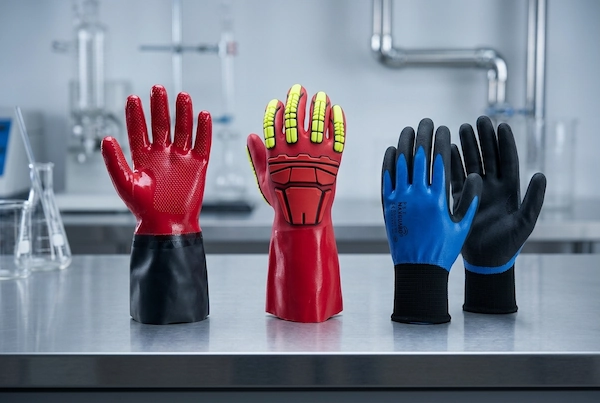
To address these complex hazardous conditions, the flagship SQG® P-901 model innovatively employs a proprietary PVC/nitrile polymer blend formulation (PVC/Nitrile Hybrid Formulation):
Complementary swelling resistance from dual-phase polymers: The strong polarity of nitrile molecules effectively prevents non-polar hydrocarbon solvents from swelling and softening the rubber membrane, while the weather-resistant PVC component provides excellent flexibility and resistance to inorganic salt corrosion, eliminating the industry-wide problem of gloves becoming brittle and hard in deep-well crude oil operations;
One-Piece Molding for Impact Protection and Fluid Backflow Prevention: The back of the glove features a three-dimensional, segmented TPR impact-resistant exoskeleton firmly anchored via high-frequency heat pressing, which directly dissipates high-energy blunt impacts and crushing forces caused by the swinging of heavy drilling tools and the movements of drillers; The extended and reinforced Safety Cuff is not only rigid and abrasion-resistant but also tightly covers the sleeves of protective clothing, preventing mud and other fluids from flowing back up the arm into the glove cavity, thereby establishing an impenetrable dual defense against fluid ingress and impact for deepwater oil and gas extraction.
Extreme Inorganic Acid & Alkali Immersion: SQG® P-902 Deployment
In metal smelting pickling tanks and passivation workshops, pulp cooking sections in the paper industry, industrial waste acid neutralization reactors, and semiconductor-grade high-purity chemical cleaning processes, the media often exhibit extremely strong acidic or alkaline properties. Such highly corrosive fluids are extremely destructive to organic elastomers; ordinary natural rubber is highly susceptible to rapid dehydration and carbonization by strongly oxidizing acids, while ordinary synthetic rubber undergoes extremely rapid molecular chain breakage when exposed to concentrated, strong acids.
For submerged, heavily corrosive applications, the heavy-duty industrial-grade SQG® P-902 sets an exceptionally high standard for engineering protection:
High-purity homopolymer PVC resin inert barrier: P-902 utilizes high-purity polyvinyl chloride resin that has undergone multi-stage dehydration and impurity removal, and is formed through a multi-step, fully automated impregnation and gelation process. With its regular molecular backbone structure and dense molecular chains, it exhibits exceptional chemical passivation and resistance to permeation when exposed to highly corrosive media such as 96% concentrated sulfuric acid, 40% caustic soda (sodium hydroxide), and high-concentration hydrochloric acid;
Fine-Sand Microporous Negative-Pressure Adhesion and Cut Resistance Enhancement: The palm of the glove features a microcrystalline fine-sand finish (Sandy Finish). When gripping metal pipe valves, fiberglass sight glasses, or soaked workpieces coated with viscous strong acid or alkali, the microscopic pits on the surface instantly displace the acid film on the contact surface, creating a micro-negative-pressure vacuum adhesion effect that provides a secure, non-slip grip. The glove lining innovatively incorporates ultra-fine glass fiber blended yarn, providing the thick rubber shell with an additional layer of tear and cut resistance, thereby preventing chemical acids from seeping in due to the glove being cut by burrs on acid-coated metal sheets.
Precision Automotive Assembly and Oily Stamping: SQG® P-286R Deployment
Unlike the two gloves mentioned above, which are designed for heavy-duty, fully submerged and impact-resistant applications, workers on automotive engine assembly lines, in precision transmission valve body machining, during CNC machine tool coolant maintenance, and in metal stamping shops have two core requirements: an “absolutely leak-proof barrier against oil and fluids” and “surgical-grade dexterity for fine motor tasks.”
If machine tool operators are issued bulky, heavy-duty gloves with safety cuffs, they may experience severe muscle fatigue in their hands or a complete loss of sensation in their fingertips, making it difficult to perform tasks such as repeatedly tightening tiny screws or installing oil seals. This limited hand mobility could even lead to a more serious risk of mechanical entanglement.
The lightweight, fully-dipped SQG® P-286R model specifically employs a “Double-Dipping” micro-molecular engineering architecture:
A dual-layer, tiered barrier eliminates micro-pores: The P-286R’s base layer consists of 360-degree fully immersed smooth nitrile, forming a completely liquid-tight lining with no pores or gaps. This thoroughly prevents the capillary penetration of water-soluble synthetic cutting fluids, mineral gear oils, and various light-duty kerosene-based cleaning agents into the glove’s inner lining;
Microporous Foam Surface with Siphon Effect and Bare-Hand-Like Tactile Sensation: The palm and fingertips of the glove are coated with a double-dipped microporous foam nitrile (Foam Nitrile) layer. This coating contains a dense network of open-cell micropores that actively absorb free oil films from the surface of oily metal workpieces into the micropores upon contact, thereby eliminating the risk of slippage. The integrated 15-gauge high-density, ultra-elastic, seamless polyester liner perfectly conforms to the contours of the palm. While providing an all-day dry, leak-proof experience, it also offers frontline technicians exceptionally sensitive tactile feedback for part identification and fatigue-reducing ergonomic support.
Enterprise Sourcing Risk Mitigation: Auditing CE Module B and Module D
In the bidding and tendering processes of multinational heavy industry contractors, large chemical clusters, and international energy projects, the technical compliance certificates issued by suppliers are by no means mere formalities; rather, they serve as a firewall protecting companies from work stoppages for rectification, legal liability, and massive workers’ compensation claims. While ordinary occupational safety gloves typically need only meet standard physical and mechanical protection requirements, industrial chemical-resistant gloves—which directly impact workers’ irreversible health risks—require compliance audits that reach a level of regulatory scrutiny that penetrates the regulations.
Penetrating CE Category III Directives for Chemical PPE
Under the regulatory framework of the EU Personal Protective Equipment Regulation (EU) 2016/425, protective equipment is strictly classified into three risk categories based on the severity of the hazards involved: Category I (low, minor risk), Category II (moderate, reversible mechanical risk), and Category III (extremely high risk and fatal, irreversible hazards).
According to the regulatory criteria, the vast majority of chemical-resistant gloves that comply with Type A and Type B (which include protection against penetration by multiple media) are mandatorily classified under Category III and subject to extremely high regulatory standards. The legal rationale behind this stringent classification is clear:
The irreversibility of injury consequences: Accidents caused by exposure to high-risk chemical agents—such as concentrated sulfuric acid, sodium hydroxide, aromatic hydrocarbons, and hydrofluoric acid—not only result in permanent chemical corrosion and necrosis of deep muscle tissue, but also allow extremely hazardous organic toxins to penetrate the skin and enter the systemic circulation, leading to chronic poisoning, organ failure, and even carcinogenic mutations;
Regulatory Red Lines and Market Access Thresholds: No industrial gloves classified as Category III may be placed on the market based solely on the manufacturer’s self-declaration or a basic type-examination report. Regulations require that such products undergo a dual market access review—comprising “design type approval combined with continuous production supervision throughout the entire product lifecycle”—conducted by an officially authorized EU Notified Body.
SATRA and Intertek Official Database Verification Protocols
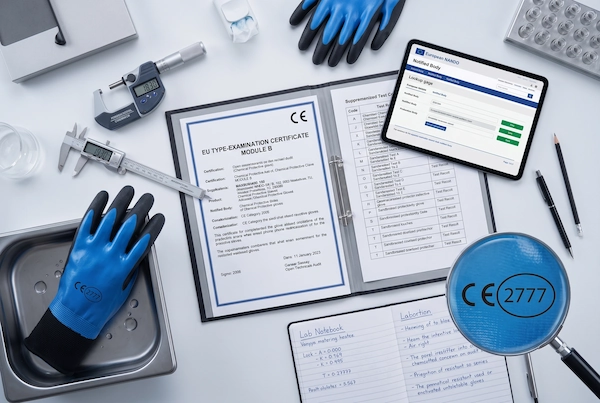
When the cross-border procurement technical team conducts an initial review of the credentials submitted by suppliers, the first line of defense is to conduct a thorough verification of Module B (EU Type-Examination) certificates through authoritative channels, resolutely eliminating any violations by intermediaries who attempt to pass inspection using forged scans, expired or borrowed certificates, or other deceptive tactics.
A rigorous verification process should include:
Verifying the legitimate scope of authorization of official Notified Bodies: Certificates must be issued by top-tier Notified Bodies legally authorized to test chemical-protective gloves, such as SATRA (Notified Body No. NB 2777), CTC (Notified Body No. NB 0075), or Intertek. Procurement technicians should log in directly to the European Commission’s official NANDO database to verify the authorization code and validity period of the relevant body;
In-depth online database verification: Access the official anti-counterfeiting verification platforms of SATRA or Intertek and enter the unique number on the certificate for real-time verification. Focus on verifying whether the certificate holder is the actual manufacturing facility and whether the certificate status is active and within its validity period, strictly eliminating certificates that have been revoked or suspended;
Compare physical product images with the test details appendix: A compliant Module B certificate must include a color photograph of the physical product sample—stamped with a cross-seal—along with a specification of key material compositions. Procurement personnel must carefully verify that the physical appearance—including the adhesive layer boundaries, cuff structure, anti-slip patterns on the palm, and the injection-molded reinforcement on the back—exactly matches the original design drawings submitted for review. Furthermore, review the list of 18 standard chemical tests in the appendix to confirm that the codes of the chemicals that passed the test (e.g., A, J, K, L) exactly match the letters printed on the glove’s label, thereby preventing suppliers from misrepresenting a moderate chemical resistance report as a Type A high-level certification.
On-Site Mass Production Audits: Reviewing Module D Factory Controls
In the context of multinational supply chains, many companies have encountered hidden “compliance pitfalls”: Sample products sent by suppliers to laboratories for testing exhibited excellent mechanical properties, allowing them to successfully obtain Module B certification; however, during the production of subsequent bulk orders totaling hundreds of thousands of pairs, factories—in an effort to cut costs—adulterated the compound with large amounts of cheap talc filler, arbitrarily reduced the rubber coating thickness, or directly shortened the baking and vulcanization time. This resulted in the final batch of products being delivered with widespread microscopic pinholes and permeability levels exceeding standards.
To fundamentally eradicate the industry’s persistent problem of “samples passing inspection while mass production cuts corners,” large buyers must mandate verification of the manufacturing facility’s Module D (Production Process Quality Assurance) certification audit reports:
Review the production’s Statistical Process Control (SPC): The factory must establish a comprehensive SPC system covering everything from raw latex emulsification and polymer resin internal mixing to online viscosity and temperature monitoring. Any fluctuation in resin ratios directly affects the molecular cross-linking density of the finished product; therefore, online physicochemical control charts for the past three months must be reviewed;
Verify the micro-leakage spot-check logs: Compliant state-of-the-art manufacturing facilities must permanently maintain 100% inflation water bath leak testing stations operated in accordance with EN ISO 374-2, as well as a high proportion of destructive hydrostatic pressure sample retention tests. Purchasing technicians should conduct on-site verification of the original batch sampling logs (AQL 0.65 or 1.5) from the production line to confirm records of the melting, shredding, and destruction of non-conforming products;
Verify the 4-digit statutory identification code following the CE mark: For source factories that have obtained compliant Module D system certification, the official Category III chemical-resistant gloves they ship must have a 4-digit notified body code printed immediately after the CE mark on the outer surface, indicating ongoing annual quality supervision (for example, “CE 2777” indicates that SATRA sends personnel to the factory to conduct annual system spot audits and random inspections of bulk shipments). If the glove’s exterior bears only the two letters “CE” without a 4-digit suffix, it can be immediately deemed non-compliant mass-produced goods and must not be released into inventory under any circumstances.
For global engineering buyers planning to partner directly with source super-factories, develop customized chemical-resistant glove molds, calculate loading efficiency for bulk LCL and FCL pallet shipments, and lock in long-term total cost of ownership (TCO), we recommend thoroughly reviewing the special report on end-to-end supply chain cost reduction and fulfillment risk management: Impact Gloves Bulk Sourcing Factory Direct: Custom Tooling, Logistics & TCO.
Technical FAQ: Chemical Compatibility, Storage & Service Life
In heavy industry materials management and on-site safety operations, decision-makers and safety managers are often confronted with numerous technical details. This section compiles and provides in-depth technical answers from an industrial engineering perspective to frequently asked questions regarding chemical compatibility, effective service life, storage conditions, and the mechanisms of manufacturing processes.
Can a single chemical glove protect against all solvents and concentrated acids?
No. From the perspectives of materials chemistry and physical mechanics, there is absolutely no such thing as an “all-purpose glove” capable of withstanding all organic solvents and concentrated strong acids and bases.
The molecular repulsion properties of different polymer coatings depend on their inherent microscopic chemical polarity and the principle of “like dissolves like”:
Nitrile rubber (NBR)’s highly polar defense: Nitrile is a copolymer of acrylonitrile and butadiene; the cyano group (-CN) on its molecular chain possesses extremely strong negative polarity, endowing the material with exceptional resistance to swelling by nonpolar solvents. Consequently, NBR performs exceptionally well when exposed to gasoline, diesel, crude oil, hydraulic oil, and aliphatic hydrocarbons; however, when exposed to polar ketone solvents such as acetone and butanone, or polar esters such as ethyl acetate, the molecular polarity of NBR strongly interacts with the solvents, causing the material to rapidly absorb liquid, swell, and disintegrate within a very short time;
Polyvinyl Chloride (PVC) Thermoplastic Inorganic Barrier: PVC relies on its tightly ordered polymer chains to provide natural chemical inertness against inorganic proton-based corrosive media. When exposed to strongly oxidizing and highly corrosive inorganic acids and bases—such as 96% concentrated sulfuric acid, 40% sodium hydroxide, nitric acid, or hydrofluoric acid—PVC provides a robust barrier; However, because PVC requires the addition of plasticizers to maintain its flexibility under normal conditions, these plasticizers are rapidly leached out when exposed to organic solvents such as ketones, ethers, or certain aromatic hydrocarbons, causing the PVC to harden rapidly or even crack;
Conclusion and Countermeasures: Companies must establish a detailed polymer material compatibility registry based on the CAS numbers of chemicals encountered on-site. For work conditions involving contact with hydrocarbon sludge and heavy oil, blended and modified resins should be selected; for situations involving only acid washing and passivation, high-purity PVC resin gloves must be mandated, and the dangerous practice of using “a single type of glove for all applications throughout the plant” must be strictly prohibited.
What is the maximum safe operational wear time after chemical breakthrough?
The standard breakthrough time (BTT) must never be equated with the “maximum safe wear time” for field operations. When establishing shift change procedures, a safety margin factor must be incorporated.
In standard testing (EN 16523-1 or ASTM F739), the breakthrough time is a critical value measured under controlled conditions: a constant temperature of 23 degrees Celsius, with the material subjected to no mechanical stress, and under purely static, single-sided contact. However, in real industrial work environments, multiple variables can cause the actual chemical resistance duration of gloves to decrease dramatically:
Accelerating effects of the environment and hand temperature: High summer temperatures in the workshop or body heat generated by profuse sweating on the palms can cause local glove temperatures to rise above 35 degrees Celsius. For every 10-degree Celsius increase in temperature, the thermal motion of chemical molecules and their diffusion rate within the polymer typically increase exponentially;
Mechanical deformation and flexural shear: When workers continuously grip, lift heavy objects, or tighten fasteners, the palm and interphalangeal joints of the gloves undergo repeated stretching and thinning. External forces forcibly widen the gaps between polymer chains, significantly shortening the penetration path for molecules;
Synergistic Penetration of Chemical Mixtures: Pure reagents are rarely encountered on-site; mixed operational fluids (such as waste solutions containing cleaning solvents) often contain volatile co-solvents, whose penetration rates are typically far higher than those of individual chemicals;
Conversion Standards for Safe Shift Duration: Industrial EHS regulations generally recommend applying a safety derating factor of 30% to 50%. If a glove’s standard test report indicates a breakthrough time of 120 minutes (Level 4) for a specific strong solvent, the safe continuous exposure time in on-site shift schedules must be strictly limited to between 36 and 60 minutes. Once the warning threshold is reached, the gloves must be removed and replaced immediately, regardless of whether they appear intact.
How do warehouse temperature and UV exposure affect the shelf life of polymers?
Unopened, unused industrial chemical-resistant gloves typically have an official shelf life of 3 to 5 years; however, this figure is contingent upon the storage environment strictly meeting standards for protection from light, constant temperature, low humidity, and ozone.
If the polymer matrix is exposed to adverse storage conditions for an extended period, molecular aging will occur prematurely even while the product remains unopened:
UV-induced photo-aging degradation: High-energy UV light waves can directly break the main molecular chains of nitrile and PVC, triggering free-radical reactions that cause the material’s surface to become sticky and crack, and result in a loss of tear strength even before the gloves come into contact with chemicals. Therefore, gloves must be stored in their original, light-proof, dark packaging, away from windows and areas exposed to strong fluorescent lighting;
Environmental Temperature, Humidity, and Thermo-Oxidative Aging: Warehouse temperature must be strictly controlled between 10°C and 30°C, with relative humidity maintained below 65%. Excessively high storage temperatures accelerate the physical precipitation and volatilization of functional additives and plasticizers in the polymer matrix, reducing the gloves’ toughness;
Ozone Corrosion from Electric Motors and High-Voltage Power Grids: The warehouse must be located away from large air compressors, transformer rooms, high-frequency welding areas, and stations where electric forklifts are frequently charged. The trace amounts of ozone generated by these operating devices possess extremely strong oxidative activity and can rapidly attack the unsaturated double bonds in rubber molecules, causing microscopic cracks and fractures in the areas of the gloves that are folded or compressed inside the boxes.
How do double-dipping processes prevent micro-pinhole leaks compared to single dips?
The double-dipping process fundamentally eliminates the material defects—continuous, through-penetrating micro-pinholes—that form at the microscopic level in single-dip coating due to leveling defects and air bubble migration.
In traditional single-dip production, when polymer latex or sol adheres to the woven fiber liner, there are unavoidable microscopic forming risks: fine fibers on the fabric surface may puncture the rubber film in localized areas; moisture or volatile solvents in the rubber solution may rupture and escape from the inside out during rapid heating, drying, and vulcanization, leaving extremely fine, honeycomb-like vertical microchannels deep within the rubber layer. Although these micro-pinholes may not cause water droplets to leak during macroscopic hydrostatic pressure tests in the short term, they become “direct pathways” for the rapid penetration of chemical molecules when exposed to low-surface-tension solvents or strong acids.
The double-layer continuous impregnation process utilizes a sealing mechanism based on spatial misalignment between physical cross-linking and intermolecular networks:
First layer: Dense, fully impregnated base rubber (Smooth Nitrile Base): Under precise temperature control and at a constant lifting speed, the first layer of smooth nitrile or PVC rubber solution first penetrates the fabric’s surface fuzz, forming a highly uniform, pore-free, sealed, and dense base membrane;
Second Layer: Functional Top Coating (Top Foam or Sandy Layer): A second dip coating is immediately applied during the critical window when the base layer is in a semi-cured (gelling) state, and the molecular chains have not yet fully set. The second layer of rubber solution rapidly wets the base layer via surface tension, and the two polymer layers interpenetrate and interconnect at the molecular interface, achieving molecular-level interpenetration and cross-linking.
This dual-layer overlay molding technology ensures that the microscopic pores and material defects in the inner and outer layers are spatially arranged in a completely random, interlaced, and offset pattern. Even though the outer microporous foam coating intentionally retains an open-cell structure to enhance oil absorption and grip, the completely homogeneous and smooth internal layer of internally mixed rubber film still thoroughly prevents the formation of any continuous, longitudinally penetrating micro-pores, thereby establishing a physical defense loop that 100% eliminates micro-leakage of chemical media.
Initiate Factory-Direct Sourcing & Chemical Compatibility Evaluation (CTA)
During the implementation phase of multinational engineering tenders, bulk procurement for petrochemical refineries, and the restructuring of global brand OEM/ODM supply chains, the core tasks of the procurement and EHS teams are to ensure two key elements: transparent and accurate compliance audits, and ultimate supply chain control through direct engagement with source “super factories.”
By eliminating the layers of information filtering and unreasonable channel markups imposed by middlemen, SQG—leveraging its comprehensive automated vulcanization production lines, high-precision chemical analysis laboratories, and rigorous CE Category III (Module B / Module D) end-to-end quality control system—provides global industrial clients with turnkey project support, ranging from on-site chemical medium compatibility assessments to direct overseas shipments by full container load.
H3: Request Chemical Permeation & Degradation Test Reports for Your MSDS
Faced with complex on-site operating conditions and non-standard mixed chemical fluids, companies no longer need to repeatedly experiment with convoluted theoretical parameters. SQG provides engineering-grade MSDS/SDS chemical compatibility matching and permeation verification services led by polymer materials engineers:
Precise CAS Number-Based Chemical Compatibility Verification: Purchasers need only provide a list of specific chemical reagents involved at the worksite, complete MSDS/SDS documents, or specific CAS numbers (Chemical Abstracts Service Registry Numbers). SQG’s technical laboratory will access a database of actual permeation test results covering hundreds of hazardous media and issue a technical compatibility report that includes standardized breakthrough time (BTT), stable permeation rates, and assessments of material resistance to degradation and aging;
Custom Prototyping and Type Testing for Non-Standard Media: If the site involves contact with deep-well oil-based drilling fluids (OBM), specific high-viscosity mixed waste acids, or cleaning solvents in specific ratios, the SQG R&D Center can formulate modified polymer formulations based on on-site ambient temperature and mechanical exposure intensity, arrange for sample prototyping, and provide raw test documentation of normalized permeation curves endorsed by authoritative third-party laboratories (SATRA / Intertek);
Customized Compliance Endorsement Documentation for Enterprises: We assist procurement teams and general contractors in seamlessly addressing local safety inspection audits by providing a complete set of technical drawings and Declarations of Conformity (DoC), ranging from original EU Notified Body Module B type examination certificates to annual Module D system audit reports for manufacturing facilities.
H3: Order Master Swatch Boxes and Request Direct Container Procurement Quotations
Laboratory data is the foundation of safety protection, while the tactile feedback and grip ergonomics reported by frontline workers ensure strict adherence to safety protocols. To assist global corporate decision-makers in conducting rigorous on-site wear trials (Worksite Wear Trial) prior to bulk shipments, SQG has established a fast-track process for rapid engineering prototyping and the delivery of original master swatch boxes.
Multinational buyers and regional safety equipment distributors can immediately request factory-direct industrial engineering master swatch boxes:
Multi-dimensional field-test kits: The sample box contains precisely assembled SQG® P-901 gloves designed to withstand crude oil hydrocarbons and deep-water heavy-duty impact protection; SQG® P-902 gloves—made of pure PVC with a sand-textured finish—specifically engineered to withstand cleaning with 96% concentrated sulfuric acid and strong alkalis; and SQG® P-286R gloves that combine double-layer impermeability with the bare-hand dexterity required for precision engine assembly;
Transparent, Direct-from-Source BOMs and CIF/DDP Quotations: The SQG Business and Technical Team will provide, based on your anticipated purchase volume, custom mold requirements (such as exclusive colors and embossed logos for TPR armor), and route planning for less-than-container load (LCL) or full container load (20GP/40HQ) shipments, to provide, within 24 hours, a highly competitive factory-direct, all-tax-included, door-to-door (CIF/DDP) offshore cost analysis that breaks down the underlying bill of materials (BOM).
The first step toward establishing a zero-incident chemical barrier and optimizing the total cost of ownership for your compressed supply chain: Connect directly with a senior SQG technical application engineer today to submit your on-site media list and request an original manufacturer’s sample kit and direct-purchase quote: