
When calculating occupational safety and health costs, most factories focus solely on the unit purchase price (sourcing price) per pair listed on suppliers’ quotes. However, finance and supply chain teams often overlook a hidden expense: the cost of disposing of these gloves after use is directly eroding the company’s net profit.
Today, global regulations on industrial solid waste are becoming increasingly stringent, and the landfill fees and waste tariffs that factories pay are skyrocketing every year. Traditional petrochemical nitrile or polyurethane (PU) gloves are non-biodegradable, making them a long-term, costly burden on waste disposal bills.
Replacing these purchases with sustainable, biodegradable work gloves is not primarily a matter of environmental sentiment, but rather a purely financial decision. It directly reduces the weight and volume of solid waste, lowers final disposal costs, and can even help companies qualify for green tax credits, thereby optimizing operating expenses (OPEX). Next, we’ll examine how eco-friendly gloves actually help factories save money, based on the total cost of ownership (TCO) and actual operational data.
The Hidden Cost of PPE: What Your Balance Sheet Ignores
In the conventional logic of B2B procurement and financial auditing, most companies are accustomed to classifying personal protective equipment (PPE) as mere “consumables” on their books. However, this seemingly clear balance sheet is selectively overlooking a hidden financial drain—the costs associated with end-of-life (EoL) disposal.
As global regulations regarding supply chain compliance, carbon footprint tracking, and the safe disposal of waste become increasingly stringent, the costs associated with warehousing, transportation, sorting, specialized incineration, or hazardous waste landfill disposal for large volumes of industrial PPE after it is scrapped are skyrocketing. While your financial analysts are still fixated on the front-end figures on purchase invoices, these “hidden expenses”—which fall outside traditional cost models—are directly eroding your company’s profit margins.
The Growing Volume of Discarded Industrial Work Gloves
Among all high-turnover industrial supplies, industrial protective gloves rank among the top in terms of consumption rate and volume of waste. Based on statistics on frequent use in machining, automotive manufacturing, and precision electronics workshops, the rate at which discarded gloves accumulate is staggering.
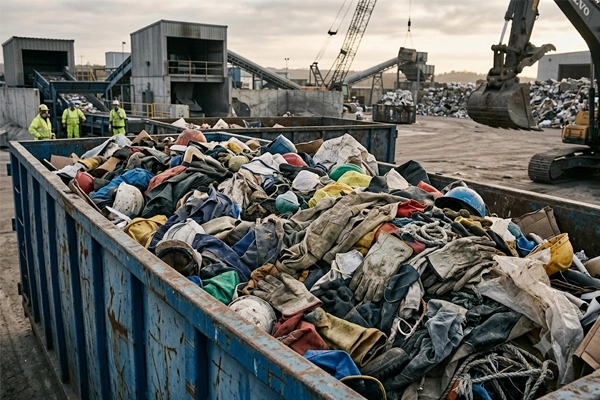
Most traditional industrial gloves, due to prolonged exposure to heavy oil contamination, chemical cutting fluids, or metal debris, cannot be disposed of through conventional municipal waste recycling systems. Under stringent environmental compliance standards, these specialized waste gloves must be handled by professional hazardous waste management organizations for centralized incineration or deep landfilling, with disposal costs per metric ton far exceeding those of ordinary industrial solid waste. Not only does this massive volume of waste directly translate into environmental liabilities on the balance sheet, but as we emphasize in the Guidelines for Sustainable PPE Supply Chain Audits of Third-Party Glove Suppliers, it also becomes a significant negative factor in comprehensive environmental compliance reviews of a company’s entire supply chain.
Why the Initial Purchase Price Is a Sourcing Illusion
The traditional model of treating “lowest unit price” as the core procurement KPI is the root cause of B2B financial blind spots. A low initial purchase price is, in essence, merely a price illusion created by suppliers. The metric that truly determines a company’s profitability should be the total cost of ownership (TCO).
A pair of traditional gloves that are cheap but have low durability and lack biodegradable properties not only significantly shortens the service life—leading to a doubling of procurement frequency—but also results in exponentially higher disposal taxes and compliance fines for the company during end-of-life (EoL) processing. When companies attempt to establish closed-loop recycling systems or fulfill their end-of-life (EoL) responsibilities, the energy consumption associated with the complex disassembly, sorting, and cross-border transport of gloves made from traditional, highly polluting materials will completely erode the price advantage of a penny or two initially negotiated during the RFQ process.
Breaking Down Industrial Solid Waste Tariffs for Manufacturing Facilities
While striving for operational efficiency, industrial manufacturing facilities often face year-on-year increases in industrial solid waste disposal tariffs and cleanup costs. Most plant managers and procurement professionals at manufacturing companies focus solely on the price of products upon arrival and rarely delve into the underlying billing logic of local environmental protection agencies and solid waste disposal organizations.
The collection and disposal of industrial solid waste is not simply a matter of a flat-rate, all-inclusive fee, but rather a tiered pricing model based on a combination of weight-based tariffs, volume-based tariffs, and material hazard classification. For high-turnover, high-consumption manufacturing plants, the direct consequence of failing to optimize the waste material matrix at the source is that the company’s daily operating profits are gradually eroded by a steady stream of waste removal bills and environmental surcharges.
How Commercial Landfill Tipping Fees Are Calculated
When assessing the end-of-line operating costs for manufacturing facilities, commercial landfill tipping fees are typically calculated using a multidimensional tiered pricing structure. First, solid waste collection companies establish a base rate per metric ton using the net weight method, which involves subtracting the tare weight (the weight of the empty container upon return) from the total weight upon entry (scale-in total weight).
However, a deeper form of economic exploitation lies in the punitive billing based on volume and density. Lightweight, hollow, and highly elastic waste materials—such as industrial protective gloves—occupy a significant amount of container space when not professionally compacted, which directly triggers the volume penalty factor in volume-based tariffs. At the same time, landfills conduct routine spot checks based on the leachate toxicity characteristics of solid waste. Once petroleum-based compounds or heavy oil contamination that cannot be naturally separated are detected in the waste, the billing rate instantly jumps from that of ordinary commercial solid waste to the highest tax rate category for special industrial solid waste, resulting in a several-fold increase in the cost per collection.
Rising Tariffs on Non-Biodegradable Petrochemical Waste
Industrial protective gear made from traditional petrochemical materials is becoming the primary culprit driving up factory waste disposal costs. Because traditional synthetic fabrics (non-biodegradable petrochemical waste) take hundreds of years to decompose in the natural environment, major industrial manufacturing hubs around the world are forcing supply chain transformation by significantly raising landfill tax rates.
Petrochemical-based gloves soaked in traditional oily wastewater or chemical cutting fluids, due to their extremely stable molecular structure, cannot be processed through low-cost biological composting, nor can they be directly sent to conventional waste incinerators. This forces manufacturers to bear high, long-term costs for specialized hazardous waste storage. As environmental regulatory agencies impose increasingly steep carbon offset penalties on non-biodegradable plastic and synthetic fiber waste, continuing to generate such non-biodegradable petrochemical waste is tantamount to planting a long-term financial time bomb on a company’s balance sheet—one that will snowball over time.
The Financial Mechanics: How Biodegradable PPE Reduces Waste Mass
The adoption of green technologies in B2B procurement is not merely a public relations stunt, but rather a precise form of financial cost optimization. The reason biodegradable enterprise-grade personal protective equipment (Biodegradable PPE) can directly reduce back-end operational expenses for manufacturing plants lies in its ability to alter the physical and chemical state of waste on the waste scale.
Once traditional PPE reaches the end-of-life stage, its weight and volume remain largely unchanged over time, forcing companies into a financial quagmire of continuous weighing and billing. In contrast, high-end PPE incorporating modern biodegradation technology triggers fundamental changes in material structure, leading to a significant reduction in both the total weight and volume of waste—specifically in the two critical stages of solid waste reporting and weighing for removal. This transforms environmental compliance into tangible cash flow benefits.
Accelerated Microbe-Driven Depolymerization in Landfills
The core mechanism of biodegradable technology in landfill environments relies on accelerated microbe-driven depolymerization (AMDD). We have previously provided an in-depth analysis of this reaction chain in the White Paper on Biodegradable Nitrile-Coated Gloves: Unlike traditional synthetic fabrics, which often remain unchanged for centuries in natural environments, specialty gloves or protective clothing with biodegradable properties have specific bioactive inducers embedded during the manufacturing stage.
When these waste products are disposed of in commercial landfills—environments characterized by high humidity, anaerobic conditions, and a rich population of active microorganisms—the inducers are rapidly activated and begin to attract specific microorganisms to aggregate on their surfaces. Specific enzymes secreted by these microorganisms precisely target the chemical bonds of the polymers, breaking down their long, robust molecular chains into low-molecular-weight fragments that can be directly metabolized by the microorganisms. This highly accelerated biochemical breakdown causes the originally hard-to-degrade petrochemical macromolecules to undergo a complete structural disintegration—from the surface to the core—within an extremely short period of time.
From Tons to Grams: Measuring the Reduction in Long-Term Waste Volume
This microscopic molecular breakdown ultimately manifests on the macro level—in financial statements—as a qualitative shift from “tons” to “grams.” Once microorganisms have fully degraded the depolymerization products, the originally heavy, dense solid waste is ultimately converted into water, carbon dioxide, and a small amount of biomass.
In the long-term waste disposal bills of manufacturing plants, the economic benefits resulting from this transformation are extremely substantial. Previously, companies had to pay commercial landfill disposal fees and exorbitant storage and transshipment costs to solid waste haulers on a long-term and frequent basis, based on the total volume and net weight of tens of metric tons of traditional petrochemical waste. However, by introducing biodegradation technology, the solid waste burden—which previously occupied significant space and weight at on-site waste collection points and landfill scales—is largely reduced in mass within a very short composting or landfill cycle. Consequently, the volume of solid waste reported by the factory, the frequency of weighing and hauling, and the corresponding carbon emission offset taxes are all drastically reduced, truly achieving a substantial reduction in long-term waste management costs.
Total Cost of Ownership (TCO) Comparison: Traditional vs. Biodegradable Gloves
In the B2B supply chain decision-making process, Chief Financial Officers (CFOs) at multinational manufacturing companies and industrial procurement groups are typically uninterested in purely environmental narratives; they are more focused on the underlying financial logic behind the numbers. To quantify the true contribution of green procurement to a company’s long-term profitability, we must move beyond the trap of focusing solely on unit price and extend the comparison to the product’s entire lifecycle.
Through comprehensive calculations comparing traditional petrochemical-based protective gloves with new biodegradable,e eco-friendly gloves—covering daily consumption, back-end warehousing, hazardous waste disposal, and regional environmental compliance costs—a clear dynamic financial curve emerges. The following comparison of total cost of ownership (TCO) data—based on a usage benchmark of 10,000 pairs—visually demonstrates how investing in eco-friendly assets can help factories transform what was once a pure capital expenditure drain into a long-term dividend from compliance cost savings.
| Cost Components & Financial Matrix | Traditional Petrochemical Gloves (Standard PU/Nitrile) | Advanced Biodegradable Gloves (Bio-based / RPET Matrix) |
| Initial Unit Cost (Per Pair) | $0.65 – $0.85 (Low entry barrier) | $1.10 – $1.35 (Premium pricing) |
| Average Shelf Life & Durability | 3 – 5 Shifts (High degradation when exposed to oil) | 8–12 Shifts (Reinforced cross-linking polymer) |
| Disposal Fees per 10,000 Pairs | $450 – $600 (High tariffs based on weight and bulk density) | $80–$120 (Mass reduction via rapid decomposition) |
| Regulatory Compliance Penalties | High Risk ($5,000 – $20,000 progressive tax) | Zero Risk (Tax credits & Scope 3 carbon offsets) |
| Total Lifecycle Cost (Per 10,000 Pairs) | $3,200 – $4,500 (Escalating downstream fees) | $1,800–$2,400 (Optimized supply chain ROI) |
From Procurement Expense to Long-Term Investment Return
As clearly shown in the quantitative table above, the low initial unit cost of traditional petrochemical gloves merely masks the high environmental costs incurred over several years down the line. Due to the low abrasion resistance and poor resistance to cutting fluid corrosion of standard PU or nitrile gloves, factories must purchase them more frequently, resulting in actual consumption far exceeding expectations based on a benchmark of 10,000 pairs. More critically, these 10,000 pairs of non-biodegradable, heavily oil-contaminated petrochemical waste trigger the local environmental protection agency’s strictest commercial landfill disposal fees when weighed on trash scales, based on their maximum total volume and total net weight. For information on how to conduct quantitative audits of traditional consumables through carbon tracking, please refer to Life Cycle Assessment (LCA) of Protective Gloves: A B2B Carbon Accounting Guide.
In contrast, while the new biodegradable, le eco-friendly gloves carry a certain premium upon initial purchase, their average service life is significantly extended thanks to a specialized cross-linked polymer process, directly eliminating the procurement cost losses caused by frequent restocking. When these supplies reach the end-of-life stage, their rapid physical degradation—which involves depolymerization into water and gas—causes the actual waste disposal fees paid by factories to drop sharply. Faced with increasingly stringent Carbon Border Adjustment Mechanisms (CBAM) and regional tiered solid waste tax rates, these eco-friendly materials not only completely exempt companies from the risk of regulatory fines but can even serve as green supply chain credentials to offset corporate environmental surcharges. These back-end cost reductions ultimately result in a nearly 50% reduction in the total lifecycle cost (TLC), demonstrating the long-term return on investment of eco-friendly procurement to financial management through irrefutable profit figures.
Leveraging Corporate ESG Incentives and Green Procurement Tax Credits
Supply chain optimization for modern multinational corporations and large manufacturing plants is no longer limited to simply reducing material costs; it has evolved into a financial strategy centered on corporate environmental, social, and governance (ESG) performance. Under the dual regulatory framework of international trade and regional regulations, green procurement has become a powerful tool for companies to manage their financial statements.
Replacing high-consumption industrial protective equipment with internationally certified green assets essentially provides companies with high-value compliance leverage. By incorporating biodegradable enterprise-grade personal protective equipment (PPE) into their supply chain matrix, manufacturing companies can not only significantly improve their ESG ratings in major capital markets and during bank credit audits, but also directly convert these procurement expenses into verifiable evidence for applying for government environmental subsidies, special tax exemptions, and even cross-border carbon credits, thereby ensuring that environmental investments yield tangible financial returns.
Government Rebates for Zero-Waste-to-Landfill Facilities
In regions with highly developed industries, local governments and environmental regulatory agencies have generally established special financial incentives and tax rebate mechanisms for “zero-waste-to-landfill facilities.” The core metric of this audit is to assess the absolute total mass of solid waste sent by these facilities to commercial landfills.
When manufacturing facilities fully adopt biodegradable or compostable specialty protective gloves, downstream depolymerization and disposal technologies directly reduce the tonnage of solid waste ultimately sent to landfills. This quantifiable reduction in waste serves as the most compelling underlying evidence for factories applying for government rebates for green supply chains. Factories that meet compliance standards not only receive substantial cash rebates but also directly benefit from the lowest tax bracket under the tiered solid waste tax system, thereby transforming traditional end-of-pipe expenses into policy-driven financial gains for the enterprise.
Mitigating Compliance Penalties Under Stricter Environmental Laws
With the global Carbon Border Adjustment Mechanism (CBAM) and the widespread tightening of regulations regarding non-biodegradable petrochemical plastic waste (Environmental Laws), continuing to generate non-biodegradable, highly polluting solid waste is tantamount to exposing companies to the risk of massive compliance fines. Traditional petroleum-based personal protective equipment (PPE) generates significant indirect greenhouse gas emissions during disposal, incineration, and landfilling, directly lowering a company’s compliance score in Scope 3 carbon emissions audits.
By cutting off the inflow of non-biodegradable petrochemical materials at the procurement stage, manufacturers can hedge against the risk of compliance penalties at an extremely low cost. This proactive risk and compliance management not only grants companies legitimate exemptions during environmental inspections and carbon tax audits but also builds a robust moat of resilience within the supply chain. Regarding how to systematically mitigate such environmental risks in procurement, we provide comprehensive reference standards for compliance testing in In-Depth Analysis of OEKO-TEX Standard 100 Certification for Protective Gloves, giving brands an unparalleled competitive advantage in green credentials when expanding overseas and competing for major international trade contracts.
Integrating High-Performance Eco-Gloves into Mass Industrial Sourcing
Translating overarching financial compliance and corporate environmental, social, and governance (ESG) strategies into concrete actions on the production floor ultimately depends on the implementation of precise green material substitutions at every stage of the manufacturing process. The key to the success of Mass Industrial Sourcing lies in selecting eco-friendly personal protective equipment (PPE) that makes zero compromises on physical protective performance while demonstrating an overwhelming advantage over traditional synthetic fiber materials in terms of total cost of ownership (TCO).
By implementing modular substitutions tailored to the energy consumption and wear characteristics of different job roles in manufacturing plants, supply chain management can seamlessly integrate green procurement into existing corporate centralized procurement agreements. This not only cuts off the generation of environmental debt at the source but also, through precise product matching, directly optimizes fixed waste disposal budgets in daily operations. Below, we have compiled industrial-grade, core selection solutions for sustainable biodegradable work gloves tailored to various industrial manufacturing scenarios:
Precision Electronics & Lightweight Assembly: The High-Volume Waste Reducer
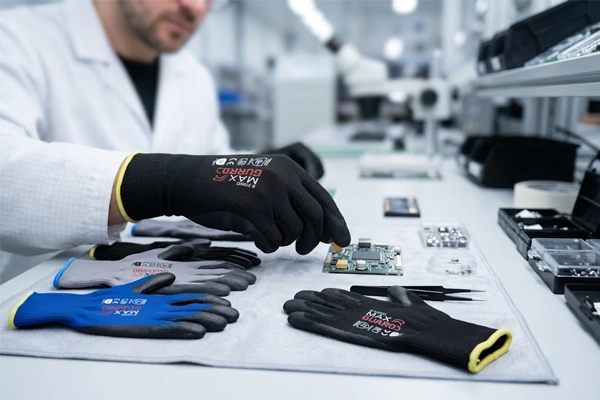
In precision manufacturing, automated semiconductor assembly, and lightweight component sorting workshops, the turnover rate of personal protective equipment (PPE) is the highest, and the volume of discarded items is the largest. Since gloves come into frequent contact with high-precision components, even minor coating wear or a slight decrease in fingertip sensitivity can lead to their immediate disposal, resulting in massive volumes of solid waste.
To achieve a dramatic reduction in solid waste in this high-turnover environment, the MAXGUARD B-312-BIO series is the ideal replacement solution for factories seeking large-scale cost savings and a reduction in solid waste volume. This series includes multiple color-coded variants—B-312-BIO-BL (black), B-312-BIO-G (gray), B-312-BIO-GBL (green-black), and B-312-BIO-WL (white)—and is specifically designed for the intensive management of multiple production lines.
Recycled Fiber Liner: Featuring a 13-gauge seamless recycled RPET liner, this design transforms recycled plastic bottles—which would otherwise end up as environmental waste—into a highly elastic, breathable, and fatigue-resistant glove shell, directly offsetting the primary carbon footprint at the procurement stage. For more information on how this material quantifies reductions in a factory’s corporate carbon emissions, please refer to [How RPET Liners Help Manufacturing Companies Reduce Scope 3 Carbon Emissions].
Bio-based Coating Technology: The palm features an exceptionally fine bio-based PU coating. The underlying technical architecture of this material is detailed in our previous article, What Is Bio-based PU Coating? An In-Depth Analysis of Industrial Protective Glove Performance. It not only offers an abrasion resistance lifespan far exceeding that of traditional petrochemical polyurethane but also maintains a bare-hand-like tactile sensitivity for fine motor tasks and touchscreen compatibility.
Physical Volume Reduction: Thanks to its extremely high pro-microbial degradability, this series rapidly initiates a depolymerization reaction once discarded in landfills, helping precision manufacturing companies reduce punitive waste disposal bills based on volume-based tariffs at the source.
Machining & Heavy-Duty Industries: Balancing Rigorous Safety with Environmental Mandates

Unlike lightweight assembly operations, heavy industrial manufacturing, automotive metal stamping, and large-scale machining workshops subject tools to nearly brutal physical standards. In these harsh working conditions—rife with sharp metal burrs, heavy-duty oil-based cutting fluids, and high-intensity mechanical friction—protective equipment must not only meet regional environmental compliance requirements but also serve as a critical line of defense to protect frontline workers from severe cut injuries.
To address cut-resistance needs in machining and heavy industry, the Industrial Procurement Group recommends the comprehensive adoption of the BLADEGUARD B2-310-BIO and B2-340-BIO Heavy-Duty Cut-Resistant Series.
Composite Blended Armor: Constructed from a 13-gauge HPET, RPET, and high-performance cut-resistant fiberglass blended lining. Through a rigorous mechanical cross-linking process, a robust physical defense barrier is established in high-risk abrasion areas such as the palm and web, providing exceptional tear resistance and cut resistance.
A Win-Win for Reverse Logistics and Environmental Compliance: Traditional heavy-duty cut-resistant gloves contain large amounts of non-biodegradable composite petrochemical fibers and petroleum-based coatings, which directly trigger high disposal costs for hazardous waste once they are discarded. In contrast, this series maintains industrial-grade protective performance while ensuring excellent compliance with biodegradability standards.
Long-Term ROI: The gloves’ unique material formulation allows them to maintain molecular structural stability even after exposure to heavy oil contamination, significantly extending the service life of each pair in the workshop. This substantially reduces the total cost of ownership based on a procurement volume of 10,000 pairs, achieving a profound win-win scenario that balances safety standards with corporate low-carbon compliance.
Case Study: How a Mid-Sized Assembly Plant Reduced Waste Expenses by 25%
In the practical world of B2B procurement and multinational supply chains, any theoretical cost model must ultimately be validated through financial audits on the shop floor. To assess the actual economic returns generated by the transition from traditional synthetic fiber materials to eco-friendly alternatives, we conducted an in-depth 12-month financial tracking study at a mid-sized assembly plant with approximately 800 frontline operators that specializes in the assembly of automotive parts and electromechanical products.
The facility had long suffered from financial challenges stemming from massive volumes of scrap generated by high-turnover materials and year-on-year increases in end-of-life disposal costs. By fully implementing a modular green material substitution program, the plant not only successfully passed a regional supply chain carbon footprint audit but also delivered impressive results in the solid waste management category on the balance sheet—results that fully satisfied the group’s CFO.
Baseline Waste Metrics with Standard PU Sourcing
Before the full-scale implementation of biodegradable personal protective equipment, the facility’s material procurement and waste disposal had long been trapped in a typical, energy-intensive, petrochemical-based cycle:
High Procurement Volume: The factory previously relied entirely on synthetic fiber gloves made from standard polyurethane (Standard PU) with traditional nylon linings. Due to intense mechanical friction in the workshop and frequent contact with oily cutting fluids, the average service life of single- and double-layer protective gear was only 3 to 4 shifts, resulting in consistently high procurement frequency year-round.
Enormous absolute weight of waste: During the audit period, the factory generated approximately 32,000 pairs of heavily oil-contaminated, petrochemical waste gloves that are difficult to degrade each year. When this waste passed through the solid waste transfer station’s weighbridge upon leaving the premises, its absolute net weight—amounting to several metric tons annually—directly pushed the base disposal rate to the upper limit of the tiered pricing model.
Volume Penalties and Loss of Control Over Disposal Costs: Because traditional high-elasticity nylon is not readily biodegradable under natural conditions, and uncompressed waste gloves occupy a large volume, this directly triggers the local environmental agency’s high volume-based tariff penalty factors. During the base period, the factory’s annual net cash expenditures on commercial landfill tipping fees and the storage and removal of special hazardous waste alone amounted to as much as $18,500, and it faced the risk of environmental regulatory fines at any time.
Post-Implementation ROI After Switching to Bio-Based PU Sourcing
To address the aforementioned financial challenges, the plant’s supply chain management team decisively cut off the supply of traditional petrochemical-based materials and fully implemented a green protective equipment portfolio featuring 13-gauge seamless recycled fiber shells combined with bio-based polyurethane coatings. Following two consecutive quarters of operational testing and end-of-process audits, the facility’s overall operating profit margin and environmental balance sheet showed a dramatic improvement:
Lifespan Multiplied: Thanks to a specialized reinforcement and cross-linking process, the new bio-based PU coating’s abrasion resistance and resistance to cutting fluid corrosion have been extended to 8 to 10 shifts. This leap in physical performance directly led to a nearly 45% reduction in overall plant-wide material consumption, significantly lowering the frequency of daily restocking and curbing the growth of total solid waste at the source.
Solid waste disposal costs plummeted: When these environmentally friendly materials—which possess high microbial degradability—reached the end of their service life and were transported to commercial landfills, accelerated microbial-driven depolymerization reactions rapidly broke down a large proportion of the solid mass within a very short period. The total weight and reported volume of waste actually paid for by the factory at the disposal site decreased sharply, directly cutting the annual solid waste disposal bill by 25%.
Compliance Leverage and Financial Benefits: Leveraging this quantifiable waste reduction data, the facility successfully secured special green financial subsidies from the local government for “Zero-Waste-to-Landfill Facilities” and obtained high-value tax credits in its Scope 3 carbon emissions audit. This classic example of long-term return on investment (ROI) once again demonstrated to management that fully embracing green, intensive procurement not only builds a strong compliance moat but also delivers tangible financial gains that directly translate into hard-earned profits for the company.
Storage, Shelf Life, and Operational Viability: Addressing Financial Risks
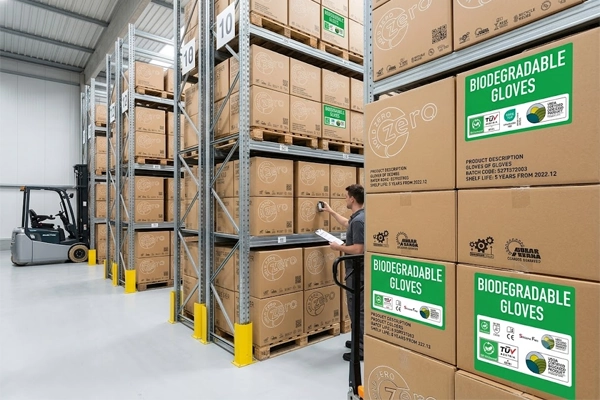
In the decision-making process for large-scale, industrial, and intensive procurement, supply chain management, and warehouse supervisors often exhibit an instinctive resistance to introducing new types of eco-friendly materials. Traditional supply chain concerns are very clear: if a piece of protective equipment is labeled as “biodegradable,” will it undergo premature aging, degradation, or a loss of physical performance during long-term storage and logistics in high-humidity industrial warehouses?
These concerns regarding a product’s operational viability often become the core obstacle preventing companies from fully implementing green material alternatives. In fact, understanding the mechanisms that trigger degradation in biodegradable protective gear under various external conditions is key to assessing its shelf life and managing financial risks.
Do Biodegradable Gloves Degrade Prematurely in the Warehouse?
The most common question raised by procurement teams is: Do biodegradable gloves spontaneously undergo molecular chain breakdown under normal warehouse conditions? The answer is no. The physical disintegration of biodegradable personal protective equipment (PPE) is subject to extremely strict preconditions:
Specific environmental triggers: The degradation process of these new bio-based or recycled gloves is not based on simple natural aging over time; rather, it is activated only when the gloves are placed in commercial landfills or industrial composting environments characterized by high microbial density, high humidity, anaerobic conditions, and normal temperature and pressure.
Long-Term Storage Stability: Under standard factory warehouse management systems, as long as basic conditions—such as dryness, protection from light, ventilation, and normal temperature and humidity control—are maintained, the chemical properties of the bio-based PU coating and RPET recycled liner remain absolutely stable.
No Risk of Inventory Impairment: Its physical and chemical stability is identical to that of traditional petrochemical-based protective gloves. Over a turnover period of 2 to 3 years, there will be no spontaneous powdering, delamination, or coating peeling. The company, therefore, does not face the risk of inventory asset impairment resulting from premature product failure.
Maintaining Tensile Strength and Abrasion Resistance Under Industrial Stress
In addition to storage safety, the physical protective performance of these new eco-friendly gloves under extreme workshop conditions has also undergone rigorous stress testing. Biodegradable technology does not mean compromising on employee safety or abrasion resistance:
Performance Under Industrial Stress: During the manufacturing process, a specialized reinforced cross-linking polymer process endows the palm coating with extremely high tear strength and abrasion resistance (Abrasion Resistance).
Resistance to Heavy Oil Contamination: When faced with heavy oil contamination, metal cutting fluids, and frequent high-pressure friction—common in machining operations—the fiber shell of these eco-friendly gloves not only maintains its integrity but also outperforms many traditional, low-end work safety products made primarily from standard polyurethane (Standard PU) in terms of resistance to oil penetration and maintaining fingertip sensitivity.
Ensuring Production Line Operational Efficiency: This combination of physical toughness and environmental compliance ensures that, after a company fully transitions to green supply chain materials, not only will the risk of workplace injury compliance issues on the production line not increase, but the company will also be able to further spread out the total cost of ownership based on a procurement benchmark of 10,000 pairs by increasing the number of shifts per pair of gloves in use. This fundamentally eliminates the psychological reservations on the procurement side regarding the lack of practical durability in eco-friendly materials.
Key FAQs Regarding Biodegradable PPE and Waste Cost Optimization
In the process of transitioning enterprise-level personal protective equipment (PPE) toward a green supply chain, corporate decision-makers, CFOs, and environmental compliance officers often face a series of scrutiny regarding cost-effectiveness and technical details. To help industrial procurement groups quickly grasp the underlying logic, we will provide in-depth answers to the following key questions regarding waste cost optimization, degradation trigger mechanisms, and international carbon accounting standards. The structure of this section precisely aligns with Google’s FAQ Schema structured data logic, directly addressing the core, high-frequency queries of B2B decision-makers in search engines.
Q1: Do biodegradable work gloves cost more to dispose of than regular gloves?
On the contrary, from a long-term total cost of ownership (TCO) perspective, the end-of-life disposal costs for biodegradable industrial gloves are significantly lower than those for conventional gloves. Since traditional synthetic fiber or petroleum-based nitrile/PU gloves are completely non-biodegradable in the natural environment, companies must pay expensive commercial landfill tipping fees and volume-based surcharges over the long term based on the gloves’ maximum total volume and net weight when they pass through the waste scales at solid waste transfer stations.
In contrast, gloves incorporating advanced biodegradation technology rapidly break down and are absorbed upon entering a landfill, converting into water and gas. This microscopic depolymerization and absorption directly reduces the absolute tonnage reported by manufacturing plants in their solid waste declarations and the frequency of container hauls, resulting in a sharp decrease in end-of-life disposal costs on a per-10,000-pairs basis. At the same time, it helps companies completely avoid the punitive environmental tariffs associated with generating highly polluting, non-biodegradable petrochemical waste.
Q2: What specific landfill conditions trigger the biodegradation of industrial safety gloves?
The molecular chain breakdown of biodegradable industrial safety gloves is triggered by extremely specific environmental mechanisms; it will never occur prematurely in clean, dry, conventional factory warehouses. This degradation process is only formally activated after the materials are decommissioned and sent to commercial landfills or industrial composting environments that possess the following three core elements:
Active Microbial Communities: The environment must be rich in high-density populations of specific anaerobic or aerobic microorganisms; the specific enzymes secreted by these microorganisms are the primary agents that attack the chemical bonds of the gloves’ polymer chains.
High Moisture and Optimal Temperature: The constant humidity and biogenic heat deep within the landfill provide the necessary physical medium for the activation of the active inducers.
Anaerobic Environment: In an oxygen-deprived, sealed environment—buried beneath layers of other solid waste—Accelerated Microbe-Driven Depolymerization (AMD) is significantly accelerated, ultimately breaking down hard-to-degrade petrochemical macromolecules from the surface inward into harmless natural biomass.
Q3: Can switching to sustainable PPE help our facility qualify for Scope 3 emissions reductions?
Absolutely. The comprehensive adoption of eco-friendly personal protective equipment (PPE) that meets low-carbon compliance standards is a key compliance strategy for modern manufacturing facilities seeking to manage their Scope 3 greenhouse gas (GHG) emissions.
In multinational supply chain audits and ESG ratings, the virgin carbon footprint of traditional petroleum-based PPE at the manufacturing stage, as well as the carbon emissions generated at the end-of-life stage due to long-term non-degradation or specialized waste incineration, are directly counted toward a company’s environmental liability. By adopting high-performance eco-friendly gloves featuring a 13-gauge recycled RPET fiber lining combined with a bio-based polyurethane coating (such as the MAXGUARD B-312-BIO series or BLADEGUARD B2-340-BIO series), not only do they eliminate the consumption of fossil resources at the source in the supply chain, but also significantly offset the carbon footprint at the end of the product’s life (EoL) through biodegradation. Factories can use these quantifiable waste reduction and low-carbon procurement credentials to directly offset carbon emissions in Scope 3 of their supply chain audits. They can even serve as direct commercial evidence for applying for government environmental subsidies and tax credits, granting companies a decisive competitive edge in securing major green trade contracts and expanding into overseas markets.