
RPET Liners (Recycled Polyester Liners) refer to seamless knitted skeletons for industrial-grade protective gloves used in protective equipment, which are produced by processing post-consumer PET bottles through physical cleaning, high-temperature pelletization, and melt-spinning technology, thereby completely replacing fossil-derived resources at the textile source. While fully retaining the tear resistance and tensile strength required for heavy industrial manufacturing, this material reduces greenhouse gas (GHG) emissions in the upstream manufacturing stage by more than 30%, providing modern enterprises with a green supply chain solution featuring full physical traceability.
Against the backdrop of increasingly stringent environmental compliance requirements and Carbon Border Adjustment Mechanism (CBAM) audits in the global manufacturing sector, centralized procurement teams at major multinational corporations are turning their attention to carbon reduction in the more complex upstream segments of the supply chain. According to the standards of the GHG Protocol, Scope 3 Category 1 (purchased goods and services) typically accounts for more than 80% of a manufacturing company’s total carbon footprint. As high-frequency PPE consumables that circulate rapidly and are heavily used on the factory floor, traditional petroleum-based virgin nylon or virgin polyester-lined gloves have inadvertently accumulated massive “carbon liabilities” for companies. Therefore, upgrading the inner lining of protective gloves to quantifiable, auditable RPET liners is becoming the tactical entry point with the greatest marginal benefit for companies seeking to optimize their ESG Supply Chain Ledger.
The Environmental Liabilities of Legacy Petrochemical PPE Fibers
Upstream Crude Oil Cracking and Thermal Polymerization Carbon Debts
In traditional personal protective equipment (PPE) manufacturing systems, the textiles used for inner linings and structural support rely almost entirely on petroleum-based virgin nylon (primary nylon/polyamide) or virgin polyester (primary polyester) filaments. Every step in the micro-synthesis of these traditional fossil-derived fibers requires an extremely lengthy and heavily polluting upstream heavy chemical processing chain. From the initial stage of crude oil cracking to extract precursor monomers (such as adipic acid, hexamethylenediamine, or purified terephthalic acid), to the subsequent ultra-high-temperature thermal polymerization reaction required to extend the molecular chains, the entire process consumes an enormous amount of fossil energy. In this chain of high-pressure, high-temperature chemical reactions, due to the substantial energy consumption involved in cracking and the occurrence of side reactions, upstream plants directly release dense concentrations of CO₂ and associated greenhouse gases into the atmosphere. In the modern environmental auditing model known as Life Cycle Assessment (LCA), these fossil-based fibers already carry an extremely heavy natural “carbon debt” from the raw material extraction and synthesis stages, even before they enter the weaving workshop.
Cumulative Scope 3 Carbon Inflation in High-Volume
Consumables When conducting supply chain asset audits, the centralized procurement teams of many large multinational manufacturers often fall into a hidden trap: They are accustomed to devoting significant resources to optimizing direct carbon reduction for fixed assets such as large machine tools and industrial boilers, yet they severely overlook high-frequency, fast-moving consumables—such as industrial personal protective equipment (PPE)—which circulate rapidly on the shop floor and are consumed in massive quantities daily. Work gloves, as high-volume consumables that must be replaced almost daily within factories, consume only a small amount of fossil resources per pair. However, when amplified by the high-frequency replacement of tens of thousands of employees year after year, the cumulative total grows to an astonishing exponential increase. Under the standards of the Greenhouse Gas Protocol (GHG Protocol), the faster these traditional gloves—made from fossil-derived fibers—move through the procurement pipeline, the more rapidly a company’s “hidden carbon deficit” in Scope 3 Category 1 (purchased goods and services) will balloon like a snowball. This cumulative release of greenhouse gases—resulting from the neglect of low-value consumables—is becoming a major compliance pitfall for many large manufacturers, repeatedly causing them to fall short of their carbon reduction targets when facing multinational environmental compliance audits or brand ESG performance assessments.
From Post-Consumer Waste to High-Gauge Filaments: The Upcycling Process
Mechanical Sorting, Ultrasonic Cleaning, and High-Purity Pelletization
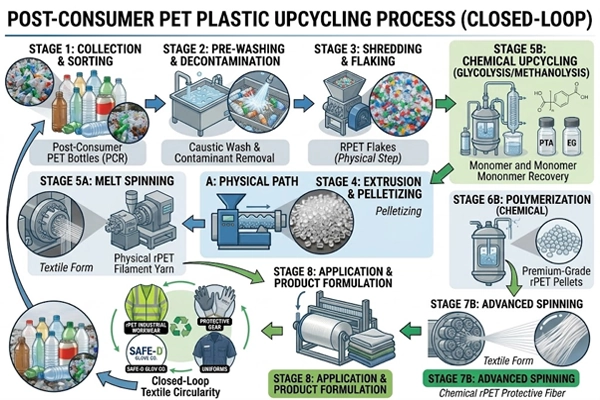
Modern protective engineering successfully transforms post-consumer solid waste into protective fibers with full industrial viability through advanced closed-loop recycling technology. The entire process strictly adheres to international industrial-grade recycling standards: First, scattered waste PET plastic bottles are collected and transported to a digitized processing workshop, where they undergo high-precision mechanical sorting (an automated mechanical and optical sorting system) to be separated and categorized by material purity and color in milliseconds.
Subsequently, the high-purity bottle flakes—with labels removed—enter the core Ultrasonic Cleaning system. Utilizing the cavitation effect of ultrasonic waves at specific frequencies, this process thoroughly strips away residual industrial oils, adhesives, and other trace impurities at the microscopic level. After cleaning, the purified bottle flakes undergo rigorous ultrasonic decontamination and vacuum drying before being fed into high-compression-ratio single-screw or twin-screw extruders. In a strictly temperature-controlled, nitrogen-protected environment, the material undergoes melting, filtration, and continuous pelletizing, ultimately solidifying into high-purity Recycled PET Pellets (high-performance recycled polyester pellets). This standardized physical recycling process not only reduces toxic residue to zero but also establishes a pure molecular foundation for subsequent filament spinning and weaving processes.
High-Orientation Melt-Spinning for 13-Gauge/15-Gauge Protective Skeletons
These recycled pellets, produced through high-purity pelletization, subsequently undergo a phase of physical transformation that determines their mechanical protective strength. In ultra-high-pressure melt-spinning equipment, the molten recycled resin is continuously extruded through a high-precision, micron-scale spinneret. Under the instantaneous solidification effect of cooling air blown from the side, the filaments undergo ultra-high-ratio mechanical stretching between the draw rolls. This process induces a dramatic reorientation of the originally disordered polymer molecular chains, forming High-Orientation Filaments with extremely high crystallinity, which fundamentally establishes the fiber’s tensile strength and rigidity against tearing.
Finally, these highly tenacious filaments are seamlessly mounted onto modern digital constant-tension knitting machines. In accordance with precise operational protection requirements, the filaments are tightly woven into a 13-gauge (13-needle) or even finer, denser 15-gauge (15-needle) seamless knitted protective framework. Field tests demonstrate that this highly engineered, seamless, adaptive structure enables RPET Liners to perfectly inherit the low elongation at break and extremely high tensile recovery rate that rival or even surpass those of virgin synthetic fibers. Whether under continuous high tensile stress on the front lines or during extreme physical shear stress, it provides rock-solid “Protective Skeleton” support, using irrefutable mechanical data to shatter the traditional prejudices within the heavy industry sector regarding the safety of recycled consumables.
Auditing the ESG Ledger: Quantifying Life Cycle Assessments (LCA) for Procurement
Calculating the Carbon Offset: Virgin Polymers vs. Recycled Polyester
In the low-carbon transition of modern supply chains, vague “green slogans” cannot pass board-level compliance reviews; only quantifiable data models can be directly translated into effective financial evidence. To help multinational procurement teams accurately measure the marginal environmental benefits of material substitution, we conducted a full-process Lifecycle Assessment (LCA) data reconciliation between Virgin Polymers and Recycled Polyester (RPET).
According to greenhouse gas calculations based on actual measurements across the entire production chain by an authoritative third-party testing agency, for every dozen (12 pairs) of genuine RPET knitted liner gloves purchased, CO₂ equivalent (CO2e) released is significantly reduced by 30% to 38% compared to traditional virgin nylon or polyester gloves. This specific carbon offset percentage means that major manufacturers do not need to forcibly shut down or retrofit large machine tools and fixed assets in their workshops. Simply by upgrading the sustainability of their routine consumables, they can inject clear, traceable greenhouse gas emission reduction credits into the front end of the supply chain, providing a robust, data-driven foundation for their low-carbon procurement strategies.
Generating Audit-Ready Data for Cross-Border Carbon Tariffs (CBAM)
With the full implementation of the EU’s CBAM (Carbon Border Adjustment Mechanism/Carbon Tariff) and the routine, large-scale spot checks on supply chain ESG audits by leading global consumer brands, the procurement departments of multinational manufacturing giants are facing unprecedented compliance pressures. Under traditional procurement models, personal protective equipment (PPE) consumables often become a “carbon black hole” in brand audits—difficult to account for due to the lack of full lifecycle data tracking.
The core business value of fully implementing protective solutions based on RPET liners lies in their ability to continuously provide companies with audit-ready data (ready-to-use, compliant data that meets audit standards). Since all our recycled materials are equipped with fully transparent traceability chains, our technical support team can work directly with compliance officers at major manufacturers to seamlessly convert the procurement costs and shipment quantities of each batch of gloves into upstream supply chain carbon reduction credits that fully comply with the international GHG Protocol standards. This seamlessly integrated, hard-hitting data can be transferred verbatim by centralized procurement teams into the company’s annual ESG reports, supply chain compliance declarations, or ledgers prepared for carbon tariff audits, directly transforming traditional “personal protective equipment procurement costs” into “compliance assets” that ensure major manufacturers remain invincible in the face of international trade barriers.

Mechanical Performance and Carbon Accounting Matrix
SQG® Industrial-Grade Composite Reinforcement Core Parameter Comparison Table
| Frame Series and Core Models (Model Fleet) | Liner Fiber Base Matrix (Liner Spec) | Coating Materials and Processes (Coating Tech) | Scope 3 Category 1 Carbon Offset Benefits (ESG Benefits) | Shop Floor Utility and Safety |
| P-311-BIO -GL / -OL | 13-Gauge Seamless RPET Recycled Eco-Friendly Fiber Reinforcement | Bio-Based PU Bio-Based Polyurethane Coating | Directly reduces carbon emissions from fiber sources by 30% or more; 100% physically traceable, reducing the cumulative carbon footprint of purchased materials. | Light industrial environments require the highest level of tactile sensitivity, such as precision electronic assembly, lightweight automotive final assembly, and material handling. |
| B3-340-BIO | 13-Gauge HPPE / RPET / Glass Fiber Composite Cut-Resistant Matrix | Bio-Based Soft PU Bio-Based Soft Polyurethane | The integration of physically recycled fibers and plant-based resins significantly offsets the high carbon footprint associated with high-workload workshops. | High-frequency handling of sheet metal, light stamping, and automotive repair—balancing high cut protection with visible environmental benefits. |
| B4-310-BIO | 13-Gauge HPPE / RPET / Glass Fiber Heavy-Duty Tear-Resistant Reinforcement | Bio-Based Soft PU High-Density Dip Coating | Converts the depreciation rate of heavy industrial consumables into traceable carbon reduction metrics. | Workshops involving heavy-duty machining, high-load metal component assembly, and complex hardware operations with significant risks of puncture and laceration. |
| B4-319-BIO | 13-Gauge HPPE / RPET / Glass Fiber High-Visibility Fluorescent Reinforcement | Bio-Based PU Ultra-High Flexibility Coating | Dual compliance: Data supports Scope 3 procurement audits, while high-contrast color coding directly aligns with EHS visual safety audit metrics. | Low-light operations, heavy-duty truck warehousing and logistics dispatch, and steel structure assembly—providing mandatory visual safety protection under extreme working conditions. |
Dispelling Workshop Skepticism: Ergo-Weaving and Tensile Strength Testing
Low-Modulus Elasticity and Anti-Fatigue Elastic Recovery Rates
On the production floor, shop managers and safety supervisors often harbor deep-rooted “quality biases” toward recycled PPE materials, worrying that gloves made from recycled materials will be stiff, dry, and lacking in elasticity—which could lead to hand muscle fatigue when workers wear them continuously during operations.
SQG’s R&D team has completely shattered this technical barrier by introducing advanced Low-Modulus Ergo-Weaving technology. In the standard ASTM D412 (tensile property test), this lining—interwoven with high-elasticity RPET fine-denier filaments—demonstrates an exceptionally resilient stress-strain curve. Its elastic recovery rates and microscopic tensile modulus exhibit a smoothness highly consistent with that of traditional virgin nylon. This low-modulus structure adapts to the high-frequency flexion and extension of every joint in the palm, significantly reducing reverse shear stress on muscles during prolonged tool handling. It offers a soft, comfortable feel combined with exceptional moisture-wicking and sweat-absorbing efficiency, ensuring that frontline workers experience absolutely no muscle fatigue or operational lag during 12-hour continuous shifts.
Interlocking Micro-Structure Under Extreme Mechanical Shear Pressures
In addition to exceptional comfort, the naturally high-crystallinity molecular structure of RPET recycled polyester fibers also endows them with exceptional physical durability when subjected to extreme mechanical friction. Combined with our proprietary high-density seamless locking process, this creates an “Interlocking Micro-Structure” between the fibers, resembling a microscopic molecular interlocking mechanism.
In high-load grip tests simulating conditions in automotive stamping shops and friction against sharp metal edges, when the glove surface is subjected to intense mechanical shear stresses, this interlocking grid instantly and evenly disperses the tensile load in all directions. This ensures, at the most fundamental level, that the fibers never experience microscopic fractures, fraying, or damage. At the same time, the high-density continuous weaving process achieves a virtually lint-free, dust-free standard, preventing lint shedding or pilling even under high-frequency, high-friction conditions—perfectly addressing the heavy industry’s inherent concerns regarding the “short lifespan and susceptibility to aging” of recycled materials.

Cross-Linking the Fleet: Integrating RPET Liners into the SQG® Portfolio
In today’s modern industrial ecosystem, a single material specification cannot address the complex safety challenges that span multiple trades. SQG® has successfully interwoven traceable RPET liners (recycled polyester liners) with a protective matrix of varying performance levels, forming the SQG® BIO-FIRST® green, compliance-driven production fleet—which spans applications from light industrial digital precision assembly to heavy industrial extreme tear protection.
By synergizing these sustainable fiber skeletons with our proprietary Bio-Based PU coating, we deliver a fully integrated, zero-fossil PPE solution. As thoroughly detailed in our comprehensive performance analysis of bio-based coatings, this molecular engineering achieves eco-compliance without sacrificing tactile sensitivity. Through modular weaving upgrades, procurement teams can precisely match and select products based on the risk levels of specific job roles:
The MAXGUARD Precision Series (RPET Foundation for Precision Operations)
In light industrial supply chains where requirements for tactile sensitivity, dust control, and anti-static contamination are extremely stringent, the MAXGUARD Precision Assembly Series represents the premier low-carbon consumable solution:
P-311-BIO -GL (Forest Green Tech Armor): Features a 13-gauge seamless RPET recycled eco-friendly fiber skeleton paired with a high-contrast forest green color. This highly recognizable visual design is specifically tailored for daily inspections by EHS (Environmental, Health, and Safety) officers at major manufacturers, enabling supervisors to quickly assess frontline workers’ safety compliance rates from a distance.
P-311-BIO -OL (High-Visibility Safety Orange): Features a 13-gauge high-performance lining made from recycled plastic bottles, paired with a striking industrial safety orange. In fast-paced automated conveyor belt operations and high-frequency warehouse logistics, it provides operators’ hands with excellent visual safety protection and tactile sensitivity.
The BLADEGUARD Laceration Defense Series (High-Performance Recycled Cut Resistance)
Designed for heavy-industry applications—such as automotive stamping, metal cutting, and high-frequency steel plate handling—where there are extreme risks of shearing and pinching, the BLADEGUARD series features a composite weave of RPET fibers and high-strength cut-resistant materials:
B3-340-BIO: 13-gauge seamless HPPE/RPET/glass fiber composite cut-resistant matrix. While ensuring rigid cut resistance, the lining—infused with high-performance recycled polyester—offers excellent microporous breathability and moisture-wicking efficiency, making it ideal for comfortable wear during long shifts.
B4-310-BIO: A 13-gauge heavy-duty laceration-resistant (cut and tear-proof) framework, paired with a bio-based soft PU coating impregnated on the palm side. Designed specifically for environments involving friction with sharp metal burrs, it demonstrates through its robust physical durability that eco-friendly materials can also deliver top-tier wear resistance and cost-effectiveness.
B4-319-BIO: A 13-gauge high-visibility fluorescent lime green frame that perfectly combines physical cut- and pinch-resistant properties with the benefits of carbon footprint traceability. While ensuring maximum safety, it directly provides transparent, verifiable green data to support supply chain procurement audits for major multinational manufacturers.
People Also Ask: Frequently Asked Questions About Recycled PPE Materials
Q1: Are RPET-lined gloves certified by global recycling traceability standards like GRS?
Yes, absolutely. All recycled lining materials used in the SQG® Green Protection Matrix have fully passed the most stringent Global Recycled Standard (GRS) certification for end-to-end supply chain traceability.
This means that every material movement along the entire value chain—from the initial collection of post-consumer plastic bottles, through flaking and shredding, high-temperature pelletization, and melt spinning, all the way to the final smart knitting workshop—is supported by a compliant Transaction Certificate (TC). Compliance teams at large procurement companies can access this end-to-end, closed-loop documentation at any time to present to brand investors, corporate headquarters, or third-party ESG audit firms as tamper-proof and fully transparent evidence of a legitimate and compliant supply chain, thereby completely eliminating the risk of “greenwashing.”
Q2: Does the recycling process affect the skin-friendliness of the fabric or cause contact dermatitis among production line operators?
Not at all. Many frontline safety officers are concerned that RPET fibers derived from recycled materials may contain trace chemical impurities, which could trigger skin allergies in factory workers.
SQG® employs a state-of-the-art physical recycling process that includes multiple stages of ultrasonic deep cleaning and thorough high-temperature decontamination. The finished gloves have achieved 100% compliance with the extremely stringent OEKO-TEX Standard 100 (international eco-textile certification), ensuring that their microstructure is completely free of heavy metals, formaldehyde, carcinogens, and any potential allergenic chemical residues. The finished gloves exhibit excellent biocompatibility and a skin-friendly feel. Even when worn for extended periods under high-intensity conditions by frontline workers with sensitive skin prone to heavy sweating, they completely prevent the occurrence of contact dermatitis and skin redness and swelling, effectively mitigating occupational health risks for companies and avoiding the pitfalls of potential workers’ compensation claims.
Q3: How do manufacturers translate glove procurement volume into audit-ready Scope 3 carbon reports?
Once a company has procured and deployed gloves with traceable RPET liners on a large scale, our technical support team will provide a customized LCA (Life Cycle Assessment) reconciliation report directly to the supply chain audit department of major manufacturing clients.
Procurement teams do not need to hire expensive third-party consulting firms to perform these calculations. By simply applying our authoritative, certified greenhouse gas quantification model to their quarterly and annual total glove procurement volumes (in dozens), they can seamlessly convert the expenses associated with traditional disposable PPE into absolute carbon emission reduction equivalents that fully comply with the GHG Protocol standards. This highly structured, data-driven output serves as quantifiable and verifiable evidence of low-carbon procurement achievements. It can be directly incorporated into a listed company’s annual ESG Report or compliance records for carbon tax audits, effortlessly fulfilling the group’s carbon reduction assessment requirements for its upstream supply chain.
Conclusion: Specifying the SQG® BIO-FIRST® Series for Zero-Compromise Manufacturing Safety
In the historic, long-term transition of the global manufacturing industry from “high-carbon extraction” to “green and low-carbon” practices, upgrading the supply chain for personal protective equipment (PPE) should never be a forced compromise that sacrifices frontline workers’ hand safety or wearing comfort. Instead, it should be a process that leverages the full lifecycle compliance benefits offered by modern materials science. By introducing high-strength, 100% traceable RPET liners (recycled polyester liners) at the source of production, the SQG® BIO-FIRST® green protective fleet not only perfectly retains the mechanical foundation—including cut resistance, abrasion resistance, flexibility, and high-sensitivity tactile feedback—required for heavy industrial manufacturing, but also directly provides multinational centralized procurement teams with a “game-changing tool” to break the deadlock in Scope 3 carbon footprint audits. This underlying material strategy—which balances rigorous on-site protection with headquarters’ ESG Supply Chain Ledger metrics—is redefining the safety boundaries of modern B2B green manufacturing.
Next Procurement Milestone: Want to include these precise, traceable carbon reduction benefits directly in your group’s annual ESG report? Click “Explore Sustainable Compliance Category Portfolio” now to view our complete sustainable compliance protection matrix, or contact our senior technical engineers directly to request a full set of third-party GRS traceability certificates, accounting white papers, and production-grade factory test samples (Complimentary Sample Pack)!