

When evaluating 13-Gauge vs 18-Gauge Safety Gloves, global occupational safety and health (OSH) accident statistics reveal that over 70% of recordable hand injuries occur because workers custom-stripped off their PPE due to severe bulkiness and rigid finger stiffness. Traditional heavy yarn safety gloves numb tactical sensitivity, forcing frontline fleets to choose between protocol compliance and operational precision constantly.
To systematically lower on-site injury rates, advanced procurement teams must shift focus from yarn mass to ergonomic manual dexterity. Upgrading your facility inventory to lightweight, high-density 18-gauge seamless knitting technology ensures all-day worker compliance while driving down your overall PPE total cost of ownership.
Before diving into specifications, optimizing your procurement loop with premium cut-resistant work gloves is the single most effective, data-driven maneuver to secure both fleet safety and supply chain efficiency.
The “Thicker is Safer” Fallacy in Industrial PPE Procurement
[H3] Breaking the Myth of Raw Fabric Mass in Bidding Specifications
In traditional B2B safety procurement, many site foremen fall into a deeply ingrained misconception when drafting bidding specifications: they blindly specify heavy 13-gauge coarse-weave gloves or bulky leather gloves, mistakenly believing that physical “thickness” directly equates to greater mechanical protection. This outdated procurement logic is creating serious systemic vulnerabilities in modern companies’ occupational safety equipment management. Such work gloves—which prioritize thickness at the expense of flexibility (made from unyielding fabrics)—create significant physical resistance when workers frequently clench their fists during tasks. This not only exacerbates severe hand fatigue but also numbs the subtle tactile feedback from the fingertips.
The True Total Cost of Ownership (TCO) vs. Worker Non-Compliance
When performing precision sub-assembly or adjusting high-torque tools on the shop floor, workers often take a risk to ensure operational accuracy—quietly removing their bulky safety footwear. The financial cost of this non-compliance, driven by poor comfort, is extremely high. In industrial settings, a single documented hand laceration incident can easily trigger medical claims, compliance fines, and significant project downtime totaling tens of thousands of dollars. Therefore, prioritizing rigid mass in bid proposals while neglecting ergonomic compliance not only fails to truly protect workers but also systematically increases a company’s annual operational risks and total cost of ownership (TCO).
The Physics of “Gauge”: What Do These Numbers Actually Mean?
High-Density Needle Bed Engineering and Textile Definitions
To completely dispel the industry myth that “thicker equals safer,” B2B procurement managers must first understand the physical definition of “gauge” from the fundamentals of textile engineering. Simply put, gauge refers to the number of needles per inch on a knitting machine. Safety gloves with different gauges have vastly different microscopic physical structures:
Traditional 13-Gauge Physical Limitations: 13 needles per inch. Due to low needle bed density, it can only use thicker yarns for a loose weave, resulting in large mesh openings and a fabric thickness typically ranging from 1.5 mm to 2.2 mm. This bulky structure directly limits hand dexterity.
Advanced 18-Gauge Physical Advantages: 18 stitches per inch. Utilizing an ultra-high-density precision knitting process (ultra-fine knitting), the stitches are minute and arranged extremely closely. This significantly reduces the fabric’s net thickness to approximately 0.8 mm – 1.0 mm, achieving lightweight construction at the microscopic level.
Eradicating Hand Fatigue Through the “Second Skin Effect”
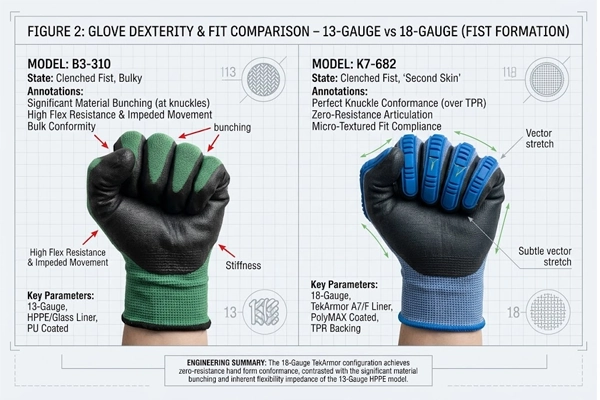
From an ergonomic perspective, these microstructural differences directly contribute to unsafe behaviors among workers on the job. The loose weave of 13-gauge fabric creates significant stiffness and physical creasing when workers bend their fingers, making it highly prone to causing severe hand fatigue. In contrast, the high-density, seamless 18-gauge knit fabric creates a natural “Second Skin Effect” when worn. It provides 100% snug coverage that conforms to every physiological curve of the palm and fingertips. This tactile feedback, which feels almost like bare hands, not only eliminates the temptation for workers to remove gloves due to perceived bulkiness but also ensures safety compliance during high-frequency, high-precision tasks on both psychological and physiological levels.
The Materials Science Behind TekArmor®: Breaking the Density Barrier
Overcoming the “Thinness vs. Protection” Dilemma in Procurement
When evaluating modern [cut-resistant work gloves], procurement directors and safety officers at many multinational corporations often raise a fundamental technical question: “If 18-gauge gloves are only about half as thick as traditional gloves, how can they withstand the brutal cuts from sharp blades in heavy industrial settings?” This concern stems entirely from outdated perceptions of traditional materials. Due to outdated material technology, traditional 13-gauge work gloves can only rely on the “raw volume” of low-density cotton yarn or coarse glass fibers to physically block cuts from sharp blades. In contrast, the TekArmor® fiber technology developed by the SQG® laboratory has completely revolutionized this volume-dependent defense logic.
Molecular Kinetic Energy Dissipation Under High Shear Stress
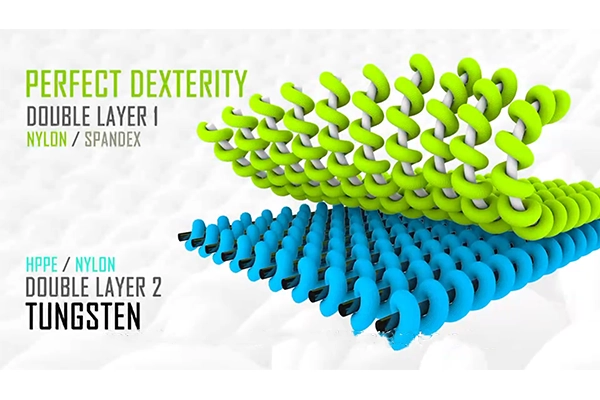
Empowered by the 18-gauge seamless knitting process, TekArmor® demonstrates the cutting-edge capabilities of a major manufacturer’s modified polymer materials. Decoding it at the microscopic molecular level: The core of this technology relies on long polymer chains with ultra-high tensile strength and ultra-high elongation.
When sharp metal burrs, stamping flash, or blades on-site instantly apply high shear stress, the molecular chains within the 18-gauge high-density knit fabric do not snap cleanly; instead, they undergo dynamic slippage and interlocking. This mechanism rapidly dissipates localized destructive energy within microseconds, distributing it across the entire fabric base of the glove. It is precisely this materials science breakthrough that allows 18-gauge gloves to meet the ANSI Cut Level A4/D high-cut-resistance standard recognized in international tenders while maintaining an ultra-thin profile (just 0.8 mm–1.0 mm), truly achieving the perfect balance between “ultra-thin construction” and “high defense.”
Behavioral Safety: How Manual Dexterity Systematically Lowers Injury Rates
[H3] The Direct Impact of Tactile Sensitivity on PPE Compliance Rates
In modern industrial safety management, applying the research model of behavioral safety reveals that compliance with hand protection depends largely on the ergonomic interaction between tools and the hands. Traditional supply chain decision-making often overlooks the dynamic compliance of workers on the job site. In fact, there is an unbreakable, strong causal relationship between the manual dexterity of gloves and the compliance rate of frontline workers regarding full-time wear. When protective equipment severely hinders operations, compliance management that relies solely on administrative penalties will ultimately fail.
Positive Ergonomic Chain vs. Chronic Hand Fatigue
Through high-density seamless knitting technology, the 18-gauge gloves establish an efficient positive ergonomic chain in industrial settings:
Ultra-lightweight precision and sensitivity: Provide fingers with virtually “zero-resistance tactile feedback.”
Eliminates the risk of removing gloves: Workers no longer need to frequently “take off their gloves” to ensure precision when performing high-precision engraving, tightening tiny frame screws, or operating control panels.
Soaring 24/7 compliance rates: On-site safety equipment wear compliance has been forced up to over 95%.
Eliminating workplace injury risks at the source: The incidence of sudden localized abrasions and laceration accidents has plummeted.
Counter-Analysis: The Fabric Rigidity Trap
Conversely, a reverse analysis easily reveals the drawbacks of traditional 13-gauge heavy-duty gloves. Because 13-gauge work gloves are made of coarse, stiff fibers and lack structural elasticity, workers must overcome more than 30% additional resistance from the fabric’s rigidity every time they perform a gripping or fist-clenching motion during an 8- to 12-hour shift. Under prolonged, high-frequency use, this latent physical resistance accumulates rapidly, easily leading to severe hand fatigue, soreness in the finger joints, and even long-term chronic muscle strain. When workers habitually remove their gloves to perform tasks despite slipping and exhaustion, companies are directly exposed to the risk of massive secondary injuries and the costs associated with work stoppages and corrective measures.
Spec Sheet Blueprint: 13-Gauge vs. 18-Gauge Multi-Variant Matrix
Data-Driven Evaluation for Procurement and Safety Executives
In the centralized procurement and bid approval processes of multinational corporations, Safety Directors and CFOs often require hard, quantitative data to assess the actual return on investment (ROI) of equipment upgrades. To eliminate vague, subjective descriptions, SQG® leverages established industrial glove manufacturing standards to summarize the core differences between 13-gauge and 18-gauge gloves in terms of physical performance and operational impact. This is presented in the following multi-dimensional technical matrix, enabling procurement management to use it directly as a key point in their bid decision-making reports to senior leadership:
Technical Comparison Matrix (Elementor Table Module ready)
| Engineering Parameter | Traditional 13-Gauge Gloves | SQG® 18-Gauge TekArmor® Series | B2B Procurement Strategy Impact |
| Fabric Thickness | 1.6mm – 2.2mm (Bulky) | 0.8mm – 1.0mm (Second Skin) | Eliminates the urge for workers to remove gloves due to bulkiness. |
| Tactile Sensitivity | Low (Difficulty picking small screws) | Excellent (Supports precision carving/assembly) | Improves operation accuracy and prevents tool drop hazards. |
| Cut Protection Rating | ANSI A2 – A3 (Relies on mass pile-up) | ANSI A4/D to A5/E (Molecular kinetic locking) | Upgrades physical defense vector while minimizing garment weight. |
| Hand Fatigue Index | High (Workers fight fabric stiffness) | Near-Zero (Ergonomic zero-resistance) | Mitigates long-term chronic fatigue, ensuring sustained productivity. |
Strategic Procurement Value and Workflow Integration
Through a thorough comparison of the technical specifications outlined above, supply chain management can clearly see that by drastically reducing physical thickness and eliminating friction, 18-gauge gloves fundamentally eliminate any excuse for on-site workers to operate bare-handed in violation of safety protocols. When selecting personal protective equipment (PPE) for high-precision manufacturing, complex assembly operations, and high-intensity infrastructure projects, specifying high-density cut-resistant work gloves through centralized procurement is the golden rule for balancing corporate compliance rates with worker comfort. This shift toward centralized procurement—replacing raw physical volume with advanced engineering parameters—not only makes a company’s supply chain logistics more forward-looking but is also a critical step toward maximizing control over total workers’ compensation costs.
Technical Specifications of the SQG® Precision Lineup: Matching Gauges to Applications
[H3] Aligning Industrial Use Cases with Specific Needle Bed Geometries
To meet the stringent physical requirements of multinational centralized procurement tenders and comprehensively resolve the conflict between “all-day compliance” and “precise manual operations” in industrial settings, SQG® leverages its mature polymer dipping production lines and leading materials science systems to officially launch the following high-conversion-rate technical solutions tailored for various extreme operating conditions. By referring to our core product portfolio, Safety Directors can precisely match solutions based on the following specific engineering parameters to achieve seamless safety upgrades and asset optimization across your entire workshop:
The 18-Gauge Flagship: Maximum Manual Dexterity & Elite Impact Defense
SQG® K7-682 — 18-Gauge Anti-Cut & TPR Impact Armor
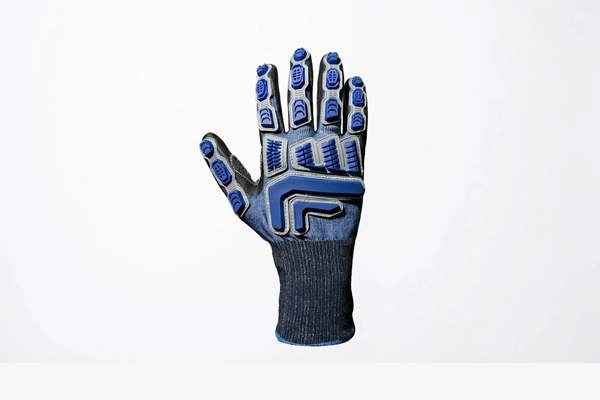
Microscopic Architecture: This is the ultimate solution to “compliance pain points,” completely shattering the industry’s traditional belief that “the thinner the glove, the weaker the protection.” It masterfully combines ultra-high-density 18-gauge seamless knitting with a proprietary TekArmor® A7/F-grade anti-cut lining, delivering an ultra-thin, “second-skin” feel on the palm that offers the precision of bare hands and exceptional grip performance.
Tactical Defense Vector: While maintaining exceptional manual dexterity, this product features a groundbreaking integration of hard-core TPR impact-resistant armor on the back. This perfectly addresses the complex, high-risk scenarios of high-precision tool assembly and intricate sculpting, where workers must guard against sudden mechanical impacts in heavy industrial settings while requiring extreme macro-level tactile feedback. It is the golden ace that corporate safety directors rely on to ensure strict compliance with full-time wear requirements.
The 13-Gauge & 15-Gauge Legacy Class: Heavy-Duty Lifespan & Cost Efficiency
SQG® K9-610 — 15-Gauge Ultra-High Cut Shield
Engineering Defense Profile: For applications that do not require the 18-gauge extreme close-up tactile feedback but are directly exposed to heavy, extreme destructive environments, the K9-610 is an excellent compromise upgrade. This product utilizes a 15-gauge seamless TekArmor® substrate, achieving a cut resistance rating that reaches the top tier of ANSI A9/F standards. It utilizes a denser ultra-high molecular weight composite lattice structure to rigidly lock out high physical shear stresses caused by sharp broken wires, large automotive metal burrs, and other hazards.
SQG® B6-311T — 13-Gauge Heavy-Duty General Sourcing Standard
Procurement Lifecycle Impact: In response to the classic 13-gauge bulk procurement system favored by traditional site foremen, as mentioned at the beginning of this article, we have specifically introduced the Wear-Resistant King B6-311T. It features a standard 13-gauge HPPE/stainless steel wire/polyester/spandex seamless composite lining (with composite cut resistance up to ANSI A6/F).
TCO Optimization Focus: This product perfectly addresses a key pain point in supply chain optimization—it comes standard with a high-abrasion-resistant reinforced thumb crotch. This provides robust support for high-volume bulk procurement in high-wear scenarios such as general heavy-duty handling and infrastructure logistics. By reinforcing the physical weak points most prone to damage, the operational lifespan of the entire glove is extended several-fold, directly eliminating hidden procurement costs for enterprises and significantly reducing the total cost of ownership (TCO) for PPE.
SQG® B3-310 / B4-310 / B5-310 — 13-Gauge Multi-Color PU Sourcing Matrix
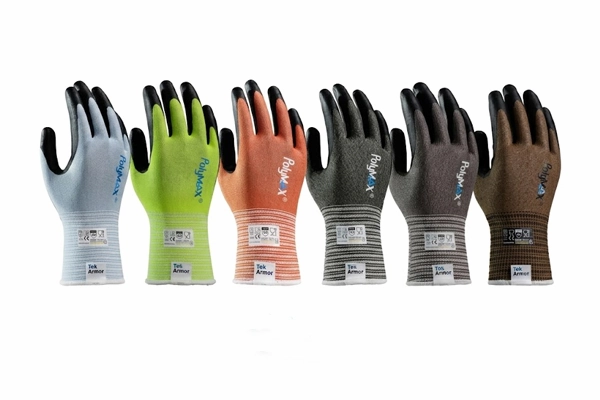
Color-Coded Safety Management: Designed for high-volume assembly line operations, this range of 13-gauge anti-cut PU gloves—featuring both HPPE/glass fiber and HPPE/steel wire liners—offers a rich visual color matrix (including green, orange, and cyan) for multinational supply chain procurement. In industrial operations, this multi-color product matrix serves as the optimal foundation for companies to establish modern “color-coded safety management” production lines. It greatly facilitates management’s implementation of modular visual zoning for different safety zones, production processes, and hazard levels, achieving a significant improvement in overall workshop compliance while maintaining cost-effectiveness.
FAQ: Debunking Myths About Gauge and Cut Resistance
Structural FAQ Schema for Google Search Snippet Optimization
To secure featured snippets in Google search results and generate FAQ Schema structured data highly favored by Google’s algorithms, this section provides expert technical answers based on industry standards (ANSI Rating) and materials science for the core concerns most frequently encountered by multinational buyers during daily bulk procurement screening, technical evaluations, and financial reporting:
Q1: Does a higher gauge number mean a safety glove is more protective?
A1 (Technical Clarification): In textile engineering, this is a common industry misconception. A higher gauge actually indicates a higher density of needles per inch on the needle bed, resulting in a thinner, more compact fabric (glove liner) rather than physical thickness.
The gauge number itself does not directly determine the level of cut resistance. Traditional 13-gauge work gloves typically rely solely on crude “thickness and bulk” to block cuts; in contrast, the SQG® 18-gauge series leverages TekArmor® polymer modification technology. Through the ultra-high tensile strength of its microscopic lattice structure, it achieves a “technological leap” that surpasses the physical defense performance of standard 13-gauge gloves while reducing physical thickness by nearly half.
Q2: Why does increasing manual dexterity directly reduce the company’s annual workers’ compensation costs?
A2 (Financial Impact & Behavioral Logic): From the perspective of total cost of ownership (TCO) accounting, the underlying logic is extremely tight. When the gloves’ manual dexterity undergoes a significant improvement, they provide fingertip tactile feedback with near-bare-hand sensitivity and zero resistance. This fundamentally eliminates the frequent violation of workers “secretly removing gloves” due to discomfort caused by thickness or stiffness.
Workers can maintain high compliance with wearing gloves throughout their entire shift, which directly leads to a sharp drop in the rate of sudden, unexpected cuts on the job site. This improvement in behavioral safety can directly help companies systematically reduce annual costs—including tens of thousands of dollars in hidden workers’ compensation claims, compliance fines, and claims related to work stoppages caused by labor shortages.
Q3: Can the SQG® 18-gauge series withstand repeated commercial wash cycles without losing its ANSI rating?
A3 (Durability & ROI Validation): Absolutely. The SQG® 18-gauge high-density seamless knit series was designed from the outset with extended lifespan and repeated use in mind. Under standard 40°C industrial washing procedures, even after more than five complete industrial wash cycles, its micro-polymer high-density structure remains stable, with no degradation in physical cut resistance or ANSI rating.
Unlike outdated traditional leather or coarse cotton workwear, it will never suffer from severe shrinkage, hardening, cracking, or fiber loosening after washing and drying. This exceptional wash durability eliminates the premature scrapping of workplace safety gear, significantly extends inventory turnover cycles, and thereby maximizes the long-term return on investment (ROI) for reusable items across multinational supply chains and corporate finances.
Global Sourcing Hub: Secure Volume Pricing and Contract Bidding
[H3] Streamlined Supply Chain Integration for Enterprise Procurement Officers
To support the annual bidding and centralized procurement plans of multinational corporations, procurement directors, and global PPE distributors, the SQG® International Business Team has officially established a fast-track process for bulk container procurement. We understand that in modern supply chain logistics, delivery times, compliant bid proposals, and full lifecycle ROI are all essential. Therefore, whether for 18-gauge high-sensitivity core safety workshops or 13-gauge reinforced-wrist-guard heavy-duty assembly lines, we provide the most professional, comprehensive technical solutions and seamless alignment of bid terms to help you systematically optimize the total cost of ownership (TCO) for your annual PPE supplies.


