
When the temperature in the work environment plummets to -30°C—such as during polar oil and gas drilling, winter construction in high latitudes, or heavy-duty cold-chain logistics—the fundamental principles of industrial hand protection are completely upended. Under such extreme cold conditions, traditional abrasion resistance and cut resistance requirements must yield to the thermodynamic and physical limits of the materials.
EHS managers and procurement professionals at many multinational corporations frequently face an extremely challenging problem: as soon as conventional industrial gloves are exposed to temperatures below zero, the polymer coating on their surface rapidly undergoes a physical phase transition. The originally soft rubber hardens and becomes brittle, much like ice. Not only does this completely eliminate grip on cold metal tools, but—more critically—workers must exert exponentially greater hand muscle energy to flex and extend their fingers through the stiff gloves. This “splint effect,” caused by material hardening, rapidly cuts off blood circulation to the fingertips, making it extremely easy for hands to freeze instantly or even suffer irreversible severe frostbite.
Faced with the challenges of a harsh winter, blindly increasing glove thickness is not a scientifically sound solution. This article will set aside empty marketing rhetoric and provide an in-depth analysis of the technical core of true industrial-grade cold-resistant gloves, drawing directly from the “glass transition temperature (Tg)” of polymer materials and the thermodynamics of modern textile engineering.
We will break down in detail how SQG has completely overcome the technical shortcoming of synthetic rubber becoming brittle at low temperatures through a customized cold-resistant latex formulation, and how this is deeply integrated with a heavyweight Acrylic Terry Loop liner to create a new generation of thermal cold resistant latex coated work gloves. This innovative material architecture not only maintains incredible softness in extremely cold environments but also blocks heat loss through the inner lining’s air-lock thermal layer, thereby providing global supply chain buyers with a professional winter work safety procurement guide based on the rigorous EN 511 testing standards.
The Engineering Challenge of Sub-Zero PPE
In extremely cold outdoor work environments, the design of personal protective equipment (PPE) gloves faces exceptionally demanding engineering challenges. Under these conditions, ambient temperatures exceed the physical operating limits of most conventional materials. For procurement and EHS teams, understanding the mechanisms by which low temperatures degrade polymer materials is an absolute prerequisite for making scientifically sound selections for cold-weather protection.
Loss of Dexterity in Freezing Conditions
Many frontline workers and safety supervisors mistakenly believe that the greatest threat to hand protection in extreme cold is simply “frostbite.” However, the real engineering challenge lies in the “splinting effect” caused by the hardening of polymer coatings.
When the rubber coating on conventional gloves cools rapidly below zero degrees, the originally soft surface becomes as stiff as cardboard—as if a layer of hard plaster had been applied to the outside of the worker’s fingers. To overcome this stiffness, workers must exert 30% to 50% more muscle force every time they flex their fingers or grip cold tools. This unnecessary physical exertion leads to severe hand muscle fatigue within just a few hours of a shift. The result is a significant decline in finger dexterity and grip control, which can easily lead to fatal operational errors when operating heavy machinery or working at heights.
Cold Cracking and Micro-Fractures
In addition to loss of flexibility, another critical physical flaw that conventional polymer coatings face in extremely cold environments is brittle fracture. When frozen, stiff gloves are subjected to mechanical impact from metal pipes or heavy equipment during operations—or even just frequent bending motions—the coating surface rapidly cracks, producing numerous micro-fractures.
The appearance of these micro-fractures is catastrophic for the protective system. First, it directly compromises the glove’s original physical barrier against water and oil, allowing biting ice melt and industrial coolants to seep in and come into direct contact with the inner liner. Second, these dense cracks create a “cold bridge effect,” completely breaching the thermal insulation barrier and allowing extremely cold external air to be directly conducted inward, instantly accelerating the loss of core body heat from the worker’s hands.
Polymer Physics: Glass Transition Temperature (Tg)
What determines a pair of gloves’ performance in extremely cold environments is often not their thickness, but the underlying physical properties of the outer coating. In the field of materials engineering, the key metric for evaluating a polymer’s cold resistance is called the “glass transition temperature (Tg).” Simply put, this is the critical temperature at which a rubber material abruptly transitions from a soft, highly elastic state to a hard, glass-like, brittle state. Once this critical point is crossed, the glove’s mechanical properties will experience a drastic, cliff-like decline.
Why Nitrile Fails in the Cold
Many industrial procurement professionals are often puzzled as to why conventional nitrile gloves—which perform excellently in summer and offer oil resistance and abrasion resistance—become extremely difficult to use once they are exposed to the harsh winters of northern regions or cold storage facilities.
From a polymer physics perspective, traditional nitrile rubber (NBR) typically has a glass transition temperature (Tg) of around -15°C to -20°C. At room temperature, these polymer chains can move freely, allowing the gloves to remain soft and form a snug fit. However, once the ambient temperature approaches or drops below this physical threshold, the movement of the NBR macromolecular chains is completely “frozen” by the extreme cold. The material instantly loses its elasticity, transitioning directly from a soft, highly elastic state to a brittle, glassy state. At this point, the NBR coating not only fails to provide any grip friction, but even clenching one’s fist slightly can cause the surface to crack, rendering the protection ineffective.
The Inherent Low-Temperature Elasticity of Natural Latex
To thoroughly resolve the challenge of coating hardening under extreme polar cold conditions, we need to return to more flexible natural polymer materials. By comparison, natural latex (whose main component is cis-1,4-polyisoprene) exhibits dominant physical advantages at low temperatures.
Natural latex possesses an extremely flexible polymer backbone structure; this inherent molecular topology grants it an ultra-low glass transition temperature as low as -70°C. This is an astonishing engineering statistic. This means that even under extreme icy conditions at -30°C—where the vast majority of synthetic rubbers freeze and become brittle—natural latex coatings remain firmly within an active, highly elastic state. Not only do they not harden, but they also continue to provide unmatched flexibility and exceptional resistance to bending fatigue, ensuring that frontline workers can still operate various metal tools and heavy equipment with precision and minimal effort even in extreme cold.
The Science of Thermal Insulation: Acrylic Terry Loop
Having solved the problem of external coatings hardening in extremely cold environments, the next core technology to tackle is internal heat loss. In the thermodynamic design of high-end cold-weather gloves, true warmth does not come from simply piling on heavy fabrics, but rather from precise fiber structures and advanced textile processes.
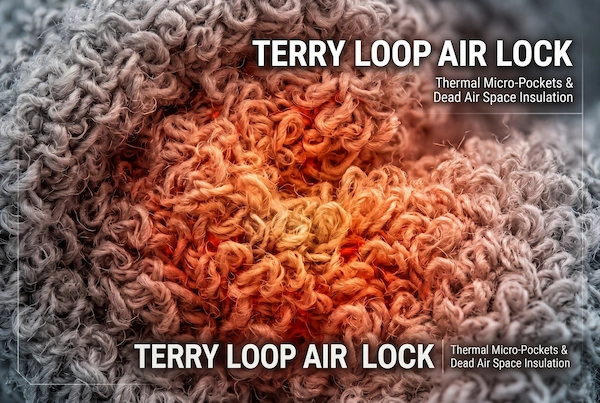
The Aerodynamics of Dead Air Space
In the field of thermal insulation engineering, there is a fundamental principle of physics: still air (“dead air”) is one of the media with the lowest thermal conductivity in nature. Therefore, to achieve top-tier warmth in gloves, it is essential to find a way to “lock in” more still air within the material.
Based on this thermodynamic principle, SQG’s winter cold-weather series has abandoned conventional thin linings in favor of heavy-weight, thick acrylic fiber liners with 7-gauge and 10-gauge weaves. Acrylic fibers not only possess excellent thermal insulation properties comparable to wool, but more importantly, their unique microscopic cross-sectional structure creates countless tiny, sealed air pockets within the gaps between the interwoven fibers. These micro-air pockets trap body heat just as a sponge absorbs water, significantly slowing the rate at which internal heat is conducted to the cold external environment—thereby achieving highly efficient heat retention based on fundamental physical principles.
The Napping Process (Terry Loop)
To maximize the thermal insulation efficiency of still air, we have incorporated the heavy-duty Terry Loop process into the inner lining of the acrylic fibers. This is an advanced manufacturing technique that uses precision textile machinery to create a dense, looped pile on the glove’s inner lining.
This cutting-edge process delivers irreplaceable engineering benefits for winter protection. On the one hand, the extremely dense loops on the interior significantly increase the direct contact area between the fibers and the worker’s skin, providing an exceptionally soft feel and superior cushioning. On the other hand, these fluffy loops create an “Air-Lock Layer” several millimeters thick on the glove’s inner surface. This natural thermodynamic barrier acts like a miniature polar down jacket, completely blocking the convective intrusion of extremely cold external air and ensuring that workers’ hands do not suffer life-threatening heat loss during prolonged work in snowy and icy environments or in cold storage facilities.
Decoding EN 511: Contact Cold and Convective Cold Metrics
In professional B2B personal protective equipment (PPE) procurement, “warmth” is far more than just a subjective wearing experience—it must be precisely quantifiable physical data. For multinational corporations committed to building compliant supply chains, the European EN 511 cold protection standard is the gold standard for evaluating gloves’ low-temperature protection capabilities. Through two extremely rigorous physical tests, this standard reveals how gloves perform in real-world, extremely cold working conditions.
Contact Cold Resistance (Levels 0–4)
At polar drilling sites or winter construction sites, the most common—and most dangerous—action workers perform is grabbing with bare hands scaffolding pipes that are completely frozen solid, heavy metal drilling tools, or frozen shelves in cold storage facilities. To quantify a glove’s protective capability in such direct-contact scenarios, EN 511 introduced the “Contact Cold” test.
Its testing methodology is extremely rigorous: a glove sample is placed between two metal plates with a significant temperature difference (one extremely hot, the other extremely cold), and precision instruments measure the rate at which heat penetrates the sample—that is, the thermal resistance. The slower the heat escapes, the higher the Contact Cold rating (up to Level 4).
As mentioned earlier, SQG’s heavyweight brushed acrylic lining demonstrates an overwhelming advantage in this test. The extremely thick fiber layer, combined with countless tiny pockets of still air inside, forms an insurmountable thermodynamic barrier. It effectively blocks heat transfer pathways, ensuring that even when workers grip freezing metal equipment at sub-zero temperatures for extended periods, the core temperature of their hands does not drop sharply—thus easily earning a high-level certification for protection against contact chill.
Convective Cold Resistance (Level 0–4)
If the gloves you are purchasing are intended for winter fieldwork, the conditions will be far more dangerous than those in a static indoor cold storage facility. This is because in environments with wind and snow, the biting cold wind can exponentially accelerate heat loss from the body’s surface. This is the second core metric emphasized by EN 511—“Convective Cold.”
This test is typically conducted in specialized climate chambers, where high-intensity cold winds are simulated to precisely measure the rate at which cold air penetrates the gloves and carries away heat. In this grueling test, if the gloves rely solely on a thermal lining, cold air will instantly rush through the pores of the yarn, rapidly carrying away body heat.
This is where our outer layer of cold-resistant latex coating plays a decisive role as a barrier. This special polymer not only maintains remarkable elasticity and flexibility even at -30°C, but also acts as a dense, physical windproof shield, completely sealing off any path for the cold wind to penetrate. It completely defends against the deadly “Wind Chill Factor,” ensuring that the precious heat trapped by the inner acrylic loop pile is never drained away by the cold wind from outside, providing unbreakable protection against convective cooling in polar blizzard conditions.
Comparative Thermal Performance Matrix (Table)
For EHS procurement teams and supply chain managers at multinational corporations, it is extremely risky to rely solely on the term “warmth” in supplier brochures when conducting centralized bidding for winter personal protective equipment. To help procurement decision-makers precisely define the physical protection limits of different polymer combinations as early as the project initiation phase, we have translated the aforementioned polymer thermodynamics theory and the EN 511 testing standard into the following highly intuitive engineering selection matrix.
This comparative matrix clearly reveals the actual physical performance of different materials under extreme cold conditions approaching -30°C:
| Polymer Coating + Liner Material | Glass Transition Temperature (Tg) | Flexibility at -30°C | EN 511 Insulation Focus | Primary Winter Application |
| Standard Nitrile + 13G Nylon | ~ -15°C | Rigid / Brittle (Micro-cracking) | Low (No air-lock layer) | Not recommended for sub-zero temperatures |
| Natural Foam Latex + 7G Acrylic Terry | ~ -70°C | Highly Flexible & Elastic | High Contact & Convective Cold | Arctic construction / cold storage |
| PVC + Cotton Flocked | ~ -30°C (Requires Plasticizers) | Moderately Stiff | Medium Contact Cold | Petrochemical winter handling |
Based on this set of structured, rigorous benchmarking data, procurement professionals can draw a clear conclusion: in polar construction, high-latitude winter field operations, or heavy-duty cold-chain logistics, traditional nitrile gloves are prone to catastrophic hardening and brittle cracking and must be decisively excluded from the procurement list. While PVC gloves barely meet the minimum freeze resistance requirements by relying on large amounts of chemical plasticizers, their noticeable moderate stiffness still severely hampers workers’ operational efficiency.
In contrast, a composite protective system constructed from Natural Foam Latex and 7G Acrylic Terry demonstrates a dominant, absolute advantage—whether in terms of high elasticity and flexibility at ultra-low temperatures or thermal insulation against direct cold exposure and penetrating cold winds—making it the optimal solution for balancing safety protection and ergonomics in extremely cold working conditions.
Dual-Layer Architecture: The WR-150 Dexterity Solution
When translating theory into industrial equipment for mass production, the SQG engineering team keenly identified a long-standing, critical pain point in winter personal protective equipment. To address this issue, we developed the flagship WR-150 model, which offers a near-perfect physical solution for multinational supply chains.

Combating the “Bulkiness” Problem
When procuring traditional winter gloves, EHS managers often face the dilemma of choosing between “warmth” and “extreme bulkiness.” To protect against the bitter cold, gloves are designed to be as bulky as bear paws. When workers wear these gloves outdoors, their ability to perform fine motor movements with their fingers is completely compromised, making even the most basic tasks—such as gripping a screw or operating a machine button—impossible. Ultimately, to meet deadlines, workers often violate safety protocols by removing their cold-weather gloves to work barehanded, leading to severe frostbite incidents.
To completely resolve this engineering dilemma, the WR-150 has abandoned the traditional single-layer, bulky, and clunky design and innovatively introduced a dual-layer composite knitted structure (Dual-Layer Architecture). This design ensures thermal resistance while maximizing the hand’s mechanical flexibility.
15G Polyester Outer + 7G Acrylic Inner
The WR-150’s superior ergonomics stem from the precise cutting and functional division of its inner and outer fiber frameworks. The outer layer features a 15-gauge seamless polyester shell. This dense, high-strength outer framework not only effectively resists the penetration of cold winds but also provides the glove with an excellent foundation for resistance to mechanical abrasion.
Nested tightly within is a 7-gauge seamless acrylic terry liner. This exceptionally soft lining is designed to conform to the skin, creating an air-lock insulation layer through its dense loops to provide core warmth against extreme cold.
For the exterior coating, these gloves feature a 3/4-coverage foam latex coating on the back of the hand. The microporous structure unique to foam latex allows the gloves to remain breathable and water-resistant, while providing excellent grip in both dry and wet work environments. With its classic red-and-black color-blocked design, the WR-150 successfully achieves the perfect balance between ultimate warmth and fingertip dexterity while meeting the CAT. II standard for protection against moderate mechanical hazards.
High Visibility and Extreme Insulation: The WR-155
Having resolved the balance between precision operations and thermal protection, the design focus of protective gear for even more extreme polar snow and wind environments must shift further toward “life-saving early warning” and “extreme heat retention.” For supply chain procurement in high-latitude regions such as North America and Northern Europe, the obstruction of visibility caused by harsh weather is often a more lethal hazard than low temperatures.
Visibility in Low-Light Winter Conditions
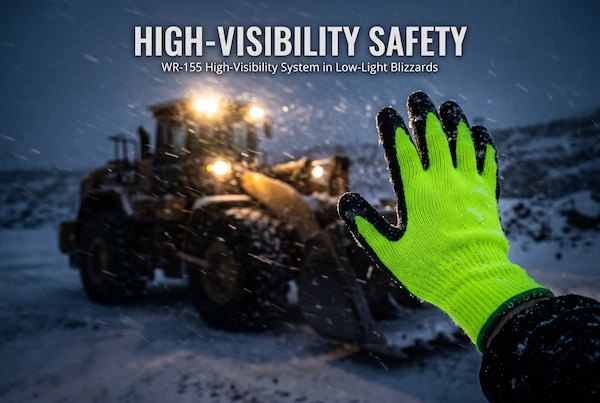
For winter outdoor projects in high-latitude regions—such as forestry operations, highway snow removal, or large-scale open-pit mines—extreme cold is often accompanied by another deadly threat: extremely low light conditions. In these regions, winter days are extremely short, and work sites are frequently shrouded in blizzards or dense fog.
In such low-light environments with severely obstructed visibility, operators of heavy machinery (such as loaders and cranes) find it difficult to see ground crew members around them. If a worker’s hand movements are not detected in time, it can easily lead to irreversible accidents involving being run over or struck. Therefore, the high-visibility (Hi-Vis) design of safety gloves has evolved from a mere added feature to a mandatory compliance requirement that directly determines the safety and lives of frontline workers.
The Full Terry Design
To address the dual environmental challenges of “extreme cold” and “low visibility,” SQG has introduced the WR-155 model, specifically designed for harsh snowy conditions.
This product features an exceptionally thick 7-gauge acrylic terry liner (7-gauge Acrylic Terry liner for cold resistance) in its material construction. Most notably, the entire liner is finished in a highly visible fluorescent yellow, paired with a black foam latex coating that covers 3/4 of the back of the hand (Foam Latex, 3/4 coated). This high-contrast, eye-catching color scheme ensures that workers’ hand movements remain highly visible in snow-covered or dimly lit construction sites.
In terms of thermal performance, its dense, full-terry interior is specifically designed to withstand extreme convective cold winds, effectively blocking cold air penetration and firmly retaining hand warmth. Combined with foam latex—which provides excellent grip in both dry and wet environments as well as a certain degree of water resistance— the WR-155 not only successfully meets the rigorous mechanical and cold-protection testing standards of EN 511 and EN 388 (CAT. II), but also maintains good breathability and dexterity, providing a robust safety barrier for workers engaged in heavy physical labor in windy and snowy conditions.
Waterproofing in Freezing Conditions: The WP-176
In extremely cold outdoor work environments, dry cold and wet cold present entirely different safety challenges. When low temperatures and liquid water coexist, the design of work gloves must evolve from “mere thermal protection” to providing an “absolute physical barrier.” To address this complex, multifaceted hazard, the WP-176 offers an engineering solution that can be described as “heavy-duty armor.”
The Threat of Sub-Zero Moisture
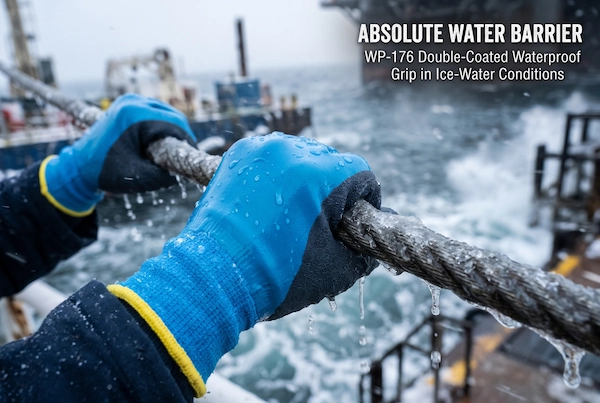
EHS managers at multinational corporations must be vigilant against the deadly threat posed by the “wet-cold effect.” On high-latitude construction sites where frozen snow melts in early spring, or on offshore oil and gas drilling platforms where ice and water splashes are a year-round occurrence, the consequences would be catastrophic if workers’ cold-weather gloves lack top-tier waterproofing capabilities.
From a thermodynamic perspective, water’s thermal conductivity is more than 20 times that of still air. This means that once meltwater from ice and snow or frozen liquid penetrates the glove’s protective barrier and seeps inside, the “air-lock insulation layer” intended to retain heat instantly fails, replaced by extremely cold moisture. Under these conditions, the core heat from the worker’s hands is rapidly drawn away by the external environment at 20 times the normal rate, often leading to excruciatingly painful instant frostbite within just a few minutes. Therefore, in polar regions or when working in icy, wet conditions, waterproofing is absolutely not an optional feature—it is an absolute red line that protects frontline workers’ hands from the risk of amputation.
Fully Coated Double Latex Integration
To completely eliminate the challenges of wading in extremely cold conditions, we conducted in-depth R&D on the WP-176 model, which employs an exceptionally precise and robust “Fully Coated Double Latex Integration” process.
First, for the thermal base layer, this model features a 13-gauge seamless acrylic terry liner. This inner layer not only ensures basic thermal insulation and heat retention but, thanks to its high gauge count, also maintains excellent dexterity and breathability.
The true protective barrier lies in the external double-layer polymer armor:
First Line of Defense (Complete Water Blocking): The entire glove undergoes a full immersion coating of smooth, cold-resistant latex. This bright blue, full-coverage coating acts like a seamless wetsuit, completely sealing off any path for moisture to enter and providing absolute water resistance.
Second Line of Defense (Extreme Grip): Merely being waterproof is not enough; a mixture of ice and water can make tool surfaces exceptionally slippery. To address this, we have precisely applied a second layer of dark-colored, fine-grained “Sandy Latex” coating (palm-coated) to the palm and finger areas of the gloves. Its rough, microporous surface quickly pierces through water and oil films, ensuring workers maintain exceptional physical grip (Excellent grip in dry and wet environments).
The bright blue, fully coated finish of these gloves not only offers excellent industrial stain resistance but also provides a 360-degree, all-around physical barrier for polar wading, fishing operations, and infrastructure projects during the freezing winter months.
Frequently Asked Questions (FAQ) on thermal cold resistant latex coated work gloves
Why should procurement avoid standard nitrile gloves for winter outdoor work?
When conducting centralized procurement for winter outdoor work, standard nitrile gloves must be avoided. From a polymer physics perspective, standard nitrile rubber has a relatively high glass transition temperature (Tg). When the ambient temperature drops to -10°C or lower, the nitrile macromolecular chains become completely frozen. At this point, the glove coating becomes as stiff as cardboard. Not only does this severely drain workers’ physical energy when flexing their fingers, but if they forcefully bend their fingers or grip tools, the coating is highly prone to brittle fracture (cold cracking), instantly losing all oil and stain resistance as well as mechanical protection.
Does the thick acrylic terry liner trap sweat and cause internal freezing?
Many purchasing managers worry that a thick, insulated liner will trap sweat and cause internal freezing, but the answer is absolutely not. High-quality acrylic fibers not only offer top-tier thermal insulation similar to wool but also possess excellent wicking properties. When combined with the microporous, breathable structure unique to foamed latex (such as the coating design of the WR-150 model), the gloves can rapidly wick away moisture generated during high-intensity work. This scientific thermal and moisture management effectively prevents the deadly “wet-cold effect” caused by the accumulation of condensed sweat.
How is the Contact Cold (EN 511) level practically relevant to our workers?
For frontline workers, the Contact Cold rating is far more than just a string of abstract numbers on a safety certificate. It directly determines whether workers can safely handle steel shelving at -20°C in cold storage facilities or hold icy metal tools for extended periods in polar field conditions. The higher the EN 511 Contact Cold rating, the slower the rate at which core body heat from the hands is conducted to cold metal objects. In real-world, extremely cold work environments, this means the threshold for hand frostbite can be significantly delayed, providing the most robust physical thermal barrier for heavy physical labor.
If I need both cold resistance and waterproof performance, which type is best?
If your work environment is not only extremely cold but also involves slush, offshore operations, or cold-chain rinsing, be sure to specify fully coated thermal cold resistant latex coated work gloves in your bid. For example, the WP-176 uses a double-layer latex fully coated process that effectively prevents melted snow, ice-water mixtures, or industrial refrigerants from penetrating the inner thermal lining. In standard palm-coated gloves, the yarn on the back of the hand is permeable to water; once moisture penetrates the inner layer and conducts heat at extremely low temperatures, it can instantly cause severe frostbite, making them completely incapable of withstanding the combined hazards of water exposure and freezing conditions.