At this critical juncture in the global supply chain’s transition toward deep decarbonization, multinational manufacturing companies are facing unprecedented compliance pressures. With the full implementation of the European Corporate Sustainability Reporting Directive (CSRD) and the continued tightening of ESG (Environmental, Social, and Governance) audit standards by international organizations, the underlying logic of procurement for traditional industrial personal protective equipment (PPE) has been completely reshaped.
For large industrial clusters and multinational assembly lines, annual centralized procurement of personal protective equipment (PPE) can no longer be limited to haggling over the “direct purchase unit price” of a single pair of gloves. Compliance and audit departments require supply chain decision-makers to extend their perspective upstream and mandatorily incorporate the full life-cycle carbon footprint (CFP) of PPE consumables into the company’s Scope 3 indirect greenhouse gas emissions accounting and reduction targets. Traditional virgin fibers and synthetic rubber—which consume large quantities of non-biodegradable petrochemical raw materials—are gradually becoming a hidden burden that drags down corporate environmental ratings.
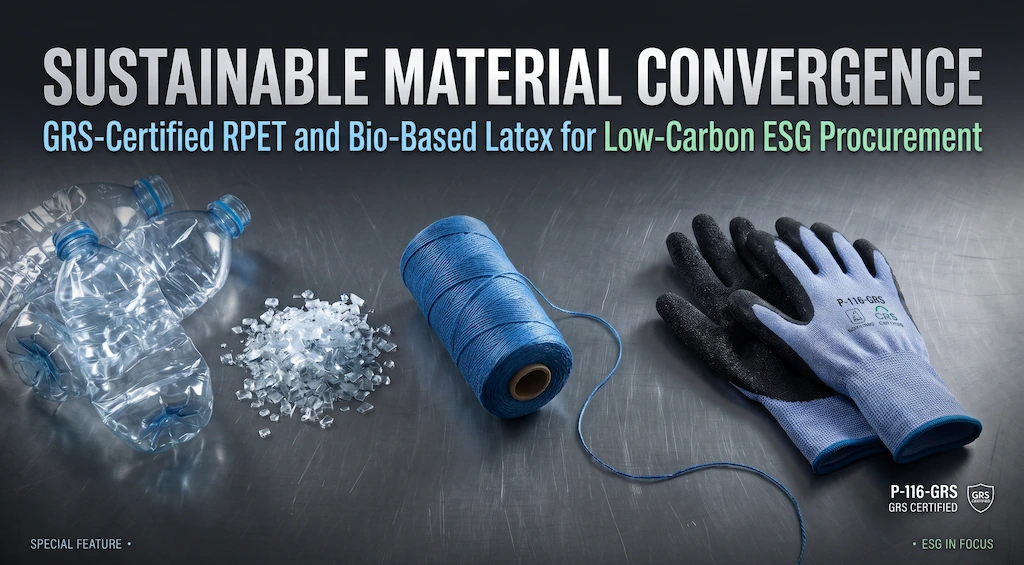
In the face of this stringent green procurement trend, this article will strip away hollow environmental marketing slogans and conduct an in-depth analysis of SQG’s low-carbon manufacturing system directly from the fundamental, technical perspective of polymer recycling and materials engineering. We will provide a detailed breakdown of how post-consumer plastic bottles are transformed into GRS-certified, high-strength RPET (recycled polyester) continuous filaments through physical and chemical depolymerization technologies, and how these are seamlessly integrated with natural bio-based latex sourced from responsibly managed rubber plantations and certified by the USDA.
This innovative polymer engineering process has successfully produced a new generation of recycled rpet latex coated work gloves that combine high performance with low carbon emissions. This green manufacturing process not only firmly upholds the safety standards for industrial-grade mechanical protection in terms of tensile strength and tear resistance, but also—by significantly reducing overreliance on underground fossil resources—provides multinational corporations with a robust and cost-effective technical pathway to address future carbon tariff barriers and achieve quantifiable, supply-chain-compliant decarbonization.
The ESG Imperative in B2B PPE Procurement
Amid a strategic transformation of modern industrial supply chains, the performance metrics for procurement departments are undergoing profound changes. Centralized procurement of personal protective equipment (PPE) has evolved from a simple “cost versus lifespan” trade-off to become a core component of companies’ efforts to address global climate compliance audits.
Navigating Scope 3 Carbon Emissions
In the greenhouse gas (GHG) inventory systems of global multinational corporations, Scope 3—that is, indirect carbon emissions generated upstream and downstream in the corporate value chain—typically accounts for the overwhelming majority of a company’s total carbon emissions. In the past, EHS teams and supply chain management often focused their emission reduction efforts on technical upgrades to energy-intensive equipment or the electrification of logistics fleets, while severely overlooking the high-frequency consumption of personal protective equipment (PPE) on production lines and in workshops.
In fact, traditional, purely petrochemical-based PPE consumables are major sources of hidden carbon emissions that are easily overlooked in corporate carbon audits. Take the most common gloves on the market—those with “virgin polyester liners combined with fully synthetic rubber”—as an example. From the very upstream stages of fossil crude oil extraction, high-temperature cracking and refining, and polymerization, all the way to the non-biodegradable landfilling or incineration of gloves after they become damaged and are discarded, their entire lifecycle releases concentrated greenhouse gases into the atmosphere. Given the annual consumption at large multinational factories—which often runs into the hundreds of thousands of pairs—these protective supplies, which rely entirely on virgin petrochemical raw materials, are silently and dramatically driving up companies’ Scope 3 emissions baselines, becoming a major burden that drags down their annual ESG ratings.
European Supply Chain Decarbonization Policies
The regulatory pressure is more severe than the industry had anticipated. With the gradual implementation of the EU’s Carbon Border Adjustment Mechanism (CBAM) and the mandatory tightening of supply chain compliance requirements under the European Green Deal, the admission criteria for global suppliers set by major European manufacturing conglomerates have undergone a fundamental shift. Decarbonization has evolved from a “moral imperative” of corporate social responsibility into a “trade barrier” that directly determines the flow of orders.
Against this backdrop of stringent macro-level compliance, the mandatory inclusion of GRS (Global Recycling Standard)-certified eco-friendly recycled materials in the technical specifications for PPE tenders is no longer merely a “nice-to-have option” that multinational corporations use to embellish their brochures. For suppliers eager to secure existing orders from major European clients or seeking to break into Europe’s high-end industrial contract manufacturing system, completely severing dependence on high-carbon virgin materials and switching to GRS-certified eco-friendly gloves backed by precise carbon footprint calculations has become a mandatory compliance threshold for maintaining supplier qualifications in the European market and avoiding future exorbitant implicit carbon taxes.
Decoding RPET: From Post-Consumer Plastic to High-Tenacity Yarn
When discussing sustainable protective gear, we must start at the very foundation of materials engineering. Transforming discarded plastic water bottles into glove liners capable of withstanding industrial-grade mechanical wear is by no means a simple matter of “physical crushing and reshaping.” It is a hardcore materials science transformation involving polymer phase transitions, melt depolymerization, and precision spinning.
The Depolymerization and Extrusion Process
From a polymer physics perspective, post-consumer PET (polyethylene terephthalate) plastic bottles must first undergo extremely rigorous optical sorting, deep cleaning, and fragmentation to completely remove adhesive residue, label remnants, and other impurities from their surfaces. Subsequently, these purified polyester bottle flakes are fed into a high-temperature reactor.
The true core technology lies in the subsequent high-temperature melting and depolymerization stages. Under specific high-temperature and high-pressure conditions, the originally solid waste plastic undergoes a physical phase transition, during which its long-chain macromolecules are temporarily broken down, transforming into a highly fluid melt. At this stage, a nanoscale melt filter completely intercepts microscopic metal particles or dust invisible to the naked eye. Immediately afterward, this purified polymer melt is precisely extruded under extremely high pressure through thousands of micropores in a precision spinneret. During the extrusion and instantaneous cooling and setting process, the polymer chains re-align in a highly ordered, oriented arrangement along the direction of the tensile force. This microscopic realignment of the polymer chains endows the final continuous filament (RPET) with extremely high crystallinity and outstanding mechanical strength (high tenacity), making its abrasion resistance and tensile strength fully comparable to those of synthetic yarns derived from virgin petroleum.
GRS Certification and Supply Chain Traceability
However, in B2B bulk procurement, there is often a significant trust gap between “claiming to be environmentally friendly” and “proving it.” To completely eliminate the “greenwashing” practices commonly found in supply chains, the introduction of internationally recognized, authoritative third-party certification has become an indispensable cornerstone of trust.
The Global Recycled Standard (GRS) was created precisely for this purpose. For SQG’s RPET eco-friendly glove series, GRS certification not only provides rigorous technical validation on a physical level—strictly verifying that the actual content of recycled material derived from discarded plastic bottles in the glove lining has exceeded the high threshold of >50%—but it also serves as an extremely stringent set of systematic traceability standards.
From the source collection points for used plastic bottles, through the pelletizing plants and spinning mills, all the way to the final assembly line for coated gloves, GRS requires that a tamper-proof Transaction Certificate (TC) be issued for every stage of the supply chain. This end-to-end “blockchain-like” traceability, combined with the standard’s rigorous audits of manufacturing facilities’ wastewater discharge, energy consumption, and restrictions on hazardous chemicals, ensures that purchasers receive not only a pair of high-performance work gloves but also irrefutable evidence capable of withstanding multinational corporations’ ESG audits and carbon audits at any time.
Bio-Based Natural Latex: A Renewable Polymer Alternative
After successfully addressing the issue of recycling glove textile frameworks, we turned our attention to polymer coatings that come into direct contact with industrial hazards. In stark contrast to nitrile or polyurethane (PU)—which rely heavily on petrochemical extraction—natural latex is, by its very nature, an extremely eco-friendly renewable polymer. By combining RPET recycled liners with natural latex coatings, we have truly achieved a dual green closed-loop system that transitions from “recycling” to “renewability at the source.”

Sustainable Rubber Forest Management
From the rigorous perspective of polymer chemistry, the core component of natural latex is cis-1,4-polyisoprene. This long-chain macromolecule, characterized by exceptional elasticity and damping properties, does not originate from crude oil extracted from wells thousands of meters underground, but is a gift from nature—naturally synthesized within the trunks of three-leaf rubber trees through photosynthesis.
This unique biological property grants natural latex coatings an irreplaceable environmental advantage in ESG assessments. In modern, responsible rubber plantations that comply with international standards, rubber farmers strictly adhere to scientifically established tapping and rest cycles. When the latex yield of older trees declines, the plantation conducts targeted harvesting (with the wood used for eco-friendly furniture manufacturing) while simultaneously initiating a new cycle of replanting with young saplings. Under this scientifically managed, self-sustaining system, the vast rubber forest forms a massive and highly active natural carbon sink. Throughout their 20- to 30-year latex-producing lifecycle, these thriving trees continuously absorb and sequester carbon dioxide from the atmosphere, offsetting greenhouse gas emissions generated by subsequent industrial processing and logistics at the very source.
Integration of USDA-Certified Biobased Products
Transforming plant sap sourced from tropical rainforests into standardized industrial coatings that comply with the EU’s EN 388 standard for mechanical protection requires not only advanced vulcanization and impregnation engineering but also impeccable compliance certification to alleviate the procurement concerns of large enterprises.
Leveraging SQG’s state-of-the-art precision impregnation production line, we have maximized the retention of the raw material’s bio-based characteristics while ensuring the coating’s grip strength and abrasion resistance. We are proud that our natural latex coating formulation has successfully obtained the highly authoritative USDA (U.S. Department of Agriculture) Certified Biobased Product certification. This highly prestigious international certification provides EHS directors and supply chain teams worldwide with a verifiable scientific fact: the coating contains a high proportion of bio-based carbon isotopes derived from renewable plants in modern agriculture, rather than fossil carbon sources formed during ancient geological periods. Through this strategic substitution at the polymer formulation level, we have not only significantly reduced industrial manufacturing’s absolute reliance on non-renewable fossil resources but also provided multinational corporations with a robust, concrete foundation for low-carbon transformation in their supply chains—one that can be directly incorporated into their annual sustainability reports.
Material Synergy: Engineering Recycled Liners with Latex
In the manufacturing of modern polymer protective equipment, top-tier eco-friendly work gloves are far more than a simple combination of two types of green raw materials. The key to determining whether a pair of gloves can perform effectively over the long term in heavy-duty industrial settings lies in whether a “1+1>2” engineering synergy (Material Synergy) can be achieved between the underlying textile framework (liner) and the outer polymer coating.

Structural Integrity of 10G and 13G RPET Liners
Within traditional supply chain procurement circles, a deeply ingrained stereotype persists: many EHS managers worry that “the use of recycled plastic materials inevitably results in a significant sacrifice in mechanical strength.” However, modern mechanical data on textile materials has long since thoroughly debunked this empiricist assertion.
As demonstrated by the in-depth analysis of the depolymerization process presented earlier, high-quality RPET filaments undergo extremely rigorous stretching and molecular chain realignment during the precision melt extrusion stage, resulting in the near-perfect restoration of their macromolecular crystallinity. When these high-strength, eco-friendly filaments are processed on advanced seamless knitting machinery—whether in 10G (10-gauge) knitted liners designed for heavy-duty, rugged applications and enhanced tear resistance, or in 13G (13-gauge) blended liners emphasizing lightweight breathability and a refined tactile feel—they demonstrate exceptional structural integrity.
Rigorous laboratory tensile strength and Martindale abrasion tests clearly demonstrate that this engineered RPET fiber interlaced network, when subjected to high-intensity industrial mechanical friction and instantaneous tearing stress, matches—and in some respects even surpasses—traditional virgin petrochemical-based nylon or polyester fibers in terms of abrasion resistance and tear strength. They easily meet the stringent requirements of the EU EN 388 standard for mechanical hazards, ensuring physical safety protection for frontline workers without compromise—all while contributing to low-carbon emissions and emission reduction efforts.
Adhesion Mechanics of Bio-Latex Coatings
With a strong and resilient inner liner framework in place, the next technical challenge is coating adhesion (Adhesion Mechanics). During heavy-load gripping and high-frequency flexing operations, the most critical engineering defects in PPE consumables are interface delamination and “coating detachment.”
From an in-depth physicochemical analysis of the interface, the surface of RPET fibers exhibits unique surface tension and polarity characteristics. When 10G or 13G recycled knitted liners undergo the vulcanization dipping process with natural latex, the liquid bio-latex, thanks to its exceptional fluid extensibility, is able to deeply penetrate the microscopic pores of the interwoven yarns and the capillary grooves on the fiber surfaces.
As the subsequent high-temperature vulcanization stage proceeds, the latex’s three-dimensional polymer cross-linked network forms an extremely dense and deep “physical anchoring” effect with the RPET fibers. This ultra-high-strength bond—established solely through microscopic interfacial compatibility and structural interlocking—addresses a core environmental challenge in the industry: factories can achieve an unbreakable bond between the coating and the liner without having to over-rely on—or even abuse—traditional chemical interfacial coupling agents or highly polar primer solvents, which are extremely harmful to aquatic environments and workers’ respiratory systems, during the pre-dipping process. This not only ensures that the gloves will never delaminate or peel under harsh wet or oily working conditions but also thoroughly implements the concept of a non-toxic, low-carbon green supply chain at the very foundation of the manufacturing process.
Quantifying the Impact: Life Cycle Assessment (LCA)
In ESG audit and carbon inventory systems for B2B supply chains, any claim of being “green” must be based on rigorous, quantifiable scientific data. For procurement directors at multinational corporations, emotional environmental narratives hold no value; only hard data matrices based on international standards can truly be transformed into compliance assets in corporate sustainability reports.
Measuring the 38% CFP Reduction
To accurately quantify the actual ecological benefits resulting from polymer substitution, we introduced a Life Cycle Assessment (LCA) model based on the ISO 14067 international standard. This model conducted a “cradle-to-grave” analysis of the carbon footprint (CFP) of work gloves across the entire supply chain.
In the traditional “virgin polyester + synthetic nitrile/virgin PU” manufacturing chain—from the extraction of crude oil from the ground, through the cracking of naphtha and the synthesis and spinning of polymers, all the way to the energy-intensive dip-coating process—every stage results in excessive greenhouse gas emissions into the atmosphere. In contrast, SQG’s eco-friendly solution completely eliminates reliance on high-carbon-emission fossil crude oil by using physically and chemically depolymerized RPET recycled filaments for the inner liner; simultaneously, for the coating, natural bio-based latex sourced from sustainable rubber plantations replaces heavily petrochemically synthesized nitrile and polyurethane. Following rigorous calculations using an LCA model—covering everything from upstream raw material extraction, spinning, and dip-coating manufacturing all the way to final use, disposal, and degradation—these recycled rpet latex coated work gloves have successfully reduced the product’s total life-cycle carbon footprint by 38%. This 38% absolute reduction in emissions is not only a triumph for materials science but also a powerful tool for companies to address Scope 3 carbon verification.
Comparative Carbon Data Matrix (Table)
To provide corporate EHS teams and supply chain procurement engineers with the most intuitive basis for decision-making, we have transformed the abstract results of the aforementioned life cycle assessment into the following highly structured carbon data benchmarking matrix. This matrix clearly defines the absolute physical boundaries of different polymer combinations across ESG dimensions, further reinforcing the EEAT (Expertise, Authority, and Trustworthiness) of technology selection:
| Material Composition (Liner + Coating) | Raw Material Source | Estimated Carbon Footprint (kg CO2e / pair) | End-of-Life Degradability | Primary Industrial Application |
| Virgin Polyester + Synthetic Nitrile | 100% Petrochemical | Base Benchmark (100%) | Non-degradable (Microplastics) | Heavy Oil Environments |
| RPET (Recycled) + Bio-Based Latex | Post-Consumer Waste + Renewable Plant Sap | – 38% Reduction | Latex is highly biodegradable | Dry/Wet Mechanical Handling |
Chemical Safety and Compliance with the OEKO-TEX Standard 100
Within the ESG assessment framework of multinational corporations, a truly green manufacturing system is by no means limited to reducing carbon footprints at the macro level; it also places a strong emphasis on chemical safety in the micro-level work environment and the occupational health of frontline employees. A qualified, low-carbon personal protective equipment (PPE) product must be absolutely chemically harmless to both the industrial product and the wearer, while simultaneously protecting the ecological environment.
Eliminating Harmful Solvents (Silicone-Free)
Traditional polymer impregnation and textile dyeing and finishing processes often involve the heavy use of volatile organic compounds (VOCs) and toxic solvents. To completely reverse this trend, we have implemented extremely rigorous Management of Substances of Concern (MRSL) controls in the weaving of RPET filaments and the application process for natural bio-based latex, thereby eliminating the introduction of harmful solvents at the source.
Under this rigorous green chemistry management strategy, we have successfully implemented silicone-free process standards across the entire production line. In practical industrial applications, the engineering value of this standard is immense. For industries where surfaces are extremely sensitive—such as automotive white body assembly, precision aerospace coating, and the manufacturing of high-end home appliance exterior components—even micrometer-level silicone oil residues on work gloves can cause extensive “fish-eye” defects and paint peeling during subsequent spray-painting processes. Our strict adherence to silicone-free standards not only purifies the production environment but also directly helps these high-end manufacturing enterprises eliminate critical quality risks in their supply chains.
Skin-Friendly and Hypoallergenic Properties
During high-intensity shifts lasting eight hours or more, industrial gloves are subjected to heavy perspiration and frequent, direct physical friction against the operator’s skin. If the material itself contains hidden toxic chemicals, these can easily penetrate the skin’s stratum corneum through capillary action caused by sweat.
To completely eliminate this occupational health threat, our eco-friendly glove series has undergone and successfully passed the most rigorous testing required by the world’s most authoritative textile eco-label—the OEKO-TEX Standard 100. This compliance certification provides the most legally binding assurance to corporate EHS teams: it has been absolutely verified that neither the seamless RPET blend liner—which comes into direct contact with workers’ skin—nor the outer foam latex coating contains any prohibited carcinogenic aromatic amines (azodye decomposition products), free formaldehyde, phthalates, or heavy metal residues. This rigorous chemical safety screening mechanism fundamentally eliminates the pathways for the migration of hidden toxins, significantly reducing the risk of occupational diseases—such as contact dermatitis and rashes—among frontline workers engaged in heavy physical labor caused by long-term use of substandard PPE gloves. It perfectly aligns with the mandatory social responsibility (Social) requirements of multinational procurement systems regarding “employee health and safety protection.”
The ESG Glove Portfolio: Bridging Sustainability and Performance
The life cycle assessments and chemical toxicology tests discussed earlier have demonstrated the absolute advantages of combining RPET with natural bio-based latex from both theoretical and regulatory compliance perspectives. However, in real-world industrial settings, any environmental considerations must be balanced against physical protective performance. SQG’s engineering team has successfully transformed these abstract low-carbon polymers into mass-produced solutions capable of withstanding extreme mechanical wear and complex ergonomic challenges. The following two product series precisely address core B2B procurement scenarios ranging from precision assembly to heavy-duty material handling.
Precision Series: P-111-GRS and P-116-GRS
In lightweight logistics and warehousing, 3C electronics assembly, and precision component machining, frontline workers have extremely high demands for fingertip dexterity and sweat management within the hand’s microclimate. To address this, we developed the Precision Series, featuring a 13-gauge ultra-fine, seamless RPET liner.
The two flagship models in this series feature targeted differences in their coating’s microscopic topology:
P-111-GRS features a microporous foam latex coating. Its unique, sponge-like structure with through-holes creates a micro “air pump effect” when workers repeatedly flex and extend their fingers, delivering optimal heat dissipation and all-weather breathability.
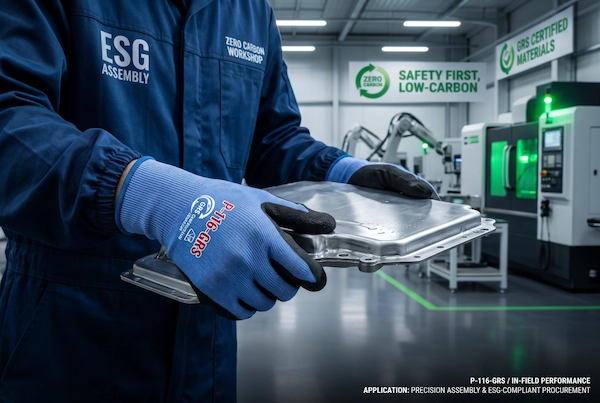
[P-116-GRS], on the other hand, utilizes “Sandy Latex,” which has undergone a salt-precipitation treatment on its surface. Through a dense array of microscopic concave suction cups, it significantly enhances the glove’s capillary adhesion and extreme dry and wet grip performance in dry, slightly damp, or slightly oily environments.
In terms of quantifying environmental contributions, this series provides a visually striking data anchor for multinational corporations’ ESG reports: according to rigorous calculations, the production of each pair of 13-gauge RPET eco-friendly gloves directly consumes and removes 1.3 discarded 500-milliliter polyester plastic bottles from the natural environment. This means that a standard annual purchase order of 100,000 pairs will directly eliminate 130,000 potential sources of microplastic pollution from the ocean or soil.
Heavy-Duty Series: The B-111R Model
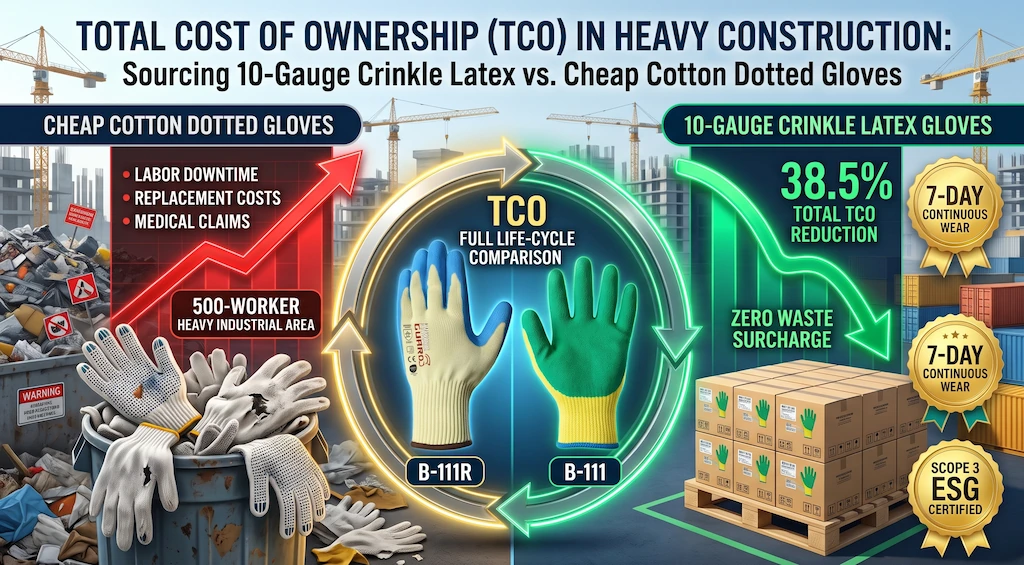
For high-intensity, high-wear applications such as construction, municipal engineering, rough bricklaying, and the handling of heavy-duty metal pipes, a lightweight 13-gauge liner clearly cannot provide sufficient physical protection. To address this, SQG has specifically introduced the B-111R model, designed for heavy-duty field operations.
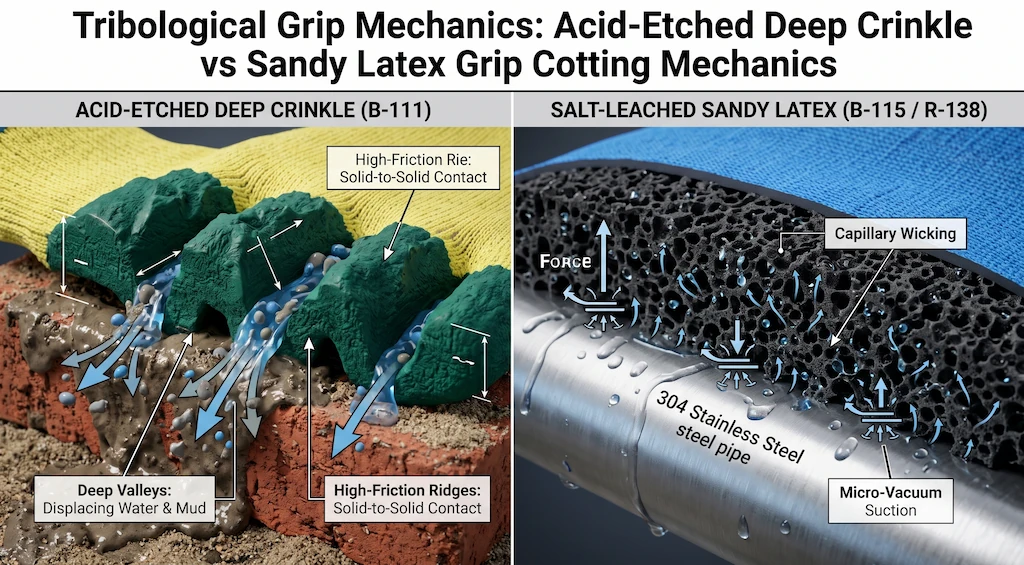
This product completely eliminates conventional lightweight yarns, instead utilizing a high-grammage, 10-gauge, coarse-count RPET eco-friendly blended liner, which is coated with “Wrinkle Latex”—a material offering exceptional physical cushioning. This macro-level, deep-grooved texture not only rapidly disperses mud, sand, and standing water from the work surface—much like the tread of an off-road tire—but its thick and highly elastic cross-linked polymer network also endows the gloves with exceptional tear resistance and protection against blunt impact and puncture, easily meeting the EU CAT. II certification standards for medium-to-high-level mechanical hazards.
Most importantly, even with such robust heavy-duty protective properties, the B-111R strictly adheres to the dual environmental standards of GRS-certified recycled plastic and high-standard USDA Biobased certification. It demonstrates to the industry a hard fact: under advanced polymer impregnation processes, “heavy-duty mechanical protection” and “low-carbon emissions” can coexist without contradiction.

Strategic Implementation for Corporate ESG Sourcing
Once the technical aspects of life cycle assessment (LCA) and toxicological validation have been fully validated, the final and most critical challenge facing multinational corporations is how to effectively integrate these advanced, low-carbon consumables into their vast global supply chains. For group procurement directors and EHS (Environment, Health, and Safety) teams, this is far more than simply switching to a different product model; it requires a thorough, systemic upgrade of existing supply chain sourcing strategies.
Updating PPE Technical Specifications
In traditional annual requests for proposals (RFPs), the technical requirements for PPE gloves often remain limited to basic physical and commercial dimensions such as “liner weight,” “abrasion resistance cycles,” or “unit price per pair.” These severely outdated procurement standards result in green suppliers—who are genuinely engaged in R&D on base materials—frequently being outcompeted by unscrupulous suppliers who still rely on cheap, high-carbon-emission raw materials.
To systematically optimize and clean up the global supplier list, EHS managers and procurement engineering teams must restructure the PPE technical specifications in next year’s RFP. Specific practical recommendations are as follows: First, during the initial screening phase of the Approved Vendor List (AVL), establish the Global Recycled Standard (GRS) and OEKO-TEX Standard 100 as mandatory, deal-breaking entry requirements. Bidders must not only provide valid factory certificates but also commit to supplying GRS Transaction Certificates (TCs) for the corresponding batches during the delivery period; Second, add a weighting for the “CFP Emissions Reduction Indicator” (carbon footprint reduction ratio) to the bid evaluation scoring system, requiring suppliers to provide authoritative carbon emissions calculation data. By transforming these green indicators into non-negotiable technical benchmarks, companies can directly block the infiltration of “pseudo-environmentally friendly” products at the source of the bidding process, thereby fundamentally ensuring compliance with decarbonization requirements at the supply chain level.
Horizontal Comparison: Bio-Based Solutions
After establishing a green procurement system through rigorous bid upgrades, the supply chain team must also adopt a holistic perspective on polymer selection across different materials. Although the combined solution of RPET recycled liners and natural bio-based latex has demonstrated dominant low-carbon advantages in dry-handling and slightly damp operating conditions, real-world heavy industrial environments are far more complex than that.
Procurement professionals must clearly recognize that, when dealing with automotive engine machining, heavy-oil-contaminated CNC stamping shops, or semiconductor cleanrooms requiring extremely high levels of fine particulate control, natural latex has inherent physical limitations in terms of resistance to chemical solvents and oils. Fortunately, with rapid advances in materials science, mainstream polymers other than latex are also undergoing a profound green revolution. For special operating conditions involving moderate to heavy oil contamination or ultra-high-precision assembly, we strongly recommend that procurement and engineering personnel consult the in-depth technical comparison published by SQG: Bio-Based vs. Petroleum PU Coatings. This document provides a comprehensive guide to selecting sustainable polymer solutions that transcend the limitations of any single material and address the full spectrum of industrial hazards.
Frequently Asked Questions (FAQ) on Recycled PPE
Does RPET compromise the mechanical strength of the gloves?
In supply chain procurement, the biggest concern for many EHS managers is whether “environmental friendliness means sacrificing performance.” The answer is an emphatic no. From the perspective of polymer science, a high-quality high-temperature melt extrusion process is not merely a simple physical reshaping. After waste plastic bottle flakes are depolymerized in a reactor, their macromolecular chains undergo a highly ordered rearrangement during the process of being re-stretched into filaments, forming dense microscopic crystalline regions. This profound physical phase transition ensures that the final RPET eco-friendly filaments exhibit virtually no difference in data—such as breaking strength and tensile strength—compared to traditional virgin polyester fibers derived from underground mining and refining. In actual laboratory testing, our recycled fiber liners have successfully passed the extremely rigorous tear resistance and abrasion resistance tests required by the EU’s EN 388 standard for mechanical hazards, providing uncompromising, industrial-grade safety protection.
How many plastic bottles are actually recycled per pair of gloves?
In B2B sustainability strategies, environmental concepts must be precisely quantifiable in order to be transformed into data assets that can be included in reports. Take our 13-needle P-116-GRS model, designed for precision assembly, as an example. Based on rigorous calculations of factory material consumption, the production of each pair of these gloves directly consumes and recycles approximately 1.3 standard 500-milliliter post-consumer PET plastic bottles. This means that a company’s routine bulk procurement of personal protective equipment (PPE) effectively transforms metric tons of hard-to-degrade environmental waste directly into high-value industrial PPE assets that protect the hands of frontline workers—providing a visually striking data anchor for the company’s annual environmental report.
Are these recycled latex-coated work gloves fully biodegradable?
To address this question, the compliance departments of multinational corporations require an extremely objective and rigorous technical assessment. These composite gloves are composed of two distinctly different polymer materials: the outer layer’s natural bio-based latex coating, derived from plant sap, does indeed exhibit excellent and rapid degradability under the combined action of soil microorganisms, light, and heat in the natural environment; however, the RPET knitted liner that forms the base layer is, by its very nature, still a thermoplastic polyester, and its degradation cycle in natural conditions remains lengthy. However, we must be clear that the core value of RPET within the modern industrial ESG framework lies in “physical recycling (Recycled)” rather than “biodegradability (Biodegradable).” By giving waste plastic a high-impact second life, it successfully prevents the extraction of new fossil crude oil required to manufacture synthetic fiber yarns right at the very source of the supply chain—and this is where its true power in reducing carbon emissions lies.
How does purchasing GRS-certified gloves help our corporate ESG rating?
Completely replacing traditional occupational safety supplies with GRS-certified recycled products can provide multinational corporations with direct compliance benefits that hold significant value during audits. When compiling annual corporate sustainability reports (CSR or ESG reports), the procurement value of these eco-friendly gloves—which come with explicit Trade Certificates (TCs)—can be directly and legally counted toward the company’s “green supply chain procurement ratio” as well as the “Scope 3 indirect carbon reduction metrics,” which are among the most challenging to improve. Furthermore, the OEKO-TEX Standard 100 textile eco-label, TÜV certification, and USDA Biobased certification accompanying the SQG eco-friendly glove portfolio collectively provide an unassailable international third-party chain of evidence for the company’s carbon inventory data. These robust compliance credentials can substantially improve a company’s overall scores with top international rating agencies such as EcoVadis and CDP, directly enhancing its competitiveness in global trade tenders.