At construction sites for curtain wall glass installation, heavy-duty metal sheet stamping, and end-of-life vehicle dismantling, front-line workers consistently face an extremely complex occupational safety challenge. Many EHS managers and procurement professionals have found that while traditional cut-resistant gloves issued to workers perform exceptionally well in static cut tests conducted in laboratories, they often fail when workers are actually handling extremely smooth heavy glass or steel plates coated with rust-preventative oil, leading to potentially fatal “slip-and-drop” incidents.
This hidden hazard—where gloves “protect against cuts but not against slips”—is extremely dangerous. Once a heavy object slips out of control from a worker’s hands, the immense gravitational acceleration generated in an instant can result in a devastating physical impact. Even more terrifying is that when glass weighing dozens or even hundreds of jin falls at high speed, its sharp edges generate an extremely terrifying “dynamic cutting force.” This force, akin to that of a guillotine, can even pierce through conventional cut-resistant yarn armor, causing extremely severe lacerations and foot crush injuries.
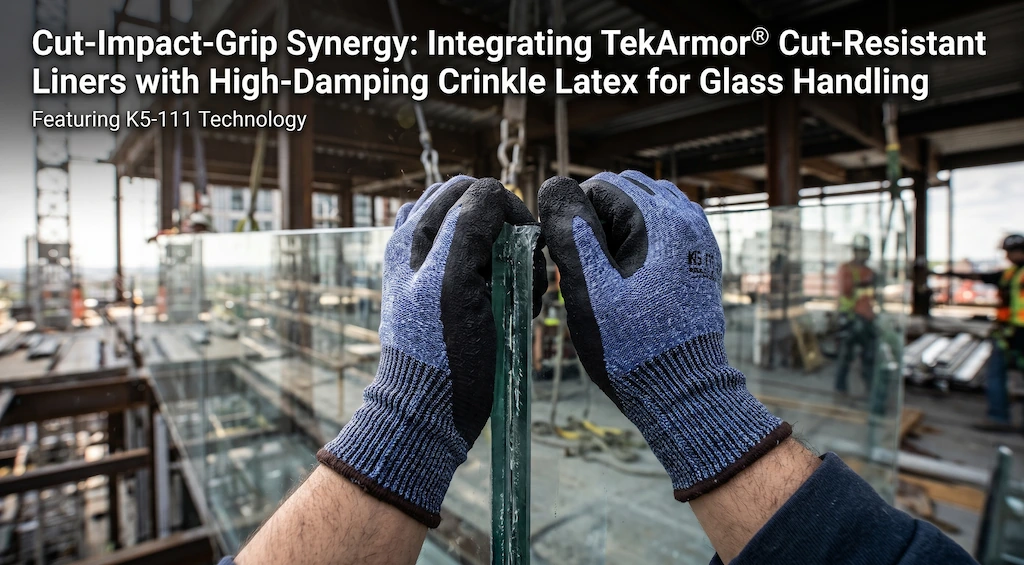
Faced with this compound industrial hazard—a combination of “gravitational impact” and “dynamic cutting”—a single-material protective approach has proven completely ineffective. To fundamentally address this safety challenge, this article will provide an in-depth analysis of the underlying material synergy behind cut resistant crinkle latex gloves glass handling.
We will visually demonstrate how the TekArmor® physical cut-resistant liner—which boasts top-tier tensile strength—is precisely laminated with natural crinkle latex, known for its exceptional damping and shock-absorbing properties. This robust underlying architecture eliminates the safety pitfall of “cut resistance but slippage” commonly encountered in heavy industrial material handling. As the grand finale of this series, this is not only a professional selection guide for extremely high-risk blade-handling operations but also a technical manifesto through which we are propelling the entire latex-coated work gloves industry toward a new level of protective standards.
The Lethal Gap in Standard Glass Handling PPE
When procuring personal protective equipment (PPE) for high-risk tasks involving sharp edges, the EHS teams at many companies often fall into a data trap: they place excessive faith in the cut-resistance ratings listed in reports while overlooking the actual physical gripping forces encountered in real-world work environments. In glass fabrication and heavy sheet metal handling, standard industrial protective equipment design contains an extremely critical safety blind spot. Unless this blind spot is thoroughly addressed, even the highest-rated cut-resistant gloves will fail to prevent serious workplace injuries.
Static Cut Protection vs. Dynamic Slip Failure
Most mainstream cut-resistant gloves currently on the market feature palm coatings made of PU (polyurethane) or smooth nitrile materials. Undeniably, these coatings perform reasonably well in routine assembly line operations. Under laboratory blade-cutting tests, they also deliver impressive results when paired with cut-resistant liners—this is known as “static cut resistance.”
However, real-world heavy industrial environments are far harsher than laboratory conditions. When workers wearing PU- or smooth nitrile-coated gloves attempt to grasp large, extremely smooth architectural curtain wall glass panels or stamped metal sheets coated with rust-preventive oil with their bare hands, the surface friction coefficient of these coatings drops dramatically. Due to the lack of effective oil repellency and microscopic physical interlocking structures, the glove surface simply cannot provide sufficient mechanical traction. This directly leads to frequent incidents of “dynamic slippage and loss of grip”—while the gloves remain intact, heavy glass panels slip right out of the workers’ hands.
The Kinetic Impact of Dropped Panels
When heavy glass or metal panels slip and fall, the resulting physical destructive force is catastrophic. From a basic physics perspective, the moment a piece of glass weighing tens of kilograms slips from a worker’s grasp, its immense weight combined with the acceleration due to gravity generates an enormous amount of destructive kinetic energy.
When this immense impact force is concentrated on the glass’s extremely sharp edges and slides across a worker’s palm or forearm, it creates a terrifying “guillotine effect.” The harsh reality that must be emphasized to all safety auditors is that the current EN 388 mechanical hazard testing standard merely simulates cutting by a blade under constant, slow pressure. It completely fails to account for the “dynamic impact cutting” generated when a heavy object slides or falls at high speed. Under such extreme gravitational impact, even cut-resistant yarns rated at the highest level can be instantly and forcibly pierced or severed.
Therefore, in glass-handling operations, preventing heavy objects from slipping is the first line of defense for saving lives. Only by thoroughly resolving the issue of slippage can the physical protection provided by cut-resistant liners have practical safety significance.
TekArmor® Core: Engineered for A5/E Cut Resistance
Before discussing how to address the most dangerous issue of “heavy objects slipping out of workers’ hands,” we must first build an indestructible layer of base armor for workers’ hands. Faced with construction curtain wall glass with edges as sharp as knife blades and steel plates fresh off the press and riddled with metal burrs, ordinary cotton or nylon gloves are virtually useless—they tear at the slightest touch. To address this, we’ve introduced a core physical cut-resistant material specifically developed for heavy-duty cutting applications: TekArmor® yarn technology.
UHMWPE and Fiberglass Composite Blends
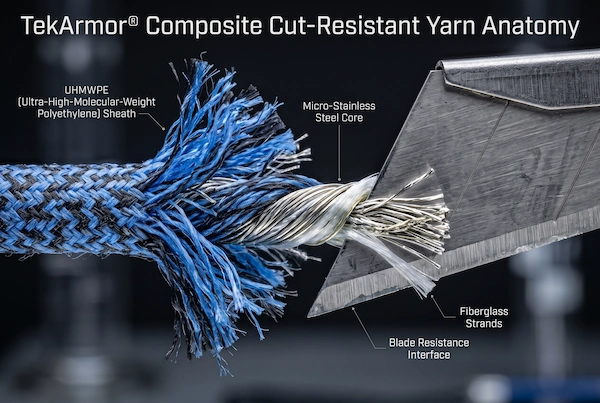
The first step toward achieving top-tier cut resistance is to move away from traditional single-fabric materials. The core framework of the TekArmor® cut-resistant liner utilizes ultra-high-molecular-weight polyethylene (UHMWPE). In the field of materials science, this is a miraculous high-tech fiber—its tensile strength is 15 times that of high-quality steel of the same cross-sectional area, yet it is extremely lightweight and feels incredibly smooth against the skin.
However, when facing the extreme linear cutting pressure generated by a piece of glass weighing hundreds of jin as it falls, pure UHMWPE still faces the physical risk of being forcibly severed. Therefore, we have adopted an advanced composite blending textile process (Composite Blends). Inside the extremely fine UHMWPE core yarn, our factory has precisely twisted high-strength fiberglass and even incorporated micron-sized flexible stainless steel wires. When sharp glass edges attempt to cut into the surface, these rigid inorganic fibers hidden within the polyethylene act like countless miniature files, instantly blunting and damaging the glass’s cutting edge—thereby achieving exponentially higher tensile strength and resistance to mechanical cutting.
Scaling Up: Connecting to Advanced Hand Protection
In industrial glove manufacturing, leaping from basic A2-level light cut resistance to ANSI A5 or EN 388 Class E heavy-duty armor—capable of withstanding the handling of heavy glass and scrap metal—is far more than simply using thicker yarn. If one were to rely solely on increasing glove thickness, the finished product would become as stiff as cardboard, and workers would completely lose the fine tactile sensation and flexibility in their fingers—which would actually increase workplace hazards.
True “scaling up” in cut resistance relies on extremely complex underlying material engineering. By precisely adjusting the ratio of glass fibers in the composite core and introducing a higher-density knitted matrix, we have successfully pushed the physical limits of mechanical protection while keeping the yarn extremely lightweight.
For a deeper dive into high-level cut protection metallurgy and yarn architecture, explore our technical guide on Beyond ANSI A5: Scaling Hand Protection.
Crinkle Latex: The High-Damping Grip Engine
With the top-tier TekArmor® physical cut-resistant liner serving as our foundational armor, we’ve eliminated the threat of “cut hands.” But as mentioned earlier, in real-world scenarios involving the handling of heavy glass, the ultimate prerequisite for cut resistance is “never letting go.” To address this critical shortcoming in friction, we entrusted the outer palm coating of the glove to nature’s most exceptional friction and shock-absorption engine—natural crinkle latex.
Micro-Texture Friction on Smooth Glass
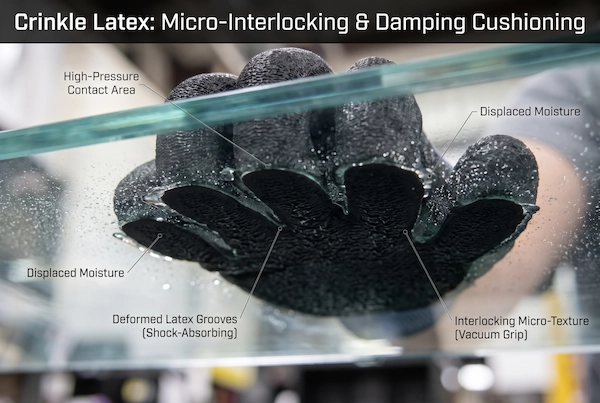
When faced with extremely smooth curtain wall glass or metal sheets with residual oil films, any smooth glove coating instantly loses its grip. To break this physical curse of smooth surfaces, Crinkle Latex undergoes a special chemical foaming and high-temperature washing process before leaving the factory, creating a deep, highly irregular network of physical grooves on its surface.
This rough microstructure functions exactly like the “all-terrain tread pattern” found on the undercarriage of heavy-duty off-road vehicles. When a worker presses their palm firmly against a smooth glass surface, these deep rubber grooves instantly displace fine dust, moisture, and even a slight oil film from the contact area. This displacement effect allows the resilient rubber framework to grip the surface of the material directly and tightly, generating exceptionally strong mechanical friction. It is precisely through this purely physical, microscopic textural grip that Crinkle Latex completely locks down the sliding trajectory of heavy, smooth materials, minimizing the risk of them slipping out of the hand.
Impact Cushioning and Localized Pressure Distribution
In addition to providing exceptional grip, natural latex offers a sophisticated engineering advantage that is often overlooked in EHS assessments: its exceptionally high-damping energy-absorption properties.
When handling large-format architectural glass or metal sheets weighing hundreds of jin, the extremely narrow, sharp edges of the materials press forcefully against the worker’s palms. From a physics perspective, this generates terrifying “localized line contact pressure” over an extremely small contact area. If workers are wearing thin PU or nitrile gloves, this extreme pressure is transmitted directly to the bones, not only causing unbearable pain but also leading to rapid muscle stiffness, cramping, and fatigue in the hands.
In contrast, the thick, textured latex coating acts as tens of thousands of highly elastic “micro-shock absorbers.” When the heavy glass edge sinks deeply into the latex coating, the highly damped rubber mesh undergoes intense physical deformation. This deformation ingeniously disperses and dissipates the extreme pressure—which would otherwise be concentrated along a single, critical “line”—evenly across the entire “surface” of the palm (Localized Pressure Distribution). This ultimate cushioning and shock-absorbing effect not only significantly alleviates mechanical pain and muscle fatigue in the hands but also enables frontline workers to maintain exceptionally stable grip endurance during prolonged, high-intensity heavy-lifting tasks.
Interfacial Coupling Technology: Anchoring Latex to TekArmor®
As a manufacturing facility deeply rooted in industrial protection, we understand that top-tier gloves are by no means simply the result of “gluing” two good materials together. In heavy industry, the adhesion of the coating directly determines the lifespan of protection and workplace safety. To perfectly integrate the cut-resistant liner with high-damping rubber, we have introduced the industry’s most advanced interfacial coupling technology into our automated dipping production line, ensuring industrial-grade quality from the very beginning.
Chemical Primers for UHMWPE Adhesion
Many procurement managers may be unaware of a harsh truth in materials science: although ultra-high-molecular-weight polyethylene (UHMWPE) boasts exceptional cut resistance and tensile strength, its surface is extremely smooth and highly “chemically inert” (its physical properties are similar to those of a nonstick pan in the kitchen). This means that if traditional dipping processes are used, conventional latex coatings simply cannot adhere to the yarn and will peel off over large areas at the slightest stress.
To overcome this fundamental manufacturing challenge, we’ve incorporated an extremely rigorous chemical pretreatment step before the gloves enter the latex tank. We use proprietary chemical primers to activate the surface of TekArmor® cut-resistant yarn at the microscopic level. These high-tech coupling molecules act like countless microscopic “double-barbed hooks”: one end firmly grips the inert cut-resistant fibers—which are normally extremely difficult to coat—while the other end undergoes a deep chemical cross-linking reaction with liquid natural latex during the high-temperature vulcanization stage. Through this robust interface anchoring technology, we have successfully and permanently bonded the latex to the yarn at the molecular level.
Preventing Delamination Under Heavy Loads
This maximum adhesion, established on factory production lines, serves as the lifeline for frontline workers in real-world heavy-load handling environments.
When workers grip construction curtain wall glass weighing over a hundred jin or heavy stamped steel plates with both hands, the intense pull of gravity creates terrifying shear and tearing forces between the outer rubber coating of the glove (pulled downward by the heavy object) and the inner knitted skeleton (pulled upward by the hand). With substandard cut-resistant gloves produced by ordinary contract manufacturers, the coating would instantly and catastrophically delaminate under such extreme tension—the rubber coating would stick to the glass, while the worker’s hand, along with the inner liner, would slip right out, causing the heavy object to plummet instantly.
Thanks to our interface coupling technology, natural crinkled latex has fused with the TekArmor® cut-resistant framework into a single, indivisible physical unit. No matter how extreme the heavy-load tension or friction, the glove coating will never delaminate in the slightest. It ensures that every heavy grip is as steady as a rock, eliminating the risk of heavy objects falling.
K5-111: The Ultimate 18-Gauge Synergy Solution
To achieve the perfect industrial implementation of cut resistant crinkle latex gloves glass handling, we are officially launching the K5-111—our flagship model designed specifically for extreme slip- and cut-resistant applications. This glove is not merely a routine product iteration; it represents a complete revolution in glove manufacturing engineering, perfectly blending extreme protection with exceptional tactile sensitivity.
ANSI A5 / EN388 E in an Ultra-Light 18G Shell
In traditional occupational safety procurement, cut resistance ratings are often closely tied to glove thickness. Many EHS managers believe that achieving A5-level protection against sharp glass cuts requires enduring thick, hot, and stiff 13-gauge or 10-gauge gloves. However, the K5-111 has completely shattered this technical barrier.
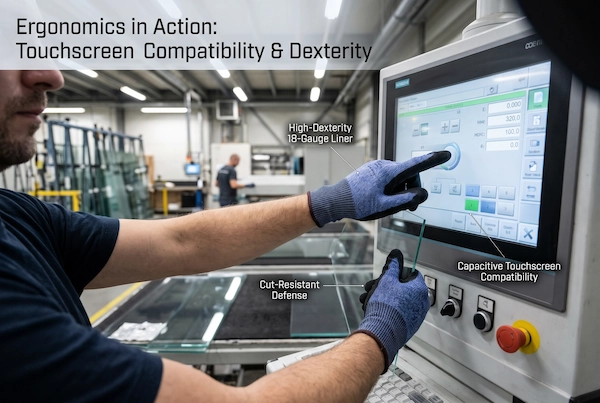
Thanks to cutting-edge blended fabric technology, the K5-111 innovatively incorporates an 18-gauge seamless TekArmor® cut-resistant liner. The 18-gauge weave is currently one of the highest-density knitting processes in the industrial glove industry; it not only makes the gloves extremely lightweight but also provides workers with a “second-skin” fit and exceptional dexterity. Most impressively, despite its extremely lightweight construction, it has passed the most rigorous laboratory tests, meeting the astonishing ANSI A5 and EN388 3X42E heavy-duty cut-resistant standards. This means that when handling heavy, sharp glass, workers can enjoy the ultimate mobility of bare hands while still benefiting from top-tier cut-resistant protection.
Touchscreen Compatibility and CAT. II Compliance
In modern glass processing plants or automotive sheet metal stamping shops, front-line workers no longer face purely physical labor. They frequently need to operate CNC cutting machines, view digital drawings on tablets, or operate the control panels of precision instruments.
The K5-111 not only fully complies with the EU’s authoritative CE CAT. II certification for medium-risk protection, demonstrating the authenticity and reliability of its protective data; more importantly, its 18-gauge construction—which offers exceptional ergonomics—and special coating treatment provide these heavy-duty cut-resistant gloves with excellent touchscreen compatibility. This seemingly minor upgrade directly addresses the greatest safety hazard in factory workshops: workers no longer need to frequently remove their cut-resistant gloves to swipe screens or press buttons on CNC panels. This not only significantly improves production line efficiency but also fundamentally eliminates hand laceration accidents caused by workers “operating machinery without protective gear,” making it a truly user-friendly product designed with EHS compliance in mind.
Technical Matrix: Grip and Cut Resistance Data
In the rigorous world of B2B industrial procurement, safety decisions made by EHS teams must never be based solely on suppliers’ marketing claims; they must rely on solid materials science testing and engineering data. To help multinational construction firms and large manufacturing plants make the most rational decisions within complex supply chains, we have condensed the actual physical performance of the three most common cut-resistant glove constructions under “heavy-duty smooth glass handling” conditions into the following quantitative comparison matrix.
Through this data-driven performance report, you can clearly see the significant safety gap resulting from upgrades in underlying manufacturing processes:
| Coating and Liner Architecture (Coating Architecture) | Slip Rate on Glass | Cut Resistance Level (Cut Level) | Localized Pressure Dampening | Primary Application |
| PU Coated (Standard Polyurethane Coating) | Extremely high (smooth surface, lacking a microporous displacement structure) | ANSI A2 – A4 (depending on the liner yarn) | Very Poor (The coating is extremely thin; force is transmitted directly to the bone) | Drying lightweight electronic components; oil-free assembly line operations |
| Smooth Nitrile (Smooth Nitrile Coating) | High (instant loss of traction when exposed to water or oil films) | ANSI A2 – A4 (depending on the liner yarn) | Poor (The rubber framework is relatively stiff, providing almost no shock absorption) | Sorting standard metal hardware with dry surfaces |
| Crinkle Latex on TekArmor® (e.g., K5-111) | Extremely low (deep, wrinkled grooves create strong microscopic interlocking) | ANSI A5 / EN388 3X42E | Excellent (High-damping natural latex acts as a micro-shock absorber) | Installation of heavy-duty curtain wall glass; handling of sharp, oil-contaminated stamped sheet metal |
From the core benchmarking matrix above, procurement decision-makers can draw an extremely clear technical conclusion:
Although standard PU or smooth nitrile cut-resistant gloves are inexpensive and provide basic cut resistance, their persistently high dynamic slippage rates and virtually zero physical cushioning capacity when handling extremely smooth, heavy glass make them highly prone to causing serious accidents involving falling heavy objects and secondary impact injuries.
In contrast, the industrial-grade design—which combines the TekArmor® physical cut-resistant core with natural crinkled latex—is currently the only ultimate solution capable of comprehensively addressing the compound hazard of “extreme sharpness” combined with “extreme smoothness.” Not only does it meet the top-tier A5/E-grade heavy-duty cut resistance standards, but its purely physical rubber crinkle structure also provides frontline workers’ hands with extreme grip strength and robust shock absorption—a dual safety redundancy—making it a truly high-performance tool for heavy-duty material handling that meets the highest ergonomic standards.
Expanding Industrial Applications Beyond Glass
Although this composite structure—combining a “high-performance cut-resistant liner” with “high-damping crinkled latex”—was originally developed specifically to address critical safety challenges in heavy-duty glass handling, its proven practical value extends far beyond that. In the real-world landscape of heavy industry, any complex, high-risk work environment characterized by both “extremely sharp” and “difficult-to-grip” surfaces is the perfect application for this product series. By introducing these gloves into the following extreme scenarios, EHS procurement teams can easily standardize and streamline the procurement of specialized personal protective equipment (PPE) across their facilities.
Metal Sheet Stamping and Sharp Edges
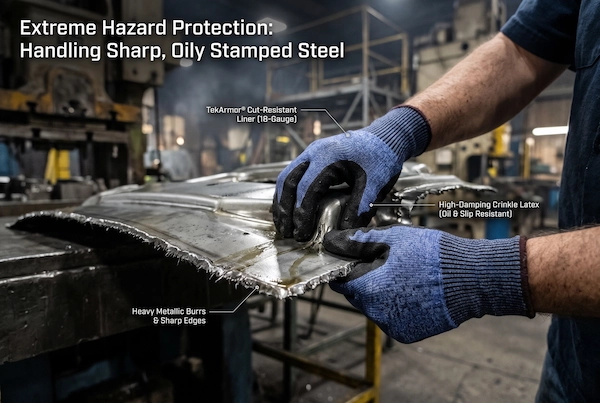
In modern automotive manufacturing facilities or heavy-duty metal stamping production lines, metal sheets that have just been cut by thousand-metric-ton presses often have extremely sharp edges and may even be covered with hard metal burrs that are nearly invisible to the naked eye. When workers handle these smooth, thick steel sheets—which have not been chamfered or ground—with their bare hands, the danger is no less than that of directly grasping a giant razor blade.
In such extremely hazardous blade-exposed work conditions, gloves equipped with TekArmor® A5/E-grade cut-resistant liners act like flexible chain mail, completely blocking the threat of sharp steel edges cutting into the workers’ tendons. At the same time, the glove’s exceptionally thick, textured latex coating not only grips smooth metal sheets—even those with residual stamping oil—firmly but also effectively cushions the sensation of sharp burrs piercing the palm thanks to the rubber’s thickness, providing the sheet metal fabrication and automotive assembly industries with the ultimate “cut-resistant + slip-resistant” solution.
Waste Metal and Demolition Recycling
While the hazards on an automotive stamping assembly line are relatively straightforward and predictable, urban waste metal recycling and large-scale building demolition operations face a completely “unpredictable mix of physical hazards.” In these scrap sorting yards filled with rusty scrap metal, twisted and torn rebar, and large amounts of broken glass debris from construction sites, workers’ hands are exposed to unknown sharp objects every second.
Traditional work gloves are often cut or torn within minutes when exposed to these meat-grinder-like piles of scrap. In contrast, composite protective gloves—which combine high-strength cut-resistant yarn with highly abrasion-resistant crinkled latex—demonstrate exceptionally robust overall “environmental resistance” in such conditions. The thick outer layer of natural latex acts as a physical barrier, providing initial protection against puncture and severe abrasion from rough scrap metal and rusty sharp objects; meanwhile, the underlying A5-grade cut-resistant liner serves as an indestructible final line of defense, completely blocking deep cuts from broken glass and jagged metal edges. This ensures that frontline workers can continue to work efficiently and safely with their bare hands, even in the harshest rubble-sorting environments.
EHS Procurement and Inspection Protocols
For EHS managers at multinational construction firms and large manufacturing plants, selecting the right top-tier cut-resistant and slip-resistant gloves is merely the first step toward safety compliance. In high-risk, heavy-duty material-handling environments, establishing a rigorous daily inspection and standardized maintenance SOP (Standard Operating Procedure) for gloves is the key to ensuring the long-term effectiveness of protective equipment and accurately controlling the procurement costs of consumables.
Visual Checks for Crinkle Coating Wear
When handling rough-surfaced scrap metal or heavy glass with sharp edges, the crinkle coating on the exterior of the gloves will inevitably suffer physical wear. EHS teams must clearly communicate a “mandatory retirement threshold” to frontline workers, which is determined by visually inspecting the depth of wear on the palm coating.
During the early and middle stages of use, the deep grooves on the crinkle-coated surface will gradually be smoothed out by friction. At this stage, although the gloves have lost some of their maximum microscopic grip strength, the underlying cut-resistant lining remains intact, and they can still be used for low- to medium-intensity handling tasks. However, as soon as a worker notices that the black rubber coating on the palm or fingertips has been completely worn through, exposing the color of the underlying yarn in the internal cut-resistant liner, the glove must be immediately discarded. This indicates that the physical anti-slip barrier has completely failed, making it extremely easy for heavy objects to slip out of the worker’s hands; simultaneously, the underlying network of cut-resistant fibers is now directly exposed to the cutting threat posed by sharp glass and is at risk of physical rupture at any moment.
Maintenance of High-Gauge Cut-Resistant Liners
Since top-tier cut-resistant gloves such as the K5-111 utilize an extremely precise 18-gauge high-density knitting process and incorporate high-tech materials such as ultra-high-molecular-weight polyethylene (UHMWPE) and glass fiber into the liner, improper industrial cleaning methods can directly destroy their microscopic cut-resistant fiber network.
When performing routine cleaning and maintenance, the following technical specifications must be strictly adhered to: First, the use of cleaning solutions containing strong acids, strong alkalis, or industrial bleach is strictly prohibited, as these potent chemicals will rapidly degrade the molecular chains of the UHMWPE fibers, resulting in a drastic decline in the cut-resistance rating. The correct procedure is to use a mild, neutral detergent and perform a standard machine wash in warm water not exceeding 40°C. Second, after washing, the gloves must be placed in a well-ventilated area to air-dry naturally; it is strictly prohibited to place them in an industrial dryer for high-temperature drying, and prolonged exposure to direct sunlight must also be avoided. This is because sustained high temperatures and UV exposure not only cause irreversible physical shrinkage of the high-strength yarn but also accelerate the aging of the outer natural latex coating, causing it to become sticky or even crack, ultimately leading to the premature scrapping of this high-value composite protective gear.
Frequently Asked Questions (FAQ)
Does crinkle latex leave marks on sensitive glass panels?
This is the primary concern for purchasing managers at many high-end door and window manufacturers and curtain wall installation companies. For expensive Low-E coated architectural glass or high-transmittance panels, any stains or chemical residues on the surface are unacceptable.
In fact, high-quality, industrial-grade crinkle latex undergoes an extremely rigorous process of repeated high-temperature washing and dehydration before leaving the factory. This process removes the vast majority of free chemical substances and impurity residues from the rubber’s surface. Under normal physical handling forces, pure crinkled latex generates friction through its purely physical microscopic textured surface and will never leave permanent, hard-to-clean chemical marks on the glass surface or cause discoloration of sensitive coatings. Of course, in the interest of the most rigorous EHS quality management practices, we still recommend that workers perform a simple pressure-friction test on the scrap edges of the glass before handling extremely sensitive optical-grade specialty glass.
Why choose 18-gauge over traditional 13-gauge for A5 cut resistance?
Traditional 13-gauge A5-rated cut-resistant gloves often have to use thicker composite yarns to meet cut resistance test standards. When workers wear them, their fingers feel noticeably stiff and swollen, making them extremely clumsy when installing precision glass clips or operating CNC machine tool panels.
In contrast, the 18-gauge process represents the pinnacle of current cut-resistant knitting technology. It utilizes extremely fine high-tech fibers and features an exceptionally high knitting density. The most revolutionary aspect of the 18-gauge process is that, while strictly adhering to the top-tier ANSI A5 cut-resistant safety standards, it restores to workers the ultimate finger dexterity and tactile feedback—much like working with “bare hands.” This design, which is ergonomically tailored to the hand, completely eliminates the “bulky” feel of the gloves. Not only does it enable precise assembly movements, but it also significantly reduces muscle soreness and fatigue in the hands when workers grip heavy objects for extended periods.
Will the latex coating degrade if the metal sheets are coated in stamping oil?
This is an excellent, highly technical question that addresses a key challenge in materials science. In heavy industry B2B procurement, we must objectively and candidly explain the physical limitations of various materials to EHS teams: While natural latex offers unmatched damping, shock absorption, and grip in dry conditions or environments with pure water or muddy water, its chemical molecular chains are inherently incompatible with heavy petrochemical oils.
If the surface of stamped metal sheets is covered with extremely thick industrial stamping oil, grease, or highly acidic or alkaline machine tool cutting fluids, natural rubber will swell, become sticky, or even degrade prematurely after prolonged, frequent contact, leading to the early failure of the anti-slip coating. Therefore, if your factory’s core operating conditions involve “heavy oil contamination + extremely sharp edges,” we strongly recommend switching to nitrile cut-resistant gloves, which offer superior oil resistance, rather than natural latex. We firmly believe that matching each type of coating to the specific harsh conditions where it performs best is the professional approach to truly reducing a company’s consumable procurement costs and ensuring the safety of frontline workers.